

TTMS Blog
TTMS experts about the IT world, the latest technologies and the solutions we implement.
Posts by: Karolina Panfil

E-Learning Pricing in 2026: How Much Does It Cost to Build an E-Learing Course?
Is employee training still expensive, time-consuming, and hard to scale? Just a few years ago, the answer would have been yes. But today — in the age of remote work, global teams, and rising expectations towards HR and L&D departments — e-learning has become not just a viable alternative to classroom training but often its strategic successor. This article is dedicated to people who stand at the intersection of team development and business efficiency: operational managers, HR Business Partners, HR managers, and Chief Learning Officers (CLOs). If you’re wondering how much it really costs to produce an e-learning module, who’s involved in the process, what drives the final budget, and — most importantly — how to reduce these costs without sacrificing quality, you’re in the right place. In the sections below, we’ll break down the cost of e-learning into its components. We’ll show that effective online training is not just about technology, but above all about good planning, smart production decisions, and conscious resource management. You’ll discover why the per-minute rate for a course can range from a few dozen to several thousand euros — and what factors drive these differences. Let’s start with the basics: what exactly makes up the cost of an online course? 1. What Makes Up the Cost of E-learning? If you ask an e-learning provider for a price and hear the answer: “it depends” — that’s actually true. But only partially. Yes, costs can vary, just like with any project. That’s why it’s worth understanding what exactly makes up this cost. You don’t need to know every technical detail or remember each stage of production. All you need is a general understanding: creating e-learning is a process. And a multi-stage one — without it, no meaningful training can be developed. If a company tries to skip any of these steps, the outcome will be, to put it mildly, disappointing. And your budget will go to waste. So what exactly does the cost of e-learning consist of? Here are the key stages: Training needs analysis – understanding the course’s purpose, audience, and expected outcomes. This is non-negotiable. Script and storyboard – the skeleton of the course: core content, presentation method, and interactivity. Multimedia production – everything the learner sees and hears: videos, animations, graphics, quizzes, and voice-over recordings. Software and platform (LMS) – licensing costs, authoring tools, and learning management systems. Testing and implementation – checking if everything works properly and publishing the course for users. Maintenance and updates – e-learning is not a one-off product. Content often needs updates, e.g., due to policy or regulation changes. These elements — well-planned and properly executed — determine whether the training achieves its goals and is worth the investment. 2. Who Creates an E-learning Course? Meet the Team Robert Rodriguez made El Mariachi for $7,000 — he wrote the script, directed, filmed, edited, and recorded the audio himself. It worked, but it came at the cost of sleep, health, and complete burnout. Sounds familiar? In e-learning, you can try doing everything yourself — from content creation to design and implementation. But that’s a risky approach. Effective online training is a team effort, with clearly defined roles and phases. So who is behind professional e-learning production? E-learning Developer – responsible for technically building the course using tools like Articulate Storyline, Rise, or Adobe Captivate. Instructional Designer – designs the structure, interactions, narrative, and knowledge transfer strategy. Graphic Designer – creates visuals, icons, illustrations, and animations. Manual Tester – checks the course quality and ensures it functions correctly. Project Manager – coordinates timelines, budgets, and client communication. E-learning Administrator – implements modules on LMS platforms. Business Analyst / Solution Architect – supports larger projects involving integration, analytics, and storytelling components. 3. How Much Does a Day of E-learning Expert Work Cost? This is one of the key questions that arises during project planning. However, the answer isn’t straightforward — rates can vary significantly depending on several factors: provider location, market experience, team quality, and project portfolio. First, geography matters. Companies operating in Central and Eastern Europe — including Poland — typically offer lower rates than providers from Western Europe, the U.S., or Scandinavia, often while maintaining high quality. These differences stem not only from labor costs but also local business conditions. Second, the provider’s market position and team competencies are crucial. Reputable firms working with major brands and having specialized teams (instructional designers, content experts, graphic artists, LMS specialists) price their services higher — reflecting not just quality but also the predictability of the final result. Finally, the project scope and complexity affect the rates. A simple, slide-based course with narration will be priced differently than an advanced module with interactivity, animation, quizzes, or integration with other tools/apps. Below are indicative daily (8h) and hourly rates per role, segmented by region and experience level. Sample daily rates in euros Polish Consultants: Role Junior Professional Senior E-learning Developer €195 €235 €280 Instructional Designer €195 €235 €280 Graphic Designer €185 €225 €270 Manual Tester €180 €215 €260 E-learning Administrator €170 €200 €230 Business Analyst €195 €235 €280 Project Manager – €251 €305 Solutions Architect – – €325 Offshore Consultants (India): Role Junior Professional Senior E-learning Developer €100 €140 €200 E-learning Administrator €80 €110 €175 Thanks to offshoring, you can reduce course production costs by up to 40–50%. 4. How Much Does an E-learning Module Cost? Why do e-learning estimates include “modules”? Simple: they provide a clear way to assess the complexity of different course segments. A module is essentially a structured course section focused on a single topic — it can be simple and static or complex and full of interactivity. Not every piece of e-learning needs to be packed with animations or gamification — in many cases, a clear and concise format is enough. Modules are the basic building blocks of online training, and their cost depends primarily on length, complexity, and technologies used. The more multimedia, storytelling, and interactivity — the higher the price, but also the greater engagement potential. Below are estimated price ranges for different types of e-learning modules: Standard Module (clickable elements, AI narration): 15 minutes: €1,622 25 minutes: €2,105 35 minutes: €2,740 Mixed Module (interactions + animations): 15 minutes: €2,263 25 minutes: €2,940 35 minutes: €3,822 Advanced Module (storytelling, gamification, advanced animation): 15 minutes: €3,140 25 minutes: €4,336 35 minutes: €5,985 System Simulation (sandbox): Basic version: from €2,310 Advanced version: up to €5,303 Rise Modules (Articulate Rise 360): Basic (quizzes, interactions, graphics): from €1,365 Mixed (drag & drop, gamification): up to €2,972 5. What Influences the Cost of E-learning? Why does one e-learning course cost a few thousand euros while another costs tens of thousands? The pricing differences result from several key factors that you should understand before launching your project. The first is course length. The longer the content, the more screens, interactions, scripts, and narration needed — directly increasing time and production costs. Second is project complexity. A simple slide-and-quiz course will be much cheaper than a module with rich animations, storytelling, or gamification. The more engaging and interactive, the more expensive. Team composition also matters. Specialist rates vary based on their experience and location — a firm in Warsaw or Kraków may charge differently than an agency in Berlin, Copenhagen, or New York. Technology is another driver. If your project involves AI, LMS integration, or personalized features, this will be reflected in the budget. Lastly, language versions — the more languages, the higher the overall cost, which includes translation, narration, subtitles, graphic adaptation, and possibly voice-over recordings. Summary: Key Cost Factors for E-learning in 2025: Course length – more screens, interactions, and narration = higher cost Project complexity – storytelling, gamification, simulations increase the price Team composition – specialist rates depend on location and seniority Technology – AI, LMS, custom integrations affect the budget Language versions – each new version increases total production cost 6. How to Reduce E-learning Production Costs? While e-learning is often seen as a high-investment initiative, there are many smart ways to optimize your budget without compromising on quality. Here are the most effective methods: Providing source materials If the client delivers ready content — e.g., a PowerPoint with speaker notes, scripts, or graphics — it significantly shortens the project team’s work. Less content and visual development = lower costs. Simpler interactivity and graphics Skipping complex gamification, simulations, or animations helps reduce time and expenses. A simple linear course with basic buttons, quizzes, and AI narration is much cheaper than an interactive module with branching and storytelling. AI-based narration Using high-quality text-to-speech instead of studio voice-over saves money and simplifies future content updates. Choosing simpler authoring tools Courses built with Articulate Rise (pre-designed responsive blocks) are much cheaper and faster to deploy than Storyline courses, which require advanced design and testing. Limiting feedback rounds Predefined 1–2 review stages (e.g., draft and final) help avoid endless revisions and extra work hours. Shorter course duration A 15-minute module is much cheaper to produce, test, QA, and narrate than a stretched 45-minute version. Modernizing existing content Instead of building from scratch, update existing courses — refresh narration, visual style, or adapt content to new policies. This approach can reduce costs by 40–60%. Artificial Intelligence as a Cost-cutting Tool in E-learning We’ve already mentioned using AI for voice generation — a simple yet effective way to cut narration costs. But AI’s potential in e-learning goes further. With the right tools, many production phases can now be automated, reducing turnaround time by up to several dozen percent. Example: Our AI4E-learning solution enables rapid module creation based on submitted materials — presentations, Word docs, or PDFs. The tool automatically generates course structure suggestions, slides, quizzes, and AI-based narration. This not only speeds up the process but significantly lowers production costs. What’s more, AI also helps with updates. Changed procedures, new policies, or product updates? With a smart content generator, modifying your course takes minutes — not days. Thanks to tools like AI4E-learning, companies can launch training faster and scale their learning processes — without expanding the production team. This translates into real savings in time, resources, and budget. 7. Summary: What Is the Cost of E-learning in 2026? The cost of e-learning production in 2026 depends on many factors — course length and complexity, technologies used, and the chosen delivery model. Module prices start at around €1,365 (e.g., a simple Articulate Rise course) and can exceed €5,300 for advanced training with animations, gamification, and immersive storytelling. The good news? Costs can be significantly reduced if you: provide ready-to-use source materials, choose a simpler level of interactivity, use AI-based narration, opt for low-code tools like Articulate Rise, limit the number of feedback rounds, decide to update an existing course instead of building one from scratch. With the right technology and project team, e-learning can be efficient, scalable, and tailored to almost any budget. How Can TTMS Help You? As an experienced partner in digital learning design and development, TTMS offers full support — from training needs analysis to visual design, narration, and LMS implementation. We leverage cutting-edge technologies, including artificial intelligence and proprietary tools like AI4E-learning, allowing faster and more cost-effective development — with no compromise on quality. Visit ttms.com/e-learning to see how we can support your project. Contact us — we’ll guide you every step of the way, from first idea to final launch.
Read
AI Avatars in E-Learning: Boost Engagement in 2026
Online learning has amotivationproblem.Courses get built, learners enroll, and thena significant portionquietlystopshowing up. The content may be excellent, but without a human presence to guide and engage, it canfeel like readinga manual alone.AI avatars in e-learning are changing the learning experience by making online training feel more engaging, interactive, and easier to remember than traditional course formats. 1. Why AI Avatars Are Changing the Way People Learn Online AI avatars work because they make online training feel less like clicking through slides and more like being guided by a real instructor. A face, voice, and consistent on-screen presence help learners follow the material, stay focused, and complete the course. In many traditional e-learning modules, attention drops after the first few screens. Learners start to skim, click through, or lose context. AI avatars can reduce this fatigue by turning passive content into a more guided experience. Instead of leaving employees alone with blocks of text, the avatar introduces topics, explains key points, and keeps the pace clear and consistent. For organizations training people at scale, this matters even more. When hundreds of employees go through onboarding, compliance training, or product updates, avatars help deliver the same message with the same tone, energy, and clarity across locations, languages, and time zones. 2. What AI Avatars in E-Learning Actually Are AI avatars in e-learning are digital characters powered by artificial intelligence that simulate human instruction within a course environment. They use technologies like natural language processing, text-to-speech synthesis, and adaptive learning logic to interact with learners in real time. What separates an AI avatar from a simple talking head video is interactivity. A talking head delivers a script. An AI avatar can respond to learner inputs, adjust pace based on performance data, offer feedback, and guide learners down different paths depending on their choices. 2.1 AI-Powered Avatars vs.Traditional Video Instruction Recorded video works well for straightforward content delivery, but it has a fixed ceiling. Once recorded, it cannot adapt or respond. An AI avatar changes that relationship entirely, bringing presence and responsiveness without requiring a live instructor. It can detect when a learner is struggling andofferan alternative explanation, or prompt reflection with a question rather than simply presenting answers. 2.2 Types of AI Avatars and Their Roles Instructor avatarsserve as theprimary guide through course content, presentinginformationand keeping learners oriented. A well-designedinstructoravatar carries authority without feeling distant, striking a tone that feels like a knowledgeable colleague rather than a textbook. Peerand coach avatarsaddress one of online learning’s most persistent challenges: isolation. Peer avatars simulate the social dimension of learning, encouragingreflectionand creating a sense of learning alongside someone. Coach avatars motivate, check in on progress, and celebrate milestones. Scenario-based character avatarsappear within simulated situations. A customer service course might feature a challenging customer the learner must respond to; a leadership course might include a team member presenting a workplace conflict. These let learners practice in realistic, low-stakes environments before the real thing. 3. Key Benefits of Using AI Avatars in E-Learning 3.1 Personalized Learning at Scale AI avatars analyze how each learner responds to content andadjustdelivery accordingly. A learner who breezes through foundational material can move faster, while someone needing reinforcement getsadditionalexplanation before advancing. This kind of adaptive instruction was once reserved for one-on-one tutoring. Withavatars, itscales tothousands of learners simultaneously. 3.2 Higher Learner Engagement and Completion Rates One of the biggest challenges in e-learning is keeping learners engaged until the end of a course. When training feels impersonal or repetitive, attention naturally starts to fade. AI avatars help create a more engaging learning experience by presenting information in a way that feels conversational rather than static. They can explain concepts, guide learners through scenarios, andmaintaina consistent presence throughout the course. As a result, employees are more likely to stay focused, complete the training, and remember what they have learned. 3.3 Faster Production and Lower Costs Traditional training videos are expensive to produce and difficult to update. They require recording sessions, presenters, editing, and often another round of production whenever the content changes. AI avatars make this process faster. Instead of recording a new video from scratch, teams can update the script, choose a digital presenter, and generatea new versionof the module much more quickly. This is especially useful for onboarding, compliance training, product updates, and other materials that need to stay current. For L&D teams, the main benefit is not only lower productioncost. It is the ability to refresh training content without restarting the whole video production process every time something changes. 3.4 Consistent Multilingual Delivery Global organizations face a recurring challenge: training that feels equally strong across languages and regions. AI avatars can speak dozens of languages fluently,maintainingconsistent tone and quality throughout. A learner in São Paulo and one inSingapore both receive instruction that feels native and natural, without multiplying production costs. 4. High-Impact Use Cases for Avatar-Based Training 4.1 Employee Onboarding and Orientation First impressions shape long-term retention. An avatar-guided onboarding journey delivers a structured introduction to company culture, processes, and expectations in a format new employees can engage with at their own pace. Rewe Group tookthis astep further with “goRobert,” a hyper-realistic digital twin of a management member that new hires can query both in person and via Microsoft Teams.The system lets employees ask sensitive or practical questions without fear of judgment, improving psychological safety and information access during onboarding. 4.2 Compliance and Mandatory Training An AI avatar changes the delivery of compliance content without changing the substance. It can present complex regulations clearly, check comprehension with interactive questions, and keep the experience from feeling punitive. The result is better retention andcompletionrecords that hold up in audits. 4.3 Sales, Product, and Customer Service Training AI avatar courses can simulate realistic customer conversations, allowing sales and service teams to rehearse objections and handle difficult interactions beforeencounteringthem live. Research on AI avatars in hospitality employee training found that avatar-led instruction improved learning outcomes and engagement compared to static e-learning while also reducingreliance on live facilitators. This scenario-driven approach builds both skill and confidence, with real-world performance improving as a direct result. 4.4 Soft Skills and Leadership Practice Teaching soft skills through traditional e-learning has always beenhard. Avatar simulations create situations where learners must respond, make decisions, and experience consequences. A manager in a leadership course might face a difficult performance conversation with an AI avatar playing a resistant employee. That emotional realism makes the learning stick in ways a lecture cannot. 5. How to Create and Deploy AI Avatars for Your Courses 5.1 Choose the Right AI Avatar Tool Platforms range from template-based avatars to fully customizable digital humans, so evaluating options requires a clear framework. Four criteria matter most for corporate training contexts: Check whether the platform supports SCORM orxAPIstandards for reliable integration and learner data tracking. Assess interactivity depth. Some platforms support branching scenarios and adaptive pathways; others offer only linear delivery. Consider language coverage and how naturally the synthetic voices perform in each language your teamsactually use. Evaluate avatar customization. Some platforms let you reflect your brand andlearnerdemographics; others lock you into templates. Aligning the platform’s strengths with your specific training goals, whether that’s compliance delivery, onboarding, or sales simulation, makes a meaningful difference in outcomes. TTMS has direct experience evaluating and integrating avatar platforms intoexisting learning environments, which helps organizations avoid costly mismatches between tool capabilities and training needs. 5.2 Design Avatar Appearance and Persona Visual design choices, including gender presentation, age, style, and cultural representation, shape how learners perceive and relate to the avatar. For global programs, building a diverse set of avatars ensures more learners see themselves reflected in the instruction. The persona matters equally: a compliance avatar might project calm authority, while an onboarding avatar might lean warmer. Whenpersonamatches context, the experience feels intentional rather than generic. 5.3 Script and Integrate Avatars into Your LMS Good avatar scripting reads naturally when spoken, avoids passive constructions, andbuilds innatural pauses and branching points where learner input changes the direction of instruction. Once the content is ready, integration into your LMS ensures learner progress is tracked, completion is recorded, and data flows into reporting dashboards. 6. Best Practices for Effective Avatar-Based Learning A strong AI avatar program requires more than choosing the right tool. Before designing any interaction, start with a clear answer to one question: what does this learner need to be able to do, and how does this avatar help them get there? When the purpose is clear, the experience feels cohesive. Whenit’svague, learners notice and disengage. Consistency matters just as much. If an AI avatar shifts tone or appearance between modules without explanation,learnertrust erodes. Maintaining visual and persona consistency across a course reinforces the mental model learners build early on and reflects organizational culture in corporate training contexts. Accessibility and cultural inclusivityaren’toptional extras. Caption options, visual contrast, and avatar personas that reflect the diversity of the learner population all ensure the course functions for everyone. Treatlaunchas the beginning of an iterative cycle, not the finish line. Completion data, quiz performance, and learner feedback reveal where the experience breaks down and where it earns the most engagement. 7. Frequently Asked Questions About AI Avatars in E-Learning What makes an AI avatar different from a simple animated character? An AI avatar uses artificial intelligence to generate speech, adapt responses, and interact with learner inputs in real time. A simple animated character is scripted and static. The intelligence layer is what enables personalization, real-time feedback, and adaptive learning pathways. Can AI avatars work across different languages and regions? Yes. Modern platforms support dozens of languages, and avatars can be localized not just linguistically but culturally, adapting tone and examples to suit regional audiences. How much does it cost to build avatar-based e-learning? Costs vary by platform and interactivity complexity. In general, avatar-based production is significantly faster and less expensive than traditional video, particularly for content that needs regular updates. Do learners actually respond well to AI avatars? Research and real-world deployments consistently show stronger engagement with avatar-guided content than with text-only or static video formats. The key is designing avatars that feel genuine, with strong scripts, clear purpose, and a persona appropriate to the subject matter. How does TTMS support organizations adopting avatar-based learning? TTMS provides end-to-end e-learning services covering course development, avatar integration, LMS administration, and performance analytics. As a partner with hands-on experience in both AI implementation and learning system integration, TTMS helps organizations build AI avatar training programs that are practical, scalable, and tied to measurable business outcomes.
Read
Instructional Design: A Guide to Effective E-Learning Training
Imagine you need to train not one hundred, not one thousand, but hundreds of thousands of people. Each of them must develop the same skills, follow the same procedures, and make the right decisions under time pressure. Sounds like a challenge faced by modern corporations? In reality, this problem appeared more than 80 years ago. That was when people started asking a question that is still relevant today: why do some training programs genuinely change the way people work, while others end with a completed test, but the knowledge from the course is never really mastered? The answer is instructional design – an approach that helps organizations design training as a structured learning process, not just a set of slides, videos, and quizzes. In this guide to instructional design, we explain where this approach came from, what is instructional design in practice, and how it supports effective learning in education, corporate training, and modern e-learning. We also show why instructional design online learning matters so much today, especially when organizations need scalable, engaging, and measurable training experiences. 1. Where did instructional design come from and why was it created to solve a real problem? It is 1942. The United States enters World War II. The army needs a huge number of pilots, mechanics, radar operators, navigators, and technical specialists. The traditional training model – an instructor explains, participants listen, and everyone learns at their own pace – is no longer enough. The scale is too large, and the stakes are too high. What is needed is an approach that makes it possible to teach effectively, consistently, and in a way that can be measured. This is the context in which the foundations of instructional design began to emerge. One of the key figures in this process was Robert Gagné, a psychologist who worked on training programs for military aviation. While analysing how pilots learned, he reached a conclusion that may seem obvious today but was revolutionary at the time: not all knowledge is the same type of knowledge. We learn facts in one way, procedures in another, and decision-making in complex situations in yet another way.703,30-465,82 This insight became one of the foundations of modern instructional design in education and training. It influenced the way courses are created to this day, including e-learning instructional design, where the goal is not only to deliver content, but to help learners understand, practise, remember, and apply knowledge in real situations. What is instructional design? In the simplest terms, it is the process of designing effective learning. Its goal is not just to create an attractive presentation, course, or set of training materials. The real goal is to design a learning experience that helps participants gain specific knowledge, develop a skill, or change the way they behave in practice. So when people ask “instructional design – what is it?”, the answer is not limited to content creation. Instructional design is about planning the entire learning path: from understanding the learner’s needs, through defining learning objectives, to choosing the right methods, exercises, and ways to verify knowledge. In practice, the instructional design process includes: analysing the needs of learners, defining clear learning objectives, selecting appropriate educational methods, designing exercises and knowledge checks, evaluating whether the training has achieved the expected results. This is also where the importance of instructional design becomes clear. It helps answer not only the question “what should we teach?”, but also “how should we teach it so that learners can actually use this knowledge later?”. That is why instructional design is so important in education, online learning, and corporate training. A well-designed course does not simply deliver information. It guides learners step by step toward a specific outcome. 2. Why is instructional design important? Many organizations invest significant budgets in training programs that do not deliver the expected results. Participants complete the course, pass the test, and yet they still do not change their behaviour, apply new knowledge in practice, or remember the information for long. This is where the importance of instructional design becomes clear. Instructional design helps reduce this risk by using proven learning theories and a structured approach to training design. Instead of treating a course as a collection of materials, it focuses on the learning outcome: what the participant should know, understand, or be able to do after the training. This is why instructional design in training and development plays such an important role. It helps organizations create learning programs that are more engaging, more effective, and better connected to business goals. Instructional design is used not only in education and higher education, but also in employee onboarding, compliance training, skills development programs, technical courses, sales training, and instructional design for corporate training. In each of these contexts, the goal is the same: to make learning more purposeful, measurable, and easier to apply in real work or study situations. 3. Content creation vs. designing the learning process – what is the difference? This is one of the most common misunderstandings in the world of training. Content creation focuses on preparing educational materials. It may include writing text, creating presentations, recording videos, preparing quizzes, or designing visuals. Instructional design starts much earlier. Its role is to define what the learner should be able to do after completing the training and what kind of learning activities will help them get there. In other words, content is one part of a training course. Instructional design is the plan for the whole learning journey. A good instructional designer does not start by creating slides. First, they define the problem the training is supposed to solve, identify the expected outcomes, analyse the target audience, and only then choose the right content and teaching methods. That is why two courses can include almost the same information and still produce completely different results. Very often, the difference is not in the content itself, but in how the learning path has been designed. 3.1 What should you remember? Content creation Designing the learning process Starting point Starts with materials: text, presentation, video, quiz, or graphic. Starts with the question: what problem should the training solve and what should the learner be able to do? Main task Preparing educational content in a clear and engaging format. Designing the whole learning path: from objectives, through activities, to measuring outcomes. Role of content Content is the main output. Content is one of the tools that helps the learner reach a defined outcome. Key question “What do we want to communicate?” “What change in knowledge, skill, or behaviour do we want to achieve?” Order of work Materials are created first, and a quiz or exercise is often added later. Objectives, learners, and expected outcomes are defined first. Content and methods come next. Measure of success The course looks good, feels complete, and includes the required information. The learner can apply the knowledge in practice and reach the expected training outcome. Main risk The training may look polished, but remain superficial and ineffective. The process requires more analysis, but it increases the chance of a real change in behaviour. Main takeaway Providing information alone does not guarantee learning. The effectiveness of training depends on how the entire learning path has been designed. “In recent years, the focus has shifted from content production to designing real change. The length or volume of a course matters less than whether learners can apply new knowledge and skills in their work. The most common mistake organizations make is starting with materials instead of asking: what problem should this training solve? The result is often a polished course that looks good, but does not really work.” Mikołaj Korzeniowski, E-learning Tech Lead at TTMS | Product Owner of AI4E-learning 4. Evidence-based learning – what actually works according to research? One of the biggest mistakes in training design is relying only on intuition. Many solutions that seem logical or attractive do not necessarily lead to better learning outcomes. Long presentations overloaded with information, multi-hour courses without breaks, or passive video watching may feel like intensive learning. In practice, they rarely support long-term retention or practical use of knowledge. Research on how people learn shows that effective training is not about delivering as much information as possible. What matters more is how learners work with knowledge, how often they need to recall it, and whether they have a chance to use it in realistic situations. This is where evidence-based learning connects with instructional design best practices. Good training is not built around what looks impressive on a screen. It is built around mechanisms that help people remember, understand, and act. 4.1 Retrieval practice – we learn when we recall information One of the best-documented learning mechanisms is retrieval practice, which means actively recalling information from memory. It may feel counterintuitive, but we do not learn most effectively by reading the same material repeatedly. We learn more effectively when we try to retrieve knowledge on our own. That is why well-designed training often uses: knowledge-check quizzes, open-ended questions, exercises that require a decision, scenarios and case studies. Each attempt to recall information strengthens memory and increases the chance that the learner will be able to use that knowledge later. 4.2 Spaced repetition – learning spread over time Another mechanism strongly supported by research is spaced repetition, which means returning to content at planned intervals. Learners remember more when they revisit material several times over time, rather than trying to absorb everything in one long session. This is one reason why shorter training modules delivered over several days or weeks can work better than a single, long training session. 4.3 Feedback – learning is faster when people understand their mistakes Learner activity alone is not enough. Feedback also matters. Useful feedback: shows what was done correctly, explains mistakes, helps learners understand the consequences of their decisions, points them toward the right course of action. That is why a quiz that only shows a percentage score has limited value. An exercise that explains why an answer was right or wrong gives the learner much more to work with. 4.4 Active participation instead of passive content consumption Research consistently shows that people learn more effectively when they are actively involved in the learning process. Watching a video or reading a text can be a good introduction to a topic. On its own, however, it rarely leads to lasting behavioural change. That is why modern training increasingly uses: decision-making scenarios, simulations, practical tasks, gamification, exercises based on real business problems. The learner is not just a recipient of content. They become an active participant in the learning process. The conclusions from research are surprisingly consistent. Effective training does not have to be the longest or the most complex. What matters more are mechanisms that support memory and practical application: recalling information, revisiting knowledge over time, receiving meaningful feedback, and working actively with real tasks. These are some of the most important best practices in instructional design and the foundation of modern, evidence-based e-learning. “Regardless of the industry, the same research-based learning mechanisms tend to work best: active recall through quizzes and decision-making exercises instead of passive reading, repetition spread over time, and specific feedback that explains “why”, not just “how many points”. It is also important to place learning in situations that are close to the learner’s real work. The industry changes the content, examples, and context, but the principles of effective learning remain the same.” Mikołaj Korzeniowski, E-learning Tech Lead at TTMS | Product Owner of AI4E-learning 5. Learning science – what does it teach us about how people learn? Modern instructional design is strongly connected with learning science: the field that studies how people acquire, process, and retain knowledge. Research shows that the brain does not work like a hard drive where information can simply be “uploaded”. Exposure to content does not automatically mean that learning has happened. For knowledge to move into long-term memory, learners need to actively process it, connect it with what they already know, and use it in practice. This idea is reflected in andragogy, which highlights the role of adult learners’ experience, and in Bloom’s taxonomy, which shows that real learning goes far beyond memorising facts. For an instructional designer, the message is clear: effective training is not about giving learners as much information as possible. It is about creating the right conditions for them to build, practise, and retain knowledge. From our experience in corporate training projects, many organizations still associate training effectiveness mainly with quiz results. During course design, there is often an expectation to add as many test questions as possible, because they are seen as the main way to verify knowledge. In practice, a quiz usually checks whether a learner can recall information right after completing the course. An employee may achieve a very high score and still be unable to apply that knowledge a few days later in a real work situation. That is why modern instructional design puts more emphasis on case studies, decision-making tasks, simulations, and scenarios based on real challenges inside the organization. These activities help learners practise the behaviours and decisions that later translate into everyday work. Another common misconception is the belief that every organizational problem is caused by a lack of training. During training needs analysis, we regularly see situations where the real cause lies somewhere else: unclear procedures, weak onboarding, missing tools, limited support from managers, or not enough time to adopt new skills. Effective training projects should therefore start with a diagnosis of the business problem. Only when we understand what is actually limiting employee performance can we decide whether the right solution is training, process change, better communication, or managerial support. Not every business problem is a training problem. Researcher / theory Approximate date What does the theory say about learning? B.F. Skinner – behaviourism 1950s Learning is a change in behaviour. Knowledge should be reinforced through practice, repetition, and feedback. Benjamin Bloom – taxonomy of educational objectives 1956 Learning has different levels, from remembering and understanding to analysing, evaluating, and creating. Passing on information does not automatically mean developing competence. Robert Gagné – conditions of learning 1960s-1970s Different types of knowledge and skills require different teaching methods. The learning process should be designed intentionally. Malcolm Knowles – andragogy 1970s Adults learn differently from children. They need to understand the purpose of learning, use their own experience, and see the practical value of new knowledge. Cognitive load theory – John Sweller 1980s Working memory has limited capacity. Overloading learners with information makes learning and retention more difficult. Spaced repetition Research since the late 19th century, developed further in modern learning science Knowledge is retained more effectively when repetition is spread over time instead of concentrated in one intensive learning session. Retrieval practice 1990s-present Actively recalling knowledge strengthens memory more effectively than repeatedly reading the same material. Learning science / active learning 21st century Learners achieve better results when they solve problems, make decisions, and use knowledge in practice instead of only consuming content. 6. Cognitive psychology in training – how to design courses around the way the human brain works Effective instructional design takes into account not only business goals and learner needs, but also the way the human brain processes information. Cognitive psychology plays an important role here, especially cognitive load theory. This theory shows that working memory has limited capacity. In simple terms, learners cannot process too much information at the same time and still learn effectively. In practice, too many messages, overloaded slides, complicated language, or a lack of clear structure can make learning harder, even when the content itself is valuable. That is why modern training increasingly focuses on clarity, simplicity, and gradually building knowledge instead of trying to cover everything at once. 6.1 How can you reduce cognitive load? To reduce cognitive load, it helps to: divide the material into shorter modules, present only the most important information, use clear and simple language, build a logical content structure, increase the level of difficulty step by step. Designing training in line with cognitive psychology does not mean making the course easier. It means helping learners focus their attention on learning instead of forcing them to fight through too much information. “In our work, we sometimes support organizations that have already tried to implement e-learning with another provider, but did not achieve the expected results. During the analysis of materials and conversations with stakeholders, it often becomes clear that the problem is not the technology or the platform itself. The real issue is cognitive overload. We usually see two recurring mistakes. The first is focusing on memorisation instead of understanding. This is especially common in regulatory training, where course authors try to make learners remember procedure numbers, document names, or detailed regulatory provisions. From the perspective of everyday work, however, it is often much more important for employees to know when to use a given procedure, where to find the necessary information, and how to act correctly in a specific situation. Memorising content alone does not guarantee the right behaviour. The second common problem is adding too much information “just in case”. During reviews, subject matter experts often want to include every exception, special case, and additional explanation. This usually comes from a good place: they want to avoid leaving out something important. As a result, a course that was supposed to take 20 minutes grows to 40 or 50 minutes, without becoming proportionally more effective. During audits, we use a simple but very useful question: “After completing this screen, does the learner know what they should do differently in their work?” If the answer is not clear, or if one screen tries to communicate several different messages at once, we are most likely dealing with cognitive overload. This is one of the main reasons why training programs fail to deliver results, even when the source materials are accurate and complete.” Mikołaj Korzeniowski, E-learning Tech Lead at TTMS | Product Owner of AI4E-learning 7. Scenario-based learning – why do people learn more effectively through experience? Scenario-based learning is based on realistic situations and decisions. The learner does not only read or watch the material. Instead, they face a specific problem, choose an action, and see the consequences of that decision. This is why scenarios and case studies often work better than traditional slides. They place knowledge in a practical context and help learners practise behaviours they can later use at work. 8. How to use scenarios in e-learning? An example from TTMS practice One of the most effective ways to use scenario-based learning is to combine it with elements of gamification. Instead of reading procedures or clicking through another set of slides, the learner enters a realistic work environment and makes decisions similar to those they may face in their everyday job. This is exactly the approach we used when creating a health and safety training course for one of TTMS’s clients. The learner took on the role of a character and followed them through a full working day. The scenario began before the character even entered the facility. During the commute, the learner had to remind them to fasten their seat belt and follow safe driving rules. The action then moved to a production plant, where the learner encountered further realistic situations and hazards. While completing daily tasks, the character faced problems that required decisions in line with safety procedures. Each choice had consequences. If the learner selected the wrong action, the training immediately explained the mistake, described the possible impact, and allowed them to try again. As a result, participants did not simply read about procedures. They repeatedly practised the right responses in a safe environment. This type of learning helps reinforce desired behaviours much more effectively than passive reading of instructions. We used a similar approach in information security training. In one of the games, the user moved through an office environment and had to identify potential risks, such as documents left on a desk, printouts thrown into a bin, or an unlocked computer screen. The learner’s task was to find all irregularities and choose the correct way to respond. Both projects show that a well-designed scenario allows learners to learn by doing, making decisions, and learning from mistakes. And this is often the way people learn best. “In practice, we see that learners remember situations in which they had to make a decision and see its consequences much better than information they only read on screen. Even after some time, they often remember a specific scenario or a mistake they made, even if they no longer remember the exact wording of the procedure. This is why scenarios work especially well in health and safety, information security, and compliance training – wherever the key issue is not only what an employee knows, but how they behave in a real situation.” Mikołaj Korzeniowski, E-learning Tech Lead at TTMS | Product Owner of AI4E-learning 9. Performance support systems – does an employee really need to remember everything? For many years, training was expected to give employees all the knowledge they needed to do their jobs. In practice, this expectation no longer holds up. The number of procedures, regulations, tools, and internal rules keeps growing. Expecting employees to remember everything is simply unrealistic. This is why modern instructional design increasingly looks beyond the course itself and includes performance support systems. These are tools and resources that give employees access to the knowledge they need at the exact moment they need it. This kind of support can take different forms, including: checklists, knowledge bases, contextual instructions displayed during work, chatbots, AI assistants that support decision-making. This changes the way organizations think about employee development. Not every problem can or should be solved with another training course. Sometimes, a better solution is to give employees quick access to the right information while they are doing the task. That is why the line between training and workplace support is becoming less clear. More and more often, the goal is not to make employees memorise everything. The goal is to create an environment where they can easily find the knowledge they need and use it in practice. “The most common situation we see in training projects is treating e-learning as the final stage of employee development. In reality, training is usually only the introduction to a topic. This is especially clear when a company implements new software. Participants may complete the course and pass the test without any problem, but once they return to work, they regularly face new situations that cannot be fully practised during training. That is why more organizations combine e-learning with knowledge bases, instructions, and AI assistants. Training teaches the basics and explains the process, while workplace support helps employees find the right answer at the exact moment they need it. From our experience, this combination supports competence development much more effectively than trying to put all knowledge into one e-learning course.” Mikołaj Korzeniowski, E-learning Tech Lead at TTMS | Product Owner of AI4E-learning 10. AI in instructional design – what does artificial intelligence change? Artificial intelligence is changing the way training is created faster than any technology before. Tasks that only a few years ago required many hours of work from an instructional designer can now be completed in minutes. Modern AI tools can support, among other things: generating course structures, creating quizzes and knowledge-check questions, building training scenarios, translating content into multiple languages, preparing narration and multimedia materials, analysing existing documents and turning them into training courses. For organizations, this is a major shift. AI can significantly reduce the time needed to prepare learning materials and help teams respond faster to changing business needs. At the same time, AI should be treated as a tool that supports the instructional design process, not as a full replacement for it. In theory, artificial intelligence can support the definition of business goals, data analysis, and the identification of skills gaps. More and more organizations are building dedicated solutions that use data from BI, LMS, HR, or ERP systems to support training-related decisions. However, the effectiveness of these tools still depends on the quality of the data and the expertise of the people who design them. The same applies to understanding the organizational context. A properly configured AI system can analyse processes, documentation, procedures, and company history much better than public models. But for this to work, someone first needs to identify that context, organize it, and turn it into a knowledge structure that AI can use. The biggest limitation is still expert experience. AI is very good at analysing theories, patterns, and existing knowledge. It is much harder for it to replace an expert who has spent years observing employee behaviour, running projects, making mistakes, and learning how a specific organization really works. That kind of experience often determines which solutions will work in practice and which will only look correct in theory. The future of instructional design will probably not be about replacing people with AI. It will be about combining the speed and scale of artificial intelligence with the knowledge of experts who can translate business goals into effective learning experiences. “Generative AI has taken over a large part of the “production” work. Draft scenarios, quizzes, and first versions of training content can now be created in minutes. As a result, the role of the instructional designer is moving more towards design and curation: defining objectives, understanding the organizational context, choosing the right methods, and critically reviewing what AI generates. Less time is spent on producing materials from scratch. More attention can go into making sure that the training teaches something useful and leads to a real change at work.” Mikołaj Korzeniowski, E-learning Tech Lead at TTMS | Product Owner of AI4E-learning 11. Evaluating the learning path – how can you tell whether training works? One of the most common mistakes is judging training effectiveness only by the course completion rate. The fact that a learner has completed a course does not necessarily mean they have gained knowledge, changed their behaviour, or become better prepared to perform a task. This is why modern instructional design increasingly uses learning analytics: the analysis of data related to the learning process. In practice, it is worth looking not only at course completion, but also at: quiz and test results, learner activity, time spent in individual modules, the most common mistakes, repeated visits to training materials. This data helps organizations understand which parts of the training work well and which ones need improvement. It also gives learning teams a more realistic picture of how people actually move through the course, where they struggle, and where they may need additional support. Learning analytics makes it possible to look beyond the question of whether a course was completed. It helps answer a more useful question: did the training help learners understand the topic and use the knowledge in practice? The topic of learning analytics is broad, so we discuss it in more detail in a separate article. The same applies to xAPI, which can provide deeper insight into learning activity across different environments and tools. 12. What does modern instructional design mean in the age of AI? Modern instructional design combines knowledge about how people learn with business goal analysis, learning experience design, technology, and data. The history of instructional design shows that effective training was created as a response to a very practical problem: how to teach people to perform tasks in a way that is consistent, measurable, and useful in real situations. Today, the challenges are different, but the core question remains similar: how do you design training that does not end with course completion, but affects what employees know, how they make decisions, and how they behave at work? In the age of AI, this question becomes even more important. Artificial intelligence can speed up content creation, generate a course structure, prepare a quiz, suggest a scenario, translate materials, or support data analysis. But it does not replace the design process itself. Clear objectives are still needed. So is a good understanding of the audience, the organizational context, expert review, and a thoughtful way of measuring results. The best training programs are not created by a single tool or technology. They are created when an organization combines learning science, practical expert experience, a well-designed process, and modern technology. Only this combination makes it possible to create e-learning that not only looks professional but helps people work better in their everyday roles. 13. How does TTMS help organizations create effective e-learning training? At TTMS, we look at e-learning as more than a single course. Our goal is to help organizations build a complete learning ecosystem that supports employees during training and later, in their everyday work. We support organizations at every stage of the process: from training needs analysis, through instructional design, content development, and multimedia production, to implementation, improvement, and long-term maintenance of learning solutions. Our team brings together subject matter experts, instructional designers, graphic designers, developers, and LMS specialists. This allows us to design training from end to end, not only as content, but as a full learning experience. We also use our own AI4E-learning application, which helps organizations turn existing materials into e-learning courses much faster. This makes it easier to scale knowledge across teams while maintaining control over content quality and the training process. Our support does not end with the course itself. We help organizations build knowledge bases, implement SharePoint-based solutions, integrate LMS platforms, and create workplace support systems that allow employees to find the information they need quickly. We also develop dedicated AI solutions and knowledge assistants that can answer users’ questions based on company documentation, procedures, and instructions. As a result, organizations can build an environment where training is the beginning of competence development, not the end of it. FAQ What is instructional design? Instructional design is the process of designing effective learning experiences. It is not limited to preparing a presentation, course, or quiz. Its purpose is to plan the full learning path that helps a learner achieve a specific outcome, such as gaining knowledge, developing a skill, changing behaviour, or performing a task better at work. Instructional design - what is it in practice? In practice, instructional design starts with a simple but important question: what problem should this training solve? Only after that does the designer choose the right content, exercises, scenarios, quizzes, and ways to measure results. This approach helps avoid courses that look complete but do not lead to real learning or behaviour change. What is instructional design in education? Instructional design in education helps teachers, universities, and training teams build courses around clear learning objectives and learner needs. It can be used in schools, higher education, online programs, and corporate learning. The main goal is not just to organize content, but to make learning easier to understand, remember, and apply. How does instructional design support online learning? Instructional design in online learning is especially important because learners often go through the course without direct support from a trainer. The course needs to guide them clearly through the material, give them opportunities to practise, and provide useful feedback. Good online learning design usually includes short modules, logical structure, active tasks, quizzes, decision-making scenarios, and clear progress indicators. Why is e-learning instructional design important? E-learning instructional design matters because a digital course can easily become a passive content library instead of a real learning experience. A well-designed e-learning course helps learners stay focused, understand the purpose of each module, practise new knowledge, and check whether they are ready to use it in practice. This is particularly important in corporate training, compliance, onboarding, and technical training, where the goal is not only course completion, but better performance at work.
Read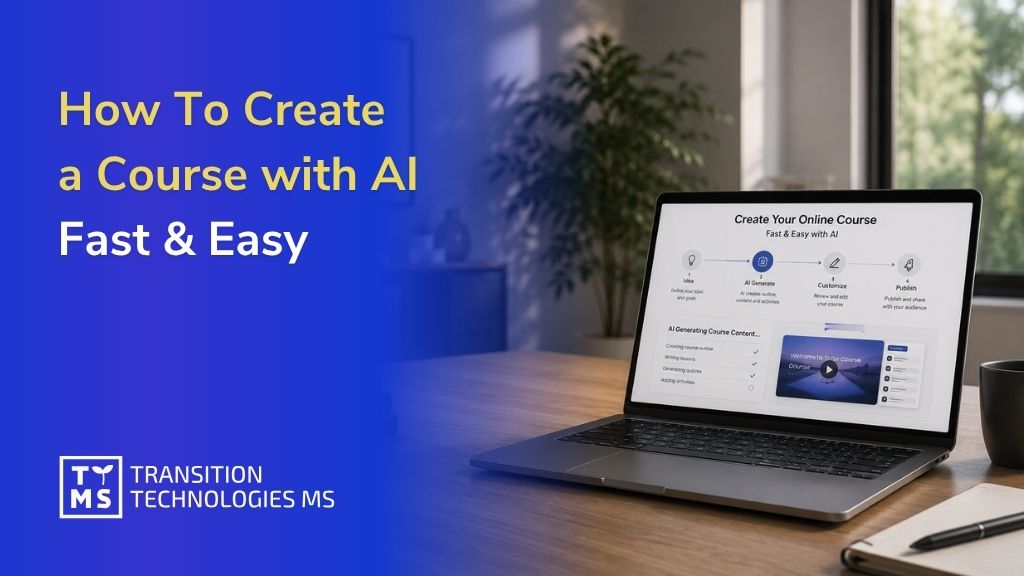
How To Create a Course with AI Fast & Easy in 2026
The biggest challenge in workplace learning is no longer producing training content. It is producing effective training content quickly. AI has dramatically reduced the time needed to create courses, but speed alone does not guarantee learning outcomes. Organizations must now balance efficiency with instructional quality. The AI in L&D market was valued at USD 9.3 billion in 2024 and is projected to reach nearly USD 97 billion by 2034, growing at a 26% CAGR. The Josh Bersin Company’s 2026 research reports that 74% of companies say they can’t keep pace with demand for new skills across their organizations. Training needs are outpacing traditional production methods, and AI is stepping in to close the gap. This guide covers how to create a course with AI, what tools to look for, where AI falls short, and how organizations in healthcare, energy, and corporate IT are already using these capabilities to build better training, faster. 1. What It Actually Means to Create a Course with AI Not all AI-powered course creation tools work in the same way. Before discussing their impact, it’s worth clarifying what “creating a course with AI” actually means in practic AI-assisted course creation means using artificial intelligence to handle the mechanical, time-consuming parts of instructional design: turning raw materials into structured content, generating learning objectives, drafting quiz questions, and organizing information into a logical learning flow. Handing the entire process to an algorithm and walking away is a different thing entirely, and it tends to end badly. AI is an accelerator rather than a substitute for expertise. It clears the path so your subject matter experts can focus on what they actually know, rather than spending hours reformatting slides or wrestling with an authoring tool. The expert still defines the goal, validates the content, and approves the final output. AI just dramatically shortens the distance between raw knowledge and a finished course. This distinction matters because the alternative framing, where AI “does it all,” sets organizations up for problems. Poorly reviewed AI output can contain inaccuracies, misaligned examples, or content that drifts from your compliance requirements. Human oversight is a design principle in any responsible AI course creation workflow, not something you bolt on afterward. Tools like AI4E-Learning, developed by TTMS, are built around this principle explicitly. The platform guides users step by step through the entire creation process, covering everything from defining training goals to exporting a SCORM package, while keeping the human in control at every decision point. It turns existing internal documents, PDFs, presentations, and even audio or video files into structured, goal-oriented training without requiring instructional design expertise to get started. That’s what modern AI course creation looks like in practice: guided, structured, and grounded in the organization’s own knowledge rather than generic content pulled from thin air. 2. What to Look for in a Free AI Course Creator Not all AI course builders are created equal – and free plans make those differences visible very quickly. Some tools let teams genuinely test AI-powered course creation, while others offer only a narrow preview designed to push users toward a paid upgrade. Before investing time in any platform, it is worth checking what the free version actually allows: content import, course structure, quizzes, branding, export options, LMS compatibility, and the level of human editing available. 2.1 Core Features That Matter The most important feature in any AI course builder is not speed. It is structure. A useful tool should generate a learning experience with clear objectives, logically sequenced lessons, and assessments that match the expected outcomes. If the output is only a wall of text divided into slides, it is not really a course. It is content packaging. For corporate training, several capabilities quickly become non-negotiable: Pedagogical structure – the course should be built around learning outcomes, not just source materials. SCORM export and LMS integration – without standard LMS connectivity, training is difficult to deploy, track, and manage at scale. Flexible content import – the tool should work with existing materials such as SOPs, policy documents, slide decks, videos, and onboarding files. Quiz and assessment generation – tests should be linked to learning objectives, with editable question types, difficulty levels, and passing thresholds. Editorial control – teams must be able to review, edit, reorder, and approve every element before publication. Accessibility and localization – mobile-friendly output, translation support, and accessibility standards are essential for global or distributed teams. This is where the difference between a simple AI content generator and a serious AI course authoring platform becomes clear. The first helps you produce material faster. The second helps you create training that can actually be used, measured, and trusted inside an organization. Capability Why it matters Pedagogical structure The course should be built around learning outcomes, not just source materials. SCORM export and LMS integration Enables organizations to deploy, track, and manage training at scale within existing learning ecosystems. Flexible content import Allows teams to reuse SOPs, policy documents, presentations, videos, and onboarding materials instead of creating content from scratch. Quiz and assessment generation Ensures knowledge checks are aligned with learning objectives and can be customized to meet training requirements. Editorial control Gives subject matter experts and training managers the ability to review, edit, reorder, and approve content before publication. Accessibility and localization Supports multilingual audiences through translation, mobile-friendly delivery, and compliance with accessibility standards. 2.2 Red Flags in Free Tools Free AI course builders can be useful for testing the concept, but there are a few warning signs that usually mean the tool will not support serious corporate training. The first is hidden feature gating. If LMS export, quiz customization, branding, or publishing options are blocked behind a paywall, the free version is closer to a demo than a real course builder. The second is generic content generation. Tools that create outlines without using your organization’s actual materials often produce courses that feel impersonal, vague, or disconnected from real procedures. In compliance, safety, or technical training, this is more than an inconvenience. It can lead to misleading or incomplete learning content. The third warning sign is limited tracking. Many free tools offer little or no analytics, completion records, or learner progress data. For organizations that need compliance documentation, engagement insights, or audit-ready training records, this quickly becomes a serious limitation. Finally, be careful with platforms that allow AI-generated content to be published without a review or approval step. In corporate learning, human oversight is not a bottleneck. It is part of quality control. 3. How to Create a Course with AI: Step-by-Step The workflow for building a course with AI is more structured than most people expect. You can’t just type a topic into a prompt and download a finished course five minutes later. The best results come from treating AI as a capable collaborator that needs clear direction. Step 1: Choose Your Topic and Define Your Audience Start before you open any AI tool. The most important decisions in course creation happen before a prompt is written or a file is uploaded. First, define the business problem the training is supposed to solve. Do you want to reduce errors in a support workflow? Onboard new employees to safety procedures? Help a distributed team understand a regulatory update? That answer shapes everything that follows: learning objectives, content depth, assessment criteria, examples, tone, and the level of detail learners actually need. Define your audience with similar specificity. A course for frontline warehouse staff requires different language, examples, and pacing than one for senior managers or IT professionals. AI tools work much better when given this context explicitly rather than asked to guess it. Step 2: Enter a Prompt or Upload Existing Content Once you’ve defined the goal and audience, bring your source materials into the tool. If your organization has existing documentation, this is where AI earns its efficiency gains most dramatically. With a platform like AI4E-Learning, you can upload internal materials in DOCX, PDF, PPTX, MP3, or MP4 format. The AI analyzes those files and uses them as the foundation for the training content, so your course is built on your organization’s actual knowledge rather than generic filler. Starting from scratch works too, provided you write a well-structured prompt that specifies the training topic, target audience, length, and business goal. The more precise you are at this stage, the less editing you’ll need later. You also set core parameters here: the training mode, the overall length (a short microlearning module versus a full onboarding course), and the interactivity level, meaning how many slides will include active learning tasks versus passive reading. Step 3: Review and Refine the AI-Generated Structure After the AI generates an initial structure, your job is to evaluate it critically rather than just accept it. Check whether the module sequence makes logical sense for a learner encountering this material for the first time. Confirm that the learning objectives match your original business goal. Look for anything that seems off-topic, overly generic, or misaligned with how your organization actually operates. AI tools suggest learning objectives in a logical order, but those suggestions are starting points. A well-designed platform lets you rearrange, rewrite, add to, or remove objectives before proceeding. This is the stage where your subject matter expert should be involved, if they haven’t been already. Step 4: Customize Lessons, Quizzes, and Assessments With the structure confirmed, go deeper into the content itself. Edit slide text to match your organization’s terminology, tone, and accuracy standards. Replace generic examples with real scenarios your learners will recognize. This is also where you configure assessments. A good AI course builder should let you generate quiz questions automatically, aligned to specific learning objectives, and then modify, add, or remove questions before finalizing. Setting passing thresholds, determining whether the quiz is required for completion, and deciding whether to allow retakes are all decisions that stay with you. For compliance-heavy environments, such as safety training or healthcare protocols, this human review step is especially critical. AI-generated quiz questions can be a strong starting point, but they require validation against the actual regulatory or procedural standard they’re meant to assess. Step 5: Add Media and Interactive Elements A course built entirely from text slides will hold attention for about ten minutes. Adding media and interactive elements changes the learning experience significantly. Depending on the tool, you may be able to embed videos, images, diagrams, and knowledge-check interactions directly in the authoring environment. Adjusting the interactivity level during setup determines how many slides include active learner tasks, but at this stage you can fine-tune that mix module by module. The Hitachi Energy “10 Life-Saving Rules” safety training illustrates this well. Hitachi Energy needed to standardize critical safety behaviors across a global workforce, with existing rules spread across internal documentation in multiple formats. TTMS used AI4E-Learning to transform that source material into a structured, multimedia-rich course, with scenario-based interactions built around each life-saving rule. A consistent, visually engaging program was deployed across regions, replacing what had previously required significant manual authoring work for each localized version. In high-stakes environments like this, the visual and interactive design isn’t cosmetic; it directly supports whether safety behaviors transfer to the workplace. Step 6: Publish, Share, or Export Your Course Once the content has been reviewed, edited, and approved, the final step is deployment. For organizations using a corporate LMS, export the course as a SCORM-compliant package and upload it to your existing platform. SCORM compliance ensures that completion data, quiz scores, and time-on-task are tracked automatically and reported back to your LMS dashboard. If your organization needs courses in multiple languages, an authoring tool with built-in translation support lets you localize content for global teams without rebuilding the course from scratch for each language. This is particularly valuable for multinational organizations that need consistent training standards across regions. 4. What AI Can (and Can’t) Do in Course Creation Using AI responsibly starts with understanding what it is good at – and where human expertise is still essential. AI is particularly strong at structure. It can take unorganized materials and turn them into a logical learning sequence. It can generate a first draft of explanatory content, propose learning objectives linked to a defined goal, and create initial assessment questions aligned with those objectives. It can also produce variations quickly, adapt the tone for different learner groups, and identify structural gaps that a human expert may miss when working with familiar material. Where AI falls short is specificity. It doesn’t know the particular regulatory environment your organization operates in, the informal knowledge your most experienced employees carry, or the real-world scenarios that actually trip people up on the job. It can produce content that sounds accurate while missing the practical detail that makes training actually change behavior. Hallucination in domain-specific contexts is a documented and quantified concern. In clinical settings, a 2025 Nature study using a structured safety workflow found a 1.47% hallucination rate and a 3.45% omission rate, even under tightly controlled conditions. In legal research, the numbers are significantly higher: a Stanford HAI finding reported by MIT Sloan EdTech identified hallucination rates of 58 to 82% on general legal queries, and even retrieval-augmented legal AI tools still hallucinated more than 17% of the time in specialized tasks. These figures reflect different task types and grounding levels, but the consistent pattern is clear: AI-generated content in regulated domains requires line-by-line expert review before deployment. TTMS’s work building e-learning for healthcare reflects this directly; training aligned to clinical practice, patient safety, and compliance standards requires SME validation that no AI tool can provide on its own. Use AI for the parts of course creation where speed and structure add the most value: drafting, organizing, and building starting materials. Keep human experts accountable for accuracy, compliance, and the judgment calls that only experience can supply. 5. Free vs. Paid AI Course Builders: When to Upgrade For many teams, a free AI course builder is a perfectly reasonable starting point. If you’re exploring whether AI-assisted creation works for your use case, running a pilot program, or building a low-stakes internal resource, free tools can get you there. When to upgrade really comes down to organizational scale, risk tolerance, and what “good enough” actually means for your training outcomes. 5.1 What You Can Accomplish for Free Most free tiers allow you to generate a basic course structure, add some customization, and publish or share the result. For small teams, one-off training needs, or exploratory projects, this is often sufficient. You can test whether your subject matter experts are comfortable with the workflow, validate whether AI-generated content aligns with your standards, and get a sense of how much editing the output requires before it’s usable. Free tools also work reasonably well for asynchronous, informal learning that doesn’t require compliance tracking, certification, or LMS integration. 5.2 How AI4E-Learning Compares to Other AI Course Builders Several capable AI course builders compete in this space. Mindsmith, Learning Studio AI, and Shiken AI are among the most discussed in 2025. Each has genuine strengths: Mindsmith excels at AI-driven scenario authoring; Learning Studio AI enables rapid one-click course generation with SCORM export; Shiken AI focuses on gamified, assessment-centric experiences. What these tools share, however, is a positioning as content generation utilities rather than enterprise compliance platforms. None prominently offers validated governance workflows, data residency controls, multi-step review processes, or audit trails required in regulated industries such as pharma, healthcare, or financial services. AI4E-Learning is built for a different tier of requirement. For organizations that need to maintain data sovereignty over proprietary content, demonstrate SCORM conformance, manage content approval at scale, and integrate training records with enterprise LMS reporting, the distinction matters considerably. Which platform can sustain a compliant, auditable training program over time is a more meaningful question than which tool generates the cleanest first draft. 5.3 Features That Justify Upgrading Free AI course builders are useful for testing ideas, but the limitations become visible when training needs to move into production. The first upgrade trigger is usually SCORM export and LMS integration. If you need to track who completed a course, when they finished it, and how they scored, the tool must connect with your learning infrastructure. The second is security and compliance. Once you upload proprietary content, internal procedures, or sensitive operational knowledge, data protection is no longer optional. Other limitations usually appear when teams start scaling: multiple course projects, consistent branding, team collaboration, learner analytics, and localization. Automatic translation can be especially valuable for organizations operating across countries and languages. For companies ready to move beyond pilots, AI4E-Learning from TTMS combines a guided authoring workflow with enterprise-ready features, including SCORM compliance, LMS integration, data security, multilingual support, and instructional design experience gained through real training projects. 6. Common Mistakes to Avoid When Building Courses with AI Even strong AI course creation tools can lead to weak training if the process is not designed properly. Most problems come from the same few mistakes. The first is treating AI output as a finished product. When teams publish generated content without review, the course may look complete but remain instructionally shallow. Typical signs include generic examples, vague learning objectives, and quiz questions that test recall instead of practical application. The solution is simple: include a structured review stage and involve subject matter experts before anything goes live. The second mistake is starting without clear learning goals. Asking an AI tool to “create a course about customer service” will produce a very different result than asking it to build a module that helps support agents resolve tier-one technical queries faster, using the organization’s existing troubleshooting documentation. The more specific the input, the more useful the output. The third mistake is neglecting governance. Many teams start using AI course builders informally, without clear rules on what content can be uploaded, who reviews the output, and what approval process applies before training is deployed. In compliance-heavy industries or organizations working with proprietary procedures, this creates real risk. Clear guidelines should be in place before AI course creation is scaled across the business. The Safety First case study from TTMS illustrates what structured governance looks like in practice. Safety-critical training requires a consistent standard delivered across all locations, with clear expectations for both managers and employees. That level of consistency doesn’t emerge from an unmanaged AI workflow; it requires careful design, expert review, and a deployment process that ensures every learner receives the same quality of instruction. Ignoring personalization is a missed opportunity that many organizations discover too late. AI makes it genuinely feasible to adapt scenarios, examples, and pacing for different roles or experience levels, but teams often use it to produce a single uniform course for all learners. Feeding role-specific context into your prompts, or building separate learning paths for different audience segments, significantly improves both engagement and knowledge transfer. Most AI course creation failures are not caused by the technology itself. They result from poor process design, unclear objectives, and insufficient oversight. Common mistake Why it matters Best practice Treating AI output as the final product Courses may appear complete but often contain generic examples, weak learning objectives, and superficial assessments. Include a structured review process and involve subject matter experts before publication. Starting without clear learning goals Broad prompts lead to generic content that may not address real business needs. Define specific business outcomes and learning objectives before generating content. Neglecting governance Unclear rules around content uploads, reviews, and approvals can create compliance and security risks. Establish governance policies and approval workflows before scaling AI adoption. Underestimating the need for consistency Safety, compliance, and operational training require standardized learning experiences across locations and teams. Use expert review and controlled deployment processes to maintain quality and consistency. Ignoring personalization opportunities A one-size-fits-all course often reduces engagement and knowledge retention. Adapt scenarios, examples, and learning paths to different roles, experience levels, and learner groups. 7. Work With TTMS to Build AI-Driven Training That Delivers Results AI course builders are becoming genuinely capable. Used well, they help organizations create more training, faster, and at a lower cost than traditional methods allow. But the tool is only part of the equation. At TTMS, we have been designing and implementing e-learning solutions across healthcare, energy, safety, and corporate IT for years. One pattern is clear: the best results come when capable AI tools are combined with deliberate instructional design, proper governance, and expert review at every stage. That is what turns a fast course draft into training that changes behavior, supports business goals, and can be trusted at organizational scale. FAQs About Creating a Course with AI Do I need technical skills to use an AI course builder? Not for the platforms designed with organizational adoption in mind. Modern AI course builders, including AI4E-Learning, are built so that HR professionals, training coordinators, and operational managers can create professional training without any background in instructional design or software development. The platform guides you through each stage, suggests learning objectives, and handles the technical formatting automatically. Where some technical awareness helps is in deployment: understanding how to export a SCORM package, upload it to your LMS, and configure completion settings. Most LMS platforms walk administrators through this process, and it rarely takes more than an hour to learn. Knowing your content and your audience well enough to review what the AI produces matters far more than software proficiency. Domain expertise is the skill that actually determines output quality. How long does it take to create a course with AI? The initial generation of a course structure can happen in minutes once your materials are uploaded and your parameters are set. A complete, ready-to-deploy module, including editing, review, media addition, and final approval, typically takes a few hours for straightforward topics with existing source materials. For more complex programs, particularly those involving compliance requirements, regulated industries, or multiple audience segments, plan for a longer cycle. The AI handles the mechanical work quickly, but expert review, SME validation, and stakeholder approval take the time they take. TTMS’s experience across sectors including enterprise safety training and healthcare consistently shows that the review and quality assurance phase is where the real value is added, and that phase should never be rushed. Compare this to traditional course development, where scripting, design, and authoring might take weeks before a first draft is ready. AI compresses the early stages dramatically, which means your experts spend more time on judgment and less time on formatting. Can AI course creators generate quizzes and assessments automatically? Yes, and it’s one of the stronger practical capabilities in current AI authoring tools. When the AI has a clear view of your learning objectives and source content, it can generate aligned quiz questions, including multiple-choice items with plausible distractors, scenario-based questions, and knowledge checks embedded at the lesson level. The critical caveat is alignment. Auto-generated questions should be reviewed to confirm they test the right skill or knowledge at the right level, not just surface-level recall of keywords from the content. For certification or compliance purposes, every question should be validated against the actual standard it’s meant to assess. AI4E-Learning includes an optional end-of-course quiz that you can configure during the setup phase, with full editorial control over questions before the course is published. Can I import existing materials into an AI course builder? Yes, and for most organizations this is the primary value driver. Starting from existing materials, whether that’s a procedural document, a slide deck from a live training session, a recorded interview with a subject matter expert, or a policy PDF, is dramatically more efficient than building from scratch. AI4E-Learning supports uploads in DOCX, PDF, PPTX, MP3, and MP4 formats. The AI analyzes the uploaded files and uses them as the foundation for the course structure, which means the content is grounded in your organization’s actual knowledge and terminology from the start. This is particularly important for organizations that want full control over their content and need training that reflects their specific processes rather than generic best practices. How is an AI course creator different from a traditional course builder? A traditional course builder is essentially a sophisticated content editor. It gives you templates, formatting tools, and an authoring environment, but every structural decision, learning objective, quiz question, and lesson flow is written manually by a human. The workflow is linear, front-loaded, and time-intensive. An AI course builder automates the drafting, structuring, and alignment stages. You define the goals and provide the source materials; the AI builds a structured course from that input. You then review, edit, and approve what the AI has produced. Human effort moves away from raw creation and toward curation and quality control. The practical difference in production speed is significant. The practical difference in output quality depends almost entirely on how seriously you take the review stage. AI generates fast; humans make sure it’s right.
Read
8 Steps of Training Content Development Process and How to Make it Efficiently
8 Steps of Training Content Development Process and How to Make it Efficiently Corporate training is a serious investment. Global spending on employee learning and development sits at an estimated $340 billion annually, yet a McKinsey Global Survey found that only 25% of respondents said their training programs measurably improved performance. That gap between spending and impact rarely comes from a lack of effort. It almost always comes from a broken or incomplete process. There is a big difference between having a good training idea and creating a program that actually helps people do their jobs better. That difference comes down to how the training is planned and developed. When the process is done right, training supports real business goals, learners see the value in what they are learning, and companies can clearly measure the results. When it is done poorly, employees often lose interest, skip the training, or quickly forget what they learned. Below, you’ll find the eight key stages of an effective training content development process. Whether you’re an L&D manager, instructional designer, HR professional, or business leader, this practical framework will help you create training that delivers real impact. What the Training Content Development Process Actually Involves The training content development process is a structured workflow for creating learning materials that solve a real performance problem. Writing content or building slides is just one small part of it. The full scope includes analysis, design decisions, actual content production, quality assurance, delivery, and evaluation, with each stage informing the next. The dominant framework underlying most modern training development is still ADDIE: Analyze, Design, Develop, Implement, Evaluate. What has changed over the past several years is how practitioners apply it. Rather than a rigid, linear sequence, today’s guidance from ATD and practitioner models like SAM (Successive Approximation Model) treats ADDIE as a flexible structure run in shorter, iterative cycles. You analyze and evaluate continuously, not just at the beginning and end of a project. Development happens in stages, with stakeholder feedback built in throughout rather than reserved for a final review. This iterative approach matters because it keeps training aligned with real-world needs as they evolve. It also reduces the risk of investing significant resources in content that misses the mark. A process that is both rigorous and adaptable is what separates organizations that see a return on their learning investment from those that do not. Phase 1: Conduct a Training Needs Analysis The training content development process begins long before anyone writes a word of content. It begins with understanding whether a training need actually exists, and what specifically that need is. Skipping this phase is one of the most common and costly mistakes in developing training materials, because it leads to content that addresses the wrong problem. Identify the Performance Gap A performance gap is the difference between where employees are performing today and where they need to be. Identifying it requires more than a hunch or a manager’s request. The most reliable approaches involve gathering data directly, through job observations, performance reviews, error logs, customer feedback, or structured surveys that compare current skills against required competencies. Be specific about what the gap looks like in practice. Instead of noting that “the sales team needs better communication skills,” define what observable behavior is missing. Are reps skipping discovery questions entirely? Are objections on a specific product line going unaddressed? The clearer the gap, the more targeted the training content can be. Define Your Target Audience Training that tries to serve everyone often serves no one well. Defining your target audience means going beyond job title to understand the demographics, prior knowledge, work context, and even the daily pressures your learners face. Creating learner personas at this stage pays dividends later, especially when you are making decisions about format, tone, language, and the kind of examples that will actually connect. A manufacturing technician working a shift rotation has very different learning constraints than a knowledge worker who spends most of the day at a desk. Both deserve training that respects those realities. Determine Whether Training Is the Right Solution Not every performance gap is a training problem. If employees know how to do something but do not do it, the issue may be motivation, unclear expectations, workflow friction, or inadequate tools, not a knowledge deficit. Training cannot fix a broken process or a lack of resources. Part of a sound needs analysis is ruling out non-training causes before committing to content development. This honest assessment protects both budget and credibility. Phase 2: Set Learning Objectives and Success Metrics Once you understand what problem you are solving and for whom, the next step is defining what success looks like. Clear learning objectives act as the backbone of everything that follows: the content structure, the format choices, the assessments, and the evaluation plan. Write Measurable Learning Objectives A learning objective describes what a learner will be able to do after the training, not what the training will cover. The distinction matters. “Understand data privacy regulations” is a topic, not an objective. “Correctly identify and report a data breach within the required 72-hour window” is an objective you can assess. Effective objectives follow the SMART framework: specific, measurable, achievable, relevant, and time-bound. They use action verbs that correspond to the level of performance required. Lower-order verbs like “define” or “list” suit foundational knowledge. Higher-order verbs like “apply,” “evaluate,” or “troubleshoot” signal that the training needs to build real capability, not just familiarity. Connect Objectives to Business Outcomes Learning objectives should trace back to a business outcome your stakeholders actually care about. If an objective does not connect to a measurable result like reduced error rates, faster onboarding, improved compliance scores, or increased customer satisfaction, it is worth questioning whether it belongs in the program at all. This connection also strengthens the case for training investment. The ATD 2025 State of the Industry indicates that organizations are increasingly evaluating learning by business-relevant measures including employee productivity improvement and the ability to meet organizational needs, not just course completion. Designing backward from these outcomes from the start puts your program on firmer ground. Phase 3: Choose the Right Training Format and Delivery Method With your objectives defined, you can make informed decisions about how the training will be delivered. Format selection is not just a preference question; it has a direct impact on whether learners achieve the intended outcomes. Different formats serve different types of learning, different audience constraints, and different organizational contexts. Common Training Content Formats There are many ways to build training content today. That is good news, because companies can choose the format that fits their team best. At the same time, having so many options can make the choice harder. The key is to know what each format is good for. eLearning and interactive modules are useful when people need to learn at different times and in different places. Employees can go through the material when it suits them, come back to it later, and learn at their own speed. This works well for topics that need to be shared with many people in the same way, such as onboarding, product knowledge, or compliance training. Training with an instructor, either in person or online, is still very useful when the topic is more difficult or needs more discussion. It gives people a chance to ask questions, talk through examples, and get feedback right away. This format works especially well when learners need to practice, understand a complex topic, or build skills that are easier to learn through conversation. Microlearning and video have grown significantly as a delivery strategy. Short, focused content supports higher completion rates and better knowledge transfer, particularly for just-in-time performance support and reinforcement. Job aids and reference materials occupy a different niche entirely: rather than asking learners to recall everything from a formal course, they put the right information in front of people exactly when they need it. Format-to-Objective Decision Matrix Format selection should be driven by what the objective actually requires, not by what is easiest to build or what was used last time. The table below maps objective type to recommended format as a starting reference. Use it as a decision anchor, then adjust for your specific audience constraints and production feasibility. Learning Objective Type Recommended Primary Format Best Use Case Key Constraint to Watch Knowledge recall or compliance awareness Microlearning / short eLearning Distributed teams, regulatory refreshers, onboarding basics No built-in practice opportunity; pair with a knowledge check Procedure or process execution Video walkthrough + job aid Step-by-step tasks, software how-tos, safety protocols Needs realistic context; generic demos lose relevance quickly Application and troubleshooting Scenario-based eLearning or simulation Complex workflows, technical support roles, clinical tasks High development cost; requires strong SME input upfront Judgment and decision-making VILT workshop or branching scenario High-stakes decisions, leadership, sales objection handling Difficult to scale; facilitator quality heavily influences outcome Behavioral change requiring coaching Blended: VILT + on-the-job practice Soft skills, culture change, management development Transfer depends on manager reinforcement after the course For knowledge-based objectives, the priority is accessibility and retrieval practice. For application-level objectives, formats must allow practice in realistic conditions. For judgment-oriented objectives, coaching and facilitated discussion produce outcomes that passive content delivery cannot match. And for any distributed or time-poor audience, a modular blended approach spreads the required practice over time without requiring everyone in the same place simultaneously. Phase 4: Plan and Structure Your Training Content Before any content creation begins in earnest, you need a solid plan. This phase translates your objectives and format decisions into a concrete structure that guides everything else. Skipping it leads to content that feels disjointed, covers more than it should, or lacks the logical flow that helps learners build understanding progressively. Build a Content Outline and Learning Flow A training content outline is more than a list of topics. It is a sequenced map of the learning experience, designed to manage cognitive load and build from what learners already know toward what they need to be able to do. Start from the desired behaviors and outcomes, then work backward to identify only the content that directly supports those outcomes. This prevents the common trap of “content dumping,” where training covers everything related to a topic rather than everything necessary for performance. Structure your outline into coherent chunks, each tied to one or two clear learning objectives. Order modules from foundational to complex, and build in explicit on-ramps for learners who may arrive with different levels of prior knowledge. An activity-first design approach works well here: map practice activities and real-world tasks first, then add only the minimum instructional content needed to support those activities. Decide on Scope: Custom vs. Off-the-Shelf Content The build-vs-buy question comes up in almost every content development project. Custom training content makes the most sense when the training involves proprietary processes, organization-specific behaviors, brand-specific language, or role-based scenarios that generic content simply cannot address. Off-the-shelf content earns its place for common, well-established topics: general compliance, cybersecurity awareness, standard professional skills, or regulatory subjects where accuracy and breadth matter more than organizational context. The ATD 2024 State of the Industry notes that outsourcing learning can bring benefits including “increased speed of development and implementation, geographic reach, and scalability,” alongside potential cost reductions. For rapidly changing content or small audience sizes, vendor-maintained libraries often outperform custom development from a pure economics standpoint. Plan for Assessment and Knowledge Checks Assessment planning belongs in this structural phase rather than as an afterthought after content is written. Decide early how learners will demonstrate that they have achieved each objective, because that decision shapes the entire learning flow. Effective assessment requires practice opportunities built into the content itself, not just a quiz tacked on at the end. Consider a range of formats: embedded knowledge checks, scenario-based decisions, practical exercises, or manager-observed demonstrations. Building assessment design into the plan from the start also sets up your measurement framework for Phase 8. Phase 5: Develop the Training Content With analysis done, objectives set, format selected, and structure planned, you arrive at the phase most people think of when they imagine developing training materials: actually creating the content. This is where instructional design principles, writing craft, and media decisions converge. Apply Core Instructional Design Principles Effective eLearning content design draws on a body of learning science refined over decades. Principles from Gagné’s events of instruction, Merrill’s first principles, and Mayer’s multimedia learning theory all converge on a common theme: learning happens when learners are actively engaged with well-structured content that connects to what they already know and gives them opportunities to apply new knowledge. The ADDIE model remains the backbone of structured content development, but today’s best practice runs it iteratively. Rather than completing each phase fully before moving to the next, experienced practitioners loop back frequently, testing and refining based on feedback. This agile approach reduces the risk of investing substantial effort in content that needs to be rebuilt after a late-stage review. Write for Clarity, Engagement, and Retention Content development is fundamentally a writing challenge before it is anything else. Materials written in plain, conversational language with concrete examples consistently outperform dense technical prose on comprehension and retention. Write to your learner persona, using the language and level of familiarity that matches who will actually read or watch the content. Storytelling is one of the most effective tools in training content development. Real-world scenarios that mirror the challenges your learners face every day make abstract concepts concrete and give learners a mental model they can use on the job. When you frame content around a familiar problem, learners are more likely to engage and more likely to transfer the learning to their actual work. Incorporate Visuals, Scenarios, and Interactivity Good visuals and interactive elements are not just there to make training look better. They help people understand and remember the content. Clear graphics can make difficult information easier to follow. Instead of reading a long explanation, learners can see how something works, how steps connect, or what matters most. This makes the material feel lighter and easier to process. Interactive elements also make a big difference. When learners have to make choices, answer questions, or work through real situations, they are more involved in the training. Scenarios are especially useful because they show how knowledge can be used in everyday work. They help people practice judgment, not just remember facts. This is why training should not only explain information. It should also give learners a chance to use it. What This Looks Like in Practice A practical way to use this process is to start by finding the real reason behind the training need. Sometimes the problem is not that employees lack general knowledge. It may be that they struggle with a few specific tasks, decisions, or procedures. When this is clear, the training can be much more focused. Instead of creating a long course from scratch, a team can build shorter learning materials around the exact moments where mistakes happen most often. Existing documents, policies, or internal materials can be used as a starting point. AI tools can help turn them into a first structure, suggest learning objectives, and organize the content into smaller modules. Then the training team can review the material, improve the wording, add realistic scenarios, and make sure everything fits the way people actually work. Before the training is shared more widely, it should be tested with a small group of learners. Their feedback can show what is clear, what is missing, and what needs to be improved. This approach makes the whole process faster and more practical. It also helps the team spend more time on the parts that matter most: useful scenarios, expert review, and training that supports real work. Build Assessments That Reinforce Learning Assessments built during content development should do more than measure: they should reinforce learning. Spacing knowledge checks across the content rather than grouping them at the end takes advantage of the well-documented “testing effect,” where retrieval practice strengthens memory more effectively than re-reading. Provide immediate, specific feedback so learners understand not just whether they answered correctly but why, and what the correct approach looks like. Phase 6: Review, Pilot, and Refine Content that looks excellent in development does not always perform as expected with real learners in a real context. The review and pilot phase exists to surface those gaps before they affect a full audience. Conduct SME and Stakeholder Reviews Subject matter experts and stakeholders bring perspectives that instructional designers and content writers cannot supply from the outside: domain knowledge, awareness of edge cases, and the organizational context that shapes whether content is truly credible and relevant. A structured SME review process, with clear review criteria and a defined feedback cycle, produces better results than open-ended requests for commentary. Ask reviewers to focus on accuracy and relevance rather than style. Define who has approval authority and what changes require a second review. Unmanaged SME review cycles are one of the most common causes of schedule delays in training content development, so building a clear process into your project plan protects both quality and timelines. Run a Pilot with a Sample Audience A pilot with a small group from the actual target audience reveals issues that no amount of internal review can catch: navigation confusion, pacing problems, scenarios that feel unrealistic, or content that assumes prior knowledge the learners do not have. Current instructional design best practice treats the pilot as part of the design cycle itself, not as a pre-launch formality. Early pilots routinely expose accessibility problems, cognitive load issues, and learner flow gaps that never show up in storyboards, and fixing them before full deployment costs a fraction of what post-launch rework does. Pilot feedback is only valuable if you act on it. Analyze what you hear systematically: which issues are isolated reactions versus patterns across multiple learners? Prioritize revisions that affect comprehension, navigation, or achievement of learning objectives, then document what changed and why. This documentation also supports the measurement work in Phase 8 by establishing a baseline of decisions made. Phase 7: Deploy and Distribute Training Content With content reviewed, refined, and ready, deployment is the bridge between what you have built and the learners who need it. The choices you make here about platform, access, and support directly affect whether learners actually complete the training and whether it reaches the right people at the right time. Deliver Through the Right Platform or LMS A learning management system is the most common infrastructure for delivering and tracking training content in organizational settings. The LMS market now exceeds $20 billion, showing how deeply embedded these platforms have become in enterprise learning operations. Platform choice should match the content and the audience. Microlearning and mobile content requires a platform optimized for short-session, on-demand access. Blended programs that combine VILT sessions with self-paced modules need scheduling and communication features. For organizations with distributed teams, ensuring the platform performs reliably across geographies and devices is a practical requirement, not just a technical detail. Support Learner Access and Completion Deploying training does not mean the work is done. Learners face real barriers to completion: scheduling conflicts, technical difficulties, unclear expectations from managers, and content that feels disconnected from their immediate priorities. Proactively addressing these barriers, through manager briefings that explain the purpose behind the training, clear completion timelines, accessible technical support, and follow-up reminders, meaningfully improves completion rates and engagement. Employee satisfaction with learning rose to 84% in 2025, up from 79% the year before, which suggests organizations are paying more attention to the quality of the learning experience, not just the mechanics of delivery. Phase 8: Measure Effectiveness and Iterate Without measurement, you can spend significant resources on training that changes nothing without ever knowing it. With it, you can demonstrate impact, identify what to improve, and build a stronger case for future investment. Key Metrics to Track After Launch The Kirkpatrick model remains the most widely used framework for evaluating training effectiveness. It organizes measurement across four levels: learner reaction, learning gained, behavioral change on the job, and business results. Each level answers a different question, and each requires different data. Start with what is most accessible: completion rates and learner satisfaction surveys give you quick signal on engagement and perceived relevance. Pre- and post-assessments measure knowledge or skill gain. Manager observations, workflow metrics, and performance data tell you whether behavior actually changed. And if the training was designed to address a specific business outcome, whether error rates, sales performance, customer satisfaction, or time-to-competency, tracking that metric before and after training provides the strongest evidence of impact. Many organizations invest time and resources in training, but far fewer take the next step and measure whether it actually works. As a result, it can be difficult to know if employees have improved their skills, changed their behavior, or applied what they learned in their daily work. Measuring training results does not have to be complicated. Even simple checks, such as learner feedback, knowledge assessments, performance indicators, or manager observations, can provide valuable insights. The important thing is to look beyond course completion rates and focus on whether the training is creating real improvements. Organizations that regularly evaluate the impact of their training are in a much better position to improve future programs, justify training investments, and show the value that learning brings to the business. Using Data to Improve Future Training Measurement data should feed back into the development process, not just sit in reports. Low assessment scores on a specific module suggest a content or design problem. High drop-off rates at a certain point in a course may indicate a pacing or engagement issue. Low behavior transfer despite strong assessment scores points to a gap between what the training teaches and what the job actually requires. Common Mistakes That Derail Training Content Development Even experienced teams fall into patterns that undermine otherwise well-designed training programs. The most consequential mistake is skipping or rushing the needs analysis. Without a clear picture of the actual performance gap, training content is built on assumptions that tend to be wrong in ways only visible after the program is deployed. Related to this is treating training as the default response to any performance problem, rather than investigating whether the root cause actually requires a learning solution. A second common mistake is writing learning objectives that describe activities rather than outcomes. When objectives focus on what the training will do rather than what learners will be able to do, the entire design is oriented around coverage rather than capability. This produces long, thorough courses that learners forget quickly because there was no clear performance target shaping the content or the practice. Underinvesting in review and pilot cycles creates expensive problems that could have been caught early. When teams skip structured SME reviews or pilot only with internal staff who already know the content, they miss the places where real learners get confused, disengage, or walk away with the wrong mental model. Finally, many organizations measure completion and satisfaction but stop there, never connecting the investment to the business outcome it was meant to support. That measurement gap makes it nearly impossible to improve training strategically over time. When to Build In-House vs. Partner with a Content Development Expert The decision to develop training content internally or work with external experts depends on what the training needs to achieve, what resources are available, and the strategic importance of getting it right. In-house development makes sense when your team has the instructional design expertise, time, and subject-matter access needed to build effectively. It also makes sense for content that is highly proprietary, culturally specific, or requires ongoing updates tied to rapidly changing internal processes. Partnering with content development specialists makes sense when the training is strategically important but your internal team lacks specialized expertise; when you need to scale content development faster than your team’s capacity allows; when the content requires capabilities like complex simulations, multilingual production, or accessibility compliance that are difficult to build internally; or when you want an outside perspective to strengthen a program that is not performing as expected. According to the ATD State of the Industry, approximately 47% of total direct learning and development expenditure already goes to external components, which suggests that hybrid approaches combining internal and external resources are the norm rather than the exception. The best decision is grounded in an honest assessment of what your internal team does well and where external expertise would add the most value. How To Make the Training Content Process Efficient with AI4E-Learning Every phase of the training content development process described in this guide takes time. Writing objectives, structuring outlines, developing content, running review cycles, and iterating based on data are all necessary activities, but they are also time-intensive. For organizations managing multiple training programs simultaneously, or trying to scale content development without scaling headcount proportionally, the bottlenecks are real and costly. This is the challenge that TTMS addresses directly with its AI4E-Learning tool, an AI eLearning authoring platform designed specifically for organizations that need to develop training content faster without sacrificing structure, quality, or compliance. AI4E-Learning is based on a simple idea: most companies already have the materials they need for training. They have process documents, product guides, policies, onboarding slides, or recorded presentations. The real challenge is turning all of this into a clear, structured course. AI4E-Learning helps with that. Users can upload materials in formats such as DOCX, PDF, PPTX, MP3, and MP4. The platform then analyzes the content and creates a course foundation, including: suggested business goals, learning objectives, a logical content order, an organized course structure. This gives teams a ready starting point instead of a blank page. What makes this approach different from generic AI content generators is that it mirrors the instructional design process described throughout this article. The platform guides users through each phase of course creation step by step: configuring the training mode, defining the business goal, setting learning objectives, choosing interactivity levels, and including assessment elements like end-of-course quizzes. The AI does not produce a finished course and hand it over. It creates a structured starting point that users can edit, reorder, approve, or override at every stage. The efficiency gains from AI-assisted authoring are well-documented. According to a Brandon Hall Group Gold Award case study of AI-assisted authoring, content creation that traditionally “took weeks and required multiple team members” can now be achieved “in a matter of hours.” A separate Brandon Hall Group and ELB Learning study on GenAI in eLearning development describes GenAI tools compressing “drafting processes from hours to minutes” for tasks such as text summarization, question generation, script editing, and voiceover creation. For an L&D team managing a full program calendar, those savings translate directly into capacity for higher-value work. AI4E-Learning supports key stages of training content development: Phase 2 – Learning objectives Suggests clear learning objectives based on business goals and uploaded materials. Phase 4 – Course structure Creates an initial course outline and logical content flow. Phase 5 – Content creation Generates slides and module sections from source materials, with adjustable interactivity. Phase 7 – LMS export Exports ready training packages in SCORM format. Phase 8 – Content updates Allows quick updates when rules, processes, or materials change. AI4E-Learning is also designed for enterprise use: Data security and compliance Helps protect sensitive internal materials used to create training content. Automatic translation Makes it easier to prepare training for multilingual teams. Easy access for different teams Can be used by HR, L&D, operations, and business teams without advanced technical skills. Expert control AI speeds up the work, but people still review, edit, and decide what is best for learners. Scalable content creation Helps teams create, update, and manage more training content without growing the team at the same pace. AI4E-Learning is useful for organizations that need to build compliance training, onboarding materials, or update large training libraries faster and more efficiently. 1. What are the key stages of the training content development process? The training content development process typically consists of eight main stages: training needs analysis, defining learning objectives, selecting the training format, planning the course structure, developing content, reviewing and testing the materials, deploying the training, and measuring its effectiveness. Each stage plays an important role in the overall success of the program. Skipping any of them can reduce the impact of the training. 2. How can you determine whether training is actually needed? Before creating any learning materials, it is important to conduct a training needs analysis. This helps identify whether the problem is caused by a lack of knowledge or skills, or by other factors such as inefficient processes, inadequate tools, or unclear expectations. A proper analysis helps organizations avoid investing time and resources in training that will not solve the real issue. 3. How do you choose the right training format? The best training format depends on the learning objectives and the needs of the audience. eLearning works well for delivering knowledge to large groups, instructor-led training is often more effective for complex topics, and microlearning is useful for sharing focused information in a short amount of time. The key is to match the format to the desired outcomes rather than choosing what is easiest to create. 4. How should training effectiveness be measured? Measuring training effectiveness should go beyond tracking course completion rates. Organizations should also evaluate assessment results, learner feedback, changes in employee behavior, and the impact on business performance. This broader approach provides a clearer picture of whether the training achieved its intended goals. 5. How can AI help speed up training content development? AI-powered tools can automate many of the time-consuming tasks involved in creating training programs. They can analyze source materials, suggest learning objectives, generate course structures, create content drafts, and simplify updates. This allows learning and development teams to spend more time improving training quality and learner experience instead of focusing on repetitive manual work.
Read
How to Create Online Training Modules Fast in 2026
How to Create Online Training Modules Fast in 2026 Building effective online training used to mean months of instructional design, costly production, and complex LMS configuration. In 2026, that has changed dramatically. AI-powered authoring tools, smarter content frameworks, and clearer design standards have made it possible to create online training modules faster than ever without sacrificing quality. Whether you’re developing onboarding content, compliance training, or role-specific upskilling, the process is more accessible and more powerful than it has ever been. This guide walks through every step, from writing objectives to tracking learner outcomes. What Makes an Online Training Module Effective in 2026 What separates a module that genuinely builds competence from one that simply gets clicked through comes down to one principle: the best e-learning activates the learner’s brain as efficiently as possible, rather than just presenting information. That principle shapes every design decision, from how long a module runs to what kinds of interactions it includes. Effective modules share a consistent set of characteristics grounded in instructional design research. Getting these right from the start saves significant rework later and directly improves learning outcomes. Core Components Every Training Module Needs Clear Learning Objectives Every strong module begins with a clear answer to one question: what will the learner be able to do after completing this? Objectives should be observable, measurable, and grounded in real job performance, not just subject coverage. Vague objectives like “understand customer service” should be replaced with specific performance statements such as “resolve a customer complaint using the four-step escalation process.” All content, activities, and assessments should align directly to these objectives. Engaging, Interactive Content Passive content, scrollable slides with minimal interaction, consistently produces lower retention and higher drop-off. Effective modules mix interactivity, real-life examples, and self-assessment activities to keep learners mentally active. This means incorporating interactive videos, animations, branching scenarios, and simulations that make abstract concepts tangible. The evidence for online learning’s retention advantages over traditional instruction is well-grounded in peer-reviewed research. A randomized controlled trial in medical education found that students in an online video plus virtual patient format showed significantly higher knowledge scores on both immediate and delayed tests than those attending a traditional face-to-face lecture on the same content. A 2022 large-scale analysis published in the British Journal of Educational Technology found that students in well-designed online sections performed at least as well as, and in some courses better than, students in face-to-face sections when controlling for student characteristics. Widely quoted figures suggesting online learning lifts retention from 8-10% to 25-60% trace back to non-peer-reviewed sources and are not verifiable in current scholarly literature. The more defensible picture, supported by multiple systematic reviews, is that well-designed digital learning is at least equivalent and often measurably superior for knowledge retention compared to traditional classroom delivery. Assessments and Feedback Loops Quizzes and knowledge checks should not be an afterthought. Used well, they are integrated learning tools that reinforce retention, surface gaps, and guide learners on what to revisit. Immediate, explanatory feedback after an incorrect answer teaches far more than a final score ever could. Assessments placed throughout a module, rather than only at the end, improve knowledge encoding and give learners a realistic picture of their progress. Mobile-Responsive, Accessible Design Mobile learning is one of the fastest-growing segments in e-learning, and for good reason. A 2024 study cited in 2026 trend articles shows that mobile-first learning can reduce time-to-completion by almost half. If your module doesn’t render cleanly on a phone or tablet, you’re losing a significant portion of learner engagement before it even starts. Accessibility is equally non-negotiable. Modules must meet WCAG 2.1 Level AA standards at minimum, covering captions, keyboard navigation, screen reader compatibility, and sufficient color contrast. How Long Should a Training Module Be? The evidence on module length points clearly in one direction: shorter is better for completion, retention, and on-the-job application. Microlearning lessons in the 5-10 minute range achieve much higher completion and lower drop-off than hour-long modules. Research comparing micro-content with longer sessions shows learners retain 70-90% of micro-content compared with about 15% for longer, one-off sessions. A good rule of thumb: each module should focus on a single objective or task, run between 5 and 15 minutes, and feel complete on its own while fitting into a broader learning path. Step 1: Define Your Learning Objectives and Audience Knowing how to create a training module that actually changes behavior starts here. Before any content is written or any tool is opened, objectives and audience must be clearly defined. Skipping this step is the most common reason training programs fail to produce measurable results. Writing Objectives That Guide Content Decisions Objectives work best when they start from the business or performance problem, not from a list of topics. Ask what employees should be doing differently after the training, then build backward from there. Use action verbs that describe observable behavior: configure, prioritize, diagnose, document, negotiate. Avoid verbs like “understand” or “appreciate,” which cannot be measured. Each objective should map to a business KPI or compliance requirement. When an objective is tied to a real outcome, it becomes possible to evaluate whether training is working at a level beyond completion rates, which is what earns executive support and keeps budgets justified. Identifying What Your Learners Already Know A needs analysis should also confirm whether the problem can actually be solved with training. In practice, many training initiatives fail before course development even begins because the organization is trying to fix a process, tooling, communication, or management issue with another e-learning module. If employees do not follow a procedure because the system is confusing, the workflow is inconsistent, or managers reward a different behavior, training will not solve the root cause. It may explain the right process, but it will not remove the obstacle. That is why this step matters so much: before building a course, L&D teams need to understand whether they are dealing with a real knowledge gap or a broader operational problem. Step 2: Choose the Right Online Training Course Builder The right authoring tool can dramatically accelerate how you develop a training module without requiring deep technical skills. In 2026, the market includes enterprise-grade AI-powered platforms and lightweight standalone tools, and choosing between them depends on your content volume, integration needs, and the level of interactivity you require. Understanding the Tool Landscape Not every authoring tool is built for the same job, and the differences matter at enterprise scale. It helps to think in three broad categories rather than evaluating individual features in isolation. Rapid authoring tools such as Articulate Storyline and iSpring Suite work best for L&D teams that need fast, template-driven production without deep AI involvement. BJC HealthCare, a healthcare system with over 35,000 employees, used Articulate Storyline 360 to develop scenario-based blended lessons at scale, reporting improved learner retention and authoring efficiency across their workforce. These tools excel at structured content and have wide LMS compatibility, though they require more manual effort per module and don’t significantly reduce the work of converting raw documentation into finished courses. AI-native platforms are better suited to enterprises that need to convert existing content at volume and speed. One large customer service organization using an AI-native authoring platform reported that tasks which previously took around a day and a half now took approximately one hour, a more than 12-fold increase in throughput. The trade-off is that AI-generated drafts still require instructional design review, and platform maturity varies considerably between vendors. Enterprise LMS-integrated suites are the right choice when deep learner management, compliance tracking, certification workflows, and reporting need to sit alongside authoring in a single system. They carry the highest implementation and licensing cost and can constrain content portability if vendor lock-in is not managed carefully. Understanding which category fits your organization’s needs is the most important decision you’ll make before evaluating specific tools. Once the right category is identified, feature selection becomes much easier. Key Features to Look For in an Authoring Tool When evaluating any online training course builder, the tool should support SCORM or xAPI export for LMS compatibility, offer responsive design for mobile learners, and provide templates that enforce consistent structure across modules. Look for built-in quiz and scenario builders, media support for video, audio, and animation, and a workflow that allows subject-matter experts to review and edit content without needing specialized training. Governance features matter too, particularly for enterprise teams. Version control, approval workflows, and content lifecycle management ensure that modules stay accurate and aligned with current policies. If your organization operates in a regulated environment, the ability to produce audit-ready records of content versions is essential. AI-Powered Tools That Speed Up Module Creation in 2026 AI has fundamentally changed how fast it’s possible to create online training modules. TTMS’s AI4E-learning platform sits in the AI-native category, built specifically for enterprises that need to convert existing documentation, presentations, audio, and video files into complete SCORM-compliant courses at scale. The platform performs deep content analysis to infer key concepts, structure content around defined learning objectives, and generate quizzes, participant materials, instructor kits, and multilingual versions from the same source upload. An AI voice-over narration feature removes the need for separate recording sessions. Subject-matter experts retain full editorial control through a Word-based editing interface, which means the workflow doesn’t require instructional design expertise to produce well-structured output. For organizations converting large volumes of compliance policies, onboarding documentation, or process guides into structured training, this kind of automation helps organizations overcome one of the biggest bottlenecks in course production: converting large volumes of existing documentation into training materials. When to Use an LMS vs. a Standalone Authoring Tool An authoring tool creates the course. An LMS delivers, tracks, and manages it. Confusing the two is one of the most common mistakes organizations make when evaluating learning technology. Most organizations need both, but the balance depends on what you’re trying to achieve. A standalone authoring tool is sufficient if you need to produce content that will be embedded in a portal, shared via a direct link, or imported into a third-party LMS. If you need centralized learner management, role-based enrollment, compliance tracking, certification management, and analytics dashboards, an LMS is essential. For enterprises already running complex learning programs, the question is often not which one to use but how to integrate them effectively. TTMS provides LMS administration services alongside content development, which means organizations can manage both sides of the delivery chain through a single partner rather than coordinating multiple vendors. Step 3: Plan and Structure Your Course Content Good structure is what makes the difference between a course that feels coherent and one that overwhelms. Planning how to design a training module before writing any content prevents the most common structural mistakes, such as mismatched pacing, redundant sections, and unclear progression. Breaking Content Into Logical Modules and Lessons Think of the full course as a series of self-contained building blocks, each focused on a single objective. This modular architecture, sometimes called LEGO-style design, means that individual units can be reused in different programs, updated independently when procedures change, and consumed as standalone resources when learners need a quick reference on the job. Each module should follow a repeatable arc: activate prior knowledge, present the concept concisely, provide a practice activity, give feedback, and close with an application prompt. This structure reduces cognitive load and helps learners navigate efficiently, because they always know what to expect. Sequencing Modules for Clarity and Progression Content should build on itself. Map the skills and knowledge dependencies before deciding on module order, starting with foundational concepts and progressing toward more complex tasks and decision-making scenarios. Learners who encounter advanced material before mastering foundational concepts are more likely to disengage and less likely to transfer learning to the job. Role-based and skill-gap-based pathways add another layer of progression. Not every learner needs every module. Designing flexible pathways, with a core track aligned to essential outcomes and optional or advanced modules for specific roles, makes training both more efficient and more relevant. Using a Training Module Template to Save Time Standardized templates are one of the most underused efficiency tools in e-learning development. A good template encodes the lesson arc, consistent page layouts, interaction patterns, and assessment formats into a reusable framework. Designers plug content into a proven structure rather than rebuilding from scratch each time. When all modules follow the same structural logic, learners spend less cognitive energy figuring out how to navigate and more on the actual content. Over time, a library of tested templates becomes one of the most valuable assets an L&D team can own. Step 4: Create Engaging Training Content Creating engaging content is where many training programs either succeed or stall. The goal is to activate the learner’s brain as efficiently as possible, which means making deliberate choices about what information to include, how to present it, and how to require learners to engage with it. Chunking Information to Prevent Cognitive Overload Working memory has limited capacity. When too much information is presented at once, learners become overloaded, reducing retention and increasing errors. The solution is progressive disclosure: start with simple, focused content and add complexity only as foundational concepts are established. Each screen or segment should carry one key message. Supporting details, context, and examples should be organized around that single message rather than layered into long, unbroken blocks of text. Short paragraphs, clear headings, and deliberate use of white space all reduce the cognitive effort required to extract meaning. Mixing Text, Visuals, Video, and Audio Effectively Different media serve different learning purposes. Working memory can only handle a limited number of discrete elements at once. Presenting too much information in a single screen or segment forces learners to split attention, which reduces retention and increases errors. Pairing a diagram with spoken narration reduces overload and improves transfer, particularly for complex procedures. Full duplicate text that reads out the same words displayed on screen actually harms retention compared with visuals supported by audio explanation alone. Video is a high-value medium best used for authentic demonstrations, role models, and simulations, not as a replacement for all other formats. A strong module might use a short text overview to frame the topic, a diagram to show a process, a 90-second video to demonstrate a real-world example, and an audio-guided scenario to let the learner practice a decision. Each format serves a specific function, and together they build understanding more efficiently than any single medium could alone. Adding Scenarios, Simulations, and Real-World Examples Scenario-based learning consistently produces stronger performance outcomes than passive content delivery. Placing learners in realistic situations, where they must choose a response, see consequences, and reflect on their decision, builds the kind of judgment that transfers to the job. Simulation-based scenarios are particularly effective for compliance, ethics, sales conversations, and leadership dilemmas, as shown in instructional design research on practice-based learning. Real-world examples should use authentic workplace artifacts, actual screenshots, forms, dashboards, and tools, rather than generic illustrations. When a learner can recognize the scenario as something they’ll actually encounter, the training feels relevant and the learning sticks. This is one of the core principles TTMS applies in its custom content development: learning should always connect to the real performance environment. Step 5: Build Assessments and Interactive Elements Assessments do more than check knowledge. When designed well, they are among the most powerful learning tools in any module. Interactive elements that require learners to make decisions, solve problems, and receive immediate feedback reinforce encoding in long-term memory and build the confidence to apply skills on the job. Types of Assessments That Reinforce Learning The choice of assessment type should match the learning objective. Recall-level objectives can be tested with multiple choice or true/false questions, but most workplace training requires higher-order thinking. Application-level objectives call for scenario-based questions where learners choose a course of action and receive feedback that explains why the correct answer is correct, not just whether they got it right. Performance-based assessments, such as simulations where learners complete a task in a realistic environment, are the gold standard for procedural and technical training. They are also significantly more accurate predictors of on-the-job performance than memory tests alone. For compliance training, attestation items that require learners to acknowledge and respond to policy statements are essential for audit trails. Using Quizzes and Branching Scenarios for Practical Application Short, frequent quizzes placed throughout a module, rather than only at the end, improve knowledge retention through spaced retrieval. Each quiz item should be directly tied to a stated learning objective, and the feedback for incorrect responses should teach, not just penalize. Branching scenarios take interactivity further by presenting a realistic situation, offering a set of choices, and leading learners down different paths based on their decisions. Done well, a branching scenario lets learners experience the consequences of a poor decision in a safe environment, which produces the kind of reflective learning that a linear quiz cannot replicate. Scenario-based learning and spaced quizzes are among the most consistently supported design features in the e-learning research literature for improving both engagement and long-term retention. Step 6: Test, Refine, and Publish Your Module No module is ready to publish the moment it’s built. A structured pilot process catches usability issues, content gaps, and technical problems before they reach the full audience, saving time and protecting learner experience at scale. Running a Pilot With a Small Learner Group A representative pilot group of 10 to 30 learners, drawn from the range of roles and experience levels present in the full audience, is sufficient to surface most significant issues. The pilot should run long enough to observe a complete learning cycle, including course start, activity completion, and, where possible, early indicators of on-the-job application. Before launching the pilot, the module should be tested in the actual delivery environment, meaning the same LMS, browser types, and device mix that the full audience will use. SCORM packages should be validated for correct bookmarking, score reporting, and completion status. Testing only on a developer machine and assuming production will behave the same way is a common and avoidable mistake. Gathering Feedback and Making Adjustments Structured feedback collection inside the module, a short survey covering relevance, clarity, ease of navigation, and confidence to apply the skill, captures learner reactions while the experience is fresh. Manager and subject-matter expert debriefs after the pilot add a different perspective, focused on content accuracy and fit with actual workflows. Analytics from the pilot reveal where learners drop off, which quiz items produce unexpected failure patterns, and which sections are consuming disproportionate time. These data points drive prioritized iteration. Fix anything that blocks access, completion, or understanding first. Cosmetic improvements can follow. Publishing and Hosting Your Course SCORM 1.2 or SCORM 2004 remains the most universally supported standard for LMS-based delivery and is the right choice when the primary requirement is compatibility and basic tracking. For organizations that need richer analytics, tracking across multiple systems, or data that flows to a Learning Record Store, xAPI combined with cmi5 is the more future-proof option. Most modern authoring tools support both. Publish content as HTML5 with responsive layouts and optimized media to ensure consistent performance across devices. Populate course metadata, including title, version, description, and identifiers, consistently to support long-term reporting and content lifecycle management. Step 7: Track Learner Progress and Improve Over Time Publishing a module is not the finish line. The most valuable work often happens after launch, when real learner data starts flowing in and the gap between what was designed and how learners actually behave becomes visible. Metrics That Reveal Whether Your Module Is Working Completion rates and assessment scores are useful baseline metrics but are not sufficient on their own. Most organizations are still at an early maturity stage when it comes to using learning data, and very few are measuring behavioral change or business outcomes. Organizations that move beyond completion rates have a real advantage here. The metrics that most accurately indicate whether a module is working include pre- and post-assessment score improvements, time-to-proficiency benchmarks, drop-off points within the module, and downstream business KPIs such as error reduction, productivity improvement, or compliance incident rates. These connect learning directly to organizational performance and make it possible to defend training investment at the executive level. Using Analytics to Update and Optimize Content Learning analytics dashboards that combine completion data, quiz item analysis, and engagement signals reveal patterns that individual feedback surveys miss. Item-level analytics show which questions are producing unexpected failure rates, which may indicate ambiguous wording or missing prerequisite content. High exit rates from specific screens identify segments that need revision. TTMS supports enterprise organizations in integrating LMS analytics with tools like Power BI and Power Automate. This includes connecting learning data with CRM, HR, and ERP systems to tie training activity to real business outcomes, so L&D teams have the evidence they need to demonstrate impact, report beyond basic LMS dashboards, and refine future programs. How TTMS Helps Organizations Create Enterprise-Grade Online Training Modules Unlike providers focused solely on content production, TTMS delivers end-to-end e-learning solutions that combine course development, AI-powered authoring, LMS integration, and learning system administration. This approach helps organizations streamline both content creation and training delivery through a single partner. TTMS’s AI4E-learning platform enables companies to transform existing business materials into structured, LMS-ready training courses significantly faster than traditional development methods. Organizations retain full editorial control over generated content while reducing the time required to build, update, and scale training programs. Beyond course creation, TTMS supports enterprise learning ecosystems through system integrations, analytics, and automation. Learning data can be connected with HR, CRM, ERP, and business intelligence platforms, helping organizations measure training effectiveness beyond completion rates and link learning initiatives to business outcomes. This is particularly important in regulated industries, where governance, security, and compliance requirements play a central role. TTMS operates under internationally recognized management standards, including ISO/IEC 42001 for AI management, ISO/IEC 27001 for information security, ISO/IEC 27701 for privacy management, ISO 9001 for quality management, ISO/IEC 20000 for IT service management, and ISO 14001 for environmental management. These frameworks help organizations reduce implementation risk while maintaining strong governance over learning and AI-enabled processes. Common Mistakes to Avoid When Creating Online Training Modules Even well-resourced teams fall into predictable traps. Knowing what to watch for makes it easier to catch these issues during design rather than after launch. The most widespread mistake is treating training as a linear “content dump followed by a quiz.” This teach-then-test structure focuses on short-term recall rather than performance change, and it consistently underperforms compared to designs that require active decision-making, practice, and application throughout. Closely related is overloading modules with “nice-to-know” information. More content does not equal better training. Excess material clutters the core message, increases cognitive load, and reduces the probability that learners will transfer what matters to their actual work. Writing objectives that are disconnected from organizational goals is another significant error. When objectives describe content coverage rather than desired performance, the training feels irrelevant and cannot be evaluated against business outcomes. Every objective should trace to a KPI, a compliance requirement, or a measurable behavior change. Neglecting accessibility is both a design failure and, in many contexts, a legal risk. Missing captions, poor color contrast, and non-keyboard-navigable interactions systematically exclude learners and reduce the overall effectiveness of the program. Accessibility should be built into templates and workflows from the start, not retrofitted after content is complete. The “design once, deliver forever” approach is increasingly recognized as a failure mode. Modules that are not regularly reviewed against learner analytics and updated to reflect current policies, technologies, or organizational priorities lose relevance and learner trust over time. Building a content review cadence into the program calendar prevents this. Do I Need Technical Skills to Create Online Training Modules? Not in 2026. Modern authoring tools are specifically designed to be accessible to subject-matter experts and L&D generalists without requiring coding or multimedia production expertise. Platforms like TTMS’s AI4E-learning allow users to upload existing content, review a generated scenario, and export a SCORM-compliant course without writing a single line of code. For more complex interactions, simulations, and custom integrations, specialist instructional designers add significant value, but basic to intermediate module creation is genuinely accessible to non-technical authors using current tools. How Much Does It Cost to Create Online Training Modules? Costs vary considerably depending on the chosen approach. A simple self-serve authoring process based on existing content will usually be much more affordable than custom e-learning development involving instructional design, simulations, multimedia production, or certification-level requirements. The final budget depends on factors such as course complexity, content volume, level of interactivity, compliance needs, localization, and the amount of expert involvement required. AI-powered tools like AI4E-learning can significantly reduce production time and overall costs by automating content structuring, quiz generation, and multilingual output from existing materials. How Do I Make My Training Modules Accessible for All Learners? Start with WCAG 2.1 Level AA as your baseline standard. In practical terms, this means providing accurate captions for all video content and transcripts for audio; adding meaningful alt text to instructional images, diagrams, and icons; ensuring full keyboard operability for all navigation, quizzes, and interactive elements; maintaining a minimum color contrast ratio of 4.5:1 for text; and using clean semantic heading structure that screen readers can interpret correctly. Accessibility should be embedded in your authoring templates so it is part of every module by default, not a checklist item at the end of production. Testing with actual assistive technology, including screen readers and keyboard-only navigation, before publishing is essential for catching issues that visual inspection misses. What File Formats Should I Use When Publishing an E-Learning Course? The right format depends on your tracking requirements and deployment environment. SCORM 1.2 offers the widest LMS compatibility and is the practical default for organizations that need a course to run reliably in almost any platform. SCORM 2004 adds more detailed scoring and sequencing options when needed. For organizations that want richer analytics, cross-system tracking, or data stored in a Learning Record Store, xAPI combined with cmi5 is the more capable and future-oriented option. All modern content should be published as HTML5, which replaces Flash and ensures responsive, mobile-compatible delivery. In most cases, your SCORM or cmi5 package will contain HTML5 content, so the formats are complementary rather than competing. If you do not need LMS tracking at all, standalone HTML5 published to a web server or intranet is a lightweight and flexible option.
Read