8 Steps of Training Content Development Process and How to Make it Efficiently
Corporate training is a serious investment. Global spending on employee learning and development sits at an estimated $340 billion annually, yet a McKinsey Global Survey found that only 25% of respondents said their training programs measurably improved performance. That gap between spending and impact rarely comes from a lack of effort. It almost always comes from a broken or incomplete process.
There is a big difference between having a good training idea and creating a program that actually helps people do their jobs better. That difference comes down to how the training is planned and developed.
When the process is done right, training supports real business goals, learners see the value in what they are learning, and companies can clearly measure the results. When it is done poorly, employees often lose interest, skip the training, or quickly forget what they learned.
Below, you’ll find the eight key stages of an effective training content development process. Whether you’re an L&D manager, instructional designer, HR professional, or business leader, this practical framework will help you create training that delivers real impact.
What the Training Content Development Process Actually Involves
The training content development process is a structured workflow for creating learning materials that solve a real performance problem. Writing content or building slides is just one small part of it. The full scope includes analysis, design decisions, actual content production, quality assurance, delivery, and evaluation, with each stage informing the next.
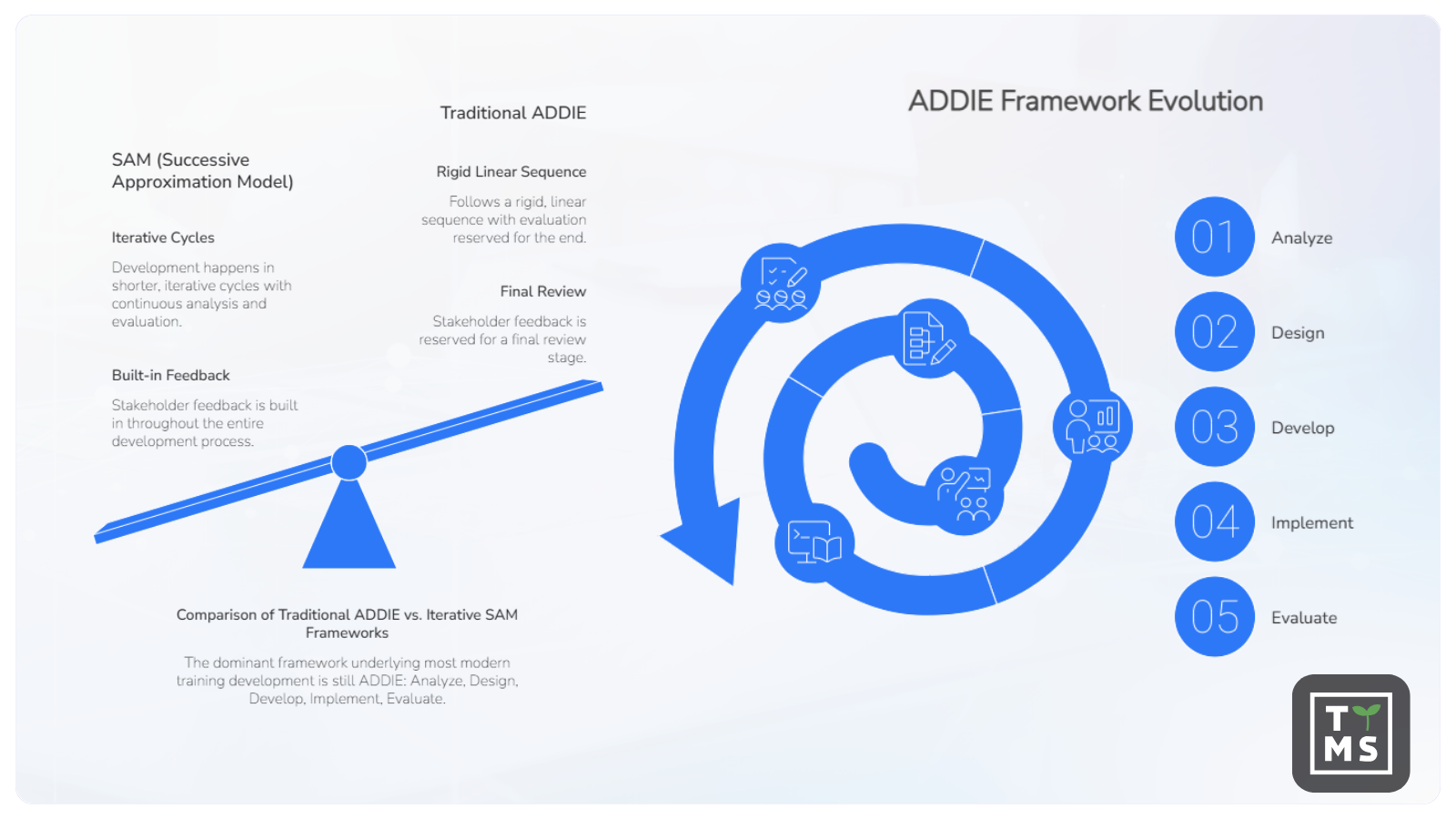
The dominant framework underlying most modern training development is still ADDIE: Analyze, Design, Develop, Implement, Evaluate. What has changed over the past several years is how practitioners apply it. Rather than a rigid, linear sequence, today’s guidance from ATD and practitioner models like SAM (Successive Approximation Model) treats ADDIE as a flexible structure run in shorter, iterative cycles. You analyze and evaluate continuously, not just at the beginning and end of a project. Development happens in stages, with stakeholder feedback built in throughout rather than reserved for a final review.
This iterative approach matters because it keeps training aligned with real-world needs as they evolve. It also reduces the risk of investing significant resources in content that misses the mark. A process that is both rigorous and adaptable is what separates organizations that see a return on their learning investment from those that do not.
Phase 1: Conduct a Training Needs Analysis
The training content development process begins long before anyone writes a word of content. It begins with understanding whether a training need actually exists, and what specifically that need is. Skipping this phase is one of the most common and costly mistakes in developing training materials, because it leads to content that addresses the wrong problem.
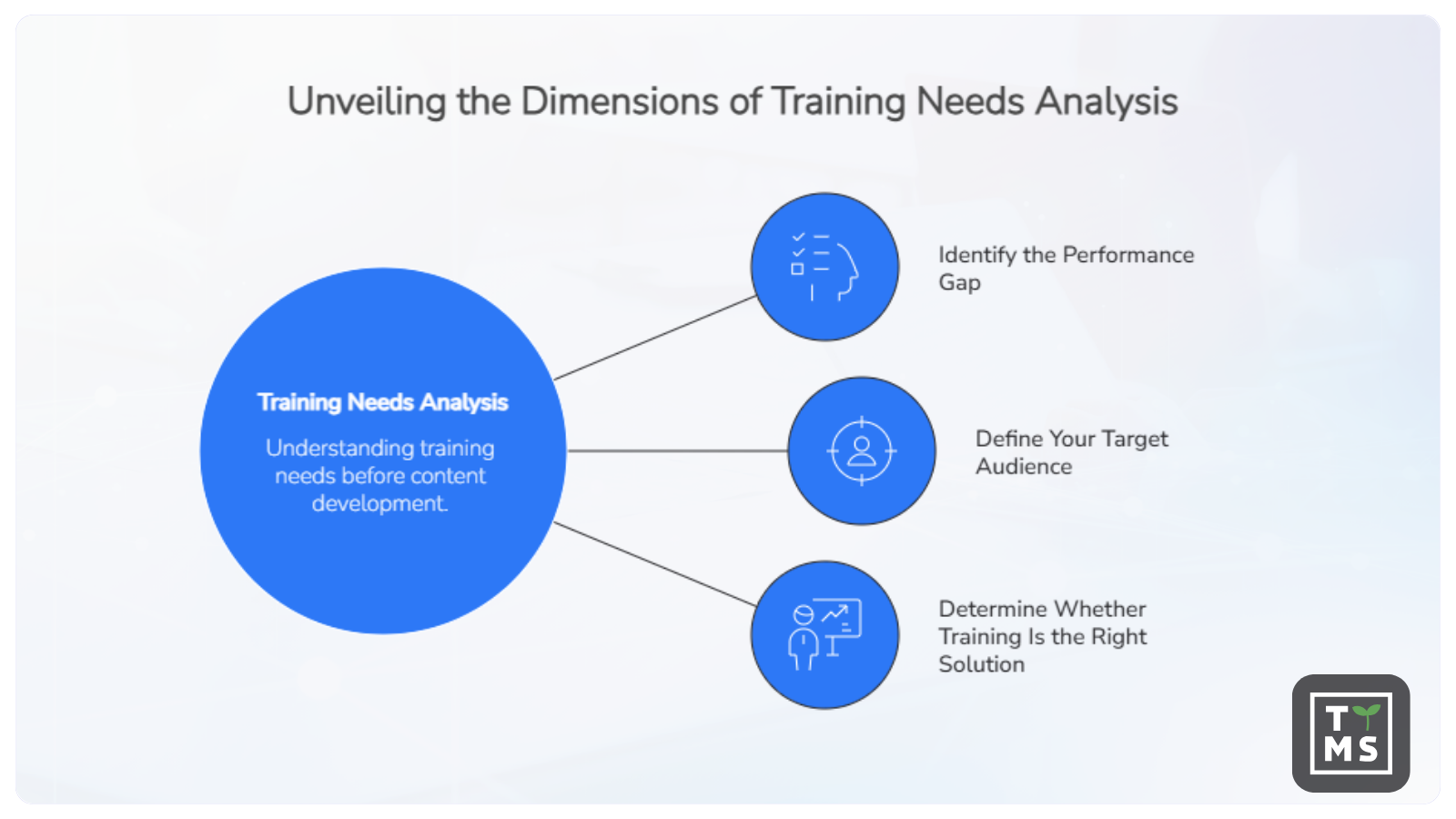
Identify the Performance Gap
A performance gap is the difference between where employees are performing today and where they need to be. Identifying it requires more than a hunch or a manager’s request. The most reliable approaches involve gathering data directly, through job observations, performance reviews, error logs, customer feedback, or structured surveys that compare current skills against required competencies.
Be specific about what the gap looks like in practice. Instead of noting that “the sales team needs better communication skills,” define what observable behavior is missing. Are reps skipping discovery questions entirely? Are objections on a specific product line going unaddressed? The clearer the gap, the more targeted the training content can be.
Define Your Target Audience
Training that tries to serve everyone often serves no one well. Defining your target audience means going beyond job title to understand the demographics, prior knowledge, work context, and even the daily pressures your learners face. Creating learner personas at this stage pays dividends later, especially when you are making decisions about format, tone, language, and the kind of examples that will actually connect.
A manufacturing technician working a shift rotation has very different learning constraints than a knowledge worker who spends most of the day at a desk. Both deserve training that respects those realities.
Determine Whether Training Is the Right Solution
Not every performance gap is a training problem. If employees know how to do something but do not do it, the issue may be motivation, unclear expectations, workflow friction, or inadequate tools, not a knowledge deficit. Training cannot fix a broken process or a lack of resources. Part of a sound needs analysis is ruling out non-training causes before committing to content development. This honest assessment protects both budget and credibility.
Phase 2: Set Learning Objectives and Success Metrics
Once you understand what problem you are solving and for whom, the next step is defining what success looks like. Clear learning objectives act as the backbone of everything that follows: the content structure, the format choices, the assessments, and the evaluation plan.
Write Measurable Learning Objectives
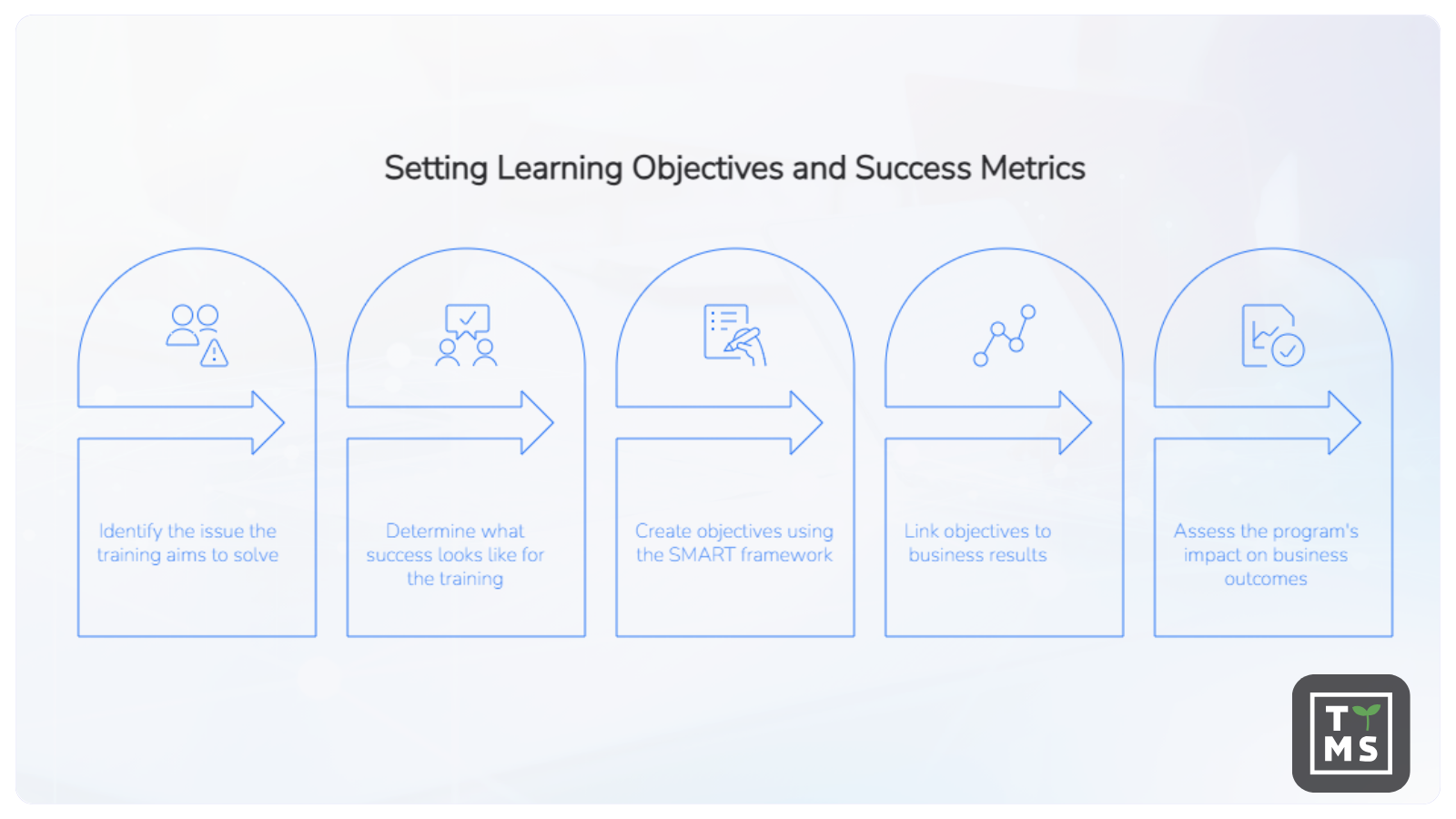
A learning objective describes what a learner will be able to do after the training, not what the training will cover. The distinction matters. “Understand data privacy regulations” is a topic, not an objective. “Correctly identify and report a data breach within the required 72-hour window” is an objective you can assess.
Effective objectives follow the SMART framework: specific, measurable, achievable, relevant, and time-bound. They use action verbs that correspond to the level of performance required. Lower-order verbs like “define” or “list” suit foundational knowledge. Higher-order verbs like “apply,” “evaluate,” or “troubleshoot” signal that the training needs to build real capability, not just familiarity.
Connect Objectives to Business Outcomes
Learning objectives should trace back to a business outcome your stakeholders actually care about. If an objective does not connect to a measurable result like reduced error rates, faster onboarding, improved compliance scores, or increased customer satisfaction, it is worth questioning whether it belongs in the program at all.
This connection also strengthens the case for training investment. The ATD 2025 State of the Industry indicates that organizations are increasingly evaluating learning by business-relevant measures including employee productivity improvement and the ability to meet organizational needs, not just course completion. Designing backward from these outcomes from the start puts your program on firmer ground.
Phase 3: Choose the Right Training Format and Delivery Method
With your objectives defined, you can make informed decisions about how the training will be delivered. Format selection is not just a preference question; it has a direct impact on whether learners achieve the intended outcomes. Different formats serve different types of learning, different audience constraints, and different organizational contexts.
Common Training Content Formats
There are many ways to build training content today. That is good news, because companies can choose the format that fits their team best. At the same time, having so many options can make the choice harder. The key is to know what each format is good for.
eLearning and interactive modules are useful when people need to learn at different times and in different places. Employees can go through the material when it suits them, come back to it later, and learn at their own speed. This works well for topics that need to be shared with many people in the same way, such as onboarding, product knowledge, or compliance training.
Training with an instructor, either in person or online, is still very useful when the topic is more difficult or needs more discussion. It gives people a chance to ask questions, talk through examples, and get feedback right away. This format works especially well when learners need to practice, understand a complex topic, or build skills that are easier to learn through conversation.
Microlearning and video have grown significantly as a delivery strategy. Short, focused content supports higher completion rates and better knowledge transfer, particularly for just-in-time performance support and reinforcement. Job aids and reference materials occupy a different niche entirely: rather than asking learners to recall everything from a formal course, they put the right information in front of people exactly when they need it.
Format-to-Objective Decision Matrix
Format selection should be driven by what the objective actually requires, not by what is easiest to build or what was used last time. The table below maps objective type to recommended format as a starting reference. Use it as a decision anchor, then adjust for your specific audience constraints and production feasibility.
| Learning Objective Type | Recommended Primary Format | Best Use Case | Key Constraint to Watch |
| Knowledge recall or compliance awareness | Microlearning / short eLearning | Distributed teams, regulatory refreshers, onboarding basics | No built-in practice opportunity; pair with a knowledge check |
| Procedure or process execution | Video walkthrough + job aid | Step-by-step tasks, software how-tos, safety protocols | Needs realistic context; generic demos lose relevance quickly |
| Application and troubleshooting | Scenario-based eLearning or simulation | Complex workflows, technical support roles, clinical tasks | High development cost; requires strong SME input upfront |
| Judgment and decision-making | VILT workshop or branching scenario | High-stakes decisions, leadership, sales objection handling | Difficult to scale; facilitator quality heavily influences outcome |
| Behavioral change requiring coaching | Blended: VILT + on-the-job practice | Soft skills, culture change, management development | Transfer depends on manager reinforcement after the course |
For knowledge-based objectives, the priority is accessibility and retrieval practice. For application-level objectives, formats must allow practice in realistic conditions. For judgment-oriented objectives, coaching and facilitated discussion produce outcomes that passive content delivery cannot match. And for any distributed or time-poor audience, a modular blended approach spreads the required practice over time without requiring everyone in the same place simultaneously.
Phase 4: Plan and Structure Your Training Content
Before any content creation begins in earnest, you need a solid plan. This phase translates your objectives and format decisions into a concrete structure that guides everything else. Skipping it leads to content that feels disjointed, covers more than it should, or lacks the logical flow that helps learners build understanding progressively.
Build a Content Outline and Learning Flow
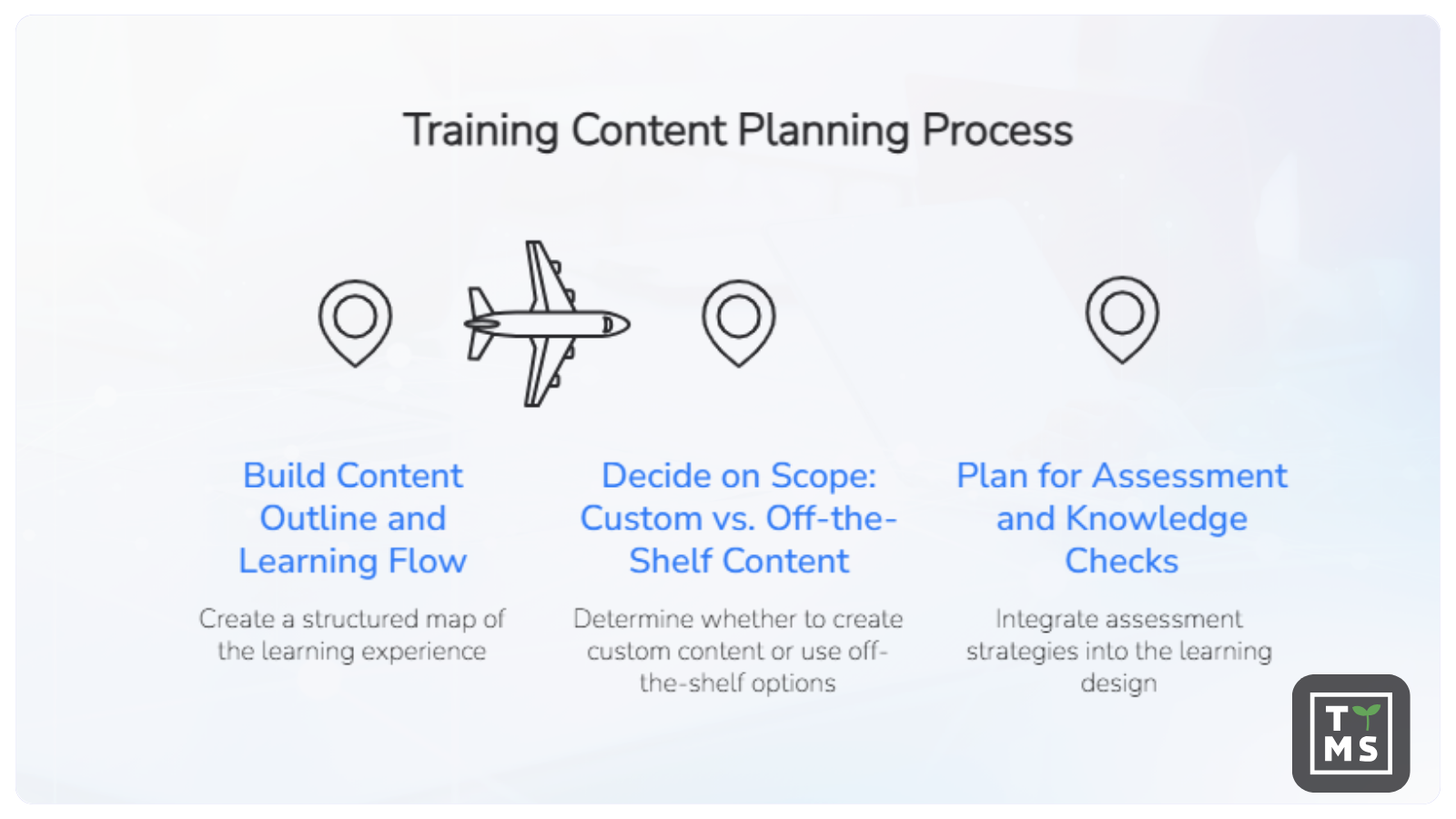
A training content outline is more than a list of topics. It is a sequenced map of the learning experience, designed to manage cognitive load and build from what learners already know toward what they need to be able to do. Start from the desired behaviors and outcomes, then work backward to identify only the content that directly supports those outcomes. This prevents the common trap of “content dumping,” where training covers everything related to a topic rather than everything necessary for performance.
Structure your outline into coherent chunks, each tied to one or two clear learning objectives. Order modules from foundational to complex, and build in explicit on-ramps for learners who may arrive with different levels of prior knowledge. An activity-first design approach works well here: map practice activities and real-world tasks first, then add only the minimum instructional content needed to support those activities.
Decide on Scope: Custom vs. Off-the-Shelf Content
The build-vs-buy question comes up in almost every content development project. Custom training content makes the most sense when the training involves proprietary processes, organization-specific behaviors, brand-specific language, or role-based scenarios that generic content simply cannot address. Off-the-shelf content earns its place for common, well-established topics: general compliance, cybersecurity awareness, standard professional skills, or regulatory subjects where accuracy and breadth matter more than organizational context.
The ATD 2024 State of the Industry notes that outsourcing learning can bring benefits including “increased speed of development and implementation, geographic reach, and scalability,” alongside potential cost reductions. For rapidly changing content or small audience sizes, vendor-maintained libraries often outperform custom development from a pure economics standpoint.
Plan for Assessment and Knowledge Checks
Assessment planning belongs in this structural phase rather than as an afterthought after content is written. Decide early how learners will demonstrate that they have achieved each objective, because that decision shapes the entire learning flow. Effective assessment requires practice opportunities built into the content itself, not just a quiz tacked on at the end. Consider a range of formats: embedded knowledge checks, scenario-based decisions, practical exercises, or manager-observed demonstrations. Building assessment design into the plan from the start also sets up your measurement framework for Phase 8.
Phase 5: Develop the Training Content
With analysis done, objectives set, format selected, and structure planned, you arrive at the phase most people think of when they imagine developing training materials: actually creating the content. This is where instructional design principles, writing craft, and media decisions converge.
Apply Core Instructional Design Principles
Effective eLearning content design draws on a body of learning science refined over decades. Principles from Gagné’s events of instruction, Merrill’s first principles, and Mayer’s multimedia learning theory all converge on a common theme: learning happens when learners are actively engaged with well-structured content that connects to what they already know and gives them opportunities to apply new knowledge.
The ADDIE model remains the backbone of structured content development, but today’s best practice runs it iteratively. Rather than completing each phase fully before moving to the next, experienced practitioners loop back frequently, testing and refining based on feedback. This agile approach reduces the risk of investing substantial effort in content that needs to be rebuilt after a late-stage review.
Write for Clarity, Engagement, and Retention
Content development is fundamentally a writing challenge before it is anything else. Materials written in plain, conversational language with concrete examples consistently outperform dense technical prose on comprehension and retention. Write to your learner persona, using the language and level of familiarity that matches who will actually read or watch the content.
Storytelling is one of the most effective tools in training content development. Real-world scenarios that mirror the challenges your learners face every day make abstract concepts concrete and give learners a mental model they can use on the job. When you frame content around a familiar problem, learners are more likely to engage and more likely to transfer the learning to their actual work.
Incorporate Visuals, Scenarios, and Interactivity
Good visuals and interactive elements are not just there to make training look better. They help people understand and remember the content.
Clear graphics can make difficult information easier to follow. Instead of reading a long explanation, learners can see how something works, how steps connect, or what matters most. This makes the material feel lighter and easier to process.
Interactive elements also make a big difference. When learners have to make choices, answer questions, or work through real situations, they are more involved in the training. Scenarios are especially useful because they show how knowledge can be used in everyday work. They help people practice judgment, not just remember facts.
This is why training should not only explain information. It should also give learners a chance to use it.
What This Looks Like in Practice
A practical way to use this process is to start by finding the real reason behind the training need. Sometimes the problem is not that employees lack general knowledge. It may be that they struggle with a few specific tasks, decisions, or procedures.
When this is clear, the training can be much more focused. Instead of creating a long course from scratch, a team can build shorter learning materials around the exact moments where mistakes happen most often.
Existing documents, policies, or internal materials can be used as a starting point. AI tools can help turn them into a first structure, suggest learning objectives, and organize the content into smaller modules. Then the training team can review the material, improve the wording, add realistic scenarios, and make sure everything fits the way people actually work.
Before the training is shared more widely, it should be tested with a small group of learners. Their feedback can show what is clear, what is missing, and what needs to be improved.
This approach makes the whole process faster and more practical. It also helps the team spend more time on the parts that matter most: useful scenarios, expert review, and training that supports real work.
Build Assessments That Reinforce Learning
Assessments built during content development should do more than measure: they should reinforce learning. Spacing knowledge checks across the content rather than grouping them at the end takes advantage of the well-documented “testing effect,” where retrieval practice strengthens memory more effectively than re-reading. Provide immediate, specific feedback so learners understand not just whether they answered correctly but why, and what the correct approach looks like.
Phase 6: Review, Pilot, and Refine
Content that looks excellent in development does not always perform as expected with real learners in a real context. The review and pilot phase exists to surface those gaps before they affect a full audience.
Conduct SME and Stakeholder Reviews
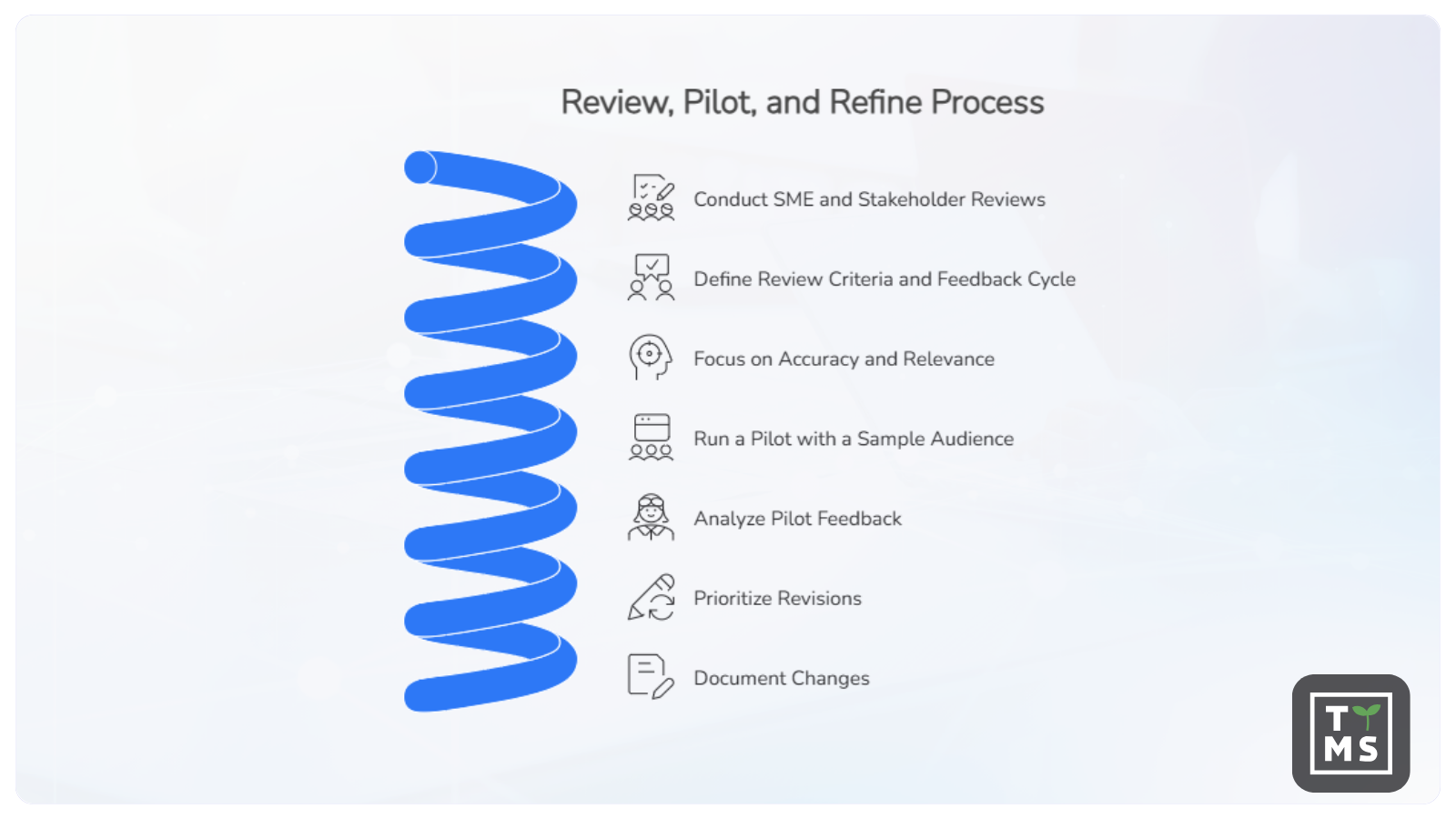
Subject matter experts and stakeholders bring perspectives that instructional designers and content writers cannot supply from the outside: domain knowledge, awareness of edge cases, and the organizational context that shapes whether content is truly credible and relevant. A structured SME review process, with clear review criteria and a defined feedback cycle, produces better results than open-ended requests for commentary.
Ask reviewers to focus on accuracy and relevance rather than style. Define who has approval authority and what changes require a second review. Unmanaged SME review cycles are one of the most common causes of schedule delays in training content development, so building a clear process into your project plan protects both quality and timelines.
Run a Pilot with a Sample Audience
A pilot with a small group from the actual target audience reveals issues that no amount of internal review can catch: navigation confusion, pacing problems, scenarios that feel unrealistic, or content that assumes prior knowledge the learners do not have. Current instructional design best practice treats the pilot as part of the design cycle itself, not as a pre-launch formality. Early pilots routinely expose accessibility problems, cognitive load issues, and learner flow gaps that never show up in storyboards, and fixing them before full deployment costs a fraction of what post-launch rework does.
Pilot feedback is only valuable if you act on it. Analyze what you hear systematically: which issues are isolated reactions versus patterns across multiple learners? Prioritize revisions that affect comprehension, navigation, or achievement of learning objectives, then document what changed and why. This documentation also supports the measurement work in Phase 8 by establishing a baseline of decisions made.
Phase 7: Deploy and Distribute Training Content
With content reviewed, refined, and ready, deployment is the bridge between what you have built and the learners who need it. The choices you make here about platform, access, and support directly affect whether learners actually complete the training and whether it reaches the right people at the right time.
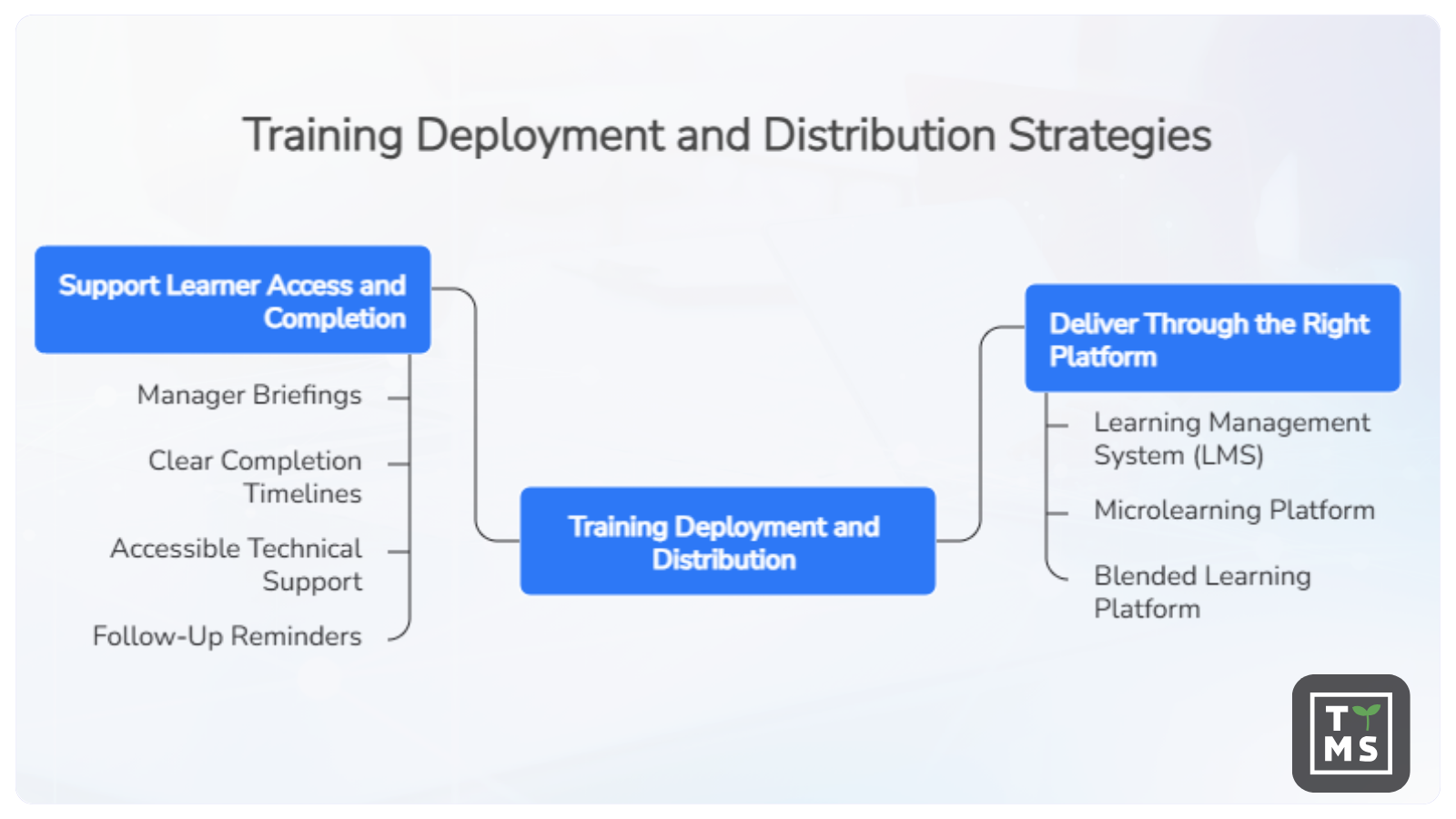
Deliver Through the Right Platform or LMS
A learning management system is the most common infrastructure for delivering and tracking training content in organizational settings. The LMS market now exceeds $20 billion, showing how deeply embedded these platforms have become in enterprise learning operations. Platform choice should match the content and the audience. Microlearning and mobile content requires a platform optimized for short-session, on-demand access. Blended programs that combine VILT sessions with self-paced modules need scheduling and communication features. For organizations with distributed teams, ensuring the platform performs reliably across geographies and devices is a practical requirement, not just a technical detail.
Support Learner Access and Completion
Deploying training does not mean the work is done. Learners face real barriers to completion: scheduling conflicts, technical difficulties, unclear expectations from managers, and content that feels disconnected from their immediate priorities. Proactively addressing these barriers, through manager briefings that explain the purpose behind the training, clear completion timelines, accessible technical support, and follow-up reminders, meaningfully improves completion rates and engagement. Employee satisfaction with learning rose to 84% in 2025, up from 79% the year before, which suggests organizations are paying more attention to the quality of the learning experience, not just the mechanics of delivery.
Phase 8: Measure Effectiveness and Iterate
Without measurement, you can spend significant resources on training that changes nothing without ever knowing it. With it, you can demonstrate impact, identify what to improve, and build a stronger case for future investment.
Key Metrics to Track After Launch
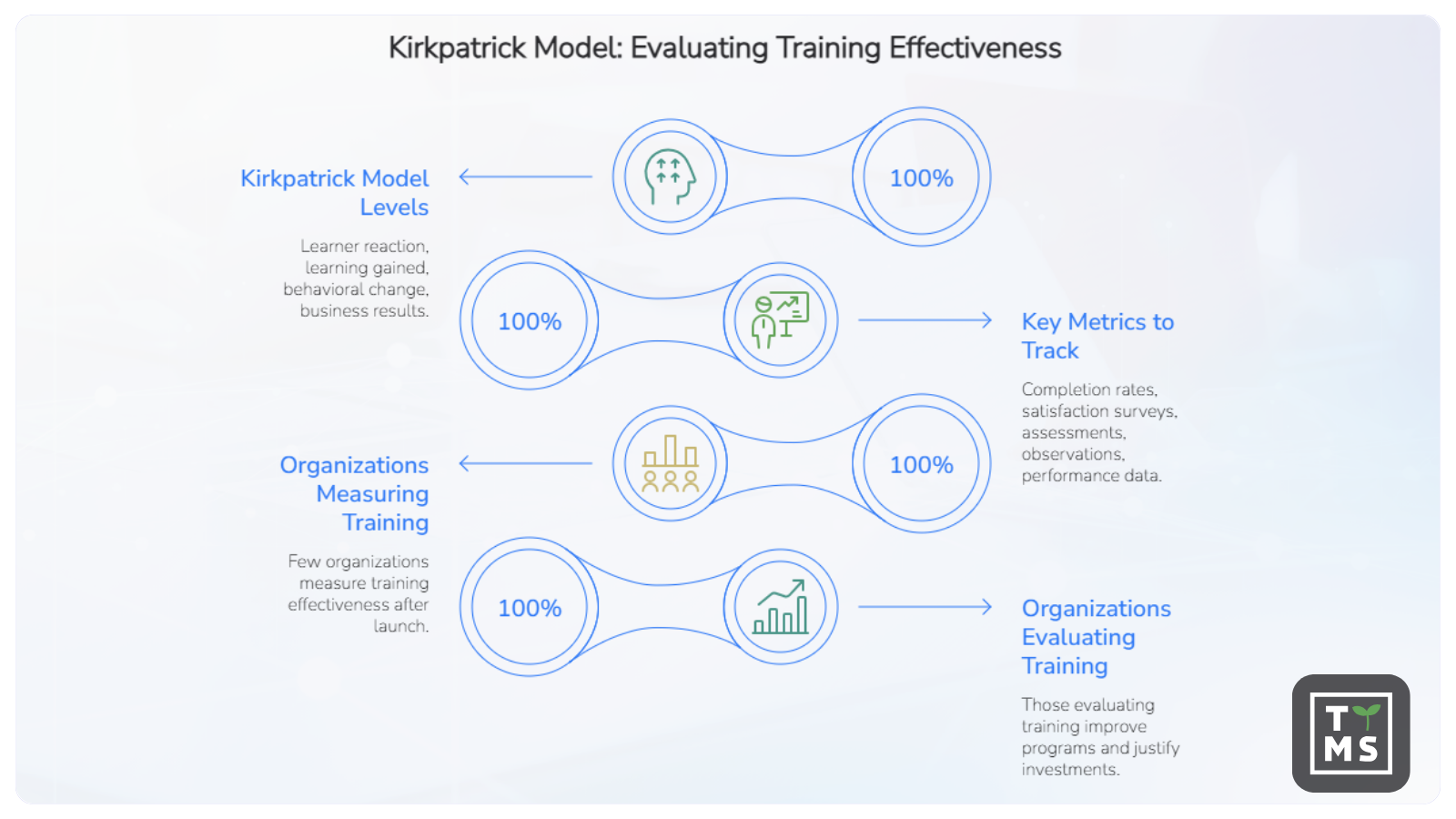
The Kirkpatrick model remains the most widely used framework for evaluating training effectiveness. It organizes measurement across four levels: learner reaction, learning gained, behavioral change on the job, and business results. Each level answers a different question, and each requires different data.
Start with what is most accessible: completion rates and learner satisfaction surveys give you quick signal on engagement and perceived relevance. Pre- and post-assessments measure knowledge or skill gain. Manager observations, workflow metrics, and performance data tell you whether behavior actually changed. And if the training was designed to address a specific business outcome, whether error rates, sales performance, customer satisfaction, or time-to-competency, tracking that metric before and after training provides the strongest evidence of impact.
Many organizations invest time and resources in training, but far fewer take the next step and measure whether it actually works. As a result, it can be difficult to know if employees have improved their skills, changed their behavior, or applied what they learned in their daily work.
Measuring training results does not have to be complicated. Even simple checks, such as learner feedback, knowledge assessments, performance indicators, or manager observations, can provide valuable insights. The important thing is to look beyond course completion rates and focus on whether the training is creating real improvements.
Organizations that regularly evaluate the impact of their training are in a much better position to improve future programs, justify training investments, and show the value that learning brings to the business.
Using Data to Improve Future Training
Measurement data should feed back into the development process, not just sit in reports. Low assessment scores on a specific module suggest a content or design problem. High drop-off rates at a certain point in a course may indicate a pacing or engagement issue. Low behavior transfer despite strong assessment scores points to a gap between what the training teaches and what the job actually requires.
Common Mistakes That Derail Training Content Development
Even experienced teams fall into patterns that undermine otherwise well-designed training programs. The most consequential mistake is skipping or rushing the needs analysis. Without a clear picture of the actual performance gap, training content is built on assumptions that tend to be wrong in ways only visible after the program is deployed. Related to this is treating training as the default response to any performance problem, rather than investigating whether the root cause actually requires a learning solution.
A second common mistake is writing learning objectives that describe activities rather than outcomes. When objectives focus on what the training will do rather than what learners will be able to do, the entire design is oriented around coverage rather than capability. This produces long, thorough courses that learners forget quickly because there was no clear performance target shaping the content or the practice.
Underinvesting in review and pilot cycles creates expensive problems that could have been caught early. When teams skip structured SME reviews or pilot only with internal staff who already know the content, they miss the places where real learners get confused, disengage, or walk away with the wrong mental model. Finally, many organizations measure completion and satisfaction but stop there, never connecting the investment to the business outcome it was meant to support. That measurement gap makes it nearly impossible to improve training strategically over time.
When to Build In-House vs. Partner with a Content Development Expert
The decision to develop training content internally or work with external experts depends on what the training needs to achieve, what resources are available, and the strategic importance of getting it right. In-house development makes sense when your team has the instructional design expertise, time, and subject-matter access needed to build effectively. It also makes sense for content that is highly proprietary, culturally specific, or requires ongoing updates tied to rapidly changing internal processes.
Partnering with content development specialists makes sense when the training is strategically important but your internal team lacks specialized expertise; when you need to scale content development faster than your team’s capacity allows; when the content requires capabilities like complex simulations, multilingual production, or accessibility compliance that are difficult to build internally; or when you want an outside perspective to strengthen a program that is not performing as expected.
According to the ATD State of the Industry, approximately 47% of total direct learning and development expenditure already goes to external components, which suggests that hybrid approaches combining internal and external resources are the norm rather than the exception. The best decision is grounded in an honest assessment of what your internal team does well and where external expertise would add the most value.
How To Make the Training Content Process Efficient with AI4E-Learning
Every phase of the training content development process described in this guide takes time. Writing objectives, structuring outlines, developing content, running review cycles, and iterating based on data are all necessary activities, but they are also time-intensive. For organizations managing multiple training programs simultaneously, or trying to scale content development without scaling headcount proportionally, the bottlenecks are real and costly.
This is the challenge that TTMS addresses directly with its AI4E-Learning tool, an AI eLearning authoring platform designed specifically for organizations that need to develop training content faster without sacrificing structure, quality, or compliance.
AI4E-Learning is based on a simple idea: most companies already have the materials they need for training. They have process documents, product guides, policies, onboarding slides, or recorded presentations.
The real challenge is turning all of this into a clear, structured course.
AI4E-Learning helps with that. Users can upload materials in formats such as DOCX, PDF, PPTX, MP3, and MP4. The platform then analyzes the content and creates a course foundation, including:
- suggested business goals,
- learning objectives,
- a logical content order,
- an organized course structure.
This gives teams a ready starting point instead of a blank page.
What makes this approach different from generic AI content generators is that it mirrors the instructional design process described throughout this article. The platform guides users through each phase of course creation step by step: configuring the training mode, defining the business goal, setting learning objectives, choosing interactivity levels, and including assessment elements like end-of-course quizzes. The AI does not produce a finished course and hand it over. It creates a structured starting point that users can edit, reorder, approve, or override at every stage.
The efficiency gains from AI-assisted authoring are well-documented. According to a Brandon Hall Group Gold Award case study of AI-assisted authoring, content creation that traditionally “took weeks and required multiple team members” can now be achieved “in a matter of hours.” A separate Brandon Hall Group and ELB Learning study on GenAI in eLearning development describes GenAI tools compressing “drafting processes from hours to minutes” for tasks such as text summarization, question generation, script editing, and voiceover creation. For an L&D team managing a full program calendar, those savings translate directly into capacity for higher-value work.
AI4E-Learning supports key stages of training content development:
- Phase 2 – Learning objectives
- Suggests clear learning objectives based on business goals and uploaded materials.
- Phase 4 – Course structure
- Creates an initial course outline and logical content flow.
- Phase 5 – Content creation
- Generates slides and module sections from source materials, with adjustable interactivity.
- Phase 7 – LMS export
- Exports ready training packages in SCORM format.
- Phase 8 – Content updates
Allows quick updates when rules, processes, or materials change.
AI4E-Learning is also designed for enterprise use:
- Data security and compliance
- Helps protect sensitive internal materials used to create training content.
- Automatic translation
- Makes it easier to prepare training for multilingual teams.
- Easy access for different teams
- Can be used by HR, L&D, operations, and business teams without advanced technical skills.
- Expert control
- AI speeds up the work, but people still review, edit, and decide what is best for learners.
- Scalable content creation
- Helps teams create, update, and manage more training content without growing the team at the same pace.
AI4E-Learning is useful for organizations that need to build compliance training, onboarding materials, or update large training libraries faster and more efficiently.
1. What are the key stages of the training content development process?
The training content development process typically consists of eight main stages: training needs analysis, defining learning objectives, selecting the training format, planning the course structure, developing content, reviewing and testing the materials, deploying the training, and measuring its effectiveness. Each stage plays an important role in the overall success of the program. Skipping any of them can reduce the impact of the training.
2. How can you determine whether training is actually needed?
Before creating any learning materials, it is important to conduct a training needs analysis. This helps identify whether the problem is caused by a lack of knowledge or skills, or by other factors such as inefficient processes, inadequate tools, or unclear expectations. A proper analysis helps organizations avoid investing time and resources in training that will not solve the real issue.
3. How do you choose the right training format?
The best training format depends on the learning objectives and the needs of the audience. eLearning works well for delivering knowledge to large groups, instructor-led training is often more effective for complex topics, and microlearning is useful for sharing focused information in a short amount of time. The key is to match the format to the desired outcomes rather than choosing what is easiest to create.
4. How should training effectiveness be measured?
Measuring training effectiveness should go beyond tracking course completion rates. Organizations should also evaluate assessment results, learner feedback, changes in employee behavior, and the impact on business performance. This broader approach provides a clearer picture of whether the training achieved its intended goals.
5. How can AI help speed up training content development?
AI-powered tools can automate many of the time-consuming tasks involved in creating training programs. They can analyze source materials, suggest learning objectives, generate course structures, create content drafts, and simplify updates. This allows learning and development teams to spend more time improving training quality and learner experience instead of focusing on repetitive manual work.