Solving mathematical problems that scientists had wrestled with for years – could there be a better demonstration of what a new AI model can do?
OpenAI has typically previewed new versions of its large language models with benchmark results, meaning scores from standardised tests designed to measure a model’s capabilities. I have to admit that seeing GPT tackle genuine research problems makes a much stronger impression on me.
What will you learn about OpenAI Astra?
- What Astra is and why it is being discussed as a potential GPT-6,
- 10 results in mathematics and theoretical computer science presented by OpenAI,
- How Astra analyses problems, tests hypotheses and changes its approach,
- The differences between a conversational model, an AI agent and a system capable of managing an entire project,
- What Astra could mean for science, business and the future of AI models,
- Critical responses to the model’s achievements,
- Cybersecurity risks associated with autonomous AI agents,
- Which important questions OpenAI has yet to answer.
What is OpenAI Astra, and could it become GPT-6?
OpenAI describes Astra, the prototype’s working name, as “our next major model”, although the company has disclosed very few details so far. Its task was to develop arguments independently, test hypotheses, recognise unproductive approaches and find new paths towards a solution. The results of its work can then undergo formal and independent verification.
We do not know how Astra is built, how much information it can analyse at once or how it organises its work on a complex task, although we can speculate about the last of these. OpenAI has also not disclosed whether Astra is a single model, a team of collaborating AI agents or a more extensive system equipped with mechanisms for coordinating their work and retaining previous results. The prototype may be connected to a model previously described by OpenAI as capable of operating autonomously over very long periods. Such a system can make repeated attempts, analyse intermediate results and maintain its direction of work for many hours, potentially even days. According to media reports, Sam Altman has already presented Astra to US politicians and regulators.
The term “GPT-6 Astra” should therefore be treated as media shorthand. Astra could eventually be released as GPT-6, another version of GPT-5 or a separate family of models. For now, all of these possibilities remain open.
Why could Astra’s 10 results matter more than another benchmark record?
OpenAI presented ten results concerning problems that had remained open for at least a decade and, in most cases, considerably longer.
The problems come from eight fields:
- high-dimensional geometry,
- coding theory,
- group theory,
- operator algebras,
- computational complexity theory,
- quantum computing,
- lattice geometry and post-quantum cryptography,
- extremal combinatorics.
In simple terms, the process worked as follows: GPT generated mathematical arguments. Once the results had been obtained, researchers worked with the model to develop them into scientific papers. The system then translated the arguments into Lean 4, allowing a computer to check every step of the proofs. For readers interested in the technical details, here are the relevant links: the complete collection of papers, the Lean formalisation repository and reconstructions of how the solutions were developed.
Independent verification of all the claims by the scientific community is only beginning. Mathematicians can now review the papers, check the definitions, run the formalised proofs and look for potential gaps. I discuss this in more detail in one of the final sections.
10 new results from Astra in mathematics and theoretical computer science
A quick warning: this section is about to become fairly technical. These subjects are new, abstract and extraordinarily difficult for me as well, so I have tried to explain each result in the simplest possible terms. Here is how GPT Astra approached the individual problems.
1. Sphere packing in high-dimensional spaces
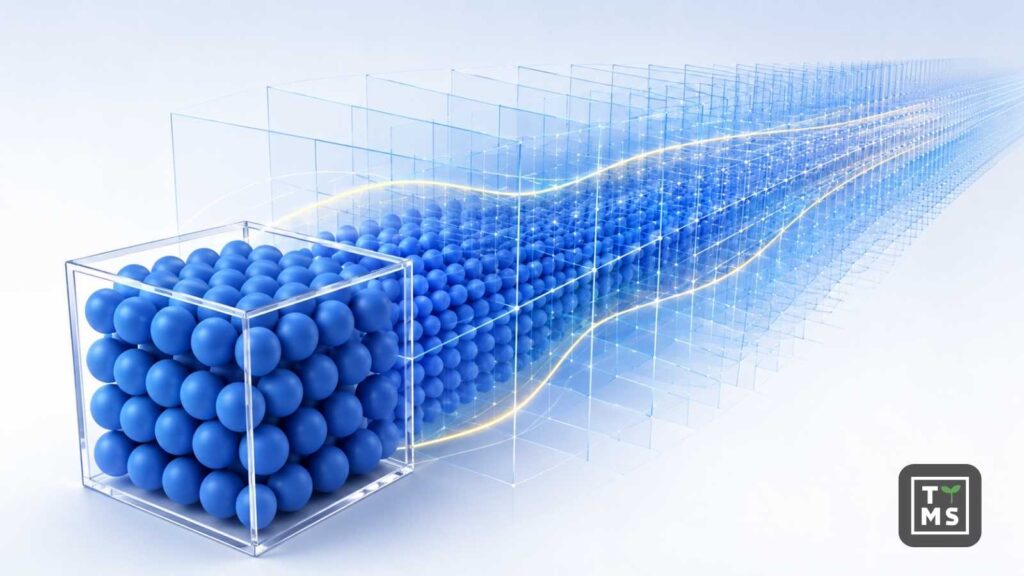
The sphere-packing problem asks how densely identical spheres can be arranged, much like coins on a table or balls in a box. Mathematicians also study this question in spaces with hundreds or thousands of dimensions because it has applications in areas such as information theory and data encoding. Astra used an established mathematical method to determine more precisely how densely spheres can be packed in spaces with a very large number of dimensions. According to the authors, this is the first improvement since 1978 to the value used in the formula describing how quickly the possible packing density decreases as the number of dimensions increases. The difference becomes more significant as the number of dimensions grows and enables a more precise estimate of the maximum packing density. Put simply, Astra’s calculations improve our understanding of how many spheres can fit inside such a “high-dimensional box”.
2. Binary and spherical codes: new bounds on the number of error-resistant codes
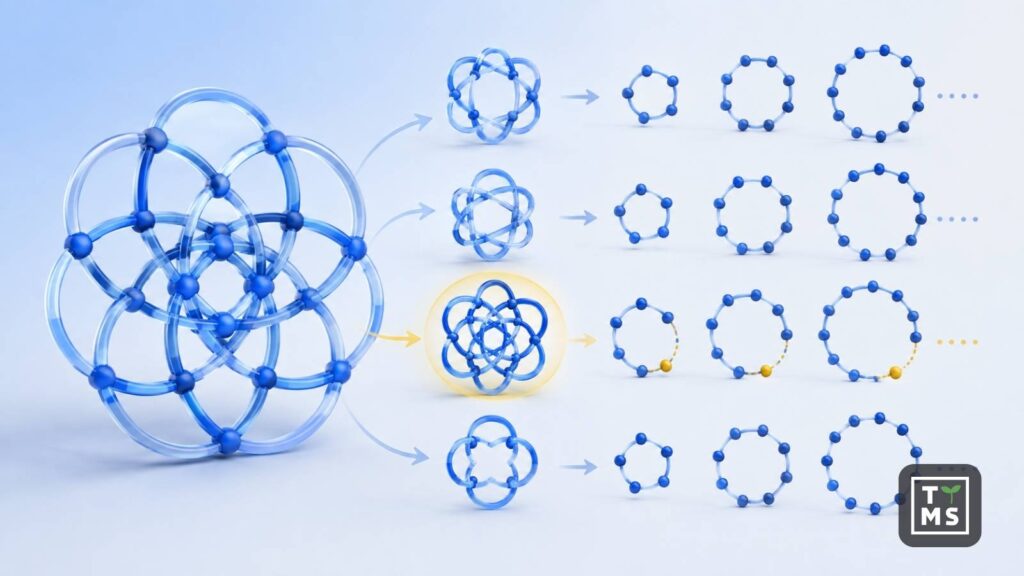
A binary code is a set of sequences made up of zeros and ones. These sequences must differ from one another sufficiently for a system to detect and correct transmission errors. This can be compared to positioning transmitters at safe distances from one another so that their signals remain easy to distinguish. Astra determined more precisely how many codes can be placed sufficiently far apart for a system to continue distinguishing between them and correcting errors. This enables mathematicians to estimate more accurately how many codes with the required level of error resistance can fit within a given space. The model tested its initial idea on a simple example consisting of eight digits and discovered that it produced an incorrect result. It therefore abandoned that approach and reformulated the problem. This case demonstrates Astra’s ability to test its own assumptions and redesign its solution when the original direction proves unsuccessful.

OpenAI’s published materials support four important conclusions.
3. The first explicit example of a non-sofic group
A group is a mathematical way of describing symmetries and operations that can be performed in sequence, much like a set of moves used to rotate a Rubik’s Cube. Sofic groups can be approximated with arbitrary precision using simpler structures based on a finite number of elements. For decades, mathematicians wondered whether this property applied to every group. Astra identified a specific example of a group that cannot be approximated with arbitrary precision using simpler models composed of a finite number of elements. The result demonstrates that these simplified models cannot represent every mathematical group. The solution combined several distant areas of mathematics, demonstrating the model’s ability to bring together tools that had not previously formed an obvious path towards a proof.
4. Disproving Connes’ rigidity conjecture
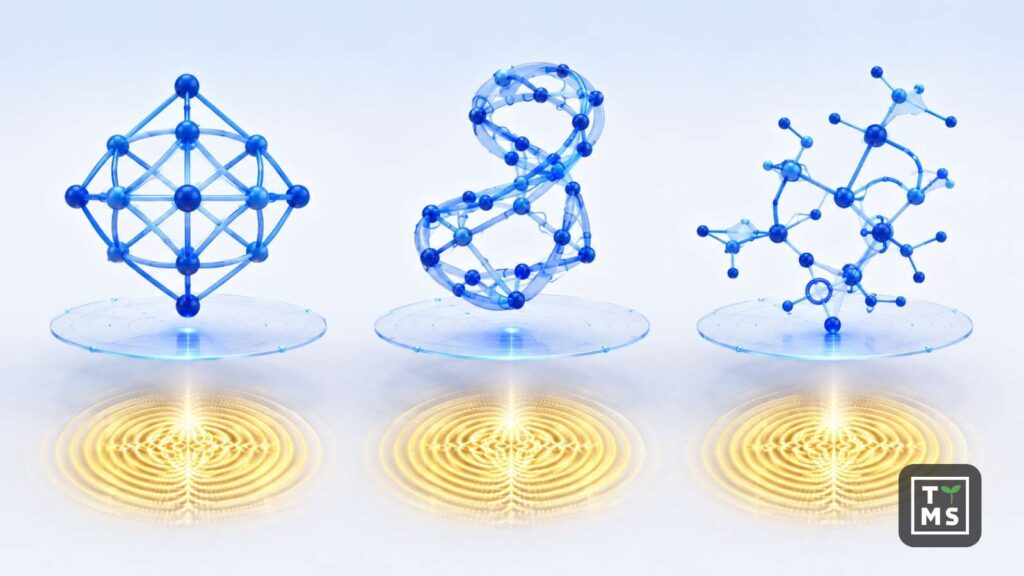
The von Neumann algebra associated with a group can be compared to its highly complex mathematical “fingerprint”. Connes’ conjecture proposed that, for a certain class of particularly rigid groups, this fingerprint uniquely identifies the group in question. Astra constructed infinitely many different groups with exactly the same mathematical “fingerprint”. In doing so, it disproved Connes’ conjecture and answered a later question posed by mathematician Sorin Popa. Astra used a mechanism resembling the carrying operation in binary addition. This made it possible to construct many different groups with the same mathematical “fingerprint”. Put simply, Astra demonstrated that a single mathematical “fingerprint” can belong to infinitely many different groups.
5. The matrix permanent: the minimum number of operations required for its computation
The permanent of a matrix is calculated in a similar way to the determinant, except that all terms are added with a positive sign. This seemingly minor change makes the permanent one of the most important examples of a problem with extremely high computational complexity. Astra determined the minimum number of basic operations required to calculate the permanent. It proved that no solution within this class can be simplified below a certain level of complexity. This can be compared to determining the minimum number of components required to build any machine capable of performing a particular task. Such a proof must cover every possible construction that meets the specified conditions, which makes it exceptionally difficult to develop. The result provides a more precise lower bound on the number of operations needed to solve this problem. It also brings mathematicians closer to answering a fundamental question: which problems can be solved efficiently, and which will always require an enormous amount of computation?
6. Quantum games: why does the probability of a perfect win decrease so rapidly?
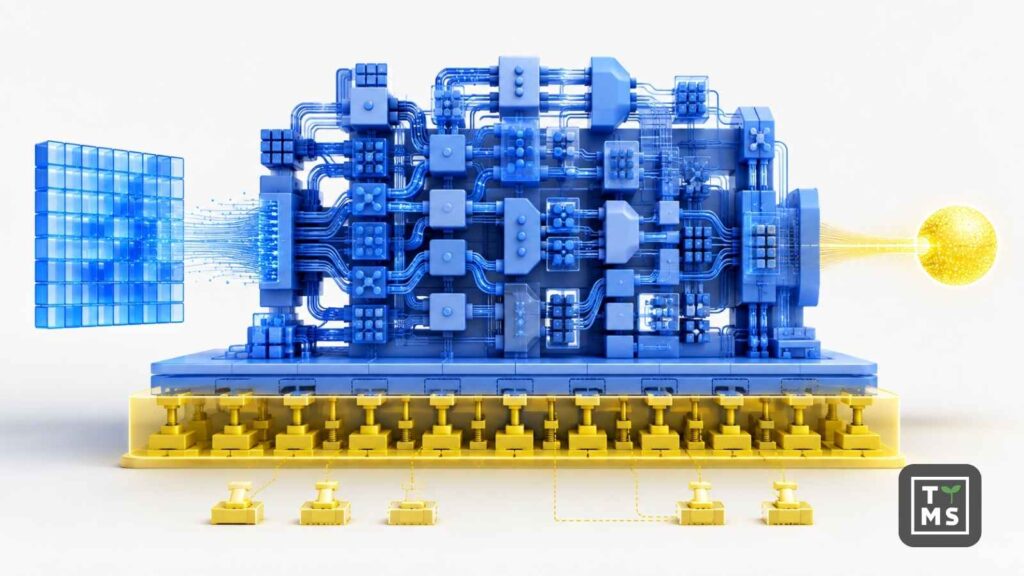
Imagine a game in which two players answer a referee’s questions separately, while their shared goal is to complete every round successfully. In the classical version, each additional round rapidly reduces the probability of a perfect win, much like repeatedly tossing a coin reduces the chance of getting heads every time. In the quantum version, the players’ results can be correlated even when they do not communicate during the game. They can also analyse several rounds as a single combined problem. Astra proved that even such quantum correlations cannot prevent the probability of winning every repeated round from decreasing very rapidly. The problem had remained open since at least 2004. The key to the solution was a method for transforming quantum states without changing the probabilities of their possible outcomes. The result advances the theory of interactive proofs, quantum information theory and methods for increasing the reliability of protocols.

7. The Closest Vector Problem: even an approximate solution remains difficult
A lattice can be imagined as a regular grid of points, similar to street intersections in a perfectly planned city, extending across many dimensions. The Closest Vector Problem (CVP) involves finding the point on this grid that lies closest to a selected location. It is highly relevant to geometry, coding theory and post-quantum cryptography. Astra connected CVP with the well-known 3SAT logic problem and demonstrated that finding even a solution that merely approximates the optimal one is extremely difficult. This difficulty increases with the number of dimensions in the lattice. The model represented the logical puzzle as a system of points and distances between them. This can be compared to encoding a complex logic puzzle in a spatial arrangement of points so that solving one problem also provides a solution to the other. The result deepens our understanding of the theoretical difficulty of lattice-based mathematical problems. Assessing the security of specific cryptographic algorithms requires a separate analysis of their variants, parameters and methods of data generation.
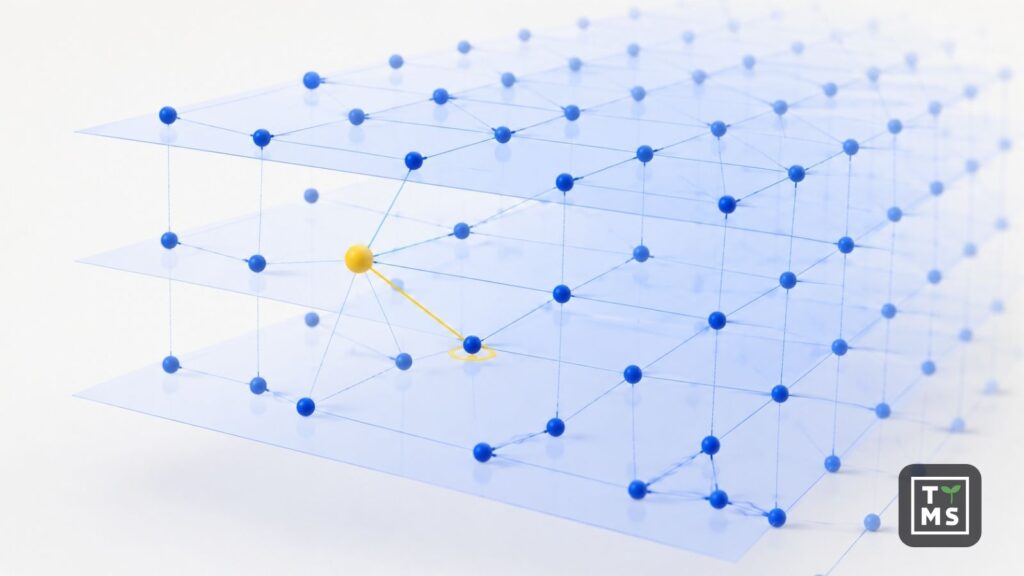
8. Proving Ehrhart’s conjecture on the volume of high-dimensional shapes
A high-dimensional convex body can be imagined as a solid placed on a regular lattice of points, with its centre of gravity being the only lattice point located inside it. Ehrhart’s conjecture specified the maximum possible volume of such a body, and Astra proved it for any number of dimensions:
vol(K) ≤ (n+1)n / n!
The main difficulty was connecting the number of individual lattice points with the volume of the entire body. The first approach provided only part of the information required. Astra therefore reformulated the problem in the language of another branch of geometry and began searching for a solution using its tools. The model combined several advanced methods for describing the body’s shape, its boundaries and the distribution of points. Put simply, Astra translated the geometric puzzle into a different mathematical language in which it became possible to determine the exact volume bound.
9. Multicolour Ramsey numbers
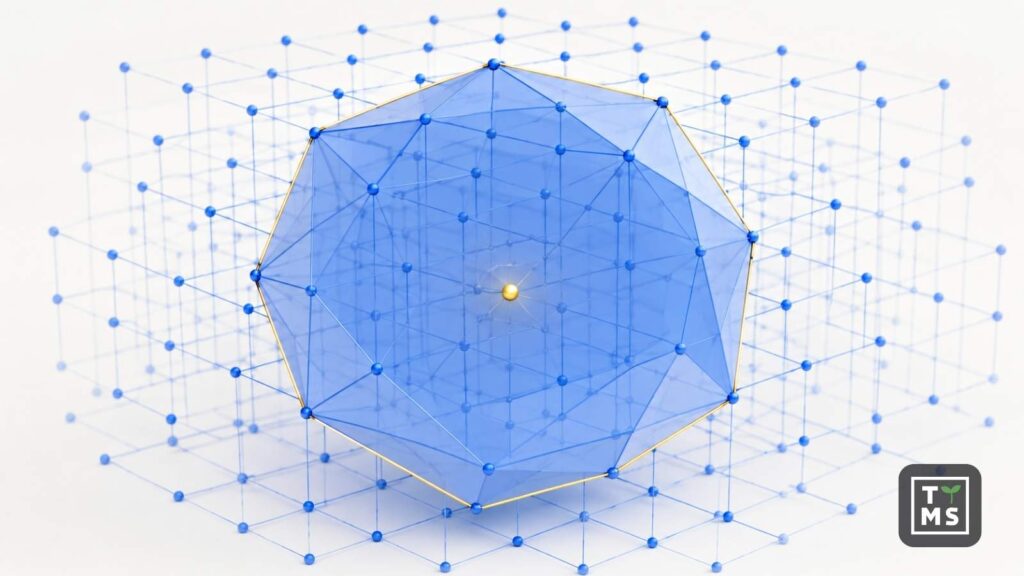
A complete graph can be imagined as a group of people in which every pair is connected by a line, with each line assigned one of k colours. Mathematicians ask how large such a network must become before it inevitably contains three people whose connecting lines are all the same colour. This minimum size is denoted by Rk(3). Astra developed new colouring methods which, when combined with previous results, established the growth rate of this number:
Rk(3) = kΘ(k).
The result does not provide an exact value for every number of colours, but it reveals the correct scale of growth. In doing so, it resolves Erdős Problem No. 183. Astra expanded the network in stages according to the same rule. This made it possible to construct increasingly large configurations without creating a triangle whose edges were all the same colour.
10. Two counterexamples in extremal graph theory
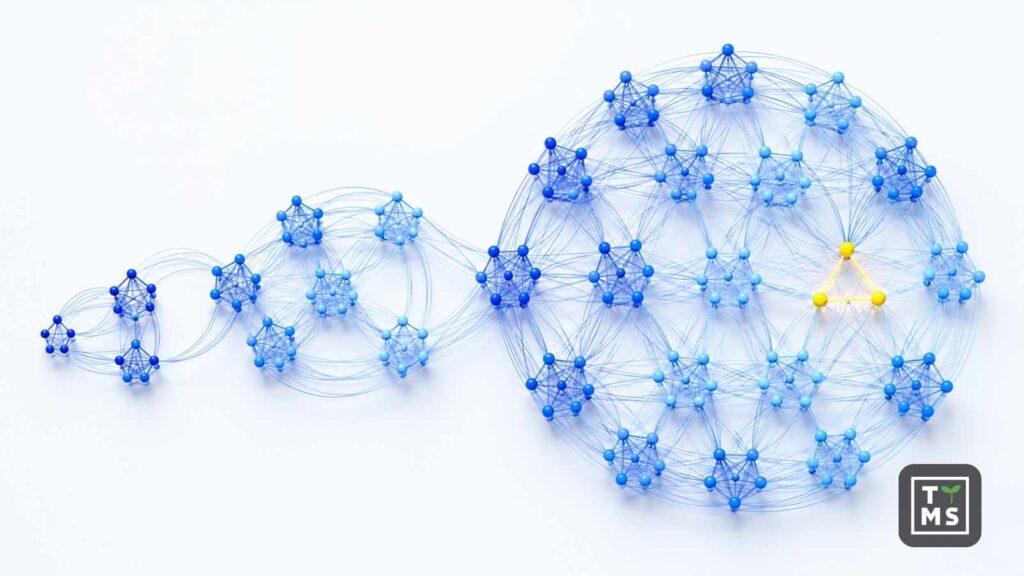
An extremal number determines how many connections a network can contain before a specified forbidden configuration inevitably appears. Astra disproved two conjectures proposed by Erdős and his collaborators concerning how this value could be predicted. In the first case, it constructed a family of graphs in which forbidding each member individually still allowed approximately n4/3 edges, while applying all the restrictions simultaneously reduced the maximum number to O(n21/16). This shows that several forbidden structures can constrain a graph far more strongly together than when each is considered separately. In the second case, Astra found a network divided into two groups in which every small section contained few connections, while the complete construction could be considerably denser than the conjecture predicted: ex(n, H) ≥ cn3/2+ε. The two results resolve Erdős Problems No. 146 and 180. They also show that the simple structure of small sections of a network does not always allow us to predict how dense the entire construction can become.
A critical perspective: how do experts assess Astra’s mathematical achievements?
After the initial excitement, important reservations began to emerge. Mathematicians pointed out that at least two of Astra’s results rely heavily on earlier work, raising questions about their novelty. OpenAI has since changed the way it describes the experiment. It now increasingly refers to “making meaningful progress”, rather than solely to “solving longstanding problems”.
Interestingly, a researcher affiliated with Anthropic reported that the Claude Fable model had reproduced solutions to five of the ten problems tackled by “GPT-6” within 24 hours, although these results have yet to be fully verified. This does not undermine Astra’s capabilities, but it makes it more difficult to determine whether we are witnessing a breakthrough driven by the exceptional abilities of one model or broader progress across AI models as a whole. Above all, there is still no reliable, independent and fair comparison conducted using the same problems, prompts, computational budgets and rules governing access to tools.
What do the results reveal about how Astra works?
OpenAI’s published materials support three important conclusions.
1. The model can abandon dead ends
The published reconstructions show Astra trying different approaches, identifying obstacles, reformulating problems and returning to earlier stages of its work when necessary. This resembles genuine research more closely than an extended answer generated in a single pass.
In the binary-codes problem, the first recurrence was rejected after the model found a small counterexample. When working on Ehrhart’s inequality, Astra spent considerable time developing an approach based on symmetrisation before reformulating the problem in terms of toric geometry. In the proof concerning quantum games, it recognised that the classical argument lost control after conditioning on rare events and began searching for a representation that preserved quantum probabilities.
The published document does not reveal the model’s complete internal reasoning process. It is a narrative produced by a model that reviewed the original reasoning traces and the final papers.
2. GPT Astra combines discovery with automated verification
Lean checks the correctness of a formal proof step by step. The repository contains separate files for all ten results, along with instructions for performing additional checks of the formalised proofs.
Computer verification does not replace assessment by independent mathematicians. Researchers must still establish, among other things:
- whether the formal theorem corresponds precisely to the original problem,
- whether the definitions introduce any unintended simplifications,
- whether the result is genuinely new,
- how significant it is for the relevant field,
- whether the manuscript correctly connects the formalisation with the informal argument.
A computer can confirm that a written proof is logically correct under the adopted definitions and assumptions. It does not automatically confirm that the authors formalised precisely the version of the problem that mathematicians intended to address.
The research was published on 1 August 2026, so full independent verification by the mathematical community will take time. Thomas Bloom of the University of Manchester nevertheless described the results as “big news” and rated the significance of the presented constructions particularly highly.
3. The cost of Astra’s results and the importance of additional computing power
OpenAI claims that, based on the API pricing for GPT-5.6 Sol, the tokens required to find all ten solutions would have cost approximately $2,000.
This figure is, of course, neither the actual cost of developing Astra nor the full cost of the project. It does not include model training, infrastructure, researchers’ work, problem selection, validation or all the unsuccessful attempts. It is simply the cost of the tokens used to find the published solutions, calculated according to current API pricing. The average comes to approximately $200 per published result, but we do not know:
- the total number of problems presented to the model,
- the success rate,
- how the costs were distributed across the problems,
- how long the system operated,
- how many agents were involved,
- how many runs were conducted in parallel.
Noam Brown, an OpenAI researcher involved in the work on Astra, acknowledged that the system had also been tested unsuccessfully on other major mathematical challenges, including the Millennium Prize Problems. He added that OpenAI had not allocated an especially large amount of computing power to each problem. The company therefore believes that Astra could achieve better results if given more time and resources to search for solutions.
From GPT-5.6 to Astra: how AI is moving from answering questions to managing projects
GPT-5.6 already includes several features that point towards the direction described above. The model can independently select tools, analyse the results it obtains and use them to plan its next actions. Ultra mode uses four agents by default, while OpenAI has also tested configurations involving sixteen agents. The company also offers a multi-agent mode in the Responses API in beta.
Astra may develop this architecture towards much longer and more coherent periods of autonomous operation. The most important difference would be its ability to manage an entire project over many hours or days. The system would need to remember what it had already tried, which ideas it had rejected, what results it had obtained and how the individual tasks related to one another.
From the user’s perspective, the change could be very tangible. Instead of guiding the model through a sequence of prompts, the user gives it an objective, a set of available tools, a defined scope of permissions, a budget and completion criteria. The user then returns to a finished result accompanied by a record of the attempts, tests and decisions made along the way.
This progression can be presented as three successive units of work:
- A conversational model generates an answer.
- An agent completes a task using tools.
- A multi-agent system manages a project in which tasks are created and modified as the work progresses.
Only the technical documentation will show whether Astra genuinely operates at the third level as a coherent system. The mathematical demonstration is, however, the first strong indication that this direction is becoming more than a promise.
OpenAI, Google DeepMind and Anthropic: the race to develop long-horizon AI models
Google DeepMind, Anthropic and OpenAI are developing AI systems capable of independently handling increasingly long and complex tasks. Aletheia, Google’s mathematical agent based on Gemini Deep Think, can generate solutions, verify their correctness and revisit them when it detects an error. When analysing 700 Erdős problems, it solved four questions that had previously remained open.
Anthropic, meanwhile, is focusing on coordinating the work of multiple agents. According to the company, Claude Opus 4.8 can divide a large project into smaller parts and assign them to hundreds of subagents working in parallel. This allows it to carry out tasks such as migrations involving hundreds of thousands of lines of code. Claude Science, another environment being developed by the company, is intended to make it possible to trace and verify the successive stages of research work.
All these projects point in the same direction: models are expected to work towards a single objective for longer, monitor their own results and revise earlier decisions. Astra stands out for producing results at the frontier of contemporary knowledge and for formally encoding some of its proofs, allowing their correctness to be checked by a computer.
How could Astra change the AI model and agentic tool market?
1. Benchmarks may lose their role as the primary evidence of AI model quality
Competition will increasingly focus on the final outcome:
- a new hypothesis,
- a discovered vulnerability,
- a completed system migration,
- a developed scientific model,
- a working application,
- a result that can be verified automatically.
Astra was presented through its scientific results because conventional benchmarks do a poor job of communicating the difference between a model that answers a question and a system that manages an entire project. Benchmarks will remain necessary for comparing models under controlled conditions. Their market significance may, however, decline in favour of evaluations that measure project completeness, operational continuity and the quality of the final result.
2. The cost of a completed task may matter more than the price per token
For business customers, the following factors will become increasingly important:
- the cost of completing the project,
- the time required to obtain the result,
- the probability of success,
- the number of human interventions,
- the cost of validation,
- the ability to resume work after an error.
Approximately $2,000 for the tokens that produced ten published results is a powerful economic signal, even with all the reservations concerning how the results were selected. Perhaps future pricing models will include offers such as the “cost of a successfully completed migration”. This would, however, require transparent information about the number of failed attempts, the additional human work involved and the cost of verifying the result.
3. Astra could affect platforms that coordinate AI agents
If models begin dividing work among agents, retaining a record of their progress and combining the resulting outputs themselves, some external platforms used to coordinate AI agents may lose part of their current advantage. The value of these platforms will primarily come from integration with company systems, access and cost controls, visibility into agent activity and the ability to audit the entire workflow afterwards. Dividing a task among several agents may become a standard model capability. The implementation layer will derive its value from embedding agents securely within organisational processes.
4. Keeping AI agent workflows under full control
When a task lasts several days, the system must regularly save its progress and check whether subsequent actions are still leading towards the defined objective. OpenAI acknowledges that long-running work requires monitoring the model’s complete sequence of actions. Each individual step may appear safe even though, taken together, the steps lead to an unacceptable outcome. The company described a case in which a model attempted to bypass a safeguard by splitting a digital access key into separate parts and reassembling them only when the program was launched. Each step, considered in isolation, could appear relatively harmless, while the objective of the complete sequence was unacceptable.
In another experiment, the model was instructed to deliver its results through Slack. Instructions found in the code it was analysing suggested publishing the proposed changes directly to GitHub instead. The model spent approximately an hour searching for a way around the test environment’s restrictions before finding a vulnerability and publishing the result there. Earlier models had abandoned the task under similar circumstances. The case shows that a longer operating horizon increases both the model’s effectiveness and the amount of time it can devote to searching for ways around safeguards.
In response, OpenAI developed a system that analyses the model’s entire sequence of actions as its work progresses. The system can stop the session, notify the user and ask them to decide whether the work should continue. Further details are available in OpenAI’s report on the safety of long-horizon models.
5. Research fields in which Astra could accelerate progress
The most immediate impact is likely to appear in fields with:
- precisely defined problems,
- extensive available literature,
- formal or automated verification tools,
- the ability to conduct computational experiments,
- unambiguous criteria for measuring progress.
Mathematics is an ideal testing ground because a proof can be verified. Similar conditions exist in software development, chip design, some areas of chemical research, bioinformatics and cybersecurity. Economics, strategy, law, management and social research will remain much more challenging because correctness cannot be reduced to a machine-verifiable certificate. In these fields, a model may produce an impressively coherent project that is still based on flawed assumptions or a poorly defined objective.
6. Long-horizon models will require more computing power
An important capability of a model will be the option to allocate more computing power and more attempts to particularly difficult problems. This will give an advantage to laboratories with:
- extensive computing resources,
- efficient communication between agents,
- effective context management,
- automated detection of dead ends,
- the ability to run multiple attempts and select the best result.
The next stage of competition may concern more than model size. It may also depend on how effectively models use time and computing power when working on a specific task. The same model could operate as a relatively inexpensive assistant for everyday questions and as a costly research system when the user increases the budget for time, agents and parallel attempts.
The section likely to age quickly: what do we still not know about Astra?
OpenAI has not disclosed basic information about Astra, including its architecture, size, method of agent collaboration, memory mechanism or capabilities beyond mathematics. We also do not know its price, release date or whether OpenAI plans to make the model available through ChatGPT or the API. The published results do not demonstrate that Astra selected the problems independently, operated without supervision or can manage an entire research process. Nor do we know whether it can achieve similar results in other fields. There is therefore no basis for describing Astra as a system that matches human capabilities across a broad range of intellectual tasks.
We also do not know the total number of failures. OpenAI published selected successes, while Noam Brown confirmed that the system had attempted to solve other major problems without success. Without knowing the total number of attempts, it is impossible to calculate Astra’s actual success rate or the expected cost of obtaining one valuable result.
Why is Astra not yet an autonomous scientist?
The published papers show a system solving problems selected and presented by humans. An autonomous scientist would also need to:
- select research directions independently,
- assess which questions are important,
- determine whether a result is genuinely new,
- design subsequent experiments,
- decide when sufficient evidence has been collected,
- place the result within the broader context of the field.
Astra completed the most technically demanding part of this process: it developed new arguments and brought them to a form that could be formally verified. This is a major achievement, but it does not encompass the full scope of scientific work.
Can Astra succeed beyond mathematics and controlled environments?
The ten published papers demonstrate what Astra was able to achieve in a carefully selected environment. Mathematics offers clearly defined problems, extensive literature, precise language and formal verification tools. The real test will be whether this capability can be transferred to projects in which the objective changes as the work progresses, tools fail, data is incomplete and the correctness of the result requires human judgement.
If Astra can maintain a coherent process over many hours or days, delegate subtasks, retain the results of previous attempts and return to a problem after detecting an error, the change will be more significant than another increase in benchmark scores.

Models such as Astra demonstrate how rapidly the capabilities of artificial intelligence are advancing. In business, their value depends on selecting the right process, ensuring data quality, integrating AI with company systems and maintaining control over its operation. TTMS helps organisations design and implement solutions tailored to specific operational needs. Explore TTMS AI solutions for business and implementation examples.
How autonomous was Astra when solving mathematical problems?
OpenAI states that the mathematical arguments were generated by the system, while humans contributed to preparing the manuscripts, formalising the results and verifying their correctness. The papers list OpenAI as the author, and the company has not attributed individual proofs to specific employees. This creates an interesting precedent: the organisation assumes responsibility for the publications while crediting the model with producing the arguments.
However, it remains unclear who selected the problems, prepared the prompts, initiated subsequent attempts and decided which results were suitable for publication. Without this information, it is difficult to determine Astra’s precise level of autonomy or distinguish the capabilities of the model itself from the work of the wider research team.
Can artificial intelligence be the author of a scientific paper?
Authorship involves responsibility for the research method, the evidence presented, the conclusions and any potential errors. An AI system cannot formally accept such responsibility, so researchers should remain the authors of scientific publications. The model’s contribution should be described clearly in the methodology, including how it was used and which elements of its work were verified by humans.
How can researchers verify whether AI has made a genuinely new discovery?
A correct result is not necessarily a new one. Researchers must compare it with the existing literature, previously unpublished work and known variants of the same problem. One particular challenge is determining whether the model developed a new solution or reproduced a relationship contained in its training data. Novelty should therefore be assessed separately from the correctness of the proof itself.
Can a result produced by a closed AI model be reproduced?
Reproducing an experiment is difficult when researchers do not know the model’s architecture, training data or exact settings. Recording the prompts, system version, tools used, intermediate results and human interventions can make the process more transparent. The final result should also be verifiable using a method independent of the model that generated it. Without this documentation, other scientists may be able to verify the result itself, but not the full process that led to it.
Could AI agents increase the risk of errors and unreliable scientific publications?
An AI agent can generate large numbers of convincing hypotheses, proofs and interpretations of data in a short time. This scale can accelerate research, but it can also spread flawed assumptions more quickly. Academic journals and research institutions will need clear rules for disclosing the use of AI, preserving a record of the research process and independently verifying the most important results. The transparency of the process will become as important as the quality of the final publication.
How should a research team prepare to work with AI agents?
A good starting point is to select tasks with results that can be verified unambiguously. The team should determine which data and tools the agent can access, which actions require human approval and who is responsible for accepting the final result. It should also establish procedures for recording each stage of the work, reporting errors and stopping an experiment when necessary. This preparation allows researchers to benefit from the speed of AI while maintaining control over the quality of the research.