AI in software test automation is moving beyond isolated experiments and becoming part of broader QA and engineering workflows. Teams are using it to support test design, verify scenarios, generate automation code, analyze execution results, and reduce repetitive maintenance work.
The value, however, depends on how these capabilities are introduced and governed. This guide explains where AI can support the test automation lifecycle, what organizations should evaluate before adopting a platform, and how to maintain control over test intent, generated code, execution evidence, and ongoing optimization.
1. AI in Software Test Automation: Why It Matters in 2026
As applications and delivery processes become more complex, test automation must cover more than the execution of predefined scripts. Teams also need to keep tests aligned with changing requirements, maintain automation assets, interpret execution results, and decide which scenarios require attention.
AI can support these activities by connecting requirements, test design, execution evidence, code generation, and maintenance signals. The value comes from reducing repetitive work while preserving clear ownership, review, and traceability across the test automation lifecycle.
For organizations adopting AI in software test automation, the priority in 2026 should be building a controlled workflow rather than adding isolated AI features. Generated outputs need reliable project context, execution-based verification, defined approval gates, and integration with existing repositories and CI/CD processes.
2. What Is AI in Software Test Automation?
AI in software test automation refers to the use of capabilities such as natural language processing, contextual analysis, pattern recognition, and AI agents to support the creation, execution, verification, and maintenance of automated tests.
Depending on the platform, AI can support different stages of the test automation lifecycle, from interpreting requirements to generating and maintaining automated tests.
2.1 How AI-Powered Testing Differs from Traditional Test Automation
Traditional test automation executes predefined scripts according to explicitly programmed steps, conditions, and assertions. This provides predictability and technical control, but creating and maintaining the scripts can require significant engineering effort as requirements, interfaces, test data, and application behavior change.
AI-powered testing adds a contextual layer to this process. It can interpret requirements, use project knowledge to prepare test scenarios, support execution-based verification, generate code, and analyze feedback from test runs. Depending on the implementation, AI may also identify unstable tests, suggest updates, or highlight gaps in coverage.
The difference is not that AI removes scripts or human involvement. AI-assisted workflows can reduce the manual effort between a requirement and working automation, while QA remains responsible for test intent and engineering retains control over the code entering the repository.
3. Where AI Supports the Test Automation Lifecycle
AI in test automation is not a single capability. Understanding its role at each stage of the testing lifecycle helps teams evaluate platforms more accurately and set realistic expectations for adoption.
Understanding these capabilities separately helps teams evaluate platforms more accurately and decide where AI can provide useful support without removing human review and technical control.
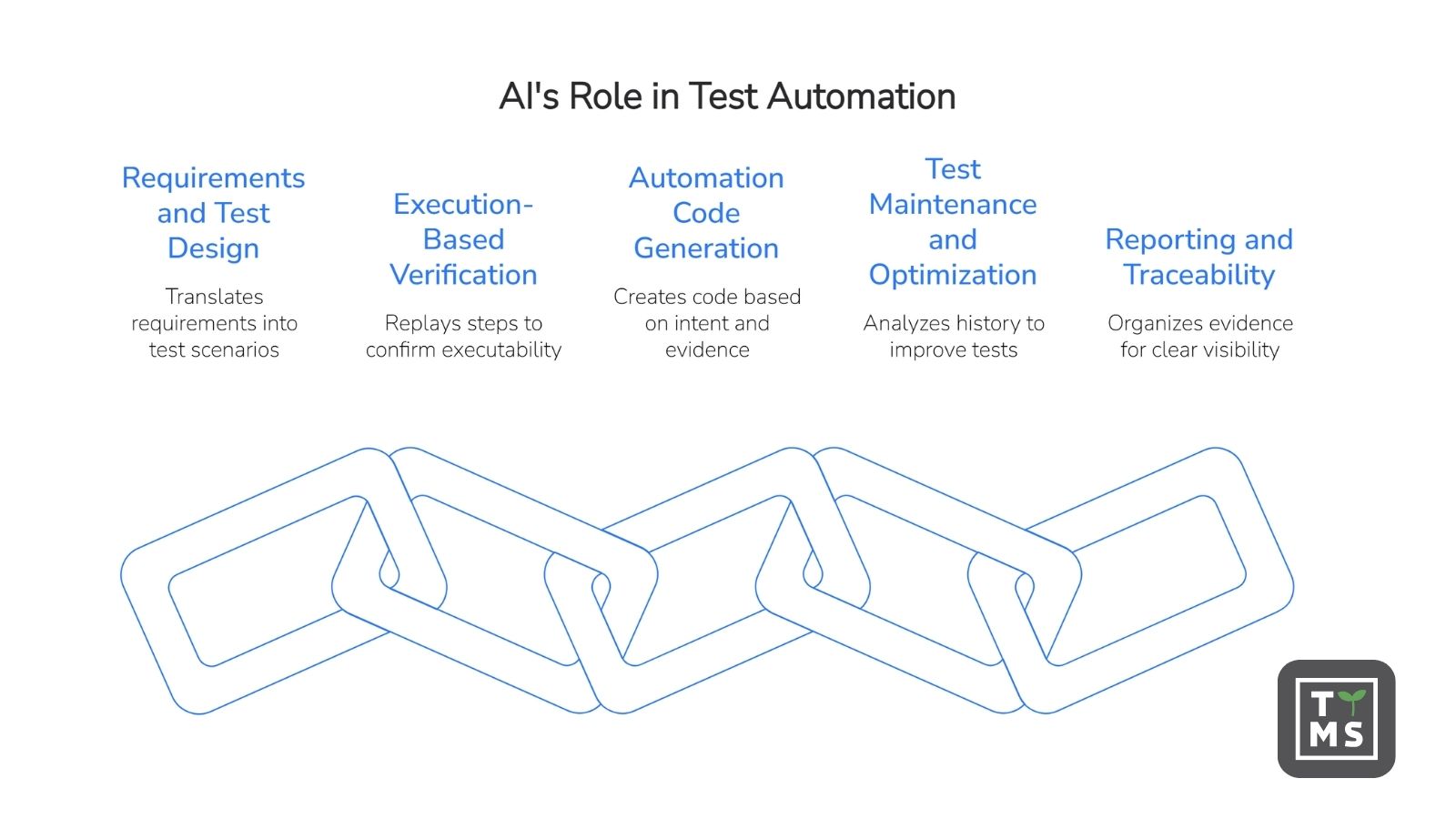
3.1 Requirements and Test Design
AI can translate requirements, acceptance criteria, tickets, and existing QA knowledge into structured test scenarios. This reduces the manual effort involved in turning business requirements into detailed test cases and can help teams identify missing preconditions, expected results, or alternative paths.
The quality of the output depends on the available project context. Generated test cases should therefore remain reviewable and should clearly distinguish confirmed information from gaps that require input from QA or business stakeholders.
3.2 Execution-Based Verification
A generated test scenario may appear correct while still being impossible to execute against the actual application. Execution-based verification allows an AI agent to replay the proposed steps, observe application behavior, identify relevant elements, and confirm whether the expected result can be reached.
This creates technical evidence before automation code is generated. QA still needs to confirm that the verified path represents the intended business scenario.
3.3 Automation Code Generation
AI can use test intent and execution evidence to generate automation code. The output should follow the project’s existing conventions, use its reusable components, and remain readable for the engineering team.
Generated code should be tested and delivered through the organization’s normal version control and review process. This keeps automation visible, reviewable, and maintainable instead of isolating it inside a proprietary environment.
3.4 AI-Assisted Test Maintenance and Optimization
AI can analyze execution history, recurring failures, unstable assertions, selector changes, and overlapping coverage to identify tests that may require attention. It can then recommend repairs, consolidation, or removal.
Significant updates should remain visible and subject to review. An automatically modified test may continue to pass while no longer validating the original requirement, so maintenance decisions need clear ownership and approval.
3.5 Reporting, Traceability, and Review
AI can help organize execution evidence and connect results with the relevant requirement, test case, code change, and review decision. This gives QA and engineering teams a clearer view of what was tested, how the automation was created, and why it changed.
For enterprise use, teams should be able to inspect AI inputs, generated outputs, execution results, and reviewer decisions rather than relying on an opaque automation process.
4. Where AI Creates Business Value in Test Automation
AI creates business value in test automation by shortening the path from a requirement to reviewable automation. It can reduce the manual work involved in interpreting tickets, drafting test scenarios, translating test intent into code, and analyzing execution results.
This allows QA professionals to contribute their domain knowledge more directly to automation, while engineering teams focus on technical review and repository standards instead of building every test from scratch. The result can be faster automation delivery without creating a separate handover for every scenario.
Greater traceability also helps teams understand how test intent becomes automation and whether later changes still reflect the original requirement.
The value depends on implementation quality. AI-generated outputs still require reliable project context, execution-based verification, clear ownership, and review before they enter the test suite. Organizations should measure success through reduced manual effort, shorter time from requirement to reviewed automation, acceptance of generated code, lower maintenance effort, and more dependable execution results.
5. How to Evaluate and Integrate an AI Test Automation Platform
Choosing an AI testing platform requires more than comparing feature lists. The platform should fit the team’s existing requirements workflow, automation frameworks, repositories, CI/CD processes, security policies, and technical skills.
Decision-makers should begin with the workflow they want to support. A platform designed only to generate test cases may not solve the wider challenge of turning requirements into executable, maintainable automation. Teams should evaluate how the tool handles test design, execution-based verification, code generation, review, reporting, and ongoing maintenance.
5.1 Key Criteria for Evaluating an AI Test Automation Tool
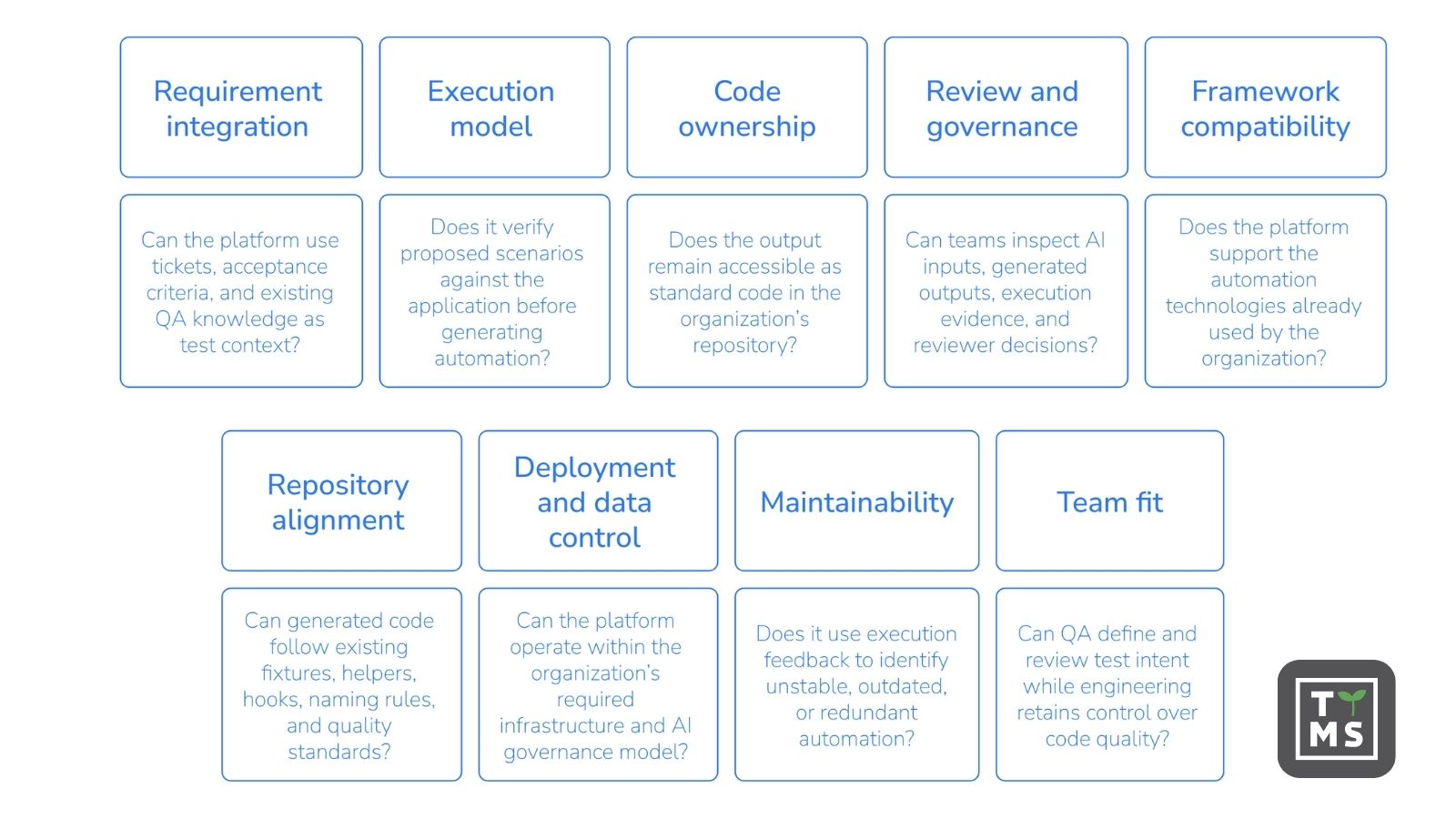
When evaluating an AI test automation tool, consider:
- Requirement integration: Can the platform use tickets, acceptance criteria, and existing QA knowledge as test context?
- Execution model: Does it verify proposed scenarios against the application before generating automation?
- Code ownership: Does the output remain accessible as standard code in the organization’s repository?
- Review and governance: Can teams inspect AI inputs, generated outputs, execution evidence, and reviewer decisions?
- Framework compatibility: Does the platform support the automation technologies already used by the organization?
- Repository alignment: Can generated code follow existing fixtures, helpers, hooks, naming rules, and quality standards?
- Deployment and data control: Can the platform operate within the organization’s required infrastructure and AI governance model?
- Maintainability: Does it use execution feedback to identify unstable, outdated, or redundant automation?
- Team fit: Can QA define and review test intent while engineering retains control over code quality?
These criteria help distinguish a complete AI test automation workflow from an isolated generation feature.
5.2 Fitting AI Testing into Your CI/CD Pipeline
An AI testing platform should work with the organization’s existing version control and CI/CD processes. Generated automation should enter the repository through the normal pull or merge request workflow, where it can be reviewed, executed, and approved before being merged.
Execution results should return to the relevant code change, test case, and requirement source. This creates traceability between test intent, automation code, execution evidence, and release decisions.
Integration may require repository access, execution environments, credentials, pipeline configuration, and approval gates. These requirements should be assessed during implementation rather than assuming the platform can be added without changes to the existing delivery architecture.
6. How to Adopt AI Test Automation with the Right Controls
A practical AI test automation strategy should begin with one clearly defined workflow rather than an attempt to automate the entire testing process. Choose a repeatable, business-critical user journey, document the current effort and maintenance burden, and define what successful adoption should improve.
Start with requirements and test cases that have clear preconditions, actions, and expected results. AI output depends on the quality of this context, so incomplete requirements and inconsistent testing conventions should be addressed before the workflow is scaled.
Define ownership and approval gates from the beginning. QA should remain responsible for test intent and business relevance, while automation engineers or developers review generated code, repository alignment, and technical quality. AI-generated automation should not enter the test suite without execution-based verification and the required human approval.
Implementation should include the technical and governance work required to connect the platform with repositories, execution environments, CI/CD, models, and reporting processes.
Finally, track practical outcomes such as the time from requirement to reviewed automation, the number of generated tests accepted with limited changes, maintenance effort, recurring failures, and user adoption. Expand to additional workflows only after the initial process is stable, reviewable, and understood by the teams responsible for maintaining it.
This shift changes how QA, automation, and engineering teams collaborate, a topic explored further in our guide to how AI is changing the work of developers, testers, and analysts.
7. Challenges and Limitations of AI in Test Automation
AI in test automation depends heavily on the quality of the requirements, project context, test data, and repository conventions available to the platform. Incomplete or inconsistent inputs can lead to scenarios that are technically executable but do not reflect the intended business behavior.
Execution-based verification can confirm that a proposed path works against the application, but it cannot independently determine whether the path represents the correct test intent. QA still needs to review the scenario, expected result, and alignment with the original requirement.
Generated automation may also require adjustment to match project-specific fixtures, helpers, authentication methods, data setup, and coding standards. Teams should expect an implementation and review process rather than treating AI test automation as a plug-and-play capability.
Security and governance create additional requirements. Organizations also need clear controls over deployment, model usage, data access, generated code, and approval of AI-supported changes, especially in business-critical or regulated workflows.
The strongest implementations use AI to reduce repetitive work while keeping responsibility for test intent, code quality, and release decisions clearly assigned.
For a broader view of risk-based testing, traceability, and quality governance, see our QA best practices guide.
8. How Qatana Brings AI Test Automation into One Controlled Workflow
Qatana brings test design, execution-based verification, code generation, review, and maintenance into one agentic test automation workflow. It starts with requirements from Jira or GitLab, turns them into automation-ready test cases, and verifies the proposed user path through Playwright execution before generating code.
The resulting standard Playwright code is delivered through a pull-ready merge request. QA retains control of test intent, while engineering reviews the technical implementation through the organization’s existing version control process. Execution results remain linked to the requirement, test case, code, and review history, providing traceability across the workflow.
Qatana also uses execution results, CI/CD signals, and reviewer feedback to support test maintenance and optimization. The platform runs entirely on-premise and supports the organization’s selected LLM, keeping project context, generated code, and execution evidence within the customer’s controlled environment.
Book a demo to see how Qatana turns requirements into execution-validated Playwright automation.
9. Frequently Asked Questions About AI in Software Test Automation
Can AI fully replace manual testers?
How does AI improve self-healing test automation?
Is AI-driven testing suitable for regulated industries?
Yes, provided the platform supports appropriate governance, traceability, access control, and data protection. Organizations should also evaluate deployment options, model control, audit evidence, and internal compliance requirements.
What skills do QA teams need to work with AI testing tools?
QA teams need strong test design, domain knowledge, and the ability to review AI-generated scenarios and execution evidence. Familiarity with automation workflows, repositories, and AI limitations is also valuable.