
Imagine you need to train not one hundred, not one thousand, but hundreds of thousands of people. Each of them must develop the same skills, follow the same procedures, and make the right decisions under time pressure.
Sounds like a challenge faced by modern corporations? In reality, this problem appeared more than 80 years ago.
That was when people started asking a question that is still relevant today: why do some training programs genuinely change the way people work, while others end with a completed test, but the knowledge from the course is never really mastered?
The answer is instructional design – an approach that helps organizations design training as a structured learning process, not just a set of slides, videos, and quizzes.
In this guide to instructional design, we explain where this approach came from, what is instructional design in practice, and how it supports effective learning in education, corporate training, and modern e-learning. We also show why instructional design online learning matters so much today, especially when organizations need scalable, engaging, and measurable training experiences.
1. Where did instructional design come from and why was it created to solve a real problem?
It is 1942. The United States enters World War II. The army needs a huge number of pilots, mechanics, radar operators, navigators, and technical specialists.
The traditional training model – an instructor explains, participants listen, and everyone learns at their own pace – is no longer enough. The scale is too large, and the stakes are too high. What is needed is an approach that makes it possible to teach effectively, consistently, and in a way that can be measured.
This is the context in which the foundations of instructional design began to emerge.
One of the key figures in this process was Robert Gagné, a psychologist who worked on training programs for military aviation. While analysing how pilots learned, he reached a conclusion that may seem obvious today but was revolutionary at the time: not all knowledge is the same type of knowledge.
We learn facts in one way, procedures in another, and decision-making in complex situations in yet another way.703,30-465,82
This insight became one of the foundations of modern instructional design in education and training. It influenced the way courses are created to this day, including e-learning instructional design, where the goal is not only to deliver content, but to help learners understand, practise, remember, and apply knowledge in real situations.
What is instructional design? In the simplest terms, it is the process of designing effective learning.
Its goal is not just to create an attractive presentation, course, or set of training materials. The real goal is to design a learning experience that helps participants gain specific knowledge, develop a skill, or change the way they behave in practice.
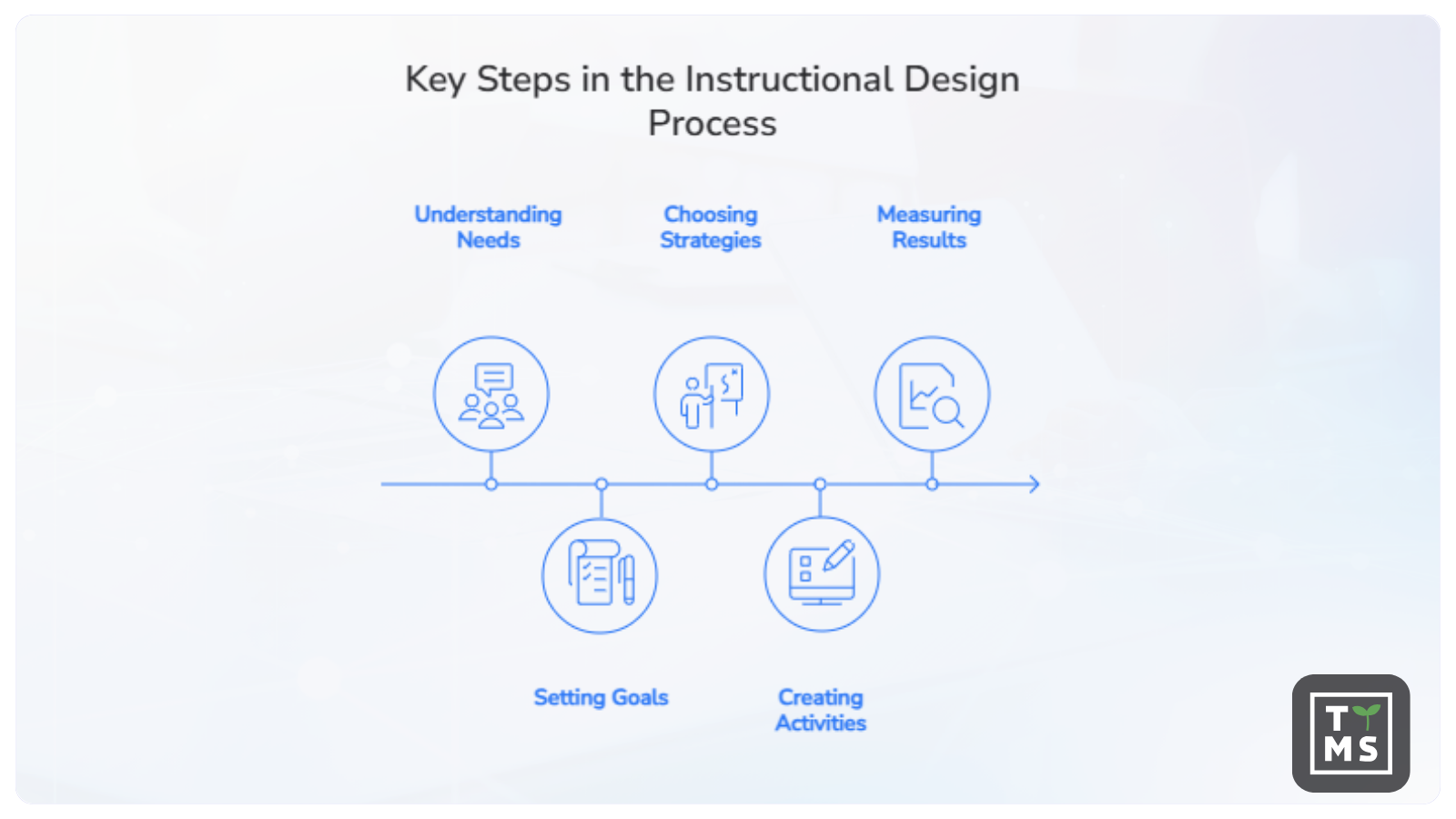
So when people ask “instructional design – what is it?”, the answer is not limited to content creation. Instructional design is about planning the entire learning path: from understanding the learner’s needs, through defining learning objectives, to choosing the right methods, exercises, and ways to verify knowledge.
In practice, the instructional design process includes:
- analysing the needs of learners,
- defining clear learning objectives,
- selecting appropriate educational methods,
- designing exercises and knowledge checks,
- evaluating whether the training has achieved the expected results.
This is also where the importance of instructional design becomes clear. It helps answer not only the question “what should we teach?”, but also “how should we teach it so that learners can actually use this knowledge later?”.
That is why instructional design is so important in education, online learning, and corporate training. A well-designed course does not simply deliver information. It guides learners step by step toward a specific outcome.
2. Why is instructional design important?
Many organizations invest significant budgets in training programs that do not deliver the expected results. Participants complete the course, pass the test, and yet they still do not change their behaviour, apply new knowledge in practice, or remember the information for long.
This is where the importance of instructional design becomes clear.
Instructional design helps reduce this risk by using proven learning theories and a structured approach to training design. Instead of treating a course as a collection of materials, it focuses on the learning outcome: what the participant should know, understand, or be able to do after the training.
This is why instructional design in training and development plays such an important role. It helps organizations create learning programs that are more engaging, more effective, and better connected to business goals.
Instructional design is used not only in education and higher education, but also in employee onboarding, compliance training, skills development programs, technical courses, sales training, and instructional design for corporate training.
In each of these contexts, the goal is the same: to make learning more purposeful, measurable, and easier to apply in real work or study situations.
3. Content creation vs. designing the learning process – what is the difference?
This is one of the most common misunderstandings in the world of training.
Content creation focuses on preparing educational materials. It may include writing text, creating presentations, recording videos, preparing quizzes, or designing visuals.
Instructional design starts much earlier.
Its role is to define what the learner should be able to do after completing the training and what kind of learning activities will help them get there.
In other words, content is one part of a training course. Instructional design is the plan for the whole learning journey.
A good instructional designer does not start by creating slides. First, they define the problem the training is supposed to solve, identify the expected outcomes, analyse the target audience, and only then choose the right content and teaching methods.
That is why two courses can include almost the same information and still produce completely different results. Very often, the difference is not in the content itself, but in how the learning path has been designed.
3.1 What should you remember?
| Content creation | Designing the learning process | |
|---|---|---|
| Starting point | Starts with materials: text, presentation, video, quiz, or graphic. | Starts with the question: what problem should the training solve and what should the learner be able to do? |
| Main task | Preparing educational content in a clear and engaging format. | Designing the whole learning path: from objectives, through activities, to measuring outcomes. |
| Role of content | Content is the main output. | Content is one of the tools that helps the learner reach a defined outcome. |
| Key question | “What do we want to communicate?” | “What change in knowledge, skill, or behaviour do we want to achieve?” |
| Order of work | Materials are created first, and a quiz or exercise is often added later. | Objectives, learners, and expected outcomes are defined first. Content and methods come next. |
| Measure of success | The course looks good, feels complete, and includes the required information. | The learner can apply the knowledge in practice and reach the expected training outcome. |
| Main risk | The training may look polished, but remain superficial and ineffective. | The process requires more analysis, but it increases the chance of a real change in behaviour. |
| Main takeaway | Providing information alone does not guarantee learning. | The effectiveness of training depends on how the entire learning path has been designed. |
“In recent years, the focus has shifted from content production to designing real change. The length or volume of a course matters less than whether learners can apply new knowledge and skills in their work. The most common mistake organizations make is starting with materials instead of asking: what problem should this training solve? The result is often a polished course that looks good, but does not really work.”
Mikołaj Korzeniowski, E-learning Tech Lead at TTMS | Product Owner of AI4E-learning
4. Evidence-based learning – what actually works according to research?
One of the biggest mistakes in training design is relying only on intuition.
Many solutions that seem logical or attractive do not necessarily lead to better learning outcomes. Long presentations overloaded with information, multi-hour courses without breaks, or passive video watching may feel like intensive learning. In practice, they rarely support long-term retention or practical use of knowledge.
Research on how people learn shows that effective training is not about delivering as much information as possible. What matters more is how learners work with knowledge, how often they need to recall it, and whether they have a chance to use it in realistic situations.
This is where evidence-based learning connects with instructional design best practices. Good training is not built around what looks impressive on a screen. It is built around mechanisms that help people remember, understand, and act.
4.1 Retrieval practice – we learn when we recall information
One of the best-documented learning mechanisms is retrieval practice, which means actively recalling information from memory.
It may feel counterintuitive, but we do not learn most effectively by reading the same material repeatedly. We learn more effectively when we try to retrieve knowledge on our own.
That is why well-designed training often uses:
- knowledge-check quizzes,
- open-ended questions,
- exercises that require a decision,
- scenarios and case studies.
Each attempt to recall information strengthens memory and increases the chance that the learner will be able to use that knowledge later.

4.2 Spaced repetition – learning spread over time
Another mechanism strongly supported by research is spaced repetition, which means returning to content at planned intervals.
Learners remember more when they revisit material several times over time, rather than trying to absorb everything in one long session.
This is one reason why shorter training modules delivered over several days or weeks can work better than a single, long training session.
4.3 Feedback – learning is faster when people understand their mistakes
Learner activity alone is not enough. Feedback also matters.
Useful feedback:
- shows what was done correctly,
- explains mistakes,
- helps learners understand the consequences of their decisions,
- points them toward the right course of action.
That is why a quiz that only shows a percentage score has limited value. An exercise that explains why an answer was right or wrong gives the learner much more to work with.
4.4 Active participation instead of passive content consumption
Research consistently shows that people learn more effectively when they are actively involved in the learning process.
Watching a video or reading a text can be a good introduction to a topic. On its own, however, it rarely leads to lasting behavioural change.
That is why modern training increasingly uses:
- decision-making scenarios,
- simulations,
- practical tasks,
- gamification,
- exercises based on real business problems.
The learner is not just a recipient of content. They become an active participant in the learning process.
The conclusions from research are surprisingly consistent. Effective training does not have to be the longest or the most complex. What matters more are mechanisms that support memory and practical application: recalling information, revisiting knowledge over time, receiving meaningful feedback, and working actively with real tasks.
These are some of the most important best practices in instructional design and the foundation of modern, evidence-based e-learning.
“Regardless of the industry, the same research-based learning mechanisms tend to work best: active recall through quizzes and decision-making exercises instead of passive reading, repetition spread over time, and specific feedback that explains “why”, not just “how many points”.
It is also important to place learning in situations that are close to the learner’s real work. The industry changes the content, examples, and context, but the principles of effective learning remain the same.”
Mikołaj Korzeniowski, E-learning Tech Lead at TTMS | Product Owner of AI4E-learning
5. Learning science – what does it teach us about how people learn?
Modern instructional design is strongly connected with learning science: the field that studies how people acquire, process, and retain knowledge.
Research shows that the brain does not work like a hard drive where information can simply be “uploaded”. Exposure to content does not automatically mean that learning has happened.
For knowledge to move into long-term memory, learners need to actively process it, connect it with what they already know, and use it in practice. This idea is reflected in andragogy, which highlights the role of adult learners’ experience, and in Bloom’s taxonomy, which shows that real learning goes far beyond memorising facts.

For an instructional designer, the message is clear: effective training is not about giving learners as much information as possible. It is about creating the right conditions for them to build, practise, and retain knowledge.
From our experience in corporate training projects, many organizations still associate training effectiveness mainly with quiz results. During course design, there is often an expectation to add as many test questions as possible, because they are seen as the main way to verify knowledge.
In practice, a quiz usually checks whether a learner can recall information right after completing the course. An employee may achieve a very high score and still be unable to apply that knowledge a few days later in a real work situation.
That is why modern instructional design puts more emphasis on case studies, decision-making tasks, simulations, and scenarios based on real challenges inside the organization. These activities help learners practise the behaviours and decisions that later translate into everyday work.
Another common misconception is the belief that every organizational problem is caused by a lack of training. During training needs analysis, we regularly see situations where the real cause lies somewhere else: unclear procedures, weak onboarding, missing tools, limited support from managers, or not enough time to adopt new skills.
Effective training projects should therefore start with a diagnosis of the business problem. Only when we understand what is actually limiting employee performance can we decide whether the right solution is training, process change, better communication, or managerial support. Not every business problem is a training problem.
| Researcher / theory | Approximate date | What does the theory say about learning? |
|---|---|---|
| B.F. Skinner – behaviourism | 1950s | Learning is a change in behaviour. Knowledge should be reinforced through practice, repetition, and feedback. |
| Benjamin Bloom – taxonomy of educational objectives | 1956 | Learning has different levels, from remembering and understanding to analysing, evaluating, and creating. Passing on information does not automatically mean developing competence. |
| Robert Gagné – conditions of learning | 1960s-1970s | Different types of knowledge and skills require different teaching methods. The learning process should be designed intentionally. |
| Malcolm Knowles – andragogy | 1970s | Adults learn differently from children. They need to understand the purpose of learning, use their own experience, and see the practical value of new knowledge. |
| Cognitive load theory – John Sweller | 1980s | Working memory has limited capacity. Overloading learners with information makes learning and retention more difficult. |
| Spaced repetition | Research since the late 19th century, developed further in modern learning science | Knowledge is retained more effectively when repetition is spread over time instead of concentrated in one intensive learning session. |
| Retrieval practice | 1990s-present | Actively recalling knowledge strengthens memory more effectively than repeatedly reading the same material. |
| Learning science / active learning | 21st century | Learners achieve better results when they solve problems, make decisions, and use knowledge in practice instead of only consuming content. |
6. Cognitive psychology in training – how to design courses around the way the human brain works
Effective instructional design takes into account not only business goals and learner needs, but also the way the human brain processes information.
Cognitive psychology plays an important role here, especially cognitive load theory. This theory shows that working memory has limited capacity. In simple terms, learners cannot process too much information at the same time and still learn effectively.
In practice, too many messages, overloaded slides, complicated language, or a lack of clear structure can make learning harder, even when the content itself is valuable.
That is why modern training increasingly focuses on clarity, simplicity, and gradually building knowledge instead of trying to cover everything at once.
6.1 How can you reduce cognitive load?
To reduce cognitive load, it helps to:
- divide the material into shorter modules,
- present only the most important information,
- use clear and simple language,
- build a logical content structure,
- increase the level of difficulty step by step.
Designing training in line with cognitive psychology does not mean making the course easier. It means helping learners focus their attention on learning instead of forcing them to fight through too much information.
“In our work, we sometimes support organizations that have already tried to implement e-learning with another provider, but did not achieve the expected results. During the analysis of materials and conversations with stakeholders, it often becomes clear that the problem is not the technology or the platform itself. The real issue is cognitive overload.
We usually see two recurring mistakes.
The first is focusing on memorisation instead of understanding. This is especially common in regulatory training, where course authors try to make learners remember procedure numbers, document names, or detailed regulatory provisions.
From the perspective of everyday work, however, it is often much more important for employees to know when to use a given procedure, where to find the necessary information, and how to act correctly in a specific situation. Memorising content alone does not guarantee the right behaviour.
The second common problem is adding too much information “just in case”. During reviews, subject matter experts often want to include every exception, special case, and additional explanation. This usually comes from a good place: they want to avoid leaving out something important.
As a result, a course that was supposed to take 20 minutes grows to 40 or 50 minutes, without becoming proportionally more effective.
During audits, we use a simple but very useful question: “After completing this screen, does the learner know what they should do differently in their work?” If the answer is not clear, or if one screen tries to communicate several different messages at once, we are most likely dealing with cognitive overload.
This is one of the main reasons why training programs fail to deliver results, even when the source materials are accurate and complete.”
Mikołaj Korzeniowski, E-learning Tech Lead at TTMS | Product Owner of AI4E-learning
7. Scenario-based learning – why do people learn more effectively through experience?
Scenario-based learning is based on realistic situations and decisions. The learner does not only read or watch the material. Instead, they face a specific problem, choose an action, and see the consequences of that decision.
This is why scenarios and case studies often work better than traditional slides. They place knowledge in a practical context and help learners practise behaviours they can later use at work.
8. How to use scenarios in e-learning? An example from TTMS practice
One of the most effective ways to use scenario-based learning is to combine it with elements of gamification. Instead of reading procedures or clicking through another set of slides, the learner enters a realistic work environment and makes decisions similar to those they may face in their everyday job.
This is exactly the approach we used when creating a health and safety training course for one of TTMS’s clients. The learner took on the role of a character and followed them through a full working day.
The scenario began before the character even entered the facility. During the commute, the learner had to remind them to fasten their seat belt and follow safe driving rules.
The action then moved to a production plant, where the learner encountered further realistic situations and hazards. While completing daily tasks, the character faced problems that required decisions in line with safety procedures.
Each choice had consequences. If the learner selected the wrong action, the training immediately explained the mistake, described the possible impact, and allowed them to try again.
As a result, participants did not simply read about procedures. They repeatedly practised the right responses in a safe environment. This type of learning helps reinforce desired behaviours much more effectively than passive reading of instructions.
We used a similar approach in information security training. In one of the games, the user moved through an office environment and had to identify potential risks, such as documents left on a desk, printouts thrown into a bin, or an unlocked computer screen.
The learner’s task was to find all irregularities and choose the correct way to respond.
Both projects show that a well-designed scenario allows learners to learn by doing, making decisions, and learning from mistakes. And this is often the way people learn best.
“In practice, we see that learners remember situations in which they had to make a decision and see its consequences much better than information they only read on screen.
Even after some time, they often remember a specific scenario or a mistake they made, even if they no longer remember the exact wording of the procedure.
This is why scenarios work especially well in health and safety, information security, and compliance training – wherever the key issue is not only what an employee knows, but how they behave in a real situation.”
Mikołaj Korzeniowski, E-learning Tech Lead at TTMS | Product Owner of AI4E-learning
9. Performance support systems – does an employee really need to remember everything?
For many years, training was expected to give employees all the knowledge they needed to do their jobs.
In practice, this expectation no longer holds up. The number of procedures, regulations, tools, and internal rules keeps growing. Expecting employees to remember everything is simply unrealistic.
This is why modern instructional design increasingly looks beyond the course itself and includes performance support systems. These are tools and resources that give employees access to the knowledge they need at the exact moment they need it.
This kind of support can take different forms, including:
- checklists,
- knowledge bases,
- contextual instructions displayed during work,
- chatbots,
- AI assistants that support decision-making.
This changes the way organizations think about employee development.

Not every problem can or should be solved with another training course. Sometimes, a better solution is to give employees quick access to the right information while they are doing the task.
That is why the line between training and workplace support is becoming less clear. More and more often, the goal is not to make employees memorise everything. The goal is to create an environment where they can easily find the knowledge they need and use it in practice.
“The most common situation we see in training projects is treating e-learning as the final stage of employee development.
In reality, training is usually only the introduction to a topic. This is especially clear when a company implements new software. Participants may complete the course and pass the test without any problem, but once they return to work, they regularly face new situations that cannot be fully practised during training.
That is why more organizations combine e-learning with knowledge bases, instructions, and AI assistants. Training teaches the basics and explains the process, while workplace support helps employees find the right answer at the exact moment they need it.
From our experience, this combination supports competence development much more effectively than trying to put all knowledge into one e-learning course.”
Mikołaj Korzeniowski, E-learning Tech Lead at TTMS | Product Owner of AI4E-learning
10. AI in instructional design – what does artificial intelligence change?
Artificial intelligence is changing the way training is created faster than any technology before.
Tasks that only a few years ago required many hours of work from an instructional designer can now be completed in minutes.
Modern AI tools can support, among other things:
- generating course structures,
- creating quizzes and knowledge-check questions,
- building training scenarios,
- translating content into multiple languages,
- preparing narration and multimedia materials,
- analysing existing documents and turning them into training courses.
For organizations, this is a major shift. AI can significantly reduce the time needed to prepare learning materials and help teams respond faster to changing business needs.
At the same time, AI should be treated as a tool that supports the instructional design process, not as a full replacement for it.
In theory, artificial intelligence can support the definition of business goals, data analysis, and the identification of skills gaps. More and more organizations are building dedicated solutions that use data from BI, LMS, HR, or ERP systems to support training-related decisions.
However, the effectiveness of these tools still depends on the quality of the data and the expertise of the people who design them.
The same applies to understanding the organizational context. A properly configured AI system can analyse processes, documentation, procedures, and company history much better than public models. But for this to work, someone first needs to identify that context, organize it, and turn it into a knowledge structure that AI can use.
The biggest limitation is still expert experience.
AI is very good at analysing theories, patterns, and existing knowledge. It is much harder for it to replace an expert who has spent years observing employee behaviour, running projects, making mistakes, and learning how a specific organization really works.
That kind of experience often determines which solutions will work in practice and which will only look correct in theory.
The future of instructional design will probably not be about replacing people with AI. It will be about combining the speed and scale of artificial intelligence with the knowledge of experts who can translate business goals into effective learning experiences.
“Generative AI has taken over a large part of the “production” work. Draft scenarios, quizzes, and first versions of training content can now be created in minutes.
As a result, the role of the instructional designer is moving more towards design and curation: defining objectives, understanding the organizational context, choosing the right methods, and critically reviewing what AI generates.
Less time is spent on producing materials from scratch. More attention can go into making sure that the training teaches something useful and leads to a real change at work.”
Mikołaj Korzeniowski, E-learning Tech Lead at TTMS | Product Owner of AI4E-learning
11. Evaluating the learning path – how can you tell whether training works?
One of the most common mistakes is judging training effectiveness only by the course completion rate.
The fact that a learner has completed a course does not necessarily mean they have gained knowledge, changed their behaviour, or become better prepared to perform a task.
This is why modern instructional design increasingly uses learning analytics: the analysis of data related to the learning process.
In practice, it is worth looking not only at course completion, but also at:
- quiz and test results,
- learner activity,
- time spent in individual modules,
- the most common mistakes,
- repeated visits to training materials.
This data helps organizations understand which parts of the training work well and which ones need improvement. It also gives learning teams a more realistic picture of how people actually move through the course, where they struggle, and where they may need additional support.
Learning analytics makes it possible to look beyond the question of whether a course was completed. It helps answer a more useful question: did the training help learners understand the topic and use the knowledge in practice?
The topic of learning analytics is broad, so we discuss it in more detail in a separate article. The same applies to xAPI, which can provide deeper insight into learning activity across different environments and tools.
12. What does modern instructional design mean in the age of AI?
Modern instructional design combines knowledge about how people learn with business goal analysis, learning experience design, technology, and data.
The history of instructional design shows that effective training was created as a response to a very practical problem: how to teach people to perform tasks in a way that is consistent, measurable, and useful in real situations.
Today, the challenges are different, but the core question remains similar: how do you design training that does not end with course completion, but affects what employees know, how they make decisions, and how they behave at work?
In the age of AI, this question becomes even more important.
Artificial intelligence can speed up content creation, generate a course structure, prepare a quiz, suggest a scenario, translate materials, or support data analysis. But it does not replace the design process itself.
Clear objectives are still needed. So is a good understanding of the audience, the organizational context, expert review, and a thoughtful way of measuring results.
The best training programs are not created by a single tool or technology. They are created when an organization combines learning science, practical expert experience, a well-designed process, and modern technology.
Only this combination makes it possible to create e-learning that not only looks professional but helps people work better in their everyday roles.
13. How does TTMS help organizations create effective e-learning training?
At TTMS, we look at e-learning as more than a single course. Our goal is to help organizations build a complete learning ecosystem that supports employees during training and later, in their everyday work.
We support organizations at every stage of the process: from training needs analysis, through instructional design, content development, and multimedia production, to implementation, improvement, and long-term maintenance of learning solutions.
Our team brings together subject matter experts, instructional designers, graphic designers, developers, and LMS specialists. This allows us to design training from end to end, not only as content, but as a full learning experience.
We also use our own AI4E-learning application, which helps organizations turn existing materials into e-learning courses much faster. This makes it easier to scale knowledge across teams while maintaining control over content quality and the training process.
Our support does not end with the course itself. We help organizations build knowledge bases, implement SharePoint-based solutions, integrate LMS platforms, and create workplace support systems that allow employees to find the information they need quickly.
We also develop dedicated AI solutions and knowledge assistants that can answer users’ questions based on company documentation, procedures, and instructions.
As a result, organizations can build an environment where training is the beginning of competence development, not the end of it.
FAQ
What is instructional design?
Instructional design is the process of designing effective learning experiences. It is not limited to preparing a presentation, course, or quiz. Its purpose is to plan the full learning path that helps a learner achieve a specific outcome, such as gaining knowledge, developing a skill, changing behaviour, or performing a task better at work.
Instructional design – what is it in practice?
In practice, instructional design starts with a simple but important question: what problem should this training solve? Only after that does the designer choose the right content, exercises, scenarios, quizzes, and ways to measure results. This approach helps avoid courses that look complete but do not lead to real learning or behaviour change.
What is instructional design in education?
Instructional design in education helps teachers, universities, and training teams build courses around clear learning objectives and learner needs. It can be used in schools, higher education, online programs, and corporate learning. The main goal is not just to organize content, but to make learning easier to understand, remember, and apply.
How does instructional design support online learning?
Instructional design in online learning is especially important because learners often go through the course without direct support from a trainer. The course needs to guide them clearly through the material, give them opportunities to practise, and provide useful feedback. Good online learning design usually includes short modules, logical structure, active tasks, quizzes, decision-making scenarios, and clear progress indicators.
Why is e-learning instructional design important?
E-learning instructional design matters because a digital course can easily become a passive content library instead of a real learning experience. A well-designed e-learning course helps learners stay focused, understand the purpose of each module, practise new knowledge, and check whether they are ready to use it in practice. This is particularly important in corporate training, compliance, onboarding, and technical training, where the goal is not only course completion, but better performance at work.