LMS and LXP platforms solve different learning challenges. An LMS is designed to manage, deliver, and track structured training, while an LXP focuses on personalized, learner-driven learning and continuous skill development. Many organizations don’t choose one over the other. Instead, they use both to support different learning objectives.
Choosing between them can feel a bit like deciding between a library and a streaming service. One organizes learning in a structured way, while the other helps people discover relevant content based on their interests, goals, and previous activity. It’s a simple comparison, but it captures why the LMS vs LXP discussion continues to shape corporate learning strategies.
From our experience working with enterprise learning programs, one of the most common misconceptions is that an LXP is simply a newer version of an LMS. In reality, the two platforms serve different purposes. Organizations that see the best learning outcomes typically treat them as complementary technologies, using each where it delivers the greatest value.
Understanding those differences is essential before investing in a learning platform. The right choice depends not only on the features you need today but also on how your organization plans to develop skills, manage compliance training, and support continuous learning over time.
1. LXP vs LMS: Understanding the Core Difference Before You Choose
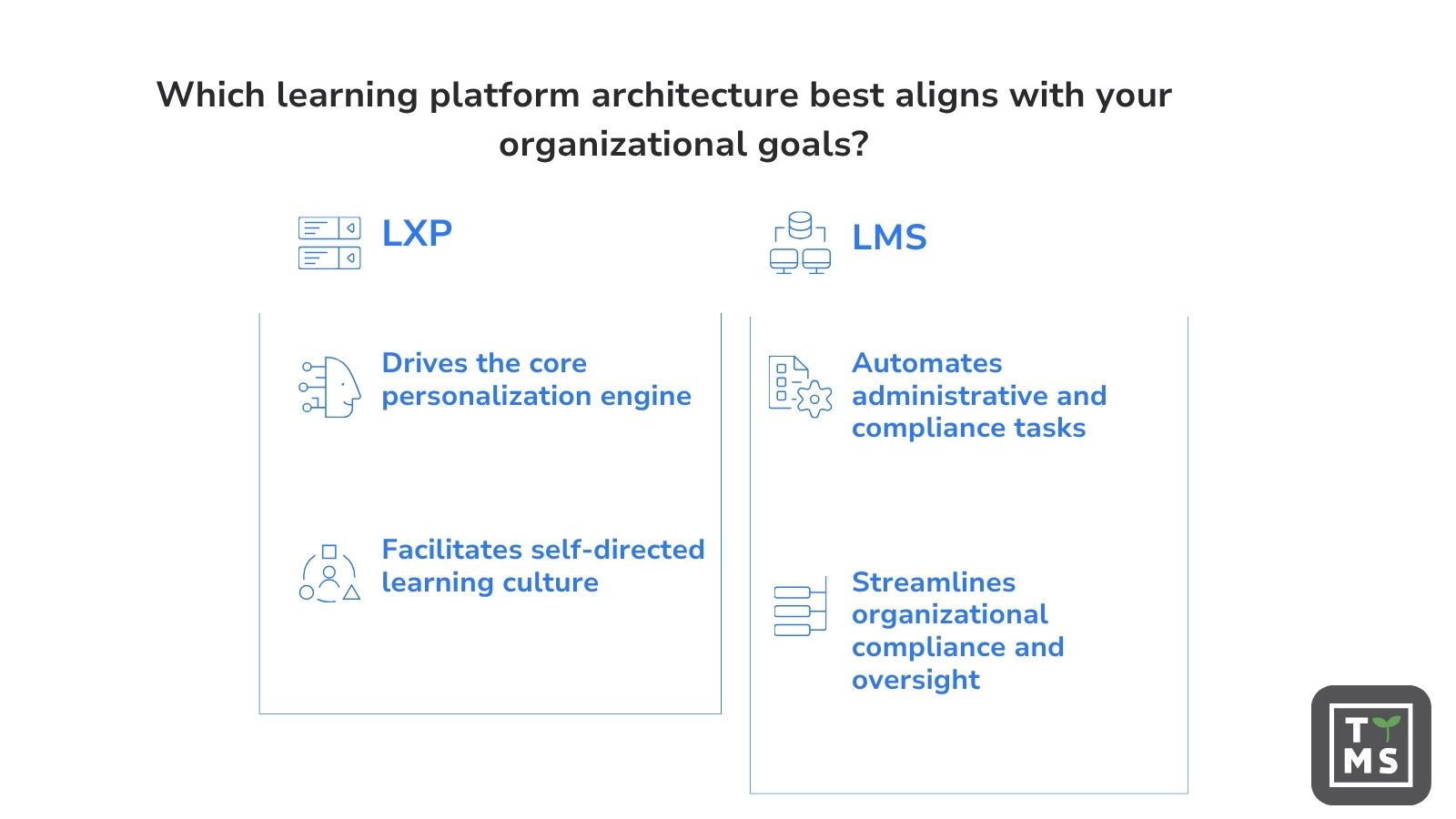
Who actually drives the learning experience? With an LMS, the organization does. Administrators design structured courses, assign them to learners, and track completion. With an LXP, the learner takes ownership. The platform surfaces relevant content, suggests next steps, and encourages exploration.
Think of an LMS as a formal curriculum and an LXP as a personalized learning feed. Neither is inherently superior. What matters is whether the platform fits your learning strategy, your workforce profile, and the outcomes you’re actually trying to drive. That distinction also shapes how your L&D team operates, how your IT infrastructure connects, and how your employees feel about learning at work.
2. What Is an LMS? Purpose, Features, and Best-Fit Use Cases
A Learning Management System is the backbone of corporate training in most organizations. It centralizes, delivers, and tracks formal learning, particularly in environments where consistency and compliance aren’t optional. Onboarding new hires and certifying staff in regulated industries are two of its most common applications, and in both cases the LMS provides the structure that keeps programs running reliably at scale.
2.1 How an LMS Structures and Delivers Learning
An LMS organizes content into predefined courses and learning paths. Learners receive assignments, complete modules in sequence, pass assessments, and receive certificates or completion records. Everyone in a given role or department ends up meeting the same standard.
This works well when the goal is measurable competency. A new safety technician needs to complete specific modules before working on-site. A financial advisor must pass compliance training before advising clients. The LMS produces a clear, documented trail of who learned what and when, which is often a legal requirement rather than just an internal preference.
2.2 Core LMS Features That Drive Compliance and Administration
A strong LMS is built around control, structure, and governance. It helps administrators track completion rates, assessment results, certification status, and mandatory training progress without digging through separate files or manual reports. It also supports role-based enrolment, automated reminders, and audit-ready documentation, which is why LMS platforms remain essential in regulated sectors such as healthcare, finance, manufacturing, and aviation.
The problem starts when organizations expect an LMS to create the whole learning experience. Most LMS platforms are not designed to spark curiosity, recommend content based on individual goals, or make learning feel self-directed. They are excellent at answering the question: “Has this person completed the required training?” They are usually weaker at answering: “What should this person learn next to grow in their role?”
That is the gap an LXP is designed to fill.
3. What Is an LXP? Purpose, Features, and Best-Fit Use Cases
A Learning Experience Platform puts learners at the center. Rather than assigning fixed courses, an LXP pulls content from multiple sources, curates it based on individual preferences and goals, and surfaces what’s most relevant to each person. It ends up feeling more like a professional development hub than a training portal.
3.1 How an LXP Personalizes and Surfaces Learning
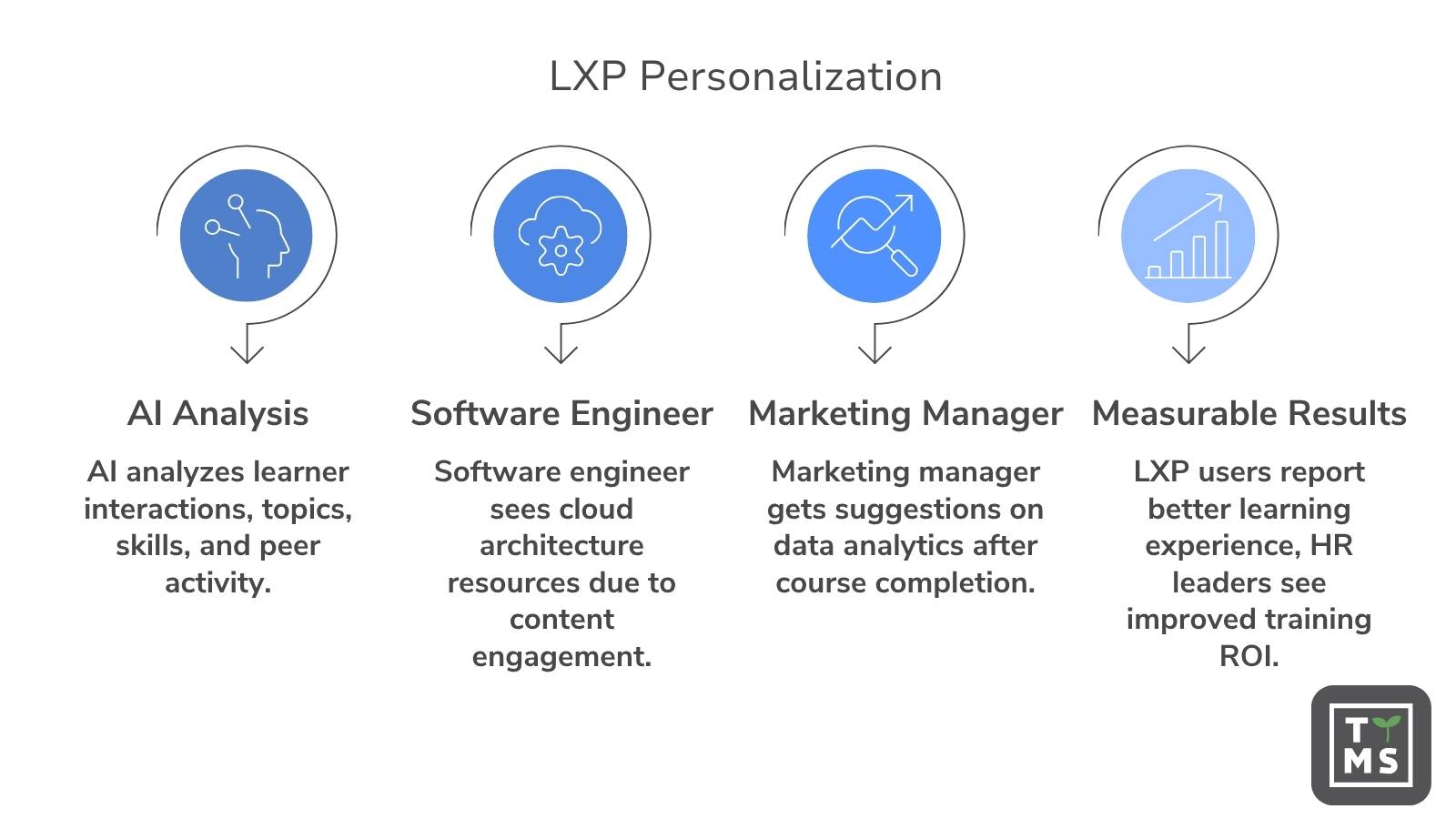
Personalization in an LXP relies on AI and machine learning to analyze how each learner interacts with the platform: what topics they engage with, what skills they’ve listed, what their peers in similar roles explore. A software engineer who watches content on cloud architecture will see more relevant resources appear in their feed. A marketing manager who finishes a course on data analytics might get suggestions on audience segmentation or attribution modeling. That kind of timely relevance is what keeps learning from feeling static.
The results are measurable. 88% of LXP users agree that an LXP provides a better learning experience than a traditional LMS, and 58% of HR leaders report improved training ROI through AI-curated learning journeys, which is the core capability LXPs are built around.
3.2 Core LXP Features That Drive Engagement and Discovery
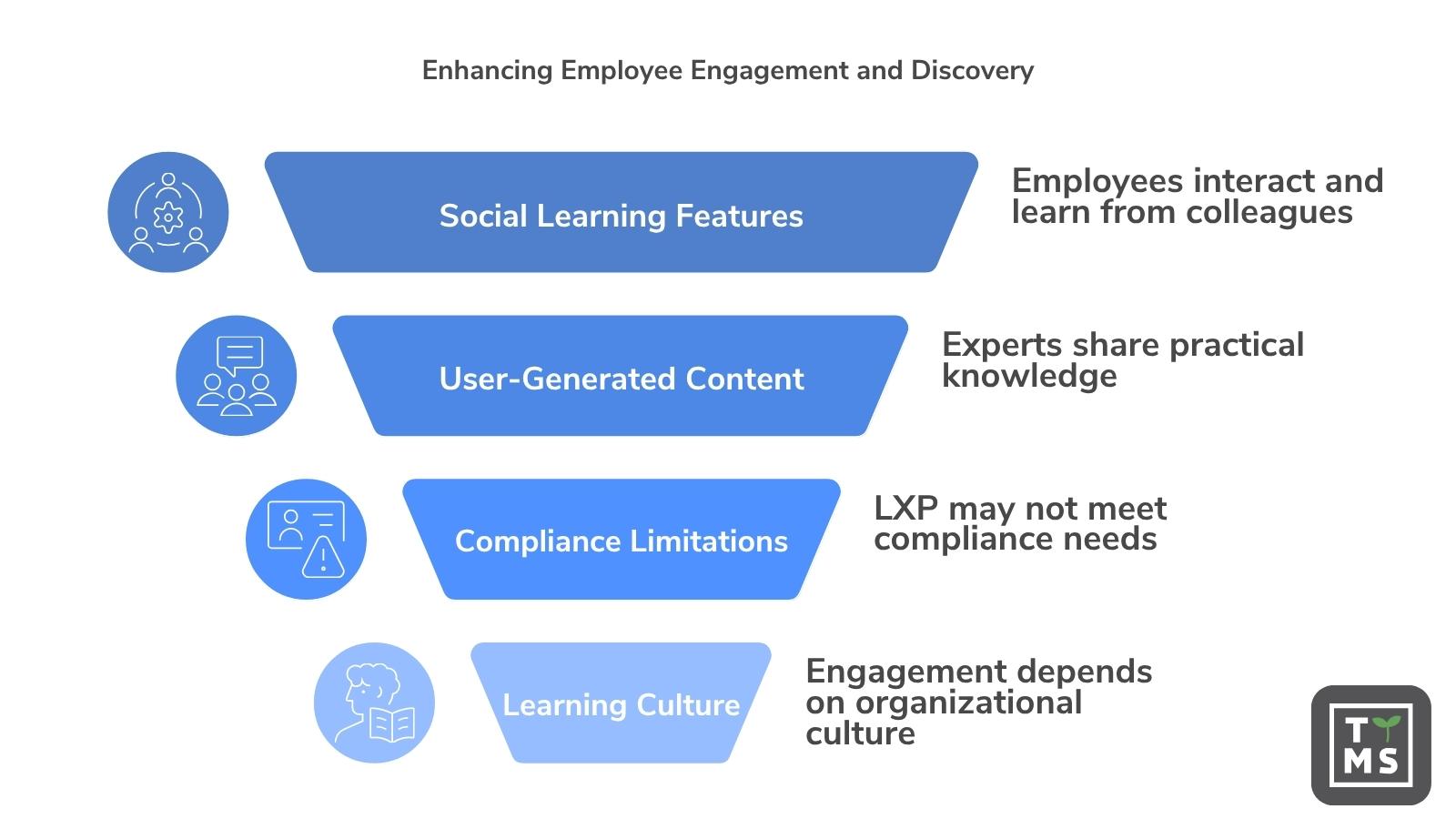
An LXP is strongest when learning is not limited to assigned courses. It helps employees discover relevant content, follow their interests, and learn from people inside the organization.
Instead of relying only on a fixed training catalogue, an LXP can bring together content from internal knowledge bases, external providers, videos, podcasts, articles, and expert recommendations. Social learning features add another layer: employees can recommend resources, comment on materials, share achievements, and learn from colleagues who face similar challenges.
This is where an LXP becomes more than a content library. With user-generated content, internal subject matter experts can contribute practical knowledge from real projects, customer cases, tools, or processes. From our experience, this often makes the platform more valuable than a polished but generic course catalogue because employees trust knowledge that comes from people who understand their daily work.
The limitation is compliance. If every employee must complete a specific data privacy course by a regulatory deadline, an LXP alone is usually not enough. It may help people discover useful learning, but it does not give administrators the same level of tracking, audit readiness, or enforcement as an LMS.
An LXP also needs the right learning culture. If employees see training only as a mandatory task, recommendation engines and social learning features will not create engagement by themselves. In that case, an LXP works best when supported by clear learning paths, manager involvement, and LMS-style structure.
4. LXP vs LMS: Side-by-Side Comparison
When comparing LMS and LXP platforms directly, four dimensions reveal the most meaningful differences.
In an LMS, administrators own the content entirely. They create, approve, and manage every piece of material learners encounter. An LXP opens that up to multiple contributors, including learners and internal experts, but doing that well requires a governance strategy to keep quality from slipping.
Control also works differently in each system. Administrators in an LMS define learning paths, set deadlines, and decide what’s available to whom. In an LXP, learners build their own playlists and search topics that interest them, finding their own way through available content.
On reporting, LMS platforms generate detailed audit logs and the documentation compliance officers need during inspections. LXP analytics focus on engagement, content popularity, and skill progression. That data is genuinely useful for L&D strategy, but it doesn’t replace compliance-grade reporting.
Integration priorities differ too. An LMS typically connects with HRIS systems, SSO providers, and payroll platforms. An LXP tends to offer broader connectivity with external content libraries, collaboration tools, and skills databases, increasingly linking learning activity to performance management and career development.
5. How to Choose Between an LXP and LMS for Your Organization
There’s no universal answer. The right choice depends on your workforce, your industry, your culture, and what you’re ultimately trying to achieve. In our experience helping organizations across healthcare, financial services, and technology evaluate platforms, the compliance question almost always comes first. Everything else tends to follow from there.
An LMS is the right fit when compliance, standardization, and accountability are the primary goals. Healthcare providers certifying staff on patient safety protocols, financial institutions managing mandatory regulatory training, and any organization where incomplete training carries legal or operational consequences should build their learning infrastructure around a well-built LMS.
An LXP suits organizations that want to build a learning culture rather than simply manage a training program. Companies in technology, creative industries, and professional services often find their workforce learns best through discovery, peer recommendation, and self-directed exploration. An LXP also works well for organizations trying to retain high performers by investing visibly in their career development.
5.1 When You Need Both: The Hybrid Approach
70% of new enterprise learning contracts now specify an LXP component, which reflects how commonly organizations are choosing to run both platforms rather than picking one. The two serve genuinely different purposes, and combining them creates a more complete learning setup than either alone.
In a hybrid model, the LMS handles mandatory and compliance-driven training with the rigor and documentation that requires. The LXP sits alongside it, giving employees space to explore voluntary learning, develop skills beyond their current role, and engage with content from diverse sources.
A practical example: a 1,500-person financial services organization arrived at a hybrid approach after realizing their compliance certification was well-managed in an LMS, but their technology and operations teams had no structured path for continuous upskilling. By integrating an LXP alongside the existing LMS and connecting both to a shared skills framework, they could enforce regulatory deadlines through the LMS while giving employees a self-directed track for career development. The L&D team gained a unified view of both mandatory completions and voluntary engagement, which made it possible to have more informed conversations about skill gaps at the team level.
This integrated approach works particularly well in mid-to-large organizations carrying both compliance responsibilities and genuine ambitions around building a stronger learning culture.
6. How AI Is Reshaping LXP and LMS Platforms in 2026
AI is no longer a future feature in learning platforms. It’s already changing how both LMS and LXP systems work. In LXP systems, AI drives the core personalization engine, making content recommendations sharper and more contextually relevant as the system learns more about each user. In LMS platforms, AI is changing the administrative side: automated tagging reduces manual cataloging work, adaptive assessments adjust difficulty based on performance, and predictive analytics can flag learners at risk of missing compliance deadlines before those problems escalate.
At TTMS, we help organizations work through this shift in practice. That means evaluating existing learning infrastructure, identifying where AI adds genuine value, and integrating both platforms into a broader IT setup. The most common mistake we see is organizations deploying an LXP without a minimum content governance framework in place first. Without that structure, user-generated content can erode platform trust quickly, and the self-directed learning culture the LXP was meant to build never really takes hold.
7. The Verdict: Which Platform Wins in 2026?
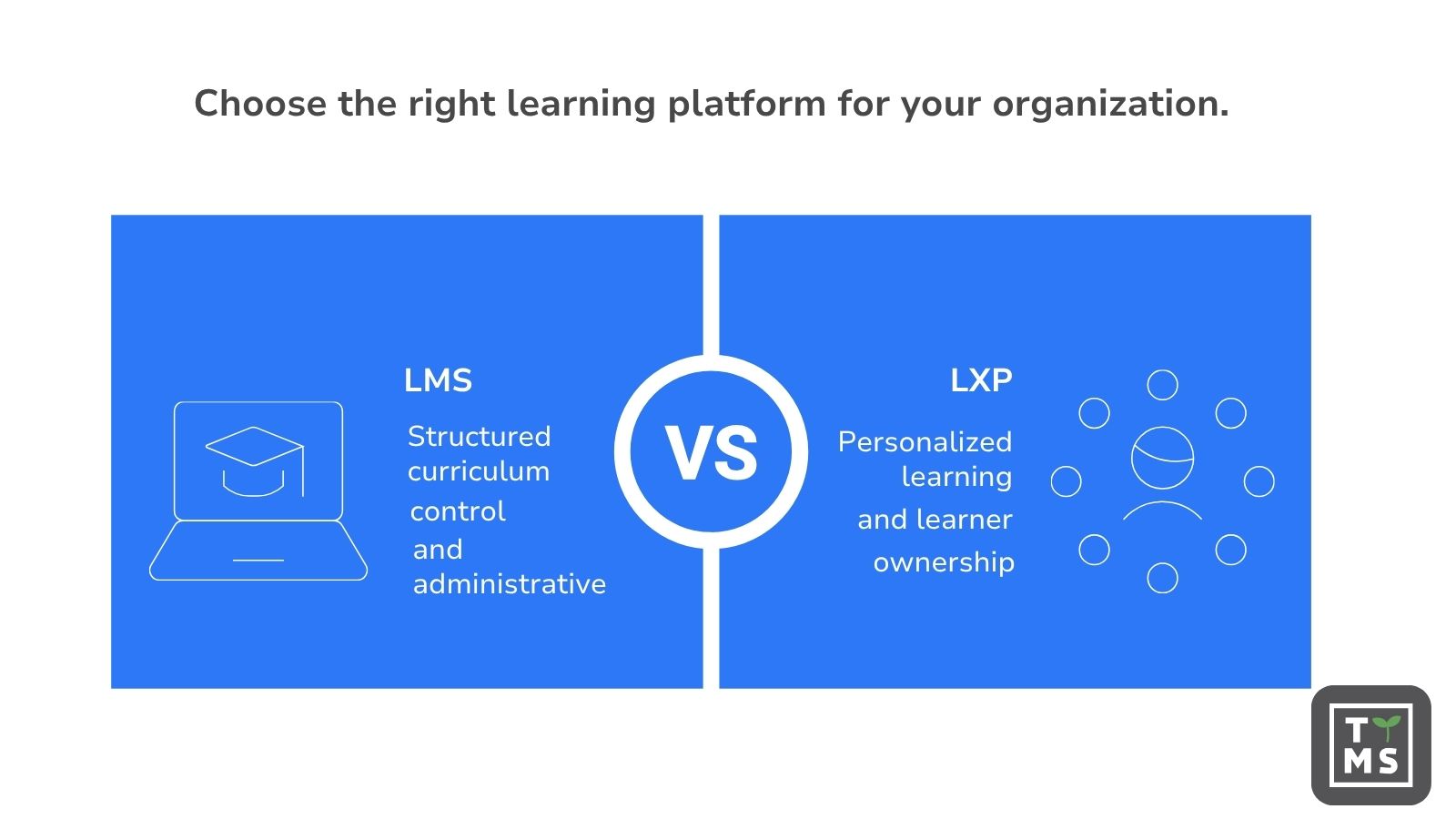
Neither platform is the clear winner, and that is the most practical answer. An LMS is still the stronger choice for structured, compliance-driven training, especially in regulated industries where tracking, reporting, and certification management are non-negotiable. An LXP solves a different problem. It supports discovery, personalization, and continuous skill development in ways a traditional LMS was not designed to deliver.
The important shift heading into 2026 is that the line between LMS and LXP platforms is becoming less rigid. AI is making LMS systems more adaptive, while LXP platforms are adding more structure around learning paths, reporting, and compliance support. Vendors are also building tighter integrations and, in some cases, offering combined environments that bring both approaches together.
For most organizations, the right decision starts with clarity. Define the learning outcomes you need to achieve, understand what keeps your employees engaged, and assess your compliance requirements honestly. Then choose the platform, or combination of platforms, that matches those realities.
The best learning platform is not the newest one. It is the one that fits the work your organization actually needs learning to support.
| If your organization needs… | Choose | Why? |
| Mandatory training and regulatory compliance | LMS | Provides structured training management, certification tracking, reporting, and audit-ready documentation. |
| Employee onboarding | LMS | Delivers standardized learning paths and ensures every new employee completes the required training. |
| Continuous employee upskilling | LXP | Recommends personalized learning content based on individual skills, interests, and career goals. |
| Building a learning culture | LXP | Encourages self-directed learning, knowledge sharing, and ongoing professional development. |
| Compliance training in regulated industries | LMS | Offers robust reporting, certification management, and compliance monitoring. |
| Career development and skills growth | LXP | Helps employees develop new capabilities through personalized recommendations and learning journeys. |
| Leveraging internal expert knowledge | LXP | Makes it easy for subject matter experts to create and share valuable organizational knowledge. |
| Managing both compliance and continuous learning | LMS + LXP | Combining both platforms provides structured compliance management while supporting personalized employee development. |
FAQ
What is the difference between an LMS and an LXP?
An LMS (Learning Management System) is designed to deliver, manage, and track structured training programs. It is commonly used for onboarding, compliance training, certifications, and mandatory learning. An LXP (Learning Experience Platform) focuses on personalized, learner-driven development. It recommends relevant content based on each employee’s skills, interests, and learning goals, helping support continuous learning beyond required courses.
When should an organization choose an LMS?
An LMS is the right choice when training must be standardized, assigned, and documented. It is particularly valuable for organizations operating in regulated industries where compliance, certifications, reporting, and audit-ready records are essential. Healthcare, financial services, manufacturing, and aviation are common examples.
When is an LXP a better option?
An LXP is best suited for organizations that want to encourage continuous learning and employee development. It works particularly well when employees are expected to build new skills independently, access learning from multiple sources, and receive personalized recommendations based on their interests and career goals.
Can an LMS and an LXP work together?
Yes. Many organizations use both platforms as part of the same learning ecosystem. The LMS manages mandatory training, compliance, and certifications, while the LXP supports self-directed learning, knowledge sharing, and continuous skills development. Together, they provide a more complete learning experience than either platform alone.
Can an LXP replace an LMS?
In most cases, no. While an LXP offers a better experience for personalized learning, it typically lacks the governance, reporting, certification management, and compliance capabilities required for mandatory corporate training. Organizations with regulatory obligations usually continue to rely on an LMS while adding an LXP to support employee development.
How is AI changing LMS and LXP platforms?
Artificial intelligence enhances both platforms in different ways. In LMS platforms, AI automates tasks such as content tagging, adaptive assessments, reporting, and predictive analytics. In LXP platforms, AI improves personalization by recommending learning content based on each employee’s role, behavior, interests, and skills. The greatest value comes from combining AI with high-quality, well-governed learning content.
Which platform is better for compliance training?
An LMS is the better choice for compliance training because it provides structured learning paths, completion tracking, certification management, automated reminders, and audit-ready reporting. These capabilities help organizations demonstrate compliance with internal policies and external regulations.
How do you choose the right learning platform?
The right choice depends on your organization’s goals. If your priority is regulatory compliance and standardized training, an LMS is usually the best option. If your goal is to build a culture of continuous learning and personalized employee development, an LXP may be a better fit. Many organizations achieve the best results by combining both platforms to support different learning objectives.