1. Why Is GPT-5.5 Becoming a Serious Enterprise AI Tool?
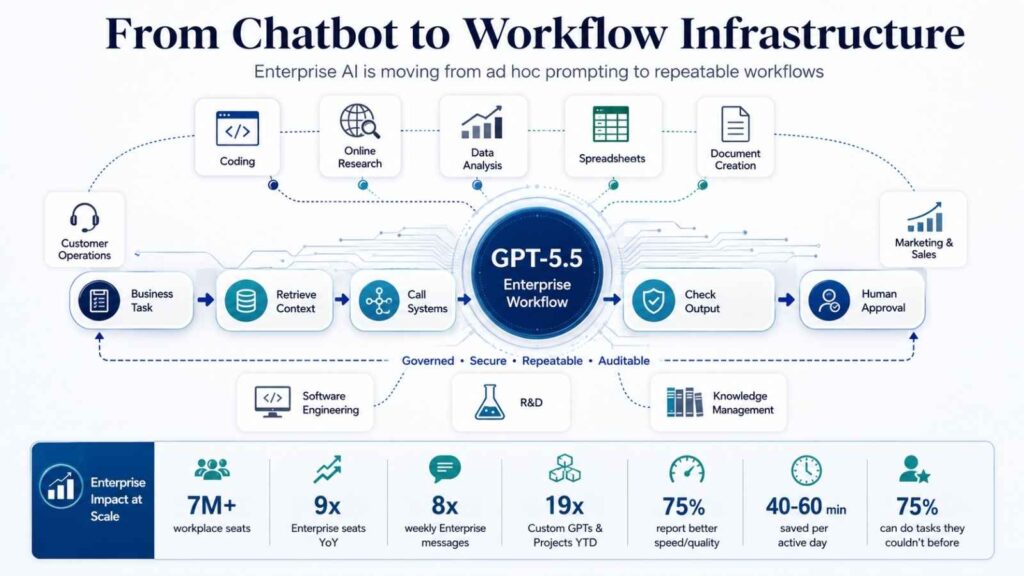
GPT-5.5 should be evaluated as workflow infrastructure for enterprise AI, not as a better chatbot. OpenAI positions it as a frontier model for complex professional work, with strengths in coding, online research, data analysis, spreadsheets, document creation, software operation, and tool use through the API. That matters because the highest-value enterprise pattern is no longer “ask a question, get an answer,” but “assign a bounded business task, retrieve context, call the right systems, check the output, and route decisions to the right human when risk is material.”
The timing is important. OpenAI says it now serves more than 7 million ChatGPT workplace seats; ChatGPT Enterprise seats have risen about ninefold year over year; weekly Enterprise messages have grown roughly eightfold; and the use of Custom GPTs and Projects has increased about nineteenfold year to date. In the same research, 75% of workers report that AI improves speed or quality, average reported time savings are 40–60 minutes per active day, and 75% say they can now complete tasks they previously could not do. In other words, the enterprise shift is already underway: from ad hoc prompting to repeatable workflows.
For CIOs, CTOs, Heads of Digital, and Heads of Operations, the strategic takeaway is straightforward. The strongest value pools remain customer operations, marketing and sales, software engineering, and R&D, while internal knowledge management can create cross-functional gains across the whole firm. OpenAI’s own enterprise guidance also points leaders toward repeatable “primitives” such as research, coding, data analysis, content creation, and automation, then encourages workflow mapping across whole departments rather than isolated prompts.
A rigor note is necessary. Because GPT-5.5 only became available in the API in late April 2026, longitudinal production data that is specific to GPT-5.5 is still limited. The most defensible evidence base therefore combines official GPT-5.5 documentation with adjacent enterprise case studies using OpenAI systems, academic productivity studies, and operational benchmarks from knowledge-heavy industries.
2. What Are the Best GPT-5.5 Use Cases for Enterprise Teams?
The KPI frames below are designed for business evaluation, not as guaranteed outcomes. The right way to read them is: these are the measures a serious enterprise pilot should baseline before rollout, then track weekly during pilot and monthly in production.
2.1 How Can GPT-5.5 Improve Customer Service Without Becoming Just Another Chatbot?
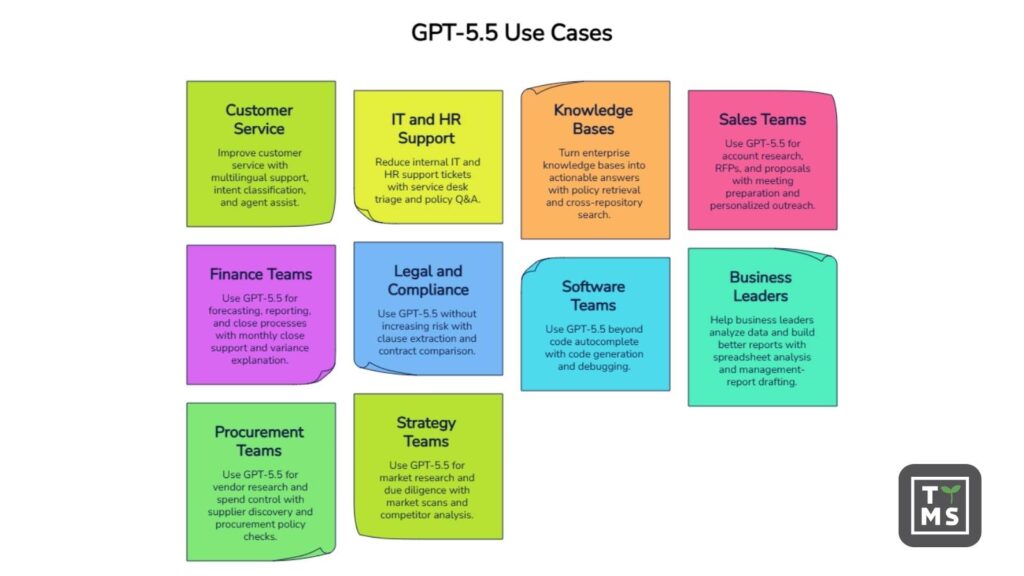
Typical scenarios: multilingual customer support, intent classification, agent assist, after-call summaries, returns and refund drafting, policy-grounded responses, and smart escalation. Business value and KPIs: containment rate, average handle time, first-contact resolution, repeat-contact rate, SLA attainment, CSAT, and NPS. Technical requirements: helpdesk plus CRM plus order and payment systems, with RAG over policy content and approval gates before any refund or account-changing action. Main risks and mitigation: hallucinated policy answers, poor escalation logic, and unsafe automations; mitigate with retrieved citations, read-only defaults, and human approval for financially material actions. As directional evidence, NBER found AI-guided support increased productivity by nearly 14%, while Klarna reported that its OpenAI-powered assistant handled two-thirds of service chats, cut resolution time from 11 minutes to under 2 minutes, reduced repeat inquiries by 25%, and held customer satisfaction at parity with human agents.
2.2 How Can GPT-5.5 Reduce Internal IT and HR Support Tickets?
Typical scenarios: service desk triage, access and entitlement guidance, onboarding question handling, policy Q&A, software request intake, and benefits or HR process support. Business value and KPIs: ticket deflection, MTTR, backlog, SLA adherence, onboarding cycle time, time-to-productivity, and employee satisfaction. Technical requirements: ITSM, identity provider, HRIS, internal knowledge base, and approval workflows for provisioning or permissions changes. Main risks and mitigation: unauthorized access changes and incorrect policy guidance; mitigate with SSO, RBAC, approval thresholds, and full audit logging. OpenAI’s enterprise report found that 87% of IT workers report faster IT issue resolution and 75% of HR professionals report improved employee engagement when using AI at work.
2.3 How Can GPT-5.5 Turn Enterprise Knowledge Bases into Actionable Answers?
Typical scenarios: policy retrieval, onboarding to a codebase or client account, cross-repository search, summarizing recent decisions, and answering internal process questions with source links. Business value and KPIs: search success rate, time-to-answer, onboarding time, duplicate-ticket reduction, and reuse of institutional knowledge. Technical requirements: Company Knowledge or File Search over permissioned repositories, with sources such as SharePoint, Google Drive, Slack, GitHub, HubSpot, Asana, and other connected apps; answers should always return citations to source material. Main risks and mitigation: stale documentation, source conflicts, and over-trust in low-quality files; mitigate with document ownership, freshness rules, and source-ranking policies. OpenAI says Company Knowledge returns answers with citations and respects existing permissions, while BBVA reports 20,000-plus Custom GPTs across the bank and a Peru assistant that cut some internal query handling from roughly 7.5 minutes to about 1 minute.
2.4 How Can Sales Teams Use GPT-5.5 for Account Research, RFPs and Proposals?
Typical scenarios: account research, meeting preparation, RFP parsing, proposal drafting, CRM summary generation, and personalized outreach preparation. Business value and KPIs: research time per account, proposal turnaround time, seller capacity, meeting prep time, pipeline coverage, and win rate. Technical requirements: CRM, email and calendar data, account notes, proposal templates, and external research sources; outbound content should remain human-reviewed before send. Main risks and mitigation: stale CRM data, fabricated personalization, and brand inconsistency; mitigate with source-grounded prompts, approval workflows, and template libraries. McKinsey identifies marketing and sales as one of the largest value pools for generative AI, and Clay’s OpenAI-powered sales research stack shows the pattern clearly: one system can centralize fragmented GTM data, automate prospect research, and materially expand outreach capacity.
2.5 How Can Finance Teams Use GPT-5.5 for Forecasting, Reporting and Close Processes?
Typical scenarios: monthly close support, variance explanation, spreadsheet modeling, procurement intake, treasury and tax research, board-pack drafting, and contract review support for finance. Business value and KPIs: days-to-close, forecast cycle time, forecast accuracy, variance analysis time, procurement turnaround, cost per transaction, and analyst hours saved. Technical requirements: ERP, procurement systems, spreadsheet tools, data warehouse access, and structured outputs for downstream workflows. Main risks and mitigation: bad accounting logic, control breaks, or unauthorized actions; mitigate with segregation of duties, read-only analysis first, approval routing, and audit logging. OpenAI and PwC are explicitly building finance agents for planning, forecasting, reporting, procurement, treasury, tax, and close workflows, and ChatGPT for Excel and Sheets is now generally available across plans powered by GPT-5.5.
2.6 How Can Legal and Compliance Teams Use GPT-5.5 Without Increasing Risk?
Typical scenarios: clause extraction, contract comparison, policy lookup, regulatory change triage, control narrative drafting, and first-pass risk summarization. Business value and KPIs: contract turnaround time, exception detection rate, outside counsel spend, compliance cycle time, false-positive and false-negative rates, and reviewer throughput. Technical requirements: authoritative legal and policy corpora, document management systems, strict citation discipline, and mandatory legal or compliance sign-off before final use. Main risks and mitigation: hallucinated citations, privilege leakage, and cross-border data issues; mitigate with restricted corpora, redaction, regional controls where needed, and human review. Thomson Reuters estimates that AI could free up around four hours per week in the near term, roughly 200 hours per year, and says that for U.S. lawyers this could translate into nearly $100,000 in extra billable time annually.
2.7 How Can Software Teams Use GPT-5.5 Beyond Code Autocomplete?
Typical scenarios: code generation, refactoring, debugging, test creation, legacy system discovery, architecture Q&A, and documentation generation. Business value and KPIs: lead time for change, deployment frequency, pull-request review time, defect escape rate, incident MTTR, and developer satisfaction. Technical requirements: repository and ticketing integration, access to internal documentation, CI or code-quality tooling, and secure handling of secrets. Main risks and mitigation: insecure code, leaking proprietary logic, and over-trust in generated changes; mitigate with human review, code scanning, sandboxing, and strong repo boundaries. GPT-5.5 is explicitly positioned for coding and professional work, OpenAI reports that 73% of engineers see faster code delivery, and GitHub’s controlled Copilot experiment found developers completed a coding task 55% faster on average.
2.8 How Can GPT-5.5 Help Business Leaders Analyze Data and Build Better Reports?
Typical scenarios: spreadsheet analysis, management-report drafting, dashboard explanation, anomaly triage, free-text commentary generation, and ad hoc data synthesis for leadership teams. Business value and KPIs: reporting cycle time, analyst hours saved, decision latency, insight adoption, and error rate in management commentary. Technical requirements: spreadsheets, governed metrics, warehouse or BI access, structured outputs, and validation rules for formula- or metric-sensitive work. Main risks and mitigation: spurious patterns, bad joins, and metric inconsistency; mitigate with semantic layers, approved queries, and human validation of high-impact reports. OpenAI’s own use-case guide treats data analysis as a core enterprise primitive, and its enterprise report says accounting and finance users report some of the largest time benefits.
2.9 How Can Procurement Teams Use GPT-5.5 for Vendor Research and Spend Control?
Typical scenarios: supplier discovery, spend intake, RFx summarization, procurement policy checks, vendor risk review, and purchase request routing. Business value and KPIs: procurement cycle time, PO turnaround, vendor onboarding time, savings captured, maverick-spend reduction, and approval SLAs. Technical requirements: ERP or procurement suite, contract repositories, inbox or form intake, policy knowledge base, and approval logic tied to spend thresholds. Main risks and mitigation: unauthorized purchases, recommendation bias, and supplier-data errors; mitigate with read-only research first, approval gates, and documented decision rules. OpenAI and PwC are already testing a procurement agent inside OpenAI’s own finance organization, while Ramp reported that Agent Builder cut iteration cycles by 70% and got a buyer agent live in two sprints rather than two quarters.
2.10 How Can Strategy Teams Use GPT-5.5 for Market Research and Due Diligence?
Typical scenarios: market scans, competitor analysis, sourcing memos, investment screening, due diligence support, and board-prep synthesis across internal and external evidence. Business value and KPIs: research cycle time, analyst capacity, coverage breadth, evidence quality, and decision latency. Technical requirements: web search, internal document retrieval, citations, traceability, and evaluation against known-good cases. Main risks and mitigation: low-quality external sources, shallow synthesis, and hidden falsehoods; mitigate with source-quality thresholds, analyst review, and evals based on real decision cases. OpenAI’s Deep Research is designed to search and analyze hundreds of sources for cited reports, Bain has described the tool as increasing individual research capacity, and Carlyle said OpenAI’s evaluation platform cut development time on a multi-agent due diligence framework by more than 50% while increasing agent accuracy by 30%.
3. Which GPT-5.5 Enterprise Use Cases Deliver the Fastest Business Value?
| Use case | Main benefits | Key KPI | Required integrations | Main risks |
|---|---|---|---|---|
| Customer service orchestration | Lower cost per case, faster resolution, higher service consistency | Containment, AHT, FCR, repeat contacts, CSAT/NPS | Helpdesk, CRM, OMS/payments, policy RAG | Hallucinated answers, unsafe actions |
| IT and employee support | Lower ticket volume, faster IT resolution, smoother onboarding | Deflection, MTTR, SLA, onboarding time | ITSM, IdP/SSO, HRIS, knowledge base | Unauthorized changes, policy errors |
| Enterprise knowledge search | Faster answers, shorter onboarding, better reuse of internal know-how | Time-to-answer, search success, duplicate-ticket rate | SharePoint, Drive, Slack, GitHub, DMS, File Search | Stale or conflicting sources |
| Sales intelligence and proposals | Higher seller capacity, faster RFP response, better personalization | Research time, proposal turnaround, win rate | CRM, email, calendar, proposal templates | Fabricated personalization, stale CRM |
| Finance operations | Faster close, better forecasting, lower analysis effort | Days-to-close, forecast cycle time, variance accuracy | ERP, procurement, spreadsheets, warehouse | Control breaks, wrong calculations |
| Legal and compliance review | Faster first pass, lower review effort, better issue coverage | Turnaround, exception rate, reviewer throughput | DMS, CLM, policy corpus, RAG | Hallucinated citations, privilege leakage |
| Software engineering | Faster delivery, lower toil, better documentation | Lead time, PR time, defect escape | Repo, tickets, docs, CI tools | Insecure code, IP leakage |
| Analytics and reporting | Faster reporting, broader self-service analysis | Reporting cycle time, analyst hours saved | BI, warehouse, spreadsheets, semantic layer | Metric drift, spurious insights |
| Procurement and vendor management | Faster intake and vendor review, better policy adherence | PO cycle time, onboarding time, savings captured | ERP/procurement, contracts, risk data | Unauthorized purchasing, recommendation bias |
| Research and due diligence | Faster research cycles, broader coverage, better evidence traceability | Research cycle time, evidence quality, analyst capacity | Web search, internal docs, citations, evals | Weak sources, shallow synthesis |
The table above is a synthesis of the benchmark evidence and platform patterns discussed in the use cases section, especially around retrieval, approvals, connected data, and workflow evaluation.
4. What Architecture Does GPT-5.5 Need for Reliable Enterprise AI Workflows?
4.1 How Do GPT-5.5, RAG and Company Knowledge Work Together?
For read-heavy enterprise AI, the default pattern is GPT-5.5 plus RAG. In practice, that means File Search over vector stores for uploaded corpora, Company Knowledge for connected apps, and source citations in the answer. When workflows need to do something rather than only summarize, add function calls, prebuilt connectors, or custom MCP servers. OpenAI’s ecosystem now supports prebuilt connectors for tools such as Google Drive, SharePoint, Dropbox, Microsoft Teams, Outlook, and Gmail, while Company Knowledge across ChatGPT can pull from Slack, GitHub, HubSpot, Asana, and more; most ERP, bespoke CRM, BI, and line-of-business transactions will still need custom APIs or MCP apps. Structured Outputs should be used whenever the model feeds downstream systems, because schema-safe JSON reduces retry logic and downstream breakage.
Reliability and scale should be engineered explicitly. Use traces to inspect every model call, tool call, and guardrail event; add task-specific evals to detect regressions; and keep human-annotated “gold” datasets for high-stakes workflows. For cost and latency, Batch API is a strong fit for offline workloads such as large-scale classification, embedding, and back-catalog document work, while Prompt Caching can materially reduce latency and input-token cost for long, repetitive enterprise prompts. Strong teams also model-mix: they reserve GPT-5.5 or stronger reasoning modes for ambiguous, long-context, or tool-heavy tasks, and use lighter models for simpler extraction or classification. Clay is a useful example of this operational pattern.
4.2 When Should GPT-5.5 Use AI Agents, Tools and Business System Integrations?
The cleanest operating model mirrors process ownership. The business owner owns the KPI and the policy boundary. The AI product owner owns prompts, tool flow, fallback logic, and the acceptance criteria for output quality. Platform and data engineering own integrations, traceability, model routing, and cost controls. Security, privacy, and compliance own retention, DLP, SIEM or eDiscovery export, access policy, and regulatory guardrails. Human reviewers sit at the final mile for sensitive actions: payment movement, legal sign-off, regulatory filing language, customer credits, account access changes, or production code merges. OpenAI’s own workflow controls align with this structure, because the platform differentiates between automatic guardrails and explicit human review before sensitive side effects.
Risk management should be handled as a design problem, not a policy memo. Bias can enter through model behavior, retrieved content, or bad training examples; mitigate with representative eval sets and human review of sensitive decisions. Privacy risk is reduced through data minimization, redaction, permission-aware retrieval, and—where required—regional projects and data residency. Security risk rises sharply when systems gain write access, so default to read-only, review every app action, and red-team for prompt injection or jailbreaks. Compliance requires logs and exportability; OpenAI’s Compliance Platform is built to feed eDiscovery, DLP, and SIEM workflows. OpenAI also says business data is not used for training by default, Enterprise supports SSO and SCIM, Enterprise and API services have SOC 2 Type 2 and ISO-aligned certifications, and regional data residency is available for eligible customers and models.
5. How Should Companies Govern GPT-5.5 in Enterprise Environments?
A strong pilot starts with one bounded workflow that is painful, frequent, and measurable, not with a vague “enterprise copilot.” OpenAI’s own guidance recommends prioritizing use cases by impact versus effort and then mapping multi-step workflows across departments. In practice, the best pilot candidates share five characteristics: clear process owner, visible baseline metrics, stable source-of-truth data, reversible outputs, and a meaningful economic unit such as cost per ticket, days-to-close, or seller hours per proposal.
Success metrics should mix business outcomes with AI quality controls. On the business side, track cycle time, backlog, SLA attainment, cost per transaction, CSAT or NPS, win rate, hours saved, and error-cost avoided. On the AI side, track grounded-answer accuracy, citation coverage, human acceptance rate, tool-selection accuracy, exception rate, policy-violation rate, and unit cost per completed workflow. A practical ROI formula is: ((hours saved × loaded labor rate) + cost avoided + revenue uplift) ÷ total program cost. That formula is simple, but the operating discipline matters more: OpenAI’s evaluation guidance explicitly argues against “vibe-based” deployment and recommends eval-driven iteration from the beginning.
6. How should an enterprise GPT pilot move from proof of concept to scale?
A successful enterprise GPT deployment should move in controlled stages: from a narrow pilot, through human-approved actions, to production hardening and cross-functional scale. The goal is not to automate everything immediately, but to build a repeatable operating pattern that can be safely expanded across the organization.
- Discovery and scope: choose one workflow owner, baseline the key KPI and risk tier, and define the source systems that the GPT workflow will use.
- Architecture and controls: connect retrieval layers and APIs, set role-based access control, define approval paths, and prepare the first evaluation set with guardrails.
- Pilot in assist mode: keep outputs read-only or draft-only, measure quality, trace failures, and train frontline users on how to work with the system.
- Approval-based rollout: enable narrow actions with human approval, add audit export, and introduce exception handling for edge cases.
- Production hardening: optimize cost with model routing, caching, and batch processing, then tune prompts and evaluations weekly.
- Scale across functions: replicate the operating pattern in adjacent teams and expand from one workflow to a managed portfolio of enterprise GPT use cases.
This staged approach helps companies avoid the common trap of treating GPT as a one-off productivity experiment. Instead, it turns enterprise AI deployment into a governed, measurable and scalable business capability.
The recommended motion is assist, then approve, then automate. Start with read-only or draft mode. Move next to narrow human-approved actions. Only after stable eval scores, strong auditability, and confirmed economic value should a workflow be allowed to automate more material decisions or actions. This is the difference between an AI demo and an enterprise operating capability.
7. What should enterprise leaders do next with GPT-5.5?
The best starting point is not “Where can we use GPT-5.5?” but “Which business workflows are expensive, repetitive, knowledge-heavy and measurable enough to improve?” This shift changes the conversation from experimentation to operating value. Instead of launching disconnected AI pilots, companies should identify workflows where GPT-5.5 can improve speed, quality, consistency or decision support without creating unacceptable operational risk.
For most organizations, the strongest first candidates are workflows that rely on large volumes of internal knowledge, repeated document analysis, customer or employee support, reporting, research, sales enablement or software delivery. These areas often have clear owners, visible bottlenecks and measurable KPIs. They also allow teams to start safely, because many outputs can remain in draft mode before the system is trusted with more advanced actions.
The companies that benefit most from enterprise GPT deployment will not be the ones that simply give every employee access to a powerful model. The real advantage will come from designing governed AI workflows, connecting GPT-5.5 to trusted data sources, measuring quality with evaluations, and scaling successful patterns across departments. In that sense, GPT-5.5 is not just a productivity tool. It is a foundation for a new layer of enterprise automation, decision support and knowledge work. For organizations ready to move from experimentation to scalable AI implementation, TTMS AI solutions for business can help identify high-value use cases, design secure workflows, and integrate AI with existing enterprise systems.
FAQ: GPT-5.5 use cases for enterprise
What are the best GPT-5.5 use cases for enterprise companies?
The best GPT-5.5 use cases for enterprise companies are usually knowledge-heavy, repeatable and measurable. Common examples include customer service support, internal knowledge search, software development, finance analysis, sales research, legal and compliance review, procurement support, reporting and market intelligence. These workflows are strong candidates because they often involve large volumes of text, documents, tickets, policies, data and decisions. GPT-5.5 can help teams work faster by summarizing information, drafting outputs, comparing documents, routing requests and supporting decisions with relevant context. However, the best use case is not necessarily the most impressive demo. It is the one with a clear business owner, a measurable KPI, reliable source data and a safe path from assist mode to controlled automation.
How is GPT-5.5 different from a traditional enterprise chatbot?
A traditional enterprise chatbot usually answers questions in a conversational interface. GPT-5.5 can go further because it can support multi-step workflows that include retrieval, reasoning, structured outputs, tool use and integration with business systems. This means it can help prepare reports, analyze documents, support agents, draft proposals, classify requests or guide users through complex processes. The difference is not only in the quality of the answer, but in the ability to operate inside a broader workflow. For enterprises, this matters because the real value of AI often comes from reducing process friction, not just from answering isolated questions.
Can GPT-5.5 automate enterprise workflows without human approval?
GPT-5.5 can support workflow automation, but enterprises should not move directly from experimentation to full automation. A safer approach is to start in read-only or draft mode, then introduce narrow human-approved actions, and only later automate more material decisions where the system has proven reliable. This is especially important in workflows involving payments, customer accounts, legal language, compliance obligations, access rights or production systems. Human approval is not a weakness in the early stages. It is a control mechanism that helps the organization test quality, understand edge cases and build trust before expanding automation.
What KPIs should companies track when implementing GPT-5.5?
Companies should track both business outcomes and AI quality metrics. Business KPIs may include cycle time, ticket resolution time, cost per case, proposal turnaround time, days-to-close, analyst hours saved, customer satisfaction, first-contact resolution or software delivery speed. AI-specific metrics should include answer accuracy, citation coverage, human acceptance rate, exception rate, tool-selection accuracy, policy violations and cost per completed workflow. The most mature organizations combine these measures into a regular evaluation process. This helps them move beyond subjective impressions and understand whether GPT-5.5 is actually improving performance at scale.
How should an enterprise start with GPT-5.5 implementation?
An enterprise should start with one bounded workflow rather than a broad, undefined AI initiative. The selected workflow should have a clear owner, a visible pain point, reliable source systems and measurable business value. The first phase should focus on discovery, scope, architecture, access controls and evaluation criteria. Then the company can run a pilot in assist mode, measure quality, collect feedback and gradually expand the level of automation. This staged approach reduces risk and makes it easier to replicate successful patterns across other teams. In practice, GPT-5.5 implementation is less about launching a model and more about building a controlled enterprise AI operating model.