Most companies today are already “digital.” They use cloud tools, collect data, and experiment with AI. Yet very few see real financial impact.
This is the paradox of 2026: technology adoption is widespread, but business transformation is not. Digital transformation no longer means implementing new tools. It means fundamentally changing how a company operates, makes decisions, and delivers value using technology.
1. What digital transformation really means in 2026
In 2026, digital transformation is no longer about simply digitizing processes, migrating systems to the cloud, or implementing another software platform. Most organizations have already completed those first-generation digital initiatives years ago. Today, transformation means something much deeper: redesigning how the entire business operates in an environment shaped by AI, automation, real-time data, and rapidly changing customer expectations.
It involves rethinking:
- how decisions are made across the organization,
- how processes are structured and optimized,
- how data flows between teams and systems,
- how employees interact with technology in their daily work,
- how companies respond to market changes in real time.
Technology itself is no longer the competitive advantage. Access to cloud infrastructure, AI models, and enterprise software has become widely available. What differentiates companies in 2026 is their ability to integrate these technologies into the core of their operations and turn them into measurable business outcomes. That is why successful transformation programs focus less on tools and more on workflows, governance, accountability, and execution. AI alone does not create value if it is layered on top of inefficient processes. Real impact appears when organizations redesign workflows around automation and data-driven decision-making.
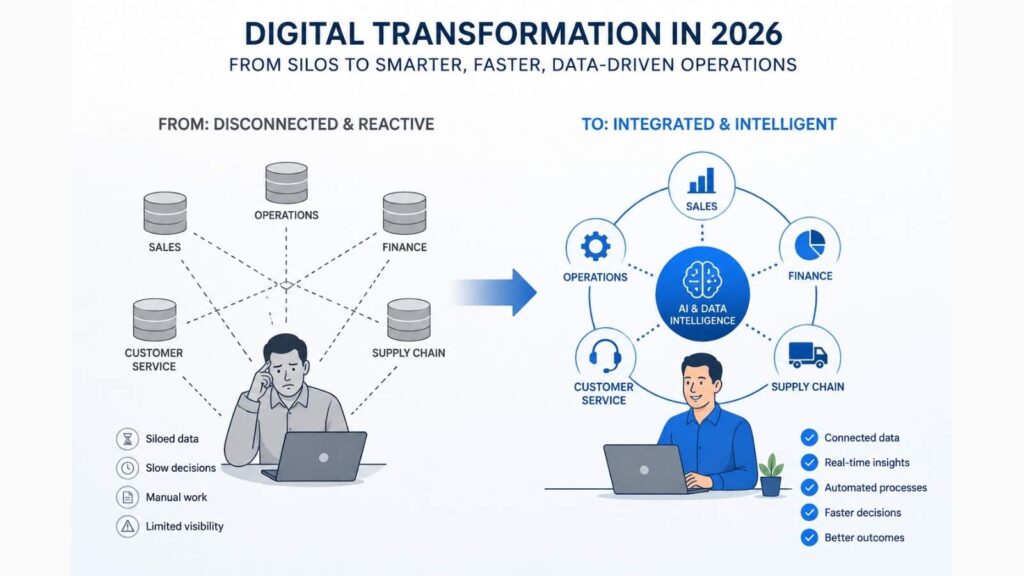
For example, many companies initially used AI as a support tool for employees. Today, leading organizations are redesigning entire operational models around AI-assisted workflows. Customer service teams are changing how they handle inquiries, finance departments are automating analysis and reporting, and operations teams are using predictive systems to optimize planning and reduce downtime. The same shift is happening at the leadership level. Executives increasingly expect real-time visibility into operations, faster access to insights, and the ability to make decisions based on live business data rather than static reports prepared days or weeks earlier.
Digital transformation also requires cultural and organizational change. Teams must learn to operate differently, managers need new performance metrics, and companies must establish governance frameworks for AI, cybersecurity, compliance, and data quality. In practice, this means that digital transformation in 2026 is no longer an IT initiative. It is a business strategy supported by technology. Companies that succeed are not those that simply “use AI.” They are the ones that redesign their business around it.
2. Why 2026 is a turning point
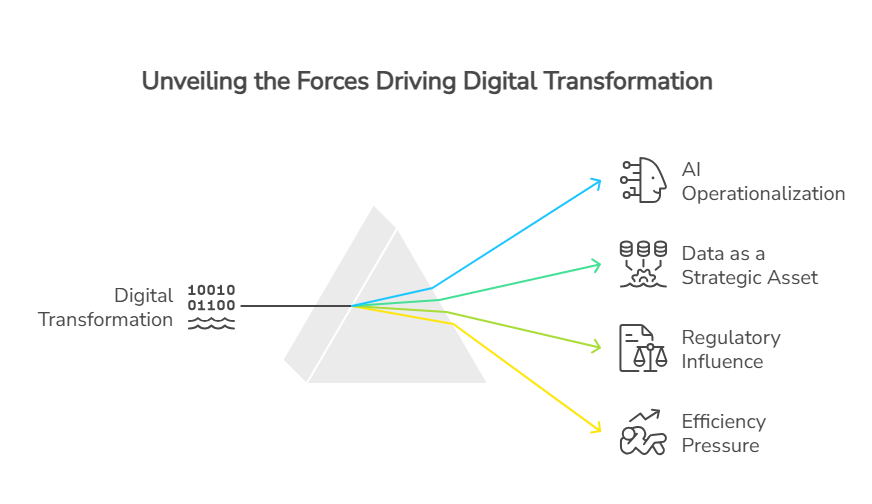
Several forces have converged to make transformation unavoidable.
2.1 AI is becoming operational, not experimental
AI is no longer limited to pilots and proofs of concept. It is being embedded into customer service, operations, finance, and decision-making processes. The key shift is from automation of tasks to automation of decisions.
2.2 Data has become a strategic asset
Organizations are moving away from fragmented data silos toward integrated data ecosystems that enable real-time insights and AI-driven workflows.
2.3 Regulation is shaping digital strategy
New regulations around AI, cybersecurity, and data governance are forcing companies to treat digital transformation as a structured, compliant program rather than a series of experiments.
2.4 Efficiency pressure is higher than ever
Rising costs, talent shortages, and market volatility are pushing companies to improve productivity without increasing headcount. Digital transformation is now one of the few scalable ways to achieve that.
3. Where companies are already seeing value
The most successful transformations are not theoretical. They focus on specific, measurable outcomes.
Across industries, companies are using AI and automation to:
- reduce customer service costs while improving response times,
- accelerate decision-making in operations and logistics,
- improve quality and reduce defects in manufacturing,
- increase productivity in knowledge-based roles,
- optimize resource usage and operational efficiency.
The common denominator is clear: measurable impact on cost, speed, and quality.
4. What digital transformation is not
Many initiatives fail because they are based on outdated assumptions.
Digital transformation is not:
- implementing a new system,
- moving infrastructure to the cloud,
- deploying AI without changing processes,
- running isolated innovation projects.
Without process redesign and clear business ownership, these initiatives rarely deliver value.
5. How to approach transformation in practice
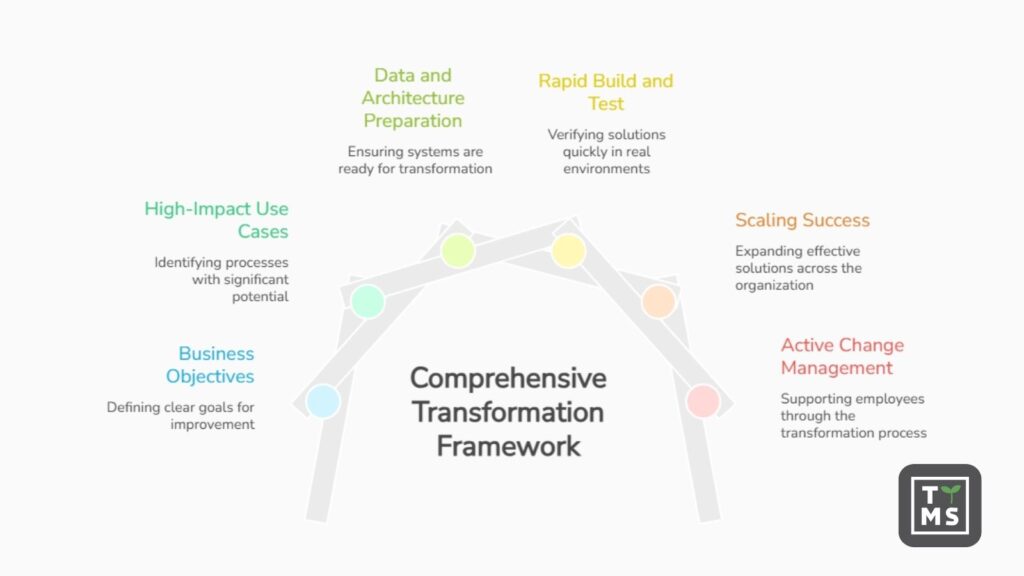
Successful transformation programs follow a structured approach focused on business outcomes.
5.1 Start with business objectives
Define what the transformation is expected to improve before choosing any technology. The objective should be specific enough to guide decisions, budgets, and priorities. Examples of clear objectives include reducing invoice processing time, lowering customer service costs, shortening reporting cycles, improving forecast accuracy, increasing sales team productivity, or reducing production downtime. Each objective should be linked to a measurable KPI. Without this, it is difficult to prove whether the initiative created business value or only introduced another system into the organization.
5.2 Identify high-impact use cases
Once business objectives are clear, the next step is to identify use cases with the strongest potential impact. These are usually processes that are repetitive, data-heavy, slow, expensive, or dependent on manual decisions. Good candidates include customer support automation, document processing, financial reporting, demand forecasting, predictive maintenance, quality control, internal knowledge search, and workflow automation. The best use cases combine three elements: clear business value, available data, and realistic implementation complexity. A use case may be attractive on paper, but if the required data is missing or the process depends on too many exceptions, it may not be the right first project.
5.3 Prepare data and architecture
Before building solutions, companies need to assess whether their data and systems are ready to support transformation at scale. Poor data quality, disconnected systems, and unclear ownership can block even well-designed initiatives. This stage should include checking where key data is stored, who owns it, how reliable it is, how often it is updated, and whether it can be safely accessed by new applications, analytics tools, or AI systems. Architecture also matters. Solutions should not be designed as isolated pilots. They need to integrate with existing systems, follow security requirements, support future scaling, and allow monitoring after deployment.
5.4 Build and test quickly
Transformation should move from assumptions to validation as quickly as possible. Instead of designing a large program for many months, companies should build a minimum viable solution and test it in a real business environment. The goal is not to create a perfect product immediately. The goal is to verify whether the solution improves the target process, whether users can work with it, and whether the expected business value is realistic. A good pilot should have a defined scope, a small group of users, baseline metrics, success criteria, and a clear decision point: scale, improve, or stop.
5.5 Scale what works
A successful pilot is not the end of transformation. It is only proof that a solution can work in controlled conditions. The real value appears when the solution is adopted across teams, departments, or business units. Scaling requires more than copying the same tool into another area. Companies need standardized processes, integration with core systems, user training, support models, governance, and clear ownership after rollout. This is also the moment to check whether the solution remains reliable at higher volume, whether costs stay under control, and whether business KPIs continue to improve outside the initial pilot group.
5.6 Manage change actively
Digital transformation changes how people work, not only which tools they use. Employees may need to follow new workflows, trust automated recommendations, use new dashboards, or shift from manual execution to supervision and exception handling. Change management should start before deployment. Teams need to understand why the change is happening, how it affects their daily work, what benefits it brings, and what skills they need to build. Leadership alignment is equally important. If managers continue to measure performance in the old way, employees will often return to old processes. New tools must be supported by updated responsibilities, KPIs, training, and communication.
6. Build, buy, or outsource?
One of the key strategic decisions in digital transformation is how to deliver it.
There is no universal answer, but in practice:
- building internally gives control but requires significant investment and time,
- buying ready-made solutions accelerates implementation but limits flexibility,
- outsourcing enables access to expertise and faster execution.
Most companies adopt a hybrid approach, combining internal ownership with external expertise to accelerate delivery and reduce risk.
7. How to measure success of digital transformation?
Transformation should always be tied to measurable outcomes.
Key metrics typically include:
- cost reduction,
- process cycle time,
- productivity per employee,
- quality and error rates,
- time-to-market.
Without clear KPIs, even technically successful projects may fail to deliver business value.
8. Final thoughts
Digital transformation in 2026 is no longer measured by the number of tools a company implements. It is measured by operational impact.
Organizations investing in AI, automation, cloud infrastructure, and data platforms expect measurable improvements in efficiency, speed, and profitability. If transformation initiatives do not reduce costs, improve decision-making, accelerate delivery, or increase productivity, they quickly lose executive support. This is why the most successful companies approach transformation as a business program with clearly defined KPIs, ownership, and timelines rather than a collection of isolated IT projects. In practice, the gap between leaders and lagging organizations is becoming increasingly visible.
Companies that move early are:
- automating repetitive operational work,
- reducing dependency on manual processes,
- improving customer response times,
- using AI to support decision-making,
- scaling operations without proportional headcount growth.
At the same time, organizations that delay transformation are facing rising operational costs, slower execution, fragmented systems, and growing pressure from competitors that operate more efficiently.
One of the biggest changes in 2026 is that access to technology is no longer the differentiator. AI tools, cloud services, and enterprise platforms are widely available. The real challenge is execution.
Many companies still struggle with:
- poor data quality,
- legacy systems that cannot scale,
- isolated AI pilots with no business impact,
- lack of internal expertise,
- unclear ownership of transformation initiatives.
As a result, the companies generating the highest value are not necessarily the ones spending the most on technology. They are the ones that can connect strategy, processes, data, and execution into one scalable operating model. That is what digital transformation really means in 2026. It is not a technology trend. It is an operational and strategic capability that directly affects competitiveness, resilience, and long-term growth.
Planning a digital transformation or AI initiative?
Explore how experienced engineering teams can support faster delivery and lower risk: https://ttms.com/outsourcing/

FAQ
How long does a typical digital transformation project take?
The timeline depends on the scale of the organization, the complexity of existing systems, and the scope of the transformation. Smaller initiatives such as workflow automation or AI-powered reporting can deliver measurable results within a few months, while enterprise-wide transformation programs often evolve over several years. Most successful companies approach transformation incrementally rather than attempting a complete overhaul at once.
What is the biggest obstacle to successful digital transformation?
In many organizations, the biggest challenge is not technology but operational alignment. Companies often struggle with fragmented systems, unclear ownership, resistance to change, or lack of coordination between business and IT teams. Even strong technical solutions can fail if the organization is not prepared to adapt processes, responsibilities, and decision-making models around them.
Can mid-sized companies benefit from AI-driven transformation?
Yes. In fact, mid-sized companies often move faster than large enterprises because they have fewer legacy systems and shorter decision-making chains. AI and automation are no longer limited to corporations with massive budgets. Many modern cloud-based tools allow mid-sized organizations to improve efficiency, automate repetitive work, and gain better operational visibility without building complex infrastructure from scratch.