Organizations are spending significant money on AI tools, yet many of those investments stall at the experimentation stage. According to McKinsey’s 2025 workplace AI report, nearly 70% of large-scale transformations fail to achieve their intended goals, and that failure rate cuts directly through the training layer. The bottleneck is rarely the technology. It is the workforce’s ability to use it confidently and consistently in real work.
This guide lays out a practical, step-by-step approach to AI employee training methods that actually translate into changed behavior on the job. It draws on current research, documented case studies, and TTMS’s experience designing and delivering AI-powered e-learning programs across industries. Whether you are an L&D manager building your first AI curriculum or an HR leader trying to scale something that already exists, the six steps that follow will help you move AI training from intention to measurable impact.
The table below maps those six steps at a glance before the full detail follows.
| Step | Goal | Key Action | What Success Looks Like |
| 1. Assess AI Readiness | Understand current skill gaps | Role-by-role audit and workforce segmentation | Workforce grouped by proficiency level with clear gaps identified |
| 2. Define Objectives | Tie learning to business outcomes | Set measurable performance baselines | Trackable KPIs linked to productivity, cost, or quality |
| 3. Design Curricula | Build role-specific learning tracks | Separate content by function and AI exposure | High completion rates paired with strong learner-reported relevance |
| 4. Choose Methods | Build real, applicable skills | Hands-on, blended, AI-adaptive delivery | Skill application visible in actual workflows |
| 5. Launch and Sustain | Drive adoption across the organization | Phased rollout with active change management | Engagement rates, reduced resistance, manager-reported uptake |
| 6. Measure and Iterate | Connect training to business performance | Track leading and lagging indicators | Productivity gains, error reduction, and ROI |
1. Why Most AI Training Programs Fail to Change How People Work
The failure pattern is consistent enough to study. Organizations procure an AI tool, assign a generic “AI 101” course to all staff, and then wait for productivity gains that never arrive. The root problem is not motivation but design. Most AI training methods for employees are built around content delivery, not behavior change.
Training gets treated as a box to tick rather than a system to build. Courses go live without clear connections to the work employees actually do. There is no segmentation by role, no baseline measurement, and no mechanism to reinforce learning after the course window closes. Employees end up able to describe what AI is but unable to explain how to use it safely in their specific function.
What distinguishes programs that work is a deliberate architecture: role-specific content, objectives tied to business outcomes, methods that build real skills, and a sustained engagement model that does not end on day one.
2. Step 1: Assess AI Readiness and Identify Skill Gaps Before You Build Anything
The most common reason AI training programs miss the mark is that they begin with content rather than context. Before a single module is created, the organization needs to understand what its people already know, what they need to know, and how wide the gap is. Skipping this step leads to training that is either too basic for some employees and too advanced for others, or simply irrelevant to either group.
2.1 Conduct a Role-by-Role AI Skills Audit
A skills audit should go deeper than a quick survey. The goal is to map current AI-related capabilities against the skills each role will require as AI tools become embedded in day-to-day workflows. This means looking at how employees currently interact with AI, whether they are using it at all, and where adoption is stalling by function.
2.2 Distinguish Between AI Literacy, Fluency, and Role-Specific Proficiency
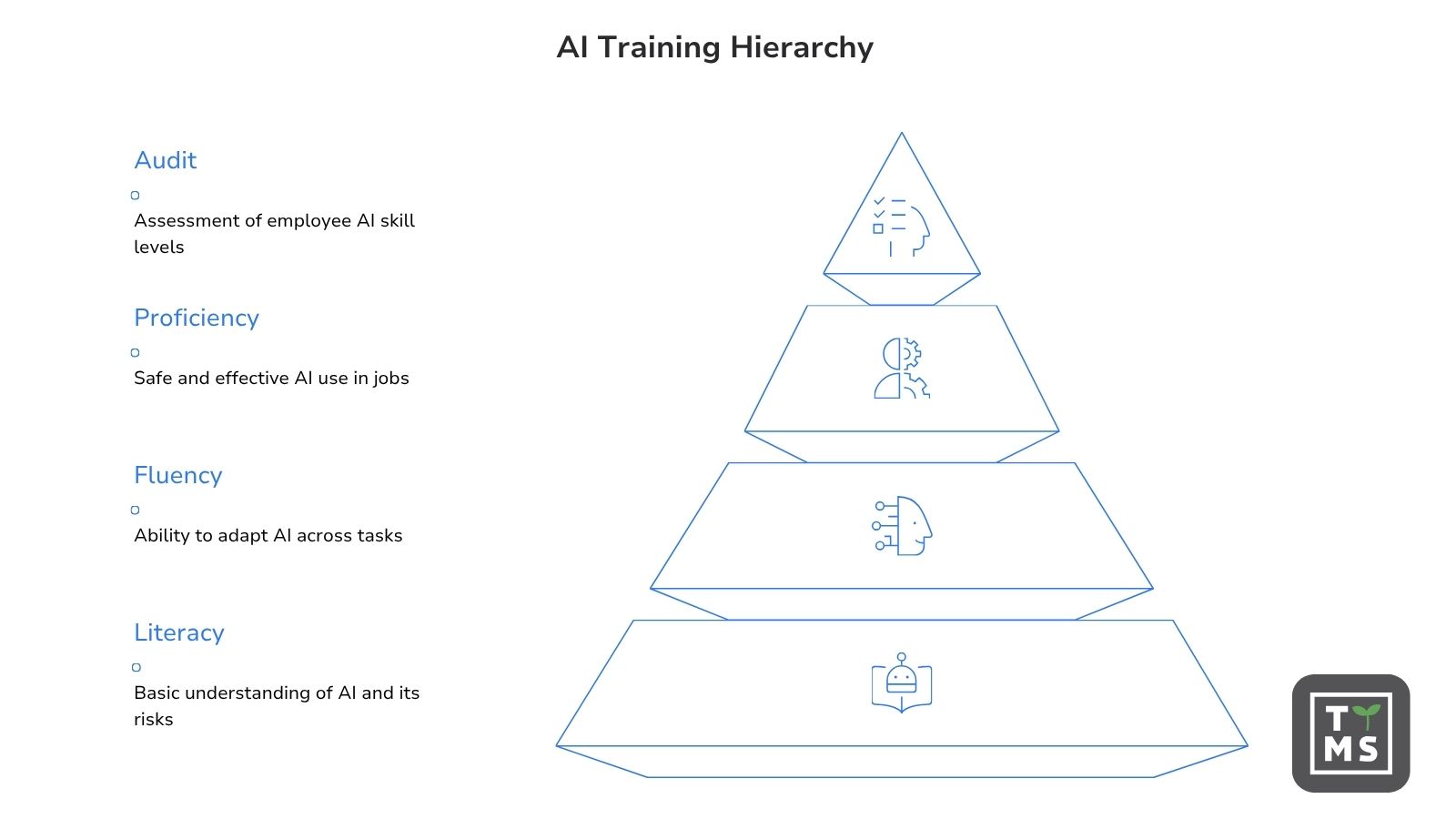
Not all AI skills are equivalent, and conflating them leads to curricula that feel misaligned to employees. AI literacy is the foundation: understanding what AI is, what it can and cannot do, and what the ethical and data considerations are. Fluency moves further, referring to the ability to actively create, adapt, and apply AI tools to generate original work or solve novel problems. Role-specific proficiency is the narrowest and most practical level: using AI competently within a defined job context, following the organization’s rules and with appropriate human oversight.
Each level requires a different training response. Literacy covers what AI is and where the risks lie. Fluency addresses how to create and adapt with AI across different tasks. Role-specific proficiency gets into how to use AI safely and effectively within a particular job. A good audit clarifies where each employee currently sits across this spectrum.
2.3 Use Assessment Results to Segment Your Workforce
Once assessment data is in hand, the next step is segmentation. Rather than assigning the same learning path to everyone, employees should be grouped by current proficiency level and AI exposure: those with minimal AI exposure, intermediate users who interact with AI tools occasionally, and advanced users who are ready to integrate AI into complex workflows.
This segmentation is not permanent. It is a starting point that allows training resources to be allocated intelligently. It also reduces a common source of disengagement: advanced employees sitting through introductory content, or newer employees being overwhelmed by concepts they lack the context to apply.
3. Step 2: Define Learning Objectives Tied to Business Outcomes
Getting this step right is what separates training programs that demonstrate value from those that generate reports about course completions. The objective of AI training is not more educated employees in the abstract. It is changed behavior that produces measurable business results.
3.1 Set Goals Around Productivity Gains, Not Just Course Completions
Course completion rates are a leading metric, not a success metric. They tell you that content was consumed, not that anything changed. Effective AI training methods connect learning objectives directly to performance outcomes: shorter processing times in a specific department, reduced escalation rates in customer support, faster drafting cycles in content teams, more accurate forecasting in finance.
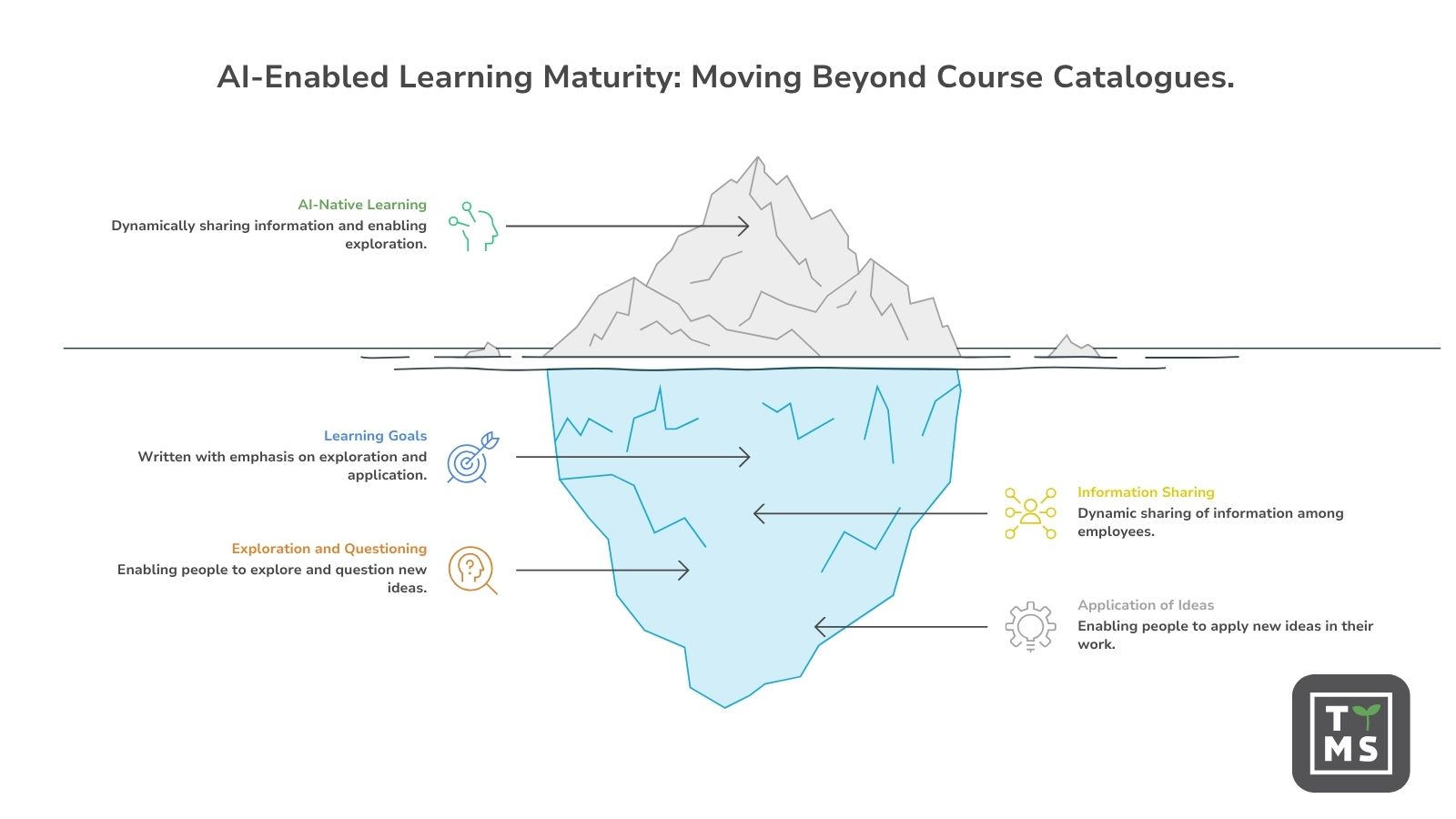
Josh Bersin’s 2026 research on AI-enabled learning maturity frames this shift clearly. In his analysis of Level 4 AI-native learning organizations, the emphasis moves away from course catalogues toward “dynamically sharing information, enabling people to explore, question, and apply new ideas” in their work. Learning goals should be written with that same emphasis from the start.
3.2 Establish Measurable Baselines So Progress Is Trackable
Before training launches, establish baselines for the indicators that matter. If the goal is to reduce the time a sales team spends on proposal drafting, measure the current average. If it is to cut support ticket resolution time, benchmark it. These baselines become the reference points against which the program’s impact will later be evaluated.
This approach also keeps the conversation honest inside the organization. When training is anchored to a number, it becomes much easier to defend investment, identify what is working, and make the case for iteration when the first version falls short.
4. Step 3: Design Role-Specific AI Training Curricula
One of the most consistent findings across recent enterprise AI research is that generic training programs underperform. MIT CISR research covering 152 enterprises identifies “creating AI-ready people, roles, and teams while redesigning work around AI capabilities” as a defining characteristic of organizations achieving above-industry-average financial performance. That does not happen with a single company-wide AI course.
4.1 Build Separate Learning Tracks by Role and AI Exposure Level
Each track should be organized around the tasks that role actually performs, the AI tools most relevant to those tasks, and the risks and governance requirements that apply. A separate track for a finance analyst, a customer service agent, and a procurement manager is not a luxury. It is the design principle that makes training stick.
Stanford Digital Economy Lab’s analysis of 51 enterprise AI deployments found that the same AI technology produced “weeks vs. years” differences in realized value depending on whether work was redesigned and training was tailored to specific roles. When Moderna built its AI Academy with differentiated tracks for scientists, clinicians, manufacturing, support functions, and executives, it achieved course completion rates 240% above industry benchmarks and a 400% year-over-year increase in enrollment. Role relevance drives engagement.
TTMS’s work in building e-learning for healthcare illustrates this in a regulated context. In an industry where accuracy, compliance, and patient safety leave no room for generic content, TTMS designed role-specific e-learning tailored to the distinct knowledge requirements and compliance obligations of different clinical and administrative functions. Each professional group completed only content directly mapped to their responsibilities, reducing time-to-competency and eliminating the disengagement that comes from irrelevant material.
4.2 What Every Employee Needs: Core AI Literacy
Before anyone receives role-specific content, there is a shared foundation that the entire organization needs to hold. This is not about making everyone a data scientist. It is about building the common language and judgment that allows AI to be used well at scale.
4.2.1 Understanding How AI Tools Work (Without the Technical Deep Dive)
Employees do not need to understand neural network architecture. They do need to understand that AI systems generate outputs based on patterns in training data, that those outputs can be wrong or biased, and that the quality of their inputs significantly influences the quality of what they get back. A clear mental model of how AI tools work, at an accessible level, prevents both overreliance and unnecessary avoidance.
4.2.2 Responsible AI Use, Data Privacy, and Compliance
Every employee using AI tools needs to understand the boundaries: what data can and cannot be entered into AI systems, what the organization’s approved tools and use cases are, and what the legal and regulatory implications of misuse look like. This is especially critical in healthcare, finance, and legal services, where the consequences of a compliance failure are significant.
TTMS’s Safety First case study demonstrates the value of building compliance and responsible use directly into e-learning design. Rather than attaching compliance content as an afterthought, TTMS integrated safety requirements into the learning flow itself, so that correct behavior became the natural outcome of completing the training. Post-deployment assessments showed employees could accurately apply the relevant safety protocols in scenario-based tests, with compliance knowledge embedded rather than requiring separate recall.
4.2.3 Evaluating AI Output and Knowing When Not to Trust It
AI outputs should be treated as drafts, not authoritative answers. Teaching employees to evaluate outputs critically, including how to ask for sources, recognize hallucinations, and verify claims before acting on them, is one of the highest-value skills in any AI training program. This is realism about how to use AI well.
4.3 What Power Users and Functional Teams Need: Applied AI Skills
Once the foundation is in place, specific groups need training that goes beyond awareness into actual skill-building. This is where training methods for employees become most instructive, because generic descriptions only go so far.
4.3.1 Prompt Engineering and Workflow Integration
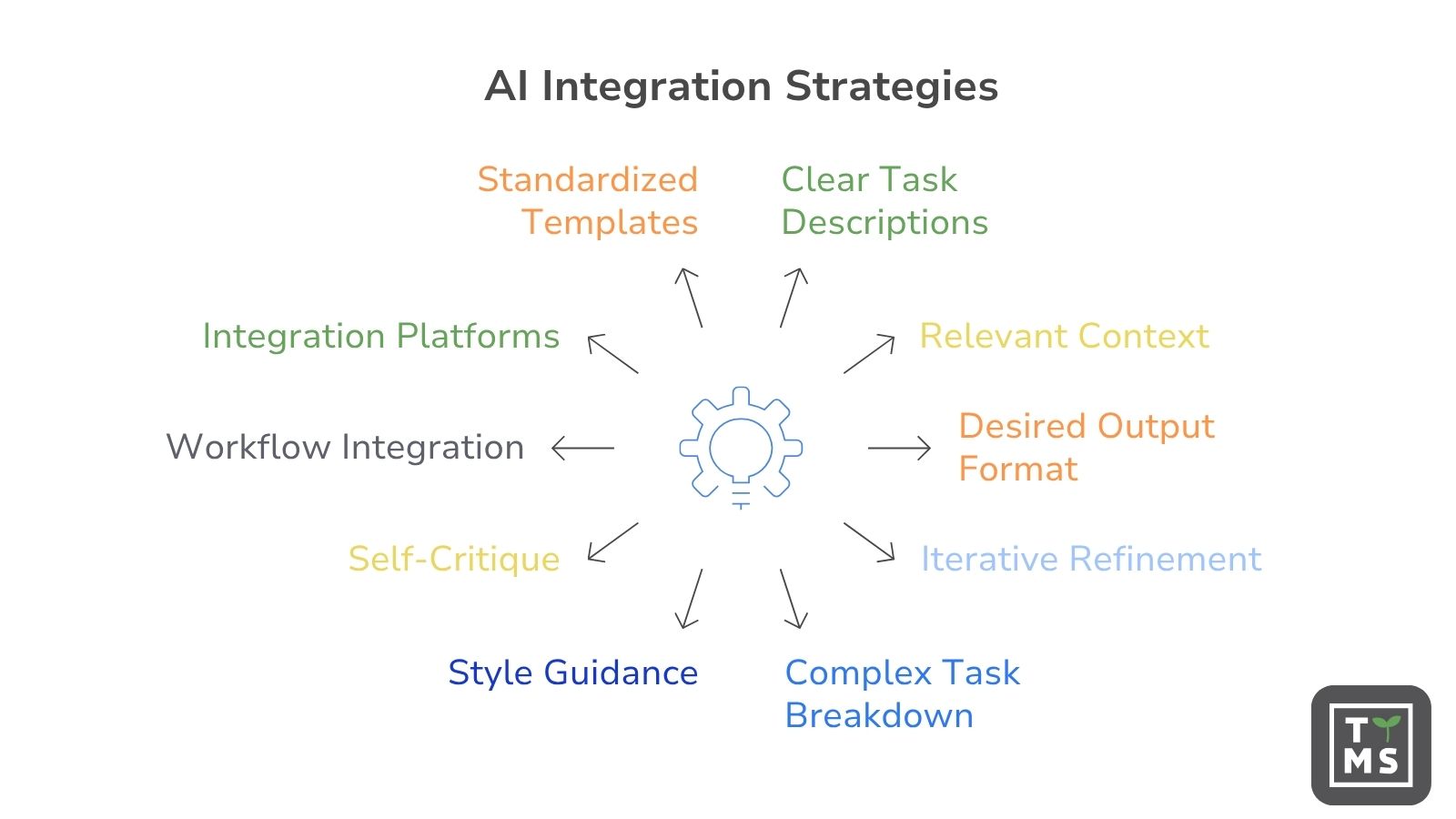
Prompt engineering is worth demystifying. Structuring instructions to AI systems so they produce reliable, useful outputs is a learnable skill, not a technical specialty. For non-technical employees, this typically means learning to include clear task descriptions, relevant context, desired output format, and iterative refinement loops. More advanced techniques, such as breaking complex tasks into sub-steps, using examples to guide style, or asking the model to critique and improve its own output, can be layered in once the basics are solid.
Beyond single prompts, employees benefit from learning how to connect AI tools into repeatable workflows. This might mean chaining AI steps in a process, using integration platforms to connect AI outputs to other business systems, or building standardized templates that apply across a team rather than being reinvented by each individual.
4.3.2 Role-Specific Use Cases: Sales, Marketing, HR, Finance, Operations
The fastest way to make applied AI training relevant is to anchor it to use cases that employees recognize from their own work. Sales teams benefit from training that addresses how AI can support prospecting, proposal drafting, and objection handling. Marketing teams need content around brief writing, content iteration, and campaign analysis. HR teams benefit from exploring AI-assisted job description drafting, benefits query handling, and onboarding content generation. Finance and operations teams see the most immediate gains from AI-supported data analysis, report summarization, and exception flagging.
4.4 What Leaders Need: Strategic AI Oversight
Leaders need a different kind of training from the rest of the organization. They are not the primary users of AI tools in most cases. Their role is to set direction, ask the right questions, allocate resources appropriately, and ensure that AI deployment aligns with business goals and risk tolerance. That requires understanding what AI can and cannot do at a strategic level, how to evaluate AI-related proposals, and how to support their teams through the adoption process. Leadership training should also cover governance: how to establish responsible use policies, how to communicate AI strategy clearly, and how to model the behavior they want to see.
5. Step 4: Choose Training Methods That Build Real Skills
The design of the curriculum determines what is taught. The choice of training method determines whether it is learned. Passive content delivery, whether that is a recorded lecture or a slide deck, rarely changes behavior on its own. The methods that work are those that create practice, context, and feedback.
5.1 Hands-On, Project-Based Learning Over Passive Video Consumption
The most effective way to learn a skill is to use it. AI training programs should be designed around realistic tasks that require employees to apply what they are learning, not just recall it. This might mean drafting a work document using a specific AI tool and then reviewing the output against a rubric. It might mean completing a workflow exercise that replicates an actual process in the employee’s team. The key is that the learning activity produces something, and that the employee gets feedback on what they produced.
Project-based learning also tends to surface questions that generic content does not anticipate. When employees work through a realistic scenario, they encounter the specific points of confusion and judgment that define their role’s AI challenges. That experience is difficult to replicate in any other format.
5.2 Microlearning and Spaced Repetition for Long-Term Retention
Microlearning refers to delivering training in short, focused modules that address a single concept or skill at a time, typically three to ten minutes in length. Spaced repetition means returning to the same material at increasing intervals to reinforce retention, rather than concentrating all learning into a single session.
These two principles work together. A concept introduced in a five-minute module is better retained when revisited briefly two days later, then again a week later, with small practice exercises each time. This approach is especially effective for AI training, where employees are learning both conceptual frameworks and practical skills that need to become habitual rather than occasional.
5.3 Peer Learning, Internal AI Champions, and Cohort-Based Models
No training program scales as effectively as a community of practice. Identifying employees who engage early and enthusiastically with AI tools and equipping them to support their peers creates a multiplier effect that formal training alone cannot produce. These internal AI champions become the first point of contact for questions, the source of role-specific tips and shortcuts, and the visible proof that AI adoption is possible in the specific context of that organization.
Cohort-based learning, where groups of employees move through training together and share their experiences, also builds the social dimension of learning that individual self-paced courses miss. When employees learn alongside their peers, they develop shared vocabulary and shared confidence.
5.4 Blending Self-Paced Courses With Live Instruction
Self-paced courses offer flexibility and scale. Live instruction, whether delivered in person or virtually, offers dialogue, depth, and the ability to address unexpected questions. The most effective AI training programs use both. Self-paced modules handle foundational content efficiently, while live sessions focus on discussion, scenario work, and the kind of judgment-based challenges that benefit from human facilitation.
This hybrid structure also accommodates the reality of different learning preferences and schedule constraints within the same workforce. The self-paced component ensures a consistent baseline; the live component ensures depth.
5.5 AI-Powered Learning Tools That Personalize the Training Experience
One of the more compelling developments in corporate learning is the emergence of AI tools that adapt training based on each learner’s progress, knowledge gaps, and engagement patterns. Rather than serving the same content to everyone, these platforms identify where a learner is struggling, adjust the difficulty level accordingly, and surface the most relevant material for that individual at that point in their learning journey.
TTMS has developed the AI4E-learning authoring tool to help organizations build and deploy exactly this kind of adaptive e-learning. The tool enables L&D teams to convert existing organizational materials, whether documentation, procedures, or policy documents, into structured e-learning courses with AI-generated quizzes, summaries, and scenarios. Courses are SCORM-compliant, making them deployable across existing LMS platforms without requiring a full infrastructure rebuild.
TTMS applied this capability when a company operating a helpdesk needed to rapidly onboard new employees and address knowledge gaps in their ticket-handling processes. In the helpdesk AI training case study, TTMS used AI to build training that adapted to each learner’s current proficiency and provided real-time feedback during exercises. Managers gained visibility into individual and team progress through integrated analytics, so they could intervene early where gaps appeared. New hires reached independent ticket-handling significantly faster, and knowledge check scores tracked upward across successive cohorts as the content was refined based on usage data.
6. Step 5: Launch and Sustain Engagement Across the Organization
The quality of training content means very little if the organization does not engage with it. Launching an AI training program is not only an L&D exercise; it is a change management challenge. The decisions made in the launch phase, and the follow-through in the weeks that follow, determine whether training becomes embedded in the culture or quietly abandoned.
6.1 Secure Leadership Buy-In Before Rolling Out to the Workforce
Leadership buy-in is not a formality. It is a precondition. When executives actively endorse and visibly participate in AI training, it signals to the broader workforce that this initiative is serious and connected to where the company is going. When they are absent, employees often interpret that as a sign that the training does not really matter.
The most effective way to secure executive support is to connect training directly to the business priorities that leaders are already accountable for. Framing AI upskilling as a productivity initiative, a risk management measure, or a competitive positioning strategy, depending on the audience, is more persuasive than framing it as an HR program. Getting leaders trained first, so they can speak to AI with informed confidence rather than vague endorsement, further strengthens their ability to champion the initiative.
TTMS’s work on the Hitachi Energy safety training program demonstrates how leadership alignment enables effective rollout at scale. For Hitachi Energy’s 10 Life-Saving Rules initiative, TTMS designed an e-learning program directly tied to measurable safety outcomes and built with visible organizational backing. The program’s phased deployment and consistent governance framework enabled a large, geographically distributed workforce to complete the curriculum within a defined rollout window, with completion tracking across business units giving leadership a clear view of adoption progress.
6.2 Use a Phased Rollout to Reduce Overwhelm and Build Momentum
A full organization-wide launch on day one is rarely the right approach for AI training. Starting with a pilot group, typically a high-engagement team or a function where AI use cases are clearest, lets the program be tested, refined, and validated before wider deployment. Measurable results from the pilot create the evidence base for the broader rollout and reduce the skepticism that often greets large-scale training mandates.
After the pilot, rolling out in waves by function, geography, or business unit lets the organization absorb and apply learning progressively. Each wave benefits from the lessons of the previous one, and the internal community of AI users grows with each phase.
6.3 Address AI Anxiety and Resistance Directly
The data on AI anxiety is hard to dismiss. EY research finds that 60% of employees are anxious about AI adoption, 75% worry AI will make certain jobs obsolete, and 48% say they are more concerned than they were a year ago. Pew Research reports that 52% of U.S. workers worry about AI’s future impact on their work. Designing a training program that ignores this is not neutral; it is a design flaw.
Addressing anxiety directly means being transparent about what AI will and will not change in each role. It means communicating clearly about the organization’s approach to job impact before rumors fill the silence. It also means building psychological safety into the training experience itself, so employees feel comfortable making mistakes and asking questions without judgment. Academic research from 2025 confirms that the negative impact of AI job anxiety on wellbeing and work engagement is significantly reduced by vocational training, emotional regulation support, and social connection at work. Training is a trust-building exercise, not just a skills intervention.
6.4 Reinforce Learning With On-the-Job Application Opportunities
Training that ends at course completion does not change behavior. The link between learning and work needs to be made explicit, and it needs to be supported by the employee’s immediate environment. This means giving employees real tasks that require them to use their new AI skills. It means giving managers the context they need to coach rather than ignore. It means building AI tool use into workflows rather than leaving it as an optional extra.
TTMS has consistently applied this principle in its e-learning programs. In the Safety First case study, safety training was designed to be directly integrated with operational responsibilities, with what employees learned immediately testable in their actual work environment. That integration between training and application is what converts knowledge into habit.
7. Step 6: Measure Impact and Iterate Continuously
Without measurement, there is no way to know what is working, where to invest more, or how to make the case for continued resources. The key is understanding which metrics reveal what, and at what stage in the program’s life they become meaningful.
7.1 Leading Indicators: Engagement, Completion, Confidence Scores
Leading indicators are signals of early health. Engagement rates, completion rates, and confidence scores tell you whether employees are showing up, finishing what they start, and feeling more capable. Low engagement signals a problem with relevance or accessibility. Flat confidence scores point to something off in the learning design. These are not proof of business impact, but they are early warning signals worth tracking from day one.
Learning analytics from AI-powered platforms can provide these indicators in real time, allowing L&D teams to make adjustments while training is still in progress rather than waiting for end-of-program evaluations. TTMS’s AI-enhanced e-learning solutions are built with exactly this feedback loop in mind, tracking individual and group progress so that both employees and managers can see where capability is improving and where it is not.

7.2 Lagging Indicators: Productivity Gains, Error Reduction, Business Outcomes
Lagging indicators take longer to emerge but are where the real evidence of training value lives. The metrics that matter to business leaders are things like productivity gains in trained functions, fewer errors or rework cycles, faster process completion, and cost savings tied to AI-assisted workflows.
Josh Bersin’s research on AI-native learning organizations provides further context. Organizations at Level 4 of AI-enabled learning maturity are 10 times more likely to be innovation leaders and 6 times more likely to exceed their financial targets. These figures describe what is possible with mature, embedded AI learning systems, not what should be expected from an initial program deployment.
7.3 When to Expect ROI From Corporate AI Training Programs
Realistic expectations matter. In most cases, measurable productivity gains from AI training begin to appear within the first three to six months of consistent application, but business-level financial outcomes often take longer, particularly if they depend on workflow redesign rather than individual skill change alone.
Gartner’s guidance on measuring AI value is useful here. The recommendation is to evaluate AI programs across three dimensions: financial return (cost and productivity gains), employee return (engagement, retention, capability), and long-term return (adaptability and innovation readiness). Tracking all three prevents organizations from declaring failure prematurely when immediate cost savings have not materialized, while still holding the program accountable for demonstrable outcomes over time.
8. Common Mistakes to Avoid When Training Employees on AI
Patterns in where AI training programs go wrong show up repeatedly across industries and organization sizes. Awareness of them makes it possible to design around them from the start.
The most common mistake is building one course for everyone. Without role-specific content, employees cannot make the connection between what they are learning and how it applies to their actual work. Engagement drops, retention is poor, and behavior does not change. Close behind this is the absence of any measurement framework. If success is only defined as “employees completed the course,” the program will never be able to demonstrate or improve its real impact.
Another recurring problem is treating AI training as a standalone event rather than a component of a larger change management effort. When training is deployed without addressing organizational culture, leadership behavior, or workflow redesign, it remains an isolated experience. The OpenAI 2025 enterprise report found that many enterprises still fail to connect AI tools to their core data and workflows, with AI sitting largely unused because the enablement work was never done. Training content alone cannot compensate for an environment that does not support application.
Ignoring AI anxiety is a design failure with predictable consequences. JFF research found that only 36% of workers say they have the training and resources they need to use AI in their jobs, and that insufficient employer-provided training is directly linked to growing anxiety and resistance. Programs that skip the change management component often create the very resistance they were designed to overcome.
9. Building an AI-Ready Workforce Is an Ongoing Process, Not a One-Time Event
AI literacy training delivered once is not a solution. It is a starting point. PwC’s 2025 Global AI Jobs Barometer reports that skills for AI-exposed jobs are changing 66% faster than in other roles. The tools employees learn this year will evolve significantly by next year, and the use cases that seem advanced today will become standard practice within a short time. A training program designed as a one-time event is already outdated before it finishes deployment.
Sustainable AI training programs are built as living systems. They include a skills taxonomy that gets updated as AI capabilities and organizational needs change. They provide universal AI literacy as a continuous baseline, with deeper, role-specific pathways that are regularly refreshed. Learning is embedded in the flow of work, not confined to an annual course calendar. The program is governed by real data: skills gaps, learning analytics, AI usage patterns, and business outcomes that feed back into curriculum decisions on an ongoing basis.
IBM’s own internal research estimates that 40% of the global workforce will need to reskill in the next three years due to AI and automation. IDC forecasts that more than 90% of organizations worldwide will face critical skills shortages by 2026, with AI and IT bottlenecks potentially costing the global economy up to $5.5 trillion. L&D and HR