Pharmaceutical companies have always faced intense pressure to move faster, spend less, and stay compliant. What’s shifted recently is the nature of the tools available to meet those demands. Low-code AI adoption in pharma is no longer a fringe concept explored by forward-thinking R&D labs. It’s becoming a practical strategy for organizations that need to digitize operations quickly, without building every solution from scratch.
This guide is written for pharma IT leaders, digital transformation managers, and compliance officers who want a clear, realistic picture of where low code AI stands in 2026 and how to use it effectively across the life sciences value chain.
1. Why low-code AI is gaining traction in Pharma right now
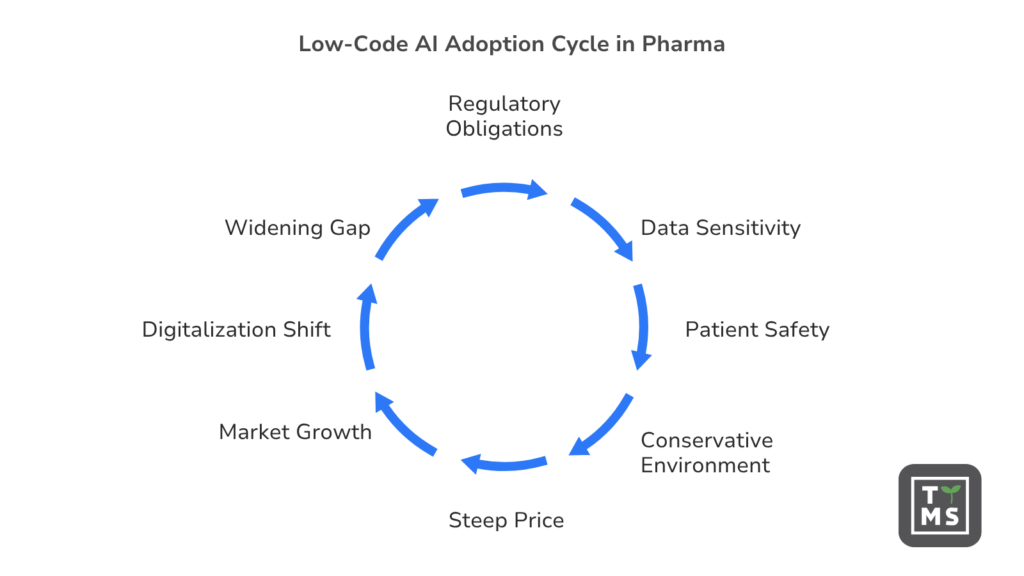
The pharmaceutical sector has historically been slow to adopt new technology, and for good reason. Regulatory obligations, data sensitivity, and patient safety create a conservative environment. But that conservatism carries an increasingly steep price. The global low-code and AI-assisted workflow automation platform market is projected to grow strongly, with Technavio estimating a 32.2% CAGR between 2025 and 2029. For pharma and life sciences organizations, this growth reflects a broader shift toward faster, more governed digitalization of complex workflows. The pressure to digitize isn’t letting up, and the gap between what pharma organizations need to deliver and what their IT teams can realistically build keeps widening.
1.1 The pressure driving faster digital adoption across the life sciences value chain
Regulatory demands are intensifying globally. At the same time, operational costs are climbing, and the time between molecule identification and market approval remains under constant scrutiny. Companies face mounting expectations from regulators, patients, and investors to do more with their data, and to do it faster. Traditional software development cycles, often spanning years, simply can’t keep pace.
Digital transformation has moved from a strategic priority to an operational necessity. Pharma companies that can’t rapidly digitize clinical data workflows, manufacturing quality processes, or pharmacovigilance functions are accumulating technical debt that compounds every year.
1.2 What low code AI actually means in a pharma context
Low code AI refers to platforms that let users build functional, AI-assisted applications through visual interfaces, drag-and-drop tools, and pre-built templates, rather than writing extensive custom code. In a pharma context, this means a quality assurance manager could configure a deviation management workflow, or a clinical operations team could build a data collection form, without waiting months for a development sprint.
Two platforms that illustrate this well in enterprise pharma environments are Microsoft Power Apps and Webcon BPS, both of which TTMS implements and supports for regulated industries. Power Apps enables rapid digitization of business processes across departments, while Webcon BPS provides structured workflow automation with a strong focus on compliance and process governance.
1.3 How it differs from traditional AI and full-code development for regulated environments
Traditional AI development in pharma typically requires dedicated data science teams, significant infrastructure investment, and long validation cycles. Full-code development offers maximum flexibility but demands specialized developers, extensive documentation, and project timelines that can stretch well beyond what business stakeholders actually need.
Low code AI sits between these extremes. It provides enough flexibility to address real business problems, with enough structure to satisfy governance requirements. Crucially, it reduces dependency on highly specialized engineers while still producing auditable, maintainable applications. For regulated environments where every system change requires documented rationale, that balance matters enormously.
2. Key benefits of low code AI adoption in pharma
The case for low code AI automation in pharma isn’t theoretical. The concrete operational gains it delivers across the organization, from IT governance to the shop floor, are what make it worth pursuing.
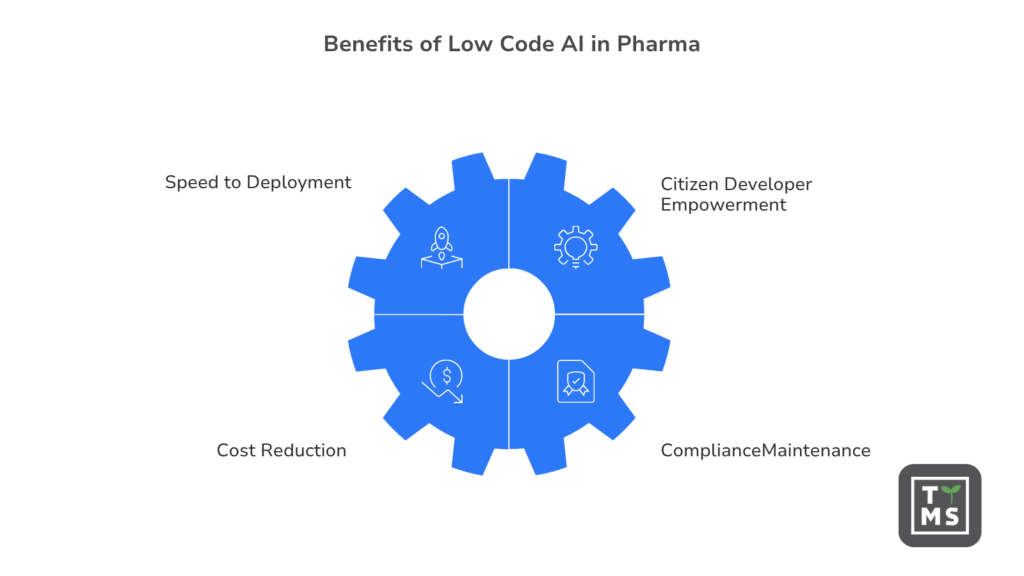
2.1 Speed to deployment: from months to weeks
The most immediate advantage is compressed development timelines. Pharma supply chain applications built on low code platforms have demonstrated up to 75% faster development cycles compared to traditional coding approaches, enabling quicker time-to-market for both drugs and supporting applications. In pharmaceutical manufacturing, where process changes need to respond to audit findings or regulatory updates quickly, that speed is operationally significant.
This isn’t about cutting corners. It’s about removing the structural inefficiencies that slow traditional development: handoffs between business and technical teams, lengthy requirements documentation cycles, and redundant testing phases. Low code platforms encode many of those quality standards directly into the build environment.
2.2 Empowering citizen developers without sacrificing it governance
One of the most practically valuable aspects of low code AI is what it does for non-technical staff. Citizen developers, business users with limited or no formal coding background, can build applications that automate their own workflows. This doesn’t mean IT steps aside; it means IT shifts from writing code to governing platforms, setting standards, and ensuring security.
TTMS’s Microsoft Power Apps consulting service is built around exactly this model. By implementing Power Apps within a governed Microsoft Power Platform environment, TTMS enables pharma teams to develop functional apps in their own domain while IT retains control over data connections, compliance configurations, and deployment permissions. Fewer bottlenecks, faster delivery, and IT resources freed for higher-complexity challenges.
2.3 Reducing costs across the pharma value chain
Custom software development at enterprise scale is expensive. Beyond developer salaries, costs accumulate in vendor licensing, integration work, project management, and ongoing maintenance.
A Forrester TEI low-code study cited by Pega found 598% ROI and $12.5 million in productivity savings over three years for enterprises using Pega’s low-code platform. While this is not pharma-specific, it illustrates the type of financial impact low-code programs may deliver when implemented at scale. For organizations managing dozens of operational systems across manufacturing sites, clinical operations, and regulatory affairs, low code platforms consolidate much of this expense through reusable components, pre-built connectors, and simplified update cycles.
2.4 Maintaining compliance in a low code build environment
Compliance is where pharma organizations most commonly hesitate on low code. The concern is legitimate: how do you ensure that applications built by non-developers meet GxP standards, maintain audit trails, and support validation documentation?
The answer lies in choosing the right platform and the right implementation partner. TTMS’s Webcon BPS implementation service is specifically designed to address this. As an official Webcon Partner, TTMS deploys Webcon BPS in ways that embed process governance, version control, and audit trail functionality directly into workflow design. Rather than retrofitting compliance onto finished applications, compliance is part of how the application is built from the start. This approach aligns well with the documentation and validation requirements that pharma quality teams manage daily.
3. High-impact use cases across the pharma value chain
Low code AI adoption in pharma isn’t limited to a single department or function. Its real value emerges when applied consistently across the value chain, each use case building on the organization’s growing low code maturity.
3.1 Accelerating drug discovery and r&d workflows
In early-stage research, scientists spend a significant portion of their time on data entry, status tracking, and reporting. Tasks that add little scientific value but consume hours. Low code platforms can automate these workflows, connecting laboratory information systems with project management tools and enabling AI-assisted data analysis through pre-built connectors to services like Azure AI.
TTMS’s background in AI implementation and IT system integration makes this kind of layered solution achievable. A Power Apps-based research tracking application, integrated with existing LIMS and ERP systems, can give R&D teams real-time visibility into experiment status, resource allocation, and milestone progress, without commissioning a full custom development project.
3.2 Improving quality control and compliance in pharmaceutical manufacturing
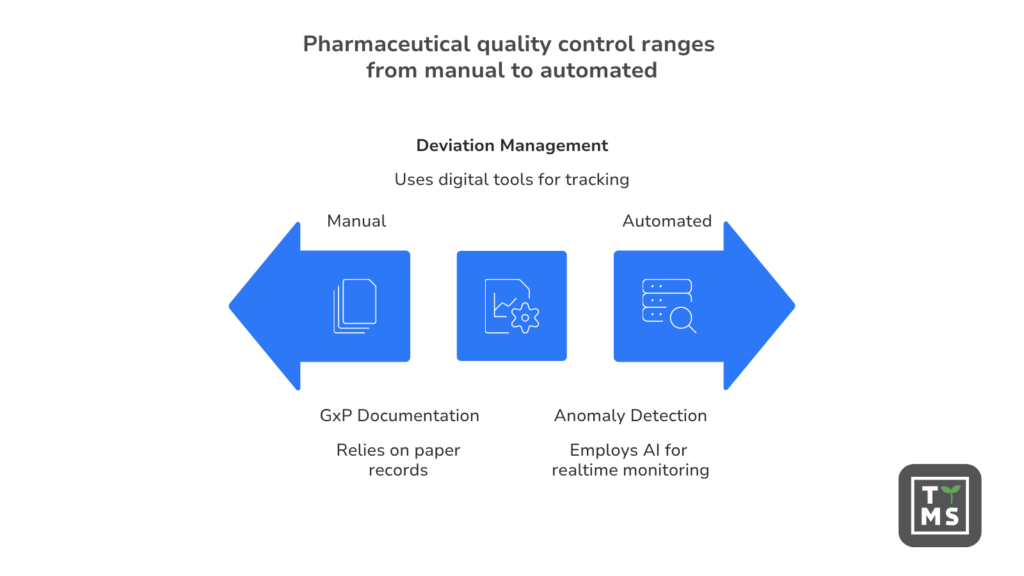
AI in pharmaceutical manufacturing is increasingly focused on anomaly detection, deviation management, and real-time quality monitoring. Low code platforms enable quality teams to build and maintain these workflows themselves, reducing the time between identifying a process gap and deploying a digital solution.
Webcon BPS is particularly well-suited here. Its process-centric architecture supports structured deviation workflows, corrective and preventive action tracking, and batch release sign-off processes, all with built-in audit trails that align with GxP documentation expectations. For manufacturers operating across multiple sites, the ability to standardize these processes on a single governed platform is a meaningful operational improvement.
3.3 Streamlining clinical trial data management
Clinical trials generate enormous volumes of data from diverse sources: electronic data capture systems, wearables, site management software, and patient-reported outcome tools. Managing this data consistently while maintaining regulatory compliance is a persistent challenge for clinical operations teams.
The potential gains here are substantial. Seagen, a biopharmaceutical company, deployed a cloud-native solution to automate clinical trial data publishing and legal/compliance review workflows that previously took up to six months to complete. By integrating the clinicaltrials.gov API directly into their review process, the team reduced approval time from months to minutes.
Pfizer’s integration team later recognized the solution as best-in-class, noting that their own equivalent process required six months to approve just three to five trials. It’s a concrete illustration of what targeted automation can achieve in regulated clinical workflows. The same architectural thinking applies when deploying low code AI tools for data aggregation dashboards, automated status reporting, and anomaly-flagging workflows across trial operations.
3.4 Enhancing pharmacovigilance and post-market surveillance
Pharmacovigilance requires rapid intake, triage, and reporting of adverse event data. Delays carry both regulatory and reputational risk. Low code AI tools can automate case intake forms, route reports to the correct reviewers, and generate draft narratives using AI assistance, all within a governed workflow that maintains a complete audit trail.
Webcon BPS’s workflow architecture maps naturally to the structured, multi-step review processes that pharmacovigilance teams rely on. Combined with TTMS’s experience in IT outsourcing and managed services, organizations can deploy and maintain these solutions without building internal platform expertise from scratch.
3.5 Optimizing supply chain visibility and logistics
Pharmaceutical supply chains are complex, tightly regulated, and vulnerable to disruption. Low code AI platforms can surface real-time inventory data, automate reorder triggers, and provide visibility into cold-chain compliance status through dashboards that operations teams can configure and update themselves.
Quest Nutra Pharma partnered with Kissflow adoption of a low-code compliance workflow platform is a useful example. By automating quality check tracking, regulatory process updates, and compliance reporting on a single governed platform, the company achieved faster response times when adapting to regulatory changes and reduced non-compliance risk across its operations. Power Apps, connected to enterprise data sources through Power Platform’s broad connector library, offers the same capability for mid-sized pharma companies that need more than a spreadsheet but can’t justify a major ERP customization project.
4. Choosing the right low code ai platform for life sciences
Platform selection is where many pharma organizations stall. The market includes dozens of low code tools, and not all of them are suited to the compliance, security, and integration demands of a regulated industry. A structured evaluation process helps narrow the field considerably.
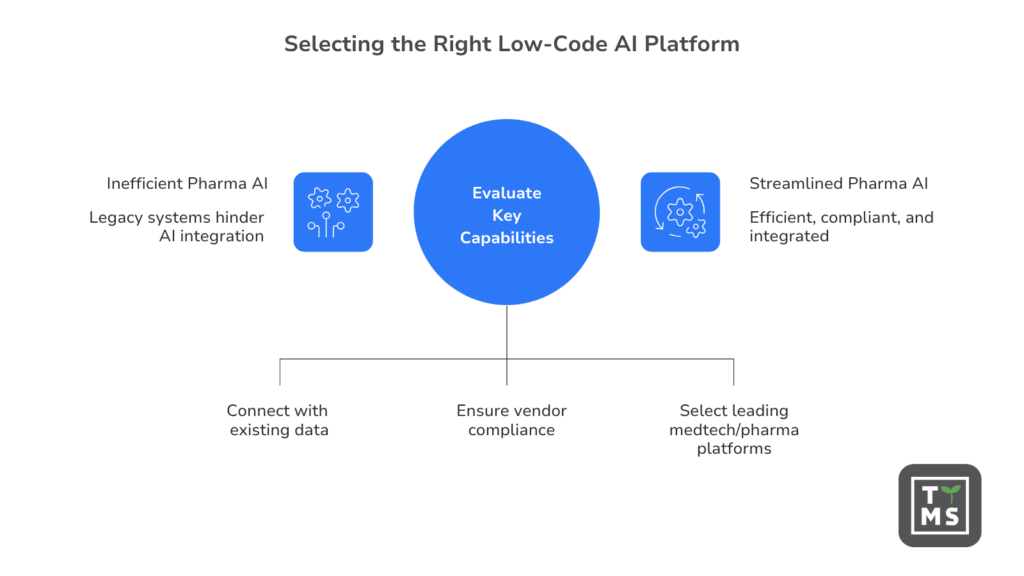
4.1 Core capabilities to evaluate for pharma-specific requirements
Any platform evaluation should start with the functional requirements most critical to pharma operations: structured workflow support, role-based access control, document handling, electronic signatures, and AI integration. Beyond features, consider the governance model. Can IT teams set guardrails for what citizen developers can build? Can platform administrators enforce data classification rules? These controls aren’t optional in an environment where data integrity is a regulatory requirement.
4.2 Integration with legacy systems and existing data infrastructure
Pharma organizations carry significant legacy system burden. ERP platforms, LIMS, document management systems, and clinical data repositories have often been in place for decades, each with its own data model and integration interface. A low code platform that can’t connect to these systems reliably adds integration risk rather than reducing it.
Both Power Apps and Webcon BPS address this challenge directly. Power Apps connects to hundreds of enterprise systems through Power Platform connectors, while Webcon BPS provides REST API support and native integrations with common business systems. TTMS’s broader IT integration expertise means these connections can be designed with the data governance standards that pharma environments require.
4.3 Vendor validation, Audit trails, and 21 CFR Part 11 readiness
21 CFR Part 11 governs the use of electronic records and electronic signatures in FDA-regulated industries. Any low code platform used in a regulated context needs to support the relevant technical controls, including audit trails, access controls, and record integrity measures. Worth noting: platform capability is distinct from validated implementation. A platform designed to support 21 CFR Part 11 compliance still requires a validation protocol, installation qualification, and operational qualification before it can be used in a regulated process.
TTMS can supports pharma clients through this validation process, drawing on experience with both Power Apps and Webcon BPS in governance-sensitive environments. This includes helping organizations build the documentation packages, test scripts, and change control procedures that regulators expect.
4.4 Leading platforms used in medtech enterprises and pharma in 2026
Platforms often considered for low-code, workflow automation, or regulated content workflows in pharma and medtech include low code environments include Microsoft Power Platform (encompassing Power Apps, Power Automate, and Power BI), Webcon BPS, Appian, ServiceNow, and Veeva Vault for specific regulatory content workflows. TTMS brings direct implementation experience with both Microsoft Power Apps and Webcon BPS in enterprise environments. The choice between them often comes down to the specific use case: Power Apps excels in broad departmental digitization and user-facing applications, while Webcon BPS is particularly strong for structured, compliance-heavy workflow automation.
5. Common barriers to low code AI adoption in pharma and how to overcome them
Even when the business case is strong, adoption rarely happens without friction. The barriers in pharma are distinct from those in other industries, and they require specific strategies to address.
5.1 Regulatory uncertainty and validation concerns
The most common hesitation in pharma IT is regulatory. Leaders worry that low code platforms will create compliance gaps, that regulators will scrutinize application builds differently, or that validation costs will negate the speed advantages. These concerns aren’t unfounded, but they’re often overstated.
The key distinction is between the platform and the application built on it. A well-governed low code platform, implemented with proper validation protocols, is defensible in an audit. The answer to regulatory uncertainty isn’t to avoid low code; it’s to build robust validation frameworks around its use. TTMS helps pharma clients develop these frameworks as part of its implementation approach, ensuring that speed and compliance reinforce rather than trade off against each other.
5.2 Data quality and interoperability challenges
Low code AI only delivers value when the data feeding it is reliable. Many pharma organizations discover their data quality and interoperability challenges are more significant than anticipated once they start digitizing workflows. Master data inconsistencies, siloed systems, and poorly documented data models can slow implementation considerably.
Addressing this barrier means treating data governance as a prerequisite, not an afterthought. Before deploying low code AI tools in a new domain, organizations should map their data sources, identify quality issues, and define ownership. TTMS’s experience in IT system integration and business intelligence helps clients build this foundation as part of a broader digital transformation strategy.
5.3 Change management and workforce readiness
Technology adoption ultimately depends on people. In pharma, where established processes carry regulatory weight, introducing new tools challenges deeply ingrained working habits. Resistance from quality teams, clinical operations staff, or manufacturing supervisors can stall a well-designed low code program.
Effective change management requires more than a training session. It means engaging business stakeholders early in the design process, demonstrating tangible improvements to their day-to-day work, and building internal champions who advocate for the new approach. TTMS’s e-learning capabilities support this by enabling pharma organizations to develop structured training programs that scale adoption across large, distributed teams.
6. What to expect from low code AI in pharma through 2026 and beyond
Market forecasts make the growth trajectory concrete. According to Technavio, the global low code AI platform market is projected to grow by USD 32.26 billion at a CAGR of 32.2% through 2029, driven by the democratization of AI, talent scarcity, and generative AI integration across sectors including healthcare. Grand View Research projects the broader low code application development platform market to reach USD 101.68 billion by 2030 at a CAGR of 22.5%, with AI-powered workflow optimization cited as a key growth driver in regulated industries. For pharma specifically, these figures signal a market where low code investment is no longer discretionary.
By 2026, organizations that began their low code journeys in 2023 and 2024 will be moving beyond individual applications toward enterprise-wide platforms that govern how low code tools are built, deployed, and maintained. The citizen developer model will mature, with clearer governance frameworks defining what business teams can build independently versus what requires IT involvement.
AI capabilities embedded in low code platforms will also deepen. Predictive analytics, natural language processing, and AI-assisted decision support will be available to business users through the same visual interfaces they use to build workflows today. This will raise new questions about model governance, explainability, and regulatory compliance for AI-generated recommendations in clinical and manufacturing contexts. Pharma organizations that build their low code governance structures now will be better positioned to incorporate these capabilities responsibly when the time comes.
The relationship between IT and business functions will continue to shift as well. IT becomes a platform enabler rather than the sole application builder, business teams take greater ownership of their digital processes, and the boundary between technology and operations grows more fluid. That’s the direction the industry needs to move.
7. How TTMS can help your organization get the most from low code in pharma
Implementing low code AI in a regulated industry isn’t simply a technology project. It’s an operational transformation that requires platform expertise, integration capability, regulatory awareness, and change management discipline. TTMS brings all of these to pharma clients as a single integrated partner.
As a recognized Microsoft Power Apps development company, TTMS helps pharmaceutical organizations deploy Power Platform solutions that enable citizen developers while maintaining IT governance. This includes designing the platform architecture, configuring security and data policies, building initial application templates, and training business users to take ownership of their workflows. The result is faster delivery of digital solutions that remain auditable and maintainable.
As an official Webcon Partner, TTMS also implements Webcon BPS for pharma clients who need structured, compliance-focused workflow automation. Webcon BPS’s process governance capabilities make it particularly well-suited for quality management, pharmacovigilance, and document control workflows where audit trail integrity and process standardization are non-negotiable. TTMS’s implementation approach incorporates the validation documentation and testing structures that pharma quality teams require.
Beyond these two platforms, TTMS’s capabilities extend across the full scope of what a pharma low code program needs to succeed. Its AI implementation expertise enables integration of intelligent automation and predictive analytics into low code workflows. Its IT system integration experience ensures that new applications connect reliably to existing ERP, LIMS, and clinical data systems. Its managed services model means pharma clients can maintain and evolve their low code environments without building a dedicated internal platform team. Its e-learning capabilities allow organizations to develop scalable training programs that bring large, distributed pharma workforces up to speed on new digital tools, accelerating adoption and reducing resistance.
If your organization is ready to explore how low code AI can solve real operational challenges, whether in manufacturing quality, clinical operations, supply chain, or pharmacovigilance, TTMS can help you build a practical roadmap and deliver results. Reach out to the TTMS team at ttms.com to start the conversation.
FAQ
What is low-code AI in the context of pharma?
Low-code AI in pharma refers to the use of visual development platforms that incorporate artificial intelligence capabilities, enabling pharma professionals to build and automate applications without extensive programming knowledge. Examples include Microsoft Power Apps for rapid application development and Webcon BPS for structured process automation in regulated workflows.
Is low-code AI compliant with pharmaceutical regulations like 21 CFR Part 11?
Low-code platforms can be designed and implemented to support 21 CFR Part 11 requirements, including audit trails, electronic signatures, and access controls. Compliance depends on how the platform is configured and validated, though. Organizations must follow appropriate validation protocols regardless of the platform used.
What types of Pharma processes benefit most from low-code AI?
Quality deviation management, clinical trial data workflows, pharmacovigilance case intake, supply chain visibility, and batch release processes are among the highest-impact use cases. Essentially, any structured, repetitive process that currently relies on manual data entry or email-based approvals is a strong candidate.
How long does it take to deploy a low-code AI solution in pharma?
Deployment timelines vary by complexity and regulatory scope, but low code platforms routinely reduce development time from months to weeks for standard workflow applications. A validation-ready deviation management workflow, for example, can often be configured and tested within four to six weeks with the right implementation partner.
What’s the difference between low-code and no code for pharma?
No code platforms are fully visual with no programming required, which limits customization. Low code platforms allow limited scripting alongside visual tools, giving developers more flexibility while still accelerating delivery. For regulated pharma environments, low code’s added flexibility usually makes it the more appropriate choice.
How does TTMS support low code AI adoption in pharma?
TTMS provides end-to-end low code implementation services, including platform selection, configuration, IT integration, validation support, and training. As both a Microsoft Power Platform partner and an official Webcon Partner, TTMS brings direct platform experience to pharma clients navigating complex digital transformation challenges.