AI can help your bid team extract requirements, deadlines, and eligibility criteria from the documentation, then compare them with information about your company’s capabilities. Each finding needs a source that allows you to verify it, along with a note of anything that still needs clarification. This overview helps the team assess whether to pursue the bid and who should be involved in preparing it.
Before committing your team to preparing a bid, check whether the contract terms are acceptable to your company. A requirement to provide round-the-clock support, buried in an appendix, could change the entire cost calculation. AI can help identify such requirements during the initial review, so you know what your company will need to deliver and which terms to clarify before work on the bid begins.
What information should AI find in the documentation?
List the information you look for in every RFP: what needs to be delivered, which conditions must be met, and how much time remains to prepare the bid. Use this list to create a standard analysis template. For the next tender, your team will immediately know where to find the requirement they need to check.
| Area | What to include in the analysis | How the team uses this information |
|---|---|---|
| Scope of the contract | Products or services, quantities, locations, contract lots, and additional options. | Assess whether the contract fits the company’s offering and what resources delivery would require. |
| Mandatory requirements | Required specifications, experience, certifications, and documents demonstrating compliance. | Identify requirements that must be confirmed as met before proceeding. |
| Deadlines | Dates for submitting questions, submitting the bid, and delivering the contract, including any specified times or events that trigger a deadline. | Plan bid preparation and check the delivery team’s availability. |
| Bid evaluation criteria | Criteria, their weightings, and scoring methods, where specified in the documentation. | Assess where the company can make its bid competitive. |
| Contract terms | Terms covering acceptance, payment, support, liability, and contractual penalties, where applicable. | Refer specific provisions for operational, financial, or legal review. |
| Required documents | Forms, appendices, and declarations, along with when they must be submitted. | Assign tasks and check whether the company has the required materials. |
The summary must clearly distinguish mandatory requirements from criteria that can earn additional points. Show the bid submission deadline and the contract delivery deadline separately. The decision-maker should be able to find this information without searching through the documentation again.
How did TTMS use AI to analyze Takeda’s RFPs?
Takeda’s Polish team reviewed extensive tender documents in which essential information was scattered across files and expressed in complex language. To streamline this work, TTMS developed a solution built on Salesforce CRM. AI helped identify key information and perform preliminary checks of whether the offering met the requirements specified in the RFPs. The system extracted details such as order volumes, delivery deadlines, and formal requirements. It prepared summaries and helped identify deviations from predefined parameters. The system also read scanned documents, processed multiple documents simultaneously, and highlighted relevant passages in the source material.

Users could see the passage on which the system based its answer and check whether the conclusion was supported by the cited text. In this implementation, AI streamlined RFP analysis and reduced the time needed to complete it. We describe the project’s scope in our case study on integrating Salesforce with AI at Takeda.
How should you organize AI-supported document analysis?
Run your first test on RFPs your team knows well. This makes it easier to check whether AI has identified the requirements that matter to the bid decision and whether it has missed anything.
1. Collect the current documentation for a single tender
Prepare the RFP together with its appendices, forms, and draft contract. For Polish public procurement procedures, include the specification of contract terms, known as SWZ, where applicable. Add any published clarifications and amendments relevant to the scope being analyzed. Record the source, publication date, and version of each file. Also identify the contract lot to which the document applies. The person responsible for preparing the bid should check that all materials have been collected and identify which provisions have been amended or supplemented in subsequent documents. A later file date alone does not establish which earlier provisions no longer apply. Check how the system reads scans and tables. Misreading a unit of measurement or assigning a value to the wrong column can change the meaning of a requirement. Microsoft identifies scan quality and text characteristics as factors affecting document recognition. Require a list of any files or pages the system could not process correctly.
2. Create a requirements list with source references
Ask AI to organize the requirements in a table, with one requirement per row. Make sure important qualifications are preserved when the text is shortened. If a requirement applies to only one product or contract lot, the summary must make this clear.
Include the following in the table:
- The requirement, including its specified value, unit of measurement, and any exceptions.
- Supporting documentation: the file name, version, section or page, and the passage supporting the finding.
- Scope of application, such as the contract lot or delivery stage.
- Review status and the person responsible for confirmation.
If AI cannot find the information, it should flag the issue for review. A missing result does not mean the requirement is absent from the documentation. Where provisions conflict, the system should show both sources so a specialist can resolve the discrepancy. In solutions using retrieval-augmented generation (RAG), the model receives relevant excerpts retrieved from the documentation and uses them to formulate its answer. This approach allows answers to be linked to their sources. To assess completeness, however, you also need to check whether the analysis covered all relevant documents and provisions.
3. Compare the requirements with your company’s capabilities
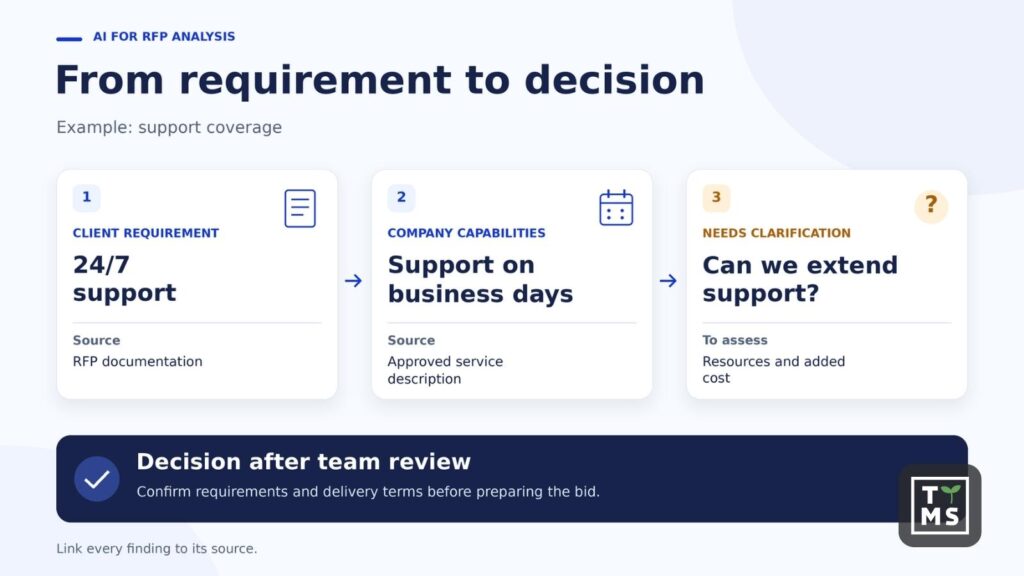
For the second part of the analysis, prepare approved internal materials: product data sheets, service descriptions, references, or certificates. Share only the data needed for the RFP in question. Information about team availability or delivery capacity can change. Assign someone to confirm that it is current. Every AI assessment of whether the company meets a requirement should include a reference to supporting documentation. A general description of capabilities may not be sufficient to demonstrate compliance with a specific condition. Assign each item a status: confirmed, discrepancy, missing information, or specialist review required. The person who checks the cited evidence confirms whether the requirement is met. If the RFP requires round-the-clock support but the service description specifies support on business days, flag the difference. The delivery manager will assess whether the company can extend its coverage and how this would affect the cost. The AI analysis should identify the discrepancy. The person responsible for delivering the service approves any decision to extend its scope.
4. Resolve outstanding questions and decide whether to bid
Use the discrepancies to create a list of issues to resolve. Separate questions for the contracting organization from internal matters, such as specialist availability, acceptance of payment terms, or the ability to provide a required document. Assign a deadline and an owner to each issue. AI can help draft a question based on an unclear provision. The person responsible for the bid should check the question’s wording and relevance, then determine how and when to submit it. Refer questions about the meaning of contractual obligations to a lawyer. Before deciding whether to bid, prepare a brief overview of which requirements the company meets, what obstacles remain, and how much work preparing the bid will require. Authorized individuals determine pricing, margins, and the acceptable level of risk. Keep a record of the decision’s rationale and the version of the documentation the team reviewed.
5. Update your findings when the documentation changes
Return to the requirements list whenever you receive a new appendix or clarification. Have it compared with the previous findings and identify which items require renewed approval. Keep a change history so the team can see why the assessment of a particular requirement changed. A change in support coverage may require an updated cost calculation. A new experience requirement may mean checking references again. Also confirm whether any deadlines have changed. If the system needs to retrieve new documents automatically, include integration with the publication source and monitoring of that integration in the implementation scope.
Which solution should you choose for RFP analysis?
Consider what your team will do with the completed analysis. If the bid manager needs a report to support document review, you can start the pilot with a document analysis tool. If findings need to be linked to sales opportunities and used to assign tasks, include CRM integration.
AI4Content is a TTMS tool for analyzing documents and preparing structured summaries using configurable templates. To use AI4Content for RFP analysis, adapt the report template and check how the tool reads your team’s documents, particularly scans and complex tables.
The CRM option allows you to link the analysis to the relevant opportunity and customer information, as in the Takeda project described above. Through its AI integration with Salesforce services, TTMS tailors the solution to the client’s process and data sources. Define during project planning which results will be saved in the CRM, which tasks should be created, and how changes will be approved.
For both options, assess document recognition quality, access to sources, handling of successive document versions, and the ability to verify results. Access requirements should also cover generated reports. Someone analyzing a public RFP does not necessarily need access to all internal cost calculations and references. Before sharing documents, agree with IT and the person responsible for security on where the documents will be processed, how long they will be retained, and how the AI service provider may use the data. Account for the confidentiality of customer documentation and the internal materials used for comparison.
How can you assess whether AI reduces your bid team’s workload?
Measure how much time the team spends preparing an analysis that is ready for approval. Include collecting files, using the tool, checking sources, and making corrections. Record time spent waiting for other departments separately. This will show how much time goes into the analysis itself and how much into obtaining the necessary confirmations. For the pilot, select completed tenders for which the team will prepare a reference requirements list. Include documentation containing tables, scans, and subsequent amendments. Set aside some cases for the final evaluation so you can also test the solution on materials that were not used to refine it.
Compare three elements:
- Completeness: Which important requirements were identified, and which were missed?
- Correctness: Do the specifications, deadlines, and cited sources match the documentation?
- Work required: How long did it take to produce a result accepted by a specialist?
Distinguish critical errors from minor corrections. Missing an eligibility requirement should carry more weight in the evaluation than awkward wording in a summary. Agree on acceptance criteria with the people responsible for bids before the pilot begins.
Put TTMS’s RFP analysis experience to work for your team
At TTMS, we implement AI in processes where business decisions depend on accurate document analysis. For Takeda’s Polish subsidiary, we developed a solution that supports RFP analysis and integrates with Salesforce. We can draw on this experience when designing improvements for your team.
TTMS has certified management systems for AI under ISO/IEC 42001, information security under ISO/IEC 27001, and quality under ISO 9001. We were the first company in Poland to obtain accredited ISO/IEC 42001 certification. When working with tender documents, these standards are relevant to risk management, information protection, and oversight of the solution.

Show us how you currently assess RFPs and which tasks take the most time. Together, we will define the pilot’s scope, evaluation criteria, and required integrations. Let’s discuss AI-supported RFP analysis and identify where we can reduce your team’s workload.
How does AI help analyze tender documents?
AI can extract requirements, deadlines, and specifications from documents, prepare summaries, and help compare them with company information. Useful results should include sources and flag issues that need clarification. The people responsible for the bid verify the findings and decide whether to participate in the tender.
What AI tools can be used to analyze RFPs?
You can use a document analysis tool such as AI4Content or a solution integrated with your CRM. TTMS implemented AI-supported RFP analysis within Salesforce for Takeda. Base your choice on document formats, how the findings need to be verified, and where the team will use the results.
Do you need to train your own AI model to analyze tender documents?
Many solutions can use an existing model supplied with relevant excerpts from the documentation, for example through retrieval-augmented generation (RAG). This means using the model rather than training it on company documents. Assess the need for additional training based on specific tasks and test results.
Can AI analyze scanned tender documents?
Yes, provided the solution supports reading scanned documents. However, the quality of the results depends on the document and the content recognition technology used. During the pilot, pay particular attention to tables, units of measurement, fine print, and footnotes. Any content read incorrectly should be flagged for manual review.
Can AI independently decide whether a company should bid?
In the process described here, AI prepares information to support the decision. An authorized person approves participation after reviewing the requirements, delivery capabilities, and commercial terms. Define who confirms each finding and which unresolved issues must be addressed before work on the bid can begin.