

Home •Blog
TTMS Blog
TTMS experts about the IT world, the latest technologies and the solutions we implement.
Sort by topics
Search results for the term: “chatgpt”
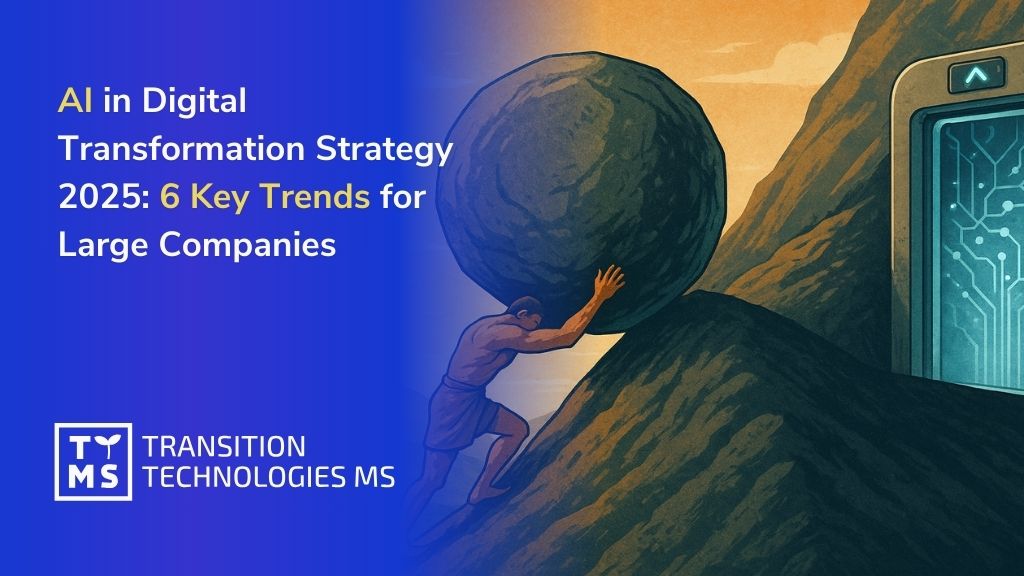
AI in Digital Transformation Strategy 2025: 6 Key Trends for Large Companies
First, some statistics… Digital transformation is gaining momentum – in 2025, as many as 94% of organizations are conducting various types of digital initiatives. Artificial intelligence (AI) is increasingly at the center of these activities. Over three-quarters of companies already use AI in at least one area of their operations, and 83% of enterprises consider AI to be a strategic priority. AI is not a futuristic curiosity, but a key factor of competitive advantage. What AI trends should be included in the strategy of organizations planning development after 2025? Below we present the most important of them, especially important for leaders of digital transformation in large companies. Global AI software revenues are growing exponentially, signaling massive business investment in AI. The rapid growth of the AI market is accompanied by a rapidly growing number of implementations in companies – according to McKinsey research, 78% of organizations use AI in at least one business function. For management, this means that AI must be included in long-term strategies to stay ahead of the competition. More and more leaders are recognizing this fact – almost half declare that AI is already fully integrated into the strategic plans of their business. A strategic approach to AI, based on current trends, is therefore becoming a condition for successful digital transformation after 2025. 1. Process automation (hyperautomation) Business process automation using AI is one of the pillars of digital transformation. In the era of striving for operational excellence, companies reach for the so-called hyperautomation – combining many technologies (AI, machine learning, RPA) to automate everything possible. According to Gartner, hyperautomation is a priority for 90% of large enterprises, which shows how important it has become to streamline processes using AI. Both routine back-office tasks (e.g. document processing, reporting) and customer interactions (chatbots, voicebots) can be automated. For example, AI algorithms can analyze documents and extract data from them in a matter of seconds – something that used to take employees hours to do manually. RPA systems combined with AI can independently handle financial, HR, and logistics processes, learning from data and improving their operation over time. 70% of organizations indicate simplifying workflow and eliminating manual activities as a top priority in their digital strategy, and AI fits perfectly into these goals. What’s more, it is estimated that by 2026, 30% of enterprises will automate more than half of their network processes (up from <10% in 2023) – proof that the scale of automation is growing rapidly. Companies investing in AI-driven automation note tangible benefits: reduced operating costs, faster task execution, and relieving employees of tedious duties (allowing them to focus on creative tasks). As a result, digital transformation accelerated by automation is becoming a fact, giving organizations greater agility and productivity. 2. Predictive analytics and data-driven decision making Predictive analytics is another key area that should be part of every large company’s AI strategy. By using machine learning to analyze historical data, organizations can predict future trends, events, and demand with unprecedented accuracy. Instead of relying solely on reports describing the past, companies using predictive analytics can predict, for example, an increase in product demand, the risk of customer churn, or a production machine failure before it happens. This type of AI in business translates into better decisions—proactive, based on data, not intuition. The market for predictive analytics solutions is growing rapidly (around 21% per year) and is expected to almost double in value from USD 9.5 billion in 2022 to around USD 17 billion in 2025. No wonder – companies implementing predictive AI models are seeing significant benefits. In one study, 64% of companies indicated improved efficiency and productivity as the main advantage of using predictive analytics. For example, retail chains using AI to forecast demand can better manage inventory (avoiding shortages and surpluses), while banks that predict which customers may have difficulty repaying their loans are able to take remedial action earlier. Predictive analytics is used in every industry – from industry (maintenance of traffic based on predicting machine failures), through logistics (optimization of the supply chain based on forecasts), to marketing (predicting customer behavior and personalizing the offer). For management, this means the ability to make better decisions faster. AI solutions for business in the area of prediction are therefore becoming an essential element of the strategy of companies that want to be data-driven and stay ahead of market changes instead of just reacting to them. 3. AI integration with CRM/ERP systems Another trend shaping AI 2025 is the penetration of AI into key business systems, such as CRM (customer relationship management) and ERP (enterprise resource planning). Instead of treating AI as a separate experiment on the sidelines, leaders are focusing on integrating AI with existing platforms—so that machine intelligence supports sales, customer service, finance, and operations processes within existing tools. Business software vendors are recognizing this need and are increasingly offering built-in AI modules. Microsoft, for example, has introduced GPT-4-based Dynamics 365 Copilot into its ERP/CRM system, and SAP is developing the AI assistant “Joule” in its business applications. The benefits of such integration are enormous. In AI-powered CRM systems, salespeople receive suggestions on which lead is the most promising (AI scoring), which products to recommend to the customer, and even ready-made drafts of offer emails generated by the language model. AI support also means automatic logging of customer interactions or analysis of the sentiment of the customer’s statements (are they satisfied or irritated?). In turn, in ERP systems, AI helps to optimize the supply chain (better demand and inventory level forecasts), detect financial anomalies, improve production planning or automatically compare supplier offers. According to analyses, more than half of companies have already implemented AI-enhanced CRM systems – what’s more, these companies are 83% more likely to exceed their sales goals thanks to better use of customer data. This shows the real impact of AI on the core of the business. Integrating AI with CRM/ERP systems often requires a professional approach – identifying the right points where AI will add the most value, adapting models to company data and ensuring smooth cooperation of the new “intelligence” with existing processes. An example of a successful implementation is a project where TTMS introduced an AI system integrated with Salesforce CRM, automatically analyzing requests for proposals (RFP) and assessing key criteria. This solution significantly improved the bidding process – AI accelerated decision-making and allocation of resources needed to prepare the offer. This is real proof that well-integrated AI can relieve employees (here: the sales department) from time-consuming document analyses and allows them to focus on building relationships with the customer. Similar AI implementations are becoming a part of an increasing number of companies – they integrate, for example, AI-based chatbots with customer service systems, machine learning modules with inventory management systems or AI in finance, connecting with ERP to automatically classify expenses. As a result, an AI strategy should closely intertwine AI with a company’s core IT infrastructure, so that AI permeates end-to-end processes rather than operating in isolation from them. 4. Generative AI – from ChatGPT to custom models Generative AI has gained a lot of publicity in 2023-2024 thanks to models like GPT-4 (ChatGPT), DALL-E and other systems capable of creating new content – texts, images, code – at a level close to human. For large companies, generative AI opens up completely new possibilities, which is why it should become an important element of the strategy for the coming years. The applications are very wide: automation of creating marketing content, generating personalized offers for customers, creating chatbots that can conduct natural dialogue, supporting R&D departments (e.g. generating and testing new product concepts), and even assistance in programming (an “artificial programmer” suggesting code). Today, 71% of organizations declare regular use of generative AI in at least one area of activity (up from 65% at the beginning of 2024). This means that generative models have very quickly moved from the phase of curiosity to practical implementations in business. For leaders of digital transformation, generative AI is a double challenge: on the one hand, a huge opportunity for innovation, and on the other – the need for caution and ethics (more on that in a moment). Trends indicate that in the coming years, companies will build their own generative models specialized in their domain (e.g. a model that will generate a financial report based on company data or an assistant to handle internal corporate knowledge). GenAI-as-a-Service solutions are already being created in the cloud, which allow models to be trained on their own data while ensuring confidentiality. Generative AI is also changing the rules of the game in the area of customer service – a new generation chatbot can solve much more complex customer problems, while connecting to the company’s internal systems. Another important trend is the use of generative AI in work tools – for example, GPT-based assistants appear in office suites, facilitating the creation of summaries, presentations and analyses. This affects employee efficiency, in a way “doubling” human resources: PwC predicts that the use of AI agents can give an effect equivalent to doubling the size of the team thanks to the automation of routine tasks. An example of the use of generative AI in a large company can be the TTMS case study from the automotive industry, where a PoC was developed using Azure OpenAI (GPT-4) to automatically process vehicle parameter queries and calculate discounts. Such an intelligent application is able to generate an optimal price offer in a few seconds based on the description of the car configuration – something that previously required manual analysis of price lists and discount tables. This shows that generative AI can support sales and pricing in real time, increasing the pace of business operations. In summary, generative AI is a trend that large companies cannot ignore. The AI strategy for 2025+ should include pilot implementations of generative tools where they can bring the fastest return (e.g. content marketing, customer service, developer support). At the same time, it is necessary to take care of the framework for managing such models – from quality control of generated content to protection against the generation of unwanted data. Those who learn to use generative AI effectively in their business first will gain an innovator’s advantage and significantly accelerate their digital transformation. 5. AI Ethics and Responsibility The integration of AI into business strategy on a large scale requires an equally large attention to ethical issues and responsible AI development. The more algorithms decide on important matters (e.g. granting credit, medical diagnosis, CV selection of candidates), the louder the questions are asked: does AI make fair and non-exclusive decisions? Is it transparent and explainable? Is customer data adequately protected? Leaders of large companies must ensure that AI operates in accordance with ethical principles, otherwise they expose the organization to legal (upcoming regulations, such as the EU AI Act), reputational and business risks. The concept of Responsible AI is gaining in importance – a set of practices and principles that are supposed to ensure that the developed models are free from undesirable biases, and their operation is transparent and compliant with regulations. The ROI from AI depends on the adoption of the principles of Responsible AI – PwC experts note. In other words, investments in AI will bring full benefits only if customers and partners trust these systems. Meanwhile, there is a lot to be done here – although 75% of executives consider AI ethical issues to be very important, at the same time only 40% of customers and citizens trust companies to use AI responsibly. We see a clear gap between intentions and social perception. Organizations must fill this gap through specific actions: creating AI codes of ethics, establishing algorithm oversight committees, training on unconscious data biases, implementing AI Governance principles and monitoring models in terms of their decisions. Fortunately, the trend is positive – awareness of the problems is growing. As many as 90% of companies admitted that they had encountered an ethical “slip” of AI in their operations (e.g. biased indications of the recruitment system), which encourages the development of better practices. Awareness of specific issues has increased: for example, 78% of managers are already aware of the importance of AI explainability (compared to 32% a year earlier). The AI strategy for 2025 and beyond should therefore include the AI ethics by design component – from the outset, implementations should be planned so that they are transparent, fair and legal. This also applies to the use of data: AI should not violate privacy or information security principles. Companies that choose responsible AI will not only minimize risk, but will also gain an advantage – they will build greater customer trust, and their brand will be distinguished by credibility. All this translates into a long-term AI strategy consistent with business values and sustainable development. 6. Scalability of AI implementations across the organization The last but absolutely crucial trend (and challenge) is scaling AI solutions across the entire organization. Many large companies have successful AI pilot implementations behind them – prototypes of models or limited rollouts, e.g. in one department. However, for AI to truly change business, it cannot remain an isolated experiment. The AI strategy should include a plan to move from PoC (proof of concept) to production use on a large scale, in all places where the technology brings value. And this can be a problem – as IDC research shows, as many as 88% of AI projects get stuck at the pilot stage and do not go into production on a company-wide scale. In other words, statistically only 4 out of 33 AI initiatives manage to successfully develop globally. The reasons can be various: lack of clear business goals for the project, insufficient data or infrastructure quality, difficulties in integrating the solution with existing systems, as well as a shortage of talent (lack of MLOps, data science experts). In 2025, large organizations are therefore focusing on AI scalability and maintenance. Concepts such as MLOps (Machine Learning Operations) are gaining popularity – they mean a set of practices and tools that allow you to manage the life cycle of models (from prototype, through testing, to implementation and monitoring) similarly to software management. IT leaders realize that the right resources are needed: cloud AI platforms that will allow for a rapid increase in computing power for model training, repositories of functions and models for reuse in various projects, mechanisms for automatic scaling of AI applications as the number of users or data grows. Companies that have managed to build such an “AI factory” note a much higher return on investment – they achieve the scale effect: if one model saves PLN 1 million, then implementing similar models in 10 areas will already give PLN 10 million in benefits. McKinsey research confirms that AI implementation leaders use AI in an average of 3 business functions, while the rest are limited to single applications. In practice, this means that these companies are able to replicate successes – for example, an AI model tested in the sales department can be more easily adapted later in the after-sales service department, etc. Scalability also means changing the organizational culture – for AI to permeate the company, employees must be trained and convinced to work with AI, cross-departmental teams should jointly implement projects (business + IT + analysts), and the board should actively patronize AI initiatives. As McKinsey points out, the CEO’s involvement in overseeing AI projects strongly correlates with achieving a higher AI impact on the company’s results. In other words, scaling AI is a strategic task, not just a technical one – it requires vision, investment, and coordination across the entire organization. The strategy for 2025+ should therefore include: a plan for building infrastructure and competencies for scaling AI, selecting appropriate platforms (e.g. tools for automating model implementations), establishing success metrics (KPIs) for AI projects and a process for evaluating them before expansion. Companies that do this will turn individual AI implementations into a lasting advantage – AI will become part of their organizational “DNA”, not just an add-on. As a result, digital transformation will be driven at all levels by AI solutions for business – from operations, through analytics, to customer interactions. Ready for AI Strategy 2025? The future of large organizations will undoubtedly be shaped by the above AI trends: from widespread process automation, through predictive data approach, AI integration in systems, generative innovation, to the emphasis on ethics and scaling solutions. Each of these elements should be reflected in your AI strategy for the coming years. Putting them into practice will allow you to streamline the digital transformation of your business and maintain a competitive advantage in the world after 2025. Contact us – TTMS experts will help you translate these trends into specific actions. Together we will develop an effective AI strategy for your company and implement AI tailored to its needs. With the support of an experienced partner, you will maximize the potential of artificial intelligence, ensuring your organization’s growth and innovation in the digital era. What is hyperautomation and how does it differ from traditional automation? Hyperautomation is an advanced approach to process automation that combines technologies such as AI, machine learning, robotic process automation (RPA), and intelligent workflows to automate as many business processes as possible. Unlike traditional automation, which typically focuses on repetitive tasks, hyperautomation integrates multiple systems and data sources to optimize entire end-to-end processes, allowing for continuous improvement and greater scalability. What exactly is generative AI and how can businesses use it? Generative AI refers to AI models capable of creating new content — such as text, images, or code — based on training data. Examples include ChatGPT and DALL·E. Businesses use generative AI to automate content creation, personalize customer communication, support product development, and assist software engineering. It enables faster innovation and improves efficiency across marketing, sales, and customer support functions. What does MLOps mean and why is it important? MLOps, short for Machine Learning Operations, is a set of practices that aims to streamline the development, deployment, monitoring, and management of machine learning models. Similar to DevOps in software engineering, MLOps ensures that AI models are continuously integrated, tested, and updated in a scalable and secure way. It is essential for organizations that want to move from pilot AI projects to large-scale, production-ready implementations across departments. Why is explainability in AI so important? Explainability in AI refers to the ability to understand how and why an AI system made a specific decision. This is crucial in regulated industries like finance or healthcare, where transparency and accountability are required. Explainable AI builds trust among users and stakeholders and helps ensure that models are fair, reliable, and compliant with ethical and legal standards. What are the risks of implementing AI, and how can they be mitigated? AI implementation comes with risks such as data bias, lack of transparency, data privacy concerns, and unintended consequences in decision-making. These risks can be mitigated through responsible AI practices — including clear governance frameworks, continuous monitoring, ethical guidelines, and user education. Involving multidisciplinary teams and ensuring human oversight are also key strategies to maintain control over AI-driven processes.
Read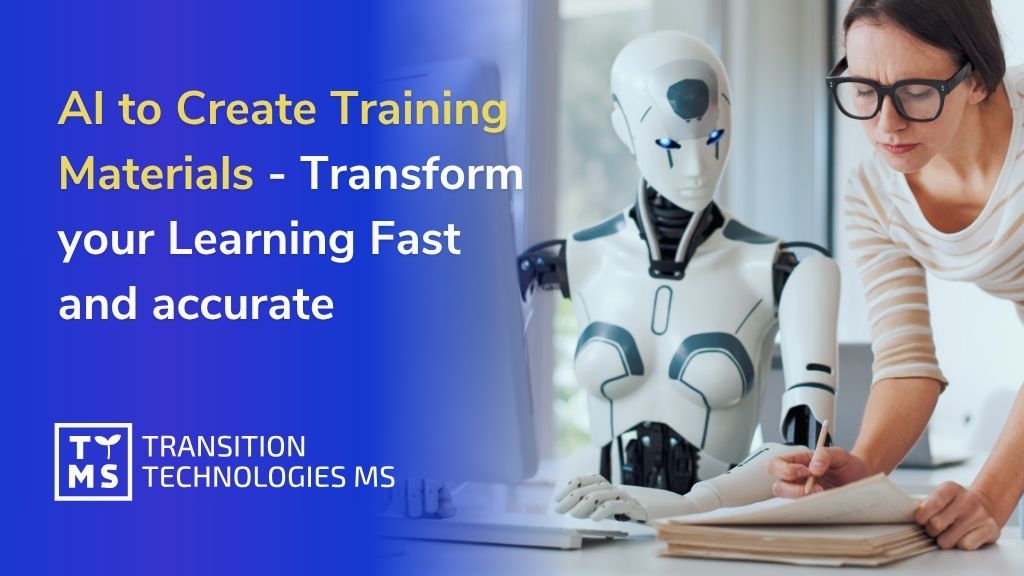
AI to Create Training Materials – Transform your Learning Fast and accurate
AI is the silent hero of HR and L&D departments— it builds training programs, tracks progress, recommends what people should focus on next, and even figures out how to keep them motivated. All without complaining about endless meetings or the lack of coffee in the break room. These days, when every minute matters and scalability is the name of the game (right alongside “synergy,” of course), getting a grip on AI tools isn’t just a competitive edge — it’s survival. 1. AI-Powered Training Tools – A Look at the Most Interesting Applications Let’s start at the beginning. It’s hard to ignore the fact that artificial intelligence in employee training and development—though often described as revolutionary—is, at its core, simply a response to the growing demands of modern business. This statement, repeated like a mantra in many corporations, might sound cliché, but today it’s more true than ever. Choosing the right tools for employee and corporate training is no longer just about cost optimization. It’s a response to the shift in how we work—a shift we’ve all experienced. After the COVID-19 pandemic, remote and hybrid work models stopped being emergency measures and became standard options—or even perks for many. It’s no surprise, then, that training has also entered a new era. When working remotely, we spend long hours in front of computer screens—writing reports, attending meetings, and handling daily responsibilities, depending on the industry. This extended screen time makes it increasingly difficult to maintain focus for long stretches. So it won’t come as a shock when I say: it’s much easier to stay engaged during a strategic game than while watching yet another “talking head” on a video call. E-learning and cognitive science experts have known this for decades. Back in the 1960s, the first known e-learning system—PLATO (Programmed Logic for Automated Teaching Operations)—was created at the University of Illinois. While the technology at the time was limited, PLATO did what mattered most: it enabled learning across various subjects with interactive elements between students and instructors via forums, tests, and chats. Today, both academia and the business world can’t imagine training without e-learning. And now, artificial intelligence is stepping in—reshaping the rules and setting new directions for education and skill development with remarkable momentum. 1.1 Competency Analysis Systems Competency analysis systems are specialized tools—often integrated with LMS (Learning Management Systems) or HRM (Human Resource Management) platforms—that allow companies to assess employees’ knowledge and skill levels, identify competency gaps, and design effective development actions such as training, mentoring, talent redeployment, or career path planning. At the organizational level, it becomes crucial not only to monitor current employee knowledge, but also to anticipate risks and potential competency losses that could threaten operational continuity, service quality, or innovation. These systems also enable competency mapping, providing a broader, more strategic view of knowledge and skills across the company. With real-time insights, organizations can pinpoint where competencies are lacking, in surplus, or unevenly distributed—whether at the individual, team, departmental, or even geographic level. 1.2 AI Learning Assistants and Chatbots AI-powered learning assistants and chatbots are intelligent tools that support the learning process in a modern, interactive way. Their main role is to guide users through training, answer questions, assist with quizzes, and keep learners motivated. Available 24/7, they allow employees to access support anytime—without needing to contact a live trainer. An educational chatbot can accompany learners from day one—for example, during onboarding—delivering personalized content tailored to each individual’s progress and needs. It can simulate real-life scenarios (such as customer or auditor conversations), send reminders about incomplete modules, ask review questions, and explain complex concepts in simple terms. In industries like pharmaceuticals, such a chatbot can play a key role in onboarding employees who work with specialized machinery—explaining calibration procedures, reminding users of GxP protocols, or helping them prepare for certifications. Crucially, these AI assistants learn in real time—analyzing user responses and behaviors to continuously refine and personalize the content. It’s not just convenient—it’s also highly effective, significantly accelerating the learning process and reducing training costs. 1.3 The Interactive Training Manual – A New Standard in Corporate Learning Traditional training materials in PDFs or slide decks are quickly becoming a thing of the past. More and more companies are turning to interactive AI e-learning manuals that actively engage employees, improve content retention, and allow for progress tracking. Powered by e-learning AI, these intelligent manuals can automatically adapt content to the user’s skill level, introduce dynamic quizzes, and provide personalized learning paths that evolve with each user’s progress. This approach not only increases engagement but also transforms traditional training into a continuous, data-driven learning experience. An interactive training manual can, for example, guide an employee step by step through every stage of working with a specific machine—from preparing the workstation, to starting up, to properly shutting down the production cycle. In such a scenario, the manual might include the following components: Visual – A 360° virtual tour of the workstation, allowing users to explore the environment, device layout, and critical elements that require special attention (e.g., safety systems, control panels). Simulative – Interactive simulations where users click through machine components to learn how to start and stop operations, recognize alarms, and respond to emergency situations. Repetitive/Practice – Interactive checklists for verifying machine readiness before operation. Assessment-based – Quizzes featuring scenario-based and multimedia questions to test understanding and decision-making. With AI integration, these manuals represent a significant step forward in efficiency, engagement, and safety in corporate training. 2. AI Course Builders – Smart Tools for Rapid Training Creation AI course builders are intelligent platforms designed to streamline and automate the creation of training content. The user simply enters a topic or provides basic information, and the system – powered by artificial intelligence in e-learning – generates the course structure, lesson content, quizzes, summaries, and even visuals and videos. This is a breakthrough for HR teams, trainers, and educators who can now develop valuable courses in a fraction of the time without having to manually craft every component. With the help of AI in e-learning, it’s also easy to translate materials into multiple languages, personalize content for diverse learners, and instantly update courses as procedures or regulations evolve. Modern e-learning AI solutions dramatically reduce the time needed to design training programs while keeping them engaging, relevant, and perfectly aligned with learners’ needs. In this way, AI for e-learning empowers organizations to scale learning initiatives efficiently, making AI e-learning a cornerstone of next-generation corporate education. 3. How to Create Training Materials with AI? 3.1 Define the Training Goal and Target Audience Before designing a course using artificial intelligence, it’s essential to clearly define its business objective and the characteristics of the target audience. What competencies need to be developed? What challenges is the organization facing? What learning outcomes are expected? An onboarding program for a new production worker will look very different from an advanced leadership path for a mid-level manager. A well-defined goal helps guide the following steps—especially tool selection and content generation. 3.2 Choose AI-Based Tools Once you know the type of course and who it’s for, you can begin selecting the right technologies to support its development. The market offers a range of AI tools for generating educational content, creating interactive quizzes, using avatars for video production, and LMS platforms with personalization and data analytics features. The tools you choose should reflect your specific needs—whether it’s fast deployment, multilingual support, or maximum learner engagement. Increasingly, AI training platforms offer all-in-one solutions that combine several of these capabilities in a single environment. 3.3 Design the Course Structure with AI At this stage, AI can play a key role in building a logical, engaging course structure. All it takes is inputting the topic and basic objectives, and the AI tool will suggest a module breakdown, key topics, sample exercises, and knowledge-check questions. This initial draft serves as a foundation for further customization to fit organizational needs. 3.4 Generate Learning Content Once the structure is in place, you can move on to content creation. AI tools can assist with writing lesson summaries, quizzes, checklists, translations, and supplemental materials. For multimedia, AI-generated avatars or animations can help create professional video content without the need for a production studio. However, it’s important to review all AI-generated content for accuracy—AI may not always reflect the nuances of a specific industry, organizational culture, or regulatory standards. 3.5 Implement the Course in an LMS The finished materials should be integrated into your chosen Learning Management System (LMS). Here, you define learning paths, set completion criteria, manage content access, and configure how materials are presented. Modern AI-supported LMS platforms offer features like automated progress tracking, personalized content suggestions, reminders, and adaptive learning experiences. A well-configured LMS is essential for a user-friendly and effective learning journey. 3.6 Pilot Testing and Optimization Before full rollout, it’s recommended to test the course with a representative user group. This allows you to identify inconsistencies, assess content difficulty, and gather early feedback. AI can support this phase by analyzing user behavior—highlighting sections where participants struggle or skip content. Insights gained here are crucial for final course optimization. 3.7 Continuous Improvement Through Data Once the course is live, ongoing monitoring and updates are key. AI tools can help identify users who are struggling, predict dropout risks, and measure the effectiveness of each module. This enables real-time improvements and helps maintain high engagement levels. Rather than a static product, the course becomes a dynamic, evolving tool that continuously supports skill development across the organization. 4. AI for Course Creation. Can AI-Generated Courses Replace Human Trainers? AI-generated courses are making an increasingly bold entrance into the world of education and training, sparking both excitement and concern. A common question arises: can their quality match that of materials developed by experienced human trainers? While AI lacks human intuition and real-world experience, its capabilities are undeniably impressive—especially when it comes to speed and scalability. In just minutes, it can generate a complete course: from structure and educational content to quizzes, animations, and AI-voiced videos. What’s more, this content can be instantly translated into multiple languages, updated to reflect new regulations, or tailored to each learner’s skill level. However, it’s important to recognize the limitations. AI doesn’t understand the specific context of a company, lacks personal experiences, and often misses the deeper industry nuances. The content it generates can feel generic, lacking the depth or authentic engagement that skilled trainers bring to the table. AI also falls short when it comes to interpreting cultural subtleties or reading participants’ emotions—an essential skill when working with groups. The quality of output also heavily depends on the input: vague prompts will likely result in poorly aligned or superficial courses. That said, the future clearly points toward human-machine collaboration. Hybrid models are gaining popularity—where AI handles the foundational content, and trainers provide context, lead workshops, moderate discussions, and engage learners in real time. AI won’t replace great trainers—but it can significantly support and elevate their work. It shifts their role from content deliverer to learning experience designer, blending technology with methodology and empathy. In this new landscape, those open to change and willing to learn will come out ahead. Trainers who embrace AI tools will become more flexible and competitive. HR and L&D teams will be able to respond more quickly to evolving training needs. Employees will benefit from more personalized, on-demand learning experiences. And training companies that integrate AI into their offerings will gain an edge by combining tech-driven efficiency with the human value of connection. On the flip side, those who ignore the shift risk being left behind. Trainers clinging solely to traditional methods may be phased out. Agencies that fail to modernize will lose their competitive edge. And companies that stick with outdated training systems will move slower and operate less efficiently than their digitally agile peers. There’s no doubt that AI in training isn’t a passing trend—it’s one of the most important transformations in corporate education. The question is no longer if we’ll use it, but how. Because while technology may be emotionless, when used wisely, it has the power to make learning more human than ever before. 5. AI for Learning and Development. How to Create Effective Training Materials Using AI. To answer this question, it’s worth turning to adult learning theory—particularly the work of Malcolm Knowles and David Kolb. Experienced trainers know that adults learn best when they understand why they need to learn something, when they can work on real-world problems, and when they learn by doing and through direct experience. Equally important is the ability to control the pace and direction of their own development. Artificial intelligence can support these needs exceptionally well—provided it’s given the right guidance. Tools like ChatGPT, Notion AI, or Microsoft Copilot can generate course outlines, break them into modules, suggest learning objectives, and recommend exercises. But they rely on well-crafted prompts—clear, thoughtful instructions that set the right direction. The same applies to multimedia creation, assessments, and quizzes: while AI offers immense potential, it still needs input from an expert who can provide context, instructional know-how, and quality source materials. Personalization and content adaptation is where AI shines even brighter. Modern training platforms powered by AI can tailor learning paths based on test results, user activity history, and even individual preferences. This allows each learner to receive exactly what they need, in the format and pace that best suits their learning style. In this area, AI can take over many of the time-consuming tasks trainers used to handle manually—analyzing responses, adjusting materials, and identifying learner needs. With AI, the process becomes faster, more precise, and effortlessly scalable. AI algorithms can instantly identify who is stuck, who is disengaged, and who is moving through content quickly. With built-in analytics tools—either as part of an LMS or as standalone systems—organizations can continuously improve training materials based on real data and learner behavior. This marks a new chapter in instructional design—one that is more dynamic, responsive, and effective than ever before. In summary, for AI-assisted training materials to truly be effective, they must be designed with clear intent and sound instructional methodology. AI isn’t a magic wand—it’s a powerful assistant: fast, versatile, but still in need of direction. You must define your learning goals, ensure the content is accurate and relevant, and thoroughly test everything before rollout. A well-designed prompt can yield excellent results—but a poorly crafted one can lead to generic, shallow, or mismatched content. 6. How to Choose the Right AI Course Maker for Your Company? Choosing the right AI-powered online course builder is a decision that can significantly impact the effectiveness of training within your organization. To ensure the tool matches your needs, start by clearly defining your training goals and target audience—onboarding frontline workers requires different features than leadership development or specialized skills training. Next, determine the type of content you want to create—text, presentations, AI-generated avatar videos, quizzes, simulations, or a combination of all. Check whether the platform supports interactive elements or only static, text-based formats. Also, assess the course creation process: does it offer a user-friendly drag-and-drop interface, or does it require technical know-how? It’s also important to test how well the AI generates content specific to your industry. Some tools are better suited for IT training, others for compliance, product training, or soft skills. Consider whether the builder integrates with your existing LMS, supports multilingual content creation, and offers analytics for tracking user performance. Don’t overlook critical aspects like data security, GDPR compliance, and technical support—especially if the tool will be used to create internal, confidential, or regulated content. Testing several tools via demo versions and gathering feedback from future users is a smart step before making a final decision. Ultimately, the best course builder is one that empowers your team—not burdens it. If AI is meant to help, it should be intuitive, flexible, and tailored to the real needs of your organization. 7. When Off-the-Shelf Solutions Fall Short – It’s Time for a Custom AI-Powered Training Tool For many organizations, standard AI-based training tools can feel too generic, limited in functionality, or ill-suited to internal processes. When available solutions don’t meet expectations—and when your organization is ready to make a strategic investment—it may be time to consider a custom-built platform designed to align with your employees’ development needs and your company’s business goals. This typically involves partnering with a technology provider that can design and implement a tailor-made AI-enhanced training platform. Such a platform would address your specific requirements around: Training structure and content (e.g., technical, onboarding, or product-related courses), Progress tracking and employee knowledge analytics, Integration with existing systems such as HR, LMS, CRM, or communication platforms like Microsoft Teams and Slack, Automated learning path customization based on job roles and competency levels, Compliance with data security policies and GDPR regulations. Custom solutions allow for precise alignment between learning content and format, and they support advanced adaptive mechanisms—such as personalized learning recommendations, AI chatbots that assist learners in real time, and semantic answer analysis to assess comprehension. When thoughtfully designed, a bespoke AI-powered tool can become a cornerstone of your organization’s talent development strategy, supporting not just education, but also employee engagement and retention. 8. What to Look for in a Technology Partner When Implementing AI-Based Corporate Training Tools 8.1 Experience and Industry Knowledge Start by evaluating whether the e-learning agency has proven experience implementing AI in the context of corporate learning and development. Ideally, the provider should offer case studies or references from similar organizations—whether in onboarding, compliance, sales, or technical training. A reliable AI e-learning platform provider understands that success goes beyond creating content. It requires deep insight into your industry, including learner expectations, operational realities, and regulatory requirements. By combining technological expertise with instructional design, the right e-learning agency can deliver scalable, personalized learning experiences that align with your organization’s goals. 8.2 Functional Scope and Integration Flexibility Equally important is the functional breadth of the solution. A modern AI-enabled learning platform should offer: Personalized learning paths based on employee performance, engagement, and goals, Tools to create and manage custom training content, Seamless integration with existing systems (LMS, CRM, HR platforms, communication tools), In-depth learning analytics to track progress and effectiveness. A key question to ask: will this platform integrate with your current infrastructure, or will it force a costly rebuild? 8.3 Technological Maturity and Real AI Functionality The AI market is flooded with “intelligent” solutions that rely on basic algorithms or surface-level recommendations. Take time to evaluate the platform’s AI engine: Does it analyze user interactions and responses in real time? Can it adapt content pacing and difficulty dynamically? Does it offer chatbot or voice assistant support? Technology must enhance—not just display—learning. AI should actively guide and engage learners through a meaningful educational experience. 8.4 Data Security and Regulatory Compliance For any IT solution—especially one that processes employee data—security and compliance (e.g., GDPR, ISO 27001) are non-negotiable. Ensure that: Data is stored on servers that comply with local legal requirements, Processing aligns with your organization’s security policies, The provider offers audit capabilities and full transparency in data handling. A well-managed vendor selection process helps avoid costly mistakes and ensures you choose a partner who adds genuine value to your talent development strategy. In times of rapid change and increasing demand for digital skills, a responsible implementation of AI in learning can become a key driver of competitive advantage. 8.5 AI Generated Courses: Game Changer or Just Hype? If you’re still wondering what value artificial intelligence can bring to your organization when it comes to creating e-learning courses for employees—the answer is clear: the time to act is now. Companies that implement AI-driven training solutions early will not only see higher employee satisfaction but also significantly reduce the risk of staff turnover. A systematic review published in the International Journal of Environmental Research and Public Health confirms that employees who engage in ongoing professional development experience greater job satisfaction. Moreover, regular training has been shown to support mental health and strengthen team cohesion. Other studies—particularly in academic settings—highlight that when employers invest in upskilling, employees tend to show greater loyalty to the organization. The job market is becoming increasingly competitive. In recent years, turnover among specialists has been on the rise, with many changing employers every three years on average. For organizations, this is not just a workforce challenge—it’s a costly one. By 2025, the total cost of recruiting, onboarding, and training a new employee is expected to reach record highs—factoring in not just HR activities, but downtime, lost expertise, and the need for renewed training investments. In this context, investing in employee well-being, development, and loyalty is not an expense—it’s a long-term cost-saving strategy. AI-powered solutions can also dramatically streamline and improve onboarding and role-specific training. Through automation, personalized content, and real-time progress analysis, AI not only accelerates a new hire’s time-to-productivity but also enhances their early experience with the company. Still unsure whether AI training tools are worth the investment? Let’s look at the numbers. By EU standards, a large company employs at least 250 people. The average cost of one hour of employee training in the European Union is €64. In countries like France (€91), Sweden (€87), and Ireland (€86), that figure is even higher. A single full-day training session per employee can cost anywhere between €512 and €700—depending on the country, industry, and format. Now multiply that across the organization. A single team-wide training—for example, on effective communication—could cost up to €175,000. And that’s just one course. Viewed through this lens, investing in AI-based training tools quickly proves to be not only more efficient but also economically sound. With the power to automate, personalize, and scale content, AI drastically lowers per-learner costs—even from the very first implementation. What’s more, once training materials are created, they can be reused, continuously updated, and tailored to evolving employee needs—without the need to bring in external trainers each time. 9. How TTMS Can Help Reduce Corporate Training Costs in 2025 At Transition Technologies MS (TTMS), we develop advanced AI-powered solutions that support organizational growth across a wide range of industries. In the field of education, we focus on combining the capabilities of artificial intelligence with the expertise of experienced trainers and HR/L&D professionals. Since 2015, we’ve been delivering modern training tools to our clients—from dynamic animations and interactive learning materials to comprehensive e-learning programs. We design solutions that genuinely engage employees, enhance skills development, and build awareness in critical areas—from soft skills to cybersecurity. Our training programs, fully compliant with SCORM standards and enriched with AI functionalities, enable organizations to effectively identify and eliminate skills gaps. As a result, we help our clients achieve not only immediate business objectives but also long-term talent development strategies. Are You Interested in AI Course Creation ? Check out our case studies.
Read
OpenAI’s Economic Blueprint for Europe – Analysis and Strategic Outlook
In April 2025, OpenAI published its EU Economic Blueprint, a vision of how Europe can harness the potential of artificial intelligence to drive economic growth. The Blueprint was released during a period of intense dialogue between OpenAI and European policymakers — the company’s European tour symbolically began in Warsaw. The document strongly emphasizes the idea of “AI developed in and for Europe”, meaning technology that is created and deployed by Europe, for the benefit of Europe. Below, we present a comprehensive analysis of the Blueprint’s key proposals, projections for how EU decision-makers may respond, Poland’s potential role as a leader in shaping the future of AI, and a critical look at the environmental challenges posed by the planned boom in computational power. Key Proposals in OpenAI’s Economic Blueprint OpenAI presents a range of strategic initiatives designed to accelerate the development of AI within the EU. The most important include: Triple compute capacity by 2030: The proposed AI Compute Scaling Plan aims to increase Europe’s compute infrastructure by at least 300% by 2030. It places particular emphasis on building a geographically distributed network of low-latency data centers optimized for AI, especially the inference phase — the point at which trained models are deployed and generate outputs. The EU has already begun taking steps in this direction, committing approximately €200 billion to digital infrastructure (including supercomputers), and France alone is investing €109 billion in its own national initiatives. OpenAI, however, calls for a significant acceleration of these efforts to ensure Europe does not fall behind global competitors. €1 billion AI Accelerator Fund: The creation of a dedicated €1 billion fund to finance high-impact AI pilot projects with measurable societal or economic value. The AI Accelerator Fund would help demonstrate the real-world benefits of AI in various sectors by supporting early-stage innovations that solve pressing problems. Investment in Talent and Skills: To ensure Europe has the human capital to develop and scale AI, OpenAI proposes the upskilling of 100 million Europeans in AI fundamentals by 2030. The plan includes free online courses available in all EU languages, an “AI Erasmus” program (educational exchanges and fellowships focused on AI), and an expansion of AI Centers of Excellence across Europe. The Blueprint also calls for massive reskilling programs to transition existing workers into AI-relevant roles. The aim is to leverage both Europe’s existing talent (scientists, engineers) and attract global experts — for example, through streamlined visa policies (EU Blue Card reform) and improved working conditions for non-EU AI professionals. Green AI infrastructure: AI development must go hand in hand with clean energy investments. The Blueprint emphasizes the need to build a Green AI Grid — an energy system for powering AI infrastructure based on renewables and next-generation technologies. This includes faster permitting for solar and wind farms, development of nuclear and potentially fusion power, and the modernization of electricity grids. The ultimate goal is for Europe’s AI infrastructure to become climate-neutral, in line with EU environmental ambitions — despite a dramatic increase in energy consumption from data centers. Open Data at the EU Scale: To unlock Europe’s vast data potential, OpenAI proposes the creation of EU AI Data Spaces by 2027 across key sectors (e.g. healthcare, environment, public services). Europe has a rich pool of data, but much of it is fragmented and siloed. OpenAI advocates for secure, privacy-respecting frameworks that enable cross-border and institutional data sharing. These shared data ecosystems would improve access to high-quality training datasets for AI developers and attract investors to locate compute resources and data hubs within Europe. Startup Support and a Unified EU AI Market: To enable startups to scale across the EU, OpenAI recommends establishing a pan-European legal entity for startups by 2026. This legal status would reduce regulatory complexity and allow AI firms to operate seamlessly across all 27 EU member states. The Blueprint also proposes the creation of a European AI Readiness Index — an annual ranking assessing countries’ progress in AI adoption (skills, infrastructure, regulation). By 2027, every EU country should also appoint a national AI Readiness Officer responsible for coordinating national strategy and sharing best practices at the EU level. Regulatory simplification – a lighter AI Act: “A house divided against itself cannot stand” — the Blueprint uses this quote to argue that Europe cannot support AI innovation while simultaneously stifling it with overregulation. OpenAI explicitly addresses the AI Act, the world’s first comprehensive legal framework for AI. While supporting its core objective — ensuring safe and ethical AI — OpenAI warns that overly complex regulations could burden innovators and drive AI research outside Europe. It references a report by Mario Draghi, which warned that excessive regulatory complexity in the EU poses an “existential threat” to its economic future. OpenAI calls for trimming redundant or conflicting laws and harmonizing national approaches across the EU. A coherent and simplified legal framework is crucial if AI companies are to scale efficiently — and if citizens are to benefit from innovation on equal terms throughout the single market. How Will EU Policymakers Respond to OpenAI’s Proposals? Will Europe embrace these ideas? Reactions from EU decision-makers are likely to be mixed. On the one hand, many of the Blueprint’s directions align with existing EU strategies, suggesting a positive reception. On the other hand, certain recommendations — especially around regulation — may provoke caution or even resistance from some lawmakers. Proposals for investment in infrastructure and talent are the most likely to be welcomed. The EU has long recognized that digital transformation and AI are essential for global competitiveness. Several existing initiatives already mirror OpenAI’s suggestions: multibillion-euro infrastructure funds, the EuroHPC project (developing supercomputers for researchers), the European Chips Act (€43 billion for domestic semiconductor production), and the Horizon Europe program funding AI R&D. The call to triple compute capacity by 2030 may be viewed as ambitious but justified — consistent with the EU’s broader aim of achieving technological sovereignty. Owning its own compute resources, data, and energy for AI would reduce Europe’s reliance on third-party providers — something the European Commission already considers a matter of strategic security. Similarly, the idea of a €1 billion AI Accelerator Fund sounds realistic within the EU’s economic scale. For comparison, the Digital Europe Programme has a budget of roughly €7.5 billion, part of which is earmarked for AI. It’s conceivable that the Commission or the European Investment Bank could launch a similar fund, especially under increasing competitive pressure from the U.S. and China. OpenAI’s proposals on skills and talent also resonate with current EU goals. The “Digital Decade” strategy sets targets for 2030 — including 80% of adults having basic digital skills and at least 20 million ICT specialists in the EU. Training 100 million citizens in AI basics complements these ambitions. The EU will likely welcome any initiative that strengthens Europe’s human capital in AI, especially given the widespread shortage of IT professionals. Partnerships with private firms (e.g. for multilingual online AI courses) and youth-oriented campaigns may follow. Ideas like an AI Youth Digital Agency, AI Ambassadors Corps, or an EU AI Awareness Day may seem symbolic, but they are politically neutral and easy to implement — and thus likely to gain traction. Where things may get more complex is regulation, particularly the AI Act. European institutions remain divided. Many lawmakers — especially in the European Parliament and countries like France or Germany — emphasize strong AI regulation, grounded in the precautionary principle and citizen protection. Calls to “streamline” the AI Act may be interpreted as attempts to weaken safeguards. Indeed, in 2023, OpenAI CEO Sam Altman’s warning that overly strict regulation might force OpenAI to withdraw from Europe sparked backlash. EU Commissioner Thierry Breton responded directly, stating: “There is no point in threatening to leave — clear rules do not hinder innovation.” Nevertheless, there are signs of flexibility. The Omnibus Simplification Package — a regulatory streamlining initiative launched by the Commission — reflects growing awareness of overregulation. Some EU countries, particularly those with pro-innovation agendas, may support OpenAI’s call for harmonization and a reduction in red tape. European Commission President Ursula von der Leyen has previously voiced support for creating a unified EU startup market (“EU Inc.”) and reducing legal fragmentation that limits competitiveness. In this context, the proposal for a pan-European startup legal framework could gain political momentum — especially from business-friendly governments and digital economy advocates. In summary, the EU is likely to welcome many of OpenAI’s proposals related to investment, skills, and infrastructure. However, it will likely approach regulatory simplification with more caution. Europe is striving to be both a global leader in responsible AI governance and in AI innovation — a delicate balance. The likeliest scenario is not a radical deregulation, but rather: regulatory sandboxes, tax incentives for low-risk AI projects, and more inclusive policymaking processes involving AI experts and industry stakeholders. OpenAI itself seems to acknowledge this: Altman later stated that “we will comply with whatever rules Europe adopts,” while emphasizing that Europe’s best interest lies in embracing AI adoption quickly — or risk falling behind. Poland as a Potential Leader in AI Transformation OpenAI’s choice to begin promoting the Blueprint in Warsaw was not accidental. Poland is emerging as a key player in the European AI scene — both in terms of talent and digital policymaking. Chris Lehane, OpenAI’s VP of Public Policy, remarked during his Warsaw visit: “Poland is among the global AI leaders,” citing that Poland ranks in the top five European countries for ChatGPT usage — a sign of strong interest in new technologies across society and business. Human capital is Poland’s greatest AI asset. OpenAI noted that “Polish roots run deep in OpenAI’s DNA” — with many co-founders and leading researchers having Polish backgrounds. Indeed, Polish engineers have played a central role in developing some of OpenAI’s most advanced models. Tech giants such as Google, Microsoft, and NVIDIA have R&D centers in Poland, and OpenAI is reportedly considering Warsaw as a location for its first European office — alongside London and Berlin. Sam Altman praised Poland’s “density of talent” as a decisive factor. Poland also holds political leverage. In the first half of 2025, the country holds the EU Council Presidency, allowing it to shape discussions around the EU’s digital agenda. While the AI Act is nearly finalized, Poland can still influence how EU AI strategies are implemented — especially regarding infrastructure, funding, and education programs. During OpenAI’s meetings in Warsaw, the legal environment and opportunities for Polish companies in AI were key themes. Poland appears eager to strike a balance — embracing economic opportunities offered by AI, while also shaping the rules of the game. That positioning may allow Poland to act as a bridge between Big Tech and EU regulators. Poland’s growing AI startup ecosystem and institutional support are also noteworthy. National programs such as IDEAS NCBR (an AI think tank connected to the National Center for Research and Development) and funding from institutions like NCBR and PARP support machine learning innovation. OpenAI’s collaboration with Warsaw’s AI community — including hackathons and research partnerships — reflects growing trust in Poland’s capacity as a development partner. If OpenAI’s Blueprint is adopted, Poland could pilot some of the initiatives. For example, the country could host one of the new AI data centers planned under the 300% compute expansion goal — in line with the geographical decentralization of infrastructure and bringing new investments and jobs. Poland could also become a leader in AI education. Top universities (Warsaw University of Technology, University of Warsaw, AGH, among others) already offer respected programs in AI and data science. With modest government support, Poland could position itself as a European center for AI talent development — perfectly aligned with the Blueprint’s vision of “100 million AI-ready citizens.” Politically, Poland’s voice in the EU — particularly after the 2023 change in government — may now carry more constructive weight. If Poland clearly supports parts of the Blueprint (e.g. calling for faster AI investment at European Council meetings), it could help shape EU conclusions and funding programs. In the past, Poland has taken leadership roles in EU digital policy — such as forming alliances around 5G development or advocating for a common digital market. Now, with the opportunity for a technological leap driven by AI, Poland could become not just a policy recipient, but a co-creator of Europe’s AI future. Compute Growth vs. Sustainability – A Delicate Balance The rapid growth of AI brings not only promise, but also major sustainability challenges. While OpenAI’s Blueprint calls for tripling Europe’s compute capacity, it simultaneously emphasizes the need to ensure sufficient clean energy to support this expansion in line with climate goals. But the scale of projected growth raises tough questions: can European energy systems keep up with AI’s insatiable demand for power? Already, data centers consume a significant portion of global electricity. In 2023, they accounted for approximately 4% of electricity use in the U.S., and with the rise of AI, that figure is expected to triple within five years. Some analysts warn that by 2030–2035, data centers could consume up to 20% of global electricity. Such a spike would pose a serious strain on energy grids and challenge the stability of power supplies. Europe is already in the midst of an energy transition, moving away from fossil fuels and toward renewables — but this transition is complex and time-consuming. If Europe adds a wave of new supercomputing farms and massive server hubs, without matching investments in generation and transmission, it risks blackouts or increased CO₂ emissions, especially if backup comes from coal or gas. To address this, OpenAI proposes an accelerated green transition — fast-track permits for wind and solar farms, investments in nuclear energy, and possibly new sources like fusion — all geared toward meeting AI’s demands. These ideas align with the European Green Deal, but energy infrastructure takes years to build, while compute demand is rising exponentially now. Beyond carbon emissions, other sustainability concerns include water consumption for cooling (a growing issue amid Europe’s recurring droughts), and the environmental footprint of AI hardware production. Chips and GPUs require rare-earth minerals, often sourced from countries with weak labor or environmental standards. An AI hardware boom could increase pressure on these resources — and accelerate global emissions, even if Europe keeps its own relatively low. Additionally, shorter hardware lifecycles — as firms race to adopt ever more powerful AI chips — may worsen the problem of electronic waste, a challenge Europe is already struggling to manage. Still, some solutions could help ease the conflict between growth and sustainability. First, energy efficiency must become a design priority — both at the hardware level (e.g., energy-saving chips, efficient cooling) and software level (e.g., optimizing AI models to require less compute for similar results). Researchers are already developing smaller, more efficient AI models as alternatives to massive, energy-hungry neural networks. Second, smart scheduling and grid management can make a difference — for instance, running AI workloads during off-peak hours or in regions with surplus renewable energy. Third, AI itself can support energy optimization, managing smart grids, forecasting demand, and helping reduce waste — turning AI into both a challenge and a solution. OpenAI’s Blueprint recognizes these trade-offs and calls for AI investments that also accelerate Europe’s green transition. For EU policymakers, this will be non-negotiable: any AI strategy will be judged through the lens of the Green Deal. A 300% compute increase will need to come with clear plans for emissions reduction, energy mix transformation, and possibly green AI standards — such as carbon footprint reporting for large AI projects, or tax incentives for climate-neutral compute centers. Ultimately, responsible AI growth must be both ethical and ecological. If not, AI’s short-term gains could come at the expense of Europe’s long-term sustainability goals. However, AI can also support sustainability — through energy optimization, predictive maintenance, and smart grid management. OpenAI’s emphasis on Green AI by design suggests that AI can be both a challenge and a solution — if developed responsibly. Conclusion OpenAI’s Economic Blueprint offers Europe a strategic vision: a roadmap for becoming a global AI hub through investment, simplification, and sustainable growth. Many of its proposals are compatible with EU priorities — especially in talent development and infrastructure. Regulatory aspects, particularly the push to lighten the AI Act, will provoke more debate but could influence future implementation strategies. Poland, with its tech talent and increasing international visibility, is well-positioned to champion parts of this agenda. By aligning national initiatives with European goals, it could become a key testing ground for OpenAI’s ideas — and a regional leader in responsible AI development. Ultimately, the challenge for the EU will be to combine innovation, regulation, and sustainability into a coherent AI strategy. OpenAI’s Blueprint provides momentum — but Europe must now decide how to channel it into actionable, inclusive, and forward-looking policies that benefit all its citizens. What is the main goal of OpenAI’s Economic Blueprint for Europe? The Blueprint aims to help Europe become a global leader in AI innovation and deployment. It proposes strategic investments in infrastructure, talent development, and regulatory simplification to accelerate economic growth and technological sovereignty while aligning with European values and sustainability goals. What does “inference” mean in the context of AI infrastructure? Inference refers to the process of using a trained AI model to generate predictions, answers, or actions in real-world applications — for example, when ChatGPT replies to a prompt. While training a model is resource-intensive, inference also requires significant compute power, especially at scale. OpenAI emphasizes optimizing infrastructure for inference because it represents the day-to-day, operational side of AI use in businesses and public services. What is meant by a “pan-European legal entity” for startups? OpenAI proposes creating a unified legal status that startups can adopt to operate seamlessly across all EU countries. Currently, launching or expanding an AI business in multiple EU member states involves navigating diverse regulatory, tax, and legal systems. A pan-European legal entity would reduce fragmentation and allow for faster scaling — similar to how the “European Company” (Societas Europaea) structure works in traditional industries. What are “AI Data Spaces” and why are they important? AI Data Spaces are sector-specific digital ecosystems where organizations (public and private) share high-quality datasets under common rules and standards. For example, a European Health Data Space would allow hospitals, research institutions, and companies to securely share anonymized medical data to develop better AI diagnostics. The goal is to overcome data silos while ensuring privacy, interoperability, and legal clarity across borders. What is the concept of “AI Readiness Officers” in the EU context? OpenAI recommends that each EU country appoint an AI Readiness Officer — a high-level coordinator responsible for aligning national AI strategies with EU goals. These officers would track progress, share best practices, and ensure effective implementation of AI-related initiatives across education, infrastructure, and regulation. The role is inspired by similar coordination positions in climate and cybersecurity governance. What can businesses do today to prepare for the AI-driven transformation outlined in the Blueprint? Firms can begin by assessing their current digital maturity and identifying areas where AI can drive efficiency or innovation. Investing in upskilling employees — especially through accessible online AI courses — will help build internal capabilities. Additionally, businesses should monitor developments in EU AI regulation (such as the AI Act), participate in national or sectoral AI pilot programs, and explore partnerships in shared data initiatives. Early engagement with these trends can position companies as frontrunners once EU-wide initiatives, like AI Data Spaces or talent programs, become operational.
Read
Not Obvious AI Software for Law Firms – Great Corporate Tools for Legal Teams
In 2025, AI tools are becoming an essential part of modern legal practice. They offer remarkable capabilities, from document analysis to decision-making support. For many lawyers, this is an opportunity to enhance efficiency and service quality. For others, it’s a challenge that demands adaptation to new technologies. Regardless of the perspective, one thing is clear—AI is revolutionizing the legal industry. In this article, we explore 10 unconventional AI tools that are shaping the future of law. 1. Introduction to AI in Law Firms. How are law firms and artificial intelligence transforming legal practice in 2025? According to the latest Market.us study, the global AI software market for the legal sector is on a path of dynamic growth. The use of artificial intelligence in law is expanding rapidly, and the numbers confirm this trend. In 2023, the AI software market for law firms in the U.S. alone was valued at $1.5 billion. However, over the next 10 years, its value is projected to rise to $19.3 billion. These optimistic forecasts demonstrate the growing demand for AI-powered tools in the legal industry. By enabling process automation, data analysis, and decision-making support, AI not only enhances law firm efficiency but also allows for more personalized client services. Integrating AI into legal work enables the rapid processing of large volumes of data, such as legal documents, contracts, and court rulings, minimizing errors and significantly reducing task completion time. The increasing number of AI vendors specializing in legal technology, along with advancements in machine learning and natural language processing, indicate that artificial intelligence is becoming an integral part of the legal industry’s future. In light of these developments, a strategic approach to AI implementation is crucial to fully leverage its potential while maintaining high ethical standards and legal compliance. 2. Top AI Tools for Law Firms.Understanding the Artificial Intelligence Legal Tech Landscape. To help law firms better understand the potential of artificial intelligence, we have prepared an overview of AI-powered tools already available on the market. These solutions utilize AI in unexpected yet highly effective ways, offering significant benefits to the legal sector. Our selection includes tools that support data analysis, process automation, and innovative applications designed for document management, client service, and legal risk assessment. Our goal is to highlight the wide range of AI-driven possibilities and showcase how different tools can enhance both the efficiency and quality of legal work. 2.1 AI in Legal Practice: A Closer Look at Salesforce Salesforce, best known as a leader in customer relationship management (CRM), has been consistently expanding its AI capabilities over the past few years. In the legal sector, AI-driven tools like the Einstein module open up new opportunities for process automation, data analysis, and workflow optimization. These innovations enable lawyers to better manage vast amounts of information, which is crucial when handling complex cases and legal document analysis. Salesforce also allows for AI customization tailored to law firms’ specific needs. These systems can streamline document management, automate routine tasks, and enhance client communication through personalized recommendations. Law firms adopting such solutions gain a competitive edge, improving both operational efficiency and service quality. 2.2 AI-Powered Document Workflow Software for Law Firms – WEBCON and Its Platform Enhancements WEBCON BPS supports the entire contract lifecycle—from creation and negotiation to revision, signing, and archiving. Automating these processes minimizes errors and significantly reduces the time needed to finalize agreements, allowing legal professionals to manage documents more efficiently and reduce the risk of losing critical information. Several solutions offered by WEBCON BPS for law firms leverage artificial intelligence (AI). For example, WEBCON BPS integrates AI-powered Optical Character Recognition (OCR) technology, enabling automatic recognition and data extraction from legal documents. This makes document digitization and data entry faster and more efficient. Thanks to machine learning techniques, WEBCON BPS can detect irregularities in data and analyze information for compliance with historical records, providing users with practical recommendations. For instance, the system can identify an unfamiliar bank account number used by a contractor, potentially signaling a risk or anomaly. 2.3 AI Tools for the Legal Industry That Unlock Endless Possibilities – Power Apps Power Apps is a platform within the Microsoft Power Platform ecosystem, designed to enable businesses to create applications without advanced coding skills. As a low-code/no-code tool, it allows users with minimal programming knowledge to design applications using an intuitive graphical interface. Power Apps seamlessly integrates with multiple systems and services, including Microsoft 365, Dynamics 365, Azure, as well as external databases and cloud services. This flexibility enables organizations to develop customized applications that automate processes, manage data, and enhance daily workflows. AI-powered solutions in Power Apps are particularly effective due to their integration with Microsoft services, such as Azure AI, Power Automate, and Power BI. Here are some examples of how AI enhances Power Apps for legal firms: 2.3.1 Automated Legal Document Analysis (AI Builder) Power Apps integrated with AI Builder can utilize AI models to automatically read and analyze documents, such as contracts, invoices, and legal regulations. 2.3.2 Predictions and Recommendations (AI Builder) AI-driven predictive models can analyze client data, forecast case outcomes, and suggest the best course of action for legal professionals. 2.3.3 AI-Powered Chatbots (Copilot Studio). A most wanted law AI tool. AI-driven chatbots can answer client inquiries, direct them to the appropriate departments, and assist with online form submissions. 2.3.4 Sentiment and Text Analysis (Azure OpenAI Service) By integrating with Azure OpenAI, Power Apps can analyze the sentiment of emails, client feedback, and legal texts, helping law firms better understand client interactions. 2.3.5 Automated Report Generation (Power BI + AI) With Power BI, law firms can generate dynamic reports based on analyzed data, enabling them to: Track case progress Forecast team workload for future periods Evaluate employee efficiency AI capabilities in Power BI also allow for natural language queries, enabling users to “converse with data” and extract insights without manually creating reports. 2.3.6 Image and Text Recognition (AI Builder) AI Builder tools can process images and text, such as recognizing scanned documents and converting them into digital data for further analysis. 2.3.7 Personalized and Optimized Client Service AI in Power Apps analyzes client data, contact history, and preferences to deliver personalized experiences, including: Automated reminders for deadlines Recommendations for additional services based on client data analysis By leveraging AI-driven automation and intelligent data processing, Power Apps helps law firms streamline operations, improve efficiency, and deliver enhanced legal services. 2.4 AI for Legal Professionals – Microsoft Power BI Microsoft Power BI is an incredibly versatile tool that can significantly support law firms by providing advanced data analysis and intuitive information visualization. Highly valued in the corporate world, Power BI has been helping managers make data-driven decisions for years, thanks to its flexibility and adaptability to diverse business needs. One of its key features is the ability to create interactive reports that analyze data from multiple integrated sources. This allows law firms to monitor key performance indicators, identify trends, and make informed decisions faster and more effectively. Power BI can be used in various ways to enhance legal operations. It enables case analysis and performance tracking by creating reports and dashboards that help monitor case progress, track team workload, and assess key performance indicators. This allows firms to detect delays, compare workload distribution among lawyers, and optimize resource management. It also supports financial monitoring by analyzing costs, revenue, court fees, invoices, and case budgets. With these insights, law firms can track expenses, identify the most profitable clients and services, and create revenue forecasts, helping them make strategic business decisions. Another important application is client analysis. By examining demographic data, collaboration history, and feedback, law firms can better understand client needs, personalize their services, and identify new business opportunities. Contract and risk management is also improved with Power BI, as it enables efficient monitoring of contract deadlines, identification of risky clauses, and tracking negotiation statuses, minimizing various legal and financial risks. Additionally, it helps ensure more precise scheduling and increases operational efficiency. Power BI also offers seamless integration with other systems, such as CRM, ERP, document management tools, and email platforms. Consolidating data from multiple sources in one place makes analysis and management easier. Moreover, its predictive analytics capabilities allow law firms to assess risks related to case outcomes, financial challenges, or operational issues. By using historical data, firms can identify potential risks, improve decision-making, and prepare for possible challenges. 2.5 AI-Powered Tools for Lawyers – Adobe Experience Manager (AEM) Adobe Experience Manager (AEM) integrates advanced AI-powered solutions to streamline the creation, management, and optimization of digital content. These AI-driven features enable law firms to enhance their content strategies and improve client engagement. One of the most valuable functions of AEM is AI-generated content variations. The platform uses generative AI to create multiple versions of legal content based on given prompts. The “Generate Variations” feature allows for the rapid development of personalized content, accelerating marketing processes and increasing audience engagement. Law firms can use this capability to efficiently produce different versions of legal articles, newsletters, and service descriptions, adapting them to various client groups and legal requirements. Another key feature of AEM is its ability to personalize content. By integrating with Adobe Target, the platform analyzes user behavior and delivers relevant content in real-time. This ensures that each visitor receives materials that are best suited to their needs, making communication more effective. For example, clients searching for information about family law will be presented with articles on divorce, custody, and parental rights, increasing the relevance of the content provided. AEM also integrates with Adobe Experience Platform, offering an AI assistant that helps users analyze data, automate tasks, and generate content. Law firms can use this tool to gain insights into client behavior, predict their needs, and automate marketing activities. This enables more effective management of legal marketing campaigns and a better alignment of services with client expectations. By leveraging AI-powered solutions like Microsoft Power BI and Adobe Experience Manager, law firms can enhance efficiency, improve decision-making, and optimize client communication. These technologies not only support internal processes but also enable firms to reach potential clients more effectively, ensuring personalized interactions and streamlined operations. In an increasingly digital legal landscape, AI is becoming an essential tool for staying competitive and delivering high-quality legal services. 2.6 Is ChatGPT the Most Popular AI Technology in Law and why? ChatGPT, based on advanced artificial intelligence algorithms, opens up new opportunities for law firms to optimize processes and enhance service quality. With its ability to deeply understand context and generate human-like responses, ChatGPT stands out among other tools available on the market, making it particularly useful in the dynamic and demanding legal industry. However, it is difficult to say that ChatGPT is the most popular AI technology in law. While its popularity is growing rapidly, its applications differ from more specialized AI tools designed specifically for the legal sector. 2.6.1 Legal Document Creation and Editing ChatGPT can generate initial drafts of contracts, legal pleadings, and other legal documents, speeding up the document creation process. This allows lawyers to focus on substantive analysis while saving time on routine tasks. 2.6.2 Analysis and Processing of Large Data Sets The model can quickly search and analyze extensive databases, identifying key information, precedents, or court rulings. This enables more effective case strategy preparation and a better understanding of the legal context. 2.6.3 Automation of Routine Tasks ChatGPT can automate repetitive tasks, such as drafting standard responses to client inquiries or generating reports. This helps optimize team workflow and reduce administrative workload. 2.6.4 Support for Legal Research With access to a vast knowledge base, ChatGPT can provide information on applicable laws, legal interpretations, and recent legislative changes, assisting lawyers in their daily work. 2.6.5 Improving Client Communication The model can generate clear and understandable explanations of complex legal issues, improving communication with clients and increasing their satisfaction with legal services. 2.6.7 Education and Training by legal ai tools ChatGPT can serve as a tool for creating training materials or simulating legal cases, supporting the professional development of law firm employees. 2.6.8 Personalization of Legal Services By analyzing client data and preferences, ChatGPT can help develop personalized offers and legal strategies tailored to individual needs. It is important to note that using ChatGPT also comes with challenges, such as ensuring data confidentiality and verifying generated content for compliance with current legal regulations. Therefore, integrating this tool into law firm operations should be carefully considered and adapted to the firm’s specific needs. 2.7 Does Microsoft Offer the Best AI Tools for the Legal Industry? Microsoft provides a wide range of AI tools that can be highly useful for the legal industry, but whether they are the “best” depends on the specific needs of a law firm and how they compare to competing solutions. In addition to the previously mentioned Power Apps and Power BI, Microsoft has been heavily investing in the development of another key tool: Microsoft Copilot. Microsoft Copilot is a suite of AI-powered tools integrated with Microsoft products such as Microsoft 365, Dynamics 365, and Azure. Once integrated, Copilot works seamlessly across applications like Word, Excel, PowerPoint, Outlook, and Teams, enabling automation of various tasks. For example, in Word, Copilot can generate draft documents based on input data or transform text into different writing styles. In Excel, it can analyze large datasets, suggest appropriate charts if needed, and process natural language queries, such as “Show me data from the last three months.” This makes Copilot an ideal AI tool for automating routine tasks within Microsoft software. But what specific benefits can it bring to law firms? The answer is quite clear. Copilot enables rapid searching and analysis of large sets of legal documents, identifying key clauses and potential risks. This allows lawyers to focus on the more complex aspects of their cases while saving time on routine tasks. With its integration into Microsoft 365 applications, such as Word and PowerPoint, Copilot supports the creation of initial drafts for contracts, legal pleadings, and presentations. It can also suggest both stylistic and substantive edits, streamlining the document review process. Copilot is also a valuable tool for quickly locating legal precedents, court rulings, and legislative changes, providing up-to-date information that is essential for legal proceedings. Moreover, its integration with tools like Power Automate allows law firms to automate routine tasks, such as managing deadlines, tracking case progress, and generating reports, ultimately improving operational efficiency. Another noteworthy feature of Copilot is its ability to generate meeting summaries and draft responses to client inquiries, enhancing communication with both clients and business partners. By implementing Microsoft Copilot, law firms can not only increase productivity but also improve the quality of their services, adapting to the rapidly evolving legal landscape. Microsoft also places strong emphasis on data security. All data processed by Copilot complies with Microsoft’s privacy policies and is fully protected against unauthorized access. 3. Evaluating AI Software for Law Firms: A Strategic Approach Selecting the right AI software for a law firm requires a strategic approach that considers the organization’s specific needs and objectives. A key part of this process is identifying the areas where AI can deliver the greatest benefits, such as automating routine tasks, analyzing legal documents, or optimizing case management processes. Once these areas are defined, a thorough assessment of available solutions must be conducted, focusing on functionality, compliance with legal regulations, data security, and integration with existing systems. Another crucial step is evaluating implementation costs in relation to potential savings and efficiency improvements. Finally, choosing a provider who not only delivers the right technology but also offers implementation support and team training is essential. Taking a strategic approach to evaluating AI software enables law firms to maximize the value of their investment while minimizing the risks associated with adopting new technologies. 4. Effective Implementation of AI Software in Legal Practices Successfully implementing AI software in law firms requires a well-thought-out approach that combines both the technical aspects of deployment and the necessary adjustments to workflow within the team. The first step is to thoroughly understand the firm’s needs and identify the areas where artificial intelligence can bring the most value, such as automating repetitive tasks, analyzing legal documents, or predicting case outcomes. Selecting the right software is a crucial stage in this process. The chosen solution should not only meet current needs but also be flexible and scalable to accommodate future technological advancements. It is equally important to ensure that the selected tool complies with existing legal regulations, such as GDPR, and adheres to high standards of data security, which is critical when handling sensitive client information. Once the software has been selected, it is essential to provide proper training for the team, allowing lawyers and administrative staff to integrate the new tool into their daily workflows effectively. Appointing technology leaders within the firm can also be beneficial, as they can assist colleagues in adapting to and fully leveraging the capabilities of AI solutions. AI software for law firms should also be continuously monitored and evaluated to measure its effectiveness. Analyzing results helps identify areas for further optimization and improvements that can enhance the software’s performance and value to the firm. In this way, artificial intelligence becomes an integral part of the firm’s strategy, contributing to higher-quality legal services and strengthening its competitive edge. 5. How Can TTMS Support the Implementation of AI Solutions Tailored to Your Needs? TTMS (Transition Technologies Managed Services) is a trusted partner in the implementation of advanced technologies, offering comprehensive support in developing and deploying AI solutions tailored to the unique needs of law firms. Through its AI4Legal offering, TTMS enables law firms to fully harness the potential of artificial intelligence in key areas such as document automation, legal data analysis, and case management optimization. TTMS experts combine deep technological knowledge with extensive experience in legal sector implementations, ensuring the development of customized solutions that are both highly efficient and fully compliant with legal regulations. The implementation process includes an in-depth analysis of client requirements, the design and deployment of best legal AI tools, and comprehensive training for legal professionals to ensure a smooth and effective transition to modern technologies. Moreover, TTMS continues to support its clients post-implementation by providing maintenance and ongoing development services, enabling law firms to continuously improve their operational efficiency. TTMS is the ideal partner for law firms looking to invest in innovation while maintaining the highest standards of security and service quality. Contact us now! Check our related case studies: Case Study – AI Implementation for Court Document Analysis Using AI in Corporate Training Development: Case Study AI-Driven SEO Meta Optimization in AEM: Stäubli Case Study Didn’t find the answers to your questions in this article? Check out the FAQ section. What is AI-powered legal software? AI-powered legal software refers to technological solutions designed to assist lawyers in document analysis, process automation, and decision-making. It utilizes advanced AI algorithms, such as natural language processing (NLP) and machine learning, to quickly search databases, identify key information, and suggest solutions. These tools can draft contracts, assess legal risks, and provide predictions on case outcomes. By reducing the time and costs associated with routine tasks, AI-driven legal software enhances law firm productivity. It is particularly useful in due diligence analysis, contract management, and regulatory compliance. What are the key characteristics of AI-powered legal technology? Legal technology powered by artificial intelligence is characterized by the automation of processes such as contract analysis and creation, legal research, and case management. By leveraging natural language processing (NLP), AI can quickly scan legal documents, identify key clauses, and suggest modifications, improving efficiency and accuracy in legal workflows. What challenges will law firms and AI in the legal sector face in 2025? Law firms and the use of AI in law will face significant challenges in 2025. Among the most pressing issues are client data protection, compliance with AI-related legal regulations, and liability for errors generated by AI algorithms. Additionally, the adoption of AI in law firms requires investment in technology infrastructure and employee training. There are also concerns related to ethics and the potential replacement of human roles by technology. However, firms that successfully integrate AI into their operations can gain a competitive advantage through process automation and increased efficiency. How popular is artificial intelligence in law in the USA compared to Europe? AI in law is gaining traction in both the USA and Europe, but adoption is generally faster in the USA. American law firms are more open to AI-driven automation, especially for legal research, document analysis, and contract management. Europe, while embracing AI, faces stricter regulations, such as GDPR, which impact AI implementation. The USA has a stronger startup ecosystem for legal AI, whereas Europe focuses more on compliance and ethical concerns. Despite differences, both regions recognize AI’s potential in improving efficiency and reducing costs. Is legal AI technology the same in the USA and Europe, or are there significant differences in its development and regulation? Legal AI technology is similar in both regions in terms of capabilities, but there are key differences in regulation and adoption speed. The USA has a more flexible regulatory environment, allowing for faster innovation and AI integration in legal services. Europe, on the other hand, has stricter data protection laws, such as GDPR, which influence how AI can be used in legal practices. Additionally, some European countries have specific guidelines on AI ethics and transparency, impacting AI deployment in law firms. These regulatory differences mean that legal AI adoption in Europe often requires additional compliance measures. How much of a competitive advantage does artificial intelligence legal software give a law firm in winning a case? AI legal software provides a significant advantage by improving research speed, document review, and case prediction. AI tools can analyze vast amounts of legal data in seconds, identifying relevant precedents and potential risks more efficiently than humans. However, AI alone does not guarantee winning a case—it serves as a support tool that enhances decision-making rather than replacing legal expertise. The firms that integrate AI with experienced legal professionals gain the most competitive edge. Ultimately, AI boosts efficiency and accuracy, but legal strategy and human judgment remain crucial. Is the use of artificial intelligence in law in court proceedings accepted by the justice system? The acceptance of artificial intelligence in law in court proceedings varies depending on the jurisdiction. In the USA, AI is increasingly used for legal research, case analysis, and document automation, but courts remain cautious about AI-generated legal arguments and decisions. In Europe, AI tools are used primarily for administrative and analytical support, while direct AI involvement in judicial decision-making is heavily regulated. Many legal systems require human oversight to ensure fairness, accuracy, and accountability in legal proceedings. While AI is a valuable tool, its role in court is still limited to supporting, not replacing, human judgment. Is it possible to quickly gain the skills needed to effectively use law firm AI software? Yes, many law firm AI tools are designed to be user-friendly and do not require advanced technical knowledge. Training programs and onboarding sessions provided by software vendors help legal professionals adapt quickly. However, mastering AI-assisted legal research and document automation may take time, depending on the complexity of the software. Continuous learning is essential, as AI capabilities evolve and new features are introduced. While basic use can be learned quickly, maximizing AI’s potential requires ongoing training and adaptation.
Read
Learn About Chat GPT Security Risks and How to Protect Your Company’s Data
AI is reshaping how we work, and ChatGPT is at the forefront of this revolution. But here’s the catch – while it’s an incredibly powerful tool, it comes with its share of risks. Think about this: it is not question if, but when, your organization run into security issues because of using AI. So, let’s tackle the big question head-on: should you be worried about ChatGPT’s security? We’ll walk through the real risks and show you practical ways to keep your company’s data safe. 1. Introduction to ChatGPT and its potential vulnerabilities ChatGPT is like a double-edged sword. On one side, it’s amazing at helping businesses get things done – from writing to analysis to problem-solving. But on the flip side, this same ability to process information can create security weak spots. The main issue? When your team puts company information into ChatGPT, that data goes through OpenAI’s servers. It’s like sending your business secrets through someone else’s mail room – you need to be sure it’s handled right. Plus, there’s always a chance that bits of information from one conversation might pop up in another user’s chat, which isn’t great for keeping secrets secret. 2. Common Security Risks Associated with ChatGPT Let’s get real about the risks. Here’s something eye-opening: nearly 90% of people think chatbots like ChatGPT could be used for harmful purposes. That’s not just paranoia – it’s a wake-up call. 2.1 Prompt Injection Attacks: What They Are and How to Stop Them Prompt injection attacks happen when someone tricks ChatGPT into sharing information it shouldn’t. This is done by creating sneaky messages to exploit the system. The solution? Carefully check inputs and keep an eye on how people use the system. 2.2. Data Poisoning: Protecting Model Integrity Data poisoning is like contaminating a water supply – but for AI. If attackers mess with the training data, they can make ChatGPT give wrong or harmful answers. Regular checkups and strong data validation help catch these problems early. 2.3 Model Inversion Attacks and Privacy Implications Here’s a scary stat: 4% of employees admit they’ve fed sensitive information into ChatGPT. Model inversion attacks try to reverse-engineer this kind of training data, potentially exposing private information. 2.4 Adversarial Attacks: How they Compromise AI Reliability Adversarial attacks are like spotting ChatGPT’s weak points and taking advantage of them. These attacks can cause the system to provide incorrect answers, which might seriously impact your business decisions. 2.5 Data Leakage: Protecting Sensitive Information Data leakage is probably the biggest headache for businesses using ChatGPT. It’s crucial to have strong guards in place to keep private information private. 2.6 Phishing and Social Engineering: Risks and Prevention Here’s something worrying: 80% of people believe cybercriminals are already using ChatGPT for scams. The AI can help create super convincing phishing attempts that are hard to spot. 2.7 Unauthorized Access and Control Measures Just like you wouldn’t let strangers walk into your office, you need strong security at ChatGPT’s door. Good authentication and access controls are must-haves. 2.8 Denial of Service Attacks: Prevention Techniques These attacks try to crash your ChatGPT system by overwhelming it. Think of it like too many people trying to get through one door – you need crowd control measures to keep things running smoothly. 2.9 Misinformation and Bias Amplification: Ensuring Accuracy ChatGPT can sometimes spread incorrect information or amplify existing biases. Regular fact-checking and bias monitoring help keep outputs reliable. 2.10 Malicious Fine-Tuning and its Consequences If someone tampers with how ChatGPT is trained, it can start giving bad advice or making wrong decisions. You need secure update processes and constant monitoring to prevent this. 3. Impact of ChatGPT Security Risks on Organizations When AI goes wrong, it can hit your business hard in several ways. Let’s look at what’s really at stake. 3.1 Potential Data Breaches and Financial Losses Data breaches aren’t just about losing information – they can empty your wallet too. Between fixing the breach, paying fines, and dealing with legal issues, the costs add up fast. Smart businesses invest in prevention because cleaning up after a security mess is way more expensive. 3.2 Reputational Damage and Public Trust Issues Your reputation is like a house of cards – one security incident can make it all come tumbling down. Today’s customers care a lot about how companies handle their data. Mess that up, and you might lose their trust for good. 3.3 Operational Disruptions and Recovery Challenges When security goes wrong with ChatGPT, it can throw a wrench in your whole operation. Getting back to normal takes time, money, and lots of effort. You need to think about: Dealing with immediate system shutdowns Finding and fixing what went wrong Setting up better security Getting your team up to speed on new safety measures Making up for lost business during recovery Having a solid plan for when things go wrong is just as important as trying to prevent problems in the first place. 4. Best Practices for Securing ChatGPT Implementations Want to use ChatGPT safely? Here’s how to do it right. 4.1 Robust Input Validation and Output Filtering Think of this as having a bouncer at the door. You need to: Check what goes in Filter what comes out Keep track of who’s talking to ChatGPT Watch for anything suspicious 4.2 Implementing Access Control and User Authentication Lock it down tight with: Multiple ways to verify users Clear rules about who can do what Detailed records of who’s using the system Regular checks on who has access 4.3 Secure Deployment and Network Protections Protect your ChatGPT setup with: Encrypted connections Secure access points Network separation Strong firewalls Solid backup plans 4.4 Regular Audits and Threat Monitoring Keep your eyes peeled by: Checking security regularly Watching for weird behavior Looking at how people use the system Updating security when needed Following industry rules 4.5 Employee Training and Awareness Programs The truth is that most employees do not know how to safely use ChatGPT. It is a very convenient tool that significantly speeds up work. However, the temptation to work easily and quickly is so strong that employees often forget even the basic principles of maintaining security when using ChatGPT. Good training should include: Regular security updates Hands-on practice Info about new threats Clear rules for handling sensitive stuff Written security guidelines 5. Conclusion: Balancing Innovation and Security with ChatGPT Using ChatGPT safely isn’t about choosing between innovation and security – you need both. Think of security as your safety net that lets you try bold new things without falling flat. The companies that get this right are the ones that’ll make the most of AI while keeping their data safe. Remember, security isn’t a one-and-done deal. It’s something you need to work on constantly as technology changes. Stay on top of it, and you’ll be ready for whatever comes next in the AI world. If you want to effectively secure your company against risks associated with using ChatGPT, contact us today! Our offer includes: Creating engaging e-learning courses, including those focused on cybersecurity. Support from our Quality department in developing and implementing procedures and tools to efficiently manage data security – and more. Integrating artificial intelligence into your company in a safe and thoughtful manner, ensuring you fully leverage the potential of this technology. Protect your organization’s security and unlock the benefits of AI – reach out to us now! Related article about ChatGPT Everything You Wanted to Know About ChatGPT The New Era of ChatGPT: What Makes o1-preview Different from GPT-4o? How Does ChatGPT Support Cybersecurity and Risk Management? ChatGPT for Business: Practical Applications & Uses Using ChatGPT For Customer Service – Revolution From AI and more FAQ What are the most critical security risks with ChatGPT? The biggest risks include: Prompt injection attacks that trick the system Data leaks through responses Attacks that mess with how the system works Unauthorized access to sensitive info How can ChatGPT be protected against cybersecurity threats? Keep it safe with: Strong input checking Multiple security checks for users Regular security reviews Real-time monitoring Encrypted data Secure access points Are there privacy concerns with using ChatGPT? Yes, you should worry about: Company secrets getting exposed How data gets stored and used Information mixing between users Following data protection laws Attacks that try to steal training data What measures should organizations take when integrating ChatGPT? Put these safeguards in place: Strong access controls Regular security checks Staff training Data encryption Emergency response plans Rule compliance checking Can ChatGPT inadvertently spread false information or biases? Yes, it can. Protect against this by: Checking facts Looking for bias Having human oversight Testing the system regularly Using diverse training data Setting clear fact-checking rules
Read
How is AI in the Fintech market used and transforming its future?
Step into the remarkable intersection of technology and finance. We’re about to embark on an exciting exploration of how Artificial Intelligence (AI) revolutionizes the financial technology or ‘fintech’ sector, making life smoother for businesses and consumers alike. This article aims to shed light on this intriguing blend of AI in fintech, with illustrative examples and glimpses into what is yet to come.
ReadRecommended articles
The world’s largest corporations have trusted us






























We hereby declare that Transition Technologies MS provides IT services on time, with high quality and in accordance with the signed agreement. We recommend TTMS as a trustworthy and reliable provider of Salesforce IT services.
TTMS has really helped us thorough the years in the field of configuration and management of protection relays with the use of various technologies. I do confirm, that the services provided by TTMS are implemented in a timely manner, in accordance with the agreement and duly.
Ready to take your business to the next level?
Let’s talk about how TTMS can help.

Monika Radomska
Sales Manager