Online learning has amotivationproblem.Courses get built, learners enroll, and thena significant portionquietlystopshowing up. The content may be excellent, but without a human presence to guide and engage, it canfeel like readinga manual alone.AI avatars in e-learning are changing the learning experience by making online training feel more engaging, interactive, and easier to remember than traditional course formats.
1. Why AI Avatars Are Changing the Way People Learn Online
AI avatars work because they make online training feel less like clicking through slides and more like being guided by a real instructor. A face, voice, and consistent on-screen presence help learners follow the material, stay focused, and complete the course.
In many traditional e-learning modules, attention drops after the first few screens. Learners start to skim, click through, or lose context. AI avatars can reduce this fatigue by turning passive content into a more guided experience. Instead of leaving employees alone with blocks of text, the avatar introduces topics, explains key points, and keeps the pace clear and consistent.
For organizations training people at scale, this matters even more. When hundreds of employees go through onboarding, compliance training, or product updates, avatars help deliver the same message with the same tone, energy, and clarity across locations, languages, and time zones.
2. What AI Avatars in E-Learning Actually Are
AI avatars in e-learning are digital characters powered by artificial intelligence that simulate human instruction within a course environment. They use technologies like natural language processing, text-to-speech synthesis, and adaptive learning logic to interact with learners in real time.
What separates an AI avatar from a simple talking head video is interactivity. A talking head delivers a script. An AI avatar can respond to learner inputs, adjust pace based on performance data, offer feedback, and guide learners down different paths depending on their choices.
2.1 AI-Powered Avatars vs.Traditional Video Instruction
Recorded video works well for straightforward content delivery, but it has a fixed ceiling. Once recorded, it cannot adapt or respond. An AI avatar changes that relationship entirely, bringing presence and responsiveness without requiring a live instructor. It can detect when a learner is struggling andofferan alternative explanation, or prompt reflection with a question rather than simply presenting answers.
2.2 Types of AI Avatars and Their Roles
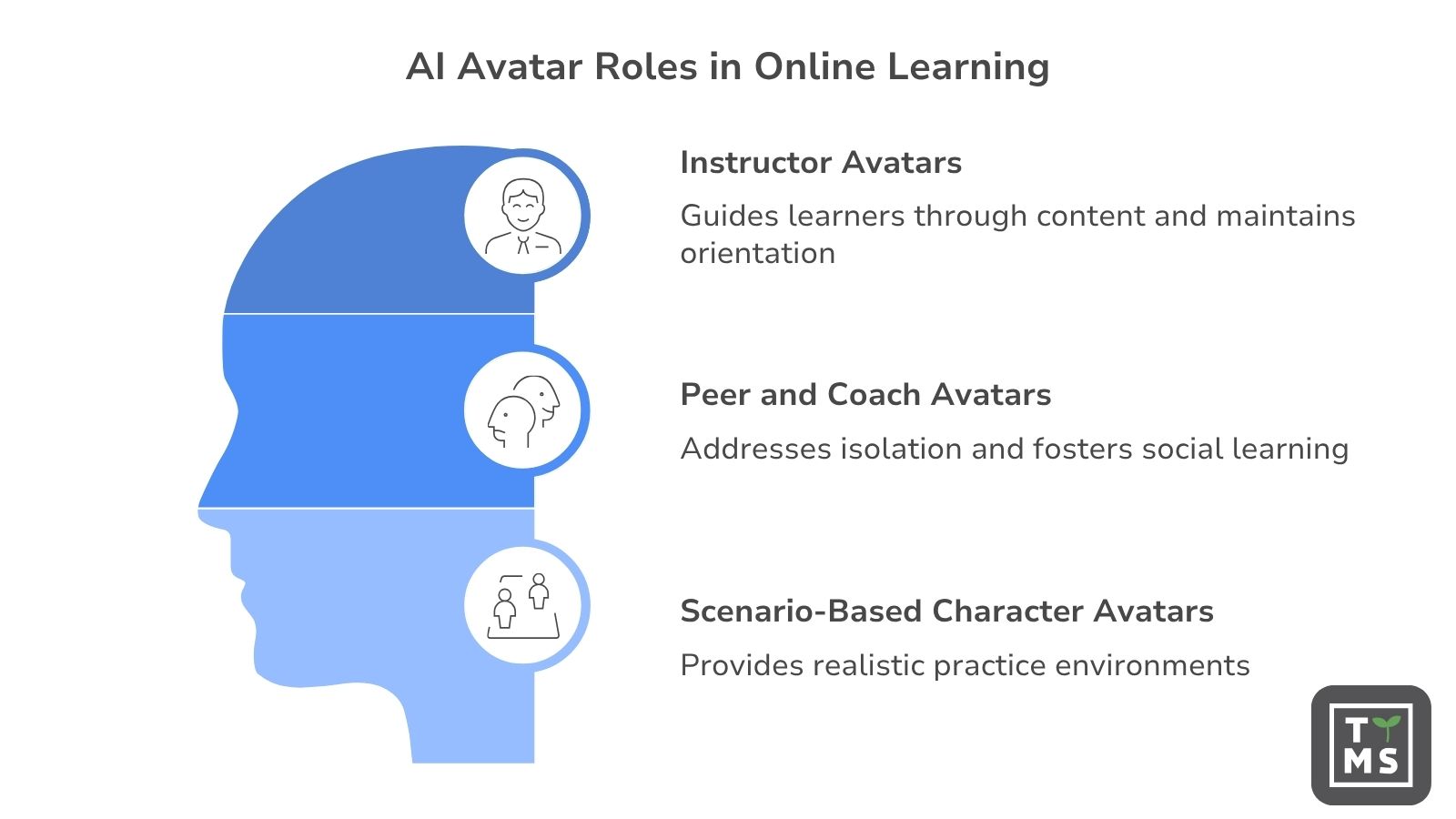
Instructor avatarsserve as theprimary guide through course content, presentinginformationand keeping learners oriented. A well-designedinstructoravatar carries authority without feeling distant, striking a tone that feels like a knowledgeable colleague rather than a textbook.
Peerand coach avatarsaddress one of online learning’s most persistent challenges: isolation. Peer avatars simulate the social dimension of learning, encouragingreflectionand creating a sense of learning alongside someone. Coach avatars motivate, check in on progress, and celebrate milestones.
Scenario-based character avatarsappear within simulated situations. A customer service course might feature a challenging customer the learner must respond to; a leadership course might include a team member presenting a workplace conflict. These let learners practice in realistic, low-stakes environments before the real thing.
3. Key Benefits of Using AI Avatars in E-Learning
3.1 Personalized Learning at Scale
AI avatars analyze how each learner responds to content andadjustdelivery accordingly. A learner who breezes through foundational material can move faster, while someone needing reinforcement getsadditionalexplanation before advancing. This kind of adaptive instruction was once reserved for one-on-one tutoring. Withavatars, itscales tothousands of learners simultaneously.
3.2 Higher Learner Engagement and Completion Rates
One of the biggest challenges in e-learning is keeping learners engaged until the end of a course. When training feels impersonal or repetitive, attention naturally starts to fade.
AI avatars help create a more engaging learning experience by presenting information in a way that feels conversational rather than static. They can explain concepts, guide learners through scenarios, andmaintaina consistent presence throughout the course. As a result, employees are more likely to stay focused, complete the training, and remember what they have learned.
3.3 Faster Production and Lower Costs
Traditional training videos are expensive to produce and difficult to update. They require recording sessions, presenters, editing, and often another round of production whenever the content changes.
AI avatars make this process faster. Instead of recording a new video from scratch, teams can update the script, choose a digital presenter, and generatea new versionof the module much more quickly. This is especially useful for onboarding, compliance training, product updates, and other materials that need to stay current.
For L&D teams, the main benefit is not only lower productioncost. It is the ability to refresh training content without restarting the whole video production process every time something changes.
3.4 Consistent Multilingual Delivery
Global organizations face a recurring challenge: training that feels equally strong across languages and regions. AI avatars can speak dozens of languages fluently,maintainingconsistent tone and quality throughout. A learner in São Paulo and one inSingapore both receive instruction that feels native and natural, without multiplying production costs.
4. High-Impact Use Cases for Avatar-Based Training
4.1 Employee Onboarding and Orientation
First impressions shape long-term retention. An avatar-guided onboarding journey delivers a structured introduction to company culture, processes, and expectations in a format new employees can engage with at their own pace. Rewe Group tookthis astep further with “goRobert,” a hyper-realistic digital twin of a management member that new hires can query both in person and via Microsoft Teams.The system lets employees ask sensitive or practical questions without fear of judgment, improving psychological safety and information access during onboarding.
4.2 Compliance and Mandatory Training
An AI avatar changes the delivery of compliance content without changing the substance. It can present complex regulations clearly, check comprehension with interactive questions, and keep the experience from feeling punitive. The result is better retention andcompletionrecords that hold up in audits.
4.3 Sales, Product, and Customer Service Training
AI avatar courses can simulate realistic customer conversations, allowing sales and service teams to rehearse objections and handle difficult interactions beforeencounteringthem live. Research on AI avatars in hospitality employee training found that avatar-led instruction improved learning outcomes and engagement compared to static e-learning while also reducingreliance on live facilitators. This scenario-driven approach builds both skill and confidence, with real-world performance improving as a direct result.
4.4 Soft Skills and Leadership Practice
Teaching soft skills through traditional e-learning has always beenhard. Avatar simulations create situations where learners must respond, make decisions, and experience consequences. A manager in a leadership course might face a difficult performance conversation with an AI avatar playing a resistant employee. That emotional realism makes the learning stick in ways a lecture cannot.
5. How to Create and Deploy AI Avatars for Your Courses
5.1 Choose the Right AI Avatar Tool
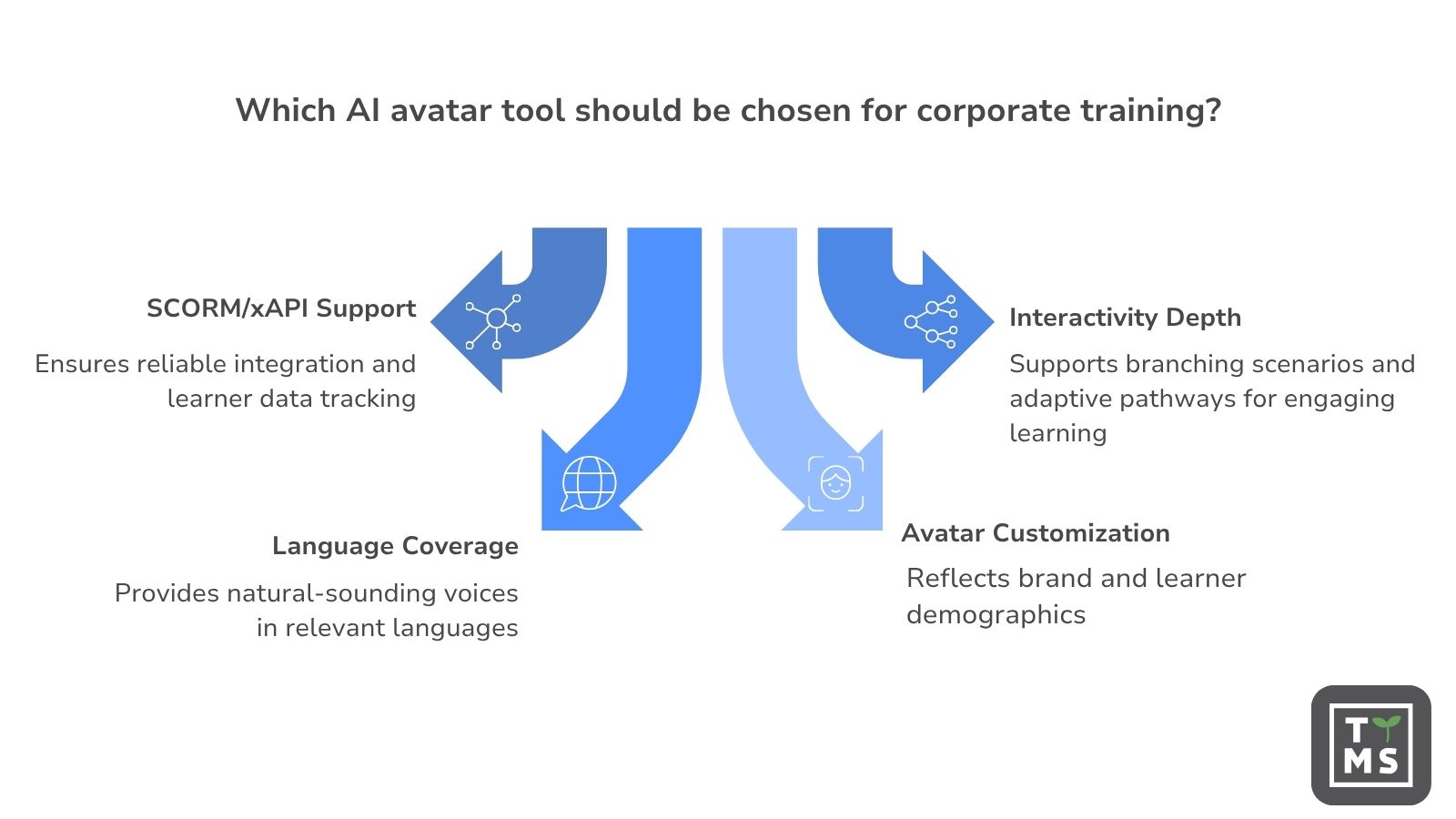
Platforms range from template-based avatars to fully customizable digital humans, so evaluating options requires a clear framework. Four criteria matter most for corporate training contexts:
- Check whether the platform supports SCORM orxAPIstandards for reliable integration and learner data tracking.
- Assess interactivity depth. Some platforms support branching scenarios and adaptive pathways; others offer only linear delivery.
- Consider language coverage and how naturally the synthetic voices perform in each language your teamsactually use.
- Evaluate avatar customization. Some platforms let you reflect your brand andlearnerdemographics; others lock you into templates.
Aligning the platform’s strengths with your specific training goals, whether that’s compliance delivery, onboarding, or sales simulation, makes a meaningful difference in outcomes. TTMS has direct experience evaluating and integrating avatar platforms intoexisting learning environments, which helps organizations avoid costly mismatches between tool capabilities and training needs.
5.2 Design Avatar Appearance and Persona
Visual design choices, including gender presentation, age, style, and cultural representation, shape how learners perceive and relate to the avatar. For global programs, building a diverse set of avatars ensures more learners see themselves reflected in the instruction. The persona matters equally: a compliance avatar might project calm authority, while an onboarding avatar might lean warmer. Whenpersonamatches context, the experience feels intentional rather than generic.
5.3 Script and Integrate Avatars into Your LMS
Good avatar scripting reads naturally when spoken, avoids passive constructions, andbuilds innatural pauses and branching points where learner input changes the direction of instruction. Once the content is ready, integration into your LMS ensures learner progress is tracked, completion is recorded, and data flows into reporting dashboards.
6. Best Practices for Effective Avatar-Based Learning
A strong AI avatar program requires more than choosing the right tool. Before designing any interaction, start with a clear answer to one question: what does this learner need to be able to do, and how does this avatar help them get there? When the purpose is clear, the experience feels cohesive. Whenit’svague, learners notice and disengage.
Consistency matters just as much. If an AI avatar shifts tone or appearance between modules without explanation,learnertrust erodes. Maintaining visual and persona consistency across a course reinforces the mental model learners build early on and reflects organizational culture in corporate training contexts.
Accessibility and cultural inclusivityaren’toptional extras. Caption options, visual contrast, and avatar personas that reflect the diversity of the learner population all ensure the course functions for everyone. Treatlaunchas the beginning of an iterative cycle, not the finish line. Completion data, quiz performance, and learner feedback reveal where the experience breaks down and where it earns the most engagement.
7. Frequently Asked Questions About AI Avatars in E-Learning
What makes an AI avatar different from a simple animated character?
An AI avatar uses artificial intelligence to generate speech, adapt responses, and interact with learner inputs in real time. A simple animated character is scripted and static. The intelligence layer is what enables personalization, real-time feedback, and adaptive learning pathways.
Can AI avatars work across different languages and regions?
Yes. Modern platforms support dozens of languages, and avatars can be localized not just linguistically but culturally, adapting tone and examples to suit regional audiences.
How much does it cost to build avatar-based e-learning?
Costs vary by platform and interactivity complexity. In general, avatar-based production is significantly faster and less expensive than traditional video, particularly for content that needs regular updates.
Do learners actually respond well to AI avatars?
Research and real-world deployments consistently show stronger engagement with avatar-guided content than with text-only or static video formats. The key is designing avatars that feel genuine, with strong scripts, clear purpose, and a persona appropriate to the subject matter.
How does TTMS support organizations adopting avatar-based learning?
TTMS provides end-to-end e-learning services covering course development, avatar integration, LMS administration, and performance analytics. As a partner with hands-on experience in both AI implementation and learning system integration, TTMS helps organizations build AI avatar training programs that are practical, scalable, and tied to measurable business outcomes.