Most companies still approach IT outsourcing with a 2015 mindset – and pay for it in 2026. The market has changed faster than most sourcing strategies. AI is reshaping delivery, talent shortages are pushing prices up, and regulatory pressure is turning vendor selection into a risk management exercise. What used to be a straightforward decision – “build vs outsource” – is now a complex trade-off between speed, control, capability, and compliance.
If you are currently evaluating IT outsourcing, you are not just choosing a vendor. You are choosing how your organization will build, scale, and operate technology over the next few years. The five shifts below are the ones that actually change how you should make that decision.
Trend #1 – You’re no longer buying capacity, you’re buying capabilities
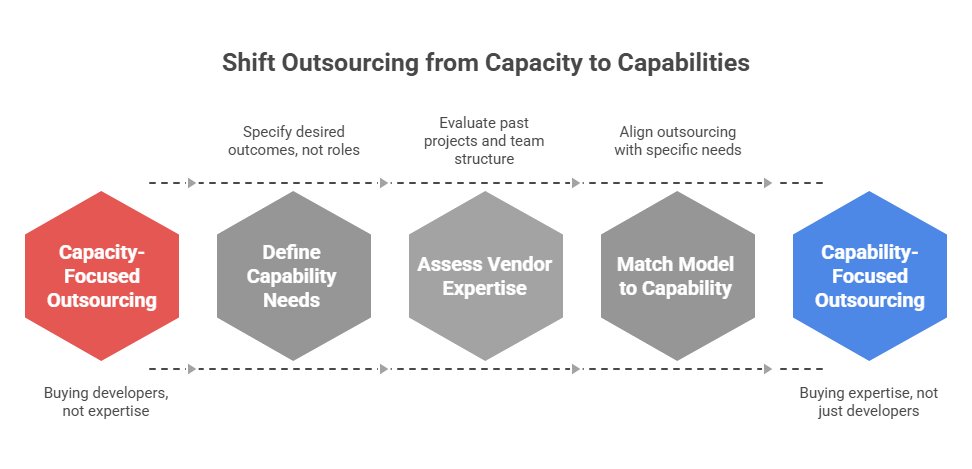
For years, outsourcing software development was primarily about capacity. You needed more developers, you couldn’t hire fast enough, so you looked externally. That model still exists, but in 2026 it is no longer the main driver – and treating it as such is one of the most common mistakes buyers make.
What companies are really buying today is access to capabilities they cannot build internally at the required speed. This includes areas like AI-powered software development, cloud architecture, data engineering, and cybersecurity. These are not skills you can reliably hire for in a matter of weeks, especially if you need teams that already know how to work together and deliver in production environments.
This is why phrases like “AI developers outsourcing” or “data engineering outsourcing” are gaining traction. The expectation is no longer that a vendor will simply execute tasks. The expectation is that they bring ready-to-use expertise that shortens the path from idea to production.
What it means for buyers: stop evaluating vendors based on CVs and hourly rates alone. Instead, assess whether they can deliver outcomes in specific domains. Ask what they have already built, how they structure teams, and how quickly they can get to production-ready delivery.
What to do differently: define the capability you need (e.g. “AI integration into product”, “cloud cost optimization”), not just roles. Then match the outsourcing model to that capability. This shift alone can dramatically improve outsourcing ROI.
Trend #2 – Nearshoring is now the default in Europe (and why it matters)
The old debate between offshore outsourcing and nearshoring IT is largely settled in the European context. While offshore outsourcing still offers lower nominal rates, it increasingly loses to nearshoring when you factor in total cost of delivery, communication overhead, and regulatory alignment.
This is where regions like Central and Eastern Europe come into play. Countries such as Poland have become default choices for IT outsourcing in Europe, not because they are the cheapest, but because they offer a balance of quality, availability, and operational simplicity. When you see search trends like “IT outsourcing Poland”, “software development Poland”, or “IT outsourcing Central Europe”, what sits behind them is a very pragmatic buyer decision: minimize friction.
Time zone alignment means faster decisions and fewer delays. Cultural proximity reduces misunderstandings in product discussions. EU membership simplifies compliance, especially in regulated industries. All of these factors have a direct impact on delivery speed and predictability.
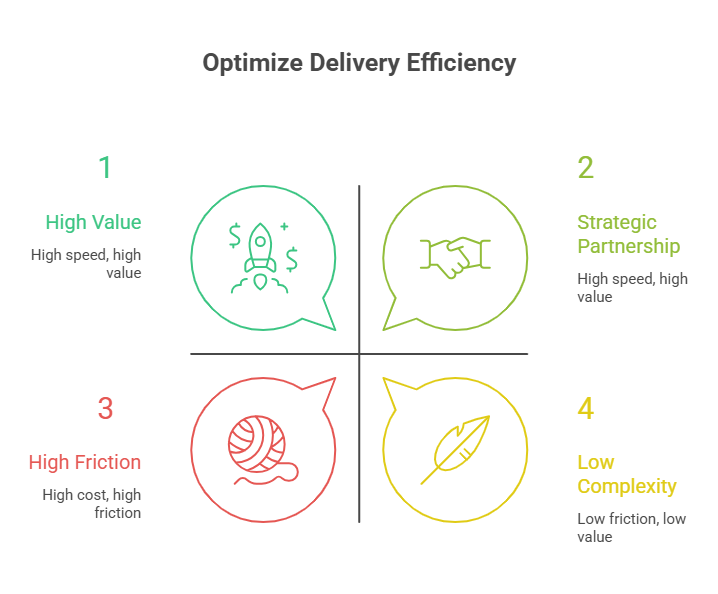
What it means for buyers: do not optimize for hourly rate in isolation. Optimize for total delivery efficiency. A slightly higher rate in a nearshore model can result in significantly faster time to market and fewer coordination issues.
When Poland and CEE make sense: product development, long-term collaboration, regulated environments, and any scenario where communication speed matters.
When they might not: extremely cost-sensitive, low-complexity tasks where coordination overhead is minimal.
Trend #3 – AI is changing pricing, delivery, and expectations
AI is not just another tool in the outsourcing stack. It is fundamentally changing the economics of software delivery. Tasks that used to take days can now be completed in hours. Code generation, testing, documentation, and even parts of architecture design are increasingly supported by AI agents in software development.
This creates a tension that buyers need to understand. On one hand, vendors can deliver faster thanks to AI-powered software development and automation in outsourcing. On the other hand, traditional pricing models based on time and materials become less aligned with actual value delivered.
As a result we are seeing gradual shift toward outcome-based outsourcing and AI-driven delivery models. The conversation is moving from “how many developers do we need?” to “how fast can we achieve a specific result?”
What it means for buyers: you should expect higher productivity, but also be careful how contracts are structured. If you are still paying purely for hours, you may not benefit from efficiency gains driven by AI.
What to do differently: introduce performance-based elements into contracts where possible. Define success metrics clearly (delivery time, stability, performance) and align them with pricing. Also, explicitly ask vendors how they use AI in their delivery process – not as a buzzword, but as a measurable capability.

Trend #4 – Choosing the wrong delivery model is the #1 hidden cost
One of the most underestimated decisions in IT outsourcing is the choice of delivery model. Many projects underperform not because of poor engineering, but because the model itself does not fit the problem.
In 2026, you are not choosing between “outsourcing” and “not outsourcing”. You are choosing between multiple models: staff augmentation, dedicated development teams, managed IT services, project-based outsourcing, or even build-operate-transfer setups. Each of these comes with different levels of control, responsibility, and risk.
Staff augmentation and IT team extension work well when you already have strong internal processes and just need to scale quickly. Dedicated development teams are a better fit when you want a stable, long-term unit responsible for a product area. Managed services are ideal for operations and environments where SLAs and predictability matter more than flexibility.
The problem is that many organizations default to the model they are familiar with, rather than the one that fits the use case.
What it means for buyers: misalignment between problem and model leads to hidden costs – delays, rework, and management overhead.
What to do differently: before selecting a vendor, define the nature of the work. Is it exploratory product development, scaling an existing system, or maintaining a stable environment? Then choose the model accordingly. This decision has more impact on success than most vendor comparisons.

Trend #5 – The new deal-breaker: governance, compliance and risk
In many organizations, IT outsourcing decisions have quietly shifted from being technical or financial choices to becoming formal risk decisions. This change is not driven by trends in technology alone, but by increasing regulatory pressure and the growing complexity of digital environments. As a result, vendor selection is no longer just about delivery capability – it is about the ability to operate within a controlled, auditable framework. Frameworks related to data protection, cybersecurity, and operational resilience are forcing companies to treat outsourcing as an extension of their own risk landscape. This is particularly visible in regulated industries, but the same expectations are rapidly spreading across the market. Buyers are now expected to demonstrate due diligence not only in choosing a vendor, but also in how that vendor manages data, processes, and third-party dependencies.
This is why concepts such as outsourcing risks, vendor lock-in, data security outsourcing, and compliance in IT outsourcing are becoming central to the decision-making process. It is no longer sufficient to ask “can they deliver?” The more relevant question is “can they operate under audit conditions, consistently and at scale?” In practice, many of the most serious issues in outsourcing do not come from technical failures, but from weak governance. Unclear ownership of data, lack of transparency in subcontracting, inconsistent processes, or poorly defined SLA structures can create long-term operational risk. In more demanding environments, they can delay projects, complicate audits, or expose the organization to regulatory consequences.
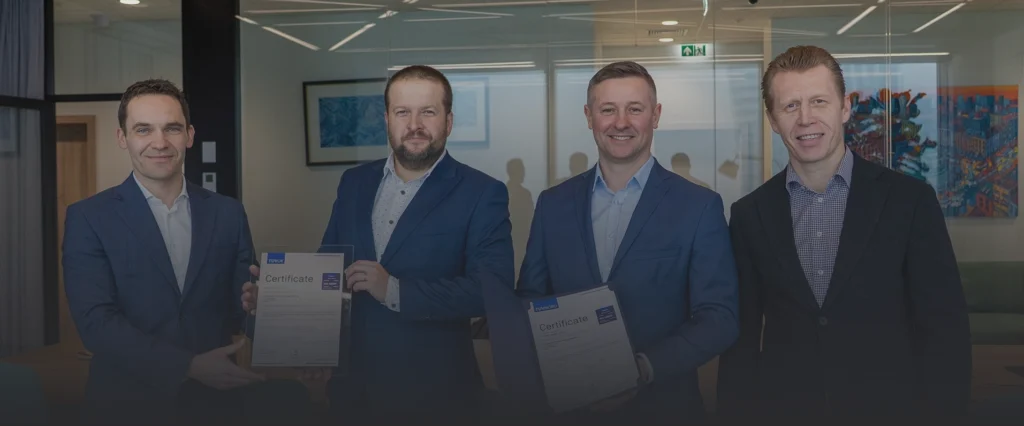
This shift is also reflected in the growing importance of structured management frameworks. Standards such as ISO/IEC 42001 illustrate how organizations are beginning to formalize governance around AI-driven systems, ensuring traceability, accountability, and risk control. More broadly, mature outsourcing providers are increasingly building integrated management systems that combine quality management, information security, and service governance into a single operational model.
What it means for you: governance is no longer a contractual detail – it is a core selection criterion. Evaluating an outsourcing partner should include not only their technical expertise, but also how they manage risk, document processes, and maintain consistency across delivery.
What to do differently: involve legal, security, and compliance teams early in the sourcing process. Define an outsourcing governance model upfront, including SLA structures, reporting mechanisms, and audit readiness. Pay particular attention to exit scenarios and knowledge transfer – a well-structured outsourcing relationship is one that can be scaled, controlled, and, if needed, safely transitioned.
In this context, it is worth looking at how potential partners approach governance in practice. Do they operate under a structured, integrated management system? Are their processes auditable and aligned with recognized standards? These factors are often a better predictor of long-term success than delivery capacity alone.
See how TTMS approaches quality management and governance in IT services and how integrated management systems can support compliant, scalable, and predictable outsourcing delivery.
How to choose an IT outsourcing company in 2026
If you reduce all of the above to a practical decision framework, choosing an IT outsourcing company in 2026 comes down to four dimensions.
First, capability over capacity. Does the vendor bring expertise you do not have, or are they simply adding more people? Second, delivery maturity. Do they have proven processes, or are they adapting to your organization on the fly? Third, AI readiness. Are they actually using AI to improve delivery, or just talking about it? Fourth, compliance and risk awareness. Can they operate within your regulatory environment without creating additional exposure? These factors matter more than branding, size, or even price in isolation.
Start your outsourcing process with the right assumptions
If you are currently evaluating IT outsourcing, nearshoring, or scaling your development capacity, the biggest risk is not choosing the wrong vendor – it is starting with the wrong assumptions about how outsourcing works in 2026.
Explore how TTMS approaches IT outsourcing and see how different delivery models, European nearshoring, and capability-driven teams can support your specific use case.

FAQ
What are the most overlooked IT outsourcing trends in 2026?
Most articles focus on obvious trends like AI or nearshoring, but the more impactful shifts are often less visible. One of them is the move from capacity-based to capability-based buying, where companies prioritize access to specific expertise over simply adding more developers. Another overlooked trend is the growing importance of delivery model fit – many outsourcing failures are not caused by poor engineering, but by choosing the wrong model, such as staff augmentation instead of managed services.
There is also a shift in pricing logic driven by AI. As productivity increases, time-based contracts become less aligned with value, pushing companies toward outcome-based models. At the same time, governance and compliance are becoming deal-breakers, especially in regulated industries, where outsourcing decisions must pass security and audit requirements. Finally, nearshoring in regions like Central and Eastern Europe is no longer just a cost decision, but a way to reduce operational friction and improve delivery speed.
These trends are less visible than headline topics, but they have a direct impact on whether outsourcing delivers real business value or becomes a costly mistake.
Is outsourcing software development worth it in 2026?
Yes, but only if approached strategically. Outsourcing software development is most effective when used to access capabilities that are difficult to build internally, rather than just to reduce costs. Companies that align outsourcing with business goals, delivery models, and measurable outcomes tend to see significantly higher returns.
What is the difference between IT outsourcing and staff augmentation?
IT outsourcing is a broader concept that includes full responsibility for delivery, while staff augmentation focuses on extending an internal team with external experts. The key difference lies in ownership and control. Choosing between them depends on whether you want to manage the work internally or delegate it to a partner.
When should a company outsource software development?
A company should consider outsourcing when it needs to scale quickly, access specialized expertise, or accelerate time to market. It is particularly useful in situations where hiring internally would take too long or where the required skills are not readily available in the local market.
How to scale a development team fast?
The fastest way to scale a development team is through staff augmentation or dedicated teams provided by an outsourcing partner. This allows companies to bypass lengthy recruitment processes and quickly integrate experienced professionals into ongoing projects.
What are the biggest risks in IT outsourcing?
The most common risks include vendor lock-in, data security issues, and misalignment between delivery models and business needs. These risks can be mitigated through clear contracts, strong governance, and careful selection of outsourcing partners.