Many companies are already using AI in one way or another. Employees ask AI assistants for help, business teams test copilots, and technology leaders look at agentic AI as a way to automate more complex processes. But after the first wave of experiments, one thing is becoming clear: a powerful language model is not enough to create real business value.
The problem is usually not the model, but the context around it. AI can only give useful answers when it understands what company data actually means. That means knowing how metrics are defined, which sources can be trusted, how different systems relate to each other, and what rules apply to specific business processes. This is why more organizations are now investing in semantic layers, data governance, and architectures that make enterprise data understandable not only for people, but also for AI systems.
1. Why Enterprise AI Often Produces Inconsistent Answers
Modern large language models are remarkably capable. They can summarize information, generate reports, answer questions, and assist with decision-making. However, they do not inherently understand how a specific organization operates.
Consider a seemingly simple question:
“What is our current customer profitability?”
To answer accurately, an AI system may need to access data from ERP systems, CRM platforms, financial applications, customer support tools, and analytics environments. Even if all required data is available, another challenge emerges. Different departments may use different definitions for the same metric.
Finance may calculate profitability differently than sales. Operations may classify customers differently than marketing. Regional teams may follow different reporting standards than global headquarters. When AI interacts with fragmented or inconsistent information, it can produce answers that appear correct while actually reflecting conflicting business assumptions. This is one of the primary reasons many organizations struggle to scale AI beyond isolated use cases.
2. The Missing Piece: Business Context
For years, organizations focused on collecting and storing data. Data lakes, warehouses, analytics platforms, and reporting tools became central elements of enterprise architecture. AI introduces a new requirement. Systems must not only access data – they must understand it.
A customer record, product identifier, invoice number, or performance metric may seem straightforward from a technical perspective. However, every organization has its own definitions, relationships, policies, and business rules that shape how information should be interpreted. Without this context, AI is forced to infer meaning from technical structures alone. With context, AI can generate answers that align with how the business actually operates. This distinction becomes even more important as organizations move from AI assistants toward AI agents capable of making recommendations, triggering workflows, and supporting operational decisions.

3. What Is a Semantic Layer?
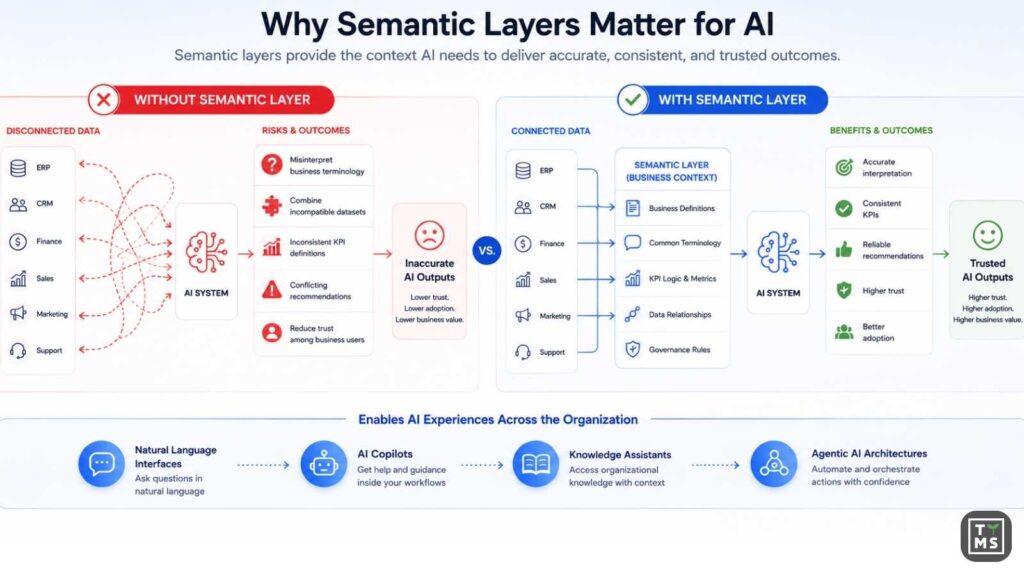
A semantic layer provides a business-friendly interpretation of enterprise data. Instead of exposing raw tables, schemas, and technical metadata, it creates a structured representation of business concepts that both humans and AI systems can understand.
A semantic layer typically defines:
- Business metrics and KPIs
- Relationships between datasets
- Common terminology
- Calculation logic
- Data ownership
- Business rules and policies
For example, when an executive asks about revenue, customer churn, inventory availability, or working capital, the semantic layer ensures that everyone – including AI systems – uses the same definitions. This creates a single source of business truth that can be reused across reporting, analytics, applications, and AI initiatives.
4. Why Semantic Layers Matter for AI
The value of a semantic layer increases dramatically in AI-driven environments. Traditional dashboards require users to interpret data manually. AI systems, on the other hand, must interpret information autonomously.
Without a semantic layer, AI models may:
- Misinterpret business terminology
- Combine incompatible datasets
- Apply inconsistent KPI definitions
- Generate conflicting recommendations
- Reduce trust among business users
With a semantic layer, AI systems gain access to the organizational context required to produce more accurate and consistent outputs. This is increasingly important for natural language interfaces, AI copilots, knowledge assistants, and agentic AI architectures. The quality of AI responses becomes directly tied to the quality of the semantic framework supporting them.
5. Why Governance Is Becoming a Strategic Requirement
As AI becomes embedded in business processes, governance is evolving from a compliance topic into a strategic business capability. Organizations need confidence that AI systems are operating within defined boundaries and using trusted information.
The growing importance of governance in the field of artificial intelligence is also reflected in emerging international standards. An increasing number of organizations are adopting the requirements of ISO/IEC 42001 – the world’s first standard defining the principles for establishing and maintaining an Artificial Intelligence Management System (AIMS).
TTMS is among the pioneers of this approach, having achieved ISO/IEC 42001 certification as one of the first companies in Europe and the first organization in Poland. The certification confirms that our processes for designing, implementing, and managing AI solutions are aligned with internationally recognized standards for security, transparency, accountability, and risk management.

Strong governance helps answer critical questions:
- Which datasets are approved for AI use?
- Who owns specific business definitions?
- How should sensitive information be protected?
- Which users can access which data?
- How can AI-generated outputs be monitored and audited?
Without governance, AI may generate answers that are technically correct but operationally risky. With governance, organizations can scale AI adoption while maintaining trust, security, compliance, and accountability. This explains why governance is becoming a central component of modern enterprise AI platforms rather than an afterthought.
6. The Rise of Agentic AI Changes Everything
The next phase of enterprise AI extends beyond answering questions. Organizations are increasingly exploring agentic AI systems that can execute tasks, coordinate workflows, analyze data, and support operational decisions. Unlike traditional AI assistants, these systems are expected to interact with business processes directly. That creates a much higher standard for data quality and contextual understanding. An AI agent responsible for inventory optimization, customer service, financial planning, or procurement cannot rely on ambiguous definitions or inconsistent information. It requires a governed environment where business concepts are clearly defined and consistently applied. This is precisely why semantic layers and governance frameworks are becoming foundational components of agentic architectures.
7. Why Leading Technology Vendors Are Investing in Semantic Architectures
Across the enterprise software market, a common pattern is emerging. Technology providers are investing heavily in metadata management, business context layers, semantic models, governance capabilities, and AI-ready data architectures. The reason is straightforward. Organizations no longer need AI that can simply generate text. They need AI that understands their business. Enterprise value is created when AI can accurately interpret operational realities, financial metrics, customer relationships, regulatory requirements, and organizational objectives. The companies enabling this contextual understanding will play a critical role in the next generation of enterprise technology.
8. Building an AI-Ready Data Foundation
For organizations evaluating their AI strategy, the focus should extend beyond model selection. Questions such as “Which LLM should we use?” remain important, but they are increasingly secondary to more fundamental considerations.
Technology leaders should also ask:
- Do we have consistent KPI definitions?
- Can AI access trusted and governed data?
- Do business users agree on terminology?
- Is ownership of critical data clearly defined?
- Can our AI systems explain how conclusions were reached?
The organizations that answer these questions successfully are more likely to achieve measurable business outcomes from AI investments.
9. Conclusion
Enterprise AI is entering a new phase. The conversation is gradually shifting away from model performance and toward business understanding. Semantic layers, governance frameworks, and contextual data architectures are becoming critical enablers of trustworthy AI. They help transform disconnected data into business knowledge and ensure that AI systems operate with the context required to support meaningful decisions. As organizations move toward increasingly autonomous AI capabilities, competitive advantage will not come solely from access to advanced models. It will come from the ability to connect those models with trusted data, shared business definitions, and a clear understanding of how the organization operates. In the era of enterprise AI, context is becoming as important as intelligence itself.
Organizations looking to move beyond AI experimentation should focus not only on selecting the right models, but also on building the data foundations that allow AI to deliver measurable business value. This requires a combination of data strategy, governance, system integration, and AI expertise. At TTMS, we help organizations design and implement AI solutions that connect advanced models with real business processes, enterprise data, and operational goals. Explore our AI solutions for business to learn how we can support your AI transformation journey.

What are some signs that an organization needs a semantic layer?
One of the clearest indicators is when different departments report different values for the same KPI. If finance, sales, and operations each have their own version of revenue, profitability, or customer metrics, AI systems will struggle to provide consistent answers. Other warning signs include long discussions about which data source is correct, difficulties scaling analytics initiatives, or a lack of trust in AI-generated insights. A semantic layer helps create a common business language that can be used across teams, applications, and AI solutions.
Can small and mid-sized companies benefit from semantic layers, or are they only for large enterprises?
While semantic layers are often associated with large organizations, smaller businesses can benefit as well. As companies adopt more systems and generate more data, maintaining consistency becomes increasingly difficult. Establishing common definitions and governance practices early can prevent future complexity and make AI initiatives easier to scale. For growing organizations, a semantic layer can serve as a foundation that supports expansion without creating data silos.
How do semantic layers support regulatory compliance?
Many industries operate under strict regulations regarding data access, privacy, reporting, and auditability. A semantic layer can help by ensuring that business metrics and definitions are applied consistently across the organization. When combined with governance controls, it becomes easier to track how information is used, who has access to it, and how AI-generated outputs are produced. This level of transparency can simplify compliance efforts and reduce operational risk.
What is the relationship between semantic layers and knowledge management?
Organizations often store valuable business knowledge in documents, spreadsheets, presentations, emails, and the experience of individual employees. A semantic layer helps connect structured business definitions with this broader organizational knowledge. As a result, AI systems can provide more relevant answers and recommendations by combining enterprise data with the business context behind it. This makes knowledge more accessible and less dependent on specific individuals.
Will future AI systems automatically create semantic layers on their own?
AI will likely play an increasingly important role in identifying relationships between datasets, suggesting business definitions, and helping build semantic models. However, organizations will still need human expertise to validate those definitions and ensure they reflect real business objectives. Business context, governance policies, and strategic priorities cannot be fully automated. Rather than replacing semantic layers, future AI systems will likely make them easier and faster to develop and maintain.