According to a recent report, only 15% of Polish company leaders believe that artificial intelligence (AI) supports the development of their firms. This is strikingly low compared to about 33% globally. Paradoxically, 1 in 3 companies in Poland include AI in their business strategy, yet many initiatives never move beyond experimentation – a full two-thirds of enterprises admit they suspended or abandoned AI projects at the pilot stage. The data paints a clear picture: despite high hopes for AI-driven growth, most organizations struggle to capture tangible value from it. In fact, 59% of Polish CEOs fear their company may not survive the next 10 years without a business model change, yet over 40% still expect AI to boost profitability in the near term. If AI is truly a catalyst for competitive advantage, why do so few decision-makers see real benefits today? And more importantly, how can businesses bridge this gap between AI’s promise and actual impact?
1. Why Many AI Initiatives Fall Short
High expectations, low integration: Business leaders worldwide are optimistic about AI – nearly half of global CEOs anticipate AI projects will increase profits within a year. Polish executives, however, remain cautious. The limited trust (15%) in AI’s business value suggests that many AI initiatives aren’t yet delivering measurable results. A key issue is that AI often remains on the fringes of the business, implemented as isolated pilots. Indeed, an MIT study found that only 5% of generative AI prototypes succeed beyond the prototype phase, largely because companies struggle to embed AI into core business processes. In other words, many organizations experiment with AI, but few integrate it deeply into workflows where it can directly influence performance.
Data quality and silos: “More and more companies understand that before implementing AI, they must first ensure proper data structure and quality,” notes Łukasz Wróbel, VP at Webcon. Poor data is a major stumbling block – globally, only 12% of firms feel their data quality and availability are sufficient for effective AI use. Many Polish businesses overestimate their readiness: 88% claim to have high-quality data, yet only 34% actually base decisions on data. Without clean, well-structured, and accessible data, even the most advanced AI algorithms will yield poor results. Webcon’s expert observes that organizations historically treated AI as a plug-and-play add-on, expecting instant magic. In reality, AI is only as good as the information feeding it. Companies that haven’t unified their data or that suffer from siloed, inconsistent information will find their AI projects stalling.

Unclear metrics of success: Another challenge is the lack of clear KPIs and measurement for AI initiatives. Over 57% of Polish firms do not track the effectiveness of their AI deployments at all, and an additional 34% rely only on qualitative observations. This means 91% of companies have no hard data on AI’s impact. Without defined metrics – whether it’s process speed, error rates, customer satisfaction or revenue growth – it’s impossible to tell if an AI project is working. Experts from Webcon point out that companies must link AI projects to concrete business indicators like time savings, quality improvements or cost reduction. Otherwise, AI investments remain a leap of faith and are vulnerable to being cut when immediate ROI isn’t evident.
Cultural and skill gaps: Behind these issues is often a cultural hesitancy and a talent gap. Polish executives recognize the need for fundamental change – they want to boost innovation and efficiency – but there is a “paradox of caution” at play. Leaders are optimistic about economic growth and acknowledge the need to use new technologies, yet there is wariness toward tools like AI. This cautious mindset can trickle down the organization, leading to less experimentation and risk-taking with AI. On top of that, if employees lack AI-related skills or fear automation, it can impede adoption. Companies might not have the right talent to implement AI or might face internal resistance, causing AI projects to stall before delivering value.
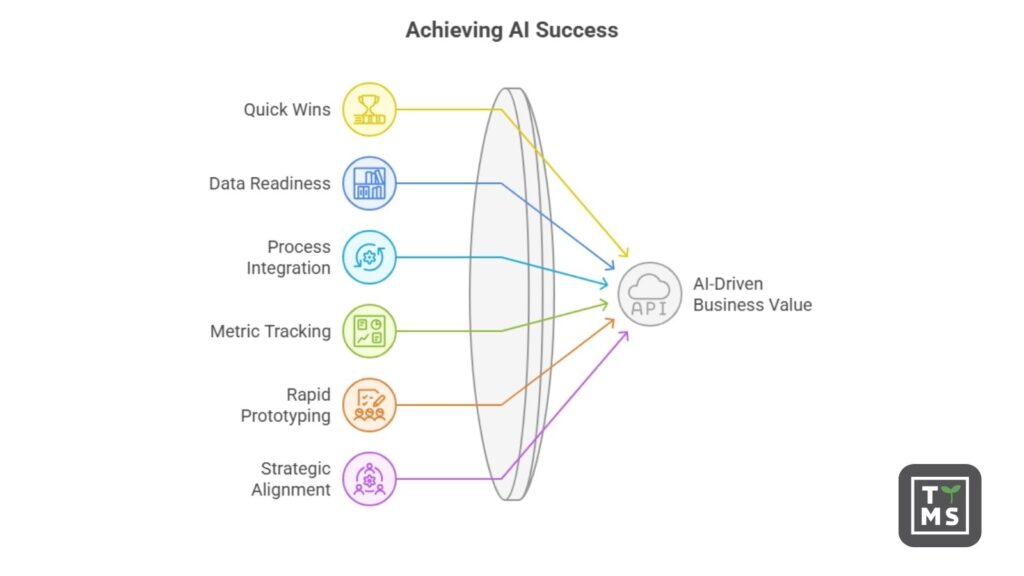
2. From Pilot to Performance: 7 Signs Your AI Is Delivering Real Value
Despite these challenges, the message is clear: AI’s potential to improve efficiency and drive growth is real – but realizing that potential requires a strategic and pragmatic approach. Here’s how businesses can turn AI from buzzword to business value:
2.1 Your AI projects deliver quick, visible business wins
Rather than deploying AI for AI’s sake, identify use cases where AI can immediately address a pressing business need or bottleneck. In fact, over 40% of Polish CEOs are looking to AI to increase company profitability – the key is to apply AI where it can deliver fast, visible benefits. Develop a focused AI strategy that aligns with your business objectives and targets areas with clear ROI. For example, if customer service is slowing down due to manual inquiries, an AI chatbot or intelligent email triage could be a high-impact project. Companies should prioritize AI applications that improve specific metrics – whether it’s reducing response times, cutting processing costs, or boosting sales conversion – within a 1-2 year horizon. Recent research shows CEOs now expect AI payback faster than before (within 1-3 years, down from 3-5), so choosing attainable projects is critical. Quick wins build confidence and create momentum for broader AI adoption.
2.2 Your data is structured, clean, and AI-ready
Data is the fuel of AI, so getting your data house in order is non-negotiable. This means breaking down data silos, cleaning and standardizing information, and possibly modernizing your data infrastructure (e.g. data warehouses, integrations, cloud storage). If your company has been operating in departmental data islands, consider a data integration initiative as a precursor to AI. Ensure you have processes to continuously collect, update, and verify data quality. Many companies are now appointing data stewards or establishing data governance frameworks to maintain data health. The payoff is huge: with high-quality, well-governed data, AI models can uncover insights that were previously hidden in noise. As Webcon’s VP emphasizes, getting data “AI-ready” is a critical step before expecting any AI tool to perform. For instance, if you plan to use AI for predictive maintenance in manufacturing, you may first need to unify sensor data from all your machines and clean up any inaccuracies. This groundwork might not be glamorous, but it directly correlates with AI success.
2.3 AI is integrated into key business processes
To move beyond the prototype stage, AI solutions must be woven into the fabric of everyday operations. Aim to create an “agentic enterprise” – a concept where AI agents are built into key workflows and have defined roles with access to relevant data. In practice, this could mean an AI system that automatically routes customer requests to the right department, an AI assistant that helps finance teams by scanning invoices, or a machine learning model guiding sales reps on the next best offer. The goal is to integrate AI tools so seamlessly that they become part of the standard process flow, rather than a novelty. Low-code platforms like WEBCON can be extremely helpful here. WEBCON’s Business Process Suite allows companies to automate and streamline workflows – and when combined with AI, it can take things further. For example, by integrating AI with WEBCON’s low-code process automation, companies can automatically classify incoming emails or support tickets and route them to the appropriate team, drastically reducing manual triage. This kind of integration ensures AI is working hand-in-hand with human teams. As a result, AI isn’t a side project; it becomes a co-worker, embedded in your operations. When AI solutions are part of core processes, their impact on efficiency and quality becomes measurable and significant.
2.4 You track clear metrics to measure AI performance
Tying AI initiatives to business outcomes is crucial. “What gets measured gets managed” holds true for AI projects. Before implementation, define what success looks like – is it reducing customer churn by X%, processing Y more transactions per hour, cutting error rates in half? Establish baseline metrics and monitor changes once the AI system is in place. This may require new analytics capabilities or dashboards to track AI performance in real time. For instance, if you deploy an AI document analysis tool to help your legal team, track how much faster contracts are reviewed or how accuracy improves in risk identification. According to Webcon, linking AI to clear KPIs (like process duration, number of errors, or customer satisfaction scores) is essential for informed decisions on whether to scale or adjust a project. By measuring results, you not only prove ROI to stakeholders, but also gain insights to fine-tune the AI system. If an AI solution isn’t hitting the mark, the data will show it, enabling you to iterate or pivot before too much time or money is lost. Conversely, demonstrated success on key metrics can justify broader rollouts and further investment in AI.
2.5 Small innovation teams are rapidly prototyping AI use cases
Successful AI adoption often starts bottom-up, not just top-down. Create cross-functional teams that can quickly prototype AI solutions for specific problems. As Webcon’s Łukasz Wróbel observes, “The best solutions often arise in small teams. An employee brings a problem, IT specialists propose a solution, a prototype is built in one afternoon, and after a few days it’s in production helping hundreds of people”. This agile, iterative approach allows businesses to test ideas on a small scale, learn from failures, and rapidly refine what works. To enable this, companies need technology that supports rapid development and deployment. This is where modern platforms and tools come in – from AutoML services to drag-and-drop app builders. Low-code environments (like WEBCON BPS, Microsoft Power Apps, etc.) empower “citizen developers” and IT alike to collaborate on quick solutions without starting from scratch. By fostering a culture where experimentation is welcomed and prototypes can be built in days, you tap into employees’ creativity and domain knowledge. Many times, front-line staff know exactly where inefficiencies lie; with the right tools, they can help craft AI-driven fixes. These quick wins not only solve niche problems but also build a company-wide culture of innovation and shared ownership of digital transformation.
2.6 Your AI strategy aligns people, processes, and technology
Ultimately, AI should be viewed not as a standalone technology project, but as part of a holistic transformation. Experts predict that the real winners will be companies who succeed in marrying technology, data, and human engagement into one system. That means alongside deploying AI software, you’re also upskilling your workforce to work with AI, adjusting processes to leverage AI outputs, and maintaining executive support for AI initiatives. For example, if you implement an AI knowledge management system that answers employees’ questions, train your staff on how to use it and update your knowledge-sharing processes accordingly. Make AI a part of employees’ daily routines and decision-making. Encourage teams to treat AI as a collaborator – something that can handle the grunt work or provide data-driven insights – while humans focus on what they do best (strategic thinking, empathy with clients, creative problem-solving). When people, processes, and AI tools are all aligned, the synergy can unlock productivity and innovation leaps that were previously unreachable.
3. Conclusion: Embracing AI for Strategic Advantage
AI’s role in business is no longer a speculative future – it’s here, and companies that harness it effectively will outpace those that do not. The fact that only 15% of Polish CEOs currently see AI as a growth driver is both a caution and an opportunity. It suggests that many firms have yet to cross the chasm between AI hype and AI impact. By learning from early missteps – focusing on data quality, integration, clear metrics, and agile execution – organizations can turn things around. The rewards are compelling: streamlined operations, smarter decisions, reduced costs, and enhanced customer experiences, to name a few. As AI matures (with advances like generative AI and autonomous agents on the horizon), businesses need to position themselves to capitalize, or risk being left behind by more tech-savvy competitors. The strategic imperative is clear: treat AI not as a shiny object, but as an integral part of your business strategy and process architecture. In doing so, you’ll move from the wary 15% to the winning cohort of companies that truly leverage AI for sustainable growth.
At TTMS, we specialize in helping businesses make this transformation. TTMS offers a range of AI solutions and services to address various organizational needs, from automating legal document analysis to streamlining HR recruitment. Here are some of our key AI solutions (with links for more information):
- AI Solutions for Business – A comprehensive suite of AI-driven services to boost operational efficiency and data-driven decision-making across industries.
- AI4Legal – Advanced AI solutions for law firms that automate routine legal tasks (like court document analysis and contract generation) to increase efficiency and reduce human error.
- AML Track – An AI-powered Anti-Money Laundering platform that automates customer verification and compliance screening against global sanction lists, ensuring fast, accurate risk assessment and reporting.
- AI Document Analysis Tool (AI4Content) – An intelligent document analyzer that automatically processes large volumes of documents and produces precise, structured summaries or reports in minutes, all with enterprise-grade security.
- AI E-learning Authoring Tool (AI4E-learning) – An AI-driven platform that converts your internal materials (documents, presentations, audio/video) into comprehensive training courses, dramatically accelerating the e-learning content creation process.
- AI-Based Knowledge Management System (AI4Knowledge) – A smart knowledge hub that centralizes company know-how (procedures, manuals, FAQs) and uses AI to let employees quickly find information or get guidance, improving knowledge sharing and decision-making.
- AI Content Localization Services (AI4Localisation) – A customizable AI translation platform that delivers fast, context-aware translations tailored to your industry and brand style, helping you localize content efficiently while maintaining terminology consistency.
- AI Resume Screening Software (AI4Hire) – An AI tool for HR that automatically screens and analyzes CVs to match the right candidates or internal talent to the right roles/projects, reducing hiring time and optimizing resource allocation.
- AI Software Test Management Tool (QATANA) – A next-generation test management platform with built-in AI assistance that generates test cases, integrates manual and automated testing workflows, and provides real-time insights, enabling faster and more effective QA cycles.
By leveraging these and other tailor-made AI solutions, businesses can accelerate their digital transformation – turning the promise of AI into measurable results. TTMS is here to support that journey every step of the way. Contact us!