A legal AI tool can summarize hundreds of pages in minutes and still overlook the one sentence that changes the outcome of a matter. It may return a confident, polished answer based on an outdated rule, mix up jurisdictions, or expose confidential information when connected to the wrong data environment.
In practice, these are not arguments against using AI in legal work. They are reminders that legal AI needs stronger controls than a general-purpose productivity tool. The real question is not simply whether a model can produce a useful answer, but what data it can access, how its output is verified, and where human review remains mandatory.
This is particularly important in regulated and data-sensitive environments. In AI projects, the model itself is often only one part of the risk. Data flows, access permissions, system architecture, retention policies, and review procedures can be just as important as the quality of the generated response.
This article looks at the main limitations of generative AI in legal software and the safeguards that should be considered before these tools are used on live client matters. It focuses primarily on the European Union and the United Kingdom, where the regulatory framework is currently more developed.
Europe, the Middle East, and Africa should not be treated as a single legal environment. Firms operating in Switzerland, the Gulf states, or African jurisdictions will need to assess local data protection requirements, professional secrecy obligations, and rules governing the provision of legal services. The underlying operational principle, however, remains similar: the more sensitive the legal task and the data involved, the stronger the controls around the AI system need to be.

1. Key Takeaways for 2026
- Legal AI risk in Europe is both technical and regulatory; hallucinations are only one part of the picture.
- EU and UK requirements differ, and the wider EMEA region cannot be covered by a single legal conclusion.
- Not every legal AI tool is high-risk under the AI Act, but every use case should be classified and documented.
- Confidentiality, privilege, professional secrecy, and data protection require separate analysis.
- AI4Legal can support document-based work across jurisdictions, but it does not automatically supply or update the applicable national law.
- Human review must be qualified, source-based, and built into the workflow rather than added as a disclaimer.
- A trustworthy implementation combines grounded outputs, controlled data, auditability, testing, and clear responsibility.
2. Why Legal AI Risk Matters More in 2026
The regulatory environment has moved from general principles to operational obligations. In the EU, the AI Act now applies in stages. Prohibited practices and AI literacy obligations have applied since 2025, while additional governance, enforcement, and transparency provisions became applicable in 2026. The precise obligations depend on the system’s intended purpose and on whether an organization acts as a provider, deployer, importer, or distributor. The European Commission maintains the current AI Act enforcement timeline.
The UK follows a different model based on existing legislation and sector regulation. In August 2026, the Solicitors Regulation Authority issued a warning focused on inaccurate AI-generated content, client confidentiality, legal professional privilege, data protection, and inadequate supervision. The message is consistent across both regimes: using AI does not transfer responsibility away from the firm or the professional approving the work. See the SRA warning notice.
This makes legal AI governance a current management issue rather than a future compliance project. Firms need to know which tools are being used, what information enters them, what sources they rely on, who checks their outputs, and how incidents are reported.
3. Core Limitations of Generative AI in Legal Software
3.1 Hallucinations and Unsupported Legal Authority
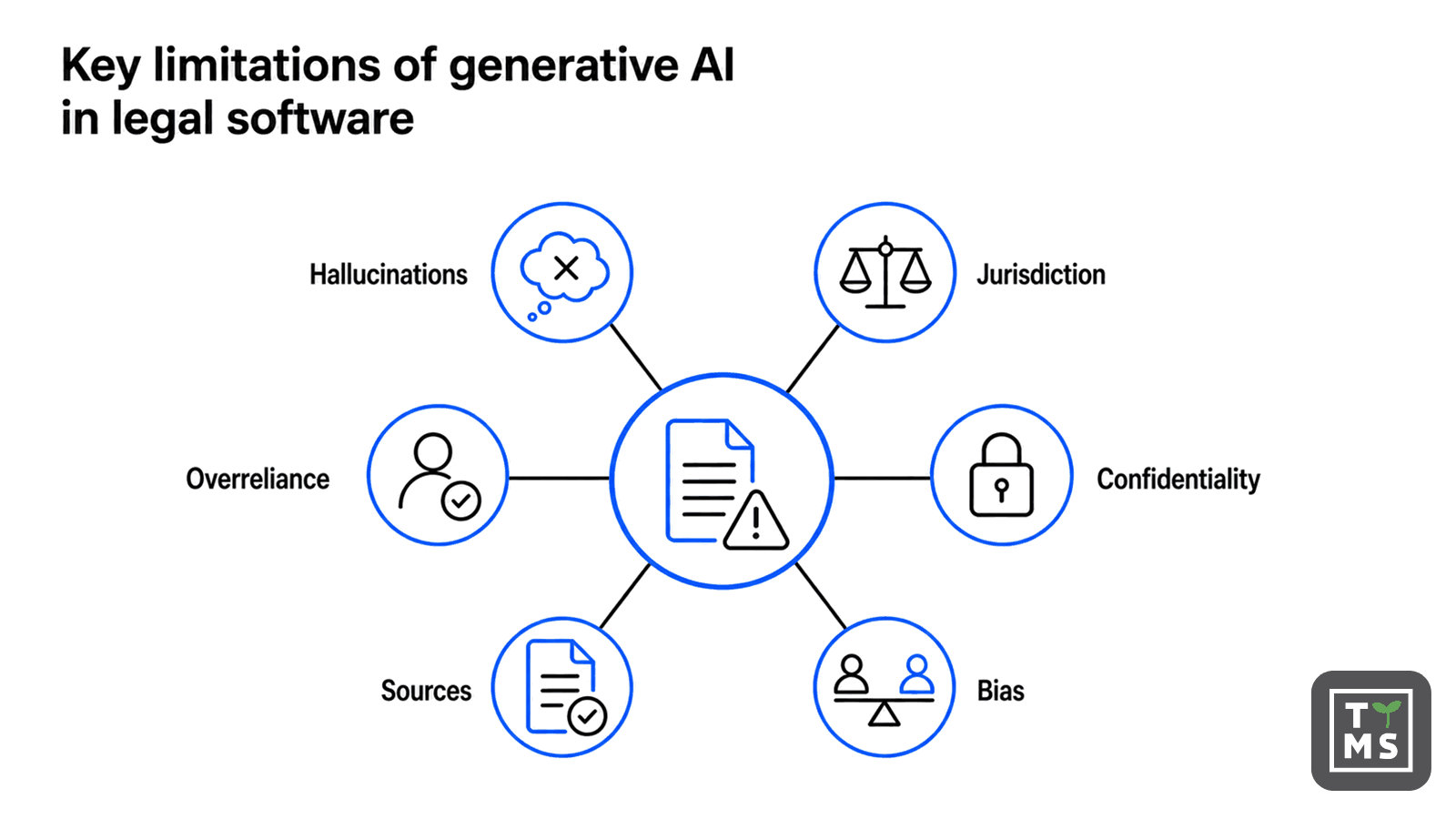
Large language models generate statistically plausible text. They do not independently determine whether a proposition is legally correct. An answer may contain a nonexistent case, an inaccurate quotation, a real authority applied to the wrong issue, or a source that no longer reflects the law. Fluency can make these errors harder to detect because an incorrect answer may look as polished as a correct one.
Retrieval-augmented generation can reduce this risk by grounding answers in selected material, but it does not eliminate it. A peer-reviewed Stanford study of leading legal AI research tools found material rates of hallucinated or unsupported answers even in specialist systems. The practical control is therefore not a promise that a model is hallucination-free, but a workflow that exposes sources and requires proportionate verification.
3.2 Jurisdiction and Context Gaps
European legal work is particularly sensitive to jurisdiction. EU law, national legislation, local procedural rules, regulator guidance, and contractual choice-of-law clauses may all affect the answer. The UK is legally distinct from the EU, while privilege and professional secrecy are not defined identically across European jurisdictions. A system that does not reliably identify the relevant country, court, date, and hierarchy of authority can combine individually plausible statements into a legally incorrect conclusion.
AI can support research and document analysis, but it should not be treated as a substitute for the professional judgment required to identify the controlling rule, interpret ambiguity, or decide how law applies to disputed facts.
3.3 Confidentiality and Data Protection
Legal documents often contain personal data, special-category data, commercially sensitive information, litigation strategy, and information protected by professional secrecy or legal professional privilege. Entering that material into an AI service can create exposure if prompts or files are retained, accessed by unauthorized personnel, transferred internationally, or used to improve a model.
Under the GDPR and UK GDPR, firms must identify their role, establish a lawful basis, limit processing to what is necessary, provide appropriate information, control processors and subprocessors, set retention periods, secure international transfers, and implement measures appropriate to the risk. A data protection impact assessment may be required where the proposed processing is likely to result in a high risk to individuals. The UK’s Information Commissioner’s Office also provides detailed guidance on AI and data protection.
Confidentiality and privilege should be assessed separately from data protection. Processing may have a GDPR basis and still violate a professional duty, client instruction, engagement term, or court restriction.
3.4 Bias, Incomplete Data, and Uneven Performance
AI outputs reflect the data, retrieval process, instructions, and evaluation criteria behind the system. Historical imbalance, missing jurisdictions, language coverage, poor document quality, or inconsistent labeling can produce uneven results. Bias may appear in risk scoring, document prioritization, settlement analysis, or recommendations that seem neutral but systematically underperform for certain matters or groups.
Evaluation should therefore use representative legal tasks and documents, including difficult examples, minority languages, scanned files, conflicting authorities, and cases where the correct response is to flag uncertainty rather than provide a confident answer.
3.5 Limited Explainability and Source Traceability
A lawyer does not always need a technical explanation of every model parameter, but the legal work product must be reviewable. Users should be able to identify the documents or authorities supporting an answer, distinguish quotations from generated analysis, check the version and date of the source, and understand when the system lacks sufficient evidence.
A citation interface is not enough if the cited source does not support the proposition. Trustworthy systems should make source checking easier, not merely attach links to generated text.
3.6 Overreliance and Automation Bias
Fast, well-written output creates a risk of automation bias: users may apply less scrutiny to a machine-generated draft than they would to work produced by a colleague. Repeated reliance can also weaken research habits and reduce the likelihood that lawyers will notice jurisdictional or factual anomalies. Human-in-the-loop review is effective only when the reviewer has enough time, authority, subject-matter knowledge, and access to the underlying sources to challenge the system.
4. The EU AI Act and Legal Services
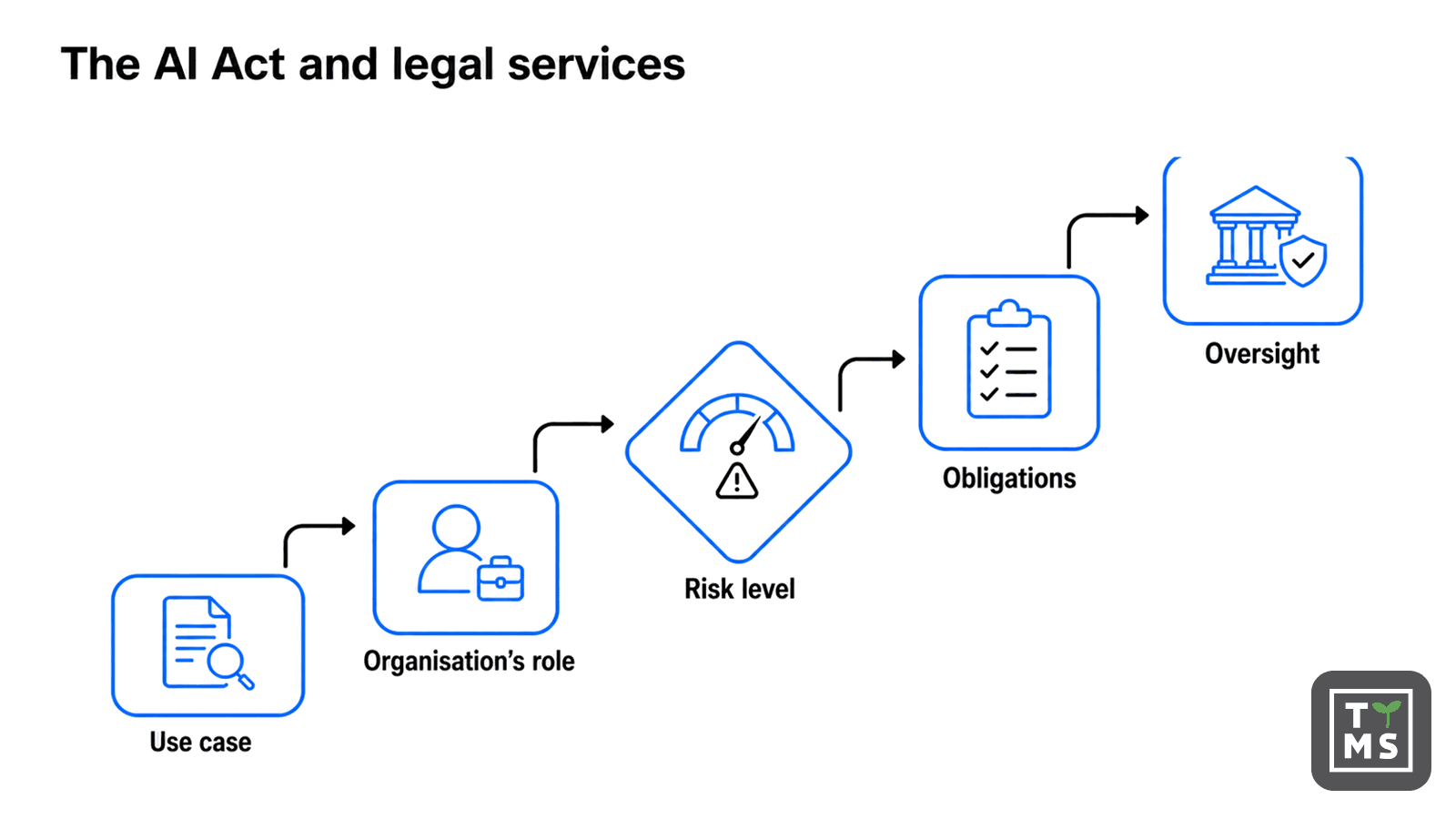
The AI Act does not classify every legal AI application as high-risk. Risk classification depends on the intended purpose and context. Internal document summarization, clause extraction, or knowledge search will not automatically become high-risk merely because a law firm uses the tool. By contrast, certain systems used by or on behalf of judicial authorities to research and interpret facts and law and to apply law to concrete facts may fall within the high-risk categories when the relevant provisions apply. The Commission’s AI Act overview explains the risk-based structure and implementation dates.
For legal organizations, the first compliance question is often role and use case rather than model brand. A firm that deploys a third-party tool, materially modifies it, places it under its own name, or develops a client-facing system may have different obligations. Procurement and product teams should document this assessment instead of assuming that the vendor alone carries regulatory responsibility.
Article 4 also makes AI literacy an operational requirement for providers and deployers. Training should reflect the person’s role, the system’s purpose, and the people or groups affected. Generic awareness training is unlikely to be sufficient for lawyers approving court submissions, administrators configuring access, or developers changing retrieval sources.
Article 50 introduces transparency obligations for specified AI systems and content. These rules do not require every internal AI-assisted draft to carry the same label, but they do require a use-case analysis. The Commission published guidelines on the 2026 transparency obligations to clarify when providers and deployers must inform people or mark generated content.
5. UK Professional Duties and Court Expectations
UK firms must consider the SRA Principles and Codes of Conduct, duties to the court, confidentiality, legal professional privilege, UK data protection law, and the firm’s supervision arrangements. The SRA’s guidance emphasizes that an authorized individual must retain responsibility for legal services delivered with AI assistance and that AI-generated work requires appropriate human scrutiny.
The risk is visible in litigation. In Ayinde v London Borough of Haringey and Al-Haroun v Qatar National Bank, the High Court examined legal materials containing false authorities and stressed the responsibility of legal representatives to verify material placed before the court. The relevant lesson is not that AI is prohibited. It is that the duties of accuracy, supervision, and candour continue to apply regardless of how a document was drafted.
Firms operating across the EU and UK should avoid treating one policy as universally sufficient. The same technical platform may require different notices, contractual provisions, approval paths, and professional controls depending on jurisdiction and use.
6. Intellectual Property, Contracts, and Vendor Risk
Legal AI procurement should address more than cybersecurity. Contracts need to define permitted data use, model training, subprocessors, retention and deletion, incident notification, audit rights, service continuity, output ownership, confidentiality, liability, and support for regulatory requests. Firms should also confirm that they have the right to upload third-party documents and that generated content is checked for infringement and unauthorized reproduction.
Security or AI management certifications can support due diligence, but they are not a legal safe harbour and do not establish the accuracy of legal output. The assessment should connect each control to the actual deployment architecture and use case.
7. What Sets a Trustworthy Legal AI System Apart
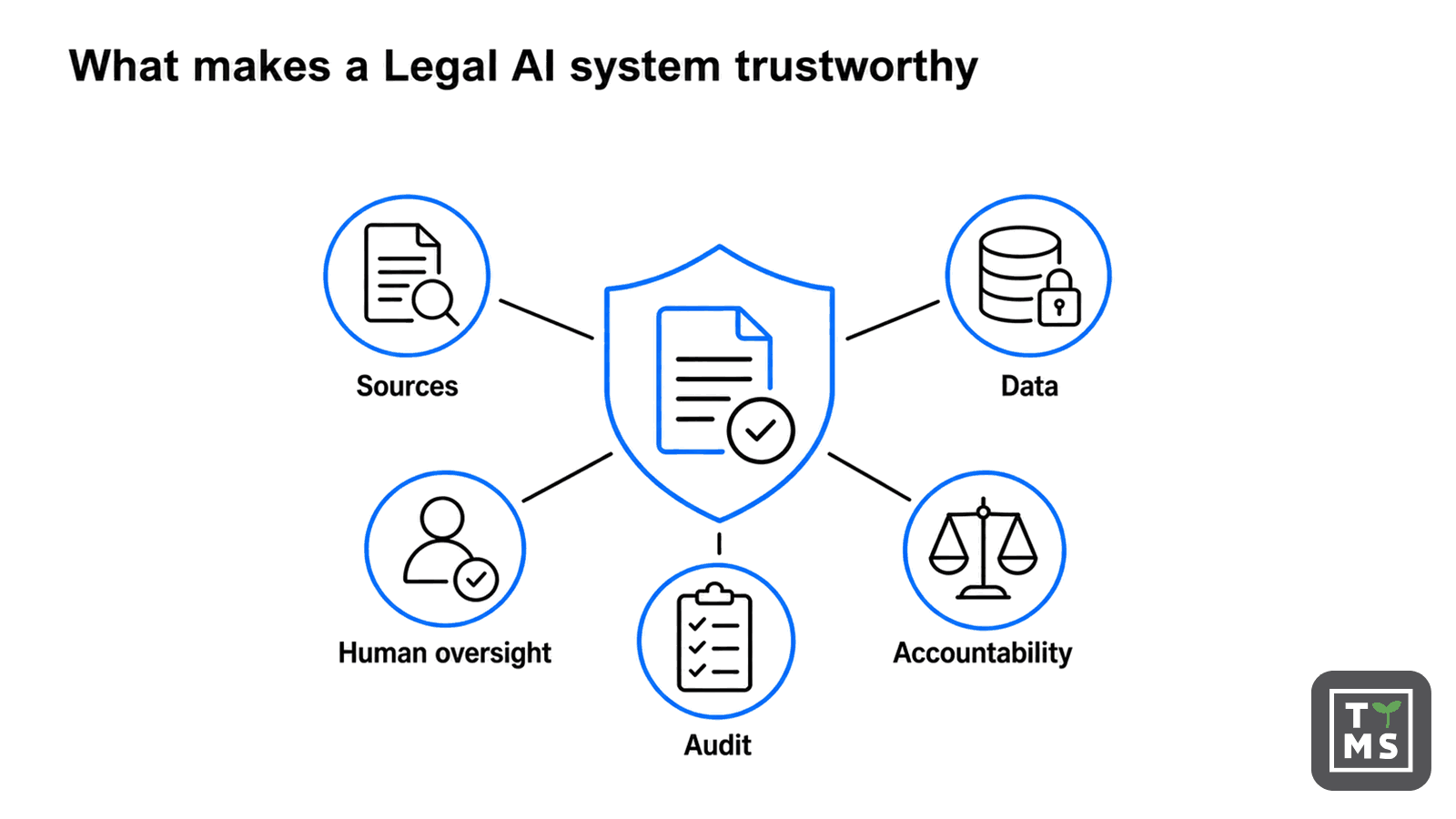
- Defined purpose and jurisdiction: the system is designed for specified tasks, users, countries, languages, and source sets.
- Grounded and reviewable output: users can open the supporting material, verify quotations, and see when the system lacks evidence.
- Controlled data environment: client data is segregated, access is restricted, retention is defined, and data is not used for model training unless expressly authorized.
- Human approval at meaningful decision points: qualified professionals review advice, filings, client communications, and other high-impact outputs.
- Logging and auditability: the organization can reconstruct the input, sources, model or configuration, output, reviewer, and final decision where appropriate.
- Representative evaluation: accuracy, retrieval quality, security, bias, and failure modes are tested before launch and monitored after changes.
- Clear responsibility: the vendor, firm, product owner, information security team, data protection function, and legal reviewer each have defined obligations.
8. European Legal AI in Practice: TTMS and Sawaryn & Partners
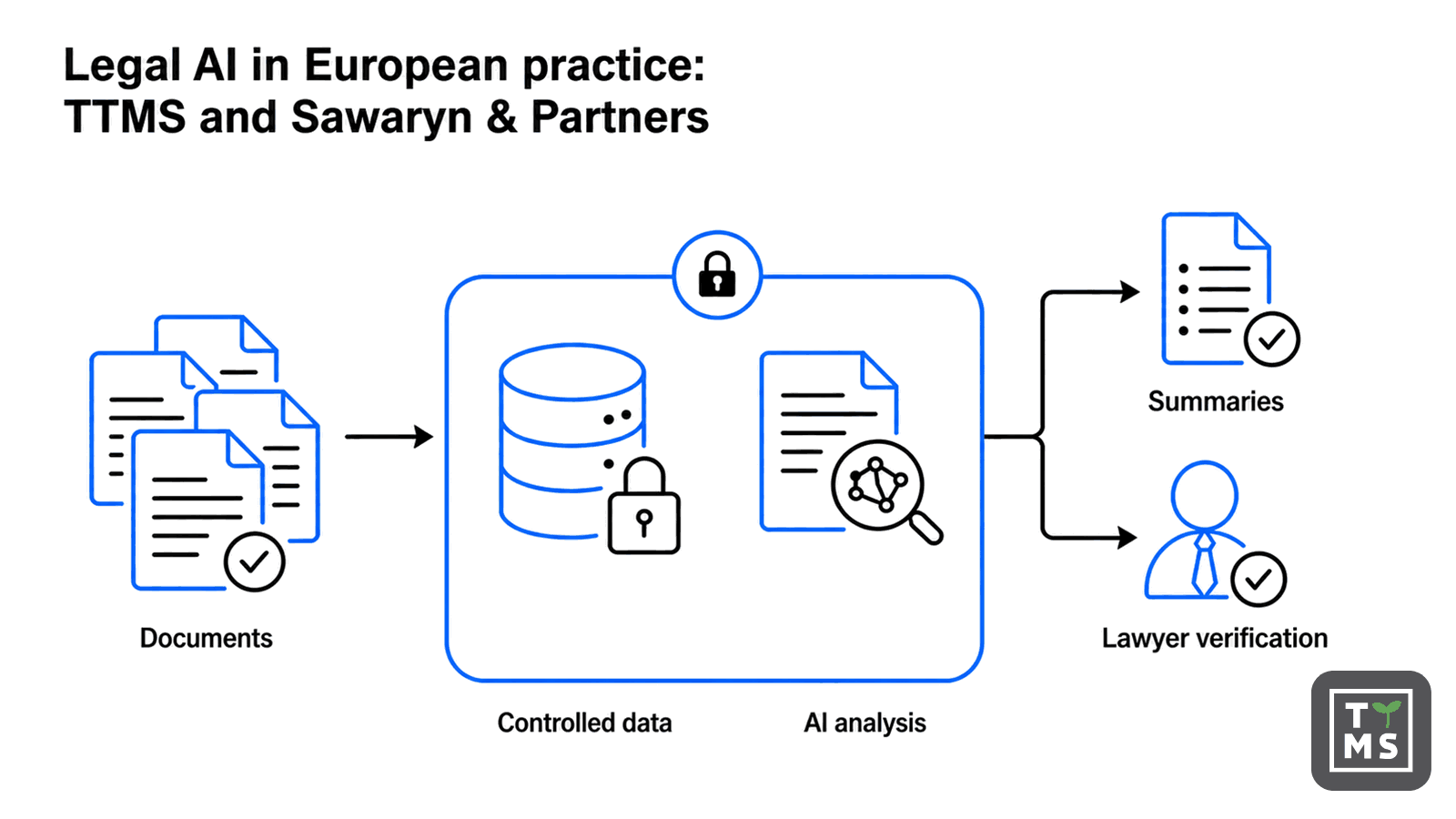
A practical example comes from TTMS’s work with Sawaryn & Partners, a Polish law firm. The firm needed to process large volumes of case documents, court records, meeting notes, and recordings. TTMS implemented an Azure OpenAI-based application that generates summaries and supports document updates. According to the published case study, the architecture was designed so that input data and generated results were not shared with external organizations or used to train neural networks.
AI4Legal is not limited to a single jurisdiction. Its document-based architecture allows it to support legal document analysis in EU Member States, the United Kingdom, the United States, and other markets because it works with materials supplied to the system rather than automatically retrieving a national code or body of case law. This makes the platform adaptable across jurisdictions without implying that it contains a complete, continuously updated database of each country’s law.
The case demonstrates an appropriate use of AI to support document-intensive legal work within a controlled environment. Jurisdictional flexibility does not make the output error-free: results depend on the completeness, accuracy, and currency of the uploaded materials. Legal professionals must still verify controlling law, citations, and conclusions under the rules applicable to the matter. The value lies in matching the technology to a defined workflow, protecting the data, and keeping legal review with the firm. Sawaryn & Partners also publishes practical commentary on AI Act roles and obligations, illustrating the need to connect technical implementation with legal governance.
9. How to Safeguard a Legal Organization
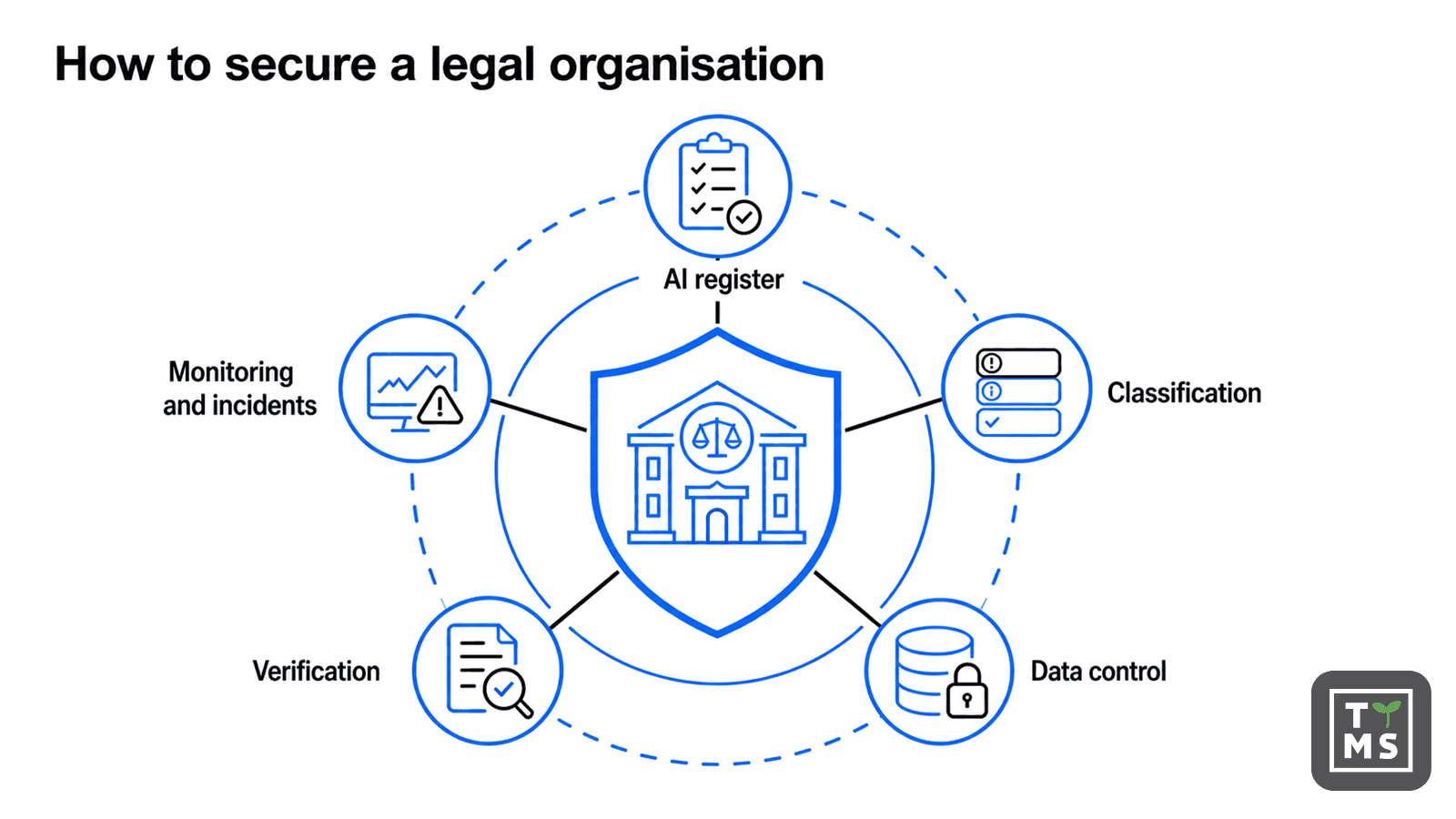
- Create an AI inventory. Record approved and unapproved tools, owners, users, data categories, integrations, jurisdictions, and intended purposes.
- Classify each use case. Assess AI Act role and risk, data protection impact, professional secrecy, privilege, client terms, court requirements, and local professional rules.
- Set data-entry rules. Define which information may be used, which environments are approved, and when anonymization or synthetic data is required.
- Perform vendor and architecture due diligence. Review data flows, training settings, storage locations, subprocessors, access controls, deletion, incident response, contractual protections, and exit arrangements.
- Design verification by task. Court citations, legal advice, deadlines, calculations, quotations, and client-facing content need explicit checking against authoritative sources.
- Train for real roles. Lawyers, support staff, developers, procurement teams, and managers need different training and escalation paths.
- Monitor the live system. Re-test after model, prompt, source, or integration changes and track errors, overrides, complaints, and near misses.
- Prepare an incident process. Staff should know how to stop use, preserve evidence, correct affected work, inform decision-makers, and assess notification duties.
10. Balancing Risk and Value
AI can reduce time spent searching, organizing, comparing, and summarizing information. It can also improve access to large document sets that would otherwise be difficult to review consistently. These benefits are real, but they depend on use-case design and cannot be assumed from the model name or a vendor demonstration.
The strongest approach treats AI as part of a controlled legal process. The system handles defined computational or language tasks; professionals remain responsible for legal judgment, source validation, confidentiality, and the final decision. This balance allows firms to gain efficiency without presenting automation as a replacement for professional accountability.
FAQ
Is legal AI prohibited under the EU AI Act?
No. The AI Act uses a risk-based framework. Obligations depend on the intended purpose, risk category, and role of the organization. Many internal productivity tools will not be high-risk, although other AI Act, GDPR, contractual, and professional requirements may still apply.
Can a law firm enter client documents into a generative AI tool?
Only after confirming that the use is lawful and consistent with confidentiality, privilege, client instructions, professional rules, and the tool’s contractual and technical safeguards. Public consumer tools should not be treated as approved environments for confidential legal material.
Do lawyers have to verify every AI-generated citation?
Any authority relied on in advice, a filing, or another material legal conclusion should be checked against an authoritative source. The extent of review for lower-risk administrative tasks can be proportionate to the task and the tested reliability of the system.
Does a security certification make legal AI compliant?
No. Certifications may provide useful assurance about selected controls, but compliance depends on the actual use case, data flow, configuration, contracts, governance, and legal obligations. They do not establish legal accuracy.
Should clients be told that AI is being used?
Sometimes. The answer depends on applicable transparency rules, professional duties, engagement terms, client expectations, the materiality of the AI-supported task, and how client information is processed. Firms should define disclosure triggers rather than use a universal statement.
Can AI replace a lawyer’s legal judgment?
No. AI can support research, document analysis, drafting, and knowledge retrieval, but responsibility for legal advice, strategy, filings, and professional obligations remains with qualified people and regulated organizations.