High-profile incidents involving medical data show that even information processed by specialized systems can become a target for cybercriminals. When a breach occurs, management must determine not only what data may have been exposed, but also whether the organization can maintain its most important processes and restore its IT environment safely.
In August 2026, the President of Poland’s Personal Data Protection Office announced an inspection of the technical and organizational measures applied by MyDr following reports of an incident involving patient data. The authority emphasized that the exact scale of the event was not yet fully known and that the company’s risk analysis would also be examined. This qualification matters: while proceedings are ongoing, the cause of the incident and the responsibility of individual parties should not be assumed.
This was not the first serious warning for the Polish market. In November 2023, Poland’s Personal Data Protection Office reported a ransomware attack accompanied by a data breach at ALAB Laboratoria. The incidents differ in method and circumstances, but they point to the same conclusion: data security cannot depend on a single product or procedure.
Many companies still treat backup as their main response to cyber threats. A well-designed backup can save an organization after data has been encrypted, deleted or corrupted. It cannot reverse a breach, take stolen information away from an attacker, or replace access controls, encryption, monitoring and a prepared incident response plan.
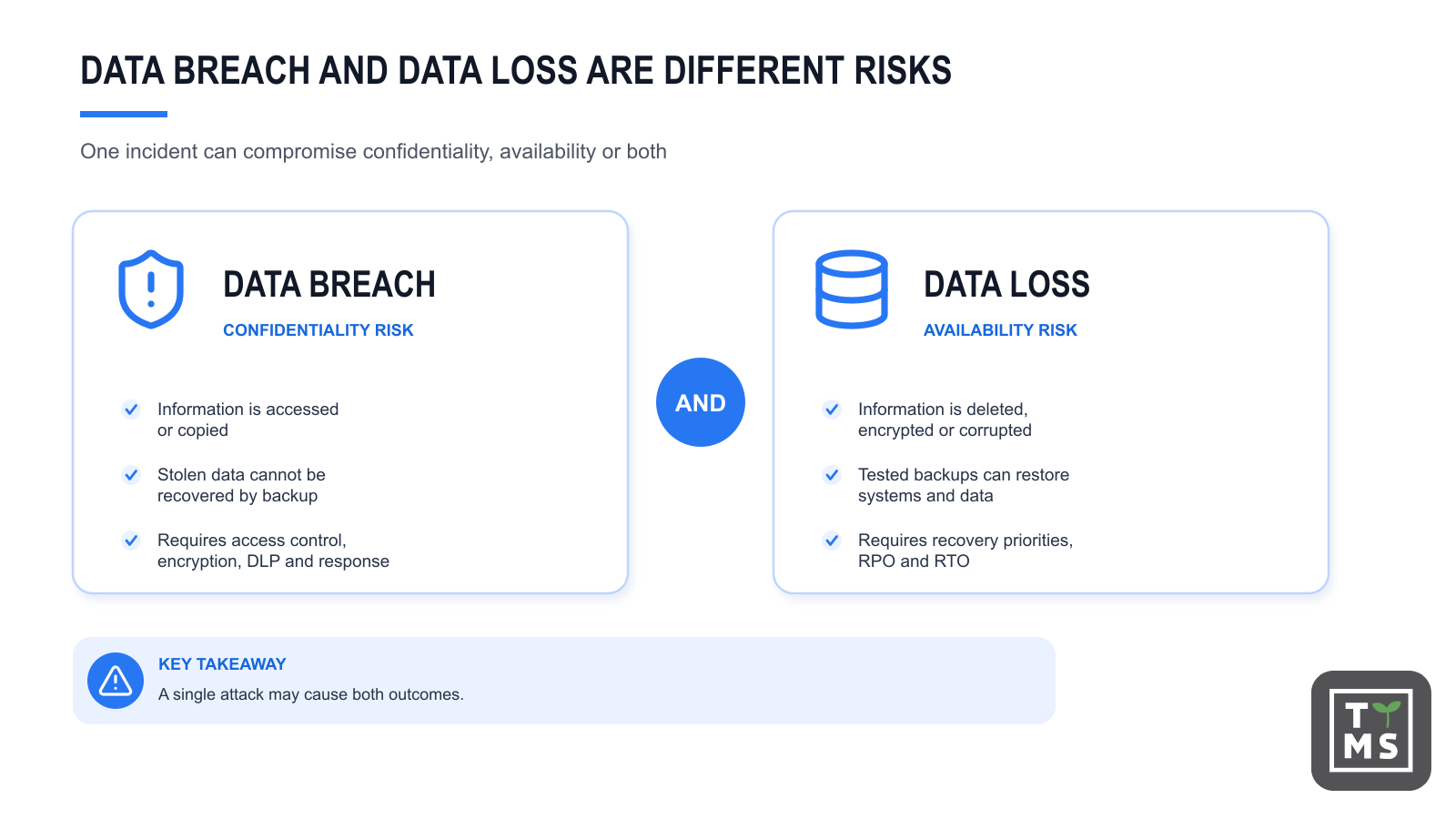
1. A data breach and data loss are different risks
A data breach means that an unauthorized person has obtained, or may have obtained, access to information. Data loss concerns information that has become unavailable, deleted, encrypted or corrupted. A single attack can cause both outcomes: criminals may copy data first, then encrypt systems and demand payment for restoring access or withholding publication.
Backup primarily addresses availability and recovery. If backups are current, isolated and usable, the company can rebuild systems without relying on an attacker’s promises. A backup cannot restore the confidentiality of information that has already left the organization. Legal obligations, fraud risk, incident-handling costs and loss of customer trust remain after the breach.
1.1 Double extortion changes the role of backup
In a traditional ransomware scenario, the attacker encrypted data and demanded payment for a decryption key. Increasingly, attackers copy information first and then threaten to publish or sell it. This model, known as double extortion, means that restoring systems does not end the crisis. The company may resume operations, but it still needs to determine the scope of the breach, assess the risk to individuals and business partners, and communicate in line with its legal obligations.
In practice, organizations therefore need two parallel plans. The first covers system recovery and business continuity. The second addresses the confidentiality breach: preserving logs, identifying the data that was taken, preventing further access and deciding which notifications are required. Backup is essential to the first plan, but it does not replace the second.
This distinction also matters under the GDPR. Article 32 of the GDPR refers, among other things, to the ability to restore the availability of personal data promptly and to regularly test the effectiveness of security measures. It also requires organizations to protect confidentiality and integrity, which calls for a broader set of safeguards than backup alone.
2. Lessons from major data breaches for businesses in Poland
The first lesson concerns the value of data. Medical records, customer data, financial information, employee data and intellectual property can be used for extortion, identity theft, phishing or further attacks. An organization should know where such information is stored, who can access it and how quickly unusual downloads will be detected.
The second lesson concerns dependence on suppliers. Business data is often processed in SaaS systems, cloud environments, data centers and applications maintained by third parties. Outsourcing technical operations does not remove the customer’s risk. Organizations need contractual requirements, periodic security assessments, agreed incident-reporting rules and confidence that data can also be recovered after an outage or the end of the supplier relationship.
The third lesson concerns governance. Security does not begin when an attack occurs. The organization should define recovery priorities, decision-making roles, communication channels and acceptable downtime in advance. For entities covered by national laws implementing NIS2, the Directive’s business continuity measures include backup management, disaster recovery and crisis management.
3. When backup genuinely protects the business
Backup delivers the greatest value when primary data or systems become unavailable. This may result from ransomware, infrastructure failure, administrator error, a faulty update, accidental deletion by an employee or damage to a cloud environment. Backup can then reduce downtime, restore services and limit irreversible information loss.
The entire process must be covered, not merely one folder. Resuming operations may require databases, configurations, keys, application code, documentation, integrations, system images and information about the correct service startup sequence. A copy of the data may be insufficient if the organization does not know how to restore its dependencies.
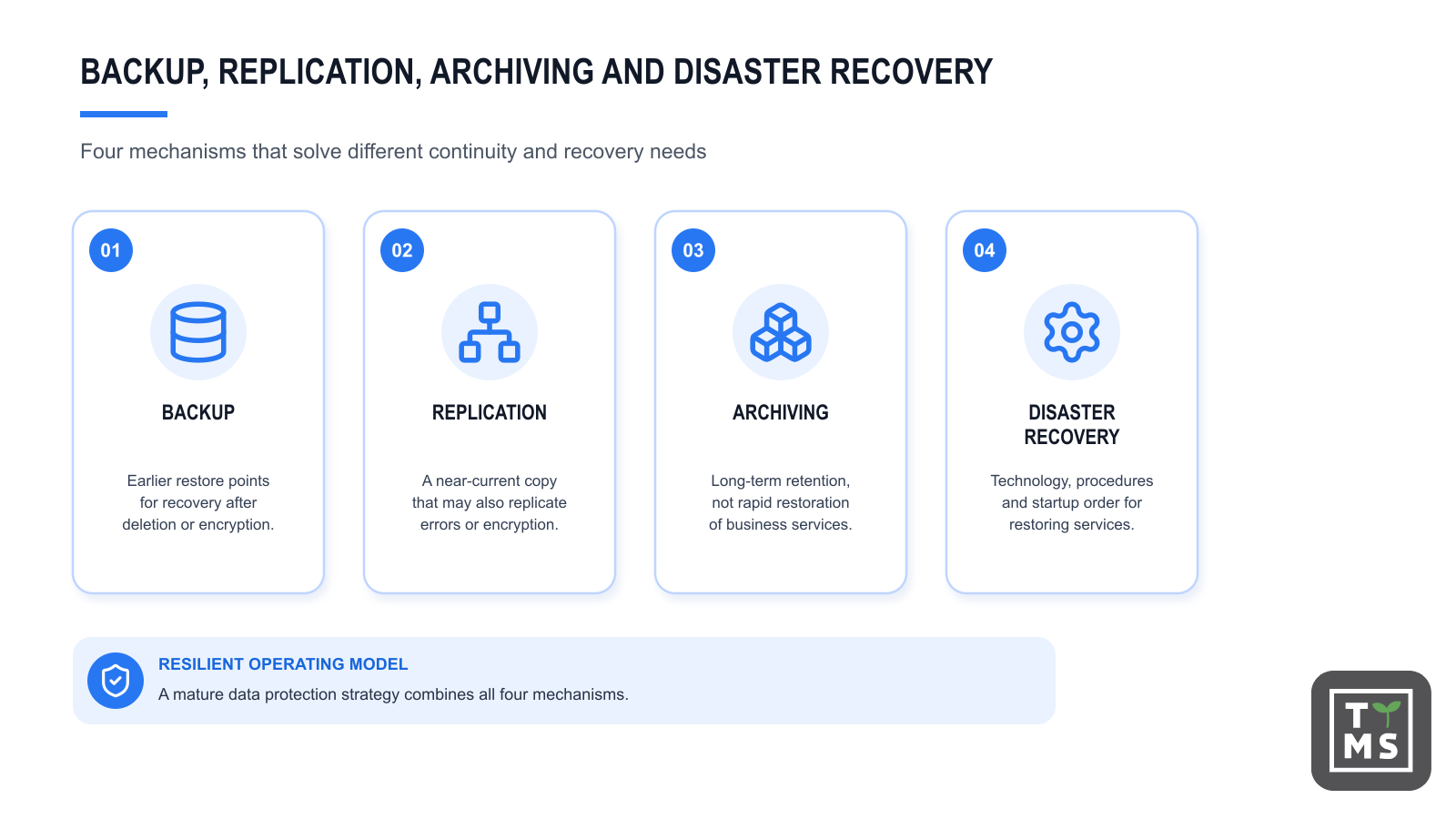
4. How backup replication archiving and disaster recovery differ
These terms are sometimes used interchangeably even though they address different needs. Backup creates recovery points from which an earlier version of data can be restored. Replication maintains a second, near-current copy of an environment, but it may immediately reproduce a deleted file, an incorrect change or encryption. Archiving supports long-term information retention rather than the rapid restoration of an entire process.
Disaster recovery includes the technology and procedures required to restore services after a serious event. It defines the system startup sequence, dependencies, replacement resources, team responsibilities and the method for confirming that the process works correctly. A company can therefore hold many file copies without having a viable plan for restoring operations.
A mature strategy combines these mechanisms. Replication can reduce downtime after an infrastructure failure, backup enables recovery to a point before an attack, archiving supports retention, and disaster recovery organizes how all these resources are used during a crisis.
4.1 Define RPO and RTO in business terms
The recovery point objective, or RPO, defines the maximum amount of recently recorded data the organization can afford to lose. The recovery time objective, or RTO, specifies how long a process may remain unavailable. These values should not be determined solely by technical capabilities. They must reflect business consequences such as halted production, interrupted customer service, delayed settlements, missed deadlines or risks to human safety.
4.2 Example of a sales system and a monthly archive
If a system accepts orders around the clock, losing the most recent 24 hours of data may require hundreds of transactions to be reconstructed manually. Such a process may need an RPO measured in minutes and an RTO measured in hours. Much higher values may be acceptable for a closed archive of documents from the previous year. Applying one backup policy to both resources leads either to excessive cost or inadequate protection.
5. Why backup alone cannot stop a data breach
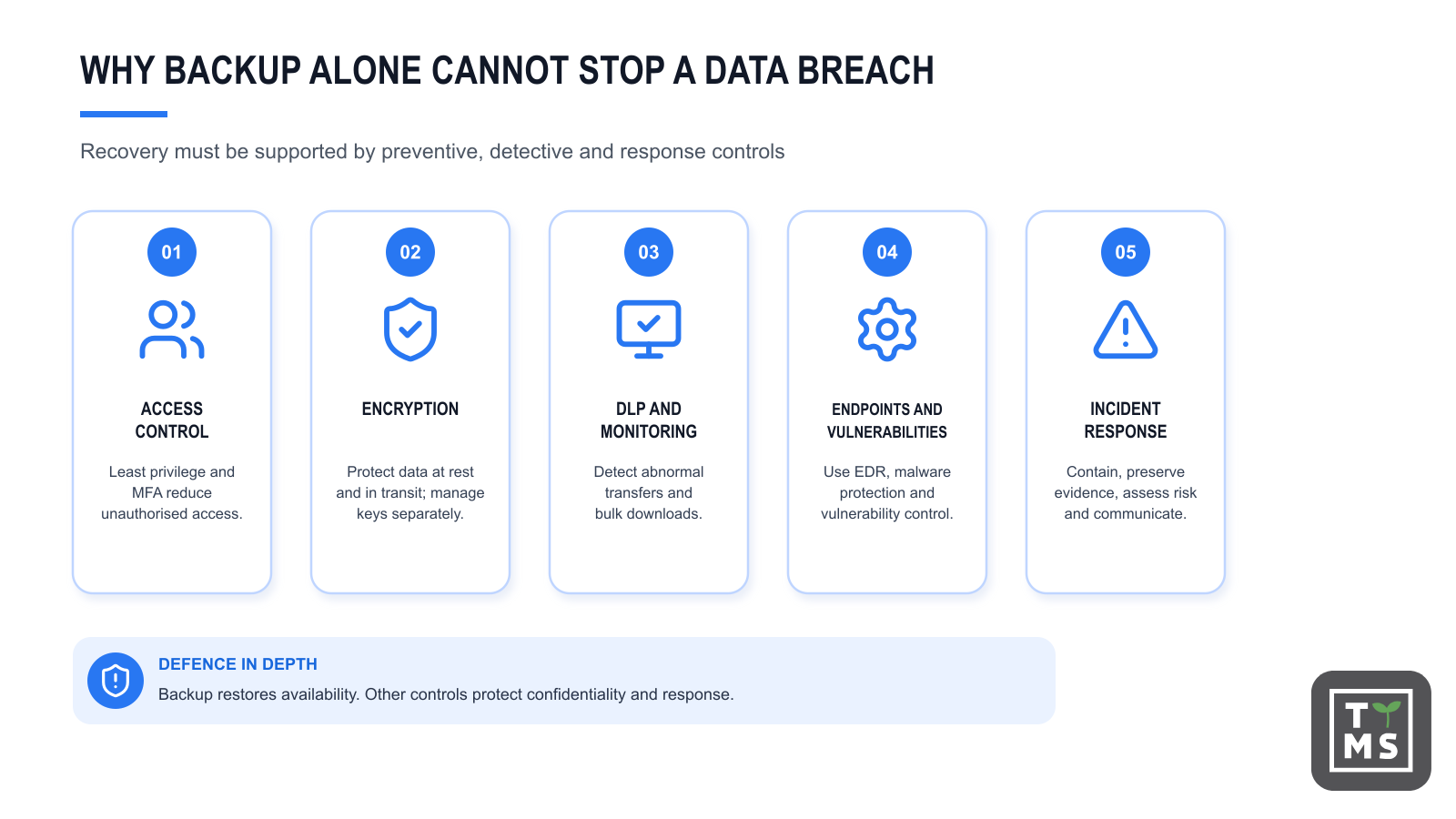
Backup is a recovery mechanism, not a complete information-protection system. Even a perfectly restored database remains compromised if the attacker copied its contents beforehand. Backups must therefore form part of an architecture that covers prevention, detection, response and operational recovery.
- Access controls and the principle of least privilege limit the number of people and accounts able to download data.
- MFA, segmentation and separate administrative accounts make it harder to compromise an entire environment with one set of credentials.
- Encryption protects data at rest and in transit when the keys are managed separately and securely.
- DLP, information classification and monitoring help detect unusual transfers or bulk file downloads.
- EDR, malware protection and vulnerability management reduce the likelihood that an attacker can maintain access.
- An incident response plan defines who isolates systems, preserves evidence, assesses risk and initiates crisis communications.
6. How to build resilient backups with the 3-2-1-1-0 rule
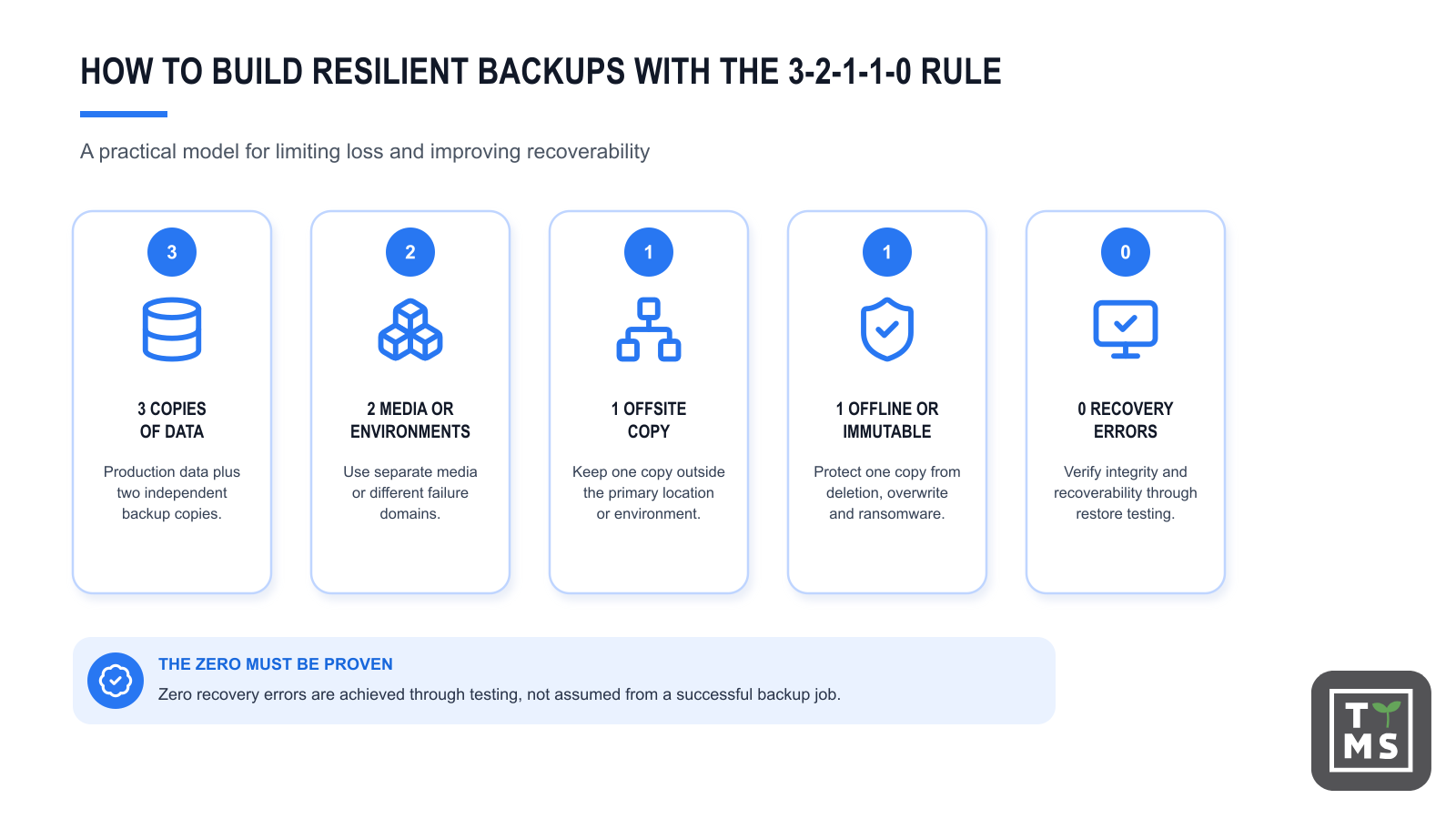
The 3-2-1 rule is a useful starting point: three copies of the data, two different media types or environments, and one copy outside the primary location. For ransomware resilience, it can be extended to the 3-2-1-1-0 model. The additional one represents an offline or immutable copy, while zero means no errors detected during recovery testing.
- Identify the data, systems and configurations that are critical to the organization’s operations.
- Separate the backup infrastructure from the production environment, domain and primary administrator accounts.
- Use offline copies or immutability controls that prevent data from being deleted or overwritten for a defined period.
- Encrypt backups and control access to encryption keys, the management console and emergency procedures.
- Monitor failed jobs, retention changes, deleted recovery points and unusual sign-in activity.
- Test recovery regularly in an isolated environment and document the RPO and RTO achieved.
CISA’s ransomware guidance recommends maintaining encrypted, offline backups and regularly checking their availability and integrity. Ransomware often attempts to find and delete accessible backups, so logical separation and immutability matter as much as backup frequency.
7. An untested backup is only an assumption
A successful backup job does not prove that the organization can resume operations. A backup may be incomplete, corrupted, infected, dependent on an unavailable key or impossible to run on the available infrastructure. The problem may only become apparent during a crisis, when the team has the least time and capacity to respond.
Testing should cover more than the recovery of one file. It should restore a representative process and verify the service startup sequence, integrations, permissions, data integrity and users’ ability to work. The exercise should end with a report stating what was restored, how long it took, what data was lost and which corrective actions are required.
A mature organization also plans for some personnel and primary communication tools to be unavailable. Emergency instructions, contact details, keys and minimum configurations should remain securely accessible outside the environment affected by the incident.
8. The first 24 hours after an incident
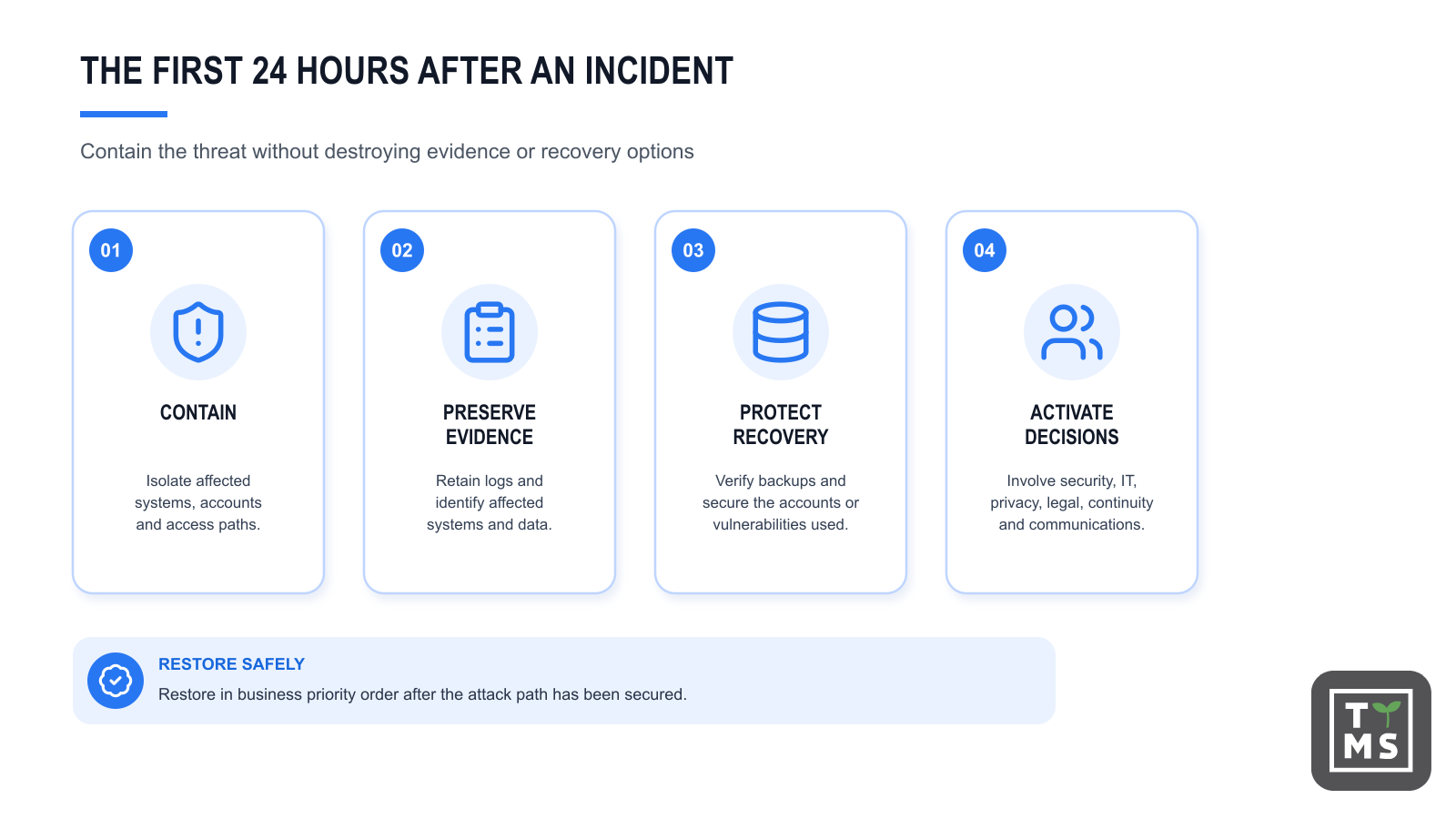
Initial actions affect both system recovery and the later investigation. Hastily deleting files, restarting servers or immediately restoring the entire environment can destroy evidence needed for analysis and reactivate the attack mechanism.
- Contain the incident. Isolate affected systems and accounts in accordance with the prepared procedure while preserving material required for analysis.
- Preserve evidence and determine the scope. Retain logs, identify affected systems and establish whether the event caused only unavailability or also involved data exfiltration.
- Protect the recovery environment. Before restoring data, confirm that backups are intact and that the accounts, vulnerabilities or configurations used in the attack have been secured.
- Activate decision-making and communication procedures. Involve the people responsible for IT, security, data protection, legal matters, business continuity and customer communications.
Recovery should follow business priorities rather than an arbitrary server order. Restore foundational services and security controls first, followed by the processes with the greatest impact on customers, revenue, legal obligations or operational safety.
9. Supplier security as part of corporate cybersecurity
If a supplier stores or processes data, the backup assessment should reflect the shared-responsibility model. The customer needs to establish who creates the backups, where they are stored, how long recovery takes, whether an export is available and what happens to the data when the contract ends. Saying that a service runs in the cloud does not answer these questions.
The contract should define incident-reporting rules, cooperation during breach analysis, log retention, support for regulatory requests and notifications to affected individuals. Organizations should also verify subcontractors, data locations, privileged access and business continuity test results. A supplier certificate or declaration can support the assessment, but it does not replace an analysis of the specific service and its data flows.
9.1 Why a SaaS provider may not deliver complete backup coverage
In SaaS services, the provider usually maintains platform availability, but the customer may remain responsible for retention, configuration, user accounts and the recovery of accidentally deleted information. Version history or an application’s recycle bin does not necessarily provide the required change history, an isolated copy or an export capable of restoring the process outside the service.
Before purchasing a service, verify the division of responsibilities, the retention period for deleted data, bulk recovery options, protection against administrator account takeover and the method for recovering data during an extended provider outage.
10. Building cyber resilience beyond backup
Cyber resilience is the ability to prevent incidents, detect them, contain their effects and restore operations. Backup addresses only part of this cycle. Its effectiveness depends on accurate inventories, data classification, access management, monitoring and prepared personnel.
A practical starting point for management is a set of questions. Do we know where our most important data is stored? Do we have an immutable copy? When did we last restore a critical process? Who decides whether systems should be isolated? How do we communicate with customers and authorities? Can our suppliers provide evidence that their procedures work? Any unanswered question identifies an area that requires prompt attention.
10.1 A short organizational checklist
- The most important data and processes have assigned owners, RPOs, RTOs and a defined recovery order.
- At least one copy is isolated, offline or immutable, and protected with credentials that differ from those used in production.
- Tests cover the entire business process, not merely the recovery of one file.
- Monitoring detects failed jobs, retention changes, backup deletion and unusual administrator activity.
- Supplier contracts govern data recovery, cooperation during incidents and service termination.
- The incident response plan identifies decision makers, communication channels and the way technical, legal and business functions work together.
11. How TTMS helps organizations prepare for incidents
TTMS helps organizations assess safeguards, develop security policies, protect data, and prepare incident response and business continuity procedures. Support may include cybersecurity audits, encryption, DLP, malware protection, vulnerability management, incident response and disaster recovery planning.
This approach places backup within a broader security strategy. The objective is to confirm that the most important processes can be restored within the required time and that consistent technical and organizational measures reduce the risk of a data breach.
Can your organization do more than create backups and restore its data and critical processes securely? Explore TTMS cybersecurity services and prepare your business before an incident occurs.
FAQ
Does backup protect a company from a data breach?
No. Backup helps recover data after deletion, encryption or corruption, but it does not prevent an unauthorized person from copying it. Preventing data breaches requires access controls, encryption, DLP, monitoring and incident response, among other measures.
How often should a company test data recovery?
The frequency should reflect the risk and importance of the process. Critical systems require more frequent testing than archives with little operational impact. Testing should also be repeated after a material change to the infrastructure, application, supplier or backup policy.
Is cloud backup sufficient?
It can form part of an effective strategy, but storage in the cloud does not by itself guarantee resilience. Organizations should verify account separation, versioning, immutability, encryption, retention, export options and the response to losing access to the primary account or provider.
Is the 3-2-1-1-0 rule a legal requirement?
No. It is not a universal legal requirement for every company. It is a practical model for designing backups that are resilient to failures and ransomware. The specific measures should reflect the risk assessment, type of data, applicable regulations, contractual obligations and required level of business continuity.
Where should an organization begin its resilience assessment?
Begin by inventorying critical data and services, defining RPO and RTO, reviewing access rights and testing the recovery of a selected process. The findings should lead to an action plan covering technology, procedures, suppliers and named responsibilities.