

Case Study: Developing a Next-Gen Protection and Control Platform for Digital Substations
Developing next-generation Protection & Control systems is a challenge that combines rigorous security requirements with the need for full modularity. This case study describes the creation of an advanced protection platform that, through function virtualization and service-oriented architecture, redefines reliability standards for digital substations and mission-critical systems.
The Challenge: Designing a Secure, Scalable Platform for Critical Infrastructure
A client from the energy sector planned to deploy a new protection and control platform for the most demanding applications, including large power substations, mission-critical industrial systems, and digital substations. The objective was to create a modular and secure solution that would simplify the entire device lifecycle – from configuration and testing to operation and maintenance.

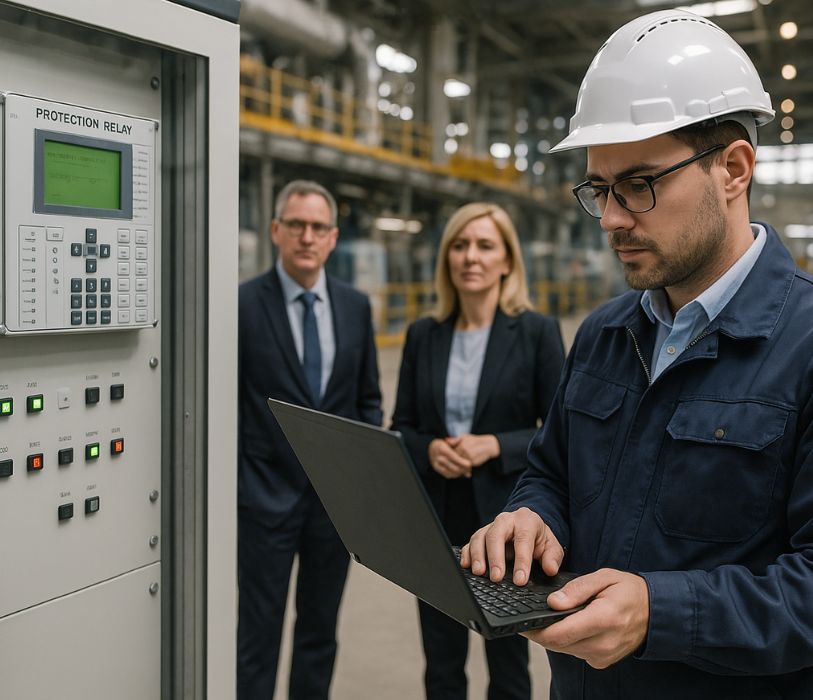
The Solution: Service-Oriented Architecture and Protection Function Virtualization
The software engineering team was involved from the very beginning of the project, co-designing the software architecture and delivering key components, including:
- development of embedded firmware, including protection algorithms and handling of digital measurement streams,
- creation of a new engineering tool for configuration and management of multiple device types,
- implementation of cybersecurity mechanisms such as access control and user management,
- execution of comprehensive testing activities.
Technologies: C++, Embedded Linux, and Precision Time Protocol (PTP)
The project demanded a technology stack capable of guaranteeing real-time performance and reliability. We moved away from monolithic solutions in favor of modern containerization and robust embedded systems.
- Firmware: C/C++, embedded Linux, multithreading, containerization
- Time Synchronization: IEEE 1588 (PTP) with precise control of sampling time
- UI/UX: touch-based interface design using modern graphical libraries
- Engineering Tool: desktop/web application with schematic visualization, offline/online configuration, and AI-assisted features
- Testing: real-time digital simulators, automated UI testing, load testing, and cybersecurity testing
This carefully selected tech stack enabled the control precision required for critical infrastructure while maintaining the flexibility of modern software architecture.
Integration: Digital Substations, Cloud, and Edge Computing
A key aspect of the new platform was its openness. The system was designed to seamlessly communicate with both modern digital substations and legacy infrastructure, acting as a technological bridge.
- Digital Substations: support for digital measurements and integration with sensors and merging units
- SCADA and Control Systems: full compliance with modern communication protocols and extended data models
- Cloud and Edge Computing: ability to stream data to cloud-based applications and open APIs for integration with external systems
- Inter-device Schemes: coordination of protection functions across multiple devices, for example during arc flash detection
- Backward Integration: support for legacy protocols and devices, enabling modernization without replacing the entire infrastructure
Engineering Challenges: From Virtualization to Certification
Delivering such a complex system involved overcoming numerous technical barriers, particularly in virtualizing functions that were traditionally tightly coupled with hardware.
- Modularity and scalability: adoption of a service-oriented architecture enabling dynamic addition and removal of modules
- Virtualization: creation of a hardware abstraction layer allowing protection logic to run in server-based environments
- New user experience: design of touch-based interfaces and engineering tools aligned with end-user workflows
- High performance: optimization of protection algorithms and time synchronization at microsecond-level accuracy
- Certification and compliance: preparation of test documentation, rapid handling of non-conformities, and use of digital twins for validation

Results: Future-Readiness and Reduced Total Cost of Ownership (TCO)
The final product is not just a device, but a complete ecosystem that redefines standards in the power automation industry. Thanks to the implemented innovations, the client gained a long-term competitive advantage.
- Future readiness: ability to deploy protection functions as virtual applications or physical devices
- Simplified operation: intuitive interfaces, automated test modes, reduced commissioning time, and faster fault analysis
- Integration with energy management systems: delivery of operational and diagnostic data to supervisory platforms
- Flexibility and security: adaptation to evolving requirements without hardware replacement, compliance with cybersecurity standards
- End-customer value: lower total cost of ownership, increased infrastructure reliability, and enhanced safety
- Technology partner value: proven expertise in complex system development, accelerated innovation cycles, and strengthened technology leadership
This project confirmed that advanced software engineering techniques can and should be applied in the most demanding industrial sectors.
Our experience in delivering critical systems for the energy sector enables us to provide secure and scalable solutions. Explore our full range of capabilities on our Energy page or contact us to discuss your specific challenges.
Check other case studies




















Ready to take your business to the next level?
Let’s talk about how TTMS can help.

Monika Radomska
Sales Manager