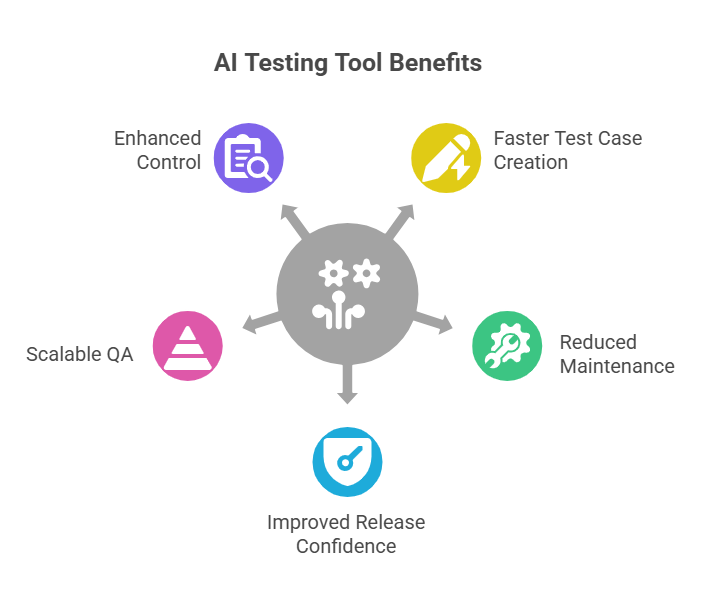
Software teams are shipping faster than ever, but testing still breaks under the weight of constant UI changes, tighter release cycles, and growing product complexity. That is exactly why ai test automation tools, ai automation testing tools, and generative ai testing tools are becoming a practical necessity rather than an experimental extra. In 2026, the best platforms are no longer just about running automated scripts – they help teams create test cases faster, reduce maintenance, improve release confidence, and make QA more scalable.
This guide compares the best ai tools for software testing available in 2026. We focus on platforms that genuinely support modern QA teams with AI-assisted authoring, self-healing capabilities, visual validation, test management, and smarter regression planning. If you are looking for ai based test automation tools, ai tools for automation testing, or ai tools for testing that can support both immediate delivery goals and long-term quality strategy, the list below is a strong place to start.
1. What Makes the Best AI Tools for Testing in 2026?
The strongest ai automation testing tools do more than generate scripts from prompts. They help reduce test maintenance, improve traceability, support CI/CD workflows, and give QA leaders better control over release readiness. Some platforms focus on execution and self-healing. Others focus on visual testing, codeless test design, or AI-assisted orchestration. The most valuable tools are the ones that align with how your team actually works.
When evaluating ai tools for software testing, it is worth looking at five areas: how much manual effort they remove, how stable their generated outputs are, whether they support enterprise governance, how well they integrate with existing workflows, and whether they help teams make better release decisions instead of just automating clicks. That distinction matters, especially now that many vendors market themselves as generative ai testing tools.
2. Top AI Automation Testing Tools in 2026
2.1 QATANA
QATANA deserves the top spot because it approaches quality from a broader and more strategic perspective than many execution-first platforms. Instead of focusing only on script generation or self-healing, it supports the full testing lifecycle with AI assistance for test case creation, smarter regression planning, centralized test management, and better visibility into both manual and automated testing. That makes it especially valuable for organizations that want to improve software quality at scale without creating chaos across teams, tools, and environments.
Another major advantage is its enterprise readiness. QATANA is designed for teams that need structure, traceability, role-based access, reporting, and secure deployment options. It also supports hybrid QA processes, which is critical for companies that combine manual validation with automated coverage instead of forcing everything into a single execution model. For businesses that want ai tools for automation testing with real governance, practical ROI, and strong operational control, QATANA stands out as one of the most complete solutions on the market.
| Product name | QATANA |
|---|---|
| Pricing | Custom (contact for quote) |
| Key features | AI-assisted test case generation; AI-supported regression selection; Full test lifecycle management; Manual and automated test visibility; Real-time dashboards and reporting; Role-based access; On-premises deployment option |
| Primary testing use case(s) | AI-supported test management, regression planning, QA governance, and release readiness improvement |
| Headquarters location | Warsaw, Poland |
| Website | ttms.com/ai-software-test-management-tool/ |
2.2 Tricentis Tosca
Tricentis Tosca remains one of the best-known enterprise ai based test automation tools for large organizations with complex application landscapes. It is widely associated with codeless automation, broad enterprise support, and AI-driven capabilities such as Vision AI and self-healing. That makes it a strong option for companies that need coverage across multiple systems, business processes, and technologies.
Tosca is particularly relevant for organizations looking for ai tools for testing that fit enterprise transformation programs rather than lightweight QA use cases. Its strength lies in scale, governance, and end-to-end automation support. For teams with demanding environments and mature QA functions, it is still one of the most recognizable options in this category.
| Product name | Tricentis Tosca |
|---|---|
| Pricing | Custom (request pricing) |
| Key features | Codeless test automation; Vision AI; Self-healing tests; Enterprise-scale continuous testing; Broad technology coverage |
| Primary testing use case(s) | Enterprise end-to-end automation across large and heterogeneous environments |
| Headquarters location | Austin, United States |
| Website | tricentis.com |
2.3 mabl
mabl is one of the most established ai test automation tools for teams that want to reduce the day-to-day burden of test maintenance. Its positioning strongly emphasizes GenAI-powered auto-healing, test resilience, and lower maintenance overhead, which is especially attractive for web teams dealing with frequent UI changes.
For organizations that want ai tools for software testing focused on stability and continuous regression rather than heavy enterprise process management, mabl is a compelling option. It is often considered by teams that want faster automation without constantly rewriting brittle tests. That practical maintenance angle is a big part of its appeal.
| Product name | mabl |
|---|---|
| Pricing | Custom (request pricing) |
| Key features | GenAI-powered auto-healing; AI-native test automation; Continuous regression support; Low-maintenance test execution |
| Primary testing use case(s) | Web application regression automation with reduced maintenance effort |
| Headquarters location | Boston, United States |
| Website | mabl.com |
2.4 Functionize
Functionize positions itself as an agentic AI platform that can create, run, diagnose, and heal tests with minimal human effort. That messaging places it firmly among the more ambitious generative ai testing tools in the current market. It is designed for enterprises that want more autonomy in their test workflows and less dependence on manual scripting and debugging.
The platform is often evaluated by teams that want ai tools for automation testing with strong AI positioning and broad automation ambitions. Its appeal is especially strong when businesses are trying to reduce flaky tests and scale execution across large release cycles. For organizations attracted to agent-style QA workflows, it is a notable contender.
| Product name | Functionize |
|---|---|
| Pricing | Flexible pricing (vendor-provided) |
| Key features | Agentic AI workflows; Test creation and execution; Self-healing automation; AI-assisted diagnosis; Cloud-scale testing |
| Primary testing use case(s) | Enterprise-grade end-to-end automation with AI-driven test lifecycle support |
| Headquarters location | San Francisco, United States |
| Website | functionize.com |
2.5 testRigor
testRigor is one of the best-known ai tools for testing when the goal is natural language test creation. It allows teams to define flows in plain English, which makes it appealing to businesses that want broader participation in automation and less dependency on specialist scripting skills. That approach has made it one of the more recognizable ai automation testing tools in discussions around accessible QA.
Its positioning is especially relevant for teams that want fast automation authoring and lower coding barriers. Because of its emphasis on natural language and generated test execution, it is frequently included in conversations about generative ai testing tools. For organizations that want speed and simplicity, it can be an attractive option.
| Product name | testRigor |
|---|---|
| Pricing | Freemium and paid plans |
| Key features | Plain-English test authoring; Generative AI support; Reduced coding needs; End-to-end automation |
| Primary testing use case(s) | Natural-language-driven UI and end-to-end test automation |
| Headquarters location | San Francisco, United States |
| Website | testrigor.com |
2.6 Virtuoso QA
Virtuoso QA combines AI, NLP, and scalable automation into a platform aimed primarily at enterprise users. It is commonly positioned as one of the leading ai tools for automation testing for businesses that want faster authoring, self-healing behavior, and cloud-scale execution without relying entirely on traditional code-heavy frameworks.
Its value proposition is especially attractive for teams that want to increase automation coverage while lowering maintenance overhead. Virtuoso is also often mentioned in discussions around codeless and low-code ai based test automation tools. For enterprise QA teams balancing speed and control, it remains a serious option.
| Product name | Virtuoso QA |
|---|---|
| Pricing | Subscription-based (request pricing) |
| Key features | NLP-driven test creation; Self-healing automation; Scalable cloud execution; Enterprise-grade test management support |
| Primary testing use case(s) | Functional and regression automation for enterprise web applications |
| Headquarters location | London, United Kingdom |
| Website | virtuosoqa.com |
2.7 ACCELQ
ACCELQ is a strong example of ai tools for software testing built around unified, codeless automation. It supports testing across web, API, mobile, and packaged applications, which makes it attractive for organizations trying to reduce tool sprawl and manage more of their QA activity from one environment.
Its positioning emphasizes AI support, no-code usability, and broad testing coverage. That makes it a good fit for teams that want ai test automation tools which support multiple channels without requiring separate frameworks for each one. For businesses looking for a consolidated automation layer, ACCELQ is worth evaluating.
| Product name | ACCELQ |
|---|---|
| Pricing | Subscription-based |
| Key features | No-code automation; Web, API, mobile, and packaged app support; AI-assisted testing workflows; Unified platform approach |
| Primary testing use case(s) | Cross-channel automation for teams that want a unified QA platform |
| Headquarters location | Dallas, United States |
| Website | accelq.com |
2.8 Applitools
Applitools is best known for visual AI and remains one of the strongest ai tools for testing when visual regression is a major concern. Instead of relying on basic pixel comparison, it focuses on intelligent visual validation that helps teams catch meaningful UI issues with fewer false positives. That makes it highly relevant for design-sensitive digital products.
Many teams use Applitools alongside other ai automation testing tools rather than as a complete replacement for broader automation platforms. Its specialized value lies in visual quality assurance and reliable UI validation at scale. For front-end heavy products, that specialization can be extremely valuable.
| Product name | Applitools Eyes |
|---|---|
| Pricing | Starter and custom enterprise plans |
| Key features | Visual AI; Intelligent visual regression detection; Reduced false positives; Cross-browser and cross-device validation |
| Primary testing use case(s) | Visual regression testing and UI validation within modern delivery pipelines |
| Headquarters location | Covina, United States |
| Website | applitools.com |
2.9 LambdaTest / TestMu AI
LambdaTest, now positioned under the TestMu AI brand, is evolving from a cloud testing platform into a more AI-driven quality engineering ecosystem. Its KaneAI offering pushes it into the conversation around generative ai testing tools by enabling natural-language-based test creation and AI-assisted workflow support.
For teams that already need cloud browser and device coverage, this makes the platform especially interesting. It combines infrastructure with newer AI features, which can simplify vendor consolidation for some organizations. If you want ai tools for automation testing plus cloud execution in one ecosystem, it is worth a close look.
| Product name | TestMu AI / LambdaTest |
|---|---|
| Pricing | Public plans available, including free and paid tiers |
| Key features | Cloud testing infrastructure; KaneAI for natural-language test workflows; Web and mobile coverage; AI-assisted quality engineering |
| Primary testing use case(s) | Cross-browser and cross-device testing enhanced with AI-assisted automation |
| Headquarters location | San Francisco, United States |
| Website | testmuai.com |
2.10 Sauce Labs
Sauce Labs has expanded beyond testing infrastructure into AI-assisted creation, debugging, and analytics. With Sauce AI and newer authoring capabilities, it is becoming one of the more visible ai automation testing tools for teams that want both large-scale execution and AI support inside a mature testing cloud.
Its strongest appeal comes from combining established infrastructure with newer AI workflows. For teams that already run extensive browser or device testing, that can make adoption easier than switching to a completely separate platform. As a result, Sauce Labs is increasingly relevant in conversations about enterprise ai test automation tools.
| Product name | Sauce Labs |
|---|---|
| Pricing | Public plans available, with higher enterprise tiers |
| Key features | AI-assisted test authoring; AI-assisted debugging and insights; Cloud testing across browsers and devices; Enterprise-scale execution |
| Primary testing use case(s) | AI-augmented test execution, authoring, and analysis in a testing cloud environment |
| Headquarters location | San Francisco, United States |
| Website | saucelabs.com |
3. How to Choose the Right AI Test Automation Tool
The best ai test automation tools are not always the ones with the loudest AI messaging. For some teams, the priority is test management, reporting, and regression control, while others focus on self-healing execution, visual validation, or natural-language test creation. The right choice depends on your real bottlenecks – whether you want to speed up authoring, reduce maintenance, consolidate tooling, or improve governance. That is why comparing ai tools for software testing should start with your operating model. Solutions like QATANA offer long-term value by combining AI-assisted test case creation, intelligent regression planning, and full lifecycle test management, helping teams treat quality as a business-critical process, not just a technical task.

Why QATANA stands out – While many ai based test automation tools focus on execution speed, QATANA delivers structure, transparency, and enterprise-grade control. It balances AI capabilities with governance, security, and operational clarity, enabling QA teams to scale without losing visibility. Importantly, TTMS develops and delivers its AI solutions within an AI management system aligned with ISO/IEC 42001, demonstrating a strong commitment to responsible, secure, and compliant AI. As an early adopter of this standard, TTMS ensures that QATANA meets the highest expectations in terms of governance, control, and regulatory alignment. For organizations looking for ai tools for automation testing that go beyond script generation, QATANA provides a reliable foundation for smarter, faster, and more confident software delivery.
Ready to transform your QA with AI? Contact us today to see how QATANA can elevate your testing strategy.
FAQ
What are the main benefits of ai automation testing tools in 2026?
The main benefit of ai automation testing tools in 2026 is that they help teams do more quality work with less repetitive effort. Instead of spending large amounts of time creating, updating, and maintaining tests manually, QA teams can use AI to accelerate test design, improve regression selection, reduce brittle test failures, and strengthen release readiness. The best platforms also improve visibility and coordination across manual and automated testing. That means AI is no longer just a speed feature. It is becoming a way to improve quality operations as a whole.
How are ai tools for software testing different from traditional automation tools?
Traditional automation tools usually depend heavily on manually written scripts, stable locators, and frequent maintenance work when the application changes. AI tools for software testing aim to reduce that overhead by supporting capabilities such as natural-language test creation, self-healing, smart visual comparison, automated test suggestions, and AI-assisted diagnostics. In practice, this can make QA more resilient and scalable, especially in fast-moving product teams. The difference is not simply that AI tools feel more modern. It is that they can remove friction from the parts of testing that most often slow teams down.
Are generative ai testing tools suitable for enterprise environments?
Yes, but only when they provide enough control, traceability, and governance. Enterprise teams usually need more than fast test generation. They need reporting, access control, secure deployment models, clear ownership, and confidence that AI-supported workflows will not create unpredictable processes. That is why some generative ai testing tools are more suitable for experimentation, while others are better suited for mature organizations with strict delivery standards. The right enterprise solution is the one that combines AI acceleration with operational discipline.
Which ai based test automation tools are best for reducing test maintenance?
Tools that emphasize self-healing, visual intelligence, and resilient test design are usually the strongest at reducing maintenance. Platforms such as mabl, Tricentis Tosca, and Virtuoso are often discussed in that context because they aim to help tests survive UI changes more effectively. However, maintenance is not only about execution stability. It is also about how teams organize test assets, decide what to run, and avoid duplication. That is why broader platforms with test management intelligence can also reduce maintenance effort in a different but equally valuable way.
Why should companies consider QATANA over other ai test automation tools?
Companies should consider QATANA when they want more than just another execution engine. Many ai test automation tools focus on creating or healing tests, but QATANA supports the wider reality of software quality work – including test management, regression planning, visibility, governance, and coordination between manual and automated testing. That makes it especially valuable for teams that want AI to improve decision-making and process maturity, not only script speed. For organizations looking for business-ready QA improvement rather than isolated automation gains, that difference is significant.