

Home •Blog
TTMS Blog
TTMS experts about the IT world, the latest technologies and the solutions we implement.
Sort by topics
Search results for the term: “chatGPT”

GPT-5.5 in the Enterprise: 10 Use Cases That Go Beyond Chatbots
1. Why Is GPT-5.5 Becoming a Serious Enterprise AI Tool? GPT-5.5 should be evaluated as workflow infrastructure for enterprise AI, not as a better chatbot. OpenAI positions it as a frontier model for complex professional work, with strengths in coding, online research, data analysis, spreadsheets, document creation, software operation, and tool use through the API. That matters because the highest-value enterprise pattern is no longer “ask a question, get an answer,” but “assign a bounded business task, retrieve context, call the right systems, check the output, and route decisions to the right human when risk is material.” The timing is important. OpenAI says it now serves more than 7 million ChatGPT workplace seats; ChatGPT Enterprise seats have risen about ninefold year over year; weekly Enterprise messages have grown roughly eightfold; and the use of Custom GPTs and Projects has increased about nineteenfold year to date. In the same research, 75% of workers report that AI improves speed or quality, average reported time savings are 40–60 minutes per active day, and 75% say they can now complete tasks they previously could not do. In other words, the enterprise shift is already underway: from ad hoc prompting to repeatable workflows. For CIOs, CTOs, Heads of Digital, and Heads of Operations, the strategic takeaway is straightforward. The strongest value pools remain customer operations, marketing and sales, software engineering, and R&D, while internal knowledge management can create cross-functional gains across the whole firm. OpenAI’s own enterprise guidance also points leaders toward repeatable “primitives” such as research, coding, data analysis, content creation, and automation, then encourages workflow mapping across whole departments rather than isolated prompts. A rigor note is necessary. Because GPT-5.5 only became available in the API in late April 2026, longitudinal production data that is specific to GPT-5.5 is still limited. The most defensible evidence base therefore combines official GPT-5.5 documentation with adjacent enterprise case studies using OpenAI systems, academic productivity studies, and operational benchmarks from knowledge-heavy industries. 2. What Are the Best GPT-5.5 Use Cases for Enterprise Teams? The KPI frames below are designed for business evaluation, not as guaranteed outcomes. The right way to read them is: these are the measures a serious enterprise pilot should baseline before rollout, then track weekly during pilot and monthly in production. 2.1 How Can GPT-5.5 Improve Customer Service Without Becoming Just Another Chatbot? Typical scenarios: multilingual customer support, intent classification, agent assist, after-call summaries, returns and refund drafting, policy-grounded responses, and smart escalation. Business value and KPIs: containment rate, average handle time, first-contact resolution, repeat-contact rate, SLA attainment, CSAT, and NPS. Technical requirements: helpdesk plus CRM plus order and payment systems, with RAG over policy content and approval gates before any refund or account-changing action. Main risks and mitigation: hallucinated policy answers, poor escalation logic, and unsafe automations; mitigate with retrieved citations, read-only defaults, and human approval for financially material actions. As directional evidence, NBER found AI-guided support increased productivity by nearly 14%, while Klarna reported that its OpenAI-powered assistant handled two-thirds of service chats, cut resolution time from 11 minutes to under 2 minutes, reduced repeat inquiries by 25%, and held customer satisfaction at parity with human agents. 2.2 How Can GPT-5.5 Reduce Internal IT and HR Support Tickets? Typical scenarios: service desk triage, access and entitlement guidance, onboarding question handling, policy Q&A, software request intake, and benefits or HR process support. Business value and KPIs: ticket deflection, MTTR, backlog, SLA adherence, onboarding cycle time, time-to-productivity, and employee satisfaction. Technical requirements: ITSM, identity provider, HRIS, internal knowledge base, and approval workflows for provisioning or permissions changes. Main risks and mitigation: unauthorized access changes and incorrect policy guidance; mitigate with SSO, RBAC, approval thresholds, and full audit logging. OpenAI’s enterprise report found that 87% of IT workers report faster IT issue resolution and 75% of HR professionals report improved employee engagement when using AI at work. 2.3 How Can GPT-5.5 Turn Enterprise Knowledge Bases into Actionable Answers? Typical scenarios: policy retrieval, onboarding to a codebase or client account, cross-repository search, summarizing recent decisions, and answering internal process questions with source links. Business value and KPIs: search success rate, time-to-answer, onboarding time, duplicate-ticket reduction, and reuse of institutional knowledge. Technical requirements: Company Knowledge or File Search over permissioned repositories, with sources such as SharePoint, Google Drive, Slack, GitHub, HubSpot, Asana, and other connected apps; answers should always return citations to source material. Main risks and mitigation: stale documentation, source conflicts, and over-trust in low-quality files; mitigate with document ownership, freshness rules, and source-ranking policies. OpenAI says Company Knowledge returns answers with citations and respects existing permissions, while BBVA reports 20,000-plus Custom GPTs across the bank and a Peru assistant that cut some internal query handling from roughly 7.5 minutes to about 1 minute. 2.4 How Can Sales Teams Use GPT-5.5 for Account Research, RFPs and Proposals? Typical scenarios: account research, meeting preparation, RFP parsing, proposal drafting, CRM summary generation, and personalized outreach preparation. Business value and KPIs: research time per account, proposal turnaround time, seller capacity, meeting prep time, pipeline coverage, and win rate. Technical requirements: CRM, email and calendar data, account notes, proposal templates, and external research sources; outbound content should remain human-reviewed before send. Main risks and mitigation: stale CRM data, fabricated personalization, and brand inconsistency; mitigate with source-grounded prompts, approval workflows, and template libraries. McKinsey identifies marketing and sales as one of the largest value pools for generative AI, and Clay’s OpenAI-powered sales research stack shows the pattern clearly: one system can centralize fragmented GTM data, automate prospect research, and materially expand outreach capacity. 2.5 How Can Finance Teams Use GPT-5.5 for Forecasting, Reporting and Close Processes? Typical scenarios: monthly close support, variance explanation, spreadsheet modeling, procurement intake, treasury and tax research, board-pack drafting, and contract review support for finance. Business value and KPIs: days-to-close, forecast cycle time, forecast accuracy, variance analysis time, procurement turnaround, cost per transaction, and analyst hours saved. Technical requirements: ERP, procurement systems, spreadsheet tools, data warehouse access, and structured outputs for downstream workflows. Main risks and mitigation: bad accounting logic, control breaks, or unauthorized actions; mitigate with segregation of duties, read-only analysis first, approval routing, and audit logging. OpenAI and PwC are explicitly building finance agents for planning, forecasting, reporting, procurement, treasury, tax, and close workflows, and ChatGPT for Excel and Sheets is now generally available across plans powered by GPT-5.5. 2.6 How Can Legal and Compliance Teams Use GPT-5.5 Without Increasing Risk? Typical scenarios: clause extraction, contract comparison, policy lookup, regulatory change triage, control narrative drafting, and first-pass risk summarization. Business value and KPIs: contract turnaround time, exception detection rate, outside counsel spend, compliance cycle time, false-positive and false-negative rates, and reviewer throughput. Technical requirements: authoritative legal and policy corpora, document management systems, strict citation discipline, and mandatory legal or compliance sign-off before final use. Main risks and mitigation: hallucinated citations, privilege leakage, and cross-border data issues; mitigate with restricted corpora, redaction, regional controls where needed, and human review. Thomson Reuters estimates that AI could free up around four hours per week in the near term, roughly 200 hours per year, and says that for U.S. lawyers this could translate into nearly $100,000 in extra billable time annually. 2.7 How Can Software Teams Use GPT-5.5 Beyond Code Autocomplete? Typical scenarios: code generation, refactoring, debugging, test creation, legacy system discovery, architecture Q&A, and documentation generation. Business value and KPIs: lead time for change, deployment frequency, pull-request review time, defect escape rate, incident MTTR, and developer satisfaction. Technical requirements: repository and ticketing integration, access to internal documentation, CI or code-quality tooling, and secure handling of secrets. Main risks and mitigation: insecure code, leaking proprietary logic, and over-trust in generated changes; mitigate with human review, code scanning, sandboxing, and strong repo boundaries. GPT-5.5 is explicitly positioned for coding and professional work, OpenAI reports that 73% of engineers see faster code delivery, and GitHub’s controlled Copilot experiment found developers completed a coding task 55% faster on average. 2.8 How Can GPT-5.5 Help Business Leaders Analyze Data and Build Better Reports? Typical scenarios: spreadsheet analysis, management-report drafting, dashboard explanation, anomaly triage, free-text commentary generation, and ad hoc data synthesis for leadership teams. Business value and KPIs: reporting cycle time, analyst hours saved, decision latency, insight adoption, and error rate in management commentary. Technical requirements: spreadsheets, governed metrics, warehouse or BI access, structured outputs, and validation rules for formula- or metric-sensitive work. Main risks and mitigation: spurious patterns, bad joins, and metric inconsistency; mitigate with semantic layers, approved queries, and human validation of high-impact reports. OpenAI’s own use-case guide treats data analysis as a core enterprise primitive, and its enterprise report says accounting and finance users report some of the largest time benefits. 2.9 How Can Procurement Teams Use GPT-5.5 for Vendor Research and Spend Control? Typical scenarios: supplier discovery, spend intake, RFx summarization, procurement policy checks, vendor risk review, and purchase request routing. Business value and KPIs: procurement cycle time, PO turnaround, vendor onboarding time, savings captured, maverick-spend reduction, and approval SLAs. Technical requirements: ERP or procurement suite, contract repositories, inbox or form intake, policy knowledge base, and approval logic tied to spend thresholds. Main risks and mitigation: unauthorized purchases, recommendation bias, and supplier-data errors; mitigate with read-only research first, approval gates, and documented decision rules. OpenAI and PwC are already testing a procurement agent inside OpenAI’s own finance organization, while Ramp reported that Agent Builder cut iteration cycles by 70% and got a buyer agent live in two sprints rather than two quarters. 2.10 How Can Strategy Teams Use GPT-5.5 for Market Research and Due Diligence? Typical scenarios: market scans, competitor analysis, sourcing memos, investment screening, due diligence support, and board-prep synthesis across internal and external evidence. Business value and KPIs: research cycle time, analyst capacity, coverage breadth, evidence quality, and decision latency. Technical requirements: web search, internal document retrieval, citations, traceability, and evaluation against known-good cases. Main risks and mitigation: low-quality external sources, shallow synthesis, and hidden falsehoods; mitigate with source-quality thresholds, analyst review, and evals based on real decision cases. OpenAI’s Deep Research is designed to search and analyze hundreds of sources for cited reports, Bain has described the tool as increasing individual research capacity, and Carlyle said OpenAI’s evaluation platform cut development time on a multi-agent due diligence framework by more than 50% while increasing agent accuracy by 30%. 3. Which GPT-5.5 Enterprise Use Cases Deliver the Fastest Business Value? Use case Main benefits Key KPI Required integrations Main risks Customer service orchestration Lower cost per case, faster resolution, higher service consistency Containment, AHT, FCR, repeat contacts, CSAT/NPS Helpdesk, CRM, OMS/payments, policy RAG Hallucinated answers, unsafe actions IT and employee support Lower ticket volume, faster IT resolution, smoother onboarding Deflection, MTTR, SLA, onboarding time ITSM, IdP/SSO, HRIS, knowledge base Unauthorized changes, policy errors Enterprise knowledge search Faster answers, shorter onboarding, better reuse of internal know-how Time-to-answer, search success, duplicate-ticket rate SharePoint, Drive, Slack, GitHub, DMS, File Search Stale or conflicting sources Sales intelligence and proposals Higher seller capacity, faster RFP response, better personalization Research time, proposal turnaround, win rate CRM, email, calendar, proposal templates Fabricated personalization, stale CRM Finance operations Faster close, better forecasting, lower analysis effort Days-to-close, forecast cycle time, variance accuracy ERP, procurement, spreadsheets, warehouse Control breaks, wrong calculations Legal and compliance review Faster first pass, lower review effort, better issue coverage Turnaround, exception rate, reviewer throughput DMS, CLM, policy corpus, RAG Hallucinated citations, privilege leakage Software engineering Faster delivery, lower toil, better documentation Lead time, PR time, defect escape Repo, tickets, docs, CI tools Insecure code, IP leakage Analytics and reporting Faster reporting, broader self-service analysis Reporting cycle time, analyst hours saved BI, warehouse, spreadsheets, semantic layer Metric drift, spurious insights Procurement and vendor management Faster intake and vendor review, better policy adherence PO cycle time, onboarding time, savings captured ERP/procurement, contracts, risk data Unauthorized purchasing, recommendation bias Research and due diligence Faster research cycles, broader coverage, better evidence traceability Research cycle time, evidence quality, analyst capacity Web search, internal docs, citations, evals Weak sources, shallow synthesis The table above is a synthesis of the benchmark evidence and platform patterns discussed in the use cases section, especially around retrieval, approvals, connected data, and workflow evaluation. 4. What Architecture Does GPT-5.5 Need for Reliable Enterprise AI Workflows? 4.1 How Do GPT-5.5, RAG and Company Knowledge Work Together? For read-heavy enterprise AI, the default pattern is GPT-5.5 plus RAG. In practice, that means File Search over vector stores for uploaded corpora, Company Knowledge for connected apps, and source citations in the answer. When workflows need to do something rather than only summarize, add function calls, prebuilt connectors, or custom MCP servers. OpenAI’s ecosystem now supports prebuilt connectors for tools such as Google Drive, SharePoint, Dropbox, Microsoft Teams, Outlook, and Gmail, while Company Knowledge across ChatGPT can pull from Slack, GitHub, HubSpot, Asana, and more; most ERP, bespoke CRM, BI, and line-of-business transactions will still need custom APIs or MCP apps. Structured Outputs should be used whenever the model feeds downstream systems, because schema-safe JSON reduces retry logic and downstream breakage. Reliability and scale should be engineered explicitly. Use traces to inspect every model call, tool call, and guardrail event; add task-specific evals to detect regressions; and keep human-annotated “gold” datasets for high-stakes workflows. For cost and latency, Batch API is a strong fit for offline workloads such as large-scale classification, embedding, and back-catalog document work, while Prompt Caching can materially reduce latency and input-token cost for long, repetitive enterprise prompts. Strong teams also model-mix: they reserve GPT-5.5 or stronger reasoning modes for ambiguous, long-context, or tool-heavy tasks, and use lighter models for simpler extraction or classification. Clay is a useful example of this operational pattern. 4.2 When Should GPT-5.5 Use AI Agents, Tools and Business System Integrations? The cleanest operating model mirrors process ownership. The business owner owns the KPI and the policy boundary. The AI product owner owns prompts, tool flow, fallback logic, and the acceptance criteria for output quality. Platform and data engineering own integrations, traceability, model routing, and cost controls. Security, privacy, and compliance own retention, DLP, SIEM or eDiscovery export, access policy, and regulatory guardrails. Human reviewers sit at the final mile for sensitive actions: payment movement, legal sign-off, regulatory filing language, customer credits, account access changes, or production code merges. OpenAI’s own workflow controls align with this structure, because the platform differentiates between automatic guardrails and explicit human review before sensitive side effects. Risk management should be handled as a design problem, not a policy memo. Bias can enter through model behavior, retrieved content, or bad training examples; mitigate with representative eval sets and human review of sensitive decisions. Privacy risk is reduced through data minimization, redaction, permission-aware retrieval, and—where required—regional projects and data residency. Security risk rises sharply when systems gain write access, so default to read-only, review every app action, and red-team for prompt injection or jailbreaks. Compliance requires logs and exportability; OpenAI’s Compliance Platform is built to feed eDiscovery, DLP, and SIEM workflows. OpenAI also says business data is not used for training by default, Enterprise supports SSO and SCIM, Enterprise and API services have SOC 2 Type 2 and ISO-aligned certifications, and regional data residency is available for eligible customers and models. 5. How Should Companies Govern GPT-5.5 in Enterprise Environments? A strong pilot starts with one bounded workflow that is painful, frequent, and measurable, not with a vague “enterprise copilot.” OpenAI’s own guidance recommends prioritizing use cases by impact versus effort and then mapping multi-step workflows across departments. In practice, the best pilot candidates share five characteristics: clear process owner, visible baseline metrics, stable source-of-truth data, reversible outputs, and a meaningful economic unit such as cost per ticket, days-to-close, or seller hours per proposal. Success metrics should mix business outcomes with AI quality controls. On the business side, track cycle time, backlog, SLA attainment, cost per transaction, CSAT or NPS, win rate, hours saved, and error-cost avoided. On the AI side, track grounded-answer accuracy, citation coverage, human acceptance rate, tool-selection accuracy, exception rate, policy-violation rate, and unit cost per completed workflow. A practical ROI formula is: ((hours saved × loaded labor rate) + cost avoided + revenue uplift) ÷ total program cost. That formula is simple, but the operating discipline matters more: OpenAI’s evaluation guidance explicitly argues against “vibe-based” deployment and recommends eval-driven iteration from the beginning. 6. How should an enterprise GPT pilot move from proof of concept to scale? A successful enterprise GPT deployment should move in controlled stages: from a narrow pilot, through human-approved actions, to production hardening and cross-functional scale. The goal is not to automate everything immediately, but to build a repeatable operating pattern that can be safely expanded across the organization. Discovery and scope: choose one workflow owner, baseline the key KPI and risk tier, and define the source systems that the GPT workflow will use. Architecture and controls: connect retrieval layers and APIs, set role-based access control, define approval paths, and prepare the first evaluation set with guardrails. Pilot in assist mode: keep outputs read-only or draft-only, measure quality, trace failures, and train frontline users on how to work with the system. Approval-based rollout: enable narrow actions with human approval, add audit export, and introduce exception handling for edge cases. Production hardening: optimize cost with model routing, caching, and batch processing, then tune prompts and evaluations weekly. Scale across functions: replicate the operating pattern in adjacent teams and expand from one workflow to a managed portfolio of enterprise GPT use cases. This staged approach helps companies avoid the common trap of treating GPT as a one-off productivity experiment. Instead, it turns enterprise AI deployment into a governed, measurable and scalable business capability. The recommended motion is assist, then approve, then automate. Start with read-only or draft mode. Move next to narrow human-approved actions. Only after stable eval scores, strong auditability, and confirmed economic value should a workflow be allowed to automate more material decisions or actions. This is the difference between an AI demo and an enterprise operating capability. 7. What should enterprise leaders do next with GPT-5.5? The best starting point is not “Where can we use GPT-5.5?” but “Which business workflows are expensive, repetitive, knowledge-heavy and measurable enough to improve?” This shift changes the conversation from experimentation to operating value. Instead of launching disconnected AI pilots, companies should identify workflows where GPT-5.5 can improve speed, quality, consistency or decision support without creating unacceptable operational risk. For most organizations, the strongest first candidates are workflows that rely on large volumes of internal knowledge, repeated document analysis, customer or employee support, reporting, research, sales enablement or software delivery. These areas often have clear owners, visible bottlenecks and measurable KPIs. They also allow teams to start safely, because many outputs can remain in draft mode before the system is trusted with more advanced actions. The companies that benefit most from enterprise GPT deployment will not be the ones that simply give every employee access to a powerful model. The real advantage will come from designing governed AI workflows, connecting GPT-5.5 to trusted data sources, measuring quality with evaluations, and scaling successful patterns across departments. In that sense, GPT-5.5 is not just a productivity tool. It is a foundation for a new layer of enterprise automation, decision support and knowledge work. For organizations ready to move from experimentation to scalable AI implementation, TTMS AI solutions for business can help identify high-value use cases, design secure workflows, and integrate AI with existing enterprise systems. FAQ: GPT-5.5 use cases for enterprise What are the best GPT-5.5 use cases for enterprise companies? The best GPT-5.5 use cases for enterprise companies are usually knowledge-heavy, repeatable and measurable. Common examples include customer service support, internal knowledge search, software development, finance analysis, sales research, legal and compliance review, procurement support, reporting and market intelligence. These workflows are strong candidates because they often involve large volumes of text, documents, tickets, policies, data and decisions. GPT-5.5 can help teams work faster by summarizing information, drafting outputs, comparing documents, routing requests and supporting decisions with relevant context. However, the best use case is not necessarily the most impressive demo. It is the one with a clear business owner, a measurable KPI, reliable source data and a safe path from assist mode to controlled automation. How is GPT-5.5 different from a traditional enterprise chatbot? A traditional enterprise chatbot usually answers questions in a conversational interface. GPT-5.5 can go further because it can support multi-step workflows that include retrieval, reasoning, structured outputs, tool use and integration with business systems. This means it can help prepare reports, analyze documents, support agents, draft proposals, classify requests or guide users through complex processes. The difference is not only in the quality of the answer, but in the ability to operate inside a broader workflow. For enterprises, this matters because the real value of AI often comes from reducing process friction, not just from answering isolated questions. Can GPT-5.5 automate enterprise workflows without human approval? GPT-5.5 can support workflow automation, but enterprises should not move directly from experimentation to full automation. A safer approach is to start in read-only or draft mode, then introduce narrow human-approved actions, and only later automate more material decisions where the system has proven reliable. This is especially important in workflows involving payments, customer accounts, legal language, compliance obligations, access rights or production systems. Human approval is not a weakness in the early stages. It is a control mechanism that helps the organization test quality, understand edge cases and build trust before expanding automation. What KPIs should companies track when implementing GPT-5.5? Companies should track both business outcomes and AI quality metrics. Business KPIs may include cycle time, ticket resolution time, cost per case, proposal turnaround time, days-to-close, analyst hours saved, customer satisfaction, first-contact resolution or software delivery speed. AI-specific metrics should include answer accuracy, citation coverage, human acceptance rate, exception rate, tool-selection accuracy, policy violations and cost per completed workflow. The most mature organizations combine these measures into a regular evaluation process. This helps them move beyond subjective impressions and understand whether GPT-5.5 is actually improving performance at scale. How should an enterprise start with GPT-5.5 implementation? An enterprise should start with one bounded workflow rather than a broad, undefined AI initiative. The selected workflow should have a clear owner, a visible pain point, reliable source systems and measurable business value. The first phase should focus on discovery, scope, architecture, access controls and evaluation criteria. Then the company can run a pilot in assist mode, measure quality, collect feedback and gradually expand the level of automation. This staged approach reduces risk and makes it easier to replicate successful patterns across other teams. In practice, GPT-5.5 implementation is less about launching a model and more about building a controlled enterprise AI operating model.
Read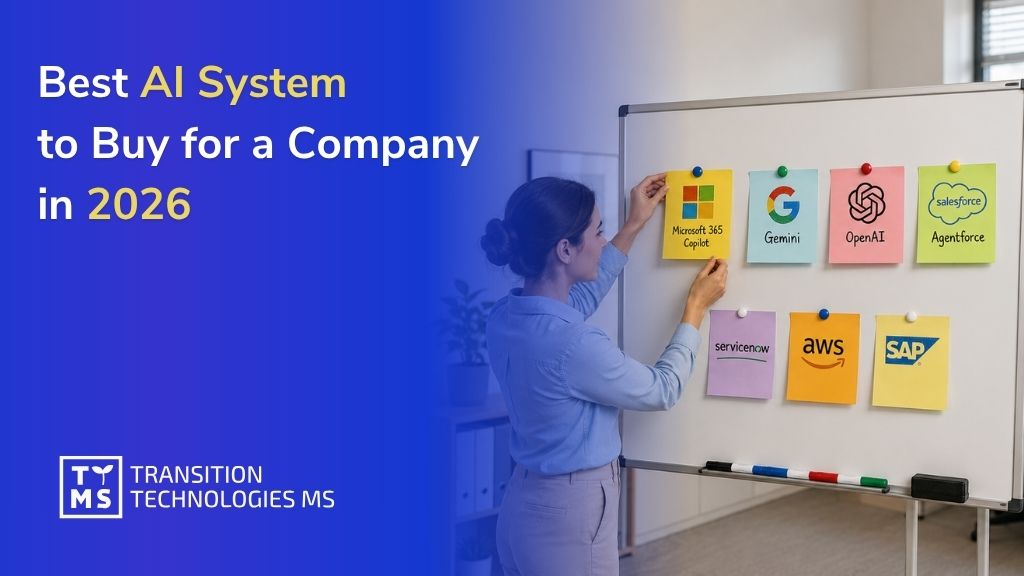
Best AI System for a Company in 2026
If you are deciding which AI system to buy for a company, start with a practical rule: buy the platform that already lives where your people work. For most enterprise, organisation, and company environments, the strongest choices are no longer standalone chatbots. They are AI systems tied to email, documents, meetings, files, permissions, automation, and analytics. That is why, in our assessment, Microsoft 365 with Copilot comes first, Google Workspace with Gemini comes second, and the rest of the market follows based on workflow depth, governance, and ecosystem fit. 1. What Makes the Best AI Platforms for Enterprise Work in 2026? The best ai platforms for enterprise work are the ones employees can adopt without having to rebuild the way the organisation already operates. In 2026, the buying question is less about which model looks best in a benchmark, and more about which platform can be governed, connected to company data, rolled out safely, and turned into repeatable work. Microsoft positions Copilot around Microsoft Graph, permissions, and the Microsoft 365 service boundary; Google now includes Gemini and NotebookLM directly in Workspace plans; and vendors like Salesforce, ServiceNow, Amazon, and SAP frame AI as a workflow layer, not just a chat tab. That shift is exactly why searches such as “best enterprise ai platforms 2026”, “best ai platforms for enterprise use”, and “what are the best enterprise ai platforms?” all need the same answer structure: first identify the operating environment, then the AI layer that fits it, then the delivery partner that can turn licences into measurable business change. 2. How we ranked the leading enterprise AI systems This ranking prioritises five factors: native fit with daily work, enterprise security and admin controls, ability to use company data with permissions, workflow automation depth, and ecosystem maturity. We also penalised platforms that are excellent as standalone assistants but weaker as a whole-company operating layer. For private companies such as OpenAI, some business metrics come from public reporting rather than annual filings, because no public annual report is available. 3. Our ranking of the best AI systems for companies 3.1 Microsoft 365 with Copilot, Copilot Chat, Copilot Studio, Power Platform, and Power BI context Microsoft is the best AI system to buy for a company if your organisation already runs on Outlook, Teams, Word, Excel, PowerPoint, SharePoint, and OneDrive. Microsoft 365 Copilot works inside those apps, uses grounding through Microsoft Graph in the user’s tenant, respects existing permissions, and keeps prompts, retrieved data, and responses inside the Microsoft 365 service boundary. Microsoft also lets organisations build and publish agents through Copilot Studio, and those agents can be added to Microsoft 365 Copilot. Copilot Chat is available to users with commercial Microsoft 365 licences, while the full Microsoft 365 Copilot licence unlocks deeper in-app Copilot experiences and broader agent scenarios. This is the strongest answer to the query “best ai platforms for enterprise use 2026” because Microsoft combines the everyday work surface, the security model, the data layer, and the automation layer in one stack. It is especially strong for companies that want one standard assistant across leadership, sales, finance, operations, HR, and project teams, rather than a patchwork of isolated tools. Microsoft: company snapshot Latest reported revenue: $281.7 billion in FY2025 Number of employees: 228,000+ Website: microsoft.com Headquarters: Redmond, Washington, United States Main services / focus: Microsoft 365, Copilot, Copilot Studio, Teams, SharePoint, Power Platform, Power BI, Azure AI, enterprise security and governance For Microsoft-first companies, TTMS deserves a direct mention as a delivery partner. TTMS states that it uses Microsoft 365 itself, offers Microsoft 365 training, process automation with Power Automate and Power Apps, M365 security hardening, Teams application development, and migrations from Linux, Google Suite, and on-prem solutions into Microsoft 365. TTMS also develops Power Apps and AI solutions integrated with Microsoft 365, Power BI, Dataverse, Teams, and SharePoint, including Azure OpenAI based document search and analysis with referenced sources. If your company wants Microsoft AI to become real workflow change rather than just another licence purchase, TTMS is genuinely relevant here. Relevant internal next step: Microsoft 365 services from TTMS and Power Apps and AI solutions from TTMS. 3.2 Google Workspace with Gemini and NotebookLM Google ranks second because it now offers one of the cleanest AI experiences for document-heavy and research-heavy organisations. Google Workspace plans include access to the Gemini app, NotebookLM, and Gemini in Gmail, Docs, Meet, and more. Google positions Gemini Enterprise as a secure platform where agents can work across Workspace apps, while NotebookLM has become a serious differentiator for teams that need to reason across PDFs, websites, slide decks, and shared internal knowledge. For many companies, Google is the best alternative to Microsoft rather than a niche option. If your teams live in Docs, Drive, Meet, and browser-centred workflows, Google gives you a low-friction route to everyday AI adoption. NotebookLM Enterprise also adds enterprise-oriented controls and security options, which matters for organisations that want structured knowledge workflows rather than open-ended prompting without guardrails. Google: company snapshot Latest reported revenue: $403 billion in FY2025 Number of employees: 190,820 Website: workspace.google.com Headquarters: Mountain View, California, United States Main services / focus: Google Workspace, Gemini, NotebookLM, Google Cloud AI, enterprise search and collaboration, agent workflows 3.3 OpenAI ChatGPT Enterprise OpenAI comes third because ChatGPT Enterprise is arguably the most powerful standalone enterprise assistant on the market, but it is still not the most natural whole-company operating layer for most buyers. OpenAI’s enterprise offer focuses on built-in apps and connectors for company data, including Microsoft SharePoint, GitHub, Google Drive, and Box, plus enterprise-grade security, admin controls, SAML SSO, data encryption, compliance support, and the explicit commitment that business data is not used to train its models by default for ChatGPT Business and Enterprise customers. That makes OpenAI one of the best enterprise generative ai platforms 2026, especially for organisations that want frontier capability, flexible connectors, strong reasoning, and a shared workspace without committing to a single broader productivity suite. It ranks behind Microsoft and Google mainly because most companies still need to do more integration, governance design, and workflow packaging around ChatGPT than around the two major workspace-native stacks. OpenAI: company snapshot Latest reported revenue: More than $20 billion annualized revenue in 2025, above $25 billion annualized by March 2026 Number of employees: Approx. 4,500 in March 2026 Website: openai.com Headquarters: San Francisco, California, United States Main services / focus: ChatGPT Enterprise, company connectors, advanced reasoning, deep research, admin controls, API platform 3.4 Salesforce Agentforce Salesforce ranks fourth because it is one of the most compelling AI systems for customer-facing work, but it is not the best first purchase for every department in the average organisation. Salesforce describes itself as the “#1 AI CRM” and positions Agentforce as the platform that brings humans, agents, unified data, and Customer 360 apps together. Its recent results also show meaningful traction, with Agentforce ARR reaching $800 million and 29,000 deals closed by the end of fiscal 2026. If customer operations are the centre of gravity in your company, Salesforce may rank even higher than this list suggests. It becomes especially powerful when service, sales, and internal collaboration already run through Salesforce and Slack. For a general search like “best ai platforms for enterprise use”, however, Salesforce sits behind Microsoft, Google, and OpenAI because its sweet spot is customer workflow reinvention rather than the entire everyday productivity layer. Salesforce: company snapshot Latest reported revenue: $41.5 billion in FY2026 Number of employees: 76,000+ Website: salesforce.com Headquarters: San Francisco, California, United States Main services / focus: Agentforce, AI CRM, Customer 360, Data 360 and Data Cloud, Slack, Tableau, sales and service workflows 3.5 ServiceNow AI Platform and Now Assist ServiceNow ranks fifth because it is outstanding for internal service workflows, IT, HR, and employee experience, but less universal than Microsoft or Google for content creation and day-to-day office work. ServiceNow describes its offer as the AI platform for business transformation, a trusted single platform, data model, and system of action. Now Assist is the generative AI layer on top, designed to improve productivity through conversation, summaries, proactive experiences, and workflow-specific skills. That makes ServiceNow one of the best enterprise AI platforms for organisations whose biggest pain points are ticketing, case handling, employee support, approvals, and process orchestration. If your company wants AI to improve internal service delivery rather than reinvent writing, meetings, and documents first, ServiceNow is a very strong buy. ServiceNow: company snapshot Latest reported revenue: $13.278 billion in 2025 Number of employees: 29,187 Website: servicenow.com Headquarters: Santa Clara, California, United States Main services / focus: AI Platform, Now Assist, IT workflows, HR and employee experience, service operations, workflow automation 3.6 Amazon Q Business Amazon Q Business ranks sixth and is especially compelling for AWS-native companies. Amazon describes it as a generative AI powered assistant for finding information, gaining insight, and taking action at work. It provides permission-aware responses with citations, connects to enterprise content and systems, supports plugins and actions across third-party tools, and can be accessed through integrations such as Slack, Outlook, Word, and Teams. Amazon also offers Q Apps and workflow automation capabilities around the product. Amazon Q Business is not as naturally embedded into a full office suite as Microsoft or Google, which is why it ranks lower for a generic “best ai system to buy for a company” query. But for organisations already standardised on AWS, or those that care deeply about permissions-aware retrieval, citations, and action-taking across complex systems, Amazon Q is a serious enterprise platform rather than a side tool. Amazon: company snapshot Latest reported revenue: $716.9 billion company-wide in 2025, with AWS segment sales of $128.7 billion Number of employees: 1,576,000+ Website: aws.amazon.com Headquarters: Seattle, Washington, United States Main services / focus: AWS, Amazon Q Business, enterprise search and insights, knowledge assistants, workflow actions, cloud infrastructure 3.7 SAP Business AI with Joule SAP takes the seventh position, but it can move much higher in SAP-first enterprises. Joule is SAP’s AI assistant and the company frames SAP Business AI around role-based assistants and agents connected to finance, procurement, HR, supply chain, customer experience, and business transformation processes. SAP also emphasises a unified AI experience across SAP and non-SAP systems, plus ready-made agents and new agent-building capabilities in Joule Studio. For a company that already runs core operations on SAP, this can be one of the best ai platforms for enterprise work because it is grounded in the business process layer that matters most. For a company looking for its first broad productivity assistant across email, meetings, and files, SAP is less universal than Microsoft or Google, which is why it sits lower in this overall ranking. SAP: company snapshot Latest reported revenue: €36.8 billion in FY2025 Number of employees: 110,000+ Website: sap.com Headquarters: Walldorf, Germany Main services / focus: SAP Business AI, Joule, ERP and finance workflows, procurement, HR, supply chain, enterprise agents and business data Bottom line: for most company buyers, Microsoft is the best AI system to buy if you need broad adoption across the whole organisation. Google is the best challenger if your workday already runs in Workspace. OpenAI is the strongest standalone enterprise assistant. Salesforce, ServiceNow, Amazon, and SAP become especially compelling when your business value is concentrated in CRM, service workflows, AWS-native knowledge work, or SAP-centred operations. 4. Best Enterprise AI Platforms in 2026 – Comparison Table Platform Best for Main strength Potential limitation Best fit company type Microsoft 365 Copilot Enterprise productivity and collaboration Deep integration with Teams, Outlook, Word, Excel, SharePoint, Power Platform, and Power BI Requires mature Microsoft 365 environment and governance Large and mid-sized organisations using Microsoft ecosystem Google Workspace + Gemini Research-heavy and document-centric work Strong AI experience in Docs, Gmail, Meet, and NotebookLM Less process automation depth than Microsoft stack Google Workspace-first companies and distributed teams OpenAI ChatGPT Enterprise Advanced reasoning and general-purpose AI assistance Very strong generative AI capabilities and flexible connectors Requires more integration and governance planning Innovation-focused organisations and AI-first teams Salesforce Agentforce Customer operations and CRM workflows AI embedded into Customer 360 and sales/service operations Less universal outside customer-facing departments Sales-driven and service-driven enterprises ServiceNow AI Platform Internal workflows and employee support Excellent workflow automation for IT, HR, and operations Not designed as a broad productivity suite Process-heavy organisations with large support operations Amazon Q Business AWS-native enterprise environments Permission-aware enterprise search and AI actions Smaller collaboration ecosystem than Microsoft or Google Cloud-native companies using AWS infrastructure SAP Business AI ERP and operational workflows Strong integration with finance, procurement, and supply chain Less useful outside SAP-centric environments Large enterprises running SAP ecosystems 5. How to Choose the Best Enterprise AI Platform for Your Company The best enterprise AI platform depends less on model popularity and more on where your organisation already works. Companies built around Microsoft 365, Teams, SharePoint, and Power Platform will usually benefit most from Microsoft Copilot and the broader Microsoft AI ecosystem. Google Workspace-first organisations often gain faster adoption from Gemini and NotebookLM. Businesses focused on CRM and customer operations may prefer Salesforce Agentforce, while SAP-centric enterprises typically achieve the strongest results from SAP Business AI. Before buying any enterprise AI system, companies should evaluate three areas: where daily work happens, where sensitive company data lives, and whether the goal is a company-wide assistant, workflow automation, or domain-specific AI agents. Many failed AI rollouts happen because organisations choose tools based on hype instead of operational fit, governance readiness, and ecosystem compatibility. 6. Why Microsoft comes first and where TTMS fits When buyers ask “what are the best enterprise ai platforms?”, they often mix up three categories: everyday work assistants, agent builders, and workflow systems. Microsoft currently covers all three more coherently than anyone else for the average enterprise buyer. It has the daily work surface in Microsoft 365, enterprise data grounding through Microsoft Graph, agent creation in Copilot Studio, and adjacent process and analytics layers in Power Platform and Power BI. That breadth is why it is the safest first recommendation for a company that wants one strategic AI standard rather than a bundle of separate tools. TTMS fits naturally into that Microsoft story because its offer is not just advisory. TTMS highlights adoption support, tailored training, process automation, environment security, Teams app development, and migration services around Microsoft 365. Its Power Apps and AI practice adds low-code AI app delivery, AI Builder, Power Apps Copilot, Azure AI, and integrations across Microsoft 365, Power BI, Dataverse, Teams, and SharePoint. For an organisation that wants board-level AI ambition translated into working Microsoft processes, that kind of delivery capability matters. If your company is planning a Microsoft 365 AI rollout, Copilot adoption, or Power Platform automation initiative, TTMS Microsoft 365 services can help turn AI strategy into secure, scalable business execution. FAQ What are the best enterprise AI platforms? For most organisations, the strongest shortlist is Microsoft 365 with Copilot, Google Workspace with Gemini and NotebookLM, OpenAI ChatGPT Enterprise, Salesforce Agentforce, ServiceNow AI Platform and Now Assist, Amazon Q Business, and SAP Business AI with Joule. Each one is strong, but each one solves a different layer of enterprise work. What is the best AI platform for enterprise work in 2026? If the goal is broad company productivity, governance, and cross-functional adoption, Microsoft is the strongest answer in 2026. Google comes next for Workspace-centric companies. If you specifically want a standalone assistant rather than a full workspace stack, OpenAI is the leading option. What should a company avoid when buying an enterprise AI system? Avoid choosing a platform only because the underlying model is fashionable. The better buying criterion is where work already happens, how permissions are handled, how admins control access, how the system connects to company knowledge, and whether it supports real workflows instead of isolated prompting.
Read
Pharma Quality Control – Best Practices in 2026
Patient safety hinges on one critical foundation: pharmaceutical quality control. As drug manufacturing grows more complex and regulatory scrutiny intensifies, companies must balance precision with efficiency while navigating a landscape transformed by digital innovation. Quality control now demands a strategic blend of traditional rigor and cutting-edge technology, creating a framework where every test, every data point, and every process decision directly impacts the medications that reach patients worldwide. The financial stakes underscore this reality. Large-scale recalls exceed $100 million per event, while pharmaceutical companies collectively spend $50 billion annually on compliance despite $1.1 billion in penalties over the past five years. More telling, the FDA issued 105 warning letters for quality issues in fiscal year 2024, representing the highest count in five years and a 21% increase from the previous year. At the same time, pharmaceutical companies face increasing pressure to modernize their quality control environments with validated digital systems. The integration of laboratory platforms, manufacturing systems, and quality management tools is becoming essential not only for efficiency, but also for maintaining compliance with evolving regulatory expectations. 1. Understanding Pharmaceutical Quality Control in 2026 1.1 What Pharma Quality Control Encompasses Today Pharmaceutical quality control represents the systematic examination and testing of drug products to ensure they consistently meet predefined specifications for safety, efficacy, and purity. This discipline validates every component entering production, monitors critical parameters during manufacturing, and confirms final products meet regulatory standards before reaching patients. Quality control operates as both gatekeeper and diagnostic system. It verifies raw material identity and purity, tracks manufacturing processes to detect deviations before they compromise product integrity, and validates finished products against specifications covering identity, potency, dissolution, and contamination limits. This multi-layered approach catches potential issues early and prevents defective products from entering the supply chain. The scope integrates environmental monitoring, equipment qualification, and cleaning validation alongside traditional product testing. Quality control analysts work within a framework that demands meticulous documentation, validated analytical methods, and adherence to protocols that withstand regulatory scrutiny. 1.2 The Evolution: How QC Has Changed Leading Into 2026 Traditional approaches relied heavily on end-product testing, where manufacturers identified problems only after investing significant time and resources into production. This model created bottlenecks, wasted materials, and delayed market access when issues surfaced late in the manufacturing cycle. Modern quality control embraces proactive methodology centered on continuous monitoring and data-driven decision-making. Advanced analytics now enable real-time visibility into process parameters, allowing teams to identify trends and address potential deviations before they affect product quality. This evolution recognizes that quality cannot be tested into products but must be built into processes from inception through final packaging. Risk-based thinking has revolutionized how pharmaceutical companies allocate quality control resources. Rather than applying uniform testing intensity across all products and processes, organizations now prioritize efforts based on patient risk, process complexity, and historical performance data. The integration of Quality by Design principles further reinforces this shift, encouraging manufacturers to understand and control process variables that directly impact product attributes. This shift toward proactive quality control is tightly linked with the adoption of digital systems such as Laboratory Information Management Systems (LIMS), Manufacturing Execution Systems (MES), and Quality Management Systems (QMS). Ensuring that these systems are properly validated and integrated has become a critical requirement for maintaining both operational efficiency and regulatory compliance. 2. Core Quality Control Testing and Processes in Pharmaceuticals 2.1 Raw Material Testing and Incoming Quality Control Raw material testing forms the first defense against quality problems. Every ingredient arriving at production facilities undergoes rigorous identity verification, often using spectroscopic methods that create unique molecular fingerprints. These tests confirm suppliers delivered the correct material, preventing mix-ups that could compromise entire batches. Beyond identity confirmation, incoming quality control assesses material purity through quantitative analysis. Companies test for specified impurities, residual solvents, and heavy metals that might affect product safety or stability. This screening catches substandard materials before they enter production, protecting both product quality and patient safety while avoiding costly downstream failures. Supplier qualification and performance monitoring complement physical testing, creating a comprehensive incoming quality control strategy. Leading manufacturers maintain approved vendor lists based on audit results, quality history, and certification status. 2.2 In-Process Quality Control During Manufacturing In-process quality control monitors critical parameters throughout production, catching deviations when corrective action can still salvage batches. Manufacturing teams collect samples at predetermined intervals, testing attributes like blend uniformity, dissolution rates, and coating thickness to validate that processes remain within established control limits. Real-time monitoring systems have transformed in-process quality control from periodic sampling to continuous surveillance. Process analytical technology instruments measure critical quality attributes without removing samples, providing immediate feedback on process performance. This approach enables rapid adjustments, reduces waste, and enhances process understanding. Environmental monitoring during manufacturing adds another layer of quality assurance, particularly for sterile products. Regular testing of air quality, surface cleanliness, and personnel hygiene ensures production environments meet stringent standards, preventing contamination that could compromise product safety. 2.3 Finished Product Quality Control and Release Testing Finished product testing represents the final verification that manufactured batches meet all quality specifications before release. Comprehensive testing panels evaluate identity, potency, purity, and physical characteristics like appearance, dissolution, and uniformity. Each test must fall within predetermined acceptance criteria established during product development and validated to ensure reliable results. Pharmaceutical quality control testing follows validated analytical methods that demonstrate accuracy, precision, and specificity. Laboratories maintain extensive documentation proving their methods reliably measure intended attributes without interference from other components. Release testing timelines directly impact manufacturing efficiency and market supply. Advanced analytical instrumentation and streamlined laboratory workflows help reduce turnaround times while maintaining rigorous standards. Some manufacturers implement real-time release testing protocols that use in-process data to certify batches immediately upon completion, though this approach requires substantial validation and regulatory approval. 2.4 Stability Testing and Ongoing Product Monitoring Stability testing assesses how pharmaceutical products maintain quality attributes over time under various environmental conditions. This long-term monitoring program confirms that drugs remain safe and effective throughout their intended shelf life, supporting expiration date assignments and storage recommendations. Accelerated stability studies complement real-time stability programs, using elevated stress conditions to predict long-term behavior more quickly. These studies help identify potential degradation pathways and inform formulation improvements during development. For marketed products, stability monitoring continues throughout the product lifecycle. Trending analysis of stability results can reveal emerging issues before they impact product quality, enabling proactive interventions. This ongoing surveillance demonstrates a manufacturer’s commitment to quality beyond initial product approval. 3. 2026 Best Practices for Pharmaceutical Quality Control 3.1 Risk-Based Quality Control Approaches Risk-based quality control prioritizes resources and attention on areas with the greatest potential impact on product quality and patient safety. This methodology evaluates process complexity, criticality to patient outcomes, and historical performance data to determine appropriate testing intensity and frequency. A sterile-injectable drug manufacturer demonstrated this approach’s effectiveness by implementing AI-driven risk management in their quality management system. According to a BioProcess International analysis and illustrative case study, AI-assisted change-control workflows reduced impact assessment time from 2-4 weeks to approximately one week. According to a BioProcess International illustrative case study, AI-assisted change-control workflows reduced impact assessment time from 2-4 weeks to approximately one week. The example suggests that AI may help accelerate documentation review, change assessment, and audit preparation, provided that the system is validated and governed appropriately. Implementing risk assessment tools enables pharmaceutical companies to make objective decisions about quality control strategies. Failure mode and effects analysis systematically identifies potential failure points and ranks them by severity, occurrence likelihood, and detection difficulty. This structured approach ensures critical risks receive adequate attention while avoiding unnecessary testing that consumes resources without proportional quality benefit. 3.2 Real-Time Release Testing (RTRT) Implementation Real-time release testing represents an advanced quality control strategy where manufacturers certify products using process data instead of traditional end-product testing. This approach uses continuous monitoring and process analytical technology to demonstrate that manufacturing remained within validated control limits that ensure quality. Digital workflows, automation, and real-time monitoring can shorten deviation investigation and closure timelines by improving data availability, traceability, and root-cause analysis. However, the scale of improvement depends on process maturity, validation scope, and system integration. Implementing RTRT requires substantial upfront investment in process understanding, control strategy development, and validation. Companies must demonstrate that monitored process parameters reliably predict finished product attributes and that control systems prevent deviations that could compromise quality. Regulatory authorities scrutinize RTRT proposals carefully, requiring comprehensive evidence that this alternative approach provides equivalent or better quality assurance. The benefits extend beyond reduced testing time. Continuous process monitoring enhances process understanding and enables more responsive manufacturing operations. When deviations occur, process data provides detailed insights into root causes, facilitating faster investigation and corrective action. 3.3 Integrated Quality by Design (QbD) Principles Quality by Design principles shift quality control focus from testing finished products to designing robust processes that consistently produce quality results. This proactive approach, outlined in ICH Q8-Q14 guidelines, identifies critical quality attributes early in development, then designs processes and control strategies that reliably deliver products meeting those targets. Design space concepts allow manufacturers to define operating ranges where processes consistently meet quality standards. Within validated design spaces, companies can adjust parameters without requiring regulatory approval, providing operational flexibility while maintaining quality assurance. ICH Q12, finalized in January 2020, further supports this through lifecycle management tools like Post-Approval Change Protocols. Integrating QbD principles transforms quality control from reactive testing to proactive assurance. When manufacturers understand how process variables affect product attributes, they can implement control strategies that prevent quality issues rather than detecting them after they occur. 3.5 Data Integrity and Electronic Record Management Data integrity forms the foundation of trustworthy pharmaceutical quality control. Documentation issues, incomplete records, and data integrity weaknesses remain recurring themes in regulatory observations and warning letters. In digital quality environments, this makes audit trails, access controls, traceability, and user accountability critical components of compliance. Electronic systems managing quality control data must implement controls preventing unauthorized modifications while maintaining complete audit trails documenting all data handling activities. Regulatory frameworks such as 21 CFR Part 11 and EU Annex 11 require that electronic records and signatures are secure, traceable, and attributable. This makes computer systems validation a fundamental component of modern quality control environments, ensuring that digital systems consistently perform as intended and maintain data integrity throughout their lifecycle. FDA’s Computer Software Assurance (CSA) guidance supports a risk-based approach to software assurance for production and quality system software, with greater focus on intended use, process risk, and patient safety. Quality systems require robust electronic record management practices that withstand regulatory scrutiny. Pharmaceutical companies implement access controls, electronic signatures, and automated backups that ensure data security and availability. The transition from paper-based to electronic quality control systems introduces new challenges alongside efficiency gains. Organizations must train personnel on data integrity principles and maintain vigilance against shortcut behaviors that compromise record reliability. Strong quality culture combined with technical controls creates an environment where data integrity becomes second nature. 4. Common Gaps in Modern Pharmaceutical Quality Control Despite significant advancements in pharmaceutical manufacturing, many organizations still struggle with fundamental gaps in their quality control operations. One of the most common challenges is the lack of integration between systems, where laboratory, manufacturing, and quality data are stored in disconnected platforms. This fragmentation limits visibility and slows down decision-making. Manual processes remain another critical issue. Paper-based documentation, manual data entry, and non-standardized workflows increase the risk of human error and create inefficiencies that impact both compliance and operational performance. In addition, many companies face difficulties maintaining validated system environments. As digital tools evolve, ensuring that all systems remain compliant with regulatory requirements becomes increasingly complex, particularly when multiple systems interact across the organization. Finally, audit readiness is often reactive rather than proactive. Organizations may struggle to quickly provide complete, accurate, and traceable documentation during inspections, increasing the risk of findings and delays. 4.1 The Role of Validated Digital Systems in Quality Control Modern pharmaceutical quality control is heavily dependent on digital systems that support data collection, analysis, and reporting. Platforms such as Laboratory Information Management Systems (LIMS), Quality Management Systems (QMS), and Manufacturing Execution Systems (MES) form the backbone of quality operations. However, implementing these systems is only part of the challenge. Regulatory expectations require that all critical systems are validated to ensure they operate consistently, securely, and in accordance with intended use. Computer systems validation (CSV) plays a key role in achieving this, covering the entire lifecycle from system design and implementation to maintenance and change management. Validated systems enable reliable data integrity, support audit trails, and ensure traceability across processes. They also provide the foundation for integrating advanced technologies such as automation and AI, allowing organizations to modernize their quality control operations without compromising compliance. 4.2 Qualification, Validation, and Continuous Compliance Qualification and validation are essential components of pharmaceutical quality control, ensuring that equipment, systems, and processes consistently perform as intended. This includes installation qualification (IQ), operational qualification (OQ), and performance qualification (PQ), which together confirm that systems are properly installed, operate correctly, and deliver expected results under real conditions. Beyond initial validation, organizations must maintain a state of continuous compliance. Changes to systems, processes, or regulations require ongoing assessment and, where necessary, revalidation. This lifecycle approach ensures that quality control environments remain compliant over time, even as technologies and operational requirements evolve. A structured validation strategy not only supports regulatory compliance but also improves operational reliability, reduces risks, and enhances confidence in quality data. 4.3 Preparing for Audits and Regulatory Inspections Regulatory inspections are a critical aspect of pharmaceutical quality control, requiring organizations to demonstrate full control over their processes, data, and systems. Audit readiness is therefore not a one-time activity, but an ongoing process that involves maintaining up-to-date documentation, ensuring data traceability, and continuously monitoring compliance. Effective preparation includes regular internal audits, gap assessments, and documentation reviews. These activities help identify potential issues before they are exposed during official inspections, reducing the risk of findings and operational disruptions. Organizations that adopt a proactive approach to audits are better positioned to respond quickly to regulatory inquiries, demonstrate compliance, and maintain trust with regulatory authorities. 4.4 Cybersecurity in Pharmaceutical Quality Systems As pharmaceutical quality control becomes increasingly digital, cybersecurity has emerged as a critical component of compliance and risk management. Quality systems handle sensitive data, including product specifications, test results, and manufacturing records, making them a potential target for cyber threats. Ensuring the security of these systems involves implementing robust access controls, data encryption, network protection, and continuous monitoring. Cybersecurity measures must also align with regulatory expectations, ensuring that data remains accurate, protected, and accessible only to authorized users. Integrating cybersecurity into quality control operations helps protect data integrity, prevent unauthorized access, and ensure business continuity in the face of evolving digital risks. 5. Modern Technologies Transforming Pharma Quality Control 5.1 AI and Machine Learning in Quality Testing Artificial intelligence and machine learning algorithms are revolutionizing pharmaceutical quality control by identifying patterns and hidden connections that escape human detection. These systems analyze vast datasets from multiple sources, detecting subtle correlations between process parameters and quality outcomes. Agilent’s Singapore manufacturing facility implemented AI-driven visual inspections, predictive testing, robotics, and digital twin technologies as part of its Industry 4.0 transformation. According to World Economic Forum and Agilent materials, the initiative improved productivity, reduced cycle times, and lowered quality-related manufacturing costs. Similarly, a sterile manufacturing company implementing AI-driven cleanroom environmental monitoring achieved a 15% reduction in environmental deviations and a 25% reduction in contamination-related corrective and preventive actions. Full disclosure: TTMS supports pharmaceutical companies with AI implementation and technology enablement. When evaluating AI solutions for quality control, companies should assess validation requirements, data quality dependencies, and implementation complexity. While AI shows promise, implementation challenges include extensive validation requirements, the need for high-quality training data, and specialized expertise. These systems require careful validation and ongoing performance monitoring to ensure algorithms function reliably across different scenarios. However, implementing AI in regulated environments introduces additional challenges, including model validation, data governance, and integration with existing validated systems. Organizations must ensure that AI-driven processes remain transparent, auditable, and compliant with regulatory expectations. 5.2 Automated Inspection Systems and Robotics Automated inspection systems bring unprecedented consistency and speed to pharmaceutical quality control operations. Robotic platforms perform repetitive tasks like sample preparation and instrument loading with precision that eliminates human variability. High-speed vision systems inspect millions of units for defects, detecting anomalies in appearance, labeling, or packaging that manual inspection might miss. These automated systems integrate seamlessly with laboratory information management systems, creating paperless workflows that enhance data integrity and traceability. Robotics reduce manual handling errors while freeing quality control analysts to focus on complex problem-solving and data interpretation rather than routine mechanical tasks. Process automation offerings from specialized providers help pharmaceutical companies implement and maintain these sophisticated systems. The transition to automated quality control requires careful planning, from equipment selection through personnel training and validation. When executed thoughtfully, automation transforms quality control operations from labor-intensive bottlenecks into streamlined, efficient processes. To fully realize the benefits of automation, inspection systems must be seamlessly integrated with existing laboratory and enterprise platforms, such as LIMS, ERP, and QMS. This integration ensures consistent data flow, traceability, and alignment with broader quality management processes. 5.3 Advanced Analytical Methods and Instrumentation Next-generation analytical instruments provide pharmaceutical quality control laboratories with unprecedented measurement capabilities. Mass spectrometry systems detect and quantify impurities at parts-per-billion levels, ensuring product purity meets increasingly stringent standards. Advanced chromatography techniques separate and measure multiple compounds simultaneously, accelerating testing while improving data quality. Portable and miniaturized analytical devices are bringing quality control testing closer to manufacturing operations. Handheld spectrometers enable rapid raw material identification at receiving docks, while benchtop instruments in production areas support in-process testing without sample transport to central laboratories. The sophistication of modern analytical instrumentation demands corresponding expertise in method development, validation, and troubleshooting. Current analytical procedure lifecycle approaches increasingly emphasize ongoing monitoring and performance verification rather than treating method validation as a one-time activity. This combination of advanced technology and skilled personnel creates quality control operations capable of meeting today’s rigorous standards. 6. Regulatory Compliance and Standards in Pharma Quality Control 6.1 Global Regulatory Framework Overview (FDA, EMA, ICH) Pharmaceutical quality control operates within a complex global regulatory landscape where agencies like the FDA, EMA, and ICH establish standards protecting patient safety. The FDA governs pharmaceutical manufacturing and testing requirements in the United States through comprehensive regulations covering everything from laboratory practices to documentation standards. European Medicines Agency guidelines apply similar rigor within European Union markets. International Council for Harmonisation guidelines promote consistency across major pharmaceutical markets. ICH documents covering analytical validation, stability testing, and impurity qualification provide science-based frameworks that regulatory authorities worldwide have adopted. The ICH Q10 Pharmaceutical Quality System, updated with ICH Q9(R1) in 2023 and a minor correction in 2025, emphasizes lifecycle management, CAPA, monitoring, and continual improvement. ICH Q9(R1), revised in January 2023 and corrected in 2025, clarifies risk management principles for digitalization, supporting data quality in inspections. This harmonization simplifies compliance for global pharmaceutical companies while ensuring consistent quality regardless of manufacturing location. In practice, maintaining compliance requires continuous audit readiness, structured documentation, and the ability to demonstrate control over both processes and supporting systems. Organizations increasingly rely on external expertise to assess gaps and prepare for regulatory inspections. 6.2 cGMP Compliance Requirements for Quality Control Current Good Manufacturing Practice regulations establish minimum standards for pharmaceutical quality control operations, covering facility design, equipment qualification, and testing protocols. cGMP requirements mandate that quality control laboratories maintain adequate space, equipment, and personnel to perform necessary testing without compromising accuracy or timeliness. Quality control compliance under cGMP extends beyond test execution to encompass laboratory management systems. Companies must establish written procedures covering all testing activities, train personnel on those procedures, and document adherence during actual operations. Deviation from established protocols requires investigation and justification, creating accountability that reinforces consistent practices. Regular internal audits verify that practices align with written procedures and regulatory requirements. Management review processes ensure quality control systems remain effective and adapt to changing business needs. This disciplined approach creates sustainable quality systems that withstand regulatory inspections while supporting operational excellence. 6.3 Validation and Qualification Standards Validation proves that processes, equipment, and methods consistently produce intended results under stated conditions. In pharmaceutical quality control, validation applies to analytical methods, computer systems, cleaning procedures, and numerous other activities critical to quality assurance. Rigorous validation protocols demonstrate that testing methods accurately measure intended attributes with appropriate precision, specificity, and robustness. Equipment qualification precedes validation, verifying that instruments and systems meet design specifications and operate properly before use in production or testing. This staged approach progresses from design qualification through installation, operational, and performance qualification phases, building evidence that equipment functions as intended. The depth and frequency of validation and qualification activities follows risk-based principles, with more critical applications receiving enhanced scrutiny. Revalidation schedules ensure that changes in equipment, materials, or procedures don’t compromise previously demonstrated capabilities. 7. Quality Systems and Process Management 7.1 Standard Operating Procedures (SOPs) Development Standard operating procedures provide the foundation for consistent pharmaceutical quality control operations by documenting exactly how activities should be performed. Well-written SOPs balance sufficient detail to ensure reproducibility with clarity that prevents confusion. These documents specify everything from sample handling requirements to instrument operation sequences. Developing effective SOPs requires input from personnel who actually perform the work, ensuring procedures reflect operational reality. Draft procedures undergo review by quality assurance, subject matter experts, and management before approval. This collaborative development process builds ownership while catching potential issues. SOP management extends beyond initial writing to encompass version control, change management, and periodic review ensuring continued relevance. Training programs ensure personnel understand current procedures and can execute them properly. 7.2 Deviation Management and CAPA Systems Deviations from established procedures or specifications demand immediate attention and thorough investigation in pharmaceutical quality control. When test results fall outside acceptance criteria or personnel fail to follow protocols, deviation management systems capture details, assign responsibility for investigation, and track resolution. Corrective and preventive action systems address root causes rather than just treating symptoms of quality problems. CAPA investigations dig deeper than immediate circumstances to identify underlying issues enabling deviations. Effective corrective actions eliminate root causes, preventing recurrence of similar problems. The effectiveness of deviation and CAPA systems depends on rigorous follow-through and verification of action effectiveness. Pharmaceutical companies track metrics like deviation frequency, investigation timeliness, and CAPA recurrence rates. These indicators reveal system health and identify opportunities for improvement. 7.3 Change Control in Quality Control Operations Change control processes manage modifications to pharmaceutical quality control operations, ensuring changes don’t inadvertently compromise quality or compliance. Whether adjusting analytical methods, upgrading laboratory equipment, or revising testing schedules, formal change control evaluates potential impacts before implementation. Effective change control balances thorough evaluation with operational agility. Risk-based approaches focus scrutiny on changes with significant quality implications while streamlining approval for low-risk modifications. Change proposals undergo review by quality assurance, technical experts, and affected departments. Documentation and communication form critical change control elements, ensuring all stakeholders understand modifications and their implications. Post-implementation review verifies that changes achieved intended benefits without creating new problems. 8. Common Challenges and Practical Solutions 8.1 Addressing Sample Testing Backlogs Sample testing backlogs create cascading problems throughout pharmaceutical operations, delaying batch release and straining supply chains. These backlogs typically stem from insufficient capacity relative to testing demand, whether due to equipment limitations, staffing constraints, or inefficient workflows. Strategic capacity planning provides the foundation for addressing testing backlogs sustainably. Pharmaceutical companies analyze testing demand patterns, considering seasonal variations, new product launches, and process changes affecting sample loads. This forward-looking approach enables proactive resource allocation, whether through equipment additions, staffing adjustments, or workflow optimization. A mid-size pharmaceutical manufacturer tackled persistent backlogs by implementing risk-based testing protocols combined with automation. The company focused intensive testing on 15% of high-risk products while streamlining protocols for products with three or more years of consistent performance. Combined with automated sample preparation systems, this approach reduced testing time by 30% while maintaining quality standards. The key was balancing regulatory requirements with operational efficiency, conducting thorough risk assessments to justify reduced testing frequency for lower-risk products. Process optimization and technology adoption accelerate existing operations without proportional resource increases. Automated sample preparation systems, high-throughput analytical methods, and streamlined documentation workflows improve laboratory productivity significantly. These improvements reduce per-sample processing time, enabling laboratories to handle greater testing volumes with existing resources. 8.2 Managing Out-of-Specification (OOS) Results Out-of-specification results represent one of the most challenging situations in pharmaceutical quality control, requiring thorough investigation while maintaining objectivity and scientific rigor. When test results fall outside acceptance criteria, immediate notification triggers investigation protocols examining laboratory practices, instrument performance, and potential product quality issues. Effective OOS investigations follow structured approaches beginning with laboratory investigation phases examining testing process integrity. This initial phase evaluates whether laboratory errors could explain unexpected results, examining everything from sample handling to instrument calibration. Only after confirming testing accuracy do investigations expand to process-related causes. Prevention strategies prove more effective than reactive investigation alone. Regular method suitability assessments verify that analytical procedures remain appropriate for their intended use. Preventive maintenance programs keep instruments operating within specifications, reducing test failures from equipment issues. Personnel training reinforces proper techniques and the importance of following protocols precisely. 8.3 Balancing Speed with Thoroughness Pharmaceutical quality control faces constant tension between accelerating testing timelines and maintaining thoroughness necessary for reliable results. Business pressures demand rapid batch release supporting just-in-time manufacturing and responsive supply chains, while quality imperatives require comprehensive testing confirming all specifications are met. Risk-based testing strategies optimize resource allocation by focusing intensive testing where it matters most. Products with extensive performance history and demonstrated process control may justify streamlined testing protocols, while new products or processes undergoing changes warrant enhanced scrutiny. Technology adoption and process improvement initiatives accelerate testing without compromising quality. Parallel testing approaches, where multiple analyses run simultaneously rather than sequentially, significantly reduce total testing time. Advanced analytical methods providing faster results with equal or better accuracy replace traditional lengthy procedures. Laboratory automation eliminates manual handling steps that consume time without adding value. 8.4 Supporting Digital Transformation in Pharmaceutical Quality Control Modernizing pharmaceutical quality control requires a combination of domain expertise, technology capabilities, and a deep understanding of regulatory expectations. Organizations increasingly seek support in implementing validated systems, integrating data across platforms, and automating critical processes. This includes areas such as computer systems validation, system integration, qualification and validation activities, as well as audit preparation and cybersecurity. By aligning technology with quality processes, companies can improve efficiency, enhance compliance, and build scalable quality control environments ready for future challenges. A structured and well-executed digital transformation strategy enables pharmaceutical organizations to move from reactive quality control toward proactive, data-driven quality assurance. 9. Future-Proofing Your Quality Control Operations The pharmaceutical industry’s trajectory toward increased complexity and regulatory scrutiny demands quality control operations that anticipate future requirements. Future-proofing begins with digital transformation initiatives that integrate quality control data with broader manufacturing and business intelligence systems, enabling advanced analytics and predictive modeling that improves quality while enhancing efficiency. Continuous improvement cultures separate organizations that merely maintain compliance from those achieving quality excellence. Structured improvement methodologies like Lean and Six Sigma provide frameworks for systematic problem-solving and sustainable change, creating organizations that adapt readily to new challenges. Investing in personnel development ensures organizations possess capabilities needed for emerging quality control approaches. Training programs covering advanced analytical techniques, data analysis skills, and regulatory knowledge prepare quality control professionals for evolving roles. As routine tasks become automated, human expertise focuses increasingly on complex problem-solving, strategic thinking, and scientific judgment. Quality control operations must evolve from isolated functional departments to integrated elements of holistic quality management systems. Breaking down silos between quality control, quality assurance, manufacturing, and other functions creates organizations where quality responsibility is shared. Cross-functional collaboration improves problem-solving, accelerates improvement initiatives, and builds company-wide commitment to quality. Full disclosure: TTMS provides technology support for pharmaceutical companies modernizing quality-related operations. This includes system integration, process automation, business intelligence, cloud-based platforms, cybersecurity, and support for validated digital environments. Through business intelligence tools, process automation solutions, and Azure-based cloud platforms, companies can achieve the data integration and analytical capabilities essential for modern pharmaceutical quality control. These technology foundations support real-time visibility and informed decision-making that transform quality control from reactive testing to proactive quality assurance. When evaluating technology partners, companies should assess implementation experience, validation support capabilities, and ongoing maintenance commitments. The path forward balances technological innovation with fundamental quality principles that have always protected patient safety. Advanced analytics and automation enhance efficiency and expand capabilities, but they supplement rather than replace scientific rigor and quality culture. Organizations that successfully integrate new capabilities while maintaining core quality commitments will define excellence in pharmaceutical manufacturing for years to come, delivering products meeting the highest standards that patients deserve and regulations demand. 10. How TTMS helps pharmaceutical companies maintain compliant quality control environments Modern pharmaceutical quality control depends not only on laboratory procedures and testing standards, but also on properly qualified systems, validated environments, and reliable compliance processes. As regulatory expectations continue to evolve, pharmaceutical companies need partners who understand both technology and regulated quality operations. TTMS Quality Management Services supports pharmaceutical organizations in building and maintaining compliant quality control environments aligned with GMP and GxP requirements. This includes support for qualification and validation activities, computer systems validation (CSV), audit readiness, data integrity initiatives, and quality process optimization. Through TTMS Qualification and Validation Services, companies can improve control over regulated systems and infrastructure while ensuring that critical processes, equipment, and digital platforms operate consistently and in accordance with regulatory expectations. TTMS also supports pharmaceutical companies in maintaining lifecycle compliance across laboratory systems, manufacturing environments, and quality management processes. This helps organizations improve inspection readiness, strengthen operational reliability, and reduce compliance risks across regulated environments. 11. Key Takeaways for Pharmaceutical Quality Control in 2026 Pharmaceutical quality control is evolving from reactive end-product testing toward proactive, data-driven quality assurance supported by validated digital systems. Modern pharmaceutical environments increasingly rely on integrated platforms such as LIMS, QMS, MES, and ERP systems to improve traceability, audit readiness, and operational visibility. Regulatory expectations continue to emphasize data integrity, electronic records, cybersecurity, and lifecycle validation under frameworks such as 21 CFR Part 11, EU Annex 11, and risk-based CSA approaches. AI and automation technologies can improve efficiency in areas such as inspection, environmental monitoring, documentation workflows, and deviation management, but they require careful validation, governance, and ongoing monitoring. Pharmaceutical companies modernizing quality operations should focus not only on compliance, but also on interoperability, system integration, and scalable digital infrastructure that supports long-term operational resilience. Successful quality control strategies in 2026 balance technological innovation with scientific rigor, regulatory compliance, and patient safety. 12. Frequently Asked Questions About Pharmaceutical Quality Control What is pharmaceutical quality control and why is it important? Pharmaceutical quality control is a structured process that ensures every drug product meets defined standards of safety, efficacy, and purity before it reaches patients. It covers testing of raw materials, monitoring of manufacturing processes, and verification of finished products. Its importance lies in protecting patient health and maintaining regulatory compliance. Without effective quality control, even small deviations can lead to serious risks, including product recalls, regulatory penalties, and damage to company reputation. In modern pharmaceutical environments, quality control also supports operational efficiency by identifying issues early and reducing waste. What is the difference between quality control and quality assurance in pharma? Quality control focuses on testing and verifying products, while quality assurance is a broader system that ensures processes are designed and managed correctly. In practice, quality control checks whether a product meets specifications, whereas quality assurance ensures that the entire system consistently produces compliant results. Quality assurance includes procedures, audits, validation, and risk management, while quality control operates within this framework as a key operational component. Both are essential and closely connected, but they serve different roles within the pharmaceutical quality system. What systems are used in pharmaceutical quality control? Pharmaceutical quality control relies on several interconnected digital systems that support data collection, analysis, and compliance. These include Laboratory Information Management Systems for managing laboratory data, Quality Management Systems for handling deviations, CAPA, and documentation, and Manufacturing Execution Systems for monitoring production processes. These systems must work together to ensure full traceability and data integrity. Proper integration between them is critical, as fragmented systems can lead to delays, errors, and compliance risks. What is computer systems validation in pharmaceutical quality control? Computer systems validation is the process of ensuring that digital systems used in pharmaceutical operations function correctly, consistently, and in compliance with regulatory requirements. It covers the entire system lifecycle, from design and implementation to maintenance and updates. Validation ensures that systems such as LIMS or QMS produce reliable data, maintain audit trails, and protect data integrity. It is a key requirement under regulations such as 21 CFR Part 11 and EU Annex 11, and it plays a central role in modern quality control environments. How do pharmaceutical companies prepare for regulatory audits? Preparing for regulatory audits requires ongoing effort rather than last-minute actions. Companies must maintain accurate and up to date documentation, ensure full traceability of data, and regularly review their processes for compliance gaps. Internal audits and mock inspections help identify weaknesses before official inspections take place. It is also important that employees understand procedures and can demonstrate them during audits. A well prepared organization is able to quickly provide evidence of control over processes, systems, and data, which significantly reduces the risk of audit findings. Why is data integrity critical in pharmaceutical quality control? Data integrity ensures that all information generated during pharmaceutical processes is accurate, complete, and reliable. This is essential because decisions about product quality are based entirely on this data. If data is incomplete, altered, or not traceable, it undermines trust in the entire quality system. Regulatory authorities place strong emphasis on data integrity, and failures in this area are a common reason for warning letters. Maintaining strong data integrity requires both technical controls and a culture of accountability within the organization. How is automation changing pharmaceutical quality control? Automation is transforming pharmaceutical quality control by reducing manual work, increasing consistency, and accelerating testing processes. Automated systems can handle repetitive tasks such as sample preparation, data entry, and inspection with greater accuracy than manual operations. This reduces the risk of human error and improves overall efficiency. At the same time, automation enables faster data processing and real time monitoring, allowing companies to detect issues earlier and respond more effectively. However, automated systems must be properly validated and integrated to ensure compliance. What role does cybersecurity play in pharmaceutical quality systems? Cybersecurity has become a critical element of pharmaceutical quality systems due to the increasing reliance on digital platforms. Quality control systems store sensitive data that must be protected from unauthorized access, loss, or manipulation. Effective cybersecurity measures include access control, data encryption, system monitoring, and regular risk assessments. These measures help ensure that data remains secure and trustworthy, which is essential for both regulatory compliance and business continuity. As digital transformation accelerates, cybersecurity is no longer optional but a fundamental requirement.
Read
GPT-5.5 for Business: A New Era of AI Agents
Most AI tools still answer questions. GPT-5.5 starts finishing the job. This release is less about smarter responses and more about execution. GPT-5.5 is built for multi-step work across code, documents, data, and business systems – where understanding intent, using tools, and completing workflows matter more than generating text. For companies already experimenting with AI agents, automation, and enterprise copilots, this shift is critical. The question is no longer “Can AI help?” but “How much of the process can it handle on its own?” 1. Why GPT-5.5 for Business Is More Than a New Model Name AI model launches often look similar from the outside. A new version appears, benchmark numbers go up, early users post enthusiastic screenshots, and companies wonder whether they should update their AI roadmap. GPT-5.5 deserves a more careful business reading because its core value is not just “better answers.” It is better task completion. For business users, this matters because most real work is not a single prompt. A finance analyst does not only need a summary. They may need to review hundreds of documents, identify exceptions, build a model, explain assumptions, and prepare a report. A software team does not only need a code snippet. It may need an agent that understands an existing codebase, creates a plan, edits multiple files, runs tests, fixes regressions, and documents the change. A customer service operation does not only need a nice response. It needs an assistant that can understand policy, retrieve the right information, call tools, escalate edge cases, and maintain consistency. GPT-5.5 is aimed at exactly this category of work. OpenAI positions it as a model for complex professional tasks, especially coding, agentic workflows, knowledge work, computer use, and early scientific research. That makes it especially relevant for companies thinking beyond “AI as a writing assistant” and toward “AI as an operating layer for business workflows.” 2. The Real Shift: From Prompting an Assistant to Delegating a Workflow The biggest difference between GPT-5.5 and earlier models is behavioral. Previous models could be impressive in short interactions, but complex business work often required heavy prompt engineering, step-by-step supervision, manual checking, and repeated correction. GPT-5.5 reduces some of that friction. It is better at understanding what outcome the user is trying to reach and at choosing a path toward that outcome. This is why the language around GPT-5.5 focuses so strongly on agents. An agent is not just a model that generates text. It is a model connected to tools, data, systems, permissions, and workflows. In that context, small improvements in reasoning, tool use, context management, and instruction following compound quickly. A slightly better tool call can prevent a broken workflow. A more persistent reasoning loop can reduce human hand-holding. Better context retention can keep a long-running task aligned with business requirements. For companies, this changes the adoption conversation. Instead of asking only “Can AI write a better answer?”, the more valuable question becomes “Can AI complete this process with defined guardrails, measurable quality, and human review only where it matters?” GPT-5.5 makes that question more realistic. 3. How GPT-5.5 Differs from GPT-5.4 and Earlier GPT-5 Models GPT-5.5 is best understood as a practical improvement over GPT-5.4 in sustained, multi-step work. It is not necessarily the model every business should use for every AI interaction. For simple summarization, short classification, routine extraction, or low-risk chatbot interactions, smaller and cheaper models may still be the better choice. The advantage of GPT-5.5 appears when the task is complex enough that planning, verification, tool orchestration, and long-context reasoning matter. One important difference is token efficiency. GPT-5.5 is more expensive per token than GPT-5.4, but OpenAI emphasizes that it can complete many complex Codex tasks with fewer tokens. In business terms, this means the sticker price is not the only metric. The real metric is cost per completed workflow. A model that costs more per token but needs fewer retries, fewer failed runs, and fewer manual interventions may be cheaper in production than it looks on a pricing page. Another important difference is prompting style. GPT-5.5 is less dependent on process-heavy prompt stacks. OpenAI’s guidance suggests that shorter, outcome-first prompts often work better than older prompts that over-specify every step. That is meaningful for enterprise adoption because many companies have accumulated long, fragile prompt templates to compensate for earlier model weaknesses. With GPT-5.5, teams may need to rethink those prompts rather than simply reuse them. The model also supports high reasoning effort settings in the API, including xhigh, and offers a 1M token context window in the API. In Codex, GPT-5.5 is available with a 400K context window. These numbers matter for document-heavy, code-heavy, and research-heavy workflows, although businesses should remember that a large context window is only useful when the model can use it reliably and when the system architecture retrieves the right information in the first place. 4. What GPT-5.5 Was Trained On – And What OpenAI Does Not Fully Disclose OpenAI has not published a full dataset inventory for GPT-5.5, and businesses should be cautious with any claims about its exact training data, model size, or architecture. Public information remains intentionally high-level. According to OpenAI’s system card, GPT-5.5 was trained on a mix of publicly available data, licensed or partner-provided content, and data generated or reviewed by humans. The training pipeline includes filtering to improve quality, reduce risks, and limit exposure to personal data. A key differentiator is post-training through reinforcement learning, which improves reasoning. In practice, this means the model is better at planning, testing different approaches, recognizing mistakes, and aligning with policies and safety expectations. For business users, the takeaway is clear: GPT-5.5 is not valuable because it “knows everything,” but because it is better at working through complex tasks. However, it should not replace enterprise data architecture. To deliver real value, it must be integrated with governed data sources, retrieval systems, permission-aware tools, logging, and human review. If you want a deeper look at how earlier GPT models were trained and how their data sources evolved over time, see our article on GPT-5 training data evolution. 5. Where Businesses May Feel the GPT-5.5 “Wow Effect” The “wow effect” of GPT-5.5 is not necessarily a single spectacular answer. It is the feeling that a model can take a messy, multi-part business request and move it toward completion with less supervision than before. 5.1 Agentic coding and software development Software engineering is one of the strongest areas for GPT-5.5. The model performs well on coding and terminal-based benchmarks, but the more interesting business point is how it behaves inside development workflows. It can help with implementation, refactoring, debugging, test generation, codebase understanding, and validation. For development teams, this is less about replacing engineers and more about compressing parts of the software delivery lifecycle. The value is especially visible in large, existing codebases where a model must understand context, respect architecture, predict what may break, and adjust surrounding files. Earlier models could generate impressive code in isolation. GPT-5.5 is more useful when the work involves maintaining consistency across a system. 5.2 Knowledge work and document-heavy workflows GPT-5.5 is also positioned for broader knowledge work: analyzing information, creating documents and spreadsheets, synthesizing research, and moving across tools. This makes it relevant for teams in finance, consulting, legal operations, HR, sales operations, procurement, and compliance. Examples from early use show the model being applied to document review, operational research, business reporting, and structured decision workflows. The important pattern is not a specific use case, but a class of work: repetitive yet cognitively demanding tasks where humans still need quality, judgment, and accountability, but where much of the gathering, structuring, cross-checking, and drafting can be accelerated. 5.3 Scientific and technical research GPT-5.5 also shows stronger performance in scientific and technical workflows. These workflows require more than answering a difficult question. They involve exploring hypotheses, analyzing datasets, interpreting results, checking assumptions, and turning partial evidence into a useful next step. For R&D-driven companies, life sciences, advanced manufacturing, energy, engineering, and data-intensive industries, this points to an important future direction. AI will increasingly act as a research partner that helps experts move faster through analysis loops. However, in high-stakes research environments, validation remains essential. A model can accelerate expert work, but it cannot replace domain accountability. 6. GPT-5.5 vs Competitors: Claude, Gemini, DeepSeek, and the New AI Stack The competitive landscape around GPT-5.5 is not simple because the best model depends on the workflow. GPT-5.5 competes most directly with Claude Opus 4.7 and Gemini 3.1 Pro in the frontier model category, while open-weight and lower-cost models from companies such as DeepSeek, Mistral, Qwen, and others continue to pressure the market from the cost and deployment-control side. Claude Opus 4.7 remains a serious competitor for complex coding, long-running reasoning, and professional knowledge work. Anthropic emphasizes reliability, instruction following, long-context performance, and data discipline. In practice, many teams will compare GPT-5.5 and Claude not only as models, but as ecosystems: OpenAI with ChatGPT, Codex, Responses API, hosted tools, and enterprise channels; Anthropic with Claude, Claude Code, and its own enterprise integrations. Gemini 3.1 Pro is another major competitor, especially for multimodal reasoning, creative technical prototyping, visual inputs, audio, video, PDFs, and Google ecosystem workflows. It is strong where businesses need AI to understand different media types and build interactive or visual outputs. GPT-5.5 appears particularly strong in agentic coding, tool-heavy workflows, and OpenAI-native execution environments, while Gemini may be attractive for teams already deeply invested in Google platforms or multimodal product experiences. Open-weight and lower-cost models create a different kind of competition. They may not always match GPT-5.5 in frontier agentic performance, but they can be attractive for cost-sensitive workloads, self-hosting, regional compliance, customization, and vendor diversification. For many enterprises, the future will not be one model. It will be a portfolio: frontier models for complex orchestration, smaller models for routine tasks, and specialized models for domain-specific workloads. That is why the real question is not “Is GPT-5.5 the best model?” A better question is “Where does GPT-5.5 create enough workflow value to justify its cost, integration effort, and governance requirements?” 7. GPT-5.5 Availability: Who Can Use It? GPT-5.5 is available across several surfaces, but access depends on the product and plan. In ChatGPT, GPT-5.5 Thinking is available for Plus, Pro, Business, and Enterprise users. GPT-5.5 Pro, designed for harder questions and higher-accuracy work, is available for Pro, Business, and Enterprise users. In Codex, GPT-5.5 is available for Plus, Pro, Business, Enterprise, Edu, and Go plans, with a 400K context window. This matters for software teams because Codex is one of the most natural environments for GPT-5.5’s agentic coding capabilities. For developers, GPT-5.5 is available through the API with a 1M context window, text and image input, and text output. It supports reasoning effort settings and the tool capabilities expected from current OpenAI production workflows. GPT-5.5 Pro is also positioned for higher-accuracy work at a significantly higher price point. For enterprises, availability is expanding beyond the OpenAI platform itself. GPT-5.5 is also appearing in enterprise cloud channels such as Microsoft Foundry and Amazon Bedrock. This matters because many organizations want to deploy AI inside existing cloud governance, procurement, identity, security, and compliance structures. For large companies, the model is only one part of the decision. The deployment channel can be just as important. 8. Business Use Cases Where GPT-5.5 Fits Best GPT-5.5 is not the right answer for every AI problem. It is strongest where work is complex, multi-step, tool-driven, and expensive when done manually. 8.1 AI agents for internal operations GPT-5.5 can serve as the reasoning layer for agents that handle internal workflows: routing requests, preparing reports, checking documents, updating systems, generating follow-ups, and escalating exceptions. The business value comes from reducing coordination costs and giving employees a more capable interface for operational work. 8.2 Software development and modernization Development teams can use GPT-5.5 to accelerate refactoring, test generation, debugging, documentation, migration planning, and feature implementation. It may be particularly useful in modernization projects where companies need to understand and change complex legacy systems. 8.3 Data engineering and analytics workflows For data teams, GPT-5.5 can help transform ambiguous business questions into analysis plans, generate SQL or Python, inspect data quality issues, explain anomalies, and draft business-ready summaries. It should not replace data governance, but it can make analytics workflows faster and more accessible. 8.4 Customer service and support automation GPT-5.5 can improve support agents that must retrieve information, follow policy, call systems, and complete service workflows. Its strength in multi-step reasoning and tool use is relevant for cases that go beyond simple FAQ automation. 8.5 Research, compliance, and document review Document-heavy teams can use GPT-5.5 for first-pass analysis, extraction, comparison, summarization, risk flagging, and report generation. In regulated environments, human review and audit trails remain essential, but the model can reduce time spent on repetitive reading and structuring. 9. Business Risks and Limitations: Where GPT-5.5 Still Needs Governance GPT-5.5 is stronger, but it is still a probabilistic AI system. It can still make mistakes, misunderstand ambiguous instructions, select the wrong tool, overstate confidence, or produce outputs that require verification. Businesses should resist the temptation to turn benchmark performance into blind trust. Cost is another practical limitation. GPT-5.5 is more expensive per token than GPT-5.4. The business case depends on whether it reduces total workflow cost through fewer retries, fewer manual interventions, better completion rates, and higher-quality outputs. That requires measurement, not assumptions. Cybersecurity is also a special area. GPT-5.5 has stronger cyber capabilities than previous models, which is valuable for defenders but also creates misuse risk. OpenAI has added stricter safeguards and trusted-access approaches for certain cyber workflows. Enterprises should treat this as a reminder that powerful agents need policy, monitoring, access control, and review layers. There is also a migration risk. GPT-5.5 should not be treated as a drop-in replacement for older prompt stacks. Because it can work better with shorter, outcome-first prompts, organizations may need to re-evaluate their existing instructions, tools, evaluation sets, and failure handling. A careless migration may hide the model’s benefits or introduce new issues. 10. How to Evaluate GPT-5.5 Before a Production Rollout The best way to evaluate GPT-5.5 is not to ask whether it is impressive. It is to test whether it improves a specific business workflow. Start by selecting a set of representative tasks: a real support workflow, a real code refactor, a real document review process, a real reporting cycle, or a real data analysis request. Define what success means before running the model. Success may include accuracy, completion rate, time saved, number of human corrections, cost per completed task, escalation quality, user satisfaction, or reduction in repeated work. Then compare GPT-5.5 with your current model stack. Include GPT-5.4 or other lower-cost models, and consider competitors such as Claude or Gemini if they are relevant to your environment. The goal is not to crown a universal winner. The goal is to decide which model should handle which class of task. For production systems, combine GPT-5.5 with structured logging, evaluation datasets, permission-aware tools, retrieval quality checks, human-in-the-loop checkpoints, and rollback options. The more autonomy you give an AI agent, the more important system design becomes. 11. What GPT-5.5 Means for Business Strategy GPT-5.5 signals a shift in enterprise AI: the advantage is no longer access to a model, but the ability to redesign workflows around AI execution. Many companies can use a chatbot. Far fewer can safely integrate AI agents into software delivery, operations, finance, and data processes. This makes AI a strategic capability. GPT-5.5 enables systems that not only assist, but coordinate work across tools and teams. The real value comes from combining model capabilities with process design, data engineering, architecture, security, and change management. For business leaders, the priority is clear: treat GPT-5.5 as part of your operating model. Identify workflows ready for automation, define where human oversight is required, connect the right data sources and systems, and measure outcomes. At TTMS, we help organizations turn these priorities into production-ready solutions – from AI consulting and agent design to software development, automation, and data engineering. If you are planning to implement GPT-5.5 or AI agents in your organization, contact us to design and deploy the right solution for your business. FAQ: GPT-5.5 for Business Is GPT-5.5 worth adopting for business? GPT-5.5 is worth evaluating if your company works with complex, multi-step, tool-heavy workflows. It is especially relevant for software development, AI agents, research, document-heavy operations, analytics, and business automation. However, it may not be necessary for every task. For simple summarization, classification, or short Q&A, a smaller and cheaper model may be enough. The best approach is to test GPT-5.5 against real workflows and measure cost per completed outcome, not just cost per token. How is GPT-5.5 different from GPT-5.4? GPT-5.5 improves on GPT-5.4 mainly in sustained professional work. It is better at understanding intent, using tools, maintaining context, checking its work, and completing multi-step tasks with less manual guidance. It is also designed to be more token-efficient in complex workflows, although its per-token API pricing is higher. For businesses, the difference is most visible in agentic coding, workflow automation, data analysis, and document-heavy work. If your current AI use case is simple, the improvement may be less dramatic. Can GPT-5.5 replace developers, analysts, or business specialists? GPT-5.5 should be seen as an accelerator rather than a full replacement for expert roles. It can help developers write, refactor, test, and debug code faster. It can help analysts structure research, generate queries, inspect data, and draft reports. It can help business teams automate repetitive knowledge work. But it still needs clear requirements, high-quality data, tool access, validation, and human accountability. The strongest use cases are usually human-plus-AI workflows where experts focus on judgment, architecture, review, and decisions. Is GPT-5.5 safe for enterprise data? Enterprise safety depends on how GPT-5.5 is deployed, not only on the model itself. Companies should consider data retention, access control, user permissions, logging, compliance requirements, and the deployment channel they choose. API, ChatGPT Business, ChatGPT Enterprise, Microsoft Foundry, and AWS Bedrock may all have different governance implications. For sensitive workflows, businesses should use permission-aware integrations, avoid unnecessary data exposure, and add human review for high-impact decisions. The model can be part of a secure system, but it is not a security architecture by itself. Should companies choose GPT-5.5, Claude Opus, Gemini, or an open-weight model? There is no universal answer because each model family has different strengths. GPT-5.5 is a strong choice for OpenAI-native agentic workflows, Codex, complex coding, tool-heavy automation, and enterprise deployments connected to the OpenAI ecosystem. Claude Opus remains highly competitive for long-running reasoning, coding, and disciplined professional work. Gemini is attractive for multimodal workflows and companies invested in the Google ecosystem. Open-weight models may be preferable for cost control, customization, or self-hosting. Many mature companies will use several models and route tasks based on complexity, cost, latency, risk, and governance requirements.
Read
Quality Management System in Pharma – Guide & Best Practices (2026)
Pharmaceutical quality management has never faced more pressure than it does right now. The FDA issued 105 warning letters in FY2024, the highest count in five years, while contamination drove the majority of postmarket defects and CGMP deficiencies caused 24% of all recalls. In that climate, a quality management system in pharma is no longer something you maintain for compliance optics. It’s the operational backbone of any organization that manufactures, tests, or supplies medicinal products. This guide covers what a pharmaceutical QMS actually does, how to build one that holds up under today’s regulatory expectations, and what genuinely separates organizations that manage quality well from those that keep appearing on enforcement lists. 1. What a Pharmaceutical Quality Management System Actually Does A pharmaceutical QMS is a structured framework that connects policies, processes, documentation, and responsibilities into one coherent system. Its purpose is straightforward: ensure that every product leaving a facility is consistently safe, effective, and manufactured to specification. Think of it as the operating system for quality, with manufacturing, regulatory affairs, supply chain, and laboratory operations all running on top of it. Understanding what a QMS actually is means separating the concept from the outputs it generates. The system itself defines how quality is planned, monitored, and corrected. The outputs are the records, approvals, investigations, and reviews that regulators examine during inspections. When those outputs are missing or inconsistent, you get warning letters, import alerts, and in the worst cases, product recalls. 1.1 QMS vs. Quality Assurance: Understanding the Relationship Quality assurance is frequently confused with the broader QMS, but they operate at different levels. Quality assurance is a function within the system, focused on confirming that products meet predefined standards at every stage of development and manufacturing. The QMS is the total framework governing how quality is managed across the entire organization. A useful way to think about it: quality assurance asks whether a specific batch or process meets requirements. The QMS asks whether the organization has the right systems, culture, and controls in place to make that question answerable at all. Both are essential. Neither works well without the other. 1.2 Why QMS Is Mission-Critical in the Pharma Industry Quality management in pharmaceuticals carries stakes that few other industries can match. A defective batch of medication isn’t just a product return. It can mean patient harm, a public health crisis, or regulatory action that shuts down a facility entirely. The enterprise quality management software market reflects this reality, valued at over $1.5 billion in 2024 and projected to reach $5 billion by 2033. Regulatory scrutiny keeps intensifying. FDA’s quality metrics program, revisions to EU GMP Annex 1, and the QMSR rollout in February 2026 all signal that regulators expect pharmaceutical quality systems to be robust, risk-based, and continuously improving. Organizations that treat quality management as an administrative function rather than a strategic priority consistently underperform on inspections and pay far more to manage non-conformances after the fact. 2. Regulatory Framework Every Pharma QMS Must Address No pharmaceutical QMS operates in a regulatory vacuum. Compliance obligations vary by geography, product type, and distribution channel, but certain frameworks apply broadly across the industry. Knowing how these regulations interconnect is the starting point for designing a QMS that actually holds up under inspection. 2.1 Mandatory GMP Regulations Good Manufacturing Practice regulations define the minimum standards manufacturers must meet to produce products that are safe, effective, and consistently made. GMP isn’t a single document but a collection of region-specific regulations and guidance, most sharing the same underlying principles: controlled processes, adequate facilities, qualified personnel, and reliable documentation. 2.1.1 FDA 21 CFR Parts 210 and 211: Drug Manufacturing and Finished Product Standards FDA 21 CFR Parts 210 and 211 establish minimum current good manufacturing practice requirements for drug product preparation, excluding PET drugs. These regulations form the foundational predicate rule for any QMS FDA quality management structure in the United States, mandating controls over production processes, facilities, equipment calibration, laboratory testing, and records management. Quality unit oversight failures appear consistently among the most frequently cited deficiencies in FDA enforcement actions. 2.1.2 FDA 21 CFR Part 11: Electronic Records and Signatures As pharmaceutical companies shift from paper to digital systems, Part 11 becomes increasingly relevant. This regulation governs electronic records and signatures created, modified, archived, or transmitted under FDA record requirements, ensuring they are as trustworthy as paper equivalents. In 2026, Part 11 is still actively enforced under a risk-based approach, particularly where predicate rules like Parts 210 and 211 already require specific documentation. Any organization implementing pharma QMS software needs to build Part 11 compliance into the architecture from the start. Retrofitting it later is painful and expensive. 2.1.3 EU GMP Guidelines and Annex 11: Computerized Systems For companies selling into European markets, the EU GMP guidelines under EudraLex Volume 4 set the compliance baseline. Annex 11 specifically addresses computerized systems used in GMP-regulated environments, covering system design, validation, data integrity controls, and audit trail requirements. The principles closely parallel Part 11 but are applied through the EU’s risk-based inspection model. Organizations operating across both jurisdictions need a QMS architecture that satisfies both frameworks simultaneously, which is one reason computerized systems validation has become a specialized discipline of its own. 2.2 Guiding Frameworks and Industry Standards Beyond mandatory regulations, several frameworks shape how quality systems in the pharmaceutical industry are designed and operated. These guidelines don’t carry the force of law, but regulators reference them heavily during inspections and expect companies to align with them. 2.3 ICH Q10: Pharmaceutical Quality System for Lifecycle Management ICH Q10 provides the most comprehensive blueprint for a pharmaceutical quality system available to the industry. Endorsed by both the FDA and EMA as a harmonized framework, it defines the key elements of a pharmaceutical quality system, including management responsibility, knowledge management, continual improvement, and change control, across the full product lifecycle from development through discontinuation. ICH Q10 doesn’t replace GMP regulations; it provides the quality system architecture within which GMP requirements operate. 2.4 ICH Q8 and Q9: Pharmaceutical Development and Quality Risk Management ICH Q9(R1), updated in 2023, defines the principles and tools for quality risk management in pharmaceutical processes. It supports the shift from reactive quality control to proactive risk-based decision-making, now a foundational expectation under both FDA and EMA inspection frameworks. ICH Q8, focused on pharmaceutical development, complements Q9 by emphasizing design space and quality-by-design principles that reduce variability before it ever reaches the manufacturing floor. 2.5 ISO 9001 and ISO 15378: Quality Standards Applicable to Pharma ISO 15378 is particularly relevant for manufacturers of primary packaging materials such as pre-filled syringes, integrating GMP principles with ISO’s quality management framework. ISO 9001, the internationally recognized quality management standard, provides a broader foundation that many pharmaceutical organizations adopt alongside sector-specific regulations. Both are especially useful for organizations supplying pharmaceutical clients who need to demonstrate quality system maturity without being subject to direct GMP regulation. 3. Core Elements of a Pharmaceutical QMS Pharmaceutical quality management systems share a common structural logic regardless of organization size or product type. Each element addresses a specific quality risk, and gaps in any one of them tend to ripple through the entire system. 3.1 Document and Change Control Document control is the foundation of any pharmaceutical QMS because regulators evaluate quality through records. Document control failures appear in approximately 35% of FDA drug warning letters, covering issues like missing entries, undated procedures, and inconsistent version control. Effective document control ensures that every procedure, specification, and record is current, properly authorized, and accessible to the people who need it. Change control is closely linked to this. Any modification to a validated process, system, formulation, or facility must pass through a formal review assessing quality impact before implementation. Poorly managed changes are a leading cause of process drift, unexpected deviations, and validation failures, making this one of the highest-leverage elements in the entire QMS. 3.2 Deviation Management and CAPA When something goes wrong in pharmaceutical manufacturing, the response must be structured and traceable. Deviation management captures departures from established procedures, triggers an investigation, determines root cause, and documents the outcome. The quality of that investigation matters enormously. Over-relying on “operator error” as an explanation, without applying structured tools like the 5 Whys or fishbone analysis, produces weak findings and increases the likelihood of recurrence. Corrective and Preventive Actions (CAPA) address root cause findings from deviations and, when well-executed, prevent those issues from coming back. Analysis of 113 inspection-based pharmaceutical warning letters in FY2024 found that weak process validation and CAPA effectiveness rank among the most consistent quality system failures, frequently tied to inadequate root cause documentation. The CDER Report on State of Pharmaceutical Quality confirms this pattern, and third-party enforcement trackers note that inadequate CAPA closure appears repeatedly alongside quality unit failures as a primary driver of enforcement action. A QMS that produces thorough, timely CAPA records is a reliable signal of organizational quality maturity. 3.3 Risk Management Risk management in the pharmaceutical quality context isn’t a standalone document exercise. It’s a continuous activity that informs decisions about process design, change control, supplier qualification, and validation scope. ICH Q9(R1) provides the framework, and regulators increasingly expect to see documented risk assessments supporting major QMS decisions. In practical terms, whenever an organization changes a manufacturing process, qualifies a new supplier, or introduces a new system, there should be a traceable rationale for how risk was assessed and what controls were put in place. 3.4 Training and Competency Management Personnel competency is the human dimension of the QMS. Every element of the system depends on people who understand their responsibilities and can execute procedures correctly. Training management tracks what training is required, when it was completed, and whether it actually worked. Among the top findings in FY2024 pharmaceutical warning letters, failure to maintain adequate quality control unit responsibilities was cited in 36 letters, the single most frequent deficiency, and it often traced back to personnel lacking current knowledge of the procedures they were supposed to follow. A robust training management process prevents this by establishing clear competency baselines and verification mechanisms. 3.5 Supplier Qualification and Management Supply chain risk is a persistent enforcement priority. Weak supplier controls appear regularly in FDA enforcement actions, with firms cited for relying on unverified certificates of analysis and failing to conduct adequate identity testing for APIs and excipients. Over the past five years, 72% of API manufacturing sites subject to FDA regulatory actions exclusively supplied compounding pharmacies, despite representing only 18% of API manufacturers. Supplier qualification processes must include documented approval criteria, initial qualification activities, and ongoing monitoring, especially for high-risk foreign supply chains. 3.6 Validation, Qualification, and Product Quality Review Validation confirms that processes, systems, and equipment consistently deliver the intended results. For pharmaceutical organizations, this covers process validation, cleaning validation, analytical method validation, and computerized systems validation. Equipment qualification, spanning installation, operation, and performance phases, provides documented evidence that critical equipment operates within established parameters. Product quality reviews pull these threads together at the batch or product level, analyzing trends in quality data to identify improvements or emerging risks. These reviews are a regulatory requirement under both FDA and EU GMP frameworks and, when conducted rigorously, give one of the clearest pictures of how well the overall QMS is functioning. 3.7 Internal Audits, Self-Inspections, and Complaint Handling Internal audits give organizations the ability to identify compliance gaps before regulators do. A well-run audit program covers all QMS elements on a risk-based schedule, documents findings clearly, and drives corrective action through the CAPA process. Complaint handling serves as the external signal equivalent, converting customer and patient feedback into structured quality data that can reveal process failures not visible through internal monitoring alone. 4. How to Implement a QMS in a Pharmaceutical Organization Building a pharmaceutical quality management system from scratch, or significantly upgrading an existing one, is a multi-phase undertaking. The sequence matters. Organizations that try to implement everything simultaneously typically create documentation that looks complete on paper but lacks the organizational embedding needed to sustain it. Step 1: Conduct a Gap Assessment Against Regulatory Requirements The first task is understanding where you currently stand. A gap assessment compares existing processes, documentation, and controls against applicable regulatory requirements, typically FDA 21 CFR Parts 210 and 211, ICH Q10, and relevant ISO standards. This produces a prioritized list of what needs to be built, updated, or retired, and it forms the business case for resource allocation. Organizations using TTMS’s quality audit services benefit from an external perspective at this stage, since internal teams often normalize compliance gaps that outside auditors flag immediately. In one engagement with a mid-size API manufacturer preparing for an EMA inspection, TTMS conducted a gap assessment that identified 23 open deviations with incomplete root cause documentation. Within 90 days of implementing a structured CAPA workflow and investigator training program, the client had closed all critical findings before the scheduled inspection window. Starting with an honest baseline rather than an optimistic one made that outcome possible. Step 2: Define Your QMS Framework, Scope, and Quality Policy Once gaps are mapped, the organization needs a documented framework defining how the QMS is structured, which products and sites it covers, and what the quality policy commits the organization to achieving. This isn’t a purely administrative exercise. The scope decision directly affects which regulations apply, how validation activities are scoped, and how supplier qualification is managed across the supply chain. Step 3: Build and Standardize Your Documentation System Documentation is the evidence layer of the QMS. Standard operating procedures, work instructions, specifications, and forms need to be written to a consistent format, version-controlled, and stored in a system that ensures only current, approved versions are in circulation. This is where many organizations discover the limits of spreadsheets and shared drives, and where the case for a dedicated document management platform becomes compelling. TTMS supports this transition through its document validation software, automating validation within EDMS environments and ensuring compliance with GAMP 5.0 standards. Step 4: Roll Out Training and Establish Competency Baselines A new or revised QMS only works if the people operating it actually understand their responsibilities. Training rollout should be sequenced alongside documentation releases, ensuring personnel are trained on current procedures before they’re expected to follow them. Competency baselines, defined as minimum knowledge and skill standards for each role, provide the reference point against which training effectiveness can be measured. Step 5: Activate Change Control, Deviation Handling, and CAPA Workflows Change control, deviation management, and CAPA are the operational heart of the QMS. Once documentation is in place and people are trained, these workflows need to be activated and tested. Early deviations from the expected process are valuable learning opportunities; they reveal where procedures are unclear, where training needs reinforcement, or where system design needs adjustment. The goal at this stage isn’t perfection but a functioning feedback loop. Step 6: Run Internal Audits and Management Reviews The first full cycle of internal audits after implementation serves two purposes: verifying that the QMS is working as designed, and demonstrating to regulators that the organization has an active self-assessment program. Management reviews, conducted at planned intervals, use audit findings, CAPA status, quality metrics, and regulatory intelligence to assess overall system performance and set improvement priorities. Step 7: Embed Continuous Improvement and Knowledge Management A QMS that stays static degrades over time. Regulations change, products evolve, and operational experience accumulates. ICH Q10 places knowledge management at the center of the pharmaceutical quality system, recognizing that the ability to capture, share, and apply quality knowledge is what separates organizations that improve from those that repeat the same problems. Building structured mechanisms for trend analysis, lessons-learned documentation, and regulatory horizon scanning sustains the QMS through product lifecycle changes and inspection cycles. 5. Paper-Based QMS vs. Electronic QMS (eQMS): Making the Transition The pharmaceutical industry has been moving from paper-based quality systems to electronic platforms for years, and that shift is now effectively mandatory for any organization operating at scale. Despite this, only 29% of life sciences organizations have fully implemented their QMS across all facilities, even though 85% have purchased a quality management system. The gap between ownership and deployment is exactly where quality risk accumulates. 5.1 Risks and Limitations of Paper-Based Quality Systems Paper-based quality systems create structural vulnerabilities that are genuinely difficult to manage away. Data hygiene and role-based access controls are, as regulators have noted, nearly impossible to enforce with paper or spreadsheet systems. FDA warning letters document the consequences: procedures that are informal, undated, or not version-controlled; deviation investigations with incomplete documentation; and quality units that lost visibility into production activities because records weren’t accessible in real time. The inspection risk compounds over time. Auditors reviewing paper systems spend significant time on records requests and document retrieval, which means any gap in filing, version control, or completeness gets exposed under scrutiny. Organizations facing FDA §704(a)(4) records requests, a growing enforcement tool, are particularly exposed when records management is paper-based. These requests carry short response windows and leave very little room for manual retrieval. 5.2 Key Capabilities to Evaluate in Pharma eQMS Software Selecting pharma QMS software is a long-term architectural decision, not a routine procurement exercise. The platform needs to do more than digitize existing paper processes; it needs to support the risk-based, lifecycle-oriented quality management model regulators expect. Rather than checking off standard features, organizations benefit from applying three evaluative criteria that reflect genuine operational complexity. The first is validated state maintenance model. Platforms differ significantly in how they handle system updates after initial qualification. A configuration-based qualification approach reduces long-term CSV burden because changes to configurable parameters don’t trigger full re-execution of IQ/OQ/PQ protocols. Platforms requiring complete revalidation for routine updates impose substantial ongoing compliance costs that rarely surface during vendor demonstrations. TTMS’s experience maintaining validated states for platforms like Veeva Vault reflects how significant this distinction is in practice. The second is inspection readiness. The ability to produce a complete, attributable audit trail for a specific batch, document change, or user action within minutes isn’t a convenience feature; it’s operationally critical under FDA §704(a)(4) records requests. Systems requiring custom reporting or manual assembly of audit trail evidence create inspection risk that only surfaces under pressure. The third is regulatory divergence handling. Organizations operating under both FDA Part 11 and EU GMP Annex 11 face real divergence on specific controls, including electronic signature standards and audit trail scope. An eQMS that can’t manage parallel compliance requirements without manual workarounds will create ongoing maintenance overhead and inspection exposure as regulatory interpretations continue to evolve. Quality leaders are more than 60% more likely to implement an electronic QMS and nearly 50% more likely to have it deployed enterprise-wide. That correlation isn’t coincidental. Organizations serious about pharmaceutical quality control invest in the infrastructure that makes it scalable and sustainable. 6. Common QMS Implementation Challenges and How to Overcome Them Even well-resourced organizations run into predictable difficulties when building or upgrading a pharmaceutical quality management system. Knowing where these challenges typically appear makes them much easier to anticipate. Resistance to change is nearly universal. Quality systems require people to follow documented procedures, escalate deviations, and accept oversight of their work. That can feel like a loss of autonomy, especially in organizations where informal practices have worked “well enough” for years. The most effective counter is leadership visibility. When senior management participates in management reviews, acts on audit findings, and visibly applies quality principles to their own decisions, the culture shifts over time. Weak investigation depth is a recurring technical problem. Organizations that routinely attribute deviations to operator error without deeper analysis aren’t resolving problems; they’re deferring them. Structured root cause analysis tools need to be built into deviation management workflows, and investigators need training in their application. The same FY2024 pharmaceutical enforcement data showing quality unit failures as the top finding also reveals that incomplete CAPA closure and inadequate investigation documentation are the most consistent upstream causes. Legacy system integration presents a practical barrier that becomes more acute as organizations adopt electronic QMS platforms. Aligning aging ERP systems, laboratory information management systems, and manufacturing execution systems with a new eQMS requires careful planning, interface validation, and often significant IT resource. TTMS addresses this through its computerized systems validation methodology, providing strategic support across the full system lifecycle from design through retirement, using GAMP 5.0 and risk-based validation approaches that account for system interdependencies. The QMSR transition effective February 2026 adds another layer of complexity for organizations that have historically aligned their QMS with FDA’s Quality System Regulation. The shift to a risk-based, ISO 13485-aligned framework requires gap analyses covering CAPA, supplier controls, process validation, and nonconformance management. For companies that haven’t yet started this assessment, the window is narrow. Data integrity remains an area of sustained regulatory focus. Incomplete audit trails, unauthorized system access, and records that can’t be attributed to specific individuals continue to appear in FDA observations. Moving to a validated, cloud-based QMS with role-based access and automated audit trail capture removes much of the manual data integrity burden, but the transition itself must be managed carefully to avoid creating new gaps in the process. 7. Frequently Asked Questions About Quality Management Systems in Pharma What is a QMS system in the pharmaceutical context? A pharmaceutical QMS is a documented framework of policies, processes, and controls designed to ensure that medicinal products are consistently manufactured, tested, and released to quality standards. It integrates regulatory compliance requirements from bodies like the FDA and EMA with operational processes covering documentation, training, deviation management, supplier qualification, and continuous improvement. What is the difference between GMP and a QMS? GMP regulations define minimum standards for manufacturing processes and facilities. A QMS is the overarching system that implements and manages compliance with those standards. GMP tells you what the requirements are; the QMS is the operational structure that ensures you meet them consistently. Which regulations must a pharma QMS address? In the United States, pharma QMS must comply with FDA 21 CFR Parts 210 and 211 for drug manufacturing and 21 CFR Part 11 for electronic records. In the European Union, QMS must address EudraLex Volume 4 GMP guidelines, including Annex 11 (computerised systems) and Annex 15 (qualification and validation). Globally, harmonized frameworks include ICH Q10, Q9(R1), and Q8. ISO 9001 and ISO 15378 apply to organizations operating under ISO certification, particularly packaging suppliers. What are the most common QMS failures in FDA inspections? The most common QMS failures cited during FDA inspections include inadequate quality unit oversight, weak CAPA systems, poor document control, data integrity deficiencies, and insufficient component identity testing. Based on FY2024 enforcement trends, contamination remained the most frequently reported postmarket defect, particularly affecting ophthalmic agents, antibacterials, and other sterile products. When should a pharma company move to an eQMS? The practical answer is before document volume and process complexity exceed what paper-based systems can manage reliably. For most organizations, that threshold arrives well before they expect it. The regulatory risk of paper-based records grows with organizational size, product complexity, and inspection frequency. Transitioning to a validated electronic QMS, particularly a cloud-based platform with integrated audit trail and role-based access, significantly reduces that risk and improves inspection readiness. How does TTMS support pharmaceutical QMS implementation? TTMS provides end-to-end quality management services structured around its 4Q service framework: computerized systems validation, equipment and process qualification, secure IT and manufacturing process design, and compliance audits. With extensive experience supporting large international pharmaceutical companies under FDA and EU GMP frameworks, TTMS combines technical validation expertise with practical quality management knowledge to help organizations build, maintain, and continuously improve their quality systems. Whether the challenge is a new eQMS implementation, maintaining a validated state for legacy systems, or preparing for a regulatory audit, TTMS offers both on-site and remote delivery tailored to client needs.
Read
Best Legal AI Tools for Law Firms and Teams in 2026
Law firms are under pressure from both sides: clients expect faster turnaround, while legal work itself keeps getting more document-heavy, research-intensive, and risk-sensitive. That is exactly why the market for legal AI is growing so quickly. The best AI for lawyers is no longer just a chatbot that drafts generic text. The strongest tools now support legal research, document analysis, contract review, transcript summarization, knowledge retrieval, and internal productivity – all while fitting into real legal workflows. If you are looking for the best AI tools for lawyers, the top generative AI for lawyers, or simply the best AI for law firms, the right answer depends on what kind of work your team does most often. Litigation teams may prioritize transcript and case-file analysis. Transactional teams may focus on contract drafting and redlining. Firms that want a broader transformation often need a solution that can be adapted to their existing processes rather than a one-size-fits-all product. Below, we rank the top legal AI tools worth considering in 2026. This list includes purpose-built legal platforms, document-focused tools, and general AI assistants that many firms already use in practice. At the top is TTMS AI4Legal, which stands out because it is built around implementation, customization, and real legal workflows rather than generic AI adoption. 1. AI4Legal Tool for Law Firms AI4Legal takes the top spot because it is not just another standalone legal chatbot. It is a tailored AI implementation approach designed specifically for law firms and legal departments that want to automate real work instead of experimenting with disconnected tools. AI4Legal supports use cases such as: court document analysis, contract generation from form templates, processing of court transcripts, summarization of complex legal materials. That makes it especially valuable for firms handling large volumes of structured and unstructured legal data. What makes AI4Legal particularly strong is its implementation model (check the AI Implementation Use Case for Court Document Analysis) instead of offering only software access, TTMS positions the solution as a full deployment process that can include needs analysis, process and environment audit, rollout planning, configuration, team training, ongoing support, and continuous optimization. For law firms, that matters because legal AI only creates real value when it is aligned with internal workflows, governance requirements, and the way lawyers actually work day to day. Another important advantage is flexibility. AI4Legal can be shaped around a firm’s specific document types, playbooks, legal processes, and internal knowledge. Rather than forcing a team into a rigid product experience, it can be adapted to the organization’s priorities, whether the goal is faster review of hearing materials, more efficient drafting, better legal knowledge extraction, or automation of repetitive document-heavy tasks. For firms that want the best AI for law firms in a practical, scalable form, AI4Legal is the most implementation-ready option on this list. Product Snapshot Product name AI4Legal Pricing Custom (contact for quote) Key features Court document analysis; Contract generation from templates; Court transcript processing; Legal summarization; Workflow-tailored AI implementation; Training and ongoing optimization Primary legal use case(s) Litigation file analysis; Contract drafting support; Transcript summarization; Legal workflow automation; Internal knowledge extraction Headquarters location Warsaw, Poland Website ttms.com/ai4legal/ 2. Thomson Reuters CoCounsel Legal Software CoCounsel Legal is one of the most recognizable names in legal AI, especially among firms that already rely on established legal research ecosystems. It is built to support research, drafting, and document analysis, with a strong emphasis on trusted legal content and structured legal workflows. For firms that want a research-oriented assistant tied closely to a major legal information provider, it is a serious contender. Its biggest strength is credibility within legal workflows. Rather than acting like a generic AI writer, it is positioned as a legal work assistant designed for professional use cases such as research synthesis, drafting support, and review of legal materials. That makes it particularly appealing to firms that prioritize source-grounded work over purely generative convenience. Product Snapshot Product name Thomson Reuters CoCounsel Legal Pricing Custom / subscription-based Key features Legal research assistance; Drafting support; Document analysis; Workflow integration with legal content ecosystem Primary legal use case(s) Legal research; Drafting; Litigation document review Headquarters location Toronto, Canada Website thomsonreuters.com 3. AI Tool for Laweyrs “Lexis+ with Protege” Lexis+ with Protege is another major player in the legal AI space and is especially relevant for firms that already operate within the LexisNexis ecosystem. It combines legal research, drafting, summarization, and analysis into one platform experience. Its positioning is clearly aimed at legal professionals who want AI features without leaving a familiar legal research environment. This tool is particularly strong for firms that want AI support embedded into established legal content and verification workflows. It is best suited to teams that value continuity with traditional legal research tools while gaining access to newer generative AI capabilities. Product Snapshot Product name Lexis+ with Protege Pricing Custom / subscription-based Key features Legal drafting; Research assistance; Document summarization; Analysis workflows; Trusted legal content integration Primary legal use case(s) Research; Drafting; Legal analysis; Document summarization Headquarters location New York, United States Website lexisnexis.com 4. AI Legal Platform “Harvey” Harvey has become one of the most talked-about legal AI platforms in the market, especially among larger firms and innovation-focused legal teams. It is designed specifically for legal and professional services workflows, including drafting, legal research, due diligence, compliance, and review. Its brand strength comes from being seen as a legal-first AI platform rather than a general-purpose assistant. Harvey is a strong option for firms that want a premium, modern legal AI layer across multiple use cases. It is especially relevant where firms want centralized AI support for high-value legal work without being tied directly to a single traditional legal publisher. Product Snapshot Product name Harvey Pricing Custom (contact for quote) Key features Legal drafting; Due diligence support; Legal research assistance; Compliance workflows; Review and analysis tools Primary legal use case(s) Research; Drafting; Due diligence; Compliance; Review workflows Headquarters location San Francisco, United States Website harvey.ai 5. vLex Vincent AI Tool For Legal Firms Vincent AI by vLex is built for lawyers who need AI support grounded in large-scale legal content across jurisdictions. It combines legal research capabilities with workflow support and is often highlighted for international and cross-border legal work. For firms that need a broader research footprint, Vincent AI is a compelling option. Its value lies in combining legal content access with AI-driven research and analysis support. Firms with multinational clients or complex comparative legal work may find it especially useful, particularly when they want more than a simple drafting assistant. Product Snapshot Product name vLex Vincent AI Pricing Custom / subscription-based Key features AI legal research; Multi-jurisdiction support; Legal analysis; Workflow-based legal assistance Primary legal use case(s) Cross-border research; Legal analysis; Drafting support Headquarters location Miami, United States Website vlex.com 6. Luminance AI Software for Legal Teams Luminance is best known for AI-powered contract review, negotiation support, and legal document analysis. It is especially relevant for firms and legal teams that handle high volumes of commercial agreements and want to accelerate review while identifying unusual or risky clauses more efficiently. Its positioning is strongest on the document intelligence and contract workflow side of the legal AI market. For transactional practices, Luminance can be a strong fit because it focuses on practical contract work rather than broad conversational AI. It is particularly useful where teams want to streamline redlining, standardization, and compliance-oriented review. Product Snapshot Product name Luminance Pricing Custom (contact for quote) Key features Contract review; Risk detection; Legal document analysis; Negotiation support; Compliance-oriented workflows Primary legal use case(s) Contract review; Negotiation; Clause analysis; Legal document intelligence Headquarters location London, United Kingdom Website luminance.com 7. Spellbook AI Legal Tool Spellbook is a well-known AI tool for transactional lawyers, especially because it works directly inside Microsoft Word. Its core value is helping lawyers draft, review, and redline contracts without switching into a separate research platform. That makes it attractive for teams that want AI in the place where much of their daily work already happens. Spellbook is best suited for firms that want a focused contract drafting assistant rather than a broad legal operations platform. If your team spends most of its time in Word reviewing agreements, it can be one of the best AI tools for lawyers in transactional practice. Product Snapshot Product name Spellbook Pricing Custom / team-based pricing Key features Microsoft Word integration; Contract drafting; Redlining support; Clause generation; Contract Q&A Primary legal use case(s) Transactional drafting; Contract review; Negotiation support Headquarters location Toronto, Canada Website spellbook.legal 8. Relativity aiR Document Tool Relativity aiR is aimed at document-heavy legal work, especially eDiscovery, investigations, and large-scale review matters. Its strongest position is in helping legal teams accelerate document review and derive insights from large data sets in a more defensible and structured way. That makes it highly relevant for litigation support and discovery-intensive environments. It is not the most general legal AI assistant on this list, but it can be one of the most valuable for firms handling large investigations or review projects. If discovery is central to your work, Relativity aiR deserves close attention. Product Snapshot Product name Relativity aiR Pricing Custom / platform-based pricing Key features AI document review; eDiscovery support; Large-scale data analysis; Case strategy support; Privilege workflows Primary legal use case(s) eDiscovery; Investigations; Review acceleration; Litigation support Headquarters location Chicago, United States Website relativity.com 9. Google NotebookLM NotebookLM is not a legal platform in the traditional sense, but it has become highly relevant for firms that want AI grounded in their own documents. Instead of relying primarily on open-ended generation, it works best when users upload source material and then use the tool to summarize, organize, and query that information. For law firms, that can be extremely useful for matter files, internal policies, transcripts, and research packs. Its main advantage is source-based work. That makes it a smart addition to a legal AI stack, especially for lawyers who want a controlled environment for extracting insights from their own documents. In that sense, it is one of the more practical generative AI tools for lawyers, even though it is not a legal-first brand. Product Snapshot Product name Google NotebookLM Pricing Free tier available; paid options available in broader Google plans Key features Source-grounded answers; Document summarization; Structured note synthesis; Source-based Q&A Primary legal use case(s) Matter summarization; Internal knowledge Q&A; Transcript and file analysis Headquarters location Mountain View, United States Website google.com 10. ChatGPT ChatGPT remains one of the most widely used AI tools in professional environments, including law firms. While it is not a legal-specific platform, many lawyers use it for first drafts, summarization, communication support, idea generation, and internal productivity tasks. Its strength is flexibility, speed, and broad familiarity across teams. That said, ChatGPT is best used with clear governance. It can be valuable as part of a law firm’s AI toolkit, but it should not be treated as a substitute for legal authority, legal research systems, or human legal judgment. Used carefully, it can still be one of the best AI tools for lawyers for non-final drafting and internal support. Product Snapshot Product name ChatGPT Pricing Free tier available; paid plans available Key features General drafting; Summarization; Brainstorming; File analysis; Broad conversational AI support Primary legal use case(s) Internal drafting; Summaries; Brainstorming; Communication support Headquarters location San Francisco, United States Website openai.com 11. Microsoft 365 Copilot Microsoft 365 Copilot is especially relevant for law firms because so much legal work already happens inside Word, Outlook, Teams, and PowerPoint. Rather than replacing legal platforms, it acts as an AI productivity layer on top of the tools many firms already use daily. That makes it highly practical for internal drafting, email summarization, note creation, and meeting follow-up. Its role is less about legal authority and more about operational efficiency. For firms that want AI embedded into everyday office workflows, Copilot can be a useful complement to more specialized legal AI systems. Product Snapshot Product name Microsoft 365 Copilot Pricing Paid enterprise subscription Key features AI in Word, Outlook, Teams, and other Microsoft tools; Drafting assistance; Meeting summaries; Productivity support Primary legal use case(s) Internal productivity; Email drafting; Meeting notes; Document support Headquarters location Redmond, United States Website microsoft.com 12. Gemini Gemini is another general-purpose AI assistant that can support legal teams in a broad productivity context. Like ChatGPT, it is not a dedicated legal research product, but many firms may consider it for drafting, summarization, research planning, and internal support. Its practical value depends on how well it is governed inside the firm and what data policies are in place. For law firms, Gemini is most useful as a supporting assistant rather than a core legal authority tool. Used alongside document-grounded and legal-specific platforms, it can still play a meaningful role in a modern legal AI stack. Product Snapshot Product name Gemini Pricing Free tier available; paid plans available Key features General AI assistance; Drafting support; Summarization; Research planning; Integration across Google ecosystem Primary legal use case(s) Internal drafting; Summaries; Research support; Productivity assistance Headquarters location Mountain View, United States Website google.com Which Is the Best AI for Lawyers and Law Firms? The best AI for lawyers depends on whether your priority is legal research, contract work, discovery, internal productivity, or broader workflow transformation. Some firms will benefit most from a legal research platform with AI built in. Others will get more value from contract-focused review tools or document-grounded assistants. But if the real goal is to make AI work inside a firm’s existing legal processes, implementation matters just as much as the model itself. That is why AI4Legal ranks first. It offers a more strategic path for firms that want AI to support real legal operations, not just individual experiments. For organizations looking for the best AI tools for lawyers with room for customization, governance, and long-term value, AI4Legal stands out as the most complete option on this list. Turn Legal AI Into Real Operational Advantage Choosing legal AI is not only about features. It is about whether the solution can actually improve how your lawyers work, how your documents are processed, and how your knowledge is used across the firm. TTMS AI4Legal helps law firms move beyond generic AI adoption by tailoring implementation to real legal workflows, document types, and business goals. If you want a solution built for practical impact rather than hype, AI4Legal is the best place to start. FAQ What are the best AI tools for lawyers in 2026? The best AI tools for lawyers in 2026 include a mix of legal-specific platforms and broader AI assistants. Firms often evaluate tools such as AI4Legal, CoCounsel Legal, Lexis+ with Protege, Harvey, Vincent AI, Luminance, Spellbook, Relativity aiR, NotebookLM, ChatGPT, Copilot, and Gemini. The best choice depends on the type of legal work involved. Litigation-focused teams may need transcript analysis, document review, and discovery support, while transactional teams may care more about contract drafting, negotiation, and clause analysis. In practice, the strongest setup is often not a single product but a well-designed stack with a clear governance model. What is the best AI for law firms that want more than a chatbot? For firms that want more than a generic assistant, the most valuable solutions are those that can be adapted to actual legal workflows. That usually means support for structured implementation, document-heavy use cases, internal knowledge handling, and ongoing optimization. A law firm does not benefit much from AI that sounds impressive in a demo but does not fit how lawyers review files, prepare documents, or manage sensitive information. This is where implementation-led solutions become especially important, because they can align AI with real work rather than forcing the firm to adapt to the tool. Can general AI assistants like ChatGPT, Gemini, and Copilot be useful for lawyers? Yes, they can be useful, but usually in a supporting role. Many lawyers use them for internal drafting, summarization, email preparation, brainstorming, and organizing large volumes of information. However, these tools are not a substitute for legal research systems, verified legal sources, or professional judgment. Their value increases when firms define clear usage policies, limit risky use cases, and combine them with more controlled or legal-specific systems. In other words, they can boost productivity, but they should not be the only layer in a law firm’s AI strategy. Why are document-grounded AI tools becoming more important in legal work? Legal work depends heavily on precise interpretation of source materials, whether those sources are contracts, court files, hearing transcripts, internal policies, or precedent documents. That is why document-grounded AI tools are becoming more attractive. Instead of generating answers in a more open-ended way, they help lawyers work directly with defined source sets. This can make summaries, extraction, and internal Q&A more useful in practice, especially when teams need traceability and tighter control over what the AI is actually using to generate its response. How should a law firm choose the right legal AI solution? A law firm should begin with workflows, not with hype. The most effective way to choose a legal AI solution is to identify where time is lost, where document volume creates bottlenecks, and where lawyers repeatedly perform similar work. From there, the firm can evaluate whether it needs legal research support, drafting acceleration, discovery tools, source-grounded summarization, or a broader custom implementation. It is also important to consider rollout, training, governance, and long-term adaptability. A tool may look strong on paper, but if it does not fit the firm’s actual operating model, it is unlikely to deliver meaningful value.
ReadThe world’s largest corporations have trusted us




























We hereby declare that Transition Technologies MS provides IT services on time, with high quality and in accordance with the signed agreement. We recommend TTMS as a trustworthy and reliable provider of Salesforce IT services.
TTMS has really helped us thorough the years in the field of configuration and management of protection relays with the use of various technologies. I do confirm, that the services provided by TTMS are implemented in a timely manner, in accordance with the agreement and duly.
Ready to take your business to the next level?
Let’s talk about how TTMS can help.

Michał Trojanowski
Managing Director TTMS Software UK Ltd.