If you are deciding which AI system to buy for a company, start with a practical rule: buy the platform that already lives where your people work. For most enterprise, organisation, and company environments, the strongest choices are no longer standalone chatbots. They are AI systems tied to email, documents, meetings, files, permissions, automation, and analytics. That is why, in our assessment, Microsoft 365 with Copilot comes first, Google Workspace with Gemini comes second, and the rest of the market follows based on workflow depth, governance, and ecosystem fit.
1. What Makes the Best AI Platforms for Enterprise Work in 2026?
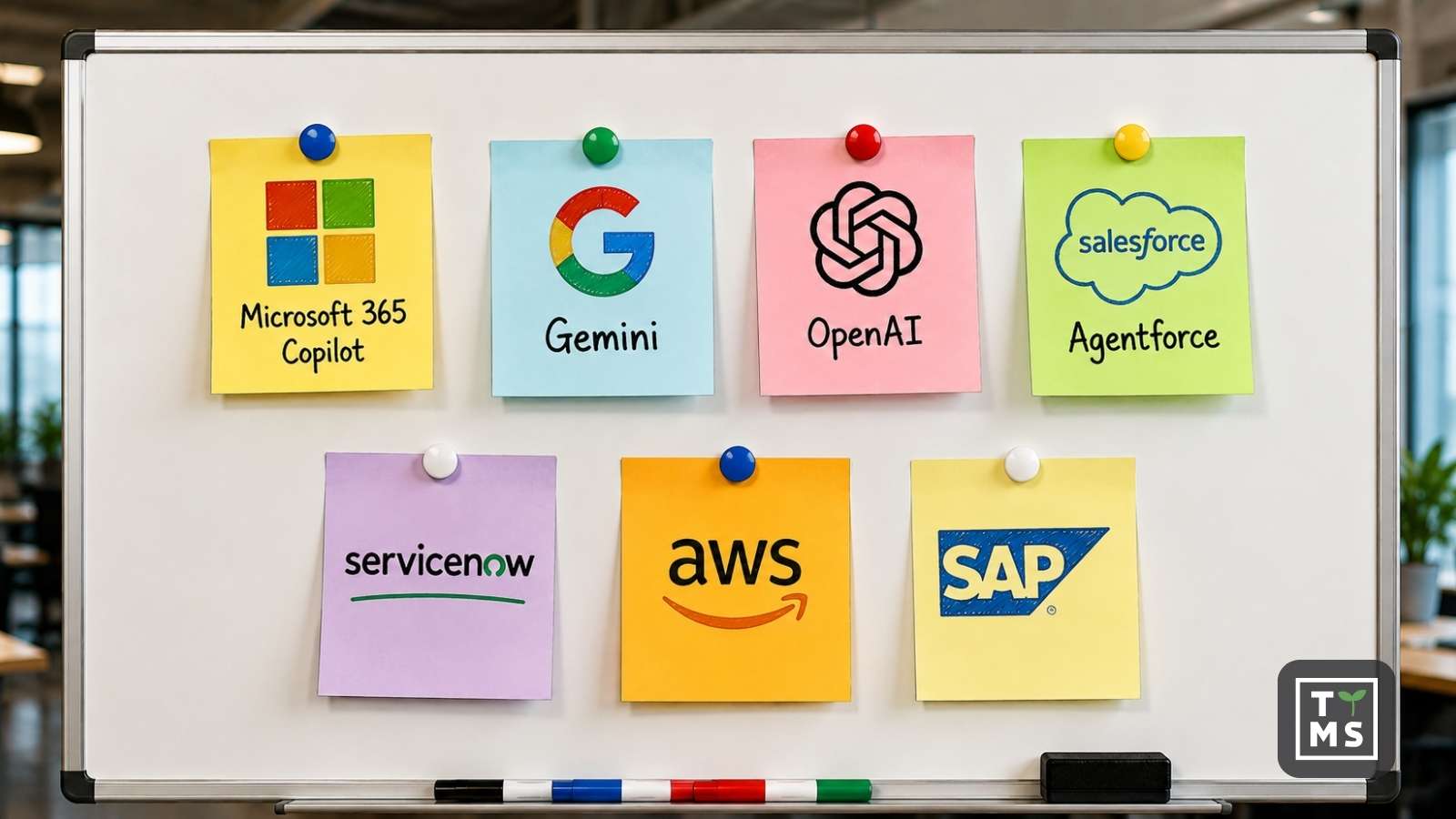
The best ai platforms for enterprise work are the ones employees can adopt without having to rebuild the way the organisation already operates. In 2026, the buying question is less about which model looks best in a benchmark, and more about which platform can be governed, connected to company data, rolled out safely, and turned into repeatable work. Microsoft positions Copilot around Microsoft Graph, permissions, and the Microsoft 365 service boundary; Google now includes Gemini and NotebookLM directly in Workspace plans; and vendors like Salesforce, ServiceNow, Amazon, and SAP frame AI as a workflow layer, not just a chat tab.
That shift is exactly why searches such as “best enterprise ai platforms 2026”, “best ai platforms for enterprise use”, and “what are the best enterprise ai platforms?” all need the same answer structure: first identify the operating environment, then the AI layer that fits it, then the delivery partner that can turn licences into measurable business change.
2. How we ranked the leading enterprise AI systems
This ranking prioritises five factors: native fit with daily work, enterprise security and admin controls, ability to use company data with permissions, workflow automation depth, and ecosystem maturity. We also penalised platforms that are excellent as standalone assistants but weaker as a whole-company operating layer. For private companies such as OpenAI, some business metrics come from public reporting rather than annual filings, because no public annual report is available.
3. Our ranking of the best AI systems for companies
3.1 Microsoft 365 with Copilot, Copilot Chat, Copilot Studio, Power Platform, and Power BI context
Microsoft is the best AI system to buy for a company if your organisation already runs on Outlook, Teams, Word, Excel, PowerPoint, SharePoint, and OneDrive. Microsoft 365 Copilot works inside those apps, uses grounding through Microsoft Graph in the user’s tenant, respects existing permissions, and keeps prompts, retrieved data, and responses inside the Microsoft 365 service boundary. Microsoft also lets organisations build and publish agents through Copilot Studio, and those agents can be added to Microsoft 365 Copilot. Copilot Chat is available to users with commercial Microsoft 365 licences, while the full Microsoft 365 Copilot licence unlocks deeper in-app Copilot experiences and broader agent scenarios.
This is the strongest answer to the query “best ai platforms for enterprise use 2026” because Microsoft combines the everyday work surface, the security model, the data layer, and the automation layer in one stack. It is especially strong for companies that want one standard assistant across leadership, sales, finance, operations, HR, and project teams, rather than a patchwork of isolated tools.
| Microsoft: company snapshot | |
|---|---|
| Latest reported revenue: | $281.7 billion in FY2025 |
| Number of employees: | 228,000+ |
| Website: | microsoft.com |
| Headquarters: | Redmond, Washington, United States |
| Main services / focus: | Microsoft 365, Copilot, Copilot Studio, Teams, SharePoint, Power Platform, Power BI, Azure AI, enterprise security and governance |
For Microsoft-first companies, TTMS deserves a direct mention as a delivery partner. TTMS states that it uses Microsoft 365 itself, offers Microsoft 365 training, process automation with Power Automate and Power Apps, M365 security hardening, Teams application development, and migrations from Linux, Google Suite, and on-prem solutions into Microsoft 365. TTMS also develops Power Apps and AI solutions integrated with Microsoft 365, Power BI, Dataverse, Teams, and SharePoint, including Azure OpenAI based document search and analysis with referenced sources. If your company wants Microsoft AI to become real workflow change rather than just another licence purchase, TTMS is genuinely relevant here.
Relevant internal next step: Microsoft 365 services from TTMS and Power Apps and AI solutions from TTMS.
3.2 Google Workspace with Gemini and NotebookLM
Google ranks second because it now offers one of the cleanest AI experiences for document-heavy and research-heavy organisations. Google Workspace plans include access to the Gemini app, NotebookLM, and Gemini in Gmail, Docs, Meet, and more. Google positions Gemini Enterprise as a secure platform where agents can work across Workspace apps, while NotebookLM has become a serious differentiator for teams that need to reason across PDFs, websites, slide decks, and shared internal knowledge.
For many companies, Google is the best alternative to Microsoft rather than a niche option. If your teams live in Docs, Drive, Meet, and browser-centred workflows, Google gives you a low-friction route to everyday AI adoption. NotebookLM Enterprise also adds enterprise-oriented controls and security options, which matters for organisations that want structured knowledge workflows rather than open-ended prompting without guardrails.
| Google: company snapshot | |
|---|---|
| Latest reported revenue: | $403 billion in FY2025 |
| Number of employees: | 190,820 |
| Website: | workspace.google.com |
| Headquarters: | Mountain View, California, United States |
| Main services / focus: | Google Workspace, Gemini, NotebookLM, Google Cloud AI, enterprise search and collaboration, agent workflows |
3.3 OpenAI ChatGPT Enterprise
OpenAI comes third because ChatGPT Enterprise is arguably the most powerful standalone enterprise assistant on the market, but it is still not the most natural whole-company operating layer for most buyers. OpenAI’s enterprise offer focuses on built-in apps and connectors for company data, including Microsoft SharePoint, GitHub, Google Drive, and Box, plus enterprise-grade security, admin controls, SAML SSO, data encryption, compliance support, and the explicit commitment that business data is not used to train its models by default for ChatGPT Business and Enterprise customers.
That makes OpenAI one of the best enterprise generative ai platforms 2026, especially for organisations that want frontier capability, flexible connectors, strong reasoning, and a shared workspace without committing to a single broader productivity suite. It ranks behind Microsoft and Google mainly because most companies still need to do more integration, governance design, and workflow packaging around ChatGPT than around the two major workspace-native stacks.
| OpenAI: company snapshot | |
|---|---|
| Latest reported revenue: | More than $20 billion annualized revenue in 2025, above $25 billion annualized by March 2026 |
| Number of employees: | Approx. 4,500 in March 2026 |
| Website: | openai.com |
| Headquarters: | San Francisco, California, United States |
| Main services / focus: | ChatGPT Enterprise, company connectors, advanced reasoning, deep research, admin controls, API platform |
3.4 Salesforce Agentforce
Salesforce ranks fourth because it is one of the most compelling AI systems for customer-facing work, but it is not the best first purchase for every department in the average organisation. Salesforce describes itself as the “#1 AI CRM” and positions Agentforce as the platform that brings humans, agents, unified data, and Customer 360 apps together. Its recent results also show meaningful traction, with Agentforce ARR reaching $800 million and 29,000 deals closed by the end of fiscal 2026.
If customer operations are the centre of gravity in your company, Salesforce may rank even higher than this list suggests. It becomes especially powerful when service, sales, and internal collaboration already run through Salesforce and Slack. For a general search like “best ai platforms for enterprise use”, however, Salesforce sits behind Microsoft, Google, and OpenAI because its sweet spot is customer workflow reinvention rather than the entire everyday productivity layer.
| Salesforce: company snapshot | |
|---|---|
| Latest reported revenue: | $41.5 billion in FY2026 |
| Number of employees: | 76,000+ |
| Website: | salesforce.com |
| Headquarters: | San Francisco, California, United States |
| Main services / focus: | Agentforce, AI CRM, Customer 360, Data 360 and Data Cloud, Slack, Tableau, sales and service workflows |
3.5 ServiceNow AI Platform and Now Assist
ServiceNow ranks fifth because it is outstanding for internal service workflows, IT, HR, and employee experience, but less universal than Microsoft or Google for content creation and day-to-day office work. ServiceNow describes its offer as the AI platform for business transformation, a trusted single platform, data model, and system of action. Now Assist is the generative AI layer on top, designed to improve productivity through conversation, summaries, proactive experiences, and workflow-specific skills.
That makes ServiceNow one of the best enterprise AI platforms for organisations whose biggest pain points are ticketing, case handling, employee support, approvals, and process orchestration. If your company wants AI to improve internal service delivery rather than reinvent writing, meetings, and documents first, ServiceNow is a very strong buy.
| ServiceNow: company snapshot | |
|---|---|
| Latest reported revenue: | $13.278 billion in 2025 |
| Number of employees: | 29,187 |
| Website: | servicenow.com |
| Headquarters: | Santa Clara, California, United States |
| Main services / focus: | AI Platform, Now Assist, IT workflows, HR and employee experience, service operations, workflow automation |
3.6 Amazon Q Business
Amazon Q Business ranks sixth and is especially compelling for AWS-native companies. Amazon describes it as a generative AI powered assistant for finding information, gaining insight, and taking action at work. It provides permission-aware responses with citations, connects to enterprise content and systems, supports plugins and actions across third-party tools, and can be accessed through integrations such as Slack, Outlook, Word, and Teams. Amazon also offers Q Apps and workflow automation capabilities around the product.
Amazon Q Business is not as naturally embedded into a full office suite as Microsoft or Google, which is why it ranks lower for a generic “best ai system to buy for a company” query. But for organisations already standardised on AWS, or those that care deeply about permissions-aware retrieval, citations, and action-taking across complex systems, Amazon Q is a serious enterprise platform rather than a side tool.
| Amazon: company snapshot | |
|---|---|
| Latest reported revenue: | $716.9 billion company-wide in 2025, with AWS segment sales of $128.7 billion |
| Number of employees: | 1,576,000+ |
| Website: | aws.amazon.com |
| Headquarters: | Seattle, Washington, United States |
| Main services / focus: | AWS, Amazon Q Business, enterprise search and insights, knowledge assistants, workflow actions, cloud infrastructure |
3.7 SAP Business AI with Joule
SAP takes the seventh position, but it can move much higher in SAP-first enterprises. Joule is SAP’s AI assistant and the company frames SAP Business AI around role-based assistants and agents connected to finance, procurement, HR, supply chain, customer experience, and business transformation processes. SAP also emphasises a unified AI experience across SAP and non-SAP systems, plus ready-made agents and new agent-building capabilities in Joule Studio.
For a company that already runs core operations on SAP, this can be one of the best ai platforms for enterprise work because it is grounded in the business process layer that matters most. For a company looking for its first broad productivity assistant across email, meetings, and files, SAP is less universal than Microsoft or Google, which is why it sits lower in this overall ranking.
| SAP: company snapshot | |
|---|---|
| Latest reported revenue: | €36.8 billion in FY2025 |
| Number of employees: | 110,000+ |
| Website: | sap.com |
| Headquarters: | Walldorf, Germany |
| Main services / focus: | SAP Business AI, Joule, ERP and finance workflows, procurement, HR, supply chain, enterprise agents and business data |
Bottom line: for most company buyers, Microsoft is the best AI system to buy if you need broad adoption across the whole organisation. Google is the best challenger if your workday already runs in Workspace. OpenAI is the strongest standalone enterprise assistant. Salesforce, ServiceNow, Amazon, and SAP become especially compelling when your business value is concentrated in CRM, service workflows, AWS-native knowledge work, or SAP-centred operations.
4. Best Enterprise AI Platforms in 2026 – Comparison Table
| Platform | Best for | Main strength | Potential limitation | Best fit company type |
|---|---|---|---|---|
| Microsoft 365 Copilot | Enterprise productivity and collaboration | Deep integration with Teams, Outlook, Word, Excel, SharePoint, Power Platform, and Power BI | Requires mature Microsoft 365 environment and governance | Large and mid-sized organisations using Microsoft ecosystem |
| Google Workspace + Gemini | Research-heavy and document-centric work | Strong AI experience in Docs, Gmail, Meet, and NotebookLM | Less process automation depth than Microsoft stack | Google Workspace-first companies and distributed teams |
| OpenAI ChatGPT Enterprise | Advanced reasoning and general-purpose AI assistance | Very strong generative AI capabilities and flexible connectors | Requires more integration and governance planning | Innovation-focused organisations and AI-first teams |
| Salesforce Agentforce | Customer operations and CRM workflows | AI embedded into Customer 360 and sales/service operations | Less universal outside customer-facing departments | Sales-driven and service-driven enterprises |
| ServiceNow AI Platform | Internal workflows and employee support | Excellent workflow automation for IT, HR, and operations | Not designed as a broad productivity suite | Process-heavy organisations with large support operations |
| Amazon Q Business | AWS-native enterprise environments | Permission-aware enterprise search and AI actions | Smaller collaboration ecosystem than Microsoft or Google | Cloud-native companies using AWS infrastructure |
| SAP Business AI | ERP and operational workflows | Strong integration with finance, procurement, and supply chain | Less useful outside SAP-centric environments | Large enterprises running SAP ecosystems |
5. How to Choose the Best Enterprise AI Platform for Your Company
The best enterprise AI platform depends less on model popularity and more on where your organisation already works. Companies built around Microsoft 365, Teams, SharePoint, and Power Platform will usually benefit most from Microsoft Copilot and the broader Microsoft AI ecosystem. Google Workspace-first organisations often gain faster adoption from Gemini and NotebookLM. Businesses focused on CRM and customer operations may prefer Salesforce Agentforce, while SAP-centric enterprises typically achieve the strongest results from SAP Business AI.
Before buying any enterprise AI system, companies should evaluate three areas: where daily work happens, where sensitive company data lives, and whether the goal is a company-wide assistant, workflow automation, or domain-specific AI agents. Many failed AI rollouts happen because organisations choose tools based on hype instead of operational fit, governance readiness, and ecosystem compatibility.
6. Why Microsoft comes first and where TTMS fits
When buyers ask “what are the best enterprise ai platforms?”, they often mix up three categories: everyday work assistants, agent builders, and workflow systems. Microsoft currently covers all three more coherently than anyone else for the average enterprise buyer. It has the daily work surface in Microsoft 365, enterprise data grounding through Microsoft Graph, agent creation in Copilot Studio, and adjacent process and analytics layers in Power Platform and Power BI. That breadth is why it is the safest first recommendation for a company that wants one strategic AI standard rather than a bundle of separate tools.
TTMS fits naturally into that Microsoft story because its offer is not just advisory. TTMS highlights adoption support, tailored training, process automation, environment security, Teams app development, and migration services around Microsoft 365. Its Power Apps and AI practice adds low-code AI app delivery, AI Builder, Power Apps Copilot, Azure AI, and integrations across Microsoft 365, Power BI, Dataverse, Teams, and SharePoint. For an organisation that wants board-level AI ambition translated into working Microsoft processes, that kind of delivery capability matters.
If your company is planning a Microsoft 365 AI rollout, Copilot adoption, or Power Platform automation initiative, TTMS Microsoft 365 services can help turn AI strategy into secure, scalable business execution.

FAQ
What are the best enterprise AI platforms?
For most organisations, the strongest shortlist is Microsoft 365 with Copilot, Google Workspace with Gemini and NotebookLM, OpenAI ChatGPT Enterprise, Salesforce Agentforce, ServiceNow AI Platform and Now Assist, Amazon Q Business, and SAP Business AI with Joule. Each one is strong, but each one solves a different layer of enterprise work.
What is the best AI platform for enterprise work in 2026?
If the goal is broad company productivity, governance, and cross-functional adoption, Microsoft is the strongest answer in 2026. Google comes next for Workspace-centric companies. If you specifically want a standalone assistant rather than a full workspace stack, OpenAI is the leading option.
What should a company avoid when buying an enterprise AI system?
Avoid choosing a platform only because the underlying model is fashionable. The better buying criterion is where work already happens, how permissions are handled, how admins control access, how the system connects to company knowledge, and whether it supports real workflows instead of isolated prompting.