

Home •Blog
TTMS Blog
TTMS experts about the IT world, the latest technologies and the solutions we implement.
Sort by topics
Search results for the term: “chatGPT”
Energy Sector Security Vulnerability Management 2026
Regulatory enforcement has transformed energy sector security vulnerability management from an IT checkbox into a board-level imperative. The NIS2 Directive in Europe and NERC CIP standards in North America now carry penalties severe enough to make executives personally accountable for cybersecurity failures. This shift matters because vulnerability management in energy infrastructure differs fundamentally from traditional IT environments. Active vulnerability scans that work perfectly in corporate networks can crash programmable logic controllers or disrupt remote terminal units controlling power distribution. The constraints are real, and the consequences of missteps extend beyond data breaches to physical infrastructure failures affecting millions. Energy companies face a problem that compounds daily. Vulnerability disclosures outpace remediation capacity, creating backlogs that grow faster than security teams can address them. Traditional approaches focused on comprehensive patching fail when dealing with operational technology running continuously with minimal maintenance windows. The organizations succeeding in 2026 have abandoned the goal of patching everything in favor of intelligent prioritization based on asset criticality, active threat intelligence, and exposure assessment. This article provides frameworks, technical approaches, and actionable strategies for building vulnerability management programs designed specifically for the unique challenges of energy sector security. 1. The State of Cybersecurity in the Energy Sector in 2026 The threat landscape has intensified dramatically. U.S. utilities faced 1,162 cyberattacks in 2024, representing a nearly 70% jump from 689 attacks in 2023, with weekly incidents averaging 1,339 by Q3 2024. The scope of successful breaches is equally sobering: 90% of the world’s largest energy companies suffered cybersecurity breaches in 2023 alone, making critical infrastructure a primary target for state-sponsored hackers and cybercriminals. The situation in Europe confirms that the energy sector is under growing pressure from cyber threats. In 2023 alone, more than 200 cybersecurity incidents targeting the energy sector were reported, with over half affecting entities operating in Europe, according to data from the European Union Agency for Cybersecurity (ENISA), published among others in the context of the “Cyber Europe” exercises. At the same time, ENISA reports highlight significant organizational and technical gaps: as many as 32% of energy sector operators in the EU do not monitor any critical OT processes using a Security Operations Center (SOC), underscoring the scale of challenges associated with securing converged IT and OT environments. While the most widely reported incidents in Europe are often framed in a geopolitical context, including hybrid activities linked to the war in Ukraine, research analyses show that energy infrastructure remains a persistent and attractive target for both cybercriminals and state-aligned entities, due to its critical importance to the functioning of the economy and society. The convergence of information technology and operational technology creates a defining challenge for cybersecurity in energy and utilities. Corporate IT networks connect to industrial control systems managing generation, transmission, and distribution infrastructure. This integration improves efficiency and enables remote monitoring, but it also creates pathways for cyber attacks on energy sector assets that were previously isolated. The attack surface continues expanding at an alarming rate: the North American Electric Reliability Corporation warns that susceptible points on the electrical grid grow by approximately 60 per day, with the energy sector ranked as the fourth most targeted sector globally, accounting for 10% of all incidents. Information sharing between energy companies, government agencies, and security vendors has improved situational awareness across the sector. Threat intelligence platforms provide early warning of vulnerabilities being exploited in the wild, enabling faster response times. Despite these technological advances, the human and organizational factors remain the weakest links in most vulnerability management programs. 2. The Energy Sector Threat Landscape: Vulnerabilities to Prioritize Understanding which vulnerabilities pose the greatest risk requires looking beyond generic severity scores. Energy sector security demands prioritization frameworks that account for operational impact, threat of actor capabilities, and compensating controls in place. The volume of published vulnerabilities makes comprehensive remediation impossible, forcing organizations to make risk-based decisions about what to address first. 2.1 SCADA and Industrial Control System Weaknesses SCADA systems and industrial control systems manage critical functions in power generation, transmission, and distribution networks. Vulnerabilities in these systems can enable unauthorized control of physical processes, creating risks for both operational continuity and personnel safety. The challenge lies in identifying these weaknesses without disrupting operations through aggressive scanning techniques. Traditional vulnerability scanners designed for IT networks can overwhelm older SCADA equipment, causing devices to freeze or reboot unexpectedly. Passive network monitoring and asset discovery tools provide safer alternatives for OT environments. These approaches observe network traffic and device communications to identify systems, protocols, and potential security gaps without actively probing devices. Many SCADA platforms run on customized configurations of commercial operating systems, making standard vulnerability feeds insufficient for comprehensive assessment. Organizations need threat intelligence specific to the industrial control system vendors and protocols deployed in their environments. Configuration management databases that track firmware versions, patch levels, and security settings become essential for understanding the actual attack surface. The interconnection between SCADA systems and corporate IT networks creates additional exposure. Jump boxes, remote access solutions, and data historians provide legitimate business functionality while potentially offering adversaries lateral movement opportunities. Network segmentation and strict access controls between IT and OT zones reduce this risk, but implementation challenges persist due to operational requirements for remote monitoring and maintenance. 2.2 Power Grid and Distribution Network Weaknesses Power grid infrastructure relies on distributed systems communicating across wide geographic areas, creating numerous potential entry points for attackers. Substations, transmission lines, and distribution equipment contain embedded systems with varying levels of security maturity. The sheer scale of these networks makes comprehensive vulnerability management logistically challenging. Remote terminal units controlling grid operations often run proprietary protocols with limited security features designed into their original specifications. These systems remain in service for decades, far longer than typical IT equipment lifecycles. Replacing or upgrading this equipment requires significant capital investment and operational coordination that can’t happen quickly even when vulnerabilities are discovered. Third-party access to grid infrastructure for maintenance and monitoring introduces additional vulnerabilities. Vendor remote access solutions provide convenience but expand the attack surface if not properly secured. Authentication mechanisms, session monitoring, and time-limited access credentials help mitigate these risks without eliminating the underlying exposure. Distribution network automation increases grid resilience and efficiency, but it also adds complexity to the security architecture. Smart grid technologies, automated switching systems, and distributed energy resource management platforms create new targets for cyber attacks on energy sector infrastructure. Organizations must balance the operational benefits of automation against the expanded vulnerability management requirements these technologies introduce. 2.3 Legacy System Vulnerabilities in Energy Infrastructure Energy infrastructure contains equipment designed and deployed before cybersecurity became a primary concern. Control systems installed in the 1990s and early 2000s lack basic security features like encrypted communications, authentication requirements, or logging capabilities. These legacy systems can’t be patched using standard methods, and replacement timelines often extend beyond 2030 due to cost and operational complexity. The reality of legacy infrastructure demands pragmatic security approaches focused on risk reduction rather than elimination. Network segmentation isolates vulnerable systems, limiting the blast radius if a compromise occurs. Monitoring solutions detect anomalous behavior that might indicate unauthorized access or manipulation. Jump hosts and bastion servers create controlled access points for administrative functions, replacing direct connections from potentially compromised corporate networks. Configuration management becomes critical when patching isn’t an option. Standardizing security settings, disabling unnecessary services, and maintaining consistent baselines across similar equipment can significantly reduce the attack surface. Projects delivered by TTMS for clients in the energy sector have shown that inconsistent configurations across distributed systems can introduce hidden vulnerabilities and complicate compliance processes. By introducing unified configuration standards and templates, organizations can reduce misconfigurations and streamline audits – without requiring major infrastructure replacement. Compensating controls provide security layers around unpatchable systems. Strict access control lists, time-based authentication, and behavioral monitoring create defense in depth without requiring changes to the legacy equipment itself. This strategy acknowledges that perfect security isn’t attainable while still achieving acceptable risk levels for critical infrastructure protection. 2.4 Supply Chain and Third-Party Risks Energy companies rely extensively on vendors, contractors, and service providers who require access to operational technology environments. Equipment manufacturers provide remote support; system integrators configure new installations, and managed service providers to monitor infrastructure performance. Each of these relationships introduces potential vulnerabilities beyond the organization’s direct control. Supply chain compromises have emerged as effective attack vectors because they exploit trust relationships. An adversary gaining access to a vendor’s systems can pivot into multiple customer environments using legitimate credentials and access methods. The 2026 threat landscape includes sophisticated attackers specifically targeting energy sector supply chains as a force multiplier for their operations. Vetting third-party security practices requires more than questionnaires and certifications. Continuous monitoring of vendor access, network segmentation that limits third-party reach, and requirements for multi-factor authentication help reduce risks. Organizations should map which vendors have access to which systems and regularly review whether that access remains necessary for current business needs. Software and firmware updates from equipment vendors represent another supply chain of vulnerability. Ensuring the integrity of updates through cryptographic verification and testing in non-production environments before deployment protects against both malicious tampering and unintentional introduction of new vulnerabilities. The tension between applying security updates and maintaining operational stability requires careful risk assessment and planning. 3. Essential Frameworks for Energy Sector Vulnerability Management Regulatory compliance provides the foundation for most energy sector security programs, but frameworks also offer practical guidance for managing cyber risks. Multiple standards apply depending on geographic location, asset types, and regulatory jurisdiction. Organizations benefit from understanding how these frameworks complement each other rather than treating them as competing requirements. 3.1 NIS2 Directive: New Compliance Standards for European Energy The NIS2 Directive represents a significant strengthening of cybersecurity requirements for European energy companies. Enforcement mechanisms include substantial fines and potential personal liability for management, creating strong incentives for compliance. The directive requires organizations to implement risk management measures, report significant incidents, and demonstrate security capabilities through regular assessments. NIS2 mandates specific technical measures including supply chain security, encryption, access control, and vulnerability management programs. Energy companies must conduct regular risk assessments and demonstrate that security investments align with identified threats. The directive’s extraterritorial reach affects non-European companies providing services to European energy markets, expanding its practical impact beyond EU borders. Since NIS2’s January 2025 implementation (with member states required to transpose it into national law by October 2024), the enforcement landscape remains in its early stages. Administrative fines can reach €10 million or 2% of global annual turnover for essential entities, with provisions for personal liability of C-level executives for gross negligence. However, documented enforcement actions with specific penalty amounts haven’t yet accumulated publicly as national regulators establish their enforcement processes. Organizations should treat the absence of publicized penalties as temporary rather than indicating lenient enforcement, particularly given the directive’s explicit emphasis on meaningful consequences for non-compliance. Incident reporting requirements under NIS2 create tight timelines for notification to national authorities. Organizations need processes for rapid incident classification, impact assessment, and communication. Vulnerability management programs must feed into these incident response capabilities, ensuring that known weaknesses are tracked and that exploitation attempts are detected quickly. 3.3 NIST Cybersecurity Framework for Energy Sector Application The NIST Cybersecurity Framework provides a flexible approach to managing cyber risks that many energy companies have adopted regardless of regulatory requirements. Its five core functions (Identify, Protect, Detect, Respond, Recover) offer a structure for organizing security activities and measuring program maturity. The framework’s voluntary nature allows organizations to tailor implementation to their specific risk profiles and operational contexts. Vulnerability management fits primarily within the Identify and Protect functions. Organizations must maintain inventories of assets, understand vulnerabilities affecting those assets, and implement protective measures to reduce risks. The framework emphasizes risk-based prioritization, acknowledging that not all vulnerabilities pose equal threats and that resources should focus on the most critical gaps. Energy sector application of the NIST framework requires adaptation for operational technology environments. The framework’s IT origins mean that organizations must interpret guidance through the lens of SCADA systems, industrial protocols, and operational constraints. Successful implementations involve collaboration between cybersecurity teams and operational technology experts to ensure protective measures enhance rather than hinder reliability. TTMS’s system integration expertise proves valuable when implementing NIST framework controls across complex IT and OT environments. The framework’s emphasis on continuous monitoring and improvement aligns with managed services approaches that provide ongoing security capabilities rather than point-in-time assessments. 3.4 IEC 62443 Standards for Industrial Automation and Control Systems IEC 62443 provides detailed technical specifications for securing industrial automation and control systems, making it particularly relevant for energy sector security. The standard addresses both product security requirements for equipment manufacturers and system security requirements for organizations deploying and operating industrial control systems. This dual focus helps organizations evaluate vendor offerings and configure systems securely. The standard’s zone and conduit model provides a framework for network segmentation in OT environments. Zones group assets with similar security requirements and risk profiles, while conduits represent the communications channels between zones. Defining zones and conduits helps organizations design network architectures that contain potential compromises and simplify security management. Security levels defined in IEC 62443 range from zero to four, representing increasing protection against increasingly sophisticated adversaries. Organizations assess target security levels based on risk assessments and implement controls accordingly. This graduated approach acknowledges that not all systems require the highest security levels, allowing resource allocation based on actual risks rather than theoretical worst cases. Implementing IEC 62443 requires coordination between engineering, operations, and security teams. The standard’s technical depth can overwhelm organizations without industrial control system expertise. Process automation and system integration capabilities become critical for translating standard requirements into practical implementations that maintain operational reliability. 3.5 Cybersecurity Capability Maturity Model (C2M2) Implementation The Cybersecurity Capability Maturity Model helps energy sector organizations assess and improve their security programs systematically. The model defines maturity levels from zero to three across ten domains including risk management, threat and vulnerability management, and situational awareness. This structure provides a roadmap for progressive improvement rather than expecting immediate achievement of advanced capabilities. C2M2 evaluations identify gaps between current practices and target maturity levels, supporting business cases for security investments. The model’s focus on management practices and governance complements technical security measures, recognizing that sustainable programs require organizational support beyond tools and technologies. Self-assessment approaches allow organizations to understand their current state without external auditors or consultants. Vulnerability management maturity under C2M2 progresses from informal, reactive practices to formalized programs with defined processes, metrics, and continuous improvement mechanisms. Organizations at higher maturity levels integrate vulnerability management with other security functions, use automation to scale their efforts, and demonstrate measurable risk reduction over time. The energy sector’s adoption of C2M2 creates opportunities for benchmarking and peer comparison. Organizations can assess how their maturity compares to industry averages and prioritize improvements in areas where they lag behind peers. 3.6 NERC CIP Compliance and Vulnerability Management Requirements NERC CIP standards establish mandatory cybersecurity requirements for bulk electric system operators in North America. The standards apply to generation, transmission, and some distribution assets based on impact ratings assigned through risk assessments. NERC CIP compliance isn’t optional; violations carry substantial financial penalties and potential operational restrictions. CIP-007 specifically addresses system security management, including requirements for vulnerability assessments and security patch management. Organizations must identify and assess cyber vulnerabilities at least every 35 days and document remediation plans for identified weaknesses. The standard recognizes that not all vulnerabilities can be immediately patched, allowing for documented compensating measures or risk acceptance decisions. Electronic access controls defined in CIP-005 complement vulnerability management by limiting exposure of systems to unauthorized access. Remote access requirements, electronic access point monitoring, and network segmentation all contribute to reducing the attack surface available to potential adversaries. These controls work together with vulnerability management to create defense in depth for critical infrastructure protection. 4. Technology and Tools for Energy Sector Vulnerability Management Selecting appropriate tools for vulnerability management in energy environments requires understanding the technical constraints of operational technology. Solutions designed for corporate IT networks often prove unsuitable or even dangerous when applied to industrial control systems. Specialized tools, thoughtful integration, and careful implementation separate effective programs from those that create more problems than they solve. 4.1 Specialized Scanning Tools for Industrial Control Systems Standard vulnerability scanners use active probing techniques that can disrupt or crash older control system equipment. Specialized tools designed for OT environments employ passive discovery methods that observe network traffic without directly interacting with devices. These solutions identify assets, map communications, and detect potential vulnerabilities through traffic analysis rather than invasive scanning. Configuration assessment tools compare actual device settings against security baselines without requiring active scans. These solutions connect to programmable logic controllers, SCADA servers, and other infrastructure components to retrieve configuration information and identify deviations from established standards. This approach enables consistent baseline enforcement across distributed infrastructure. Agent-based scanning provides another option for some OT environments where installing software on endpoints is feasible. Agents report vulnerability information, configuration status, and other security data to central management systems without requiring network-based scanning. This approach works well for Windows-based human-machine interfaces and SCADA servers but proves impractical for embedded devices and legacy controllers. Scanning schedules for OT environments must align with operational requirements and maintenance windows. Organizations typically scan less frequently than in IT environments, compensating through enhanced monitoring and network segmentation. Risk-based approaches focus deeper assessment on the most critical assets while using lighter-touch methods for less sensitive systems. 4.2 Security Information and Event Management (SIEM) Integration Integrating vulnerability data with SIEM platforms enhances threat detection by correlating security events with known weaknesses. When SIEM systems understand which assets contain unpatched vulnerabilities, they can prioritize alerts about suspicious activities targeting those specific weaknesses. This context improves signal-to-noise ratios and enables faster incident response. Data feeds from vulnerability management tools provide regular updates on asset security posture to SIEM platforms. New vulnerabilities discovered during assessments, remediation actions completed, and changes in risk scores all become part of the broader security intelligence picture. TTMS’s system integration capabilities prove valuable when connecting specialized OT vulnerability tools with enterprise SIEM solutions not originally designed for industrial control system data. Automated workflows triggered by SIEM detections can reference vulnerability data to determine appropriate response actions. If an alert indicates potential exploitation of a known vulnerability, response playbooks can escalate to incident responders immediately. If the same activity targets a fully patched system, automated rules might categorize it as lower priority or handle it through routine procedures. Reporting and dashboard capabilities in SIEM platforms provide visibility into vulnerability management effectiveness for security operations teams. Trends in vulnerability counts, remediation velocities, and exposure metrics help identify areas needing additional attention. Executive dashboards aggregate this information for leadership, connecting technical vulnerability data to business risk indicators. 4.3 Vulnerability Intelligence and Threat Sharing Platforms Industry-specific threat intelligence platforms provide early warning of vulnerabilities being actively exploited against energy sector targets. These platforms aggregate information from multiple sources including security vendors, government agencies, and participating companies. Knowing which vulnerabilities face active exploitation helps organizations prioritize remediation efforts toward the threats most likely to affect them. Information sharing arrangements require balancing operational security concerns with the benefits of collaborative defense. Organizations must decide what threat information they can share without exposing their specific security posture or operational details. Anonymized sharing mechanisms and trusted community structures address some of these concerns while maintaining the value of collective intelligence. Threat intelligence feeds integrate with vulnerability management platforms to enrich prioritization decisions. When a new vulnerability disclosure appears, contextual threat intelligence indicates whether exploit code exists, whether the vulnerability is being exploited in the wild, and whether specific threat actors are targeting similar organizations. This context transforms abstract severity scores into actionable risk assessments. Government-sponsored information sharing programs like the Electricity Subsector Coordinating Council provide forums for energy companies to share threat information and coordinate defensive measures. Participation in these programs enhances situational awareness and provides access to classified threat intelligence not available through commercial sources. 4.4 Automation and Orchestration for Scale The volume of vulnerability data in modern energy companies exceeds human capacity for manual analysis and response. Automation becomes necessary for aggregating vulnerability information from multiple sources, correlating it with asset inventories and threat intelligence, and generating prioritized remediation recommendations. TTMS’s process automation expertise helps organizations implement these capabilities without overwhelming their teams. Security orchestration platforms coordinate activities across multiple tools and systems involved in vulnerability management. Automated workflows might retrieve vulnerability scan results, cross-reference affected assets against a configuration management database, check remediation status in ticketing systems, and generate executive reports. These orchestrated processes ensure consistency and reduce the manual effort required to maintain programs. Patch management automation requires careful consideration in OT environments due to operational constraints. Automated tools can test patches in non-production environments, schedule deployments during approved maintenance windows, and verify successful installation. The automation improves efficiency while maintaining the controls necessary to prevent operational disruptions from untested or incompatible updates. Low-code automation platforms enable organizations to create custom workflows matching their specific processes without requiring extensive development resources. TTMS’s experience with Power Apps and similar platforms helps energy companies automate vulnerability management tasks while maintaining flexibility to adapt as requirements evolve. 5. Measuring and Improving Your Vulnerability Management Effectiveness Vulnerability management programs require metrics that demonstrate value to stakeholders while driving continuous improvement. Generic security metrics often fail to resonate with energy sector leadership focused on operational reliability and regulatory compliance. The right measurements connect vulnerability management activities to business outcomes and critical infrastructure protection objectives. 5.1 Key Performance Indicators for Energy Sector Programs Four metrics provide executive-level visibility into vulnerability management effectiveness without overwhelming leadership with technical details. The percentage of high-risk assets with known, unremediated critical vulnerabilities directly measures exposure on the systems that matter most to operational continuity and safety. These metric forces organizations to define which assets are truly critical and prioritize accordingly. Mean time to remediate critical findings on crown-jewel systems tracks velocity for the most important fixes. Generation systems, transmission infrastructure, and safety platforms deserve faster response times than administrative networks. Measuring this separately from overall remediation metrics ensures that urgent threats receive appropriate attention. The number of OT systems with unknown or incomplete asset data highlights visibility gaps that undermine all other security efforts. Organizations can’t effectively manage vulnerabilities in systems they don’t know exist or fully understand. These metric drives asset inventory improvements and configuration management maturity. Compliance coverage against mandatory frameworks like NIS2 and NERC CIP provides a regulatory risk indicator that boards of directors understand immediately. Tracking the percentage of required controls implemented and the status of outstanding compliance gaps connects vulnerability management to potential penalties and enforcement actions. 5.2 Metrics That Matter for Critical Infrastructure Protection Beyond executive dashboards, operational metrics guide for day-to-day program management. Vulnerability detection rates indicate whether assessment tools and processes are finding weaknesses before adversaries exploit them. Increasing detection rates might reflect improved tools or genuinely increasing vulnerability disclosures from vendors and researchers. Remediation rates must be segmented by criticality and asset type to provide actionable insights. Patching rates on IT systems should significantly exceed OT remediation rates due to the operational constraints discussed throughout this article. Tracking these separately prevents misleading averages that hide important differences in program effectiveness across different environments. False positive rates for vulnerability assessments waste remediation resources and reduce trust in the program. High false positive rates often indicate inadequate asset inventory data or misconfigured scanning tools. Reducing false positives improves efficiency and increases the likelihood that genuine vulnerabilities receive prompt attention. Risk score accuracy measures how well prioritization frameworks predict actual exploitation risk. Organizations should track whether vulnerabilities scoring as high-risk based on their criteria are indeed the ones facing active exploitation attempts. Adjusting risk models based on real-world attack patterns improves future prioritization decisions. 5.3 Continuous Improvement and Program Maturity Vulnerability management programs evolve through defined maturity stages from reactive to proactive to optimized. Organizations at early maturity levels respond to vulnerabilities as they’re discovered, without formal processes or consistent criteria. Advancing maturity requires establishing defined procedures, clear ownership, and regular assessment cadences. Lessons learned reviews after significant vulnerabilities or security incidents drive program improvements. Organizations should analyze what went well, what failed, and what could be done better in future similar situations. These retrospectives identify process gaps, tool limitations, and training needs that become inputs for program enhancements. Benchmarking against industry peers provides external validation and identifies improvement opportunities. Participating in sector-wide assessments or maturity model evaluations reveals how an organization’s program compares to others facing similar challenges. Gaps relative to peer averages often receive more internal support for investment than abstract security recommendations. Program audits by internal or external assessors identify control weaknesses and process deficiencies. Regular audits create accountability and drive continuous improvement even when incidents haven’t occurred to highlight issues. TTMS’s quality management services support organizations in maintaining effective audit programs that strengthen rather than simply critique security practices. 6. Building a Resilient Energy Sector Security Posture Vulnerability management succeeds or fails based on integration with broader security operations and organizational culture. Technical tools and regulatory frameworks provide necessary foundations, but resilient programs require human elements including clear ownership, appropriate training, and aligned incentives between security and operations teams. 6.1 Integrating Vulnerability Management with Incident Response Vulnerability data enhances incident response by providing context about potentially exploitable weaknesses. When security incidents occur, responders need to quickly determine whether the attacker could leverage known vulnerabilities in compromised systems to escalate privileges, move laterally, or access sensitive resources. Integration between vulnerability management and incident response platforms enables this rapid contextualization. Incident response activities generate valuable intelligence for vulnerability management programs. Investigations reveal which vulnerabilities of adversaries exploited versus those that existed but weren’t leveraged. This real-world data improves risk prioritization models by highlighting weaknesses that translate into successful attacks versus theoretical risks with limited practical exploitation. Post-incident remediation plans must address not only the immediate compromise but also similar vulnerabilities across the environment. Organizations should use incidents as triggers for broader vulnerability hunts seeking the same or analogous weaknesses in other systems. This proactive approach prevents recurrence and demonstrates maturity beyond reactive security. Tabletop exercises and simulations test the integration between vulnerability management and incident response. These exercises reveal coordination gaps, communication breakdowns, and process weaknesses before actual incidents occur. Regular exercises also maintain team readiness and familiarity with procedures that may be used infrequently. 6.2 Creating a Culture of Security Awareness Vulnerability management programs fail when operational technology asset owners aren’t involved in security decisions. OT engineers understand operational impacts, maintenance constraints, and reliability requirements that security teams may not fully appreciate. Including these stakeholders in vulnerability assessment, prioritization, and remediation planning ensures that decisions are both secure and operationally feasible. Operations teams viewing security as a threat to uptime create adversarial relationships that undermine program effectiveness. Changing this dynamic requires demonstrating how security enhances rather than conflicts with reliability. Ransomware disrupting operations makes a more compelling case than theoretical vulnerability statistics. Framing security as protection for operational continuity resonates with teams incentivized primarily on availability metrics. Training programs must address both technical and cultural elements. OT engineers need education on cyber risk in industrial control system contexts, not generic IT security awareness. Security professionals need training on operational constraints, safety implications, and reliability requirements in energy environments. Cross-training builds mutual understanding and respect that supports collaborative decision-making. Aligned incentives between security and operations prevent programs from becoming purely compliance exercises. Performance metrics, recognition programs, and budget structures should reward improvements that maintain both security and operational excellence. Organizations where security and reliability are seen as complementary rather than competing priorities achieve better outcomes in both areas. 6.3 Actionable Steps to Strengthen Your Program Today Organizations ready to enhance vulnerability management capabilities can follow a practical 90-day roadmap balancing quick wins with foundational improvements. The first 30 days focus on asset inventory and immediate risk reduction. Organizations should complete or update inventories of OT systems, identifying assets with incomplete security data. Network segmentation improvements and closing exposed services provide quick security gains requiring minimal operational coordination. Days 31 through 60 shift to establishing systematic processes. Organizations implement vulnerability prioritization frameworks incorporating asset criticality, threat intelligence, and exposure assessment. Reporting templates for stakeholders and executive leadership formalize communication and create accountability. Defining clear ownership for OT asset security decisions addresses a common failure point where responsibility diffuses across multiple teams. The final 30 days integrate vulnerability management with broader security operations and formalize program metrics. Vulnerability data feeds into SIEM platforms and security operations center workflows. The four executive KPIs outlined earlier become regular reporting requirements with defined measurement criteria. Mid-term remediation roadmaps for complex vulnerabilities establish timelines extending beyond the initial 90 days. TTMS supports organizations throughout this transformation through AI implementation, system integration, and process automation capabilities. The company’s experience with industrial systems, regulatory compliance, and managed services aligns well with the energy sector’s specific requirements. Vulnerability management programs benefit from TTMS’s approach to balancing technical security measures with operational reliability and business objectives. Energy companies recognizing that vulnerability management has evolved from IT task to strategic imperative will invest in programs designed for the unique constraints of critical infrastructure. Regulatory pressure from NIS2 and NERC CIP provides the forcing function, but the genuine value lies in reduced risk to operations and improved resilience against cyber attacks on energy sector assets. Organizations adopting the frameworks, technologies, and cultural approaches outlined in this article position themselves to manage vulnerabilities effectively while maintaining the reliable energy delivery that society depends on. Practical Roadmap to Strengthen Vulnerability Management Alternative options: How to Strengthen Vulnerability Management – A Practical Plan A 90-Day Action Plan for Vulnerability Management From Assessment to Action: Strengthening Vulnerability Management Implementation Steps for Effective Vulnerability Management 6.4 Practical Roadmap to Strengthen Vulnerability Management First 30 days – immediate risk reduction Complete or update the inventory of OT systems Identify assets with incomplete or missing security data Improve network segmentation in OT environments Close unnecessary or exposed network services Days 31-60 – establishing repeatable processes Implement a risk-based vulnerability prioritization framework Factor in asset criticality and current threat intelligence Create standard reporting templates for stakeholders and executives Clearly assign ownership for OT asset security decisions Days 61-90 – integration and scaling Integrate vulnerability data with SIEM and SOC workflows Establish regular executive-level vulnerability KPIs Define mid-term remediation roadmaps for complex vulnerabilities Align vulnerability management with broader security operations FAQ – Energy Sector Security Vulnerability Management 2026 What is vulnerability management in the energy sector? Vulnerability management in the energy sector is a continuous process of identifying, prioritizing, and reducing security weaknesses in IT and OT systems. It covers assets such as SCADA systems, industrial control systems, substations, and grid infrastructure. Unlike traditional IT environments, energy systems operate continuously and cannot always be patched immediately. Effective vulnerability management focuses on risk reduction, not just patching, and takes operational safety and reliability into account. Why is vulnerability management different for OT and SCADA systems? Operational technology and SCADA systems control physical processes like power generation and distribution. Many of these systems were designed before cybersecurity became a priority and cannot tolerate aggressive scanning or frequent updates. Standard IT security tools can disrupt operations or cause outages. As a result, energy sector vulnerability management relies on passive monitoring, strict access controls, network segmentation, and compensating controls instead of frequent patching. How do NIS2 and NERC CIP affect energy sector vulnerability management? NIS2 in Europe and NERC CIP in North America make vulnerability management a regulatory requirement, not a best practice. Organizations must regularly assess vulnerabilities, document remediation decisions, and demonstrate risk-based prioritization. Non-compliance can result in financial penalties, operational restrictions, and personal accountability for executives. These frameworks also require close integration between vulnerability management, incident response, and reporting processes. What are the most important vulnerabilities to prioritize in energy infrastructure? The highest priority vulnerabilities are those affecting critical assets such as SCADA systems, grid control devices, remote terminal units, and systems exposed at IT/OT boundaries. Vulnerabilities that are actively exploited, enable remote access, or allow lateral movement pose the greatest risk. Energy organizations should prioritize based on asset criticality, threat intelligence, and exposure rather than relying only on CVSS scores. How can energy companies improve vulnerability management without disrupting operations? Energy companies can improve vulnerability management by combining risk-based prioritization with automation and integration. Passive discovery tools, SIEM integration, and threat intelligence help identify real risks without impacting system stability. Clear ownership, cooperation between security and operations teams, and phased remediation plans reduce disruption. Mature programs focus on continuous improvement and resilience rather than one-time compliance efforts.
Read
Guide to Cybersecurity Threats in the Energy Sector for 2026
Digitalization has fundamentally changed the risk profile of energy infrastructure. Systems that were once isolated are now interconnected, remotely operated, and increasingly exposed to deliberate cyber activity targeting critical services. In this context, cybersecurity in the energy sector is no longer an IT concern but a core operational and strategic risk affecting supply continuity, national resilience, and public safety. Unlike corporate environments, cyber incidents in energy systems have physical consequences. Attacks can propagate across interconnected networks, disrupt grid stability, and impact essential services at scale. The opportunity for incremental, low-impact adjustments is narrowing. Energy organizations that do not embed cybersecurity as a foundational element of their digital and operational strategy risk being forced into reactive decisions under crisis conditions. 1. The Escalating Cyber Threat Landscape for Energy Infrastructure in 2026 The data clearly illustrates the scale of the challenge. As reported by Reuters, cyberattacks targeting U.S. utilities increased by nearly 70% in 2024 compared to the previous year, rising from 689 to 1,162 incidents, according to analyses by Check Point Research. 1.1 Why Energy Sector Cybersecurity Demands Urgent Attention 67% of energy, oil, and utilities organizations faced ransomware attacks in 2024, far exceeding other sectors, with 80% resulting in data encryption. These aren’t just statistics; they represent real operational disruptions. The average ransomware recovery cost reached $3.12 million per energy sector incident in 2024, though broader data breaches averaged even higher at $4.88 million. Power grids function as the backbone of modern civilization. A successful cyber attack on energy infrastructure doesn’t just compromise data (it can shut down hospitals, disrupt emergency services, and halt economic activity across entire regions). The interconnectedness of critical infrastructures means failures cascade rapidly. The urgency intensifies as regulatory frameworks tighten. The Cyber Resilience Act and NIS2 directive establish rigorous cybersecurity preparedness standards specifically targeting critical infrastructure operators. Energy companies must now demonstrate comprehensive risk management, incident response capabilities, and continuous monitoring systems (or face significant penalties). 1.2 The Convergence of OT and IT: Expanding the Attack Surface Legacy energy systems operated in isolated environments where SCADA systems and industrial control systems remained physically separated from corporate networks. The push toward smart grids has dismantled these barriers. Operational technology now connects directly to information technology networks, creating pathways for cyber threats to reach critical control systems. This convergence introduces vulnerabilities that didn’t exist in traditional architectures. The energy sector now ranks 4th most targeted, accounting for 10% of incidents, with attackers evenly exploiting public-facing apps, phishing, remote services, and valid cloud accounts (each at 25%). The challenge compounds when considering that many SCADA systems and remote terminal units were designed decades ago, never anticipating network connectivity or sophisticated cyber threats. Energy professionals report 71% greater vulnerability to OT cyber events due to sprawling legacy infrastructure providing multiple attack entry points. 57% acknowledge OT defenses lag IT security, amplifying risks in distributed energy systems. 2. Critical Cyber Security Threats Targeting the Energy Sector Understanding the threat landscape requires focusing on attacks specifically designed to exploit power grid cybersecurity weaknesses. Each threat carries distinct implications for operational technology. 2.1 Nation-State Attacks and Advanced Persistent Threats (APTs) 60% of critical infrastructure attacks, including energy, are attributed to nation-state actors. These sophisticated adversaries view energy infrastructure as strategic targets for espionage, sabotage, and geopolitical leverage, deploying advanced persistent threats that establish long-term footholds within networks. APTs targeting energy systems often begin with reconnaissance phases lasting months or years. The 2015 Ukraine power grid attack demonstrated how coordinated APT operations can simultaneously compromise multiple substations, disable backup systems, and flood call centers (maximizing disruption while hindering recovery). 2.2 Ransomware Targeting Critical Energy Infrastructure Ransomware has evolved from a nuisance into an existential threat for electric utilities. Attackers increasingly target operational technology directly, encrypting systems that control power generation and distribution. The Colonial Pipeline attack illustrated how quickly ransomware can force critical infrastructure operators to make impossible choices between paying ransoms and accepting prolonged service disruptions. Energy sector cyber security faces unique ransomware challenges because downtime directly threatens public safety and economic stability. Traditional backup and recovery strategies often prove inadequate for systems requiring constant availability. Restoring encrypted SCADA systems without introducing instability demands careful testing and phased approaches (luxuries that disappear during active outages affecting millions of customers). 2.3 Supply Chain and Third-Party Vendor Attacks Third-party supply chain risks caused 45% of energy breaches, often via software and IT vendors. Modern energy infrastructure relies on complex supply chains involving numerous vendors, contractors, and service providers. Each connection represents a potential entry point for adversaries who have learned to compromise trusted vendors as stepping stones into target networks. Software Bill of Materials has emerged as a critical tool for managing these risks. SBOM documentation provides visibility into software components, helping utilities identify vulnerabilities and assess exposure when new threats emerge. Implementation remains challenging given the proprietary nature of many industrial control system components and the fragmented landscape of energy sector suppliers. 2.4 Insider Threats and Credential-Based Attacks The human element remains stubbornly difficult to secure. Insider threats manifest in multiple forms, from disgruntled employees deliberately sabotaging systems to well-meaning staff inadvertently creating vulnerabilities through configuration errors. Credential-based attacks exploit stolen or compromised authentication information to gain unauthorized access. Attackers purchase credentials on dark web marketplaces, harvest them through phishing campaigns, or extract them from breached third-party systems. The challenge intensifies in energy environments where maintenance personnel, contractors, and field technicians require varying levels of system access. Balancing operational efficiency with security controls demands careful identity and access management strategies that accommodate legitimate business needs without creating exploitable weaknesses. 2.5 IoT and Smart Grid Vulnerabilities Smart grid deployments multiply the number of connected devices across energy networks exponentially. Smart meters, sensors, automated switches, and distributed energy resources all communicate across networks. Each represents a potential vulnerability. Many IoT devices ship with default credentials, unpatched firmware, and limited security capabilities. The sheer scale of IoT deployments complicates cyber security for electric utilities. Managing and patching thousands or millions of distributed devices requires automation and centralized visibility that many organizations struggle to implement. Unencrypted IoT traffic in critical setups, particularly in brownfield sites connecting outdated hardware to new IT systems, creates pathways for attackers to move laterally through networks. 2.6 Emerging Threats: AI-Powered Attacks and Quantum Computing Risks Artificial intelligence introduces new dimensions to cyber threats facing the energy sector. Attackers leverage machine learning for automated vulnerability discovery, adaptive evasion techniques, and social engineering at scale. AI also offers defensive capabilities when properly deployed. Anomaly detection in network traffic for power grids can identify unusual patterns indicating ongoing attacks, while automated threat intelligence systems help security teams prioritize responses based on real-world risk. The key lies in maintaining realistic expectations. Energy organizations benefit most from AI systems specifically trained on power grid operations, capable of distinguishing legitimate operational variations from malicious anomalies. This requires domain expertise combined with technical capabilities (a combination that remains scarce in the marketplace). Quantum computing represents a longer-term threat to energy cybersecurity. Future quantum systems could break current encryption standards, exposing communications and control signals to interception and manipulation. While practical quantum attacks remain years away, forward-thinking organizations have begun preparing by inventorying cryptographic dependencies and planning transitions to quantum-resistant algorithms. 3. Essential Protection Strategies for Electric Utilities and Power Grid Security Defending energy infrastructure requires strategies that acknowledge operational technology’s unique constraints. Solutions must integrate security without compromising the real-time performance and high availability that power systems demand. 3.1 Implementing Zero Trust Architecture for Energy Networks Zero Trust principles (never trust, always verify) adapt well to energy sector cyber security when implemented thoughtfully. Rather than assuming network location indicates legitimacy, Zero Trust architectures authenticate and authorize every access request based on identity, device posture, and contextual factors. Implementing Zero Trust in OT environments requires accommodating systems that cannot tolerate authentication latency. Critical control loops operating at millisecond timescales cannot pause for multi-factor authentication. TTMS designs segmented architectures where Zero Trust controls protect network perimeters while allowing verified devices to maintain continuous communication within trusted zones, balancing security requirements with operational realities. Implementation considerations: Organizations commonly encounter challenges when deploying Zero Trust in operational environments. Legacy protocols like Modbus and DNP3 lack native authentication mechanisms, requiring protocol gateways or tunneling solutions. Field devices with limited processing power may not support modern authentication methods. The solution involves layering controls: implementing network-level authentication and encryption at boundaries while using asset inventories and behavioral monitoring within operational zones. Organizations typically phase implementation over 18-24 months, beginning with corporate-to-OT boundaries before progressively segmenting operational networks. 3.2 Strengthening Industrial Control System (ICS) and SCADA Security SCADA systems and industrial control systems form the operational heart of energy infrastructure. Securing these platforms demands specialized knowledge of energy-specific protocols like DNP3, Modbus, and IEC 61850. Energy sectors received 20% of CISA ICS advisories in 2023, yet rapid patching disrupts real-time operations. Unlike general-purpose IT systems where periodic patching represents standard practice, ICS environments require careful testing and planned maintenance windows that may occur only annually. Patches cannot disrupt continuous operations, forcing organizations to develop compensating controls when immediate patching proves impossible. Physical assets with 20-30 year lifespans can’t be frequently rebooted without safety incidents, necessitating “evergreen standards” approaches. Strengthening ICS security begins with visibility. Many energy organizations lack comprehensive inventories of operational technology assets, making risk assessment and threat detection nearly impossible. Asset discovery in OT environments requires passive monitoring techniques that avoid disrupting operations (protocols designed for industrial networks rather than IT security tools repurposed for unfamiliar territory). Network segmentation isolates critical control systems, limiting potential attack paths. ENISA 2025 reports OT attacks at 18.2% of threats, urging segmentation to protect ICS from corporate breaches. Properly implemented segmentation creates defensive layers, ensuring attackers must overcome multiple barriers before reaching systems capable of physical manipulation. Monitoring at segment boundaries provides early warning of lateral movement attempts. 3.3 Supply Chain Risk Management and Vendor Security Managing supply chain risks in the energy sector requires extending security requirements throughout vendor ecosystems. Organizations must establish clear security standards for suppliers, conduct regular assessments of vendor cybersecurity postures, and maintain visibility into components integrated into critical systems. Software Bill of Materials documentation enables rapid response when vulnerabilities emerge, helping teams quickly identify affected systems and prioritize remediation. Vendor access management deserves particular attention. Third-party maintenance personnel often require remote access to operational systems, creating potential pathways for attackers. Implementing secure remote access solutions with logging, monitoring, and time-limited credentials helps balance operational needs with security requirements. Every vendor connection should follow Zero Trust principles, granting minimum necessary access and maintaining continuous verification. 3.4 Advanced Threat Detection and Response Capabilities Traditional signature-based security tools struggle with the sophisticated threats targeting energy infrastructure. Attackers customize exploits for specific environments, develop zero-day vulnerabilities, and conduct operations designed to evade detection. Energy sector cybersecurity demands advanced capabilities that identify threats based on behavioral patterns rather than known attack signatures. Anomaly detection systems trained on power grid operations can recognize deviations from normal behavior (unusual data flows, unexpected command sequences, or abnormal sensor readings that indicate ongoing attacks or system compromises). Automated threat intelligence relevant to power grid operations helps security teams understand emerging threats specific to energy systems. Incident response protocols for energy infrastructure must account for operational constraints. Response teams need playbooks addressing scenarios from malware outbreaks to coordinated multi-site attacks, with clearly defined roles, communication procedures, and decision-making authority. Response plans must integrate operational technology expertise, ensuring decisions account for potential physical consequences and grid stability requirements. 3.5 Employee Training and Security Awareness Programs People remain both the strongest defense and weakest link in cybersecurity. Regular training helps employees recognize phishing attempts, follow proper security procedures, and report suspicious activities promptly. Effective training in energy environments goes beyond generic cybersecurity awareness to address the specific threats and operational contexts energy workers face. Training programs should help staff understand how cyber attacks translate into physical consequences in energy systems. Operators need to recognize signs of system manipulation, engineers must appreciate supply chain risks in component selection, and executives require context for making informed risk management decisions during active incidents. 3.6 Backup, Recovery, and Business Continuity for Critical Infrastructure Business continuity planning for energy infrastructure extends beyond data backup to encompass operational system recovery under adverse conditions. Organizations must maintain capabilities to restore operations even when primary control systems remain compromised, potentially requiring manual operation or bringing offline backup systems into service. Recovery plans should address scenarios ranging from ransomware encryption to physical destruction of control centers. Testing these plans through tabletop exercises and simulations helps identify gaps before actual incidents occur. The goal shifts from preventing all successful attacks (an impossible standard) to ensuring resilience that maintains critical functions and enables rapid recovery when incidents occur. 4. Regulatory Frameworks and Compliance Requirements for Energy Sector Cyber Security The regulatory landscape for power grid cybersecurity has intensified dramatically, with the Cyber Resilience Act and NIS2 directive establishing comprehensive requirements for critical infrastructure operators across Europe. These frameworks mandate specific cybersecurity preparedness measures, regular risk assessments, incident reporting obligations, and security governance structures. Compliance isn’t optional; organizations face significant penalties and potential operational restrictions for failures to meet standards. The CRA focuses on supply chain security, requiring manufacturers and integrators to implement security by design, maintain software bills of materials, and support vulnerability disclosure processes throughout product lifecycles. For energy organizations, this means evaluating vendor compliance and potentially rejecting solutions that fail to meet CRA requirements. NIS2 expands on earlier cybersecurity directives, establishing harmonized requirements across member states while increasing penalties for non-compliance. The directive mandates comprehensive risk management, implementation of appropriate security measures, supply chain security, incident handling procedures, and business continuity planning. NIS2 holds senior management personally accountable for cybersecurity. Beyond European regulations, organizations operating globally must navigate overlapping frameworks including NERC CIP standards in North America, national cybersecurity strategies, and industry-specific requirements. TTMS conducts comprehensive assessments that map current capabilities against regulatory requirements, identifying gaps and prioritizing remediation activities based on risk and compliance deadlines. 5. Building Cyber Resilience: A Strategic Roadmap for Energy Organizations Cybersecurity preparedness extends beyond implementing defensive technologies to building organizational resilience capable of withstanding, responding to, and recovering from sophisticated attacks. This requires strategic thinking that balances risk management, operational requirements, and business objectives. 5.1 Conducting Comprehensive Risk Assessments for Energy Infrastructure Effective risk management begins with understanding what matters most. Comprehensive risk assessments identify critical assets, evaluate threats specific to energy operations, assess existing controls, and quantify potential impacts. Unlike generic risk assessments, energy-focused evaluations must account for physical consequences, grid stability requirements, and cascading failure potential. Risk assessments should adopt scenario-based approaches that model realistic attack sequences (how adversaries might progress from initial compromise to achieving operational impact). This helps organizations prioritize defenses around the most critical pathways and invest resources where they deliver maximum risk reduction. 5.2 Developing a Cybersecurity Maturity Framework Maturity frameworks provide roadmaps for progressive security improvement aligned with business capabilities and risk tolerance. Rather than attempting to implement every possible control simultaneously, organizations advance through defined maturity levels, building foundational capabilities before layering advanced controls. Frameworks should align with industry standards like the NIST Cybersecurity Framework while incorporating energy-specific considerations. Maturity assessments benchmark current capabilities, identify improvement opportunities, and create roadmaps showing progression toward target states. Executive dashboards derived from maturity frameworks communicate security posture in business terms, supporting informed investment decisions. 5.3 Fostering Information Sharing and Industry Collaboration Cyber threats targeting the energy sector affect all operators, creating shared interests in collective defense. Information sharing initiatives allow organizations to learn from peers’ experiences, receive early warning of emerging threats, and coordinate responses to widespread campaigns. Industry collaboration through sector-specific Information Sharing and Analysis Centers provides trusted environments for exchanging sensitive threat intelligence. Information sharing faces persistent challenges including competitive concerns, liability questions, and resource constraints. Organizations need clear policies governing what information can be shared, with whom, and under what circumstances. The benefits justify the effort; shared intelligence dramatically improves detection capabilities and response effectiveness. 5.4 Investing in Next-Generation Security Technologies Technology alone never provides complete security, but the right tools significantly enhance defensive capabilities. Energy organizations should evaluate emerging technologies through the lens of operational requirements, seeking solutions that deliver security without compromising performance. Next-generation technologies worth considering include advanced endpoint protection designed for industrial control systems, network monitoring tools understanding energy protocols, and security orchestration platforms that automate incident response while maintaining human oversight for critical decisions. Cloud-based security services offer capabilities that would prove prohibitively expensive to build internally, particularly for smaller utilities with limited security staff. 6. Future-Proofing Your Energy Cybersecurity Posture Cyber threats will continue evolving as attackers develop new techniques, geopolitical tensions shift, and technology advances. Energy organizations cannot afford static defenses. Future-proofing requires building adaptive capabilities, maintaining flexibility, and committing to continuous improvement. This starts with cultivating talent. The shortage of professionals combining cybersecurity expertise with operational technology knowledge represents perhaps the most significant challenge facing electric utility cyber security. Organizations must invest in developing internal capabilities through training, mentorship, and career development while partnering with specialized firms that bring deep energy sector experience. Architecture decisions made today will constrain or enable security for years to come. Future-proof architectures embrace modularity, allowing components to evolve independently. They incorporate security by design rather than treating it as an afterthought. They anticipate integration challenges, building standardized interfaces that accommodate new technologies without wholesale replacements. The path forward demands balancing urgency with realism. Cyber security threats in energy sector operations have reached critical levels, but transformation cannot happen overnight. Organizations should establish clear visions for target security postures while building practical roadmaps acknowledging resource constraints and operational realities. TTMS brings expertise spanning IT system integration, process automation, and specialized industrial control system security, addressing both information technology and operational technology domains. With hands-on implementation experience in Zero Trust architectures for OT environments and ICS/SCADA security hardening, TTMS has helped energy organizations navigate the specific technical challenges (from legacy system integration and patching constraints to network segmentation and OT/IT convergence) that utilities face during digital transformation. Recognized partnerships with leading technology providers enable delivery of best-in-class solutions tailored to energy sector requirements while maintaining the operational availability that power systems demand. Energy infrastructure security represents a national priority demanding collective action from utilities, regulators, technology providers, and government agencies. By building robust defenses, fostering collaboration, and maintaining vigilance, the energy sector can safeguard critical infrastructure against evolving cyber threats while enabling the reliable, resilient power delivery modern society demands. If you’re facing cybersecurity challenges in OT/ICS environments, it’s worth starting a conversation. TTMS supports energy organizations in building practical, scalable, and secure architectures — reach out to us to tailor solutions to your specific operational environment.
Read
GPT-5.4 by OpenAI: What’s new? 9 Key Improvements
Just a few years ago, AI-powered tools were mainly able to generate text or answer questions. Today, their role is changing rapidly – increasingly, they are not only supporting human work but also beginning to perform real operational tasks. OpenAI’s latest model, GPT-5.4, is another step in that direction. OpenAI introduced GPT-5.4 to the world on March 5, 2026, making the model available simultaneously in ChatGPT (as “GPT-5.4 Thinking”), via the API, and in the Codex environment. At the same time, a GPT-5.4 Pro variant was released for the most demanding analytical and research tasks. GPT-5.4 was designed as a new, unified approach to AI models – one system intended to combine the latest advances in reasoning, coding, and agentic workflows, while also handling tasks typical of knowledge work more effectively: document analysis, report preparation, spreadsheet work, and presentation creation. The model is also a response to two important problems of the previous generation. First, capabilities across the OpenAI ecosystem were fragmented – some models were better for conversation, others for coding, and still others for more complex reasoning. Second, the development of agent-based systems exposed the cost and complexity of integrating tools. GPT-5.4 is meant to simplify that ecosystem by offering a single model capable of working across many environments and with many tools at the same time. In practice, this means AI increasingly resembles a digital co-worker that can analyze data, prepare business materials, and even perform some operational tasks on the user’s computer. In this article, we take a look at the most important improvements in GPT-5.4 and what they mean for companies and business decision-makers. 1. What’s new in GPT 5.4? 1.1 One model instead of many specialized tools One of the key changes in GPT-5.4 is the combination of previously separate AI capabilities into a single model. In previous generations, OpenAI developed several different systems specialized for specific tasks – one model was better at programming, another at data analysis, and another at generating quick conversational responses. In practice, this meant that users or applications often had to choose the right model depending on the task. GPT-5.4 integrates these capabilities into one system. The model combines coding skills, advanced reasoning, tool use, and document or data analysis. As a result, one model can perform different types of tasks – from preparing a report, to analyzing a spreadsheet, to generating a code snippet or automating a process in an application. For business users, this also means a simpler way to use AI. Instead of wondering which model to choose for a specific task, it is increasingly enough to simply describe the problem. The system selects the way of working on its own and uses the appropriate capabilities of the model during the task. As a result, AI begins to resemble a more universal digital co-worker rather than a set of separate tools for different use cases. 1.2 Better support for knowledge work The new generation of the model has been clearly optimized for tasks typical of knowledge workers – analysts, lawyers, consultants, and managers. OpenAI measures this, among other ways, with the GDPval benchmark, which includes tasks from 44 different professions, such as financial analysis, presentation preparation, legal document interpretation, and spreadsheet work. In this test, GPT-5.4 achieves results comparable to or better than a human’s first attempt in about 83% of cases, while the previous version of the model scored around 71%. This represents a noticeable leap in tasks typical of office and analytical work. In practice, the model can, for example, analyze a large dataset in a spreadsheet, prepare a report with conclusions, create a presentation summarizing results, or suggest the structure of a financial model. As a result, it can increasingly serve as support for day-to-day analytical and decision-making tasks in companies. 1.3 Built-in computer and application use One of the most groundbreaking functions of GPT-5.4 is the ability to directly use a computer and applications. The model can analyze screenshots, recognize interface elements, click buttons, enter data, and test the solutions it creates. In practice, this marks a shift from AI that merely “advises” to AI that can actually perform operational tasks – for example, operating systems, entering data, or automating repetitive office activities. In previous generations of models, the user had to perform all actions in applications manually – AI could only suggest what to do. GPT-5.4 introduces native so-called computer use functions, allowing the model to go through the steps of a process itself, for example by opening a website, finding the right form field, and filling in data. In practice, this function is mainly available in development environments and automation tools – such as Codex or the OpenAI API – where the model can control a browser or application via code. In simpler use cases, it may be enough to upload a screenshot or describe an interface, and the model can suggest specific actions or generate a script that automates the entire process. In practice, some of these capabilities can already be seen in the ChatGPT interface – for example, in the so-called agent mode (available after hovering over the “+” next to the prompt field), which allows the model to carry out multi-step tasks and use different tools while working. This makes it possible to build AI agents that independently perform tasks across many applications – from spreadsheet work to handling business systems. 1.4 The ability to work on very long documents and large datasets GPT-5.4 can analyze much larger amounts of information in a single task than previous models. In practice, this means AI can work simultaneously on very long documents, large reports, or entire datasets without needing to split them into many smaller parts. Technically, the model supports a context window of up to around one million tokens, which can be compared to being able to “read” hundreds of pages of text at the same time. Thanks to this, GPT-5.4 can analyze, for example, entire code repositories, lengthy legal contracts, multi-year financial reports, or extensive project documentation in a single process. For companies, this primarily means less manual work when preparing data for AI and greater consistency of analysis. Instead of feeding documents to the model in multiple parts, teams can work on the full source material, increasing the chances of more complete conclusions and more accurate recommendations. 1.5 Intelligent tool management (tool search) GPT-5.4 introduces a mechanism for searching tools during work. Instead of loading all tool definitions into context at the beginning of a task, the model can search for the needed functions only when they are required. As a result, context usage and token consumption drop by as much as several dozen percent. For companies building AI systems, this means cheaper and more scalable agent-based solutions. Example: imagine an AI system in a company that has access to many different integrations – for example, a CRM, invoicing system, customer database, calendar, analytics tool, and email platform. In the older approach, the model had to “know” all of these tools from the start of the task, which increased the amount of processed data and the cost of operation. Thanks to the tool search mechanism, GPT-5.4 can first determine what it needs and only then reach for the right tool – for example, first checking customer data in the CRM and only later using the invoicing system to generate a document. As a result, the process is more efficient and easier to scale as the number of integrations grows. 1.6 Better collaboration with tools and process automation GPT-5.4 significantly improves the way the model uses external tools – such as web browsers, databases, company files, or various APIs. In previous generations, AI could often perform a single step, but had difficulty planning an entire process made up of many stages. The new model is much better at coordinating multiple actions within a single task. It can, for example, plan the next steps itself: find the necessary information, analyze the data, and then prepare the result in a specified format – for example, a report, table, or presentation. A good example of these capabilities is generating working applications based on a functional description. During testing, I asked GPT-5.4 to create a simple browser-based arcade game of the “escape maze” type. The AI generated a complete application in HTML, CSS, and JavaScript – with a randomly generated maze, an enemy (in this case, “Deadline Monster” 😉 chasing the player (an office worker hunting for benefits/rewards), and a leaderboard. The code was created based on a description of how the game should work and – as shown below – functions in the browser as a working prototype. This example shows that GPT-5.4 is becoming increasingly capable in end-to-end development tasks, where an idea or functional description can be turned into a working application. 1.7 Fewer hallucinations and more reliable answers One of the most frequently cited problems of earlier AI models was so-called hallucination, a situation in which the model generates information that sounds credible but is in fact false. In a business environment, this is particularly important because incorrect data in a report, analysis, or recommendation can lead to poor decisions. According to OpenAI, GPT-5.4 introduces a noticeable improvement in this area. Compared with GPT-5.2, the number of false individual claims dropped by around 33%, and the number of answers containing any error at all – by around 18%. This means the model generates false information less often and is more likely to indicate uncertainty or the need for additional verification. In practice, this translates into greater usefulness in tasks such as data analysis, report preparation, market research, or document work. Verification of critical information is still recommended, but the amount of manual checking may be significantly lower than with earlier generations of models. Importantly, early analyses by independent AI model comparison services – such as Artificial Analysis – as well as user test results from crowdsourced platforms like LM Arena also suggest improved stability and answer quality in GPT-5.4, especially in analytical and research tasks. 1.8 The ability to steer the model while it is working GPT-5.4 introduces greater interactivity when performing more complex tasks. Unlike earlier models, the user does not have to wait until the entire process is finished to make changes or redirect the AI. In practice, this can be seen in modes such as Deep Research or in tasks requiring longer reasoning. The model often first presents an action plan – a list of steps it intends to perform, such as finding data, analyzing materials, or preparing a summary. It then shows the progress of the work and indicates what stage it is currently at. During this process, the user can refine the instruction, add new requirements, or redirect the analysis without having to start from scratch. The interface allows the user to send another message that updates the model’s working context – for example, expanding the scope of the analysis, indicating new sources, or changing the final report format. For business users, this means a more natural way of working with AI. Instead of issuing a one-time instruction and waiting for the result, the collaboration resembles a consulting process – the model presents a plan, performs the next steps, and can be guided in real time toward the right direction. 1.9 A faster operating mode (Fast Mode) GPT-5.4 also introduces a special accelerated working mode called Fast Mode. In this mode, the model generates answers faster thanks to priority processing and limiting some of the additional reasoning stages. In practice, this means a shorter wait time for results, which can be particularly useful in business contexts where response time matters – for example, customer support, draft content generation, or preliminary data analysis. It is worth remembering, however, that Fast Mode does not change the model’s underlying architecture or knowledge. The difference is mainly that the system spends less time on additional analysis steps in order to generate an answer faster. In more complex tasks – such as extensive data analysis or detailed research – the standard working mode may therefore provide more in-depth results. Fast Mode may also involve more intensive use of computational resources. Answers are produced faster, but at the cost of more intensive use of computing infrastructure. In many cases, this means a slightly larger carbon footprint per individual query, although the exact scale depends on the data center infrastructure and the way the model operates. 2. Underappreciated but important changes in GPT-5.4 from a business perspective In addition to the most publicized functions, such as the larger context window or computer use, GPT-5.4 also introduces several less visible changes that may be highly significant for companies in practice. The model more often starts work by presenting an action plan, handles long and multi-step tasks better, and is more responsive to user instructions. Combined with better collaboration with tools and greater stability in long analyses, this makes GPT-5.4 much more suitable for automating real business processes than earlier generations of models. 2.1 The model more often starts with an action plan GPT-5.4 much more often presents a plan for solving the task first, and only then generates the result. In practice, this means the model may show, for example: what data it will gather, what analysis steps it will perform, what the output format will be. For businesses, this means greater predictability in how AI works and the ability to correct the direction of the analysis before the model completes the whole task. 2.2 Much better stability in long-running tasks Previous models often “got lost” in long processes – for example, when analyzing many documents or building an application. GPT-5.4 has been clearly optimized for long, multi-step workflows. Thanks to this, the model can: work on a single task for a longer time, perform subsequent analysis steps, iteratively improve the result. This is a key change for companies building AI agents that automate business processes. 2.3 Better model “steerability” by the user GPT-5.4 is much more responsive to system instructions and user corrections. It is easier to define: the response style, the model’s way of working, the level of caution in decision-making. For companies, this means the ability to build AI agents tailored to specific business processes, for example more conservative ones for financial analysis or more creative ones for marketing. 2.4 Greater resistance to “losing context” GPT-5.4 is much less likely to lose context in long conversations or analyses. The model remembers earlier information better and can use it in later stages of the task. For business users, this means more consistent collaboration with AI on long projects, for example when preparing strategy, reports, or documentation. 3. The most important GPT-5.4 numbers in one place Metric GPT-5.4 What it means in practice Context window up to 1 million tokens the ability to work on hundreds of pages of documents or large code repositories in a single task GDPval benchmark (office tasks) approx. 83% wins or ties a clear improvement over GPT-5.2 (~71%) in analytical and office tasks Computer use (OSWorld-Verified) approx. 75% effectiveness the model can perform computer tasks at a level close to a human Hallucination reduction approx. 33% fewer false claims greater reliability of answers in analyses and reports Answers containing errors approx. 18% fewer less need for manual verification of results Token savings thanks to tool search up to 47% less cheaper and more scalable agent systems API price (base model) approx. $2.50 / 1M input tokens an increase over GPT-5.2, but with greater computational efficiency API price (GPT-5.4 Pro) approx. $30 / 1M input tokens a version for the most demanding tasks and research 4. What to watch out for when implementing GPT-5.4 in a company Although GPT-5.4 introduces many improvements, practical use also comes with certain costs and trade-offs. From an organizational perspective, it is worth paying attention to several aspects. 4.1 Higher API prices – but greater efficiency OpenAI raised official per-token rates compared with earlier models. At the same time, GPT-5.4 is meant to be more efficient – in many tasks, it needs fewer tokens to achieve a similar result. The final cost therefore depends more on how the model is used than on the token price itself. 4.2 The Pro version offers the highest performance – but is significantly more expensive The model is also available as GPT-5.4 Pro, intended for the most complex analytical and research tasks. It offers the longest reasoning processes and the best results, but comes with clearly higher computational costs. 4.3 Conscious selection of the model’s working mode is necessary Users increasingly choose between different model modes – for example Thinking, Pro, or Fast Mode. The greatest strengths of GPT-5.4 are visible in long, multi-step tasks, while in simpler business use cases faster modes may be more cost-effective. 4.4 Complex analyses may take longer GPT-5.4 was designed as a model focused on deeper reasoning. In more complex tasks – for example, analyzing many documents – the answer may appear more slowly than with previous generations of models. 4.5 A very large context window may increase costs The ability to work on huge sets of information is a major advantage of GPT-5.4, but with very large documents it may increase token usage. In practice, companies often use data selection techniques or document retrieval instead of passing entire datasets to the model. 4.6 Automating actions in applications requires control GPT-5.4 collaborates better with tools and applications, making it possible to automate many processes. In enterprise systems, however, it is still worth applying safeguards – such as permission limits, operation logging, or user confirmation for critical actions. 4.7 Benchmarks do not always reflect real-world use Some of the model’s advantages are based on benchmarks, often conducted under controlled research conditions. In practice, results may differ depending on how the model is used in ChatGPT or enterprise systems. 4.8 The biggest benefits are visible in agent-based tasks Early user tests suggest that the biggest improvements in GPT-5.4 appear in tasks requiring tool use and process automation – for example, analyzing multiple data sources or working in a browser. In simple conversational tasks, the differences versus earlier models may be less visible. 5. GPT-5.4 and new AI capabilities – why implementation security is becoming critical The development of models like GPT-5.4 shows that AI is moving increasingly fast from the experimentation phase into real business processes. AI can already analyze documents, prepare reports, automate tasks, and even build applications. At the same time, the importance of safe and responsible AI management within organizations is growing – especially where AI works with sensitive data or supports key business decisions. That is why formal AI management standards are starting to play an increasingly important role. One of the most important is ISO/IEC 42001, the first international standard for artificial intelligence management systems (AIMS – AI Management System). It defines, among other things, the principles of risk management, data control, oversight of AI systems, and transparency of AI-based processes. TTMS is among the absolute pioneers in implementing this standard. Our company launched an AI management system compliant with ISO/IEC 42001 as the first organization in Poland and one of the first in Europe (the second on the continent). Thanks to this, we can develop and implement AI solutions for clients in line with international standards of security, governance, and responsible use of artificial intelligence. You can read more about our AI management system compliant with ISO/IEC 42001 here:https://ttms.com/pressroom/ttms-adopts-iso-iec-42001-aligned-ai-management-system/ 6. AI solutions for business from TTMS If the development of models like GPT-5.4 is encouraging your organization to implement AI in day-to-day business processes, it is worth reaching for solutions designed for specific use cases. At TTMS, we develop a set of specialized AI products supporting key business processes – from document analysis and knowledge management, to training and recruitment, to compliance and software testing. These solutions help organizations implement AI safely in everyday operations, automate repetitive tasks, and increase team productivity while maintaining control over data and regulatory compliance. AI4Legal – AI solutions for law firms that automate, among other things, court document analysis, contract generation from templates, and transcript processing, increasing lawyers’ efficiency and reducing the risk of errors. AI4Content (AI Document Analysis Tool) – a secure and configurable document analysis tool that generates structured summaries and reports. It can operate locally or in a controlled cloud environment and uses RAG mechanisms to improve response accuracy. AI4E-learning – an AI-powered platform enabling the rapid creation of training materials, transforming internal organizational content into professional courses and exporting ready-made SCORM packages to LMS systems. AI4Knowledge – a knowledge management system serving as a central repository of procedures, instructions, and guidelines, allowing employees to ask questions and receive answers aligned with organizational standards. AI4Localisation – an AI-based translation platform that adapts translations to the company’s industry context and communication style while maintaining terminology consistency. AML Track – software supporting AML processes by automating customer verification against sanctions lists, report generation, and audit trail management in the area of anti-money laundering and counter-terrorist financing. AI4Hire – an AI solution supporting CV analysis and resource allocation, enabling deeper candidate assessment and data-driven recommendations. QATANA – an AI-supported software test management tool that streamlines the entire testing cycle through automatic test case generation and offers secure on-premise deployments. FAQ Is GPT-5.4 currently the best AI model on the market? In many benchmarks, GPT-5.4 ranks among the top AI models. In tests related to coding, tool usage, and task automation, the model often achieves results comparable to or higher than competing systems such as Claude Opus or Gemini. On independent AI model comparison platforms, GPT-5.4 is frequently classified as one of the best models for agent-based and programming tasks. Is GPT-5.4 better than GPT-5.3 for programming? GPT-5.4 largely inherits the coding capabilities known from the GPT-5.3 Codex model and expands them with new functions related to reasoning and tool usage. In practice, this means developers no longer need to switch between different models depending on the task. GPT-5.4 can generate code, debug applications, and work with large project repositories within a single workflow. Can GPT-5.4 test its own code? Yes – one of the interesting capabilities of GPT-5.4 is the ability to test its own solutions. The model can run generated applications, check how they work in a browser, or analyze a user interface based on screenshots. In some development environments, the model can even automatically open an application in a browser, detect visual or functional issues, and correct the code on its own. This approach significantly speeds up prototyping and debugging. How long can GPT-5.4 work on a single task? One of the characteristic features of GPT-5.4 is its ability to work on complex tasks for an extended period of time. In Pro mode, the model can analyze a problem for several minutes or even longer before generating a final answer. In practice, this means the model can execute multi-step processes such as searching the internet, analyzing data, generating code, and testing solutions within a single task. Is GPT-5.4 slower than previous models? In many tests, GPT-5.4 takes more time to begin generating an answer than earlier models. This is because the model performs additional analysis steps before producing a result. Some testers have noted that the time required to produce the first response may be noticeably longer than in previous versions. At the same time, the additional reasoning often leads to more detailed and accurate answers. Is GPT-5.4 suitable for building AI agents? Yes – GPT-5.4 was designed with agent-based systems in mind, meaning applications that can perform multi-step tasks on behalf of the user. Thanks to features such as computer use, tool search, and integrations with external tools, the model can automatically search for information, analyze data, and perform actions within applications. What does “computer use” mean in GPT-5.4? Computer use refers to the model’s ability to interact with computer interfaces. This means the AI can analyze screenshots, recognize interface elements, and perform actions similar to those performed by a user – such as clicking buttons, entering data, or navigating between applications. What is tool search in GPT-5.4? Tool search is a mechanism that allows the model to look up tools only when they are needed. In older approaches, all tool definitions had to be included in the prompt at the start of a task. With GPT-5.4, the model receives only a lightweight list of tools and retrieves detailed definitions only when necessary, which reduces token usage and system costs. What does “knowledge work” mean in the context of AI? Knowledge work refers to tasks that mainly involve analyzing information and making decisions based on data. Examples include work performed by analysts, consultants, lawyers, and managers. Models such as GPT-5.4 are designed to support these tasks, for example by analyzing documents, generating reports, or preparing presentations. What is the “Thinking” mode in GPT-5.4? Thinking mode is a model configuration in which the AI spends more time analyzing a task before generating a response. This allows the model to perform more complex operations, such as analyzing data from multiple sources or planning multi-step solutions. What does “vibe coding” mean? Vibe coding is an informal term describing a programming style where a developer describes the idea or functionality of an application in natural language and the AI generates most of the code. In this approach, the developer focuses more on supervising the process, testing the application, and refining the results generated by AI rather than writing every line of code manually. Is GPT-5.4 free? GPT-5.4 is partially free. The basic version of the model may be available in ChatGPT under the free plan, although with limitations on the number of queries or available features. Full capabilities, including longer reasoning sessions or access to the Pro variant, are usually available in paid subscription plans or through the OpenAI API. Is GPT-5.4 better than Claude and Gemini? In many benchmarks, GPT-5.4 achieves results comparable to or higher than competing models such as Claude or Gemini, especially in coding, automation, and tool usage. However, different models may still perform better in specific areas. Some tests show that other models may have advantages in interface design or multimodal analysis. Can GPT-5.4 create websites? Yes, the model can generate HTML, CSS, and JavaScript code needed to build websites or simple web applications. In many cases, it can produce a complete prototype including page structure, interface elements, and basic functionality. However, the generated code still requires verification and refinement by developers or designers. Can GPT-5.4 analyze documents and company files? Yes. One of the key capabilities of GPT-5.4 is analyzing large amounts of information, including documents, reports, and datasets. Thanks to its large context window, the model can process long documents or multiple files simultaneously. In practice, this allows it to assist with tasks such as contract analysis, report processing, or document summarization. Is GPT-5.4 safe to use in companies? Like any AI tool, GPT-5.4 requires a proper approach to data security. In business applications, it is important to control data access, use auditing mechanisms, and choose an appropriate deployment environment. Many companies integrate AI with internal systems or use solutions operating in controlled cloud environments or on-premise infrastructure. How can companies start using GPT-5.4? The easiest way is to begin experimenting with the model in ChatGPT, where teams can test its capabilities on real business tasks. In the next step, companies often integrate AI models into their own systems through APIs or adopt specialized AI tools for specific tasks such as document analysis, knowledge management, or workflow automation.
Read
AI in Education: Ethics, Transparency and Teacher Responsibility
Not long ago, artificial intelligence in education was mainly portrayed as a promise — a tool meant to ease teachers’ workload, accelerate the creation of materials, and help tailor learning to students’ needs. Today, however, it increasingly becomes a source of questions, concerns, and debate. The more frequently AI appears in classrooms and on e-learning platforms, the more the conversation shifts from technology itself to responsibility. We know that AI can generate teaching materials. But an increasingly common question is: who is responsible for their content, quality, and impact on learning? At the center of this discussion stands the teacher — not as a user of a new tool, but as a guardian of the educational relationship, trust, and ethics. This is where the topic of ethics emerges. Admiration for technology is not enough — but simple prohibitions are not enough either. Staffordshire University, United Kingdom. Beginning of the autumn semester 2024. Classes are held online, and a young lecturer conducts a session using polished, visually consistent slides. Everything goes smoothly until one student interrupts the presentation, pointing out that the slide content was entirely generated by artificial intelligence. The student expresses disappointment. He openly states he can identify specific phrases indicating that the slides were created by AI — including the fact that no one adapted the language from American to British English. The entire session is recorded. A year later, the case appears in the media via The Guardian. In response, the university emphasizes that lecturers are allowed to use AI-based tools as part of their work. According to the institution, AI can automate and accelerate certain tasks — such as preparing teaching materials — and genuinely support the teaching process. This British case shows that the issue is not the technology itself but how it is used. It highlights essential questions not about the fact of using AI, but about its scope. To what extent should teachers rely on available tools? How much trust should they place in algorithms? And most importantly — how can they use AI in a way that is legally compliant and aligned with educational ethics? 1. How AI Is Used in Education Today — Practical Classroom and E‑Learning Applications Over the last two years, the use of artificial intelligence in education has accelerated significantly. AI tools are no longer experimental — they have become part of everyday practice in higher education, schools, and corporate learning. One of the most common applications is generating teaching materials. Teachers use AI to create lesson plans, presentations, exercise sets, and thematic summaries. AI allows them to quickly prepare a first draft, which can then be customized to the group’s level and learning goals. Another popular use is automatically generating quizzes and knowledge checks. AI systems can create single- and multiple-choice questions, open-ended tasks, and case studies based on source materials. This makes it easier to assess student progress and prepare testing content. A dynamically developing area is personalized learning. AI-based tools analyze learners’ answers, pace, and mistakes, offering tailored explanations, exercises, and additional learning materials. In practice, this enables individual learning paths that previously required significant teacher time. AI also supports lesson organization — helping teachers structure content, plan sessions, translate materials, and simplify texts for learners with varied language proficiency. In many cases, AI shortens preparation time and allows teachers to focus more on working directly with students. More and more schools and universities are integrating AI into daily practice. The crucial question today concerns who controls the content — and where automation should end. 2. AI Ethics in Education — European Commission Guidelines and Core Principles The discussion on how to use AI ethically in teaching is not new. As technology becomes increasingly present in education, this topic appears more often in public and expert debates. It is therefore unsurprising that the European Commission developed ethical guidelines for educators on using artificial intelligence responsibly. Although not a legal act, the document serves as a practical guide for teachers who want to use AI in a deliberate, responsible way. The guidelines emphasize one essential principle: educational decisions must remain in human hands. AI may support the teaching process, but it cannot replace the teacher or assume responsibility for pedagogical choices. Educators remain accountable for the content, how it is delivered, and the impact it has on learners. Transparency is also a key theme. Students should know when AI is being used and to what extent. Clear communication builds trust and ensures that technology is perceived as a tool — not as an invisible author of lesson materials. Another important issue is data protection. AI tools often process large volumes of information, so educators must understand what data is collected and how it is protected. Data concerning children and young learners requires special care. The guidelines further highlight the risk of algorithmic bias. Since AI systems learn from datasets that may contain distortions or stereotypes, teachers must critically evaluate AI‑generated content and be aware of its limitations. Responsible AI use requires not only technical knowledge, but also reflection on the consequences of technology in education. In this section, we look at the ethical challenges related to AI that raise the most questions and controversies. 2.1. Transparency in Using AI — Should Students Know Algorithms Are Involved? One of the most important ethical dilemmas surrounding AI in education is transparency. Should students know that teaching materials, presentations, or feedback they receive were created with the help of AI? Increasingly, experts argue that the answer is yes — not because AI usage itself is problematic, but because a lack of transparency undermines trust in the learning process. A clear example is the case described by The Guardian. For students, the ethical line was crossed when technological support stopped being a supplement to the lecturer’s work and instead became a form of hidden automation. The key difference lies between AI as a supportive tool and AI acting invisibly in the background. When students are unaware of how materials are created, they may feel misled or treated unfairly — even if the content is factually correct. When it becomes unclear where the teacher’s input ends and the algorithm’s output begins, trust erodes. Education is built not only on transmitting knowledge, but also on teacher‑student relationships and the credibility of the educator. If AI becomes the “invisible author,” that relationship may weaken. Therefore, ethical AI use does not require abandoning technology — it requires clear communication about how and when AI is used. This ensures students understand when they interact with a tool and when they benefit from direct human work. 2.2. Teacher Responsibility When Using AI — Who Is Accountable for Content and Decisions? Teacher responsibility remains a central issue in the context of AI in education. According to the European Commission’s guidelines for ethical AI use, AI tools can support teaching, but they cannot assume responsibility for educational content or outcomes. Regardless of how much automation is involved, the teacher remains the final decision‑maker. This responsibility includes ensuring the accuracy of content, its appropriateness for student needs and skill levels, and its alignment with cultural, emotional, and educational context. AI systems do not understand these contexts — they operate on data patterns, not human insight or pedagogical responsibility. The European Commission stresses that AI should strengthen teacher autonomy rather than weaken it. Delegating technical tasks to AI — such as structuring content or drafting materials — is acceptable, but delegating the core thinking behind teaching is not. This distinction is subtle, which is why educators are encouraged to reflect carefully on the role AI plays in their instruction. The aim is not to eliminate AI but to maintain control over the teaching process. Public institutions and media emphasize that ethical concerns arise not when AI supports teachers, but when it begins to replace their judgment. For this reason, the guidelines promote the “human‑in‑the‑loop” principle — teachers must remain the final authority on meaning, content, and educational impact. 2.3. Algorithmic Bias in Education — How to Reduce the Risk of Errors and Stereotypes? One of the most frequently mentioned challenges of using AI in education is algorithmic bias. AI systems learn from data — and data is never fully neutral. It reflects certain perspectives, simplifications, and sometimes historical inequalities or stereotypes. As a result, AI-generated materials may unintentionally reinforce them, even when this is not the user’s intention. For this reason, the teacher’s ethical responsibility includes not only using AI tools but also critically verifying the content they produce and consciously selecting the technologies they rely on. Increasingly, experts highlight that what matters is not only what AI generates but also where that knowledge comes from. One approach that helps mitigate bias and hallucinations is using tools that operate within a closed data environment. In such a model, the teacher builds the entire knowledge base themselves — for example, by uploading lecture notes, original presentations, research results, or authored materials. The model does not access external sources and does not mix information from uncontrolled datasets. This significantly reduces the risk of false facts, incorrect generalizations, or reinforcing stereotypes present in public training data. A practical variation of this approach involves temporary knowledge bases, created exclusively for a specific project — such as an e-learning module, presentation, or lesson plan — and then deleted afterward. A good example is the AI4E-learning platform, which operates on a closed, teacher-provided dataset. Uploaded materials and prompts are not used to train models, and the system does not draw on external knowledge. This setup minimizes the risks of hallucinations, misinformation, and unintentional bias reinforcement. 3. The Future of AI in Education — What Rules Should Guide Teachers? AI has become a permanent part of the education landscape. The question is not whether it will stay, but how it will be used. Whether AI becomes meaningful support for teachers or a source of new tensions depends on decisions made by educational institutions and individual educators. Ethical use of AI is not about blind adoption of technology or rejecting it outright. It is built on awareness of algorithmic limitations, preserving human responsibility, and ensuring transparency toward students. Clear communication about how AI is used is becoming one of the core foundations of trust in modern education. In this context, the teacher’s role does not diminish — it becomes more complex. Beyond subject expertise and pedagogical skills, teachers increasingly need an understanding of how AI tools work, what their limitations are, and what consequences their use may bring. For this reason, ongoing teacher training in responsible AI adoption is crucial. The direction for the future is shaped by clear rules for using AI and a conscious definition of boundaries — determining when technology genuinely supports learning and when it risks oversimplifying or distorting the process. These choices will shape whether AI becomes valuable support for teachers or a new source of friction within education systems. https://ttms.com/wp-content/uploads/Etyka-wykorzystywania-AI-przez-nauczycieli-3-1024×576.jpg 4. Key Takeaways — AI Ethics in Education at a Glance AI in education is now a standard, not an experiment. It is widely used to create materials, quizzes, lesson plans, and personalized learning pathways. AI ethics concerns how technology is used, not simply whether it is present in the classroom. Teacher responsibility remains crucial. Educators are accountable for content accuracy, relevance, and the impact materials have on students. Transparency is essential for building trust. Students should know when and how AI is being used. Data protection is one of the most critical areas of AI risk. Schools must control what data is processed and for what purpose. Algorithms are not neutral. AI systems may reproduce biases or errors found in training datasets, so critical evaluation is necessary. Safe AI solutions should limit access to external data and ensure full control over the system’s knowledge base. AI should support teachers, not replace them. Technology must enhance the teaching process rather than override pedagogical decisions. The future of AI in education depends on clear usage rules and teacher competencies, not solely on technological advancements. 5. Summary Artificial intelligence is becoming one of the most significant components of digital transformation — not only in institutional education but also in business, the private sector, and skill development. AI enables the automation of repetitive tasks, speeds up content creation, and opens space for more strategic human work. However, no matter how advanced the models become, their value depends primarily on conscious and responsible application. As AI adoption grows, questions of ethics, transparency, and data quality become essential for organizations using these tools in internal training, development programs, upskilling, or communication. Technology itself does not build trust — it is the human who implements it thoughtfully, ensures its proper use, and can explain how it works. For this reason, the future of AI relies not only on new technological solutions but also on competence, processes, and responsible decision‑making. Understanding algorithmic limitations, the ability to work with data, and clear rules for technology use will guide the development of organizations in the coming years. If your organization is considering implementing AI… …or wants to enhance educational, communication, or training processes with AI-based solutions — the TTMS team can help. We support: large companies and corporations, international organizations, universities and training institutions, HR, L&D, and communication departments, in designing and deploying safe, scalable, and ethically aligned AI solutions, tailored to their specific needs. If you want to explore AI opportunities, assess your organization’s readiness for implementation, or simply consult the strategic direction — contact us today. What does AI ethics in education mean? AI ethics in education refers to principles for the responsible and conscious use of technology in the teaching process. It covers areas such as transparency in education, student data protection, preventing algorithmic bias, and maintaining the teacher’s role as the primary decision‑maker. Ethical AI use does not mean abandoning technology, but applying it in a controlled way that considers its impact on students and educational relationships. The key is ensuring that AI supports teaching rather than replaces it. Who is responsible for AI‑generated content in schools? Teacher responsibility remains fundamental, even when using AI‑based tools. It is the teacher who is accountable for the factual accuracy of materials, their appropriateness for students’ level, and the cultural and emotional context of the content. AI may assist in preparing materials, but it does not take over responsibility for pedagogical decisions or their outcomes. Therefore, ethical AI use requires maintaining control over the content and critically verifying all AI‑generated materials. Should students know that a teacher uses AI? Transparency in education is one of the key elements of ethical AI use. Students should be informed when and to what extent artificial intelligence is used to create materials or evaluate their work. Clear communication builds trust and allows AI to be treated as a supportive tool rather than a hidden author. Lack of transparency can undermine the teacher’s credibility and weaken the educational relationship. How does AI relate to student data protection? AI and student data protection is one of the most sensitive areas in the use of artificial intelligence in education. AI tools often process large amounts of data regarding student performance, results, and activity. For this reason, teachers and educational institutions should fully understand what data is collected, for what purpose, and whether it is used for model training without user consent. It is especially important to adopt solutions that limit data access and ensure strong security. Will AI replace teachers in schools? Artificial intelligence in schools is not designed to replace teachers but to support their work. AI can help prepare materials, analyze results, or personalize learning, but it does not assume pedagogical responsibility. The teacher remains responsible for interpreting content, building relationships with students, and making educational decisions. In practice, this means the teacher’s role does not disappear — it becomes more complex and requires additional competencies related to ethical AI use. Is artificial intelligence in schools safe for students? The safety of AI in education depends primarily on how it is implemented. A crucial issue is the relationship between AI and student data protection — schools must know what information is collected, where it is stored, and whether it is used for further model training. It is also important to reduce algorithmic bias and verify AI‑generated content. Responsible and ethical AI use involves choosing tools that meet high standards of data security and ensure that the teacher retains control. What does ethical AI use in education look like in practice? Ethical AI use in education is based on several principles: transparency, teacher responsibility, and awareness of technological limitations. This includes informing students about AI use, critically verifying generated content, and choosing tools that ensure appropriate data protection. AI ethics is not about restricting technology — it is about using it consciously and in a controlled way that supports learning rather than oversimplifying or automating it without reflection.
Read
2026: The Year of Truth for AI in Business – Who Will Pay for the Experiments of 2023–2025?
1. Introduction: From Hype to Hard Truths For the past three years, artificial intelligence adoption in business has been driven by whirlwind hype and experimentation. Companies poured billions into generative AI pilots, eager to transform “literally everything” with AI. 2025, in particular, was the peak of this AI gold rush, as many firms moved from experiments to real deployments. Yet the reality lagged behind the promises – AI’s true impact remained uneven and hard to quantify, often because the surrounding systems and processes weren’t ready to support lasting results. As the World Economic Forum aptly noted, “If 2025 has been the year of AI hype, 2026 might be the year of AI reckoning”. In 2026, the bill for those early AI experiments is coming due in the form of technical debt, security risks, regulatory scrutiny, and investor impatience. 2026 represents a pivotal shift: the era of unchecked AI evangelism is giving way to an era of AI evaluation and accountability. The question businesses must answer now isn’t “Can AI do this?” but rather “How well can it do it, at what cost, and who bears the risk?”. This article examines how the freewheeling AI experiments of 2023-2025 created hidden costs and risks, and why 2026 is shaping up to be the year of truth for AI in business – a year when hype meets reality, and someone has to pay the price. 2. 2023-2025: A Hype-Driven AI Experimentation Era In hindsight, the years 2023 through 2025 were an AI wild west for many organizations. Generative AI (GenAI) tools like ChatGPT, Copilots, and custom models burst onto the scene, promising to revolutionize coding, content creation, customer service, and more. Tech giants and startups alike invested unprecedented sums in AI development and infrastructure, fueling a frenzy of innovation. Across nearly every industry, AI was touted as a transformative force, and companies raced to pilot new AI use cases to avoid being left behind. However, this rush came with a stark contradiction. Massive models and big budgets grabbed headlines, but the “lived reality” for businesses often fell short of the lofty promises. By late 2025, many organizations struggled to point to concrete improvements from their AI initiatives. The problem wasn’t that AI technology failed – in many cases, the algorithms worked as intended. Rather, the surrounding business processes and support systems were not prepared to turn AI outputs into durable value. Companies lacked the data infrastructure, change management, and integration needed to realize AI’s benefits at scale, so early pilots rarely matured into sustained ROI. Enthusiasm for AI nonetheless remained sky-high. Early missteps and patchy results did little to dampen the “AI race” mentality. If anything, failures shifted the conversation toward making AI work better. As one analysis put it, “Those moments of failure did not diminish enthusiasm – they matured initial excitement into a stronger desire for [results]”. By 2025, AI had moved decisively from sandbox to real-world deployment, and executives entered 2026 still convinced that AI is an imperative – but now wiser about the challenges ahead. 3. The Mounting Technical & Security Debt from Rapid AI Adoption One of the hidden costs of the 2023-2025 AI rush is the significant technical debt and security debt that many organizations accumulated. In the scramble to deploy AI solutions quickly, shortcuts were taken – especially in areas like AI-generated code and automated workflows – that introduced long-term maintenance burdens and vulnerabilities. AI coding assistants dramatically accelerated software development, enabling developers to churn out code up to 2× faster. But this velocity came at a price. Studies found that AI-generated code often favors quick fixes over sound architecture, leading to bugs, security vulnerabilities, duplicated code, and unmanageable complexity piling up in codebases. As one report noted, “the immense velocity gain inherently increases the accumulation of code quality liabilities, specifically bugs, security vulnerabilities, structural complexity, and technical debt”. Even as AI coding tools improve, the sheer volume of output overwhelms human code review processes, meaning bad code slips through. The result: a growing backlog of “structurally weak” code and latent defects that organizations must now pay to refactor and secure. Forrester researchers predict that by 2026, 75% of technology decision-makers will be grappling with moderate to severe technical debt, much of it due to the speed-first, AI-assisted development approach of the preceding years. This technical debt isn’t just a developer headache – it’s an enterprise risk. Systems riddled with AI-introduced bugs or poorly maintained AI models can fail in unpredictable ways, impacting business operations and customer experiences. Security leaders are likewise sounding alarms about “security debt” from rapid GenAI adoption. In the rush to automate tasks and generate code/content with AI, many companies failed to implement proper security guardrails. Common issues include: Unvetted AI-generated code with hidden vulnerabilities (e.g. insecure APIs or logic flaws) being deployed into production systems. Attackers can exploit these weaknesses if not caught. “Shadow AI” usage by employees – workers using personal ChatGPT or other AI accounts to process company data – leading to sensitive data leaks. For example, in 2023, Samsung engineers accidentally leaked confidential source code to ChatGPT, prompting the company to ban internal use of generative AI until controls were in place. Samsung’s internal survey found 65% of participants saw GenAI tools as a security risk, citing the inability to retrieve data once it’s on external AI servers. Many firms have since discovered employees pasting client data or source code into AI tools without authorization, creating compliance and IP exposure issues. New attack vectors via AI integrations. As companies wove AI into products and workflows, they sometimes created fresh vulnerabilities. Threat actors are now leveraging generative AI to craft more sophisticated cyberattacks at machine speed, from convincing phishing emails to code exploits. Meanwhile, AI services integrated into apps could be manipulated (via prompt injection or data poisoning) unless properly secured. The net effect is that security teams enter 2026 with a backlog of AI-related risks to mitigate. Regulators, customers, and auditors are increasingly expecting “provable security controls across the AI lifecycle (data sourcing, training, deployment, monitoring, and incident response)”. In other words, companies must now pay down the security debt from their rapid AI uptake by implementing stricter access controls, data protection measures, and AI model security testing. Even cyber insurance carriers are reacting – some insurers now require evidence of AI risk management (like adversarial red-teaming of AI models and bias testing) before providing coverage. Bottom line: The experimentation era accelerated productivity but also spawned hidden costs. In 2026, businesses will have to invest time and money to clean up “AI slop” – refactoring shaky AI-generated code, patching vulnerabilities, and instituting controls to prevent data leaks and abuse. Those that don’t tackle this technical and security debt will pay in other ways, whether through breaches, outages, or stymied innovation. 4. The Governance Gap: AI Oversight Didn’t Keep Up Another major lesson from the 2023-2025 AI boom is that AI adoption raced ahead of governance. In the frenzy to deploy AI solutions, many organizations neglected to establish proper AI governance, audit trails, and internal controls. Now, in 2026, that oversight gap is becoming painfully clear. During the hype phase, exciting AI tools were often rolled out with minimal policy guidance or risk assessment. Few companies had frameworks in place to answer critical questions like: Who is responsible for AI decision outcomes? How do we audit what the AI did? Are we preventing bias, IP misuse, or compliance violations by our AI systems? The result is that many firms operated on AI “trust” without “verify.” For instance, employees were given AI copilots to generate code or content, but organizations lacked audit logs or documentation of what the AI produced and whether humans reviewed it. Decision-making algorithms were deployed without clear accountability or human-in-the-loop checkpoints. In a PwC survey, nearly half of executives admitted that putting Responsible AI principles into practice has been a challenge. While a strong majority agree that “responsible AI” is crucial for ROI and efficiency, operationalizing those principles (through bias testing, transparency, control mechanisms) lagged behind. In fact, AI adoption has spread faster than the governance models to manage its unique risks. Companies eagerly implemented AI agents and automated decision systems, “spreading faster than governance models can address their unique needs”. This governance gap means many organizations entered 2026 with AI systems running in production that have no rigorous oversight or documentation, creating risk of errors or ethical lapses. The early rush to AI often prioritized speed over strategy, as one tech legal officer observed. “The early rush to adopt AI prioritized speed over strategy, leaving many organizations with little to show for their investments,” says Ivanti’s Chief Legal Officer, noting that companies are now waking up to the consequences of this lapse. Those consequences include fragmented, siloed AI projects, inconsistent standards, and “innovation theater” – lots of AI pilot activity with no cohesive strategy or measurable value to the business. Crucially, lack of governance has become a board-level issue by 2026. Corporate directors and investors are asking management: What controls do you have over your AI? Regulators, too, expect to see formal AI risk management and oversight structures. In the U.S., the SEC’s Investor Advisory Committee has even called for enhanced disclosures on how boards oversee AI governance as part of managing cybersecurity risks. This means companies could soon have to report how they govern AI use, similar to how they disclose financial controls or data security practices. The governance gap of the last few years has left many firms playing catch-up. Audit and compliance teams in 2026 are now scrambling to inventory all AI systems in use, set up AI audit trails, and enforce policies (e.g. requiring human review of AI outputs in high-stakes decisions). Responsible AI frameworks that were mostly talk in 2023-24 are (hopefully) becoming operational in 2026. As PwC predicts, “2026 could be the year when companies overcome this challenge and roll out repeatable, rigorous RAI (Responsible AI) practices”. We are likely to see new governance mechanisms take hold: from AI model registers and documentation requirements, to internal AI ethics committees, to tools for automated bias detection and monitoring. The companies that close this governance gap will not only avoid costly missteps but also be better positioned to scale AI in a safe, trusted manner going forward. 5. Speed vs. Readiness: The Deployment-Readiness Gap Widens One striking issue in the AI boom was the widening gap between how fast companies deployed AI and how prepared their organizations were to manage its consequences. Many businesses leapt from zero to AI at breakneck speed, but their people, processes, and strategies lagged behind, creating a performance paradox: AI was everywhere, yet tangible business value was often elusive. By the end of 2025, surveys revealed a sobering statistic – up to 95% of enterprise generative AI projects had failed to deliver measurable ROI or P&L impact. In other words, only a small fraction of AI initiatives actually moved the needle for the business. The MIT Media Lab found that “95% of organizations see no measurable returns” from AI in the knowledge sector. This doesn’t mean AI can’t create value; rather, it underscores that most companies weren’t ready to capture value at the pace they deployed AI. The reasons for this deployment-readiness gap are multi-fold: Lack of integration with workflows: Deploying an AI model is one thing; redesigning business processes to exploit that model is another. Many firms “introduced AI without aligning it to legacy processes or training staff,” leading to an initial productivity dip known as the AI productivity paradox. AI outputs appeared impressive in demos, but front-line employees often couldn’t easily incorporate them into daily work, or had to spend extra effort verifying AI results (what some call “AI slop” or low-quality output that creates more work). Skills and culture lag: Companies deployed AI faster than they upskilled their workforce to use and oversee these tools. Employees were either fearful of the new tech or not trained to collaborate with AI systems effectively. As Gartner analyst Deepak Seth noted, “we still don’t understand how to build the team structure where AI is an equal member of the team”. Many organizations lacked AI fluency among staff and managers, resulting in misuse or underutilization of the technology. Scattered, unprioritized efforts: Without a clear AI strategy, some companies spread themselves thin over dozens of AI experiments. “Organizations spread their efforts thin, placing small sporadic bets… early wins can mask deeper challenges,” PwC observes. With AI projects popping up everywhere (often bottom-up from enthusiastic employees), leadership struggled to scale the ones that mattered. The absence of a top-down strategy meant many AI projects never translated into enterprise-wide impact. The result of these factors was that by 2025, many businesses had little to show for their flurry of AI activity. As Ivanti’s Brooke Johnson put it, companies found themselves with “underperforming tools, fragmented systems, and wasted budgets” because they moved so fast without a plan. This frustration is now forcing a change in 2026: a shift from “move fast and break things” to “slow down and get it right.” Already, we see leading firms adjusting their approach. Rather than chasing dozens of AI use cases, they are identifying a few high-impact areas and focusing deeply (the “go narrow and deep” approach). They are investing in change management and training so that employees actually adopt the AI tools provided. Importantly, executives are injecting more discipline and oversight into AI initiatives. “There is – rightfully – little patience for ‘exploratory’ AI investments” in 2026, notes PwC; every dollar now needs to “fuel measurable outcomes”, and frivolous pilots are being pruned. In other words, AI has to earn its keep now. The gap between deployment and readiness is closing at companies that treat AI as a strategic transformation (led by senior leadership) rather than a series of tech demos. Those still stuck in “innovation theater” will find 2026 a harsh wake-up call – their AI projects will face scrutiny from CFOs and boards asking “What value is this delivering?” Success in 2026 will favor the organizations that balance innovation with preparation, aligning AI projects to business goals, fortifying them with the right processes and talent, and phasing deployments at a pace the organization can absorb. The days of deploying AI for AI’s sake are over; now it’s about sustainable, managed AI that the organization is ready to leverage. 6. Regulatory Reckoning: AI Rules and Enforcement Arrive Regulators have taken notice of the AI free-for-all of recent years, and 2026 marks the start of a more forceful regulatory response worldwide. After a period of policy debate in 2023-2024, governments are now moving from guidelines to enforcement of AI rules. Businesses that ignored AI governance may find themselves facing legal and financial consequences if they don’t adapt quickly. In the European Union, a landmark law – the EU AI Act – is coming into effect in phases. Adopted in late 2023, this comprehensive regulation imposes requirements based on AI risk levels. Notably, by August 2, 2026, companies deploying AI in the EU must comply with specific transparency rules and controls for “high-risk AI systems.” Non-compliance isn’t an option unless you fancy huge fines – penalties can go up to €35 million or 7% of global annual turnover (whichever is higher) for serious violations. This is a clear signal that the era of voluntary self-regulation is over in the EU. Companies will need to document their AI systems, conduct risk assessments, and ensure human oversight for high-risk applications (e.g. AI in healthcare, finance, HR, etc.), or face hefty enforcement. EU regulators have already begun flexing their muscles. The first set of AI Act provisions kicked in during 2025, and regulators in member states are being appointed to oversee compliance. The European Commission is issuing guidance on how to apply these rules in practice. We also see related moves like Italy’s AI law (aligned with the EU Act) and a new Code of Practice on AI-generated content transparency being rolled out. All of this means that by 2026, companies operating in Europe need to have their AI house in order – keeping audit trails, registering certain AI systems in an EU database, providing user disclosures for AI-generated content, and more – or risk investigations and fines. North America is not far behind. While the U.S. hasn’t passed a sweeping federal AI law as of early 2026, state-level regulations and enforcements are picking up speed. For example, Colorado’s AI Act (enacted 2024) takes effect in June 2026, imposing requirements on AI developers and users to avoid algorithmic discrimination, implement risk management programs, and conduct impact assessments for AI involved in important decisions. Several other states (California, New York, Illinois, etc.) have introduced AI laws targeting specific concerns like hiring algorithms or AI outputs that impersonate humans. This patchwork of state rules means companies in the U.S. must navigate compliance carefully or face state attorney general actions. Indeed, 2025 already saw the first signs of AI enforcement in the U.S.: In May 2025, the Pennsylvania Attorney General reached a settlement with a property management company after its use of an AI rental decision tool led to unsafe housing conditions and legal violations. In July 2025, the Massachusetts AG fined a student loan company $2.5 million over allegations that its AI-powered system unfairly delayed or mismanaged student loan relief. These cases are likely the tip of the iceberg – regulators are signaling that companies will be held accountable for harmful outcomes of AI, even using existing consumer protection or anti-discrimination laws. The U.S. Federal Trade Commission has also warned it will crack down on deceptive AI practices and data misuse, launching inquiries into chatbot harms and children’s safety in AI apps. Across the Atlantic, the UK is shifting from principles to binding rules as well. After initially favoring a light-touch, pro-innovation stance, the UK government indicated in 2025 that sector regulators will be given explicit powers to enforce AI requirements in areas like data protection, competition, and safety. By 2026, we can expect the UK to introduce more concrete compliance obligations (though likely less prescriptive than the EU’s approach). For business leaders, the message is clear: the regulatory landscape for AI is rapidly solidifying in 2026. Companies need to treat AI compliance with the same seriousness as data privacy (GDPR) or financial reporting. This includes: conducting AI impact assessments, ensuring transparency (e.g. informing users when AI is used), maintaining documentation and audit logs of AI system decisions, and implementing processes to handle AI-related incidents or errors. Those who fail to do so may find regulators making an example of them – and the fines or legal damages will effectively “make them pay” for the lax practices of the past few years. 7. Investor Backlash: Demanding ROI and Accountability It’s not just regulators – investors and shareholders have also lost patience with AI hype. By 2026, the stock market and venture capitalists alike are looking for tangible returns on AI investments, and they are starting to punish companies that over-promised and under-delivered on AI. In 2025, AI was the belle of the ball on Wall Street – AI-heavy tech stocks soared, and nearly every earnings call featured some AI angle. But as 2026 kicks off, analysts are openly asking AI players to “show us the money.” A report summarized the mood with a dating analogy: “In 2025, AI took investors on a really nice first date. In 2026… it’s time to start footing the bill.”. The grace period for speculative AI spending is ending, and investors expect to see clear ROI or cost savings attributable to AI initiatives. Companies that can’t quantify value may see their valuations marked down. We are already seeing the market sorting AI winners from losers. Tom Essaye of Sevens Report noted in late 2025 that the once “unified enthusiasm” for all things AI had become “fractured”, with investors getting choosier. “The industry is moving into a period where the market is aggressively sorting winners and losers,” he observed. For example, certain chipmakers and cloud providers that directly benefit from AI workloads boomed, while some former software darlings that merely marketed themselves as AI leaders have seen their stocks stumble as investors demand evidence of real AI-driven growth. Even big enterprise software firms like Oracle, which rode the AI buzz, faced more scrutiny as investors asked for immediate ROI from AI efforts. This is a stark change from 2023, when a mere mention of “AI strategy” could boost a company’s stock price. Now, companies must back up the AI story with numbers – whether it’s increased revenue, improved margins, or new customers attributable to AI. Shareholders are also pushing companies on the cost side of AI. Training large AI models and running them at scale is extremely expensive (think skyrocketing cloud bills and GPU purchases). In 2026’s tighter economic climate, boards and investors won’t tolerate open-ended AI spending without a clear business case. We may see some investor activism or tough questioning in annual meetings: e.g., “You spent $100M on AI last year – what did we get for it?” If the answer is ambiguous, expect backlash. Conversely, firms that can articulate and deliver a solid AI payoff will be rewarded with investor confidence. Another aspect of investor scrutiny is corporate governance around AI (as touched on earlier). Sophisticated investors worry that companies without proper AI governance may face reputational or legal disasters (which hurt shareholder value). This is why the SEC and investors are calling for board-level oversight of AI. It won’t be surprising if in 2026 some institutional investors start asking companies to conduct third-party audits of their AI systems or to publish AI risk reports, similar to sustainability or ESG reports. Investor sentiment is basically saying: we believe AI can be transformative, but we’ve been through hype cycles before – we want to see prudent management and real returns, not just techno-optimism. In summary, 2026 is the year AI hype meets financial reality. Companies will either begin to reap returns on their AI investments or face tough consequences. Those that treated the past few years as an expensive learning experience must now either capitalize on that learning or potentially write off failed projects. For some, this reckoning could mean stock price corrections or difficulty raising funds if they can’t demonstrate a path to profitability with AI. For others who have sound AI strategies, 2026 could be the year AI finally boosts the bottom line and vindicates their investments. As one LinkedIn commentator quipped, “2026 won’t be defined by hype. It will be defined by accountability – especially by cost and return on investment.” 8. Case Studies: AI Maturity Winners and Losers Real-world examples illustrate how companies are faring as the experimental AI tide goes out. Some organizations are emerging as AI maturity winners – they invested in governance and alignment early, and are now seeing tangible benefits. Others are struggling or learning hard lessons, having to backtrack on rushed AI deployments that didn’t pan out. On the struggling side, a cautionary tale comes from those who sprinted into AI without guardrails. The Samsung incident mentioned earlier is a prime example. Eager to boost developer productivity, Samsung’s semiconductor division allowed engineers to use ChatGPT – and within weeks, internal source code and sensitive business plans were inadvertently leaked to the public chatbot. The fallout was swift: Samsung imposed an immediate ban on external AI tools until it could implement proper data security measures. This underscores that even tech-savvy companies can trip up without internal AI policies. Many other firms in 2023-24 faced similar scares (banks like JPMorgan temporarily banned ChatGPT use, for instance), realizing only after a leak or an embarrassing output that they needed to enforce AI usage guidelines and logging. The cost here is mostly reputational and operational – these companies had to pause promising AI applications until they cleaned up procedures, costing them time and momentum. Another “loser” scenario is the media and content companies that embraced AI too quickly. In early 2023, several digital publishers (BuzzFeed, CNET, etc.) experimented with AI-written articles to cut costs. It backfired when readers and experts found factual errors and plagiarism in the AI content, leading to public backlash and corrections. CNET, for example, quietly had to halt its AI content program after significant mistakes were exposed, undermining trust. These cases highlight that rushing AI into customer-facing outputs without rigorous review can damage a brand and erode customer trust – a hard lesson learned. On the flip side, some companies have navigated the AI boom adeptly and are now reaping rewards: Ernst & Young (EY), the global consulting and tax firm, is a showcase of AI at scale with governance. EY early on created an “AI Center of Excellence” and established policies for responsible AI use. The result? By 2025, EY had 30 million AI-enabled processes documented internally and 41,000 AI “agents” in production supporting their workflows. One notable agent, EY’s AI-driven tax advisor, provides up-to-date tax law information to employees and clients – an invaluable tool in a field with 100+ regulatory changes per day. Because EY paired AI deployment with training (upskilling thousands of staff) and controls (every AI recommendation in tax gets human sign-off), they have seen efficiency gains without losing quality. EY’s leadership claims these AI tools have significantly boosted productivity in back-office processing and knowledge management, giving them a competitive edge. This success wasn’t accidental; it came from treating AI as a strategic priority and investing in enterprise-wide readiness. DXC Technology, an IT services company, offers another success story through a human-centric AI approach. DXC integrated AI as a “co-pilot” for its cybersecurity analysts. They deployed an AI agent as a junior analyst in their Security Operations Center to handle routine tier-1 tasks (like classifying incoming alerts and documenting findings). The outcome has been impressive: DXC cut investigation times by 67.5% and freed up 224,000 analyst hours in a year. Human analysts now spend those hours on higher-value work such as complex threat hunting, while mundane tasks are efficiently automated. DXC credits this to designing AI to complement (not replace) humans, and giving employees oversight responsibilities to “spot and correct the AI’s mistakes”. Their AI agent operates within a well-monitored workflow, with clear protocols for when to escalate to a human. The success of DXC and EY underscores that when AI is implemented with clear purpose, guardrails, and employee buy-in, it can deliver substantial ROI and risk reduction. In the financial sector, Morgan Stanley gained recognition for its careful yet bold AI integration. The firm partnered with OpenAI to create an internal GPT-4-powered assistant that helps financial advisors sift through research and internal knowledge bases. Rather than rushing it out, Morgan Stanley spent months fine-tuning the model on proprietary data and setting up compliance checks. The result was a tool so effective that within months of launch, 98% of Morgan’s advisor teams were actively using it daily, dramatically improving their productivity in answering client queries. Early reports suggested the firm anticipated over $1 billion in ROI from AI in the first year. Morgan Stanley’s stock even got a boost amid industry buzz that they had cracked the code on enterprise AI value. Their approach – start with a targeted use case (research Q&A), ensure data is clean and permissions are handled, and measure impact – is becoming a template for successful AI rollout in other banks. These examples illustrate a broader point: the “winners” in 2026 are those treating AI as a long-term capability to be built and managed, not a quick fix or gimmick. They invested in governance, employee training, and aligning AI to business strategy. The “losers” rushed in for short-term gains or buzz, only to encounter pitfalls – be it embarrassed executives having to roll back a flawed AI system, or angry customers and regulators on the doorstep. As 2026 unfolds, we’ll likely see more of this divergence. Some companies will quietly scale back AI projects that aren’t delivering (essentially writing off the sunk costs of 2023-25 experiments). Others will double-down but with a new seriousness: instituting AI steering committees, hiring Chief AI Officers or similar roles to ensure proper oversight, and demanding that every AI project has clear metrics for success. This period will separate the leaders from the laggards in AI maturity. And as the title suggests, those who led with hype will “pay” – either in cleanup costs or missed opportunities – while those who paired innovation with responsibility will thrive. 9. Conclusion: 2026 and Beyond – Accountability, Maturity, and Sustainable AI The year 2026 heralds a new chapter for AI in business – one where accountability and realism trump hype and experimentation. The free ride is over: companies can no longer throw AI at problems without owning the outcomes. The experiments of 2023-2025 are yielding a trove of lessons, and the bill for mistakes and oversights is coming due. Who will pay for those past experiments? In many cases, businesses themselves will pay, by investing heavily now to bolster security, retrofit governance, and refine AI models that were rushed out. Some will pay in more painful ways – through regulatory fines, legal liabilities, or loss of market share to more disciplined competitors. Senior leaders who championed flashy AI initiatives will be held to account for their ROI. Boards will ask tougher questions. Regulators will demand evidence of risk controls. Investors will fund only those AI efforts that demonstrate clear value or at least a credible path to it. Yet, 2026 is not just about reckoning – it’s also about the maturation of AI. This is the year where AI can prove its worth under real-world constraints. With hype dissipating, truly valuable AI innovations will stand out. Companies that invested wisely in AI (and managed its risks) may start to enjoy compounding benefits, from streamlined operations to new revenue streams. We might look back on 2026 as the year AI moved from the “peak of inflated expectations” to the “plateau of productivity,” to borrow Gartner’s hype cycle terms. For general business leaders, the mandate going forward is clear: approach AI with eyes wide open. Embrace the technology – by all indications it will be as transformative as promised in the long run – but do so with a framework for accountability. This means instituting proper AI governance, investing in employee skills and change management, monitoring outcomes diligently, and aligning every AI project with strategic business goals (and constraints). It also means being ready to hit pause or pull the plug on AI deployments that pose undue risk or fail to deliver value, no matter how shiny the technology. The reckoning of 2026 is ultimately healthy. It marks the transition from the “move fast and break things” era of AI to a “move smart and build things that last” era. Companies that internalize this shift will not only avoid the costly pitfalls of the past, they will also position themselves to harness AI’s true power sustainably – turning it into a trusted engine of innovation and efficiency within well-defined guardrails. Those that don’t adjust may find themselves paying the price in more ways than one. As we move beyond 2026, one hopes that the lessons of the early 2020s will translate into a new balance: where AI’s incredible potential is pursued with both boldness and responsibility. The year of truth will have served its purpose if it leaves the business world with clearer-eyed optimism – excited about what AI can do, yet keenly aware of what it takes to do it right. 10. From AI Reckoning to Responsible AI Execution For organizations entering this new phase of AI accountability, the challenge is no longer whether to use AI, but how to operationalize it responsibly, securely, and at scale. Turning AI from an experiment into a sustainable business capability requires more than tools – it demands governance, integration, and real-world execution experience. This is where TTMS supports business leaders. Through its AI solutions for business, TTMS helps organizations move beyond pilot projects and hype-driven deployments toward production-ready, enterprise-grade AI systems. The focus is on aligning AI with business processes, mitigating technical and security debt, embedding governance and compliance by design, and ensuring that AI investments deliver measurable outcomes. In a year defined by accountability, execution quality is what separates AI leaders from AI casualties. 👉 https://ttms.com/ai-solutions-for-business/ FAQ: AI’s 2026 Reckoning – Key Questions Answered Why is 2026 called the “year of truth” for AI in business? Because many organizations are moving from experimentation to accountability. In 2023-2025, it was easy to launch pilots, buy licenses, and announce “AI initiatives” without proving impact or managing the risks properly. In 2026, boards, investors, customers, and regulators increasingly expect evidence: measurable outcomes, clear ownership, and documented controls. This shift turns AI from a trendy capability into an operational discipline. If AI is embedded in key processes, leaders must answer for errors, bias, security incidents, and financial performance. In practice, “year of truth” means companies will be judged not on how much AI they use, but on how well they govern it and whether it reliably improves business results. What does it mean when people say AI is no longer a competitive advantage? It means access to AI has become widely available, so simply “using AI” doesn’t set a company apart anymore. The differentiator is now execution: how well AI is integrated into real workflows, how consistently it delivers quality, and how safely it operates at scale. Two companies can deploy the same tools, but get very different outcomes depending on their data readiness, process design, and organizational maturity. Leaders who treat AI like infrastructure – with standards, monitoring, and continuous improvement – usually outperform those who treat it like a series of isolated pilots. Competitive advantage shifts from the model itself to the surrounding system: governance, change management, and the ability to turn AI outputs into decisions and actions that create value. How can rapid GenAI adoption increase security risk instead of reducing it? GenAI can accelerate delivery, but it can also accelerate mistakes. When teams generate code faster, they may ship more changes, more often, and with less time for reviews or threat modeling. This can increase misconfigurations, insecure patterns, and hidden vulnerabilities that only show up later, when attackers exploit them. GenAI also creates new exposure routes when employees paste sensitive data into external tools, or when AI features are connected to business systems without strong access controls. Over time, these issues accumulate into “security debt” – a growing backlog of risk that becomes expensive to fix under pressure. The core problem isn’t that GenAI is “unsafe by nature”, but that organizations often adopt it faster than they build the controls needed to keep it safe. hat should business leaders measure to know whether AI is really working? Leaders should measure outcomes, not activity. Useful metrics depend on the use case, but typically include time-to-completion, error rate, cost per transaction, customer satisfaction, and cycle time from idea to delivery. For AI in software engineering, look at deployment frequency together with stability indicators like incident rate, rollback frequency, and time-to-repair, because speed without reliability is not success. For AI in customer operations, measure resolution rates, escalations to humans, compliance breaches, and rework. It’s also critical to measure adoption and trust: how often employees use the tool, how often they override it, and why. Finally, treat governance as measurable too: do you have audit trails, role-based access, documented model changes, and a clear owner accountable for outcomes? What does “AI governance” look like in practice for a global organization? AI governance is the set of rules, roles, and controls that make AI predictable, safe, and auditable. In practice, it starts with a clear inventory of where AI is used, what data it touches, and what decisions it influences. It includes policies for acceptable use, risk classification of AI systems, and defined approval steps for high-impact deployments. It also requires ongoing monitoring: quality checks, bias testing where relevant, security testing, and incident response plans when AI outputs cause harm. Governance is not a one-time document – it’s an operating model with accountability, documentation, and continuous improvement. For global firms, governance also means aligning practices across regions and functions while respecting local regulations and business realities, so that AI can scale without chaos.
Read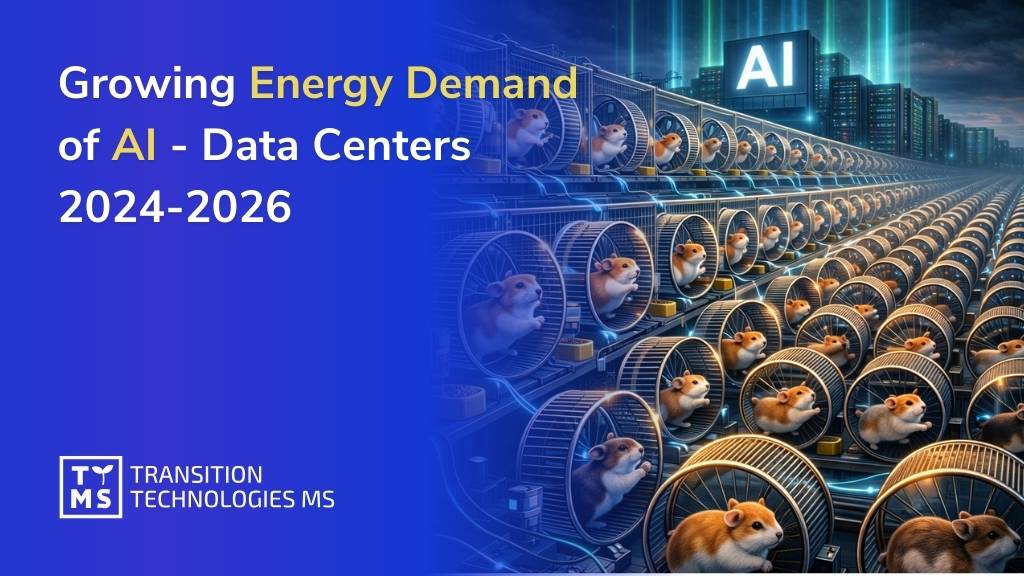
AI Data Centers Energy Consumption in 2024–2026: Trends, Projections, Environmental Impact and Investment Opportunities
Artificial intelligence is experiencing a real boom, and with it the demand for energy needed to power its infrastructure is growing rapidly. Data centers, where AI models are trained and run, are becoming some of the largest new electricity consumers in the world. In 2024-2025, record investments in data centers were recorded – it is estimated that in 2025 alone, as much as USD 580 billion was spent globally on AI-focused data center infrastructure. This has translated into a sharp increase in electricity consumption at both global and local scales, creating a range of challenges for the IT and energy sectors. Below, we summarize hard data, statistics and trends from 2024-2025 as well as forecasts for 2026, focusing on energy consumption by data centers (both AI model training and their inference), the impact of this phenomenon on the energy sector (energy mix, renewables), and the key decisions facing managers implementing AI. 1. AI boom and global data center electricity consumption 2024-2025 The development of generative AI and large language models has caused an explosion in demand for computing power. Technology companies are investing billions to expand data centers packed with graphics processing units (GPUs) and other AI accelerators. As a result, global electricity consumption by data centers reached around 415 TWh in 2024, which already accounts for approx. 1.5% of total global electricity consumption. In the United States alone, data centers consumed an estimated ~180 TWh in 2024, representing roughly 4–5% of national electricity consumption – comparable to the annual energy demand of a mid-sized country like Pakistan. The growth pace is enormous – globally, data center electricity consumption has been growing by about 12% per year over the past five years, and the AI boom is accelerating this growth even further. Already in 2023-2024, the impact of AI on infrastructure expansion became visible: the installed capacity of newly built data centers in North America alone reached 6,350 MW by the end of 2024, more than twice as much as a year earlier. An average large AI-focused data center consumes as much electricity as 100,000 households, while the largest facilities currently under construction may require 20 times more. It is therefore no surprise that total energy consumption by data centers in the United States has already exceeded 4% of the energy mix – according to an analysis by the Department of Energy, AI could push this share as high as 12% as early as 2028. On a global scale, it is expected that by 2030, energy consumption by data centers will double, approaching 945 TWh (IEA, base scenario). This level is equivalent to the current energy demand of all of Japan. 2. Training vs. inference – where does AI consume the most electricity? In the context of AI, it is worth distinguishing two main types of data center workloads: model training and their inference, i.e. the operation of the model handling user queries. Training the most advanced models is extremely energy-intensive – for example, training one of the largest language models in 2023 consumed approximately 50 GWh of energy, equivalent to three days of powering the entire city of San Francisco. Another government report estimated the power required to train a leading AI model at 25 MW, noting that year after year the power requirements for training may double. These figures illustrate the scale – a single training session of a large model consumes as much energy as thousands of average households over the course of a year. By contrast, inference (i.e. using a trained model to provide answers, generate images, etc.) takes place at massive scale across many applications simultaneously. Although a single query to an AI model consumes only a fraction of the energy required for training, on a global scale inference is responsible for 80–90% of total AI energy consumption. To illustrate: a single question asked to a chatbot such as ChatGPT can consume as much as 10 times more energy than a Google search. When billions of such queries are processed every day, the cumulative energy cost of inference begins to exceed the cost of one-off training runs. In other words, AI “in action” (production) already consumes more electricity than AI “in training”, which has significant implications for infrastructure planning. Engineers and scientists are attempting to mitigate this trend through model and hardware optimization. Over the past decade, the energy efficiency of AI chips has increased significantly – GPUs can now perform 100 times more computations per watt of energy than in 2008. Despite these improvements, the growing complexity of models and their widespread adoption mean that total power consumption is growing faster than efficiency gains. Leading companies are reporting year-over-year increases of more than 100% in demand for AI computing power, which directly translates into higher electricity consumption. 3. The impact of AI on the energy sector and the energy source mix The growing demand for energy from data centers poses significant challenges for the energy sector. Large, energy-intensive server farms can locally strain power grids, forcing infrastructure expansion and the development of new generation capacity. In 2023, data centers in the state of Virginia (USA) consumed as much as 26% of all electricity in the state. Similarly high shares were recorded, among others, in Ireland – 21% of national electricity consumption in 2022 was attributable to data centers, and forecasts indicate as much as a 32% share by 2026. Such a high concentration of energy demand in a single sector creates the need for modernization of transmission networks and increased reserve capacity. Grid operators and local authorities warn that without investment, overloads may occur, and the costs of expansion are passed on to end consumers. In the PJM region in the USA (covering several states), it is estimated that providing capacity for new data centers increased energy market costs by USD 9.3 billion, translating into an additional ~$18 per month on household electricity bills in some counties. Where does the energy powering AI data centers come from? At present, a significant share of electricity comes from traditional fossil fuels. Globally, around 56% of the energy consumed by data centers comes from fossil fuels (approximately 30% coal and 26% natural gas), while the remainder comes from zero-emission sources – renewables (27%) and nuclear energy (15%). In the United States, natural gas dominated in 2024 (over 40%), with approximately 24% from renewables, 20% from nuclear power, and 15% from coal. However, this mix is expected to change under the influence of two factors: ambitious climate targets set by technology companies and the availability of low-cost renewable energy. The largest players (Google, Microsoft, Amazon, Meta) have announced plans for emissions neutrality – for example, Google and Microsoft aim to achieve net-zero emissions by 2030. This forces radical changes in how data centers are powered. Already, renewables are the fastest-growing energy source for data centers – according to the IEA, renewable energy production for data centers is growing at an average rate of 22% per year and is expected to cover nearly half of additional demand by 2030. Tech giants are investing heavily in wind and solar farms and signing power purchase agreements (PPAs) for green energy supplies. Since the beginning of 2025, leading AI companies have signed at least a dozen large solar energy contracts, each adding more than 100 MW of capacity for their data centers. Wind projects are developing in parallel – for example, Microsoft’s data center in Wyoming is powered entirely by wind energy, while Google purchases wind power for its data centers in Belgium. Nuclear energy is making a comeback as a stable power source for AI. Several U.S. states are planning to reactivate shut-down nuclear power plants specifically to meet the needs of data centers – preparations are underway to restart the Three Mile Island (Pennsylvania) and Duane Arnold (Iowa) reactors by 2028, in cooperation with Microsoft and Google. In addition, technology companies have invested in the development of small modular reactors (SMRs) – Amazon supported the startup X-Energy, Google purchased 500 MW of SMR capacity from Kairos, and data center operator Switch ordered energy from an Oklo reactor backed by OpenAI. SMRs are expected to begin operation after 2030, but hyperscalers are already securing future supplies from these zero-emission sources. Despite the growing share of renewables and nuclear power, in the coming years natural gas and coal will remain important for covering the surge in demand driven by AI. The IEA forecasts that by 2030 approximately 40% of additional energy consumption by data centers will still be supplied by gas- and coal-based sources. In some countries (e.g. China and parts of Asia), coal continues to dominate the power mix for data centers. This creates climate challenges – analyses indicate that although data centers currently account for only about ~0.5% of global CO₂ emissions, they are one of the few sectors in which emissions are still rising, while many other sectors are expected to decarbonize. There are growing warnings that the expansion of energy-intensive AI may make it more difficult to achieve climate goals if it is not balanced with clean energy. 4. How much energy does AI use in 2026? AI power demand forecast for 2026 From the perspective of 2026, further rapid growth in energy consumption driven by artificial intelligence is expected. If current trends continue, data centers will consume significantly more energy in 2026 than in 2024 – estimates point to over 500 TWh globally, which would represent approximately 2% of global electricity consumption (compared to 1.5% in 2024). In the years 2024–2026 alone, the AI sector could generate additional demand amounting to hundreds of TWh. The International Energy Agency emphasizes that AI is the most important driver of growth in data center electricity demand and one of the key new energy consumers on a global scale. In the IEA base scenario, assuming continued efficiency improvements, energy consumption by data centers grows by approximately 15% per year through 2030. However, if the AI boom accelerates (more models, users, and deployments across industries), this growth could be even faster. There are scenarios in which, by the end of the decade, data centers could account for as much as 12% of the increase in global electricity demand. The year 2026 will likely bring further investments in AI infrastructure. Many cloud and colocation providers have planned the opening of new data center campuses over the next 1–2 years to meet growing demand. Governments and regions are actively competing to host such facilities, offering incentives and expedited permitting processes to investors, as already observed in 2024–25. On the other hand, environmental awareness is increasing, making it possible that more stringent regulations will emerge in 2026. Some countries and states are debating requirements for data centers to partially rely on renewable energy sources or to report their carbon footprint and water consumption. Local moratoria on the construction of additional energy-intensive server farms are also possible if the grid is unable to support them – such ideas have already been proposed in regions with high concentrations of data centers (e.g. Northern Virginia). From a technological perspective, 2026 may bring new generations of more energy-efficient AI hardware (e.g. next-generation GPUs/TPUs) as well as broader adoption of Green AI initiatives aimed at optimizing models for lower power consumption. However, given the scale of demand, total energy consumption by AI will almost certainly continue to grow – the only question is how fast. The direction is clear: the industry must synchronize the development of AI with the development of sustainable energy systems to avoid a conflict between technological ambitions and climate goals. 5. Challenges for companies: energy costs, sustainability, and IT strategy The rapid growth in energy demand driven by AI places managers and executives in front of several key strategic decisions: 1.Rising energy costs Higher electricity consumption means higher bills. Companies implementing AI at scale must account for significant energy expenditures in their budgets. Forecasts indicate that without efficiency improvements, power costs may consume an increasing share of IT spending. For example, in the United States, the expansion of data centers could raise average household electricity bills by 8% by 2030, and by as much as 25% in the most heavily burdened regions. For companies, this creates pressure to optimize consumption – whether through improved efficiency (better cooling, lower PUE) or by shifting workloads to regions with cheaper energy. 2. Sustainability and CO₂ emissions Corporate ESG targets are forcing technology leaders to pursue climate neutrality, which is difficult amid rapidly growing energy consumption. Large companies such as Google and Meta have already observed that the expansion of AI infrastructure has led to a surge in their CO₂ emissions despite earlier reductions. Managers therefore need to invest in emissions offsetting and clean energy sources. It is becoming the norm for companies to enter into long-term renewable energy contracts or even to invest directly in solar farms, wind farms, or nuclear projects to secure green energy for their data centers. There is also a growing trend toward the use of alternative sources – including trials of powering server farms with hydrogen, geothermal energy, or experimental nuclear fusion (e.g. Microsoft’s contract for 50 MW from the future Helion Energy fusion power plant) – all of which are elements of power supply diversification and decarbonization strategies. 3. IT architecture choices and efficiency IT decision-makers face the dilemma of how to deliver computing power for AI in the most efficient way. There are several options – from optimizing the models themselves (e.g. smaller models, compression, smarter algorithms) to specialized hardware (ASICs, next-generation TPUs, optical memory, etc.). The deployment model choice is also critical: cloud vs on-premises. Large cloud providers often offer data centers with very high energy efficiency (PUE close to 1.1) and the ability to dynamically scale workloads, improving hardware utilization and reducing energy waste. On the other hand, companies may consider their own data centers located where energy is cheaper or where renewable energy is readily available (e.g. regions with surplus renewable generation). AI workload placement strategy – deciding which computational tasks run in which region and when – is becoming a new area of cost optimization. For example, shifting some workloads to data centers operating at night on wind energy or in cooler climates (lower cooling costs) can generate savings. 4. Reputational and regulatory risk Public awareness of AI’s energy footprint is growing. Companies must be prepared for questions from investors and the public about how “green” their artificial intelligence really is. A lack of sustainability initiatives may result in reputational damage, especially if competitors can demonstrate carbon-neutral AI services. In addition, new regulations can be expected – ranging from mandatory disclosure of energy and water consumption by data centers to efficiency standards or emissions limits. Managers should proactively monitor these regulatory developments and engage in industry self-regulation initiatives to avoid sudden legal constraints. In summary, the growing energy needs of AI are a phenomenon that, between 2024 and 2026, has evolved from a barely noticeable curiosity into a strategic challenge for both the IT sector and the energy industry. Hard data shows an exponential rise in electricity consumption – AI is becoming a significant energy consumer worldwide. The response to this trend must be innovation and planning: the development of more efficient technologies, investment in clean energy, and smart workload management strategies. Leaders face the task of finding a balance between driving the AI revolution and responsible energy stewardship – so that artificial intelligence drives progress without overloading the planet. 6. Is your AI architecture ready for rising energy and infrastructure costs? AI is no longer just a software decision – it is an infrastructure, cost, and energy decision. At TTMS, we help organizations assess whether their AI and cloud architectures are ready for real-world scale, including growing energy demand, cost control, and long-term sustainability. If your teams are moving AI from pilot to production, now is the right moment to validate your architecture before energy and infrastructure constraints become a business risk. Learn how TTMS supports enterprises in designing scalable, cost-efficient, and production-ready AI architectures – talk to our experts. Why is AI dramatically increasing energy consumption in data centers? AI significantly increases energy consumption because it relies on extremely compute-intensive workloads, particularly large-scale inference running continuously in production environments. Unlike traditional enterprise applications, AI systems often operate 24/7, process massive volumes of data, and require specialized hardware such as GPUs and AI accelerators that consume far more power per rack. While model training is energy-intensive, inference at scale now accounts for the majority of AI-related electricity use. As AI becomes embedded in everyday business processes, energy demand grows structurally rather than temporarily, turning electricity into a core dependency of AI-driven organizations. How does AI-driven energy demand affect data center location and cloud strategy? Energy availability, grid capacity, and electricity pricing are becoming critical factors in data center location decisions. Regions with constrained grids or high energy costs may struggle to support large-scale AI deployments, while areas with abundant renewable energy or stable baseload power gain strategic importance. This directly influences cloud strategy, as companies increasingly evaluate where AI workloads run, not just how they run. Hybrid and multi-region architectures are now used not only for resilience and compliance, but also to optimize energy cost, carbon footprint, and long-term scalability. Will energy costs materially impact the ROI of AI investments? Yes, energy costs are increasingly becoming a material component of AI return on investment. As AI workloads scale, electricity consumption can rival or exceed traditional infrastructure costs such as hardware depreciation or software licensing. In regions experiencing rapid data center growth, rising power prices and grid expansion costs may further increase operational expenses. Organizations that fail to model energy consumption realistically risk underestimating the true cost of AI initiatives, which can distort financial forecasts and strategic planning. Can renewable energy realistically keep up with AI-driven demand growth? Renewable energy is expanding rapidly and plays a crucial role in powering AI infrastructure, but it is unlikely to fully offset AI-driven demand growth in the short term. While many technology companies are investing heavily in wind, solar, and long-term power purchase agreements, the pace of AI adoption is exceptionally fast. As a result, fossil fuels and nuclear energy are expected to remain part of the energy mix for data centers through at least the end of the decade. Long-term sustainability will depend on a combination of renewable expansion, grid modernization, energy storage, and improvements in AI efficiency. What strategic decisions should executives make today to prepare for AI-related energy constraints? Executives should treat energy as a strategic input to AI, not a secondary operational concern. This includes incorporating energy costs into AI business cases, aligning AI growth plans with sustainability goals, and assessing the resilience of energy supply in key regions. Decisions around cloud providers, workload placement, and hardware architecture should explicitly consider energy efficiency and long-term availability. Organizations that proactively integrate AI strategy with energy and sustainability planning will be better positioned to scale AI responsibly and competitively.
ReadThe world’s largest corporations have trusted us



























We hereby declare that Transition Technologies MS provides IT services on time, with high quality and in accordance with the signed agreement. We recommend TTMS as a trustworthy and reliable provider of Salesforce IT services.
TTMS has really helped us thorough the years in the field of configuration and management of protection relays with the use of various technologies. I do confirm, that the services provided by TTMS are implemented in a timely manner, in accordance with the agreement and duly.
Ready to take your business to the next level?
Let’s talk about how TTMS can help.

Michał Trojanowski
Managing Director TTMS Software UK Ltd.