Performance gaps cost organizations more than lost productivity. They erode competitive advantage, stifle innovation, and create friction across entire teams. Yet many companies treat training as a checkbox exercise rather than a strategic lever for measurable improvement. When designed and delivered effectively, training to improve employee performance transforms how teams execute, adapt, and drive business results.
Organizations now face rapidly shifting skill requirements, emerging technologies, and evolving workforce expectations. The companies that thrive are those viewing employee development as continuous investment rather than periodic intervention. This guide explores how to build training programs that close performance gaps, align with business objectives, and deliver tangible outcomes in 2026 and beyond.
1. Why Training to Improve Employee Performance Is a Strategic Business Priority
The financial case for employee development is compelling. Organizations with comprehensive training programs see 218% higher income per employee compared to those without formal programs. This isn’t just about productivity. It’s direct profitability impact. Every dollar invested in manager development returns an average of $4.50 in improved productivity, demonstrating clear ROI for leadership training specifically.
Training also drives retention, one of the largest hidden costs organizations face. Companies investing in manager development reduce voluntary turnover by 27%, directly addressing expensive replacement costs. This matters because skilled employees complete tasks faster, make fewer errors, and contribute more meaningfully to organizational goals.
Beyond retention and revenue, training addresses the growing skills gap affecting industries worldwide. As technology advances and business models evolve, yesterday’s competencies become insufficient for tomorrow’s challenges. Organizations that prioritize continuous learning create adaptive teams capable of navigating change rather than resisting it.
1.1 The Direct Link Between Training and Business Outcomes
Performance improvement through training manifests across multiple dimensions. Revenue teams equipped with modern selling techniques close deals more effectively. Customer service representatives trained in problem-solving reduce resolution times while improving satisfaction scores. Technical teams with updated skills deploy projects faster and with higher quality standards.
Consider Google’s Career Certificates program, which targeted high-demand fields like IT support, project management, and data analytics. The results: 75% of graduates landed new jobs or promotions within six months. Similarly, Walmart’s “Live Better U” program (a $50 million annual investment in employee education) delivered a 10% increase in retention and 30% boost in customer satisfaction scores.
The financial impact extends beyond productivity gains. Training reduces the cost of mistakes, particularly in regulated industries where errors carry significant consequences. Well-trained employees require less supervision, freeing managers to focus on strategic initiatives. This matters because most of the variation in team engagement is driven by the manager, meaning that investing in manager training delivers outsized returns by amplifying benefits across entire teams.
1.2 What Performance Improvement Through Training Actually Means
Performance improvement involves more than acquiring new information. It requires changing how employees approach tasks, make decisions, and solve problems in their daily work. Effective training bridges the gap between knowing and doing, ensuring knowledge translates into behavioral change and measurable outcomes.
This transformation happens when training addresses specific performance barriers rather than generic skill deficits. An employee struggling with time management needs different interventions than one lacking technical proficiency. Understanding these distinctions allows organizations to deploy targeted solutions that address root causes rather than symptoms.
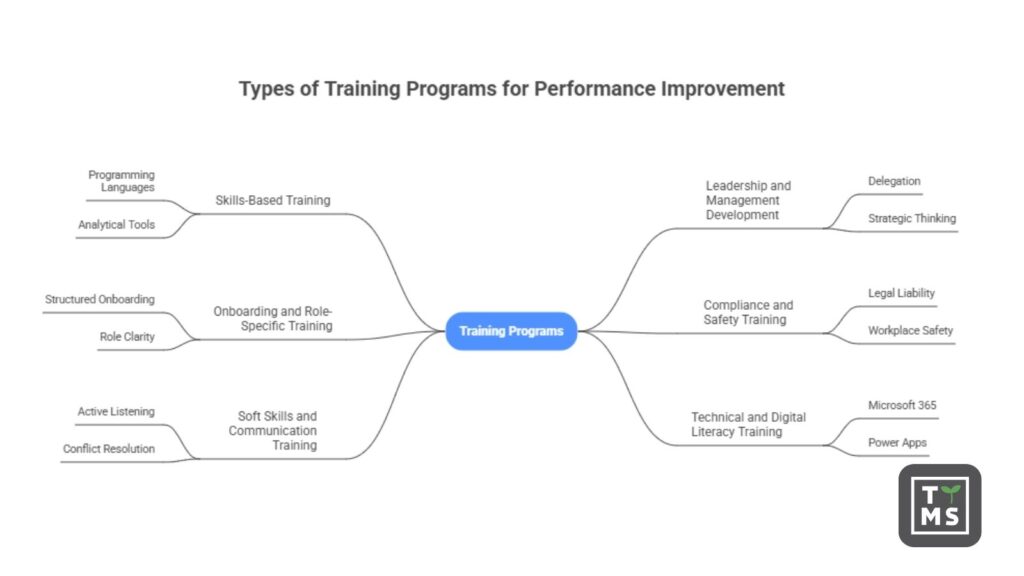
2. Types of Training Programs That Drive Performance Improvement
Different performance challenges require different training approaches. Organizations benefit from understanding which types of training provided to ensure organizational performance include options that match specific needs and objectives. A strategic training portfolio balances immediate skill requirements with long-term capability development.
2.1 Skills-Based Training
Technical competencies form the foundation of job performance across roles. Skills-based training focuses on the specific abilities employees need to execute core responsibilities effectively. For software developers, this might involve new programming languages or development frameworks. For financial analysts, it could encompass advanced modeling techniques or analytical tools.
The key is specificity. Generic skills training produces generic results, while targeted programs addressing clearly defined competencies drive measurable improvement. TTMS approaches skills development through practical application, ensuring employees practice new capabilities in contexts that mirror actual work scenarios. This methodology accelerates the transition from learning to application, reducing the time between training completion and performance improvement.
2.2 Leadership and Management Development
Leadership capability influences team performance more profoundly than individual contributor skills. Managers set priorities, allocate resources, provide feedback, and shape team culture. When leadership skills lag behind organizational needs, entire teams underperform regardless of individual capabilities.
Effective leadership development programs address both technical management skills and interpersonal capabilities. New managers need guidance on delegation, performance management, and decision-making frameworks. Experienced leaders benefit from training on strategic thinking, change management, and coaching techniques. The most impactful programs combine conceptual learning with real-world practice, allowing leaders to test new approaches and refine them based on results.
2.3 Onboarding and Role-Specific Training
First impressions matter. New employees who receive comprehensive onboarding reach full productivity faster than those learning through trial and error. Role-specific training ensures new team members understand not just what to do, but why and how it connects to broader organizational objectives.
Structured onboarding reduces the anxiety and uncertainty that often accompany new roles. It provides frameworks for success, clarifies expectations, and builds confidence through guided practice. Organizations that invest in thorough onboarding programs see improved retention, faster ramp times, and higher early-tenure performance compared to those with minimal orientation processes.
2.4 Compliance and Safety Training
Regulatory requirements and safety protocols aren’t optional. Compliance training protects organizations from legal liability while ensuring employees work within established guidelines. Safety training prevents workplace injuries and creates environments where employees feel secure.
These programs work best when they move beyond checkbox completion toward genuine understanding. Employees need to grasp not just the rules, but the reasoning behind them and the consequences of non-compliance. Interactive scenarios, case studies, and practical exercises make compliance training more engaging and effective than passive video lectures or text-heavy modules.
2.5 Soft Skills and Communication Training
Technical expertise means little if employees can’t collaborate effectively, communicate clearly, or navigate workplace dynamics. Soft skills training addresses competencies like active listening, conflict resolution, presentation skills, and emotional intelligence. These capabilities influence team cohesion, customer relationships, and organizational culture.
Communication training proves particularly valuable in remote and hybrid environments where informal learning opportunities diminish. Employees benefit from explicit guidance on digital communication norms, virtual meeting facilitation, and asynchronous collaboration techniques. Organizations that invest in these areas see improved teamwork, reduced misunderstandings, and stronger cross-functional cooperation.
2.6 Technical and Digital Literacy Training
Digital transformation requires workforce transformation. Employees need proficiency with the tools, platforms, and systems that enable modern work. Technical literacy training ensures teams can leverage technology effectively rather than struggling with basic functionality.
This category encompasses everything from foundational computer skills to advanced platform capabilities. TTMS specializes in helping organizations implement new technologies while simultaneously building the internal capability to use them effectively. Training on systems like Microsoft 365, Power Apps, or Salesforce becomes most valuable when designed around specific business processes rather than generic feature overviews.
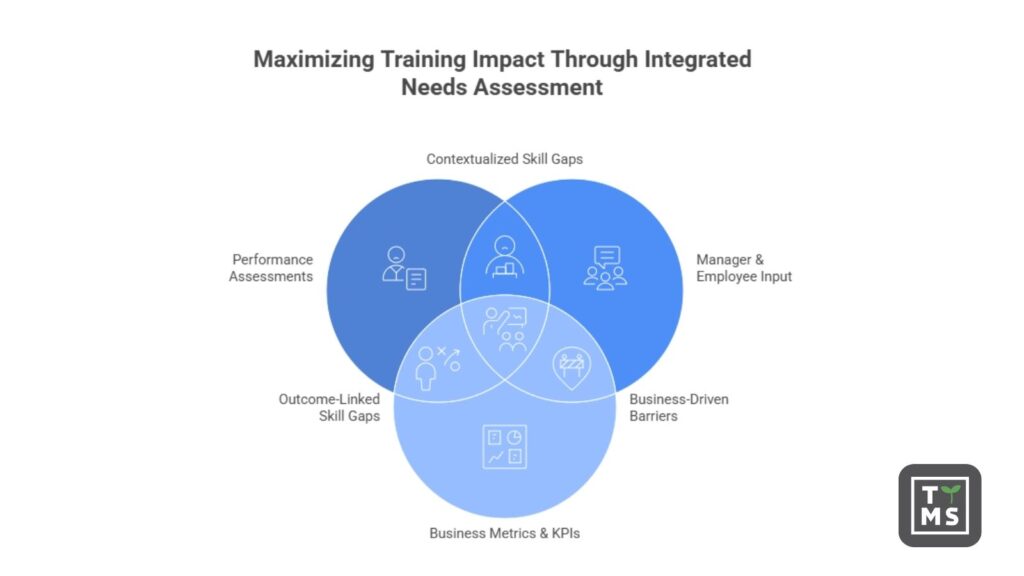
3. How to Identify Performance Gaps and Training Needs
Effective training begins with accurate diagnosis. Organizations often waste resources on programs that address perceived rather than actual performance barriers. Systematic needs assessment ensures training investments target genuine gaps with meaningful business impact.
3.1 Conducting Performance Assessments
Performance assessments reveal the difference between current and desired capabilities. These evaluations might include skills testing, competency reviews, or 360-degree feedback processes. The goal is identifying specific areas where employee performance falls short of standards or expectations.
Effective assessments measure both outcomes and behaviors. An employee might achieve results through inefficient methods that won’t scale. Another might possess strong skills but lack confidence to apply them consistently. Understanding these nuances allows for more precise training interventions that address actual limiting factors rather than surface-level symptoms.
3.2 Gathering Input from Managers and Employees
Frontline managers and employees often identify performance barriers before they appear in formal metrics. Managers observe daily work patterns, spot recurring challenges, and understand contextual factors affecting team performance. Employees experience frustration with systems, processes, or skill deficits that create unnecessary friction.
Structured input processes might include surveys, focus groups, or individual interviews. The key is creating psychological safety where people feel comfortable identifying skill gaps without fear of judgment. Organizations that cultivate this openness gain earlier visibility into training needs, allowing proactive rather than reactive interventions.
3.3 Analyzing Business Metrics and KPIs
Performance data tells stories about capability gaps. Declining quality scores might indicate insufficient technical skills. Extended project timelines could reflect planning or execution deficiencies. Customer complaints about service might point to communication or product knowledge gaps.
Connecting performance metrics to specific skill requirements requires analytical thinking. TTMS leverages Business Intelligence tools like Power BI to help organizations identify patterns and correlations between employee capabilities and business outcomes. This data-driven approach ensures training addresses root causes rather than assumptions about what employees need to improve.
3.4 Prioritizing Training Investments Based on Impact
Not all performance gaps warrant equal investment. Organizations must balance urgency, impact potential, and resource availability when planning employee training and development programs. High-impact, high-urgency gaps deserve immediate attention. Lower-priority needs might be addressed through self-directed learning resources or scheduled for future development cycles.
Prioritization frameworks consider factors like business impact, number of affected employees, complexity of the solution, and strategic importance. A skill gap affecting customer-facing teams during peak season requires faster intervention than a development opportunity for internal staff. Clear prioritization ensures limited training resources generate maximum organizational benefit.
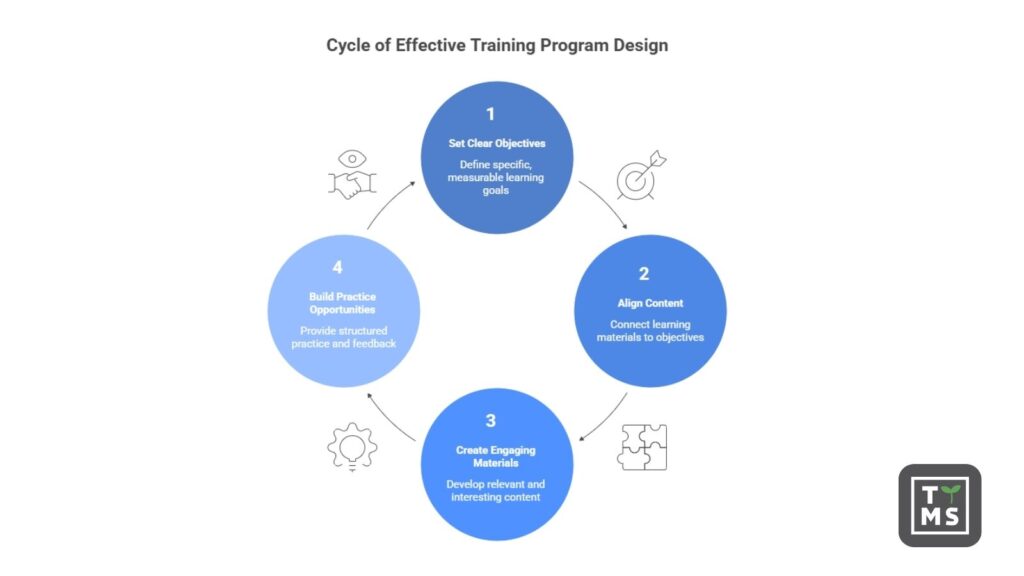
4. Designing Effective Training Programs for Performance Improvement
Program design determines whether training produces lasting behavior change or quickly forgotten information. Effective design aligns learning activities with performance objectives while keeping participants engaged throughout the experience.
4.1 Setting Clear, Measurable Learning Objectives
Vague objectives produce vague results. Effective training programs begin with specific statements about what participants will be able to do after completing the program. These objectives should be observable, measurable, and directly linked to job performance requirements.
Strong objectives use action verbs describing specific behaviors rather than abstract concepts. Instead of “understand customer service principles,” an effective objective states “resolve common customer complaints using the five-step resolution framework.” This specificity guides both content development and outcome assessment, ensuring everyone shares clarity about what success looks like.
4.2 Aligning Training Content with Performance Goals
Every module, activity, and example should connect clearly to performance objectives. Content that interests instructors but doesn’t support specific performance improvements wastes participant time and dilutes program effectiveness. Ruthless relevance keeps training focused and impactful.
This alignment requires constant questioning during design. How does this concept help employees perform better? Where will participants use this skill? What decisions or actions will improve after learning this content? If clear answers don’t emerge, the content probably doesn’t belong in the program.
4.3 Creating Engaging and Relevant Training Materials
Engagement isn’t about entertainment. It’s about maintaining focused attention on meaningful learning. Relevant examples, realistic scenarios, and clear connections to daily work keep participants mentally present and receptive to new concepts. Materials that feel disconnected from actual job requirements generate skepticism rather than enthusiasm.
TTMS develops training materials that reflect real business contexts and challenges. When teaching process automation using Power Apps, examples draw from actual workflow scenarios rather than abstract demonstrations. This authenticity helps participants immediately envision application opportunities, accelerating the transition from learning to implementation.
4.4 Building in Practice and Application Opportunities
Knowledge alone doesn’t change performance; application does. Effective programs create structured opportunities for participants to practice new skills, receive feedback, and refine their approach. This practice might occur through simulations, role-playing exercises, guided projects, or supervised on-the-job application.
The timing and structure of practice opportunities significantly influence skill retention and transfer. Spaced practice sessions generally produce better long-term results than concentrated practice blocks. Immediate feedback during practice helps participants correct errors before they become habits. Progressive difficulty levels build confidence while preventing overwhelm.
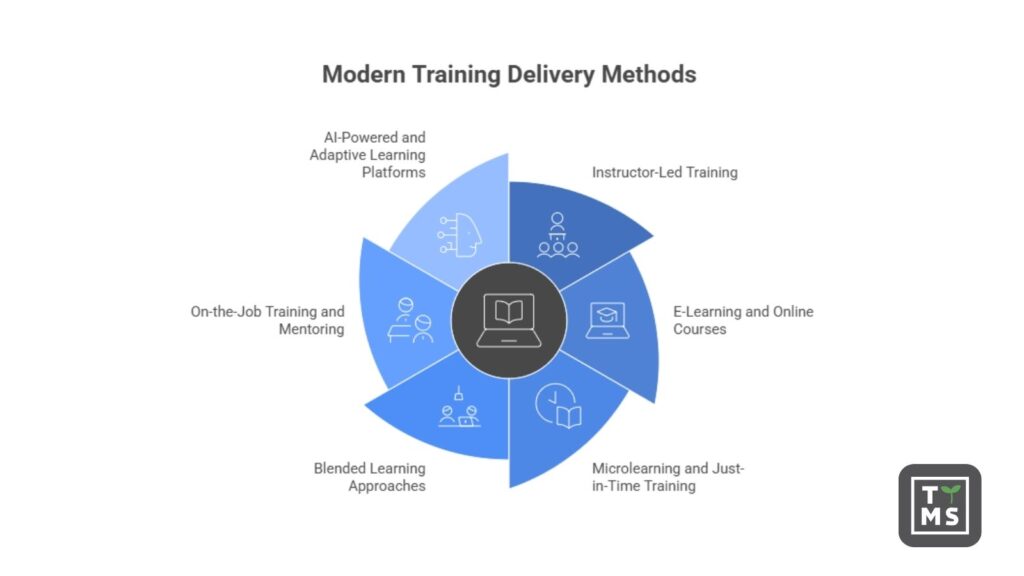
5. Modern Training Delivery Methods for 2026
Organizations now have unprecedented flexibility in how they deliver training. The most effective approaches match delivery methods to learning objectives, participant needs, and organizational constraints. New training methods for employees continue emerging as technology evolves and learning science advances.
5.1 Instructor-Led Training (In-Person and Virtual)
Instructor-led training remains valuable for complex topics requiring discussion, debate, and real-time feedback. Live instructors adapt pace and emphasis based on participant reactions, provide immediate clarification when confusion arises, and facilitate peer learning through structured interactions. In-person sessions excel at building relationships and enabling hands-on practice with physical equipment or complex scenarios.
Virtual instructor-led training extends these benefits to distributed teams while reducing travel costs and scheduling complexity. Effective virtual training requires different facilitation techniques than in-person sessions, with more frequent engagement activities and shorter presentation segments to maintain attention in digital environments.
5.2 E-Learning and Online Courses
Digital learning platforms provide flexibility and scalability that traditional training can’t match. Employees access content when and where they need it, progressing at comfortable speeds without holding back faster learners or rushing those needing more time. TTMS offers comprehensive E-Learning administration services that help organizations deploy and manage digital learning programs effectively.
Quality online courses include interactive elements like knowledge checks, branching scenarios, and application exercises rather than passive video lectures. Well-designed e-learning creates cognitive engagement through strategic interactivity, clear navigation, and multimedia content that reinforces rather than distracts from core concepts.
5.3 Microlearning and Just-in-Time Training
Microlearning delivers focused content in short segments addressing specific questions or skills. These bite-sized modules fit into busy schedules more easily than extended training sessions. Just-in-time training provides information precisely when employees need it, reducing the time gap between learning and application.
This approach proves particularly effective for procedural knowledge, quick reference needs, and reinforcement of previously learned concepts. A five-minute video demonstrating a software feature delivers more value than an hour-long course when an employee simply needs to complete a specific task.
5.4 Blended Learning Approaches
Blended learning combines multiple delivery methods to leverage the strengths of each. A typical blended program might include pre-work through online modules, live virtual sessions for discussion and practice, and follow-up microlearning for reinforcement. This variety maintains engagement while accommodating different learning preferences and schedules.
The key to successful blended learning lies in thoughtful sequencing and clear transitions between modalities. Each component should build on previous elements while preparing participants for what comes next. Poor integration creates confusion and disconnection rather than the reinforcement that effective blending provides.
5.5 On-the-Job Training and Mentoring
Learning while working offers unmatched relevance and immediate application opportunities. Structured on-the-job training pairs less experienced employees with skilled performers who model effective techniques, provide coaching, and offer feedback on actual work output. This apprenticeship-style approach transfers both explicit knowledge and tacit expertise that’s difficult to capture in formal training.
Mentoring relationships extend beyond immediate skill development to career guidance, organizational navigation, and professional growth. Effective mentoring programs provide structure through defined goals and regular meetings while allowing flexibility for organic relationship development. Organizations benefit from both the skill transfer and the cultural cohesion that mentoring relationships create.
5.6 AI-Powered and Adaptive Learning Platforms
Artificial intelligence transforms training by personalizing learning paths based on individual needs, performance patterns, and progress rates. Adaptive platforms assess learner comprehension and adjust content difficulty, sequencing, and reinforcement accordingly. This personalization creates more efficient learning experiences that focus time on areas needing development rather than reviewing already-mastered content.
TTMS helps organizations implement AI Solutions that enhance operational efficiency, including learning and development processes. AI-powered training systems analyze performance data to recommend specific learning resources, predict skill gaps before they impact performance, and provide insights about program effectiveness that inform continuous improvement efforts.

6. Common Training Challenges and How to Overcome Them
Even well-designed training programs encounter obstacles that limit effectiveness. Understanding common challenges allows organizations to implement preventive strategies and respond effectively when issues arise.
6.1 Low Employee Engagement and Participation
Employees resist training when they perceive it as irrelevant, inconvenient, or disconnected from actual job requirements. This resistance manifests as low enrollment rates, minimal participation during sessions, or quick abandonment of self-directed learning programs. Overcoming engagement challenges requires demonstrating clear value and making participation as frictionless as possible.
Successful strategies include communicating concrete benefits before training begins, gathering participant input during program design, and securing visible leadership support. When employees understand how training will make their work easier or their careers stronger, engagement improves dramatically. Flexible scheduling and accessible formats reduce participation barriers, while recognition for completion reinforces the importance of development.
6.2 Limited Time and Resources
Training competes with operational demands for employee time and organizational budget. Managers struggle to release staff for development activities when deadlines loom or workloads increase. Budget constraints force difficult choices about which programs to fund and which to defer.
Process Automation through solutions like Low-Code Power Apps can reduce operational burden, freeing time for employee development without sacrificing productivity. TTMS specializes in automating repetitive tasks and streamlining workflows, creating capacity for learning alongside daily responsibilities. Organizations can maximize limited resources by prioritizing high-impact training, leveraging scalable digital delivery methods, and building internal facilitation capabilities rather than relying exclusively on external providers.
6.3 Difficulty Measuring Real-World Impact
Only about half of organizations can measure the business impact of learning, yet understanding whether training produced actual performance improvement is critical for justifying continued investment. Many struggle to connect training participation with business outcomes or identify programs needing redesign.
Key Training Effectiveness Metrics and Benchmarks:
Effective measurement begins with clear objectives established during program design. Organizations classified as 75% more confident in profitability compared to others (64%), demonstrating the link between comprehensive development and business confidence.
Industry benchmarks for training effectiveness include:
- Training completion rates: 59% of training providers track course completion as a key metric, though e-learning completion averages around 20%
- Knowledge retention: Measured through post-training assessments, with 87% of noncompliance cases linked to knowledge gaps and uncertainty
- Behavioral application: Champions track engagement (72%), retention (64%), and skills development (55%) as primary indicators
- Business impact: Measured through promotions (48% for champions), internal mobility (32%), and direct correlation to team performance
Methods for measuring impact include performance assessments comparing pre- and post-training capabilities, manager observations of behavioral change, and analysis of relevant business metrics like productivity rates, quality scores, or customer satisfaction data. The key is establishing baseline measurements before training and tracking changes systematically afterward.
6.4 Knowledge Not Transferring to Job Performance
The most frustrating training challenge occurs when employees demonstrate mastery during training but fail to apply learning in actual work contexts. This transfer problem stems from various causes including lack of application opportunities, unsupportive work environments, insufficient reinforcement, or training that doesn’t reflect real-world complexity.
Overcoming transfer barriers requires interventions beyond training itself. Managers need guidance on reinforcing trained behaviors through coaching, feedback, and recognition. Work processes should be designed to encourage rather than prevent application of new skills. Follow-up reinforcement through job aids, peer discussions, or refresher sessions helps solidify learning over time. Organizations might also implement accountability mechanisms where employees commit to specific application goals and report on progress.
TTMS recognizes that successful training programs extend beyond content delivery to encompass the entire performance ecosystem. Through IT service management expertise and process optimization capabilities, TTMS helps organizations create environments where employee learning translates into sustained performance improvement. When training aligns with business processes, technological infrastructure, and management practices, organizations achieve the transformation that isolated training programs rarely deliver.
Building a culture where training to improve employee performance becomes standard practice rather than periodic initiative requires sustained commitment from leadership, systematic approaches to identifying and addressing capability gaps, and willingness to invest in both formal programs and supportive infrastructure. Organizations taking this comprehensive approach position themselves to adapt quickly to changing market conditions while building the workforce capabilities that drive competitive advantage.