This guide focuses on purpose-built workplace learning platforms rather than general AI chatbots, helping L&D, HR, and training teams compare AI tools for creating, localizing, scaling, and managing employee training.
The urgency behind this category is real. The World Economic Forum reports that employers expect 39% of workers’ core skills to change by 2030, and it also notes that 50% of the workforce has now completed training as part of long-term learning strategies. LinkedIn’s Workplace Learning Report says 71% of L&D professionals are already exploring, experimenting with, or integrating AI into their work. Microsoft’s 2025 Work Trend findings add that 51% of managers expect AI training or upskilling to become a key responsibility for their teams within five years.
For buyers, that changes the decision criteria. The right platform is no longer just the one with the most AI features on a landing page. The best tools are the ones that help your team turn internal expertise into usable learning, faster, with the right balance of instructional quality, localization, collaboration, deployment flexibility, and governance.
1. Why AI now belongs at the center of training and development
Across current product positioning from leading vendors, AI in learning is no longer limited to text generation. The category now includes document-to-course conversion, AI-authored assessments, multilingual localization, training video creation, collaborative SME workflows, just-in-time answers, and LMS-ready deployment. TTMS, Articulate, Easygenerator, iSpring, Adobe, 360Learning, Docebo, and Sana all highlight different parts of that workflow in their current product materials.
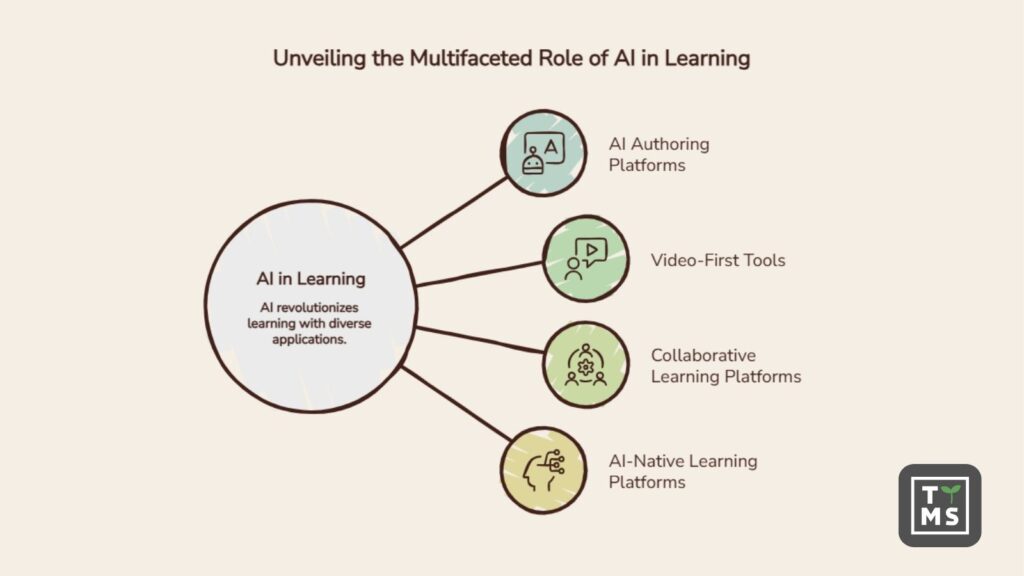
That is why the strongest AI tools for training and development now fall into four broad patterns. Some are AI authoring platforms that convert internal materials into structured courses. Some are video-first tools that make training easier to create and localize. Some are collaborative learning platforms that let subject-matter experts share knowledge directly. Others are AI-native learning platforms that combine authoring, delivery, automation, analytics, and answers in one system. In practice, most enterprise buyers need a clear primary platform and then one or two specialist tools around it.
2. How we ranked the tools
This ranking prioritizes six factors: speed from source material to first usable draft, control over learning design, ease of collaboration with experts, multilingual rollout, deployment flexibility, and enterprise readiness. We also gave extra weight to platforms that support real business use cases such as onboarding, compliance, technical training, product enablement, and employee development rather than only generic content generation. Those priorities align with the broader market pressure for faster upskilling and more adaptive learning operations.
We also favored purpose-built L&D products over general AI assistants. A general model may help with brainstorming or rough drafting, but purpose-built learning platforms now add the layers that matter in production: source handling, pedagogy-aware structuring, review workflows, language management, analytics, LMS interoperability, and in several cases stronger security and governance controls.
3. Best AI tools for training and development
The order below reflects business fit for corporate learning teams that need usable output, not AI experiments. TTMS ranks first because it combines source-to-course automation, multilingual delivery, LMS-ready output, and enterprise-grade governance in a more complete way than any other platform in this comparison.
3.1 AI4E-learning by TTMS
Ranked first, AI4E-learning is the strongest overall option for organizations that want to convert internal materials into structured training quickly without sacrificing control. TTMS says the platform accepts source materials such as DOCX, PDF, PPTX, MP3, and MP4, guides users with training goals and learning objectives, supports Word-based scenario editing, exports SCORM, integrates with LMS environments, and supports multilingual delivery. TTMS also states that the platform runs on Azure OpenAI within the client’s Microsoft 365 environment, uses encryption in transit and at rest, does not use customer data to train public AI models, and is backed by certifications including ISO/IEC 27001, ISO/IEC 27701, and ISO/IEC 42001. That makes it especially compelling for onboarding, compliance, procedural, and regulated-environment training.
| AI4E-learning: solution snapshot | |
|---|---|
| Ranking position | First |
| Best for | Enterprises that want to turn internal knowledge into onboarding, compliance, technical, and process training with strong governance. |
| Key AI workflow | Converts DOCX, PDF, PPTX, MP3, and MP4 materials into structured training, supports learning-objective guidance, Word-based scenario editing, and role-based personalization. |
| Delivery and rollout | SCORM-ready output, LMS integration, responsive course generation, and multilingual adaptation for global teams. |
| Enterprise notes | Azure OpenAI in the client’s Microsoft 365 environment, AES-256 and TLS 1.3 encryption, no public model training on customer data, and certifications including ISO/IEC 27001, ISO/IEC 27701, and ISO/IEC 42001. |
| TTMS page | AI4E-learning by TTMS |
3.2 Articulate suite
Ranked second, Articulate 360 remains the strongest mainstream authoring suite for teams that want polished course creation with a mature ecosystem around it. Articulate says the platform helps teams create workplace training faster with integrated AI, turn ideas or source materials into course drafts, generate assessments and summaries, create images, build responsive courses in Rise, create highly interactive custom content in Storyline, export to an LMS or distribute through Reach, and localize training into more than 80 languages. For organizations with dedicated instructional design teams, it remains one of the best AI tools for e-learning development because it combines strong AI assistance with high creative control.
| Articulate 360: solution snapshot | |
|---|---|
| Ranking position | Second |
| Best for | L&D teams that need polished, interactive authoring with more creative control than a turnkey document-to-course workflow. |
| Key AI workflow | AI Assistant can turn ideas or source materials into course drafts, assessments, summaries, and images; Rise and Storyline split responsive authoring and custom interactivity. |
| Delivery and rollout | Export to an LMS or distribute with Reach; browser-based review and collaboration are built in. |
| Localization and accessibility | AI-powered localization into 80+ languages and broad support for WCAG 2.1 AA course creation. |
3.3 Synthesia
Ranked third, Synthesia is the strongest video-first option for L&D teams. Synthesia says its platform creates studio-quality videos with AI avatars and voiceovers, supports more than 160 languages across the platform, integrates with LMS workflows, and on its employee development pages highlights uploading PDFs, documents, and slides to generate ready-to-edit videos, one-click translation into more than 140 languages, smart updates without reshoots, brand kits, and analytics. If your training strategy relies on explainers, SOPs, product walkthroughs, manager communication, or multilingual onboarding, Synthesia is one of the highest-leverage AI tools for training and development available today.
| Synthesia: solution snapshot | |
|---|---|
| Ranking position | Third |
| Best for | Video-first training programs, multilingual internal communications, and scalable employee development content. |
| Key AI workflow | Turns scripts, PDFs, docs, and slides into avatar-led videos, with AI voiceovers, scene generation, and update workflows. |
| Delivery and rollout | LMS integration, analytics, smart updates, and localization support highlighted across 140+ to 160+ languages depending on workflow and feature set. |
| Enterprise notes | Synthesia highlights SOC 2, GDPR, and ISO 42001-related trust signals on current product pages. |
3.4 Easygenerator
Ranked fourth, Easygenerator is an excellent choice for organizations that want subject-matter experts to create learning content without a heavy authoring learning curve. Easygenerator says its AI guides experts to create structured and contextual learning experiences, supports AI-powered video creation, offers AI coaching for workplace conversation practice, and includes localization across more than 75 languages. Its EasyTranslate workflow also lets teams manage multiple language versions from one master course and publish them as a single SCORM file. That combination makes Easygenerator one of the best AI tools for learning and development when the goal is decentralized knowledge sharing and SME-led content production.
| Easygenerator: solution snapshot | |
|---|---|
| Ranking position | Fourth |
| Best for | SME-led authoring, employee-generated learning, onboarding, and quick operational training. |
| Key AI workflow | Guides experts through structured course creation, supports AI video creation, and offers AI-based workplace conversation coaching. |
| Delivery and rollout | Localization into 75+ languages, multilingual management from one master course, and single-SCORM publication for multiple languages. |
| Commercial notes | Free trial and public plan structure are available, which is useful for buyers who want an easier evaluation path. |
3.5 Adobe Captivate
Ranked fifth, Adobe Captivate remains a strong choice for teams that need simulations, interactive video, and media-rich learning experiences. Adobe says Captivate uses generative AI to create text, images, talking avatars, voices, and transcripts, supports PowerPoint-to-eLearning conversion, responsive authoring, software simulations, slide-based and long-scroll content, and publishes LMS-compliant packages in SCORM 1.2, SCORM 2004, AICC, and xAPI. That makes it one of the most capable options for software training and complex interactive learning, even if it typically rewards more advanced authoring skill than some of the higher-ranked tools in this list.
| Adobe Captivate: solution snapshot | |
|---|---|
| Ranking position | Fifth |
| Best for | Software simulations, interactive video, and media-rich course development. |
| Key AI workflow | Uses AI for text, images, talking avatars, voices, and transcripts to accelerate course creation and improve accessibility. |
| Delivery and rollout | Responsive authoring, PowerPoint conversion, and LMS-compliant publishing in SCORM, AICC, and xAPI. |
| Commercial notes | Adobe publicly shows subscription pricing and a free trial on its product page. |
3.6 iSpring Cloud AI
Ranked sixth, iSpring Cloud AI is one of the most practical options for teams that want fast browser-based course creation. iSpring says the tool works entirely online, uses AI to structure and build courses, supports copy-paste from documents and websites, accepts PowerPoint, PDF, MP4, and MP3 source materials, allows teams to collaborate and review in the same workspace, and exports to SCORM or xAPI while also supporting direct link sharing. It also publishes transparent pricing and free-trial options. For lean HR and L&D teams that need quick production with minimal setup, iSpring Cloud AI is one of the most approachable AI tools for training and development.
| iSpring Cloud AI: solution snapshot | |
|---|---|
| Ranking position | Sixth |
| Best for | Fast browser-based authoring for smaller L&D teams, trainers, consultants, and onboarding-focused programs. |
| Key AI workflow | AI helps structure, outline, and build courses from source content, with writing help, question generation, image generation, and text-to-speech capabilities. |
| Delivery and rollout | Supports direct links, SCORM, xAPI, team collaboration, and multilingual translation workflows. |
| Commercial notes | Public annual pricing and free trial are available, which is uncommon in this category. |
3.7 Three Sixty Learning
Ranked seventh, 360Learning is a very strong fit for organizations that want collaborative authoring and deep SME participation. 360Learning says admins, editors, and contributors can create courses with AI from prompts and uploaded PDF, DOCX, or PPTX files, refine an AI-generated outline before course generation, use L&D-controlled prompts and company guidelines, co-author content, generate AI-assisted questions and scenario-based assessments, and use AI to review open-ended learner responses. The broader authoring environment also supports SCORM, cmi5, Google Drive, OneDrive, SharePoint, and LTI content. That makes 360Learning one of the best AI tools for L&D when expertise is spread across the business and learning teams need to stop being the only content bottleneck.
| 360Learning: solution snapshot | |
|---|---|
| Ranking position | Seventh |
| Best for | Collaborative course creation with strong SME involvement and platform-native delivery. |
| Key AI workflow | Generates courses from prompts and uploaded documents, supports L&D-controlled prompts, co-authoring, AI-suggested questions, and AI review of open-ended responses. |
| Delivery and rollout | Supports SCORM and cmi5 delivery plus integrations with Google Drive, OneDrive, SharePoint, and LTI content. |
| Enterprise notes | Particularly strong when L&D wants quality guardrails while still decentralizing authorship to internal experts. |
3.8 Docebo Creator
Ranked eighth, Docebo Creator is a strong enterprise choice for teams that want AI content creation within a broader learning platform strategy. Docebo says Creator can build interactive content from docs, PPTs, PDFs, or text prompts, supports pedagogically informed AI output, generates assessments, translates content into more than 50 languages, packages content in xAPI by default, and keeps customer data from training its models. Docebo also says AI is used more broadly across the platform for recommendations, search, and metadata management. For buyers who want integrated authoring, enterprise learning operations, and AI-assisted content governance in one ecosystem, Docebo remains one of the best AI tools for training and development.
| Docebo Creator: solution snapshot | |
|---|---|
| Ranking position | Eighth |
| Best for | Enterprise learning teams that want authoring tightly integrated with broader learning operations. |
| Key AI workflow | Creates content from docs, PPTs, PDFs, and text prompts, with AI-assisted assessments and pedagogy-aware generation. |
| Delivery and rollout | Supports multilingual creation across 50+ languages and packages content in xAPI by default, with future SCORM and PDF support referenced in current FAQs. |
| Enterprise notes | Docebo states that Creator respects roles and governance requirements and that customer data never trains its models. |
3.9 Sana Learn
Ranked ninth, Sana Learn is one of the most ambitious AI-native learning platforms in the market. Sana says the product combines LMS, LXP, authoring tool, and virtual classroom in one platform, adds a personal tutor, natural-language answers with citations, collaborative authoring, automated enrollments, AI-generated dashboards, PDF-to-course conversion, SCORM import, and CRM and HRIS integrations. It also positions AI as central to learning management, content creation, just-in-time learning, and analytics rather than as an isolated feature. For buyers who want a modern, AI-native platform instead of a traditional LMS with bolt-on enhancements, Sana is one of the strongest options in the category.
| Sana Learn: solution snapshot | |
|---|---|
| Ranking position | Ninth |
| Best for | Organizations that want an AI-native learning platform spanning authoring, delivery, knowledge access, and analytics. |
| Key AI workflow | Combines AI-native authoring, tutor-style answers with citations, automated learning management, and AI-generated dashboards. |
| Delivery and rollout | Supports PDF-to-course conversion, SCORM import, blended content, live sessions, and integrations with CRM and HRIS systems. |
| Enterprise notes | Sana highlights ISO 27001, SOC 2 Type I and Type II, and GDPR compliance on current product materials. |
3.10 Elucidat
Ranked tenth, Elucidat remains a strong enterprise authoring option for teams that care about scalable learning operations and structured design support. Elucidat says its AI can build outlines based on best-practice learning design, help non-designers create better content, personalize training for different audiences, generate course structures from uploaded PDFs, and still let authors translate, edit, and add new elements before launch. The vendor also emphasizes that its AI is built around learning objectives and business impact rather than generic output. It ranks lower only because several competitors now offer broader end-to-end AI workflows across authoring, delivery, collaboration, video, or platform intelligence.
| Elucidat: solution snapshot | |
|---|---|
| Ranking position | Tenth |
| Best for | Enterprise authoring teams that want AI help anchored in learning design principles and scalable content operations. |
| Key AI workflow | Builds AI-assisted outlines, uses uploaded PDFs, supports audience tailoring, and helps non-designers create stronger course structures. |
| Delivery and rollout | Authors can translate, edit, and add new elements before deployment, maintaining control over final output. |
| Commercial notes | Elucidat positions itself as an enterprise platform with demo-led buying and pricing discussions. |
4. Which AI training tool should you choose?
For most enterprise L&D teams, the right choice depends on the main training challenge. If you need to convert internal documentation, presentations, audio, or video into structured, LMS-ready courses, TTMS AI4E-learning is the strongest fit. If your priority is interactive authoring, Articulate 360 is a safe choice. If you need scalable AI training videos, Synthesia should be high on the shortlist. For SME-led course creation, Easygenerator and 360Learning are strong alternatives, while Docebo and Sana Learn make sense when you need a broader learning platform.
However, if your key question is: what is the best AI tool for training and development when enterprise governance, multilingual rollout, SCORM-ready deployment, and source-to-course automation all matter? The answer is TTMS AI4E-learning.
Want to see how AI can turn your corporate knowledge into ready-to-use training? Contact TTMS to discuss your training development needs.

FAQ
What are the best AI tools for training and development?
The strongest shortlist in this category is TTMS AI4E-learning, Articulate 360, Synthesia, Easygenerator, Adobe Captivate, iSpring Cloud AI, 360Learning, Docebo Creator, Sana Learn, and Elucidat. They are not interchangeable. TTMS is best when enterprise document-to-course automation and governance matter most, Articulate is strongest for polished authoring depth, Synthesia dominates AI training video, Easygenerator and 360Learning are excellent for SME-led creation, and Docebo plus Sana are stronger when the buying decision is really about a broader AI-enabled learning platform.
What is the best AI tool for e-learning development?
If the core problem is turning existing corporate knowledge into structured training with multilingual rollout, SCORM output, and stronger enterprise controls, TTMS AI4E-learning is the best overall answer in this ranking. If your priority is maximum creative control with a mature authoring suite, Articulate 360 is the best alternative. If your work depends heavily on simulations and interactive video, Adobe Captivate deserves a closer look.
Which AI tools for learning and development are best for onboarding and compliance?
TTMS AI4E-learning is particularly well suited for onboarding, changing procedures, certifications, OHS-style training, and software onboarding. Sana Learn, Docebo, and 360Learning also map well to onboarding and compliance because they combine authoring with learning delivery and automation. Easygenerator is a good fit when the need is faster, decentralized content creation for operational or process knowledge.
Do the best L&D AI tools replace instructional designers?
No. The strongest platforms accelerate drafting, translation, structuring, assessment generation, and administrative work, but they still rely on human judgment for learning objectives, validation, business context, and final quality. TTMS explicitly frames AI as an enabler for faster course creation, 360Learning emphasizes L&D-controlled prompts and validation workflows, and Docebo highlights pedagogically informed generation with simple post-generation editing. In practice, the best AI tools for L&D reduce manual production effort so learning teams can focus on strategy and quality.