Most AI tools still answer questions. GPT-5.5 starts finishing the job. This release is less about smarter responses and more about execution. GPT-5.5 is built for multi-step work across code, documents, data, and business systems – where understanding intent, using tools, and completing workflows matter more than generating text.
For companies already experimenting with AI agents, automation, and enterprise copilots, this shift is critical. The question is no longer “Can AI help?” but “How much of the process can it handle on its own?”
1. Why GPT-5.5 for Business Is More Than a New Model Name
AI model launches often look similar from the outside. A new version appears, benchmark numbers go up, early users post enthusiastic screenshots, and companies wonder whether they should update their AI roadmap. GPT-5.5 deserves a more careful business reading because its core value is not just “better answers.” It is better task completion.
For business users, this matters because most real work is not a single prompt. A finance analyst does not only need a summary. They may need to review hundreds of documents, identify exceptions, build a model, explain assumptions, and prepare a report. A software team does not only need a code snippet. It may need an agent that understands an existing codebase, creates a plan, edits multiple files, runs tests, fixes regressions, and documents the change. A customer service operation does not only need a nice response. It needs an assistant that can understand policy, retrieve the right information, call tools, escalate edge cases, and maintain consistency.
GPT-5.5 is aimed at exactly this category of work. OpenAI positions it as a model for complex professional tasks, especially coding, agentic workflows, knowledge work, computer use, and early scientific research. That makes it especially relevant for companies thinking beyond “AI as a writing assistant” and toward “AI as an operating layer for business workflows.”
2. The Real Shift: From Prompting an Assistant to Delegating a Workflow
The biggest difference between GPT-5.5 and earlier models is behavioral. Previous models could be impressive in short interactions, but complex business work often required heavy prompt engineering, step-by-step supervision, manual checking, and repeated correction. GPT-5.5 reduces some of that friction. It is better at understanding what outcome the user is trying to reach and at choosing a path toward that outcome.
This is why the language around GPT-5.5 focuses so strongly on agents. An agent is not just a model that generates text. It is a model connected to tools, data, systems, permissions, and workflows. In that context, small improvements in reasoning, tool use, context management, and instruction following compound quickly. A slightly better tool call can prevent a broken workflow. A more persistent reasoning loop can reduce human hand-holding. Better context retention can keep a long-running task aligned with business requirements.
For companies, this changes the adoption conversation. Instead of asking only “Can AI write a better answer?”, the more valuable question becomes “Can AI complete this process with defined guardrails, measurable quality, and human review only where it matters?” GPT-5.5 makes that question more realistic.
3. How GPT-5.5 Differs from GPT-5.4 and Earlier GPT-5 Models
GPT-5.5 is best understood as a practical improvement over GPT-5.4 in sustained, multi-step work. It is not necessarily the model every business should use for every AI interaction. For simple summarization, short classification, routine extraction, or low-risk chatbot interactions, smaller and cheaper models may still be the better choice. The advantage of GPT-5.5 appears when the task is complex enough that planning, verification, tool orchestration, and long-context reasoning matter.
One important difference is token efficiency. GPT-5.5 is more expensive per token than GPT-5.4, but OpenAI emphasizes that it can complete many complex Codex tasks with fewer tokens. In business terms, this means the sticker price is not the only metric. The real metric is cost per completed workflow. A model that costs more per token but needs fewer retries, fewer failed runs, and fewer manual interventions may be cheaper in production than it looks on a pricing page.
Another important difference is prompting style. GPT-5.5 is less dependent on process-heavy prompt stacks. OpenAI’s guidance suggests that shorter, outcome-first prompts often work better than older prompts that over-specify every step. That is meaningful for enterprise adoption because many companies have accumulated long, fragile prompt templates to compensate for earlier model weaknesses. With GPT-5.5, teams may need to rethink those prompts rather than simply reuse them.
The model also supports high reasoning effort settings in the API, including xhigh, and offers a 1M token context window in the API. In Codex, GPT-5.5 is available with a 400K context window. These numbers matter for document-heavy, code-heavy, and research-heavy workflows, although businesses should remember that a large context window is only useful when the model can use it reliably and when the system architecture retrieves the right information in the first place.
4. What GPT-5.5 Was Trained On – And What OpenAI Does Not Fully Disclose
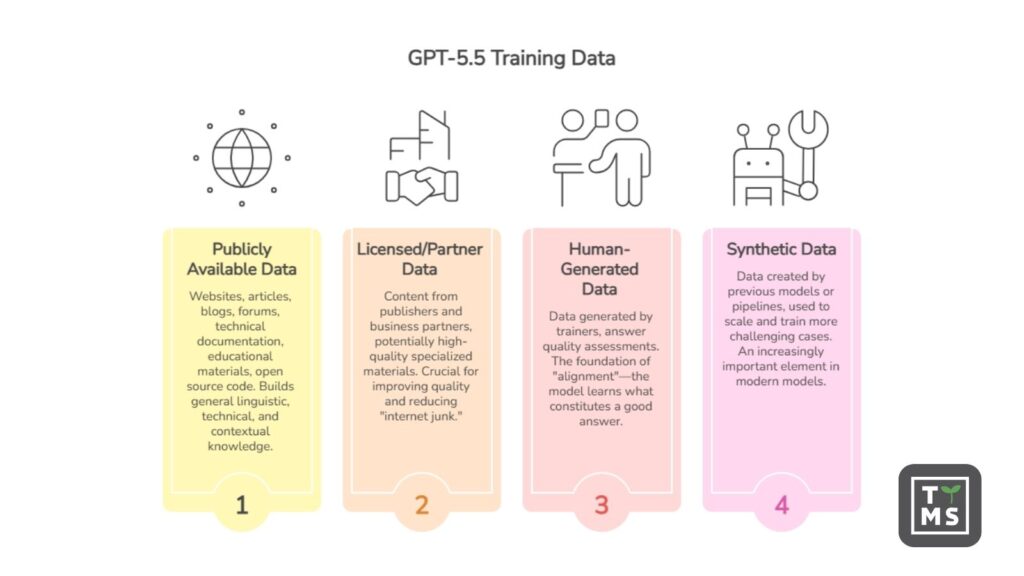
OpenAI has not published a full dataset inventory for GPT-5.5, and businesses should be cautious with any claims about its exact training data, model size, or architecture. Public information remains intentionally high-level. According to OpenAI’s system card, GPT-5.5 was trained on a mix of publicly available data, licensed or partner-provided content, and data generated or reviewed by humans. The training pipeline includes filtering to improve quality, reduce risks, and limit exposure to personal data.
A key differentiator is post-training through reinforcement learning, which improves reasoning. In practice, this means the model is better at planning, testing different approaches, recognizing mistakes, and aligning with policies and safety expectations. For business users, the takeaway is clear: GPT-5.5 is not valuable because it “knows everything,” but because it is better at working through complex tasks. However, it should not replace enterprise data architecture. To deliver real value, it must be integrated with governed data sources, retrieval systems, permission-aware tools, logging, and human review.
If you want a deeper look at how earlier GPT models were trained and how their data sources evolved over time, see our article on GPT-5 training data evolution.
5. Where Businesses May Feel the GPT-5.5 “Wow Effect”
The “wow effect” of GPT-5.5 is not necessarily a single spectacular answer. It is the feeling that a model can take a messy, multi-part business request and move it toward completion with less supervision than before.
5.1 Agentic coding and software development
Software engineering is one of the strongest areas for GPT-5.5. The model performs well on coding and terminal-based benchmarks, but the more interesting business point is how it behaves inside development workflows. It can help with implementation, refactoring, debugging, test generation, codebase understanding, and validation. For development teams, this is less about replacing engineers and more about compressing parts of the software delivery lifecycle.
The value is especially visible in large, existing codebases where a model must understand context, respect architecture, predict what may break, and adjust surrounding files. Earlier models could generate impressive code in isolation. GPT-5.5 is more useful when the work involves maintaining consistency across a system.
5.2 Knowledge work and document-heavy workflows
GPT-5.5 is also positioned for broader knowledge work: analyzing information, creating documents and spreadsheets, synthesizing research, and moving across tools. This makes it relevant for teams in finance, consulting, legal operations, HR, sales operations, procurement, and compliance.
Examples from early use show the model being applied to document review, operational research, business reporting, and structured decision workflows. The important pattern is not a specific use case, but a class of work: repetitive yet cognitively demanding tasks where humans still need quality, judgment, and accountability, but where much of the gathering, structuring, cross-checking, and drafting can be accelerated.
5.3 Scientific and technical research
GPT-5.5 also shows stronger performance in scientific and technical workflows. These workflows require more than answering a difficult question. They involve exploring hypotheses, analyzing datasets, interpreting results, checking assumptions, and turning partial evidence into a useful next step.
For R&D-driven companies, life sciences, advanced manufacturing, energy, engineering, and data-intensive industries, this points to an important future direction. AI will increasingly act as a research partner that helps experts move faster through analysis loops. However, in high-stakes research environments, validation remains essential. A model can accelerate expert work, but it cannot replace domain accountability.
6. GPT-5.5 vs Competitors: Claude, Gemini, DeepSeek, and the New AI Stack
The competitive landscape around GPT-5.5 is not simple because the best model depends on the workflow. GPT-5.5 competes most directly with Claude Opus 4.7 and Gemini 3.1 Pro in the frontier model category, while open-weight and lower-cost models from companies such as DeepSeek, Mistral, Qwen, and others continue to pressure the market from the cost and deployment-control side.
Claude Opus 4.7 remains a serious competitor for complex coding, long-running reasoning, and professional knowledge work. Anthropic emphasizes reliability, instruction following, long-context performance, and data discipline. In practice, many teams will compare GPT-5.5 and Claude not only as models, but as ecosystems: OpenAI with ChatGPT, Codex, Responses API, hosted tools, and enterprise channels; Anthropic with Claude, Claude Code, and its own enterprise integrations.
Gemini 3.1 Pro is another major competitor, especially for multimodal reasoning, creative technical prototyping, visual inputs, audio, video, PDFs, and Google ecosystem workflows. It is strong where businesses need AI to understand different media types and build interactive or visual outputs. GPT-5.5 appears particularly strong in agentic coding, tool-heavy workflows, and OpenAI-native execution environments, while Gemini may be attractive for teams already deeply invested in Google platforms or multimodal product experiences.
Open-weight and lower-cost models create a different kind of competition. They may not always match GPT-5.5 in frontier agentic performance, but they can be attractive for cost-sensitive workloads, self-hosting, regional compliance, customization, and vendor diversification. For many enterprises, the future will not be one model. It will be a portfolio: frontier models for complex orchestration, smaller models for routine tasks, and specialized models for domain-specific workloads.
That is why the real question is not “Is GPT-5.5 the best model?” A better question is “Where does GPT-5.5 create enough workflow value to justify its cost, integration effort, and governance requirements?”
7. GPT-5.5 Availability: Who Can Use It?
GPT-5.5 is available across several surfaces, but access depends on the product and plan. In ChatGPT, GPT-5.5 Thinking is available for Plus, Pro, Business, and Enterprise users. GPT-5.5 Pro, designed for harder questions and higher-accuracy work, is available for Pro, Business, and Enterprise users. In Codex, GPT-5.5 is available for Plus, Pro, Business, Enterprise, Edu, and Go plans, with a 400K context window. This matters for software teams because Codex is one of the most natural environments for GPT-5.5’s agentic coding capabilities. For developers, GPT-5.5 is available through the API with a 1M context window, text and image input, and text output. It supports reasoning effort settings and the tool capabilities expected from current OpenAI production workflows. GPT-5.5 Pro is also positioned for higher-accuracy work at a significantly higher price point.
For enterprises, availability is expanding beyond the OpenAI platform itself. GPT-5.5 is also appearing in enterprise cloud channels such as Microsoft Foundry and Amazon Bedrock. This matters because many organizations want to deploy AI inside existing cloud governance, procurement, identity, security, and compliance structures. For large companies, the model is only one part of the decision. The deployment channel can be just as important.
8. Business Use Cases Where GPT-5.5 Fits Best
GPT-5.5 is not the right answer for every AI problem. It is strongest where work is complex, multi-step, tool-driven, and expensive when done manually.
8.1 AI agents for internal operations
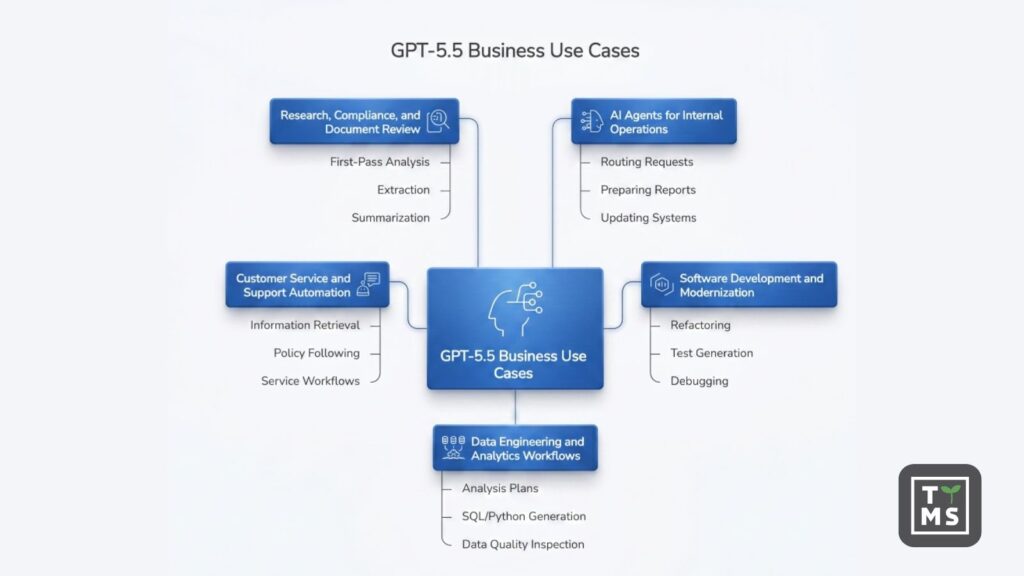
GPT-5.5 can serve as the reasoning layer for agents that handle internal workflows: routing requests, preparing reports, checking documents, updating systems, generating follow-ups, and escalating exceptions. The business value comes from reducing coordination costs and giving employees a more capable interface for operational work.
8.2 Software development and modernization
Development teams can use GPT-5.5 to accelerate refactoring, test generation, debugging, documentation, migration planning, and feature implementation. It may be particularly useful in modernization projects where companies need to understand and change complex legacy systems.
8.3 Data engineering and analytics workflows
For data teams, GPT-5.5 can help transform ambiguous business questions into analysis plans, generate SQL or Python, inspect data quality issues, explain anomalies, and draft business-ready summaries. It should not replace data governance, but it can make analytics workflows faster and more accessible.
8.4 Customer service and support automation
GPT-5.5 can improve support agents that must retrieve information, follow policy, call systems, and complete service workflows. Its strength in multi-step reasoning and tool use is relevant for cases that go beyond simple FAQ automation.
8.5 Research, compliance, and document review
Document-heavy teams can use GPT-5.5 for first-pass analysis, extraction, comparison, summarization, risk flagging, and report generation. In regulated environments, human review and audit trails remain essential, but the model can reduce time spent on repetitive reading and structuring.
9. Business Risks and Limitations: Where GPT-5.5 Still Needs Governance
GPT-5.5 is stronger, but it is still a probabilistic AI system. It can still make mistakes, misunderstand ambiguous instructions, select the wrong tool, overstate confidence, or produce outputs that require verification. Businesses should resist the temptation to turn benchmark performance into blind trust. Cost is another practical limitation. GPT-5.5 is more expensive per token than GPT-5.4. The business case depends on whether it reduces total workflow cost through fewer retries, fewer manual interventions, better completion rates, and higher-quality outputs. That requires measurement, not assumptions.
Cybersecurity is also a special area. GPT-5.5 has stronger cyber capabilities than previous models, which is valuable for defenders but also creates misuse risk. OpenAI has added stricter safeguards and trusted-access approaches for certain cyber workflows. Enterprises should treat this as a reminder that powerful agents need policy, monitoring, access control, and review layers. There is also a migration risk. GPT-5.5 should not be treated as a drop-in replacement for older prompt stacks. Because it can work better with shorter, outcome-first prompts, organizations may need to re-evaluate their existing instructions, tools, evaluation sets, and failure handling. A careless migration may hide the model’s benefits or introduce new issues.
10. How to Evaluate GPT-5.5 Before a Production Rollout
The best way to evaluate GPT-5.5 is not to ask whether it is impressive. It is to test whether it improves a specific business workflow.
Start by selecting a set of representative tasks: a real support workflow, a real code refactor, a real document review process, a real reporting cycle, or a real data analysis request. Define what success means before running the model. Success may include accuracy, completion rate, time saved, number of human corrections, cost per completed task, escalation quality, user satisfaction, or reduction in repeated work.
Then compare GPT-5.5 with your current model stack. Include GPT-5.4 or other lower-cost models, and consider competitors such as Claude or Gemini if they are relevant to your environment. The goal is not to crown a universal winner. The goal is to decide which model should handle which class of task.
For production systems, combine GPT-5.5 with structured logging, evaluation datasets, permission-aware tools, retrieval quality checks, human-in-the-loop checkpoints, and rollback options. The more autonomy you give an AI agent, the more important system design becomes.
11. What GPT-5.5 Means for Business Strategy
GPT-5.5 signals a shift in enterprise AI: the advantage is no longer access to a model, but the ability to redesign workflows around AI execution. Many companies can use a chatbot. Far fewer can safely integrate AI agents into software delivery, operations, finance, and data processes. This makes AI a strategic capability. GPT-5.5 enables systems that not only assist, but coordinate work across tools and teams. The real value comes from combining model capabilities with process design, data engineering, architecture, security, and change management. For business leaders, the priority is clear: treat GPT-5.5 as part of your operating model. Identify workflows ready for automation, define where human oversight is required, connect the right data sources and systems, and measure outcomes.
At TTMS, we help organizations turn these priorities into production-ready solutions – from AI consulting and agent design to software development, automation, and data engineering. If you are planning to implement GPT-5.5 or AI agents in your organization, contact us to design and deploy the right solution for your business.
FAQ: GPT-5.5 for Business
Is GPT-5.5 worth adopting for business?
GPT-5.5 is worth evaluating if your company works with complex, multi-step, tool-heavy workflows. It is especially relevant for software development, AI agents, research, document-heavy operations, analytics, and business automation. However, it may not be necessary for every task. For simple summarization, classification, or short Q&A, a smaller and cheaper model may be enough. The best approach is to test GPT-5.5 against real workflows and measure cost per completed outcome, not just cost per token.
How is GPT-5.5 different from GPT-5.4?
GPT-5.5 improves on GPT-5.4 mainly in sustained professional work. It is better at understanding intent, using tools, maintaining context, checking its work, and completing multi-step tasks with less manual guidance. It is also designed to be more token-efficient in complex workflows, although its per-token API pricing is higher. For businesses, the difference is most visible in agentic coding, workflow automation, data analysis, and document-heavy work. If your current AI use case is simple, the improvement may be less dramatic.
Can GPT-5.5 replace developers, analysts, or business specialists?
GPT-5.5 should be seen as an accelerator rather than a full replacement for expert roles. It can help developers write, refactor, test, and debug code faster. It can help analysts structure research, generate queries, inspect data, and draft reports. It can help business teams automate repetitive knowledge work. But it still needs clear requirements, high-quality data, tool access, validation, and human accountability. The strongest use cases are usually human-plus-AI workflows where experts focus on judgment, architecture, review, and decisions.
Is GPT-5.5 safe for enterprise data?
Enterprise safety depends on how GPT-5.5 is deployed, not only on the model itself. Companies should consider data retention, access control, user permissions, logging, compliance requirements, and the deployment channel they choose. API, ChatGPT Business, ChatGPT Enterprise, Microsoft Foundry, and AWS Bedrock may all have different governance implications. For sensitive workflows, businesses should use permission-aware integrations, avoid unnecessary data exposure, and add human review for high-impact decisions. The model can be part of a secure system, but it is not a security architecture by itself.
Should companies choose GPT-5.5, Claude Opus, Gemini, or an open-weight model?
There is no universal answer because each model family has different strengths. GPT-5.5 is a strong choice for OpenAI-native agentic workflows, Codex, complex coding, tool-heavy automation, and enterprise deployments connected to the OpenAI ecosystem. Claude Opus remains highly competitive for long-running reasoning, coding, and disciplined professional work. Gemini is attractive for multimodal workflows and companies invested in the Google ecosystem. Open-weight models may be preferable for cost control, customization, or self-hosting. Many mature companies will use several models and route tasks based on complexity, cost, latency, risk, and governance requirements.