In the world of data, a lack of data validation works like a casino roulette. The ball spins around the wheel, and the outcome remains uncertain until the very last moment. Players make decisions, but in the end the result depends on chance. In many organizations, IT system management looks similar. When validation and quality processes are overlooked, system stability stops being a result of control and begins to depend on luck.
For a long time, everything may appear to work correctly. The system runs, data is stored, users perform their tasks. The team therefore assumes that since no problems occur, additional validation is not necessary. The issue is that the absence of formal quality processes means there is no certainty that the system operates correctly in every situation. Until an error, audit, or data-related incident occurs, the risk remains invisible.
1. Why organizations overlook validation
In many organizations, the decision to implement formal validation processes is postponed. At first glance, systems seem to function properly, projects are delivered, and teams focus on new features and technological development. In such a situation, validation is often seen as an additional step that may slow down the project or increase its cost.
The problem, however, is that the lack of structured quality processes rarely causes immediate issues. Risk accumulates gradually, and early symptoms are often ignored or treated as isolated incidents. Over time, organizations begin to notice that the absence of validation makes it harder to control systems, changes, and data.
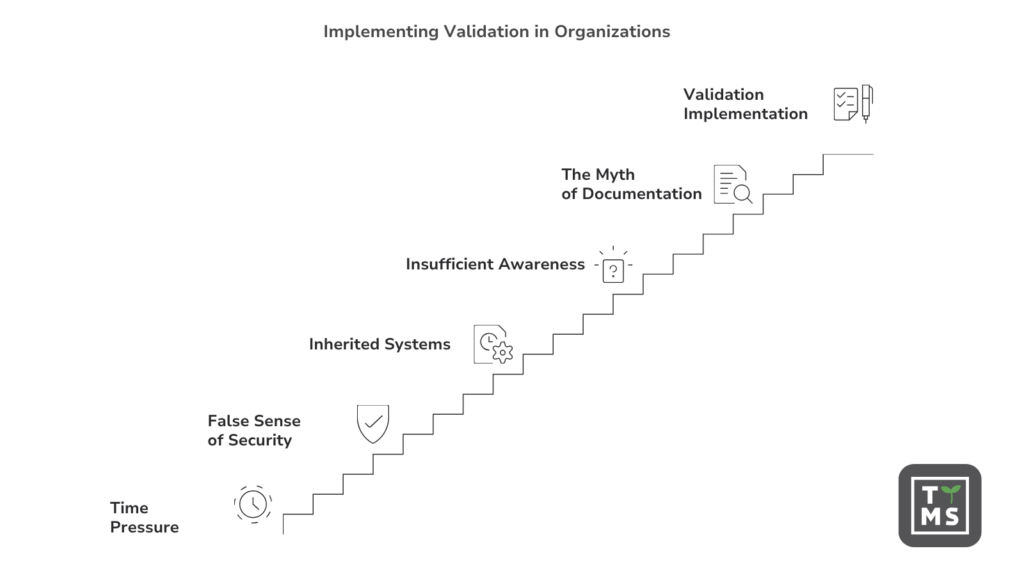
Below are the most common reasons companies delay implementing validation processes, even though in the long run their absence can lead to serious operational and business problems.
1.1 Time pressure in IT projects
One of the most common reasons is time pressure. IT projects have tight schedules, and teams want to deliver new features as quickly as possible. In such conditions, tests performed by developers are often considered sufficient quality assurance. Project teams focus primarily on delivering on time, while activities related to documentation, risk analysis, or formal validation are postponed. In practice, this means that many decisions regarding system quality are made under time pressure and without a full analysis of potential consequences.
1.2 False sense of security
In many organizations, there is also a belief that if a system operates in a production environment and users do not report major issues, there is no need for additional validation activities. However, this way of thinking leads to a situation where the absence of problems is interpreted as proof that the system works correctly. In reality, the absence of incidents does not always mean the absence of risk. It often simply means that potential errors have not yet surfaced or have not been properly identified.
1.3 Legacy systems and years of modifications
Another reason is the belief that if a system has been running for many years, it does not require additional validation. In practice, however, many organizations use systems that have been repeatedly modified, integrated with other tools, or extended with new features. Every change in system architecture, integration with a new tool, or modification of a business process can affect how the entire IT environment operates. Without formal change control, it is difficult to assess whether all components still function predictably and whether new functionalities introduce unexpected dependencies between systems.
1.4 Insufficient awareness of the role of quality
An important factor is also the lack of awareness regarding the importance of quality processes. In many technical teams, validation is mainly associated with documentation or additional formalities. In reality, its core role is to ensure that the system operates in accordance with business and technical requirements and that the organization has evidence confirming the correct functioning of key features.
1.5 The documentation myth
A common misconception is that quality processes are primarily about documentation. In fact, their main goal is to ensure control over the system and reduce operational risk. A well-designed validation process helps organize system development, increases the transparency of changes, and allows potential issues to be identified earlier, before they affect the organization’s operations.
2. Hidden risks of overlooking quality processes
The lack of validation brings a number of risks that are not always visible at first glance. In many organizations, problems become noticeable only when a serious incident, data error, or external audit occurs. Until then, the system may appear to function correctly, giving teams a false sense of security. In reality, however, the absence of quality control leads to a gradual accumulation of risk across the entire IT environment.
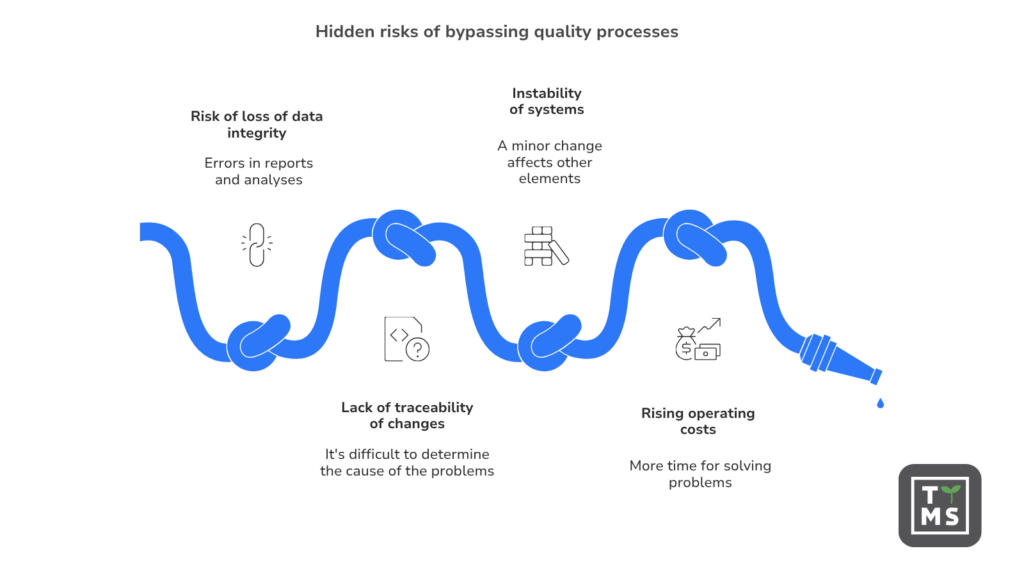
2.1 Risk of data integrity loss
One of the most serious threats is the risk related to data integrity. If a system has not been properly verified, there is no full certainty that data is processed correctly in every situation. Errors may appear in reports, analyses, or decision-making processes, and their source can be difficult to identify.
In practice, this means that an organization may make business decisions based on incomplete or incorrect information. In environments where data is critical to company operations, such situations can lead to serious financial or reputational consequences.
2.2 Lack of change traceability in the system
Another problem is the lack of transparency in system changes. Without proper documentation and change control, the organization does not have clear information about when and why specific modifications were introduced. In practice, this means a lack of full traceability of actions within the system.
When a problem arises, technical teams often spend many hours or days trying to determine which change could have affected system behavior. The lack of a clear change history makes incident root cause analysis more difficult and significantly extends resolution time.
2.3 System instability and unpredictable errors
Risk also arises in the context of system stability. Even a small change can affect other elements of the IT environment. Integrations with other systems, reporting mechanisms, or automated processes may function correctly for a long time, only to fail after a seemingly minor modification.
Such situations are particularly dangerous in complex technological environments, where one system is connected to many other tools. The lack of an appropriate testing process and risk assessment means that the organization does not have full control over the impact of changes introduced into the production environment.
2.4 Increasing operational and technical costs
Low-quality IT processes often also lead to increased operational costs. Technical teams spend more time resolving issues, analyzing incidents, and manually correcting errors in data or systems.
In the long run, the absence of structured quality processes makes system development increasingly difficult. Each subsequent change carries greater risk, and project teams become more conservative, fearing unpredictable consequences of modifications. As a result, the pace of technological development within the organization slows down, and system maintenance becomes increasingly expensive.
3. When the lack of validation starts to have a real cost
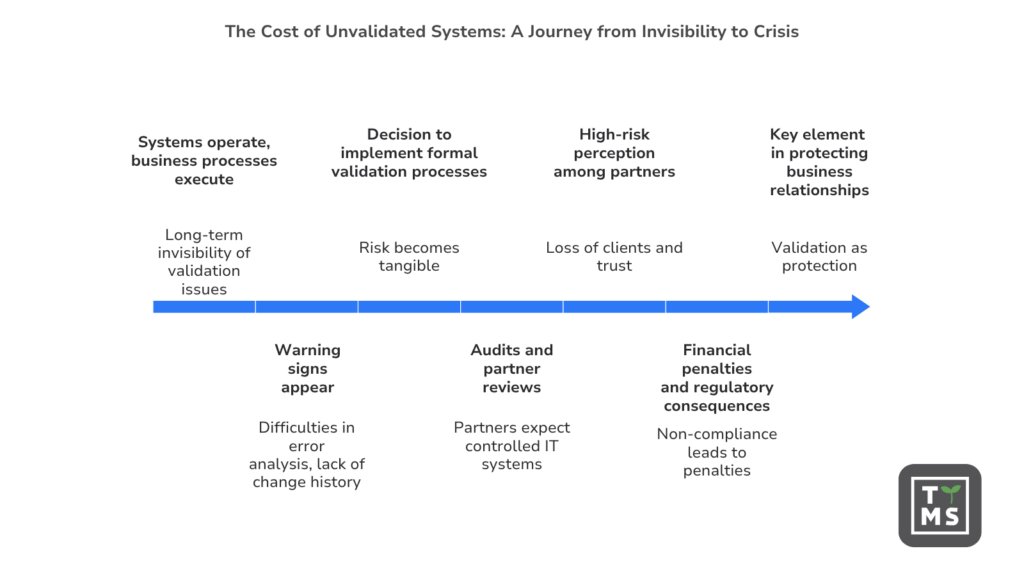
In many organizations, issues related to the lack of validation remain invisible for a long time. Systems operate, business processes are carried out, and technical teams focus on day-to-day tasks and further technological development.
Over time, however, the first warning signs begin to appear: difficulties in analyzing errors, a lack of a clear change history in the system, or an increasing number of incidents whose root causes are hard to determine. It is at this point that organizations realize that the absence of structured quality processes is not merely a formal issue, but a real operational and business problem. In such moments, organizations begin to see that validation is not an additional burden, but a tool that makes it possible to regain control over systems, data, and IT processes.
3.1 The moment when risk stops being theoretical
In many organizations, the decision to implement formal validation processes arises only when risk takes on a very tangible business dimension. For a long time, the lack of validation may not cause visible problems. The system works, processes are carried out, and teams focus on further technological development.
3.2 Audits and partner assessments
The situation changes, however, during an audit, a shift in regulatory requirements, or an assessment by business partners. Increasingly, contractors expect confirmation that IT systems are managed in a controlled manner and in accordance with established quality standards, which may support compliance with regulatory requirements.
3.3 Risk of losing partners and trust
In such situations, the lack of validation can lead to a loss of trust among business partners. An organization that is unable to demonstrate that its systems are properly tested and monitored may be considered too risky as a technology partner.
3.4 Financial penalties and regulatory consequences
In some industries, the consequences may be even more severe. Non-compliance with regulatory requirements can result in financial penalties, the need to implement costly corrective actions, or the suspension of certain operational processes.
3.5 Validation as protection of business relationships
This is why more and more companies are beginning to treat validation not as an additional obligation, but as a means of protecting business relationships and organizational stability. Quality processes are no longer seen solely as a formal requirement. They become a tool that helps maintain the trust of clients, partners, and supervisory institutions, while also improving preparedness for regulatory requirements.
4. How validation transforms chance into control
Validation introduces structure and predictability into IT system management. Instead of relying on assumptions, the organization relies on evidence confirming the correct operation of the system.
The validation process includes structured functional testing, documentation of requirements, and control of changes within the system environment. This makes it possible to confirm that the system operates in line with business and technical assumptions.
An important element is also a risk-based approach. Not all systems require the same level of validation. In practice, this means focusing on areas that have the greatest impact on data, business processes, or regulatory compliance.
5. Quality processes as part of risk management
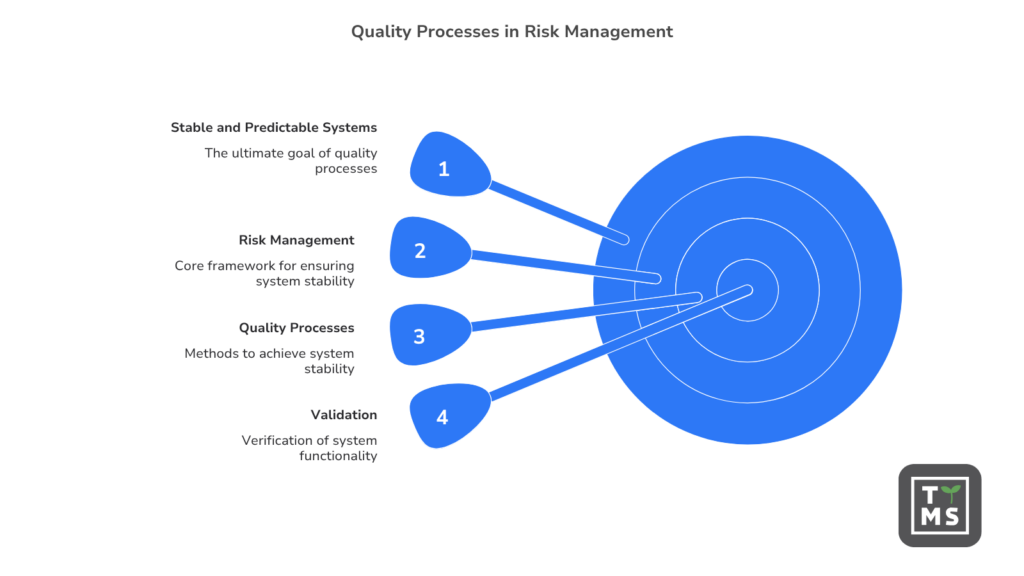
In many organizations, quality processes are perceived as something that slows down technology projects. In reality, their role is entirely different. Their purpose is not to create documentation for its own sake, but to ensure that systems operate in a stable and predictable manner.
Companies that treat validation as part of risk management gain greater control over their systems. They are also better prepared for audits and can more easily identify potential issues before they affect business operations.
Without validation, every change in the system resembles another spin of the roulette wheel. The outcome may be favorable, but it may also bring unexpected consequences. Implementing quality processes makes it possible to replace chance with control and ensures that IT systems become a stable foundation for organizational operations.
6. Why trust the Quality team at TTMS
Effective validation of IT systems requires a combination of technological expertise, knowledge of business processes, and experience in quality and regulatory compliance. This is exactly the approach taken by the Quality team at TTMS.
TTMS experts support organizations in building structured validation processes that ensure data security and system stability. Thanks to their experience working with business-critical systems, they help design solutions that meet quality requirements and can support organizations in meeting regulatory requirements, while also enabling efficient technological development.
The TTMS approach is based on risk analysis, transparent documentation, and close collaboration with both technology and business teams. As a result, the validation process becomes a factor that supports system development rather than a barrier to innovation. Contact us now!
7. FAQ
What is IT system validation?
IT system validation is a process that confirms a system operates in accordance with defined requirements and fulfills its intended purpose in a business environment. It includes functionality testing, risk analysis, and documentation of results. Through validation, an organization has evidence that the system operates correctly and can be safely used in operational processes.
Why skipping validation poses a risk to an organization?
Skipping validation means there is no certainty that the system operates correctly. Issues may arise in data processing, reporting, or integration with other systems. In the event of an audit or an incident, the organization may have difficulty proving that the system was properly tested and controlled.
Does every IT system require validation?
Not every system requires the same level of validation. In practice, a risk-based approach is applied. Systems that impact critical data, regulated processes, or business decisions require more detailed verification. In other cases, the scope of validation may be limited.
What elements does the validation process include?
The validation process includes, among others, requirements analysis, preparation of a validation plan, functionality testing, documentation of results, and control of system changes. An important element is the traceability of requirements and tests, which makes it possible to track whether all functionalities have been properly verified.
How can an organization start building a validation process?
The first step is identifying systems that have the greatest impact on business operations and data security. Next, it is advisable to conduct a risk analysis and define the scope of necessary validation activities. In many cases, support from teams experienced in designing quality processes and IT system validation is helpful.