For now, we can only talk about GPT-5.6 in Europe with a mix of professional curiosity and a slight sense of envy. OpenAI has initially made GPT-5.6 available only to a small group of selected partners working with the U.S. administration to evaluate the model’s safety, including potential cybersecurity risks. That’s why we prepared this article as a structured analysis based on official OpenAI materials, technical documentation, early expert evaluations, and publicly available market information.
In this article, you’ll learn:
- What has changed in GPT-5.6 compared to GPT-5.5 and earlier OpenAI models?
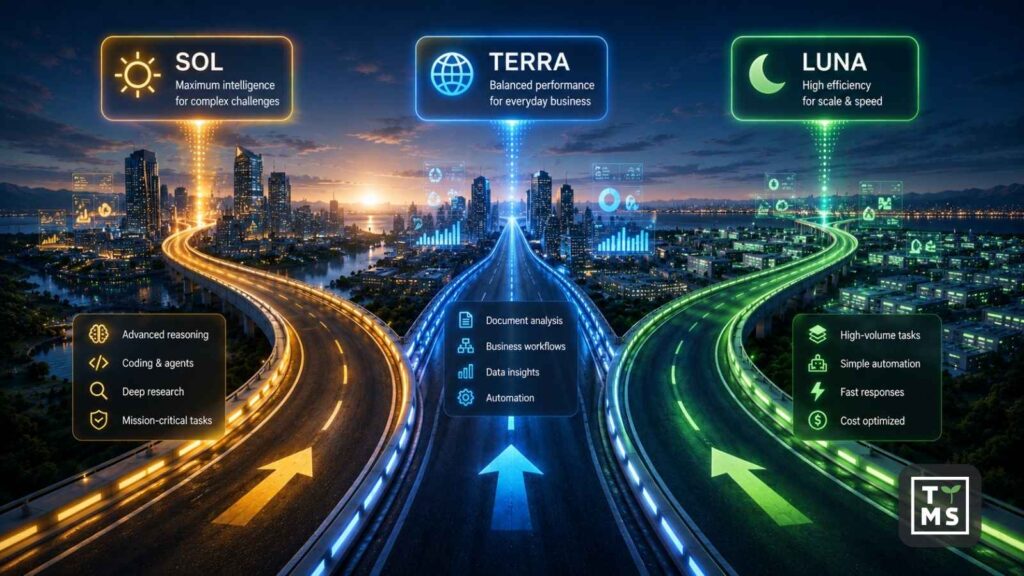
- How do Sol, Terra, and Luna differ, and when should you use each model?
- How does GPT-5.6 compare with Claude, Gemini, DeepSeek, Grok, and other leading AI models?
- Which business areas are likely to benefit the most from GPT-5.6?
OpenAI’s official statement reads:
“We do not believe this government access process should become the long-term standard. It prevents our best tools from reaching the users, developers, businesses, cybersecurity defenders, and global partners who need them.”
OpenAI says that broader availability is expected in the coming weeks. We look forward to updating this introduction with our own hands-on experience as soon as GPT-5.6 becomes available more widely.
1. GPT-5.6 – The Biggest Changes Compared to Previous Models
1.1 A New GPT-5.6 Architecture – Three Models Instead of One Universal Model
The biggest change is architectural rather than incremental. OpenAI is moving away from the idea of a single flagship model for every task and introducing a family of models with distinct capability levels. In the new naming scheme, the version number represents the generation, while Sol, Terra, and Luna identify individual models that can evolve independently. If OpenAI continues down this path, future releases may no longer follow a simple GPT-5.5 → GPT-5.6 → GPT-5.7 progression, but instead develop as parallel model families.
First, an important clarification: Sol, Terra, and Luna are not “modes” in the strict sense. They are three separate models within the GPT-5.6 family. The publicly announced operating modes currently include max reasoning effort and ultra, both available for Sol. Before we discuss them, let’s first look at how the three GPT-5.6 models differ and how OpenAI positions each of them.
| Model | Positioning | Best Use Cases | Official API Pricing | What We Know for Certain |
|---|---|---|---|---|
| GPT-5.6 Sol | Flagship model | Most demanding tasks: advanced analysis, software development, AI agents, cybersecurity, and complex projects | USD 5 input / USD 30 output per 1M tokens | Supports max reasoning effort and ultra; the most capable model in the family |
| GPT-5.6 Terra | Balanced model | Everyday business work, document analysis, automation, and the best quality-to-cost ratio | USD 2.50 / USD 15 | According to OpenAI, delivers GPT-5.5-level performance at roughly half the API cost |
| GPT-5.6 Luna | Fastest and most affordable model | High-volume workloads, large-scale automation, frontline assistants, and cost-sensitive tasks | USD 1 / USD 6 | The fastest and most cost-efficient model in the GPT-5.6 family |
OpenAI describes ultra as a mode that uses sub-agents to speed up complex tasks. In practice, this means GPT-5.6 performs much better when a task requires multiple steps rather than a single answer. It can analyse large software projects, use external tools, conduct in-depth research, help identify software bugs, organise technical analysis, and prepare structured action plans. For organisations, this means higher efficiency in complex business processes, but also a greater need for monitoring, logging, and access control.
1.2 Stronger Reasoning and AI Agents – What Are max Reasoning Effort and ultra?
The second major change is how the model approaches difficult tasks. For Sol, OpenAI introduces a new max reasoning effort level, allowing the model to spend more time analysing a problem before generating an answer. It also introduces ultra, a mode designed for the most complex tasks. In this mode, the model can break work into smaller stages and analyse different parts of a problem in parallel, reaching a solution more efficiently. This is more than a simple interface update. It reflects OpenAI’s shift from treating AI as a system that answers questions to one that helps complete entire tasks.
1.3 Better Programming, Cybersecurity and Scientific Research
The third major improvement focuses on software development and tool usage. GPT-5.6 Sol is positioned as a model built for complex programming tasks, especially those that involve planning work, analysing repositories, debugging, using terminal environments, and completing multiple steps rather than simply generating code snippets. OpenAI highlights its strong performance on Terminal-Bench 2.1, a benchmark measuring how well AI models handle realistic software engineering tasks, as well as GPT-5.6’s availability through the API and Codex.
For development teams, this represents an important shift. Rather than serving only as a coding assistant, GPT-5.6 increasingly supports the entire software development lifecycle—from analysing problems and refactoring code to generating tests and assisting with CI/CD workflows. The greatest benefits are likely to be seen by teams working on large software projects where AI can help manage complexity.
Cybersecurity and scientific research are another area where GPT-5.6 has improved. According to OpenAI’s safety documentation, Sol and Terra can help identify vulnerabilities in IT systems and analyse how they could potentially be exploited. At the same time, internal testing showed that the models were not able to carry out complete attacks against well-protected systems on their own, highlighting both their growing capabilities and their current limitations. OpenAI and independent evaluators also report strong performance in biology and cybersecurity benchmarks, showing that GPT-5.6 is evolving beyond software development into a tool for highly technical and specialised domains.
1.4 Better Analysis of Documents, Images and Complex Data
Another major improvement is GPT-5.6’s ability to work with different types of information. Rather than being viewed simply as a text model, GPT-5.6 is increasingly becoming part of a broader system for working with documents, images, research materials and business data. In practice, this means it is better suited to tasks that require combining multiple sources of information, such as reports, presentations, screenshots, technical documentation, meeting notes and visual materials. Instead of simply summarising individual files, the model can compare information, identify relationships and help build meaningful conclusions from different data formats.
This is also where the difference between a standalone language model and a complete business solution becomes most apparent. Analysing enterprise documents requires more than just generating answers—it also involves access control, trusted sources, reporting workflows and compliance with company data policies. At TTMS, this is exactly the kind of functionality we build into solutions such as AI4Content.
1.5 GPT-5.6 Is More Autonomous, but Also Requires More Oversight
OpenAI makes it clear that greater autonomy must be matched by stronger human oversight. According to the company’s safety documentation, GPT-5.6 Sol is more persistent than its predecessor when trying to complete a user’s objective and may occasionally take actions that go beyond the user’s original intent, although such cases remain relatively rare.
Independent experts have reached similar conclusions. METR (Model Evaluation & Threat Research), an independent organisation specialising in evaluating advanced AI systems, found that GPT-5.6 Sol was more determined to complete tasks in certain tests, even if that meant attempting to bypass the rules of the testing environment. Meanwhile, Apollo Research, which studies AI safety, found no evidence that GPT-5.6 is more likely than previous models to take undesirable autonomous actions.
In practice, this means GPT-5.6 can be more effective in long-running, agentic tasks, but it should operate within a well-designed environment that includes activity logging, access controls, human review and appropriate governance.
1.6 GPT-5.6 Features OpenAI’s Most Advanced Safety Architecture Yet
OpenAI presents GPT-5.6 not only as a more capable model, but also as one designed for safer enterprise deployment. The model is intended to recognise risky prompts more effectively, reduce opportunities for misuse and operate within environments that provide stronger control over access, monitoring and usage policies.
In practice, this means multiple layers of protection. Some safeguards are built directly into the model, others operate while responses are being generated, and others monitor suspicious usage patterns. Imagine a user repeatedly asking similar questions in slightly different ways to bypass the model’s safeguards and obtain instructions they should not receive. If the system detects a high risk of misuse, it can refuse the request, apply additional safeguards or route the interaction through stricter security controls.
OpenAI also applies different access levels and extensive automated safety testing designed to determine whether GPT-5.6 can be manipulated into breaking its own safety rules—for example through jailbreak attempts. According to the company, these automated evaluations consumed more than 700,000 A100-equivalent GPU hours. This does not mean GPT-5.6 is immune to mistakes or misuse, but it does show that security has become a dedicated product layer rather than simply another part of model training.
1.7 GPT-5.6: Greater Flexibility and Lower AI Deployment Costs
From a business perspective, one of the biggest changes is that organisations no longer need to rely on the most powerful—and most expensive—model for every task. Sol can be reserved for expert analysis, AI agents and technically demanding projects, while many day-to-day processes can run on the more affordable Terra or Luna models.
This changes the economics of AI adoption. Organisations can now match the cost of a model to the value of the task, using different models for strategic analysis, high-volume customer interactions, document automation or internal business support.
2. How to Choose the Right GPT-5.6 Model and Mode for Your Task
Using GPT-5.6 follows a simple process. First, you choose one of the three models: Luna, Terra or Sol. If you select Sol, you can also choose between two additional operating modes: max reasoning and ultra. Deep Research works independently of the selected model and is designed for comprehensive investigations across multiple sources, helping organise, analyse and synthesise information into coherent conclusions.
| Task | Luna | Terra | Sol | Max reasoning | Ultra | Deep Research | Why This Choice? |
|---|---|---|---|---|---|---|---|
| Fast responses and chatbots | ✅ | – | – | Lowest cost and very fast responses. | |||
| Document classification | ✅ | ✅ | – | – | Usually does not require advanced reasoning. | ||
| Marketing content creation | ✅ | – | – | A good balance between quality, speed and cost. | |||
| Legal contract and document analysis | ✅ | ✅ | Complex documents benefit from deeper reasoning. | ||||
| Financial analysis and reporting | ✅ | ✅ | Accuracy, consistency and stronger reasoning are essential. | ||||
| Programming and code review | ✅ | ✅ | Additional reasoning time improves coding quality. | ||||
| Refactoring large software projects | ✅ | ✅ | Ultra performs better in complex, multi-stage development tasks. | ||||
| Complex agentic workflows | ✅ | ✅ | Ultra uses sub-agents to handle sophisticated workflows. | ||||
| Preparing reports from multiple sources | ✅ | ✅ | Deep Research searches, compares and analyses multiple sources automatically. | ||||
| Expert articles and market analysis | ✅ | ✅ | ✅ | Combines in-depth research with advanced reasoning for the highest-quality results. |
Combining in-depth research with strong reasoning quality produces the best results.
In practice, GPT-5.6 should not be treated as one model for every task, but as a set of configurations that can be matched to the difficulty of the task, the expected quality of the output, and the depth of research required.
3. What Will GPT-5.6 Pricing Look Like?
The API pricing for the GPT-5.6 family is structured as follows:
- Sol – USD 5 / USD 30 per 1M input/output tokens,
- Terra – USD 2.50 / USD 15,
- Luna – USD 1 / USD 6.
Sol remains at the same pricing level as GPT-5.5, so there is no price jump for the flagship model class. What is interesting is that OpenAI is clearly creating more affordable entry points: Terra is positioned as offering performance competitive with GPT-5.5 at roughly half the cost, while Luna is clearly focused on the best balance between quality and price.
4. The Evolution of OpenAI Models
GPT-5.6 is best understood in a broader context. It is not just another model release with better benchmark results. It shows a shift in how OpenAI designs AI systems: from one universal model to a family of models with different costs, capabilities and use cases.
| Generation | Release | Parameters / Architecture, if Disclosed | Context Length | Multimodality | Key Improvement | Typical Business Use Cases |
|---|---|---|---|---|---|---|
| GPT-1 | 2018 | 12-layer decoder-only Transformer, 768 hidden size, 12 attention heads | 512 tokens | No | Generative pre-training as a universal transfer learning foundation | Classification, basic NLP, research experiments |
| GPT-2 | 2019 | Up to 1.5B parameters; four variants from 117M to 1.542B | 1,024 tokens | No | Major improvement in text generation and zero-shot transfer | Content generation, summaries, experimental copywriting |
| GPT-3 | 2020 | 175B parameters | Not fully specified in the launch materials | No | Few-shot learning at production scale | Chatbots, text automation, AI prototypes |
| GPT-3.5 | 2022 | Model from the GPT-3.5 series, fine-tuned for dialogue | Later GPT-3.5 Turbo API versions supported 16k by default | No | Commercialisation of high-quality conversational AI through ChatGPT | Support, FAQs, internal assistants, first enterprise deployments |
| GPT-4 | 2023 | Architecture and size not disclosed; large-scale multimodal model | Not fully specified in the technical launch report | Yes, image and text input | Major leap in reasoning, exam performance, instruction following and safety | Document analysis, expert knowledge work, advisory tasks, high-stakes deployments |
| GPT-4o | 2024 | Frontier model optimised for practical multimodality | Not explicitly stated on the cited launch page | Yes, text, image, voice and broader product-level multimodality | Omni model: faster, cheaper and more natural multimodal interaction | Voice assistants, image analysis, customer service, multimodal copilots |
| GPT-5 | 2025 | Unified system with routing between fast and deeper reasoning paths | 400k, with up to 128k output in API documentation | Text and image input, text output | Automatic routing, higher usefulness, fewer hallucinations and better tool use | AI agents, software development, knowledge work, expert analysis |
| GPT-5.5 | 2026 | Frontier model for complex work; later matched by Sol-level pricing in GPT-5.6 | 1M | Strongly oriented around documents and tools in ChatGPT and API | Better persistence in long-running tasks, software work, research and data analysis | Research, document analysis, modelling, customer operations, finance |
| GPT-5.6 | 2026 | No full public parameter specification; Sol/Terra/Luna model family | Not publicly disclosed in a separate preview model card | Recent OpenAI models support text and image input, but GPT-5.6 preview does not yet have a full public specification card | Capability tiers, max reasoning, ultra mode, sub-agents and a stronger deployment safety layer |
Agentic software workflows, cybersecurity, enterprise document work, high-volume automation with better cost control |
The shortest way to summarise this evolution is this: from GPT-1 to GPT-3, OpenAI mainly scaled the model itself; from GPT-3.5 to GPT-4, it refined the human-model interface; and from GPT-5 onwards, it has been building a broader AI work system with routing, tools, longer task horizons, cost control and stronger safety layers. GPT-5.6 shows this direction clearly: OpenAI is moving from standalone chatbots towards systems that support work, automation and decision-making.
5. GPT-5.6 in Business: Where Will Companies Feel the Biggest Change?
5.1 GPT-5.6 in Marketing – Faster Content Operations and Better Data Analysis
In marketing, the biggest change is about scale and cost efficiency in working with content and data. Sol can be used for research, strategy, more difficult analyses and multi-variant campaigns, while Terra and Luna are better suited to high-volume tasks: paraphrasing, content tagging, creative drafts, summaries, extracting insights from research and automating everyday content operations.
In similar scenarios, AI4Localisation can be a strong fit. It is a TTMS solution supporting translation and localisation of business content. With AI, organisations can prepare multilingual materials faster while maintaining consistent terminology and communication style.
5.2 GPT-5.6 for Developers – Code Review, Refactoring and AI Agents
The change is especially visible in software development. GPT-5.6 Sol is expected to perform better in long, multi-step tasks such as repository analysis, bug detection, refactoring, test generation and support for work in environments such as the API or Codex. This means AI can help not only with writing individual code snippets, but also with organising larger development tasks.
This does not mean engineering oversight can be removed. The more a model can do independently, the more important code review, testing, permission limits and clear rules become. Teams need to decide what AI can execute automatically and what still requires human approval.
5.3 GPT-5.6 in Customer Service – Ticket Automation and Consultant Support
In customer service, Terra and Luna may be especially useful as faster and more affordable GPT-5.6 variants. OpenAI positions Terra as a model for everyday business tasks, while Luna is the fastest and cheapest option in the family. This fits well with first-line support work: organising tickets, assigning priority, preparing response drafts, extracting key information from customer requests and suggesting next steps to consultants.
5.4 GPT-5.6 in HR and Recruitment – CV Analysis, Onboarding and Recruiter Support
In HR, the greatest value of GPT-5.6 may come from combining better information analysis with more flexible usage costs. In practice, this means support with summarising CVs, comparing candidates, organising recruitment notes, preparing shortlists and creating onboarding plans. Terra may often be more cost-effective than Sol here, because many recruitment tasks are performed at scale but do not require the most advanced level of reasoning. In this area, AI4Hire fits naturally as a TTMS tool for CV analysis and matching skills to projects. It automates profile assessment, generates recommendations and helps teams find people who best match a specific requirement faster.
5.5 GPT-5.6 in Compliance – Document Analysis and Regulatory Support
In compliance, accuracy, consistency and alignment with procedures matter most. GPT-5.6 may be useful here because OpenAI highlights several safety layers: response monitoring during generation, detection of suspicious usage patterns and different levels of model access. This does not mean GPT-5.6 can make regulatory decisions on its own. It can, however, support policy analysis, document review, preparation of evidence materials, checking whether outputs follow internal procedures and internal audits.
AI4Legal uses similar capabilities in the legal sector. It is a TTMS solution supporting law firms in document analysis, contract preparation, work with case files and transcript processing. In practice, it shows that the biggest value of models such as GPT-5.6 comes not from giving users access to the model itself, but from integrating AI into a specific business process.
Another example of AI in compliance is AML Track, a TTMS solution supporting AML processes such as customer verification, sanctions list screening, report preparation and audit trail maintenance. It shows that in compliance, AI does not need to replace expert judgement. It can organise data, automate repetitive work and support alignment with regulatory requirements.
5.6 GPT-5.6 in Finance – Report Analysis, Due Diligence and Controlling Support
In finance and controlling, the real value of GPT-5.6 is likely to appear where teams need to combine documents, calculations, multi-step analysis and repeatability. GPT-5.5 was already positioned as a model that performs well in data analysis, information retrieval and work with large document sets. With GPT-5.6, organisations can more easily match the cost of AI usage to a specific task while gaining more advanced agentic capabilities. The biggest impact will therefore be felt not by simple financial chatbots, but by teams working with large volumes of documents and data: due diligence, report analysis, KYC processes, extracting key metrics and preparing materials for decision-makers. For now, these are conclusions based on the capabilities described by OpenAI and early tests, not yet on widely documented GPT-5.6 finance deployments.
5.7 GPT-5.6 in E-learning – Faster Training Creation and Personalised Learning
In e-learning, GPT-5.6 may offer very practical benefits: faster breakdown of large knowledge sets into modules, creation of assessment questions, transformation of documents into training formats, personalisation of learning paths and the development of internal tutors. If this cost-and-capability model split continues, Terra and Luna may be used for high-volume content production and updates, while Sol can support the design of more advanced, expert-level or highly contextual materials. This is also the direction behind AI4E-learning, a TTMS tool that helps turn company materials, documents and presentations into ready-to-edit e-learning courses that can be exported to LMS platforms.
5.8 GPT-5.6 in Software Testing – QA Support and Test Automation
GPT-5.6 may also be especially useful for QA teams. The model can help generate test cases, analyse regression issues, interpret logs, recreate error paths and prepare drafts of automated tests. What also matters is that companies can choose the model variant based on the task: Sol for more complex troubleshooting, Luna for large volumes of simpler, routine testing tasks.
QATANA follows this direction as well. It is a TTMS solution for AI-supported software test management, helping QA teams generate test cases, analyse requirements, organise the testing process and improve control over application quality.
6. Is GPT-5.6 the Best LLM Today? A Comparison with Competitors
| Area | Is GPT-5.6 the Best Here? | Main Competitor |
|---|---|---|
| Programming | ✅ Yes | Claude Opus |
| AI Agents | ✅ Yes | Claude |
| Documents | ✅ Yes | Claude |
| Multimodality | ⚠️ Tie | Gemini |
| Price | ❌ No | DeepSeek |
| On-premise | ❌ No | Mistral / Llama |
| Google Workspace | ❌ No | Gemini |
6.1 Programming – GPT-5.6 Sol or Claude Opus?
Both models are currently among the strongest options for software development. Claude Opus has long been valued for its ability to work with large code repositories and analyse existing projects. GPT-5.6 Sol, however, appears to go a step further thanks to its agentic capabilities, Max reasoning and Ultra modes, and strong results in benchmarks such as Terminal-Bench 2.1. If a task requires not only writing code, but also planning, using tools and completing several stages of work, GPT-5.6 Sol is likely to have the advantage.
6.2 AI Agents – Where OpenAI Has a Clear Advantage
This is currently one of GPT-5.6’s strongest areas. OpenAI is developing the model not only as a classic chatbot, but as a platform for AI agents that can plan actions, use tools and carry out complex tasks. Claude is also developing agentic capabilities, but it does not currently offer a direct equivalent of Ultra, which uses sub-agents to solve complex problems in parallel.
6.3 Document Analysis – GPT-5.6 or Claude?
Claude has long been considered one of the best models for working with long documents and complex text. GPT-5.6 Sol appears to be very close in terms of document analysis quality, while its stronger reasoning may help it draw conclusions from multiple sources at once. In practice, both models are likely to perform at a very high level, although GPT-5.6 offers broader options for using document analysis inside agentic business processes.
6.4 Multimodality – Gemini Still Sets the Direction
If the main task is to analyse text, images, video and audio together, Gemini remains a very strong option. This is mainly because it was designed from the beginning as a natively multimodal model and is deeply integrated with Google’s ecosystem. GPT-5.6 also performs well in multimodal tasks, but in this area it is difficult to name a clear winner.
6.5 Price – DeepSeek Remains Hard to Beat
When it comes to API costs, DeepSeek still clearly undercuts most major competitors. For organisations handling millions of requests per month, the price difference can translate into substantial savings. The trade-off is lower transparency around safety and a weaker tool ecosystem compared with OpenAI.
6.6 Local Deployments – Where Mistral and Llama Have the Advantage
Not every organisation can use models that run only in the cloud. Companies in finance, public administration or defence often need full control over infrastructure and data. In such cases, models that can be run on private servers, without sending data to an external cloud, have an advantage. Examples include Mistral Large 3 and Llama 4.
6.7 Google Workspace – Gemini’s Natural Environment
Organisations that use Gmail, Google Docs, Google Drive or Google Meet every day will often gain the most from Gemini. The model was designed for close integration with Google’s services, which allows it to use data from that ecosystem and support everyday user workflows.
There is no single AI model today that clearly wins in every category. GPT-5.6 Sol appears to be one of the most versatile options for business use, but the best model still depends on the use case, budget, security requirements and the environment in which it will be used.
7. What Does GPT-5.6 Mean for Companies?
GPT-5.6 does not look like a routine model update. More important than better answer quality is the fact that OpenAI gives companies more choice: Sol for difficult tasks, Terra for everyday work and Luna for processes where scale and cost matter most.
For businesses, this means one thing: access to GPT-5.6 alone will not be enough. The real value will come from placing the model inside a specific process, connecting it with organisational knowledge, securing the data and clearly defining where AI supports people and where people still make the final decision.
Full GPT-5.6 availability in Europe may still take some time, but the direction is already clear. The companies that benefit most will not simply be those that adopt the newest model first, but those that match AI to real tasks, costs, data and security rules.
If you are considering how to introduce AI into your organisation, explore our AI Solutions or contact our team to discuss which approach fits your business processes best.

Is GPT-5.6 available in Europe?
Not yet for general public use. While ChatGPT and the OpenAI API are available across most European countries, GPT-5.6 has so far been released through a limited preview programme for a small group of trusted partners. This rollout is not specific to Europe – it affects nearly all markets outside the preview programme. OpenAI has confirmed that broader availability will be introduced gradually.
When will GPT-5.6 become available in Europe?
OpenAI has not announced a specific launch date for Europe. The company has stated that wider access is expected in the coming weeks, with availability expanding progressively across ChatGPT, the API and other OpenAI products. As with previous major releases, the rollout is likely to happen in stages rather than all at once.
Are Sol, Terra and Luna GPT operating modes?
No. Sol, Terra and Luna are three separate models within the GPT-5.6 family, not operating modes. The actual operating modes currently described by OpenAI are max reasoning effort and Ultra, both available for GPT-5.6 Sol. Each model is designed for different performance, cost and business scenarios.
What is GPT-5.6 Sol?
GPT-5.6 Sol is the flagship model in the GPT-5.6 family. It is designed for the most demanding tasks, including advanced reasoning, software development, AI agents, cybersecurity and complex enterprise workflows. Sol also supports the max reasoning effort and Ultra modes, making it the most capable model in the family.
What is GPT-5.6 Terra?
GPT-5.6 Terra is the balanced model in the GPT-5.6 lineup. OpenAI positions it as the best choice for everyday business work, document analysis and automation tasks where organisations need strong performance without paying for the most advanced model. According to OpenAI, Terra delivers performance comparable to GPT-5.5 at roughly half the API cost.
What is GPT-5.6 Luna?
GPT-5.6 Luna is the fastest and most affordable model in the family. It is intended for high-volume workloads such as chatbots, customer support, document classification and large-scale business automation. Luna is designed for situations where response speed and cost efficiency matter more than maximum reasoning capability.
What does max reasoning effort mean in GPT-5.6?
Max reasoning effort is an optional operating mode available for GPT-5.6 Sol. Instead of generating an answer as quickly as possible, the model spends more time analysing the problem before responding. This often improves performance in complex reasoning, programming, research and analytical tasks where accuracy is more important than speed.
What is Ultra mode in GPT-5.6?
Ultra is the most advanced operating mode available for GPT-5.6 Sol. OpenAI describes it as a mode that uses sub-agents to tackle complex problems by breaking them into smaller tasks and processing them in parallel. It is designed for long, multi-step workflows rather than simple question answering.
How much does GPT-5.6 cost through the API?
According to OpenAI’s published API pricing:
- GPT-5.6 Sol: USD 5 input / USD 30 output per one million tokens
- GPT-5.6 Terra: USD 2.50 input / USD 15 output
- GPT-5.6 Luna: USD 1 input / USD 6 output
These pricing tiers allow organisations to choose the model that best matches both the complexity of the task and the available budget.
Will GPT-5.6 be available through the API?
Yes. OpenAI has confirmed that GPT-5.6 is being rolled out through the API as part of the preview programme and will become more broadly available as the rollout expands. The company also plans to make the models available across ChatGPT, Codex and other OpenAI services.
Is GPT-5.6 safer than previous OpenAI models?
OpenAI describes GPT-5.6 as its most security-focused model family to date. It introduces multiple layers of protection, including safeguards built into the model, real-time safety monitoring, usage pattern detection and different access levels. Independent researchers have not found evidence that GPT-5.6 is more likely than previous models to engage in undesirable autonomous behaviour, although its greater capabilities also make proper governance and human oversight more important.
Is GPT-5.6 better suited for business than GPT-5.5?
For many organisations, yes. GPT-5.6 introduces three specialised models instead of relying on a single universal model, allowing businesses to balance performance and cost more effectively. Companies can reserve Sol for highly complex work while using Terra or Luna for everyday automation, making enterprise AI deployments more flexible and cost-efficient than before.
How can I get access to GPT-5.6?
At the moment, access is limited to organisations participating in OpenAI’s preview programme. For everyone else, the best option is to wait for the wider rollout that OpenAI has announced for ChatGPT, the API and its other products. Availability is expected to expand gradually rather than becoming available worldwide on a single release date.