

Home •Blog
TTMS Blog
TTMS experts about the IT world, the latest technologies and the solutions we implement.
Sort by topics
Search results for the term: “TEAMS”
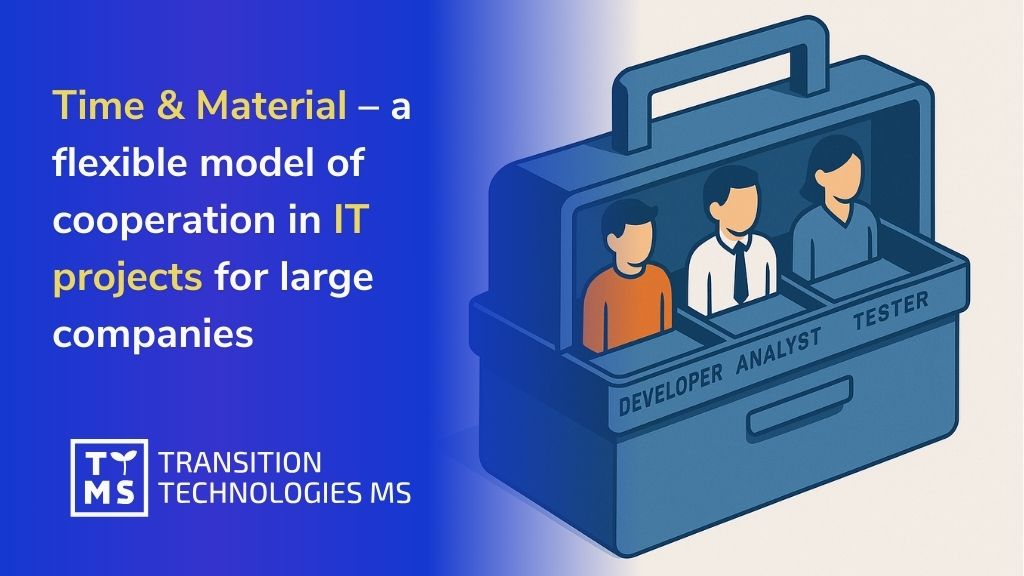
A flexible Time and Material billing model designed for complex IT projects in large companies
Time & Material (T&M) is a model of cooperation in which billing is based on the actual time worked by specialists and the resources used. Unlike the rigid Fixed Price model, where the scope and cost are defined upfront, T&M ensures flexibility – the scope of work can evolve during the project, and the client pays for the actual tasks performed. This model is gaining popularity among companies undergoing digital transformation, who need quick access to competencies and the ability to adapt to changes. Below, we explain why T&M is the preferred model for digital transformation leaders, in which situations it works best, and provide examples (including the cooperation between TTMS Software Sdn Bhd and ADA). Finally, we invite you to talk about how T&M can support your project. 1. What is the Time & Material billing model in IT? The Time and Material model means that the client pays for the hours worked and the tools used to complete the IT project. There is no fixed total cost or fully frozen scope – the project is carried out iteratively, and details can be refined during the work. This model is fully compatible with Agile methodologies and the iterative approach to software development. The project team logs work hours, reports progress, and settlements are made periodically (e.g., monthly or per stage). The client gains full transparency – they know exactly what they are paying for and can continuously adjust the direction of the work. In practice, the T&M model means that the contract sets the rates (e.g., hourly or daily) for specific roles in the project (developer, tester, analyst, etc.) and general rules of cooperation. But it leaves space for scope changes. If new requirements or changes arise during the project, there is no need to renegotiate the contract – the team simply continues the work, and the client pays for the additional time based on the agreed rates. This significantly shortens the project launch time and reduces the risk of underestimating or omitting important elements. In T&M, both the IT provider and the client act as partners sharing responsibility for the project’s success. 2. Flexibility above all – why leaders choose T&M model Today’s business environment is extremely dynamic. Companies that are leaders in digital transformation know that changes are the norm in ambitious IT projects – new ideas appear, user expectations change, and technology constantly evolves. Traditional settlement models (e.g., fixed-price projects) often turn out to be too inflexible in such conditions. That’s why leading organizations increasingly choose Time & Material to ensure the ability to respond quickly and keep up with innovation. The T&M model offers a number of benefits for large enterprises and digital transformation programs: Quick project start and delivery in stages: No need to wait for a perfectly refined scope – work can start fast, and solutions are delivered in short iterations. This allows early business value realization and continuous verification. Flexibility in implementing changes: When new challenges arise or new ideas appear, the team can immediately adjust the scope of work. There is no need to amend the contract for each change – the plan evolves within the agreed framework. Cost transparency: At every stage, it is clear how much time has been worked and what the budget is spent on. The client receives regular reports, knows exactly what they are paying for, and can control the budget throughout the project. Full control and involvement on the client side: The client is actively involved in the project – can prioritize tasks, decide on the order of implementation, and quickly change direction if necessary. Access to needed competencies exactly when they are needed: In the T&M model, the team can be scaled flexibly – increased in size or supplemented with new experts when the project enters a new phase. Higher quality through continuous improvements: As the project is run iteratively, the final product can be of better quality – continuous testing, feedback, and improvements increase value step by step. It is worth noting that the T&M model eliminates the need to pay for “extra” assumptions. In a fixed-price model, providers often add a risk buffer – so the client pays in advance, even for unforeseen difficulties. In T&M, you pay only for the actual work. If some tasks turn out to be unnecessary or simplified, the budget can be shifted to other priorities. 3. When does the T&M model work best? The Time & Material billing model is not a cure-all – there are situations where it works perfectly and others where a fixed-price model might be better. Below are typical scenarios where T&M works best: Long-term, complex projects – if the initiative is extended over time and consists of many phases, it is obvious that it’s hard to predict all requirements at the start. T&M allows scope adjustment according to current needs. Unclear requirements at the start – when the client has a general vision but not a detailed list of functionalities. This often occurs in innovative projects. T&M allows starting with MVP and then iterative development. Dynamic business or technology environment – in industries like fintech, e-commerce, or telecom, change is constant. If user needs evolve quickly, regulations change, or there’s competitive pressure, fixed contracts can slow you down. T&M allows flexibility and speed. Budget control during the project – paradoxically, although T&M doesn’t specify the final amount upfront, it allows strict budget control. You can monitor ROI and decide on funding further stages based on previous outcomes. Outsourcing and need for specific know-how – if you’re using IT outsourcing or staff augmentation, T&M is a natural choice. You can get the expert you need without long hiring processes. Of course, the T&M model requires trust and maturity on both sides – the client must be ready to collaborate and supervise, and the provider must ensure transparency. Experienced partners like TTMS introduce control mechanisms (hour tracking, budget checkpoints, milestones) to protect the project. 4. Example: TTMS and ADA – partnership in T&M model A real example of T&M flexibility is the recent cooperation between TTMS Software Sdn Bhd (TTMS branch in Malaysia) and ADA, a leading digital transformation company in Southeast Asia. ADA specializes in data analytics, AI, and digital marketing, serves over 1,500 clients in 12 markets, and is backed by investors like SoftBank and Axiata Group. The partnership began in the Time & Material model, with TTMS providing a Salesforce Administrator for three months. This form enabled ADA to use TTMS experience exactly when needed and created a foundation for further cooperation. Read more in the press release: TTMS Software Sdn Bhd starts cooperation with ADA 5. Other examples of T&M at TTMS At TTMS, we have been delivering projects in the Time & Material or similar flexible models for years. Most of our case studies are stories of long-term cooperation, iterative system improvement, and partnership approach – that’s what T&M enables. For example: In the energy sector, we created a scalable application that integrated many systems. In the pharmaceutical sector, we supported an international company in building a CRM system with a growing scope. For Schneider Electric, we are a long-term outsourcing partner – we provide specialists in the T&M model. 6. T&M in Asia – a growing trend We observe growing interest in flexible contracts in Asia. Companies in this region, known for dynamic growth, often point to the T&M model as key to successful transformation. For example: A telecom operator in Southeast Asia chose T&M for a new digital platform, which allowed them to adapt the roadmap in real time. In e-commerce, a platform was iteratively adapted to user needs through a T&M-based cooperation with an external team. These examples show that flexibility = effectiveness. 7. Choose the right model Time & Material is a proven way to run an IT project when speed, adaptability, and access to talent matter. Leaders choose it because it lets them focus on business goals instead of renegotiating contracts. Properly applied, T&M gives: Freedom of action Transparent costs Quality and results If your company is planning a new system or wants to improve an existing one and needs a flexible and experienced IT partner, T&M may be the right choice. TTMS has been supporting clients in this model for years – providing top experts and teams, building long-term relationships based on trust and shared goals. Let’s talk – we’ll tailor the cooperation model to your project. Contact us. What is the difference between Time & Material and Staff Augmentation? While both offer flexibility, Time & Material refers to billing for work completed over time, often in a project context. Staff Augmentation focuses on providing personnel to extend internal teams. T&M may include team delivery, project milestones, and shared goals—beyond just supplying resources. Is the Time & Material model more expensive than Fixed Price? Not necessarily. Although T&M lacks a fixed upfront budget, it often avoids overpayment by billing only for actual work done. Fixed Price contracts may include large risk buffers, while T&M enables better cost control if well-managed. How do you control scope and costs in a Time & Material project? T&M requires strong project governance—typically involving time tracking, regular reporting, sprint reviews, and clear communication. Clients remain actively involved, adjusting priorities and validating outcomes in real time. Is Time & Material suitable for regulated industries like pharma or finance? Yes. When combined with proper documentation, validation, and quality controls, T&M can meet industry compliance needs. It’s especially useful in complex environments where detailed requirements evolve during the project lifecycle. Can we start with Time & Material and switch to Fixed Price later? Absolutely. Many companies begin with T&M for discovery, MVPs, or early development. Once scope stabilizes, transitioning to a Fixed Price or hybrid model is common—ensuring flexibility early on and predictability later.
Read
Challenges and Entry Barriers for IT Companies in the Defense Sector – The Case of TTMS
The defense sector is becoming an increasingly important recipient of modern IT solutions. Growing defense budgets open up new business opportunities for technology companies. According to the International Institute for Strategic Studies, defense spending in Europe rose by 11.7% in 2024, reaching USD 457 billion. Despite this market’s potential, IT companies face exceptionally high formal, technological, and organizational barriers when attempting to enter the defense industry. Transition Technologies Managed Services (TTMS), a Polish software house, is a compelling example of a company that is successfully overcoming these hurdles. In recent years, TTMS has significantly expanded its defense-related operations. The company has doubled its defense contract portfolio while systematically enhancing its offer for military and governmental institutions. Sebastian Sokołowski, CEO TTMS As TTMS CEO Sebastian Sokołowski stated in a recent interview for ISBtech.pl: “We are currently focusing strongly on developing our operations in the defense sector, which has allowed us to double our order portfolio in this area. The growing demand creates many opportunities, but being a preferred partner in this market is a major challenge for many IT firms due to high entry barriers and the need for niche competencies.” Below, we explore the main challenges of entering the defense industry and how TTMS is addressing them to establish itself as a trusted supplier. Formal and Regulatory Barriers One of the biggest challenges for IT firms entering the defense industry is the number of formal requirements they must meet. In Poland, any activity related to the manufacturing or trading of military-grade technologies or products requires a government license. TTMS holds such a license since 2019. In 2024, the company renewed its permit to handle dual-use technologies for a maximum period of 50 years. This enables the company to legally participate in tenders and contracts involving advanced military technologies. Additionally, companies must have security clearances to handle classified information, a typical requirement in defense projects. This means that both the company and its staff must obtain industrial and personal security clearances at various levels. TTMS employees are certified to work on classified materials at NATO/ESA/EU Secret levels, meeting strict standards for confidentiality and secure information handling. Only a handful of Polish IT companies have this level of access and experience, putting TTMS in a select group of suppliers qualified to support military-grade IT projects. Technological Standards and Security Requirements From a technological standpoint, entering the defense market means complying with extremely high requirements for quality, resilience, and cybersecurity. Defense-related IT systems, especially those used for command, control, communications, and reconnaissance (C4ISR), must be fully operational under harsh physical and digital conditions, including cyberattacks or communication failures. As such, companies must implement encrypted communication, redundancy measures, and comply with security frameworks like ISO 27001 and STANAG (NATO Standardization Agreements). TTMS has developed these competencies through years of experience and has built internal teams capable of working on military-grade systems. The company’s consultants understand the logic and workflows of defense systems at the tactical, operational, and strategic levels, allowing them to work on both pure software projects and integrations with military equipment and battlefield sensors. TTMS also applies methodologies and standards from the space industry — such as Product and Quality Assurance for the European Space Agency (ESA) — to ensure that each system meets the highest quality and safety benchmarks. This rigorous approach is equally applicable in defense contracts, where system failure can lead to mission failure. TTMS regularly participates in technology trials and validation efforts, including within NATO’s ACT Innovation Hub, where new tools and frameworks are tested under controlled conditions before being rolled out into production environments. Procurement Cycles and Organizational Challenges Even with the right certifications and technical expertise, IT companies face another critical hurdle — the length and complexity of public sector procurement cycles. Defense contracts are typically subject to multi-stage public tenders, technical consultations, and rigorous vetting procedures, which can take months or even years to complete. Moreover, tenders often require evidence of prior experience, financial stability, and the ability to provide long-term support. Companies may also need to commit to deploying personnel on-site, maintaining hardware and software for years, and complying with strict documentation and reporting protocols. For many IT vendors, the resources required to simply submit a compliant offer are a barrier in themselves. To mitigate these challenges, TTMS has adopted a partnership-driven strategy, participating in consortiums that combine different capabilities across organizations. Large defense contracts are rarely executed by a single vendor — instead, they are typically delivered by groups that include system integrators, hardware providers, software developers, and training companies. TTMS has participated in many such tenders — either independently or as part of a consortium — and has successfully won contracts or advanced to final stages in many defense procurement processes. Another key characteristic of this market is the long lifecycle of contracts. Once a solution is implemented, the provider is often responsible for its maintenance and evolution for several years. As CEO Sokołowski notes, “Defense contracts are by definition long-term engagements — specialists are often involved for years, and system rollouts are accompanied by ongoing support and maintenance.” This long-term horizon presents both an opportunity and a responsibility, as the company becomes a long-term strategic partner for military clients. How TTMS Prepares for Defense Sector Demands To succeed in such a highly specialized field, TTMS has made strategic investments in certifications, personnel, and organizational capabilities tailored to the needs of the defense sector. Since 2017, the company has consciously developed its Defense & Space business line, combining its roots in industrial software with the unique demands of national security applications. This includes establishing a dedicated Defense & Space division, hiring staff with security clearances, and creating secure environments for working with classified data. TTMS has also created internal teams for cybersecurity, geospatial systems, AI-based decision support tools, and interoperability between national and NATO command systems. A key part of the company’s strategy is to build strong reference cases through successful implementations. Before winning its own defense contracts, TTMS served as a subcontractor in consortia — gaining valuable know-how and building a project portfolio that later opened doors to larger tenders. Today, TTMS has successfully delivered more than ten defense-related projects and is involved in many others that are ongoing or in advanced stages of procurement. Notable Projects: NATO, ESA, and Beyond TTMS’s expertise in the space sector further strengthens its capabilities. The company supports projects for ESA and the EU Space Program Agency, delivering services related to quality assurance and software safety. These space projects demand the highest standards of reliability and resilience — traits that are equally vital in military contexts. Earning Trust in the Defense Sector Ultimately, trust is the most valuable currency in the defense industry. Institutions are cautious and deliberate when selecting long-term partners. TTMS has worked for years to build a reputation for security, professionalism, and delivery excellence. Its certifications, long-term client relationships, and secure project environments help position it as a reliable supplier. TTMS’s credibility is further enhanced by its corporate governance and financial transparency. As a member of the Transition Technologies Group and a company preparing for an IPO, TTMS is subject to the oversight and reporting obligations that come with listing — reassuring public sector clients of its financial and operational maturity. The company also has a growing presence in international markets (Europe, Asia, Latin America), and its selection by major institutions such as NATO and ESA confirms its global competitiveness. TTMS’s leadership emphasizes that cutting-edge technologies such as artificial intelligence and cybersecurity will play a growing role in defense systems, and the company is committed to building long-term relationships with key institutions in these areas. Conclusion The defense sector is one of the most demanding — and most rewarding — markets for IT providers. Entry requires formal licenses, security clearances, technological specialization, and procedural fluency in public procurement. TTMS exemplifies how a company can build up these capabilities strategically, invest in the right people and certifications, and gradually earn the trust of major defense stakeholders. In doing so, it not only opens new revenue streams but also contributes to national and international security by delivering innovative, mission-critical digital systems. Why is it so difficult for IT companies to enter the defense sector? The defense sector imposes strict formal requirements (licenses, security clearances), advanced technological standards (system resilience, NATO norms), and complex procurement procedures. Trust and long-term references are also essential to succeed. What is a NATO/ESA/EU SECRET security clearance? It is an official authorization that allows a company and its personnel to access and handle classified information at the “SECRET” level in international projects for organizations like NATO, the European Space Agency (ESA), or the EU. It reflects high levels of security compliance and confidentiality. What does C4ISR stand for? C4ISR means Command, Control, Communications, Computers, Intelligence, Surveillance, and Reconnaissance. It refers to integrated systems that help military forces make decisions, communicate, analyze intelligence, and monitor the battlefield. It is the digital backbone of modern defense operations. What technologies does TTMS offer for the defense sector? TTMS provides: decision-support systems for military command, NATO-compliant software solutions, AI-powered data analytics tools, interoperability tools between national forces and NATO systems, support for space and satellite-based defense initiatives. How is a military procurement process different from a civilian one? Military tenders are more complex and formalized. They often require special licenses, security clearances, inter-ministerial approvals, and guarantees for long-term system maintenance. The process typically takes longer and includes stricter evaluation criteria.
Read
Top E-learning Best Practices for Organization Success: Evidence-Based Approaches
1. Top E-learning Best Practices for Organization Success: Evidence-Based Approaches Research shows how important training is in an organization. 94% of employees would stay at a company longer if it invested in their learning and development, while companies with comprehensive training programs see 218% higher income per employee compared to those without formalized training. These striking statistics highlight why organizations worldwide are increasingly turning to e-learning as their preferred training method. However, simply implementing an e-learning program isn’t enough—following established best practices backed by research is what truly separates successful initiatives from ineffective ones. 2. The Importance of Following Best Practices in E-Learning E-learning best practices provide a framework that ensures training programs deliver measurable results rather than becoming costly exercises with minimal impact. When organizations follow these proven guidelines, they create learning experiences that engage employees and translate into improved performance. Since 2015, TTMS has implemented hundreds of e-learning courses, animations, and presentations that effectively support the development of employee competencies for our clients. This extensive experience has shown that organizations adhering to best practices in e-learning consistently achieve better outcomes, including: Higher completion rates Improved knowledge retention Greater skill application on the job Stronger return on learning investment Recent research supports this approach, with studies showing e-learning increases retention rates by 25% to 60% compared to traditional face-to-face learning methods. Additionally, e-learning solutions reduce learning time by 40% to 60% compared to traditional classroom settings. The most successful online learning initiatives align with broader organizational goals while addressing specific learner needs. This balanced approach ensures that e-learning programs contribute directly to business objectives while keeping participants motivated throughout their learning journey. “Every $1 spent on e-learning results in $30 of productivity gains.” – Virtuemarket Research 2. Key Principles of Effective E-Learning Design Implementing e-learning best practices begins with establishing solid design principles that form the foundation of any successful digital learning initiative. Based on years of experience, TTMS creates high-quality training materials tailored to organizations’ actual needs. We analyze training requirements and develop solutions that enhance employee competencies, increase engagement, and optimize learning processes. 2.1 Creating Clear Learning Objectives One of the fundamental best practices for e-learning is establishing precise learning objectives before content development begins. These objectives should communicate exactly what learners will be able to do after completing the training. SMART objectives (Specific, Measurable, Achievable, Relevant, and Time-bound) provide the necessary structure to guide both content creation and assessment strategies. Clear objectives serve as a roadmap for learners and course creators alike, keeping training focused on relevant outcomes rather than overwhelming participants with tangential information. When designing objectives, TTMS ensures they align directly with organizational goals and address specific performance gaps identified during needs analysis. 2.2 Incorporating Scenario-Based Learning and Storytelling Among the most effective best practices for elearning is the integration of real-world scenarios that mirror challenges employees encounter in their daily work. Research by Chen et al. (2024) demonstrated that using realistic workplace scenarios and simulations in e-learning increased skill transfer to on-the-job performance by 28% compared to traditional content delivery. Scenario-based learning creates contextual relevance that abstract concepts often lack, allowing learners to practice decision-making in a risk-free environment. The narrative framework helps participants see how knowledge applies to their specific roles, bridging the gap between theoretical understanding and practical application. Check out our case study showcasing an example of how artificial intelligence is used in corporate training. 2.3 Utilizing Interactive Multimedia and Content Best practices e-learning approaches recognize that passive content rarely yields optimal results. Interactive elements transform learners from passive viewers into active participants, dramatically improving engagement and knowledge retention. TTMS incorporates diverse multimedia elements—including videos, animations, interactive assessments, and simulations—to create dynamic learning experiences that accommodate different learning preferences. A 2023 meta-analysis by Wang et al. showed that incorporating social learning elements like discussion forums and collaborative projects increased learner engagement by 41% and improved knowledge retention by 18% compared to self-paced e-learning alone. Interactive elements also provide valuable opportunities for practice and feedback, which research consistently identifies as essential components of effective learning. By balancing text, visuals, audio, and interactive components, content becomes more accessible and engaging for diverse audience groups. 2.4 Adhering to Mobile-Friendly and Accessible Design Standards Best practices elearning design must consider how and where modern professionals access training materials. With mobile device usage continuing to rise, responsive design that adapts seamlessly across devices has become non-negotiable rather than optional. Mobile-friendly designs ensure learners can access training during commutes, between meetings, or whenever they have available time. Accessibility standards represent another critical dimension of effective e-learning design. Ensuring content is accessible to learners with disabilities not only complies with legal requirements but also demonstrates organizational commitment to inclusivity. Key elements include: Proper text alternatives for images Keyboard navigation options Appropriate color contrast Closed captions for video content Compatibility with screen readers 3. Advanced Strategies for E-Learning Engagement After establishing fundamental design principles, organizations must implement advanced engagement strategies to transform good e-learning into exceptional learning experiences. These approaches leverage psychological principles and technological capabilities to create deeper connections between learners and content. 3.1. Employing Microlearning Techniques Microlearning has emerged as a critical e-learning strategy in our increasingly time-constrained work environments. By breaking content into focused, bite-sized units of 3-5 minutes, organizations can dramatically improve knowledge absorption and retention rates. A 2023 study by Ebbinghaus et al. found that breaking content into short 5-10 minute modules and spacing them out over time improved knowledge retention by 35% compared to traditional hour-long e-learning courses. The effectiveness of microlearning stems from its alignment with how our brains naturally process and retain information. Short learning bursts prevent cognitive overload while supporting the brain’s natural tendency toward spaced repetition. For maximum impact, microlearning modules should: Focus on a single skill or concept Incorporate multimedia elements Conclude with practical application opportunities Be accessible on multiple devices Allow for just-in-time learning Check out our case study on creating an Occupational Health and Safety e-learning program we developed for Hitachi Energy. 3.2. Enhancing Engagement Through Gamification Gamification represents another dimension of good e-learning that transforms passive content consumption into active participation. A 2024 study by Duolingo found that gamified microlearning increased daily active users by 47% and improved long-term knowledge retention by 23% compared to traditional e-learning formats. By incorporating game elements like points, badges, leaderboards, and challenges, organizations tap into intrinsic motivational drivers that keep learners engaged throughout their development journey. Effective gamification goes beyond superficial point systems to create meaningful experiences that reinforce learning objectives. The most successful implementations: Connect rewards to actual learning outcomes and progress Balance competition with collaboration Provide meaningful choices and consequences Offer immediate feedback Create a sense of achievement and progression Organizations should select gamification elements that align with both their learning objectives and organizational culture. A competitive sales team might respond well to leaderboards, while collaborative teams might benefit more from team-based challenges that encourage knowledge sharing. 3.3. Encouraging Reflective Learning Practices Reflection represents a critical e-learning element that transforms information into actionable knowledge. By incorporating structured reflection opportunities, organizations encourage learners to personalize content and consider how it applies to their specific work contexts. Effective reflection techniques include: Guided questions (“How will you apply this concept in your next client interaction?”) Personal learning journals Facilitated discussion forums where participants share insights and experiences Application planning worksheets Follow-up activities that reinforce key concepts The timing of reflection matters significantly. TTMS recommends incorporating reflection opportunities both during the learning experience and afterward. This dual approach allows learners to process information while it’s fresh and then revisit concepts after having opportunities to apply them in real-world situations. 3.4. Building a Constructive Feedback Culture Feedback mechanisms are essential for good e-learning environments, providing learners with guidance on their progress and areas for improvement. Effective feedback goes beyond simple right/wrong assessments to offer specific guidance that supports continued development. To maximize impact, feedback should be: Timely – delivered as close to the performance as possible Specific – addressing particular aspects rather than generalities Balanced – acknowledging strengths while identifying improvement areas Action-oriented – suggesting concrete next steps Personalized – relevant to the individual learner’s context Modern e-learning platforms can deliver automated feedback based on learner responses, but the most effective approaches combine technology with human input. For complex skills development, peer feedback and instructor guidance remain invaluable complements to automated systems. 4. Optimizing Learner Experience When implementing elearning best practices, the user experience often determines whether a program succeeds or fails. Even the most well-researched content will fall flat if learners struggle to navigate the platform or find the interface frustrating. 4.1. Providing Intuitive Navigation and User-Friendly Interface Among the most critical best practices for elearning is creating a navigation system that feels effortless to users. Research shows that cognitive load dedicated to figuring out an interface directly reduces cognitive resources available for actual learning. Effective navigation structures should include: Clearly labeled menu items Consistent placement of navigation elements Obvious progress indicators Bookmark functionality for easy resumption Search capabilities and content filtering options Visible course map or content structure When supporting companies implementing new processes or tools, TTMS ensures the e-learning interface mirrors the actual systems employees will use, creating a seamless transition between training and application. 4.2. Catering to Different Learning Styles and Preferences Best practices for elearning acknowledge that workforce diversity extends to learning preferences and styles. Rather than debating which learning style is superior, effective e-learning accommodates multiple approaches simultaneously. TTMS creates training modules that present information through various formats: Visual diagrams and infographics Narrated explanations and audio content Written summaries and reference materials Interactive practice activities and simulations Video demonstrations of processes and procedures Additionally, offering learner control over pace and sequence respects individual differences in processing speed and prior knowledge. A large-scale 2022 study by IBM found that using AI to create personalized learning paths based on individual performance improved course completion rates by 22% and reduced time-to-proficiency by 31%. 4.3. Implementing Consistent and Coherent Visual Design Visual design significantly impacts learning effectiveness—yet it’s often undervalued in elearning best practices discussions. Consistent visual treatment creates cognitive patterns that help learners organize information and recognize relationships between concepts. When optimizing training processes, visual consistency reduces extraneous cognitive load by establishing predictable patterns. This consistency should extend to: Color schemes and brand elements Typography and text formatting Icon styles and visual metaphors Treatment of interactive elements Layout and information hierarchy For companies implementing new products or processes, visual design can strategically reinforce branding while simultaneously supporting learning objectives. TTMS creates visual systems that balance organizational identity with evidence-based design principles that enhance comprehension and retention. 5. Assessing and Improving E-Learning Programs Implementing best practices in elearning isn’t a one-time effort but rather an ongoing cycle of evaluation and refinement. TTMS helps organizations measure e-learning effectiveness by supporting companies with data analysis, evaluating the effectiveness of training methods, and adapting content to meet employee needs and business goals. 5.1. Conducting Post-Course Evaluations and Surveys Online education best practices emphasize the importance of systematic feedback collection through well-designed evaluations and surveys. These instruments should go beyond simplistic satisfaction ratings to gather actionable insights about content relevance, engagement levels, and perceived application value. Effective evaluations should: Capture both quantitative metrics and qualitative feedback Measure immediate reactions and knowledge acquisition Assess behavior change and business impact Be brief and accessible to encourage participation Clearly connect to program improvement efforts Timing is another crucial consideration when implementing feedback mechanisms. While immediate post-course surveys capture fresh impressions, delayed evaluations (conducted 30-90 days after completion) often provide more valuable insights about knowledge retention and practical application. 5.2. Leveraging Data for Continuous Improvement Among the most powerful best practices in elearning is the strategic use of learning analytics to drive program refinement. Modern learning management systems capture extensive data about learner behavior, including: Completion rates and time spent on specific content Assessment performance and question-level analytics Navigation patterns and usage trends Engagement metrics like comments and social interactions Correlations between learning behaviors and performance outcomes By examining these metrics, organizations can identify which content resonates with learners and which elements require adjustment. This systematic approach ensures that e-learning programs evolve based on evidence rather than assumptions. 5.3. Staying Updated with E-Learning Trends and Innovations The e-learning landscape evolves rapidly as new technologies emerge and learning science advances. Online education best practices include maintaining awareness of these developments and thoughtfully incorporating promising innovations that align with organizational objectives. Emerging technologies that show promise include: AI-powered adaptive learning systems Extended reality (XR) for immersive learning experiences Advanced simulation tools for skill practice Learning experience platforms (LXPs) that personalize content Microlearning apps for on-the-go development Beyond technology, staying informed about advances in learning science and instructional design methodology is equally important. Organizations should establish mechanisms for regularly reviewing and incorporating evidence-based insights into their e-learning strategies. 6. E-Learning Best Practices Checklist Use this checklist to evaluate your current e-learning programs or guide the development of new initiatives: Fundamental Design Elements Clear, measurable learning objectives aligned with business goals Scenario-based learning that reflects real-world applications Interactive multimedia elements that engage multiple senses Mobile-responsive design for learning anywhere, anytime Accessible content that complies with WCAG guidelines Engagement Strategies Microlearning modules (3-5 minutes) for key concepts Appropriate gamification elements that motivate without distracting Reflective activities that connect content to personal context Constructive feedback mechanisms that guide improvement Social learning components that facilitate knowledge sharing User Experience Optimization Intuitive navigation that minimizes cognitive load Multiple content formats that accommodate different learning preferences Consistent visual design system that enhances comprehension Personalized learning paths based on role or performance Clear progression indicators that motivate completion Assessment and Improvement Multi-level evaluation system (reaction, learning, behavior, results) Learning analytics dashboard to track key performance indicators Regular content reviews based on user feedback and performance data Mechanism for updating content as information changes Continuous benchmarking against industry best practices 7. How Can TTMS Help Improve E-Learning in Your Company? With the rapid evolution of workplace learning needs, many organizations struggle to develop e-learning programs that truly deliver business impact. TTMS offers comprehensive solutions designed to transform your company’s digital learning approach by implementing field-tested best practices across the entire e-learning lifecycle. 7.1. Custom E-Learning Course Development TTMS’s team of experienced developers can tackle even the most demanding projects with precision and expertise. We focus on creating high-quality courses that deliver measurable results by aligning learning objectives with specific business goals. Each course is meticulously crafted to function seamlessly within your existing LMS platform while addressing your organization’s unique challenges. What distinguishes TTMS’s approach is our commitment to both pedagogical effectiveness and technical excellence. Our instructional designers apply evidence-based learning principles to structure content that maximizes retention and application. Meanwhile, our technical specialists ensure courses work flawlessly across different devices and platforms, providing a frustration-free learning experience. 7.2. Comprehensive Evaluation Services Measuring the effectiveness of e-learning initiatives is essential for continuous improvement and demonstrating ROI. TTMS provides sophisticated evaluation frameworks that go beyond basic completion metrics to assess knowledge transfer, behavior change, and business impact. These evaluation services help organizations identify both strengths and improvement opportunities within their learning programs. Our analysts work with your team to establish meaningful metrics aligned with your specific business objectives. This data-driven approach ensures that every learning investment delivers tangible value while continuously evolving to meet changing organizational needs. 7.3. Animation and Multimedia Production Engaging visuals dramatically improve learning outcomes, yet many organizations lack the in-house expertise to create professional multimedia assets. TTMS’s specialized team develops custom animations, videos, and interactive elements that transform abstract concepts into memorable visual experiences. These assets can significantly enhance learner engagement while improving knowledge retention and application. Whether explaining complex processes, demonstrating proper techniques, or creating scenario-based learning experiences, our multimedia specialists create assets that are both visually compelling and pedagogically sound. Each element is designed with specific learning objectives in mind rather than simply adding visual interest. 7.4. Expert Instructional Design Effective e-learning requires more than just converting existing materials into digital format. TTMS’s instructional designers apply learning science principles to structure content that maximizes comprehension and retention. This expertise is particularly valuable when addressing complex topics or when learners have limited time available for training. Our instructional design approach balances cognitive science with practical business realities. We create learning experiences that respect learners’ cognitive limitations while ensuring they develop the specific skills and knowledge needed to improve performance. This structured approach is especially valuable when introducing new processes, tools or products to your workforce. By partnering with TTMS, your organization can develop e-learning programs that not only engage employees but also deliver the measurable business results that research consistently demonstrates are possible with well-designed digital learning experiences.
Read
Must-Have Features in AI Tools for Training & Development – and Their Benefits in 2026
Not so long ago, employee training meant thick manuals, static presentations, and hours spent in meeting rooms with a trainer. But times have changed. Today, companies aren’t just wondering if they should bring AI into learning and development — they’re asking how to do it smartly. In a fast-moving world where business needs evolve month by month, more organizations are turning to AI to make learning more flexible, targeted, and scalable. Because when training feels relevant, adaptive, and easy to access — it actually works. So here’s the real question: Is your company ready to tap into the potential of AI to help your people grow? 1. The Potential of AI Tools for Training and Development The integration of AI tools for training and development represents a paradigm shift in how organizations approach employee learning. These powerful technologies don’t simply automate existing processes—they fundamentally transform the entire learning ecosystem by introducing capabilities that weren’t previously possible at scale. 1.1 Understanding AI in Learning and Development AI in L&D encompasses a wide range of technologies designed to enhance how knowledge is created, delivered, and absorbed. At its core, AI learning and development tools leverage machine learning algorithms to analyze data patterns, adapt to user behaviors, and deliver increasingly relevant content to learners. These systems continuously improve by processing feedback and interaction data. The strategic implementation of AI tools for learning and development enables organizations to move beyond the traditional one-size-fits-all approach. For instance, natural language processing can power intelligent content recommendations while predictive analytics identifies skill gaps before they impact business outcomes. Computer vision technologies even allow for analyzing learner engagement during video-based training. TTMS has observed that organizations implementing AI L&D tools typically experience 40-60% improvements in training completion rates and knowledge retention. This happens because these systems can identify precisely when learners are struggling and provide targeted interventions before disengagement occurs. Rather than replacing human trainers, AI augments their capabilities, handling repetitive tasks while allowing L&D professionals to focus on high-value strategic work. The most successful implementations start with clear learning objectives and gradually incorporate AI capabilities that directly address specific organizational challenges. 2. Benefits of Integrating AI in Training Programs The strategic implementation of AI in training and development is revolutionizing how organizations approach workforce education. With AI training tools becoming increasingly sophisticated, companies are discovering numerous advantages that extend far beyond simple automation. Let’s explore these benefits in detail. 2.1 Accelerated Content Creation and Translation AI for training and development has dramatically transformed content creation timelines. What previously took weeks of instructional design can now be accomplished in days or even hours. AI training tools can generate initial drafts of training materials, repurpose existing content into different formats, and even create simulations based on company-specific scenarios. Content translation, historically a major bottleneck for global organizations, has been streamlined through AI-powered solutions. These systems can instantly translate training materials into dozens of languages while maintaining contextual accuracy and cultural nuances. TTMS has observed that companies implementing these solutions report 70% faster deployment of global training programs. Organizations leveraging AI employee training for multilingual content have seen particularly impressive results in technical fields where specialized terminology presents unique challenges. The technology continuously improves translations based on industry-specific datasets, ensuring consistency across all learning materials. 2.2 Smarter Content Delivery through AI AI has fundamentally changed how training content reaches learners. Rather than pushing standardized materials to everyone simultaneously, AI systems analyze numerous factors to determine optimal delivery timing, format, and scope for each individual. These systems track learner behavior patterns to identify when employees are most receptive to new information. For example, AI might recognize that certain team members engage better with training during morning hours or after completing specific tasks, and adjust delivery accordingly. The result is significantly higher completion rates and knowledge retention. Content sequencing has also improved through intelligent recommendation engines similar to those used by streaming platforms. By analyzing which learning paths lead to the best outcomes for similar employees, these systems can suggest optimal progression routes through complex training materials. 2.3 Personalized and Adaptive Learning Experiences Perhaps the most transformative benefit of AI in training and development is the ability to truly personalize learning at scale. Traditional approaches forced organizations to choose between customized experiences (expensive) or standardized programs (ineffective). AI eliminates this compromise. Modern AI learning platforms continuously assess learner competencies, adjusting content difficulty, pace, and examples based on individual progress. This dynamic approach ensures employees remain in their optimal learning zone—challenged enough to remain engaged but not overwhelmed to the point of frustration. The customization extends to content formats as well. AI can identify whether a particular employee learns better through visual demonstrations, written instructions, or interactive exercises, then prioritize those formats accordingly. This adaptivity has proven particularly valuable for technical skill development where learning approaches vary significantly among individuals. 2.4 Enhanced Learner Engagement and Interactivity AI employee training systems have transformed passive learning experiences into highly interactive journeys. Gamification elements powered by AI provide meaningful challenges calibrated to each learner’s skill level, while virtual role-playing scenarios adapt in real-time based on learner decisions and responses. These interactive elements generate rich engagement data that AI systems analyze to identify potential knowledge gaps or misconceptions. When patterns emerge suggesting confusion about specific concepts, the system can automatically provide additional explanations or practice opportunities before the learner becomes disengaged. Emotion recognition technologies integrated into video-based learning can even detect when learners appear confused or frustrated, triggering appropriate interventions. This level of responsiveness was previously impossible in traditional training environments. 2.5 Improved Cost and Time Efficiency The economic benefits of integrating AI into training and development are significant. Organizations that adopt these technologies often report 30–50% reductions in training-related costs, while simultaneously enhancing learning outcomes. These savings are driven by factors such as faster content development, reduced reliance on live instruction, and minimized logistical expenses. AI-powered onboarding systems are especially effective in cutting costs, as they can automate up to 80% of standard orientation tasks while delivering personalized experiences to new employees. This approach shortens onboarding timelines and helps new hires become productive more quickly. Efficiency gains also extend to compliance training. AI systems can monitor regulatory updates in real time and automatically adjust learning content, ensuring that employees always have access to up-to-date, accurate information—without the need for constant manual revisions. 2.6 AI-Supported Role Evolution within L&D Far from replacing L&D professionals, AI is elevating their roles to more strategic positions. By automating routine tasks like content updates, assessment grading, and basic question answering, these technologies free L&D teams to focus on high-value activities like learning strategy development and performance consulting. This evolution requires L&D professionals to develop new competencies around AI implementation, ethical considerations, and strategic integration with business objectives. Those embracing this shift are finding themselves in increasingly influential positions within their organizations. 2.7 Automated Workflows and Task Management Administrative efficiency represents another major benefit of AI training tools. These systems can automate enrollment processes, generate completion certificates, send targeted reminders to learners, and maintain comprehensive training records with minimal human intervention. Compliance tracking, historically a labor-intensive process, has been particularly transformed. AI systems can monitor completion rates in real-time, automatically identify non-compliant employees, and generate appropriate notifications. This automation not only reduces administrative burden but also significantly improves compliance rates. 2.8 Advanced Data Analysis and Insights The analytical capabilities of AI in training and development provide unprecedented visibility into learning effectiveness. These systems can correlate training activities with on-the-job performance indicators, helping organizations understand which learning experiences truly impact business outcomes. Predictive analytics tools can identify employees at risk of knowledge gaps before those gaps impact performance. By analyzing patterns across thousands of learner interactions, these systems can recommend targeted interventions that prevent potential issues rather than simply reacting to them. 2.9 Virtual Assistants, Chatbots, and AI Coaching AI-powered learning support systems have transformed how employees access help during the learning process. Virtual assistants can answer questions 24/7, provide clarification on complex concepts, and direct learners to relevant resources. This immediate feedback dramatically improves the learning experience compared to waiting for instructor responses. More sophisticated AI coaching systems can provide personalized guidance throughout the learning journey. These tools analyze numerous factors—from quiz responses to practical application attempts—and offer tailored recommendations for improvement. Some advanced systems can even simulate conversation practice for customer service training or leadership development. 2.10 Innovative Uses of AI in Corporate Settings Beyond traditional implementations, pioneering organizations are leveraging AI learning tools in increasingly creative ways to address complex development challenges. Conflict Resolution and Emotional Intelligence Development Several organizations are deploying sophisticated AI L&D tools to address the challenging area of workplace conflict and emotional intelligence. These systems analyze communication patterns, identify potential conflicts before they escalate, and provide tailored guidance for resolution. More importantly, they help employees develop emotional intelligence skills by providing private feedback on communication styles and suggesting alternative approaches for difficult conversations. Predictive Career Pathing AI learning and development tools are increasingly being used to create highly personalized career development journeys. These systems analyze thousands of career progression patterns within organizations to identify optimal development paths for individual employees based on their unique skills, interests, and performance indicators. By matching employees with precise learning experiences that align with both their aspirations and organizational needs, these systems create unprecedented alignment between individual development and business requirements. Knowledge Retention Reinforcement Addressing the challenge of post-training knowledge decay, several organizations have implemented AI systems that use principles of cognitive science to maximize retention. These platforms analyze individual learning patterns to determine optimal reinforcement timing and deliver micro-learning experiences that significantly improve long-term knowledge retention. Immersive Simulations The most sophisticated AI tools for training and development are creating unprecedented immersive learning experiences. Using technologies like natural language processing, computer vision, and generative AI, these systems create highly realistic scenarios that adapt in real-time to learner decisions. For example, sales professionals can practice complex negotiations with AI-powered virtual customers that demonstrate realistic emotional reactions and unpredictable objections, providing practice opportunities that were previously impossible outside of real customer interactions. These innovative applications demonstrate the expanding possibilities of AI in L&D beyond simple automation or content creation. As these technologies continue to evolve, organizations that strategically implement them are creating significant competitive advantages through superior talent development capabilities. 3. Key Considerations and Future Outlook As organizations increasingly adopt AI in training and development, several critical factors deserve careful attention to ensure successful implementation and sustainable results. Understanding these considerations will help learning leaders navigate the evolving landscape of AI training tools while maximizing their effectiveness. 3.1 Ethical Implementation and Governance Organizations implementing AI for training and development must establish robust ethical frameworks governing these systems. Transparency around how AI evaluates learner performance, makes recommendations, or generates content is essential for maintaining trust. Employees need a clear understanding of when they’re interacting with AI versus human instructors, and how their learning data is being utilized. Data privacy concerns require particular attention when deploying AI employee training systems. Organizations must implement strong safeguards protecting potentially sensitive information gathered during learning activities. This includes establishing clear data retention policies, anonymization practices, and appropriate access controls. TTMS recommends developing specific AI governance committees with cross-functional representation to oversee these critical aspects. Algorithmic bias presents another significant challenge requiring proactive monitoring. Without careful oversight, AI training tools may unintentionally perpetuate existing biases or create new ones. Regular auditing of AI recommendations and outcomes across different demographic groups helps identify potential issues before they impact learning effectiveness or employee advancement opportunities. 3.2 Integration with Existing Systems and Workflows The most successful AI training for employees doesn’t exist in isolation but integrates seamlessly with existing technology ecosystems and workflows. Organizations should prioritize solutions that connect with current learning management systems, talent management platforms, and performance evaluation tools. This integration enables comprehensive tracking of development activities and their impact on business outcomes. Change management represents perhaps the greatest implementation challenge. Even the most sophisticated AI in training and development will fail without effective strategies for user adoption. Organizations should begin with clear communication about how AI will enhance (not replace) human capabilities, followed by phased implementation that demonstrates tangible benefits to both learners and L&D professionals. 3.3 Development of AI-Related Competencies As AI transforms workplace learning, organizations must simultaneously develop AI literacy across their workforce. Employees need sufficient understanding of AI capabilities, limitations, and appropriate uses to effectively collaborate with these systems. This creates an interesting paradox where AI training tools are increasingly used to develop AI-related competencies. L&D professionals require particular attention in upskilling initiatives. Their roles are evolving from content creators to learning experience architects who design effective human-AI collaborative learning environments. Organizations should invest in specialized development for these teams, focusing on competencies like AI implementation oversight, ethical governance, and strategic integration with business objectives. 3.4 Measurement and Continuous Improvement Measuring the effectiveness of AI for training and development requires sophisticated analytics beyond traditional completion metrics. Organizations should establish comprehensive dashboards tracking not only learning outcomes but also their correlation with business performance indicators. This connection between learning activities and business results provides the strongest justification for continued investment in AI-powered learning. Continuous improvement mechanisms should be built into any AI implementation from the beginning. These systems improve through usage, making it essential to establish feedback loops that capture both quantitative performance data and qualitative user experiences. Regular review cycles analyzing this information help organizations continuously refine their approach and maximize return on investment. 3.5 Future Outlook: Emerging Trends and Opportunities Looking ahead, several emerging trends will likely shape the evolution of AI in training and development Multimodal Learning Systems Next-generation AI training tools will seamlessly integrate multiple learning modalities (text, audio, video, simulation, AR/VR) into cohesive experiences that adapt to individual learning preferences. These systems will automatically determine the optimal combination of modalities for each learner and concept, creating unprecedented personalization at scale. Emotion-Aware Learning Advanced AI employee training systems will increasingly incorporate emotional intelligence capabilities, recognizing and responding to learner emotional states. These systems will detect frustration, confusion, boredom, or engagement through multiple inputs (facial expressions, voice tone, interaction patterns) and adjust content delivery accordingly to optimize the learning experience. Collaborative AI Learning Environments Rather than focusing exclusively on individual learning journeys, future AI systems will facilitate collaborative learning by identifying optimal peer pairings, facilitating group problem-solving, and providing targeted interventions to improve team dynamics. These capabilities will be particularly valuable for developing complex collaborative skills that require interaction with others. Knowledge Network Development Future AI in training and development will focus not just on individual competency development but on optimizing organizational knowledge networks. These systems will map knowledge flows across organizations, identify critical knowledge bottlenecks, and recommend strategic interventions to improve collective intelligence rather than just individual capabilities. Human-AI Teaching Partnerships The most sophisticated implementations will create effective partnerships between human instructors and AI systems, with each handling components that leverage their unique strengths. AI might manage personalized practice sessions and basic question answering, while human instructors focus on complex concept explanation, motivation, and addressing unique learning challenges. 3.6 The Path Forward As organizations navigate this rapidly evolving landscape, maintaining balance between technological innovation and human connection will be critical. The most successful implementations of AI in training and development will not simply automate existing approaches but fundamentally reimagine how learning happens within organizations. Organizations should begin with clear learning strategies aligned with business objectives, then thoughtfully implement AI capabilities that directly support these strategies. Starting with well-defined use cases that address specific challenges helps demonstrate value while building organizational capability for more sophisticated applications over time. The future of AI training tools is not about replacing human elements in learning but about amplifying human potential through increasingly intelligent technological partnerships. Organizations that approach implementation with this mindset will create significant competitive advantages through superior talent development capabilities. 4. Turn AI Tools for Training and Development into Real Results — With TTMS by Your Side Implementing AI tools for learning and development requires more than simply purchasing new technology—it demands strategic vision, technical expertise, and change management capabilities. Organizations achieving the greatest success typically partner with experienced implementation experts who understand both the technological and human dimensions of this transformation. 4.1 Why Expert Partnership Matters The landscape of AI L&D tools is evolving rapidly, making it challenging for internal teams to stay current with emerging capabilities and best practices. Working with a specialized partner like TTMS provides access to continuously updated expertise and implementation methodologies refined through multiple successful deployments across industries. Many organizations struggle to connect AI learning initiatives to measurable business outcomes. TTMS approaches implementation with a clear focus on business impact, helping clients define specific success metrics and establish measurement frameworks that demonstrate tangible value. This business-first approach ensures AI in L&D investments generates meaningful returns rather than simply introducing interesting technology. 4.2 TTMS’s Comprehensive Approach to AI Learning Solutions As a global IT company with extensive experience in digital transformation, TTMS brings unique capabilities to AI learning and development implementations. The company’s approach integrates technical expertise with deep understanding of learning methodologies and organizational change management. TTMS offers end-to-end solutions covering the entire AI learning transformation journey: Strategic Assessment and Roadmap Development: Before recommending specific AI tools for training and development, TTMS conducts thorough assessments of current learning ecosystems, organizational readiness, and specific business challenges. This diagnostic approach ensures solutions address genuine needs rather than implementing technology for its own sake. The resulting roadmap provides a clear implementation sequence aligned with organizational priorities and capabilities. Custom AI Learning Solution Development: While many providers offer one-size-fits-all solutions, TTMS specializes in developing customized AI learning platforms tailored to each organization’s unique requirements. As certified partners of technology leaders including Microsoft, Salesforce, and Adobe Experience Manager, TTMS creates solutions that leverage these powerful platforms while addressing specific learning challenges. The company’s E-Learning administration services ensure seamless implementation and ongoing management of AI learning platforms. This includes content migration, user management, and integration with existing HR and talent management systems—critical factors for successful adoption that are often overlooked. Process Automation for Learning Operations: Beyond learner-facing applications, TTMS’s expertise in process automation helps streamline learning operations through. These automation capabilities are particularly valuable for compliance training management, certification tracking, and skills gap analysis. Data Integration and Analytics: The true power of AI in L&D emerges through comprehensive data analytics that connect learning activities to business outcomes. These tools provide unprecedented visibility into learning effectiveness and its impact on operational performance. Additional we offer: E-learning consulting empowers organizations to design scalable, high-impact digital learning solutions tailored to business goals. Consultants assess existing learning ecosystems, recommend optimal LMS or LXP platforms, and define content strategies based on target audience needs and learning analytics. They support the integration of AI, microlearning, gamification, and other modern technologies to boost engagement and retention. This strategic guidance ensures faster implementation, better ROI, and measurable improvements in workforce performance. E-learning development team outsourcing provides companies with immediate access to a skilled, cross-functional team specializing in instructional design, multimedia production, and learning technologies. Instead of building in-house capabilities, organizations can scale faster by leveraging external experts to design, develop, and deliver high-quality digital training. The outsourced team can handle end-to-end development—from needs analysis and storyboard creation to SCORM-compliant modules and platform integration. 4.3 Getting Started with AI Learning Transformation. Where should we begin? For organizations beginning their journey with AI tools for learning and development, TTMS recommends a phased approach: Discovery Workshop: Begin with a focused session exploring current learning challenges, business objectives, and potential AI applications. This workshop helps identify high-value use cases and build internal alignment. Pilot Implementation: Start with a contained implementation addressing a specific learning challenge. This approach demonstrates value quickly while building organizational experience with AI learning tools. Measurement Framework: Establish clear metrics connecting learning activities to business outcomes before expanding implementation. This foundation ensures continued investment generates demonstrable returns. Scaled Deployment: With proven results from the pilot, expand implementation across additional use cases and organizational areas, applying lessons learned to optimize adoption. Continuous Optimization: Implement regular review cycles to assess effectiveness and incorporate emerging AI capabilities that address evolving learning needs. With the pace of change accelerating, organizations must prioritize workforce development to stay relevant and competitive.By working with TTMS to introduce AI-powered tools for training and development, companies can reshape their learning environments, speed up skill-building, and gain a lasting competitive edge through stronger talent capabilities. As AI continues to redefine how we learn at work, the real question isn’t if we should use these technologies — but how to do it right. With TTMS’s deep expertise in both the tech and human sides of learning transformation, your organization can move forward with confidence, turning the potential of AI into real, measurable business impact. Contact us now!
Read
IT Security Audit — Uncover Vulnerabilities and Protect Your Business from Digital Threats
With digital transformation accelerating across industries, cybersecurity has become a business-critical concern. According to the KPMG Cybersecurity Barometer 2024, 83% of Polish companies experienced at least one cyberattack attempt in the past year. This growing number of incidents highlights the urgent need for robust cybersecurity strategies—and a professional IT security audit is a key part of that strategy. Is your company truly secure against digital threats? An IT security audit can uncover hidden vulnerabilities and help safeguard your infrastructure before cybercriminals exploit any gaps. 1. What Is an IT Security Audit and Why Does Your Business Need One? An IT security audit is a structured and in-depth evaluation of your company’s digital infrastructure, policies, and procedures. Its purpose is to identify weaknesses, assess risks, and recommend solutions to protect your business from evolving cyber threats. Unlike a standard IT review, a security audit goes deeper—it’s not just about performance, but about protection and resilience. 1.1 How Is a Security Audit Different from Other IT Audits? While traditional IT audits often focus on system performance or compliance with internal procedures, IT security audits prioritize the protection of sensitive data and infrastructure. TTMS uses a holistic methodology developed through years of experience, which also takes human factors and organizational practices into account—not just technical aspects. 1.2 Why Regular IT Security Audits Are Essential in a High-Threat Environment Cybercriminals are becoming more sophisticated, and their attacks more damaging. Each year, the financial and operational impact of data breaches continues to grow. Regular cybersecurity audits help organizations stay ahead by proactively identifying risks and addressing them before they escalate into crises. At TTMS, we combine technical expertise with advanced auditing tools and international standards like ISO 27001 certification to deliver actionable insights and customized recommendations that strengthen your overall security posture. 2. Step-by-Step Breakdown of an IT Security Audit A professional IT audit process consists of several well-defined stages that together provide a complete overview of your security environment. Step 1: Preparation — Risk Analysis and Initial Assessment Every audit begins with a detailed initial survey and risk analysis to understand your business model, infrastructure, and industry-specific requirements. This phase includes defining the full audit scope—covering critical systems, data assets, and internal policies—following standards such as ISO 27001. Step 2: Execution — Infrastructure Inspection and Penetration Testing The main phase of the audit includes: Thorough inspection of your IT infrastructure Automated vulnerability scanning tools Manual penetration testing to simulate real-world attacks This step ensures that even the most hidden vulnerabilities are detected. TTMS also reviews your security policies to assess how they are implemented in daily operations—not just how they are documented. Step 3: Post-Audit — Reporting and Corrective Actions Following the audit, you receive a detailed report with prioritized risk findings and actionable recommendations. TTMS also supports you in implementing improvements and tracking progress through a clear, structured remediation plan. Thanks to its MSWiA license and experience in handling sensitive data, TTMS can also advise on the highest-security requirements, including those for government or defense-related sectors. 3. Most Common Cybersecurity Threats Uncovered During IT Security Audits A well-executed IT security audit can reveal a wide range of vulnerabilities that pose serious risks to your organization. Based on years of audit experience, TTMS frequently identifies recurring issues that require immediate attention. 3.1 Malware and Ransomware Attacks Malware and ransomware remain top threats to modern businesses. In the first half of 2024 alone, cyberattacks in Poland surged by 130% compared to the previous period (source: CRN Polska). The most common attack vector? Phishing emails delivering malicious payloads. Ransomware is particularly dangerous, with the potential to paralyze operations and cause severe financial losses. As part of the audit, TTMS evaluates malware defense systems, verifies backup procedures, and reviews your disaster recovery plans. 3.2 Application and System Vulnerabilities Security audits often expose critical flaws resulting from outdated software, misconfigured systems, or unsecured web applications. Especially dangerous are vulnerabilities in cloud containers, which can lead to data breaches or injection attacks. TTMS uses industry-leading vulnerability scanning tools to detect both common and deeply hidden risks, and helps plan timely patching and system hardening strategies. 3.3 Inadequate Access Control Policies Weak access management is a frequent finding in security audits—especially in companies with remote teams. Misconfigured permissions and weak passwords are among the most exploited vulnerabilities in real-world attacks. TTMS applies ISO 27001 standards to help organizations design and implement secure access control strategies. These include: Enforcing the principle of least privilege Regular reviews and updates of user roles and permissions Deployment of multi-factor authentication (MFA) Continuous monitoring for suspicious activity With its comprehensive audit approach, TTMS not only detects threats but helps prevent future incidents through proactive planning and system improvements. 4. Key Benefits of Regular IT Security Audits Regularly scheduled audits go beyond technical evaluations—they offer long-term value that impacts the entire organization. TTMS’s experience shows that consistent cybersecurity audits contribute directly to business growth, efficiency, and trust. 4.1 Enhanced Data Protection and Risk Reduction Routine IT audits help detect vulnerabilities early—before attackers exploit them. By using advanced detection tools, TTMS enables organizations to: Gain a full overview of their IT infrastructure Proactively manage cybersecurity risks Optimize data protection procedures Implement effective security controls 4.2 Regulatory Compliance and Audit Readiness Keeping up with constantly evolving regulations is a challenge. A professional compliance audit helps ensure adherence to standards such as GDPR, ISO 27001, and local government frameworks like KRI. Thanks to its integrated compliance management, TTMS helps organizations meet overlapping legal and industry requirements—while reducing the effort and cost of compliance. 4.3 Stronger Reputation and Trust Among Clients and Partners Demonstrating a proactive security posture builds trust. Businesses that invest in regular cybersecurity audits are seen as more reliable and more attractive to partners, investors, and customers. TTMS supports your long-term reputation by helping you: Clearly communicate your security status Follow and document best practices Continuously improve internal procedures Foster a culture of cybersecurity awareness In today’s threat landscape, IT security audits are a strategic investment—not just a technical checkbox. They contribute to business continuity, client trust, and competitive advantage. 5. Modern Tools and Technologies Used in IT Security Audits Today’s cybersecurity threats demand more than manual reviews—professional IT security audits must leverage advanced technologies to detect and eliminate risks effectively. TTMS combines industry expertise with modern tools to deliver audits that are thorough, fast, and future-proof. With certifications in global standards like ISO 27001, 14001, 9001, 20000, and 45000, TTMS ensures your audit is conducted in line with the highest levels of quality and international compliance. 5.1 Tools We Use During IT Infrastructure Security Audits Vulnerability scanning platforms like Tenable Nessus and Qualys VMDR for comprehensive infrastructure assessment AI-based network traffic analysis systems for detecting anomalies in real time Automated penetration testing tools for simulating real attack scenarios Centralized compliance and security management platforms 5.2 Integrated Audit Process with Real-Time Cyber Threat Detection Proactive Threat Detection Continuous scanning for new vulnerabilities Automated analysis of logs and alerts Behavioral monitoring of systems and users Risk Management Automated prioritization of identified risks Business impact analysis of potential threats Data-driven remediation strategies Compliance and Reporting Automated checks against key standards Detailed audit reports with technical and executive summaries Progress tracking for vulnerability remediation TTMS integrates these tools into a seamless audit workflow, reducing time to resolution and ensuring that no threat is overlooked. But technology alone isn’t enough—our experienced security experts interpret the results, validate findings, and provide you with actionable next steps. 6. Conduct Your IT Security Audit with TTMS TTMS offers a comprehensive, expert-led approach to IT security audits—combining proven methodology with the latest security tools. With a government-issued MSWiA license and experience in defense and law enforcement sectors, we meet even the most demanding security requirements. 6.1 Why Partner with TTMS? Integrated management system that unifies multiple areas of cybersecurity Streamlined auditing process for faster, more effective evaluations Continually updated audit methodology aligned with the latest threats Dedicated team of security specialists with years of hands-on experience 6.2 What You’ll Receive Full security assessment: In-depth infrastructure analysis Professional-grade penetration testing Review of security policies and compliance documentation Tailored recommendations based on your business needs Support throughout the process: Clear communication and regular updates Plain-language explanations of technical issues Practical guidance on implementing improvements Ongoing advisory support after the audit 6.4 Ready to Get Started? Contact TTMS today to begin your customized IT security audit. During your initial consultation, we will: Understand your organization’s cybersecurity needs Define the scope of the audit Recommend optimal solutions Deliver a clear, actionable audit plan Don’t wait until a data breach disrupts your business. Request your IT security audit from TTMS and gain confidence in your organization’s cybersecurity readiness. 7. Summary: Why Every Business Needs an IT Security Audit In an age of growing cyber threats, a professional IT security audit is essential for identifying vulnerabilities, reducing risk, and ensuring long-term business continuity. With a comprehensive process that includes risk assessment, penetration testing, and regulatory compliance checks, you gain full visibility into your security posture. By using the latest technology and aligning with standards such as ISO 27001, TTMS audits not only strengthen your defenses but also reduce financial and legal exposure. It’s a smart investment that pays off in business resilience, stakeholder trust, and competitive edge. Take action today—secure your IT systems before threats become reality. What is an IT security audit? An IT security audit is a thorough analysis of a company’s IT systems to identify potential threats and vulnerabilities. It evaluates infrastructure, procedures, and compliance with security standards. What does an IT security auditor do? An IT security auditor reviews a company’s IT infrastructure, identifies weak points, and assesses risk. They verify whether the current security measures follow best practices and legal requirements. What is an information systems security audit? An information systems security audit assesses whether data and IT systems are properly protected from potential threats. It includes technical and organizational analysis, as well as compliance checks with security policies. Who conducts an information security audit? Information security audits are carried out by cybersecurity professionals, often certified auditors. These can be internal specialists or external audit firms.
Read
The challenges of implementing Power BI – everything you should know before starting
Organizations diving into data analytics often turn to Power BI for its powerful visualization capabilities and robust features. However, most business intelligence implementations face significant challenges during deployment, making it crucial to understand and prepare for these potential hurdles. As businesses strive to become more data-driven, recognizing and addressing Power BI implementation challenges becomes paramount for success. If you are interested in what Power BI is, we encourage you to read our article: Microsoft Power BI – What is And How Does It Work. 1. Understanding Power BI Implementation Challenges 1.1 Defining Implementation Challenges in Business Intelligence Implementation challenges in Power BI extend beyond mere technical difficulties. They encompass a complex web of organizational, technical, and human factors that can impact the success of a business intelligence initiative. These challenges often manifest when organizations attempt to integrate Power BI into their existing infrastructure without proper planning or expertise. TTMS’s experience across various industries has shown that successful implementations require a balanced approach addressing both technical capabilities and business requirements. Data integration complexity represents one of the primary hurdles. While Power BI offers robust connectivity options, organizations frequently struggle with combining data from disparate sources while maintaining data accuracy and consistency. This challenge becomes particularly evident when dealing with legacy systems or incompatible data formats. 1.2 The Importance of Addressing Challenges Early Early identification and resolution of implementation challenges can significantly impact the long-term success of a Power BI project. TTMS has observed that organizations addressing potential issues during the initial planning phase experience smoother deployments and better user adoption rates. This proactive approach helps prevent costly adjustments and reduces the risk of project failure. A structured implementation strategy should include clear governance policies, data security measures, and user training programs from the outset. When these elements are established early, organizations can better manage data quality, ensure compliance, and promote user adoption. Through extensive experience in Power BI implementations, TTMS has developed a comprehensive framework that addresses these challenges systematically, ensuring a solid foundation for long-term success. 2. Common Power BI Implementation Issues Power BI implementation challenges often manifest in various forms throughout the deployment process. TTMS’s experience with numerous implementations has shown that identifying and addressing these issues early is crucial for project success. Understanding common power bi issues helps organizations prepare and develop effective mitigation strategies. 2.1 Lack of Clear Business Requirements One of the most prevalent power bi implementation challenges stems from unclear or poorly defined business requirements. Organizations frequently rush into implementation without thoroughly understanding their analytical needs or desired outcomes. TTMS emphasizes the importance of detailed requirement gathering through stakeholder workshops and business analysis sessions to ensure alignment between technical capabilities and business objectives. 2.2 Poor Data Quality and Integration Issues Data quality and integration represent significant issues with Power BI that can undermine the entire implementation. TTMS has observed that organizations often struggle with inconsistent data formats, duplicate records, and incomplete information across different sources. Implementing proper data validation and cleansing procedures early in the process helps maintain data integrity and ensures reliable insights. 2.3 Inadequate Data Modeling and Design Poor data modeling can lead to serious Power Bi issues affecting performance and usability. The challenge lies in creating efficient data models that balance performance with functionality. TTMS recommends implementing star schema designs and proper relationship management to optimize data model performance and ensure scalability. 2.4 Performance and Scalability Constraints As data volumes grow, performance issues become increasingly apparent. Organizations often face challenges with slow-loading reports and unresponsive dashboards. TTMS addresses these power bi implementation challenges through strategic data model optimization, implementing incremental refreshes, and utilizing composite models when appropriate. 2.5 DAX and Formula Optimization Mistakes Complex DAX formulas and calculations can significantly impact performance when not properly optimized. TTMS has found that many organizations struggle with writing efficient DAX queries, leading to unnecessarily complex calculations and poor report performance. Proper training and expertise in DAX optimization are essential for maintaining system efficiency. 2.6 Governance and Compliance Hurdles Governance and compliance represent critical challenges that can affect data security and regulatory compliance. TTMS implements robust governance frameworks that include data access controls, version management, and compliance monitoring. This structured approach helps organizations maintain data security while ensuring efficient information flow across the organization. 3. What can you get from a professional implementation partner? Professional implementation partners like TTMS bring extensive experience and proven methodologies to overcome common Power BI challenges. Their expertise helps organizations maximize their investment in business intelligence while minimizing implementation risks. 3.1 Comprehensive Training and Tools TTMS provides thorough training programs tailored to different user roles within an organization. From basic report consumption to advanced development techniques, these programs ensure teams can effectively utilize Power BI’s capabilities. The training includes hands-on workshops, documentation, and access to specialized tools that streamline the development process. Organizations working with professional implementation partners see a significant improvement in user adoption rates and reduce implementation time. TTMS’s comprehensive training approach focuses on practical, real-world scenarios that help users quickly apply their knowledge to actual business situations. 3.2 Agile Development Methodologies TTMS employs agile development practices that ensure quick wins while maintaining long-term strategic goals. This approach allows for rapid prototyping and iterative development, helping organizations see value from their Power BI investment sooner. Regular sprint reviews and demonstrations ensure the solution remains aligned with business objectives throughout the implementation process. 3.3 Monitoring and Optimizing Business Value Professional partners provide ongoing monitoring and optimization services to ensure continuous business value delivery. TTMS implements sophisticated monitoring tools and practices to track usage patterns, performance metrics, and user engagement. This data-driven approach helps identify opportunities for optimization and ensures the Power BI solution continues to meet evolving business needs. 3.4 Continuous Feedback and Iterative Improvement The implementation process benefits from established feedback loops and continuous improvement cycles. TTMS maintains regular communication channels with stakeholders, gathering insights and suggestions for enhancement. Through this iterative approach, organizations can adapt their Power BI solution to changing business requirements while maintaining optimal performance and user satisfaction. Professional implementation partners can accelerate the realization of business value. TTMS’s experience across various industries ensures that best practices are applied consistently throughout the implementation journey. 4. Conclusion: Avoiding Power BI Implementation Challenges with TTMS experts Successfully navigating power bi implementation challenges requires expertise, experience, and a structured approach. TTMS has demonstrated this through numerous successful implementations across various industries, helping organizations transform their data analytics capabilities. Major enterprises like British Airways and GlaxoSmithKline have achieved remarkable success with Power BI implementations, leveraging expert guidance to overcome common hurdles and maximize their return on investment. TTMS’s approach combines technical expertise with industry best practices, ensuring organizations can avoid typical implementation pitfalls. For instance, Jaguar Land Rover’s successful implementation of Power BI for real-time analytics demonstrates how proper guidance can transform complex data into actionable insights. Similarly, Barclays has effectively utilized Power BI for financial analytics, showcasing the platform’s versatility when implemented correctly. Looking at Royal Dutch Shell’s implementation success story, it’s clear that proper expert guidance can help organizations overcome initial challenges and achieve significant operational improvements. TTMS brings this same level of expertise to every implementation, ensuring clients receive customized solutions that address their specific needs while maintaining industry best practices. By partnering with TTMS, organizations gain access to proven methodologies, comprehensive training programs, and ongoing support that ensures successful Power BI adoption. This partnership approach has consistently helped businesses transform their data analytics capabilities, enabling them to make more informed decisions and drive better business outcomes. Contact us now. If you want to know Prices and Licenses of Power Bi check out this article: Power BI Costing and Licensing: How Does It Work? FAQ What are the challenges faced in Power BI? Common challenges in Power BI include handling large datasets, managing user access and security, integrating data from multiple sources, and ensuring data accuracy. What are the pros and cons of Power BI? Power BI offers strong data visualization, integration with Microsoft tools, and user-friendly dashboards. For very large datasets, however, proper data modeling and configuration are essential to maintain performance. Advanced features may also require DAX knowledge. What not to do when implementing BI? Avoid rushing implementation, neglecting user training, or ignoring data quality. Skipping stakeholder input can also lead to poor adoption and misaligned goals. What is essential for successful implementation of BI? Clear goals, clean and consistent data, user involvement, proper training, and ongoing support are key to a successful BI implementation. How do you implement a BI strategy? Start with setting business objectives, assess current data infrastructure, choose the right tools, involve stakeholders, and plan for training and maintenance.
ReadThe world’s largest corporations have trusted us


























We hereby declare that Transition Technologies MS provides IT services on time, with high quality and in accordance with the signed agreement. We recommend TTMS as a trustworthy and reliable provider of Salesforce IT services.
TTMS has really helped us thorough the years in the field of configuration and management of protection relays with the use of various technologies. I do confirm, that the services provided by TTMS are implemented in a timely manner, in accordance with the agreement and duly.
Ready to take your business to the next level?
Let’s talk about how TTMS can help.

Sunshine Ang Sen Shuen
Sales Manager