
Pharmaceutical quality management has never faced more pressure than it does right now. The FDA issued 105 warning letters in FY2024, the highest count in five years, while contamination drove the majority of postmarket defects and CGMP deficiencies caused 24% of all recalls. In that climate, a quality management system in pharma is no longer something you maintain for compliance optics. It’s the operational backbone of any organization that manufactures, tests, or supplies medicinal products.
This guide covers what a pharmaceutical QMS actually does, how to build one that holds up under today’s regulatory expectations, and what genuinely separates organizations that manage quality well from those that keep appearing on enforcement lists.
1. What a Pharmaceutical Quality Management System Actually Does
A pharmaceutical QMS is a structured framework that connects policies, processes, documentation, and responsibilities into one coherent system. Its purpose is straightforward: ensure that every product leaving a facility is consistently safe, effective, and manufactured to specification. Think of it as the operating system for quality, with manufacturing, regulatory affairs, supply chain, and laboratory operations all running on top of it.
Understanding what a QMS actually is means separating the concept from the outputs it generates. The system itself defines how quality is planned, monitored, and corrected. The outputs are the records, approvals, investigations, and reviews that regulators examine during inspections. When those outputs are missing or inconsistent, you get warning letters, import alerts, and in the worst cases, product recalls.
1.1 QMS vs. Quality Assurance: Understanding the Relationship
Quality assurance is frequently confused with the broader QMS, but they operate at different levels. Quality assurance is a function within the system, focused on confirming that products meet predefined standards at every stage of development and manufacturing. The QMS is the total framework governing how quality is managed across the entire organization.
A useful way to think about it: quality assurance asks whether a specific batch or process meets requirements. The QMS asks whether the organization has the right systems, culture, and controls in place to make that question answerable at all. Both are essential. Neither works well without the other.
1.2 Why QMS Is Mission-Critical in the Pharma Industry
Quality management in pharmaceuticals carries stakes that few other industries can match. A defective batch of medication isn’t just a product return. It can mean patient harm, a public health crisis, or regulatory action that shuts down a facility entirely. The enterprise quality management software market reflects this reality, valued at over $1.5 billion in 2024 and projected to reach $5 billion by 2033.
Regulatory scrutiny keeps intensifying. FDA’s quality metrics program, revisions to EU GMP Annex 1, and the QMSR rollout in February 2026 all signal that regulators expect pharmaceutical quality systems to be robust, risk-based, and continuously improving. Organizations that treat quality management as an administrative function rather than a strategic priority consistently underperform on inspections and pay far more to manage non-conformances after the fact.
2. Regulatory Framework Every Pharma QMS Must Address
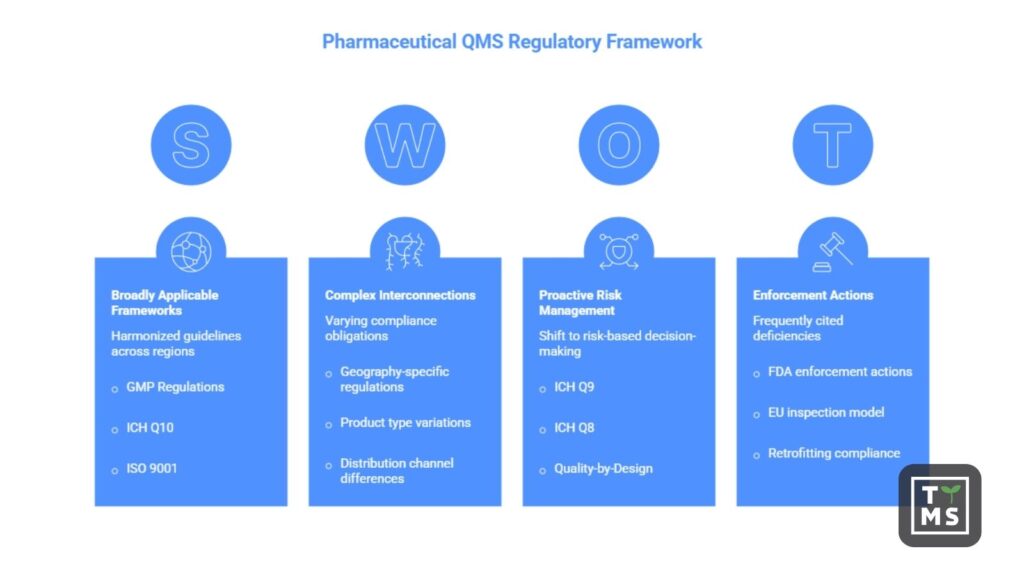
No pharmaceutical QMS operates in a regulatory vacuum. Compliance obligations vary by geography, product type, and distribution channel, but certain frameworks apply broadly across the industry. Knowing how these regulations interconnect is the starting point for designing a QMS that actually holds up under inspection.
2.1 Mandatory GMP Regulations
Good Manufacturing Practice regulations define the minimum standards manufacturers must meet to produce products that are safe, effective, and consistently made. GMP isn’t a single document but a collection of region-specific regulations and guidance, most sharing the same underlying principles: controlled processes, adequate facilities, qualified personnel, and reliable documentation.
2.1.1 FDA 21 CFR Parts 210 and 211: Drug Manufacturing and Finished Product Standards
FDA 21 CFR Parts 210 and 211 establish minimum current good manufacturing practice requirements for drug product preparation, excluding PET drugs. These regulations form the foundational predicate rule for any QMS FDA quality management structure in the United States, mandating controls over production processes, facilities, equipment calibration, laboratory testing, and records management. Quality unit oversight failures appear consistently among the most frequently cited deficiencies in FDA enforcement actions.
2.1.2 FDA 21 CFR Part 11: Electronic Records and Signatures
As pharmaceutical companies shift from paper to digital systems, Part 11 becomes increasingly relevant. This regulation governs electronic records and signatures created, modified, archived, or transmitted under FDA record requirements, ensuring they are as trustworthy as paper equivalents. In 2026, Part 11 is still actively enforced under a risk-based approach, particularly where predicate rules like Parts 210 and 211 already require specific documentation. Any organization implementing pharma QMS software needs to build Part 11 compliance into the architecture from the start. Retrofitting it later is painful and expensive.
2.1.3 EU GMP Guidelines and Annex 11: Computerized Systems
For companies selling into European markets, the EU GMP guidelines under EudraLex Volume 4 set the compliance baseline. Annex 11 specifically addresses computerized systems used in GMP-regulated environments, covering system design, validation, data integrity controls, and audit trail requirements. The principles closely parallel Part 11 but are applied through the EU’s risk-based inspection model. Organizations operating across both jurisdictions need a QMS architecture that satisfies both frameworks simultaneously, which is one reason computerized systems validation has become a specialized discipline of its own.
2.2 Guiding Frameworks and Industry Standards
Beyond mandatory regulations, several frameworks shape how quality systems in the pharmaceutical industry are designed and operated. These guidelines don’t carry the force of law, but regulators reference them heavily during inspections and expect companies to align with them.
2.3 ICH Q10: Pharmaceutical Quality System for Lifecycle Management
ICH Q10 provides the most comprehensive blueprint for a pharmaceutical quality system available to the industry. Endorsed by both the FDA and EMA as a harmonized framework, it defines the key elements of a pharmaceutical quality system, including management responsibility, knowledge management, continual improvement, and change control, across the full product lifecycle from development through discontinuation. ICH Q10 doesn’t replace GMP regulations; it provides the quality system architecture within which GMP requirements operate.
2.4 ICH Q8 and Q9: Pharmaceutical Development and Quality Risk Management
ICH Q9(R1), updated in 2023, defines the principles and tools for quality risk management in pharmaceutical processes. It supports the shift from reactive quality control to proactive risk-based decision-making, now a foundational expectation under both FDA and EMA inspection frameworks. ICH Q8, focused on pharmaceutical development, complements Q9 by emphasizing design space and quality-by-design principles that reduce variability before it ever reaches the manufacturing floor.
2.5 ISO 9001 and ISO 15378: Quality Standards Applicable to Pharma
ISO 15378 is particularly relevant for manufacturers of primary packaging materials such as pre-filled syringes, integrating GMP principles with ISO’s quality management framework. ISO 9001, the internationally recognized quality management standard, provides a broader foundation that many pharmaceutical organizations adopt alongside sector-specific regulations. Both are especially useful for organizations supplying pharmaceutical clients who need to demonstrate quality system maturity without being subject to direct GMP regulation.
3. Core Elements of a Pharmaceutical QMS
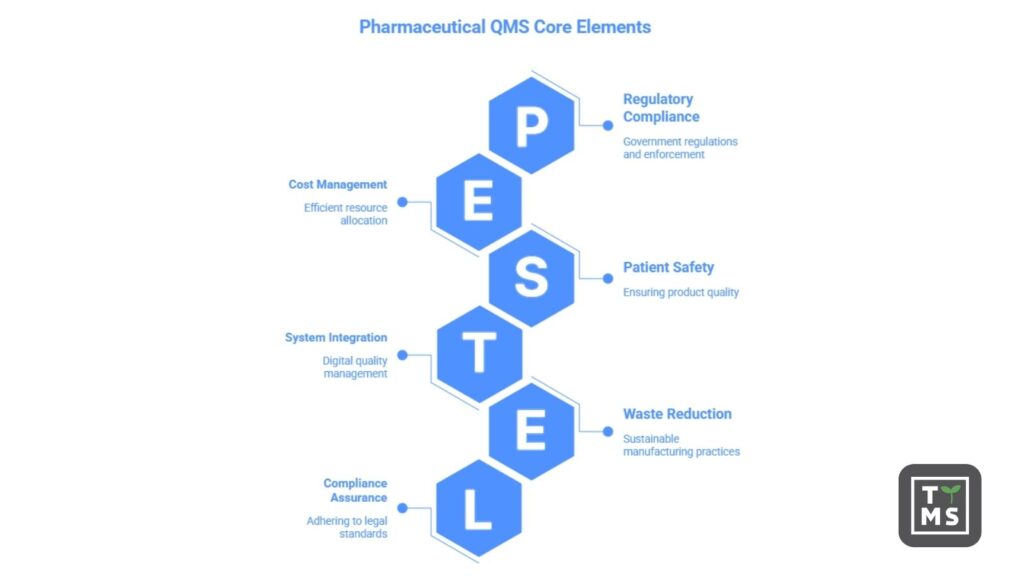
Pharmaceutical quality management systems share a common structural logic regardless of organization size or product type. Each element addresses a specific quality risk, and gaps in any one of them tend to ripple through the entire system.
3.1 Document and Change Control
Document control is the foundation of any pharmaceutical QMS because regulators evaluate quality through records. Document control failures appear in approximately 35% of FDA drug warning letters, covering issues like missing entries, undated procedures, and inconsistent version control. Effective document control ensures that every procedure, specification, and record is current, properly authorized, and accessible to the people who need it.
Change control is closely linked to this. Any modification to a validated process, system, formulation, or facility must pass through a formal review assessing quality impact before implementation. Poorly managed changes are a leading cause of process drift, unexpected deviations, and validation failures, making this one of the highest-leverage elements in the entire QMS.
3.2 Deviation Management and CAPA
When something goes wrong in pharmaceutical manufacturing, the response must be structured and traceable. Deviation management captures departures from established procedures, triggers an investigation, determines root cause, and documents the outcome. The quality of that investigation matters enormously. Over-relying on “operator error” as an explanation, without applying structured tools like the 5 Whys or fishbone analysis, produces weak findings and increases the likelihood of recurrence.
Corrective and Preventive Actions (CAPA) address root cause findings from deviations and, when well-executed, prevent those issues from coming back. Analysis of 113 inspection-based pharmaceutical warning letters in FY2024 found that weak process validation and CAPA effectiveness rank among the most consistent quality system failures, frequently tied to inadequate root cause documentation. The CDER Report on State of Pharmaceutical Quality confirms this pattern, and third-party enforcement trackers note that inadequate CAPA closure appears repeatedly alongside quality unit failures as a primary driver of enforcement action. A QMS that produces thorough, timely CAPA records is a reliable signal of organizational quality maturity.
3.3 Risk Management
Risk management in the pharmaceutical quality context isn’t a standalone document exercise. It’s a continuous activity that informs decisions about process design, change control, supplier qualification, and validation scope. ICH Q9(R1) provides the framework, and regulators increasingly expect to see documented risk assessments supporting major QMS decisions. In practical terms, whenever an organization changes a manufacturing process, qualifies a new supplier, or introduces a new system, there should be a traceable rationale for how risk was assessed and what controls were put in place.
3.4 Training and Competency Management
Personnel competency is the human dimension of the QMS. Every element of the system depends on people who understand their responsibilities and can execute procedures correctly. Training management tracks what training is required, when it was completed, and whether it actually worked. Among the top findings in FY2024 pharmaceutical warning letters, failure to maintain adequate quality control unit responsibilities was cited in 36 letters, the single most frequent deficiency, and it often traced back to personnel lacking current knowledge of the procedures they were supposed to follow. A robust training management process prevents this by establishing clear competency baselines and verification mechanisms.
3.5 Supplier Qualification and Management
Supply chain risk is a persistent enforcement priority. Weak supplier controls appear regularly in FDA enforcement actions, with firms cited for relying on unverified certificates of analysis and failing to conduct adequate identity testing for APIs and excipients. Over the past five years, 72% of API manufacturing sites subject to FDA regulatory actions exclusively supplied compounding pharmacies, despite representing only 18% of API manufacturers. Supplier qualification processes must include documented approval criteria, initial qualification activities, and ongoing monitoring, especially for high-risk foreign supply chains.
3.6 Validation, Qualification, and Product Quality Review
Validation confirms that processes, systems, and equipment consistently deliver the intended results. For pharmaceutical organizations, this covers process validation, cleaning validation, analytical method validation, and computerized systems validation. Equipment qualification, spanning installation, operation, and performance phases, provides documented evidence that critical equipment operates within established parameters.
Product quality reviews pull these threads together at the batch or product level, analyzing trends in quality data to identify improvements or emerging risks. These reviews are a regulatory requirement under both FDA and EU GMP frameworks and, when conducted rigorously, give one of the clearest pictures of how well the overall QMS is functioning.
3.7 Internal Audits, Self-Inspections, and Complaint Handling
Internal audits give organizations the ability to identify compliance gaps before regulators do. A well-run audit program covers all QMS elements on a risk-based schedule, documents findings clearly, and drives corrective action through the CAPA process. Complaint handling serves as the external signal equivalent, converting customer and patient feedback into structured quality data that can reveal process failures not visible through internal monitoring alone.
4. How to Implement a QMS in a Pharmaceutical Organization
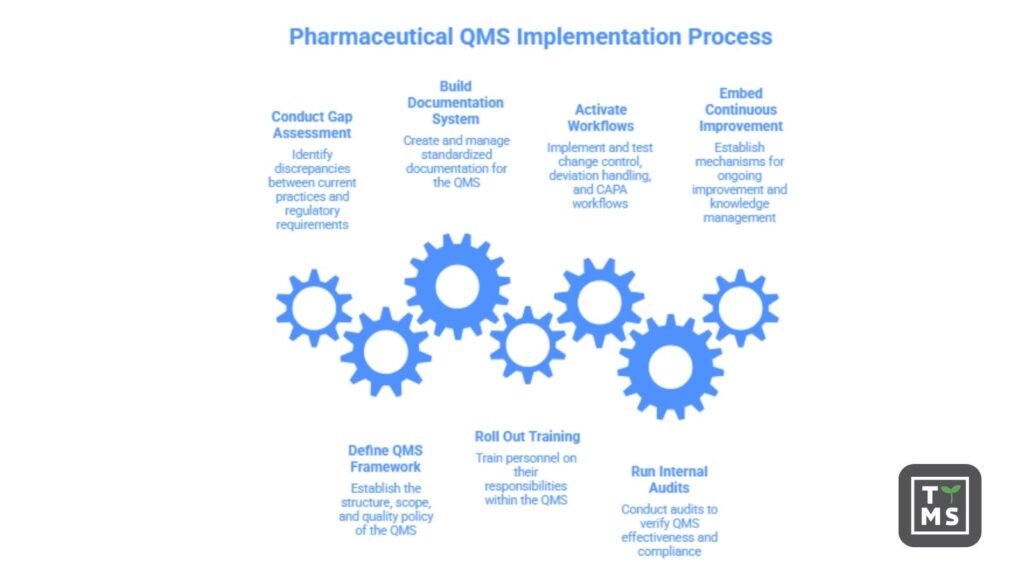
Building a pharmaceutical quality management system from scratch, or significantly upgrading an existing one, is a multi-phase undertaking. The sequence matters. Organizations that try to implement everything simultaneously typically create documentation that looks complete on paper but lacks the organizational embedding needed to sustain it.
Step 1: Conduct a Gap Assessment Against Regulatory Requirements
The first task is understanding where you currently stand. A gap assessment compares existing processes, documentation, and controls against applicable regulatory requirements, typically FDA 21 CFR Parts 210 and 211, ICH Q10, and relevant ISO standards. This produces a prioritized list of what needs to be built, updated, or retired, and it forms the business case for resource allocation. Organizations using TTMS’s quality audit services benefit from an external perspective at this stage, since internal teams often normalize compliance gaps that outside auditors flag immediately.
In one engagement with a mid-size API manufacturer preparing for an EMA inspection, TTMS conducted a gap assessment that identified 23 open deviations with incomplete root cause documentation. Within 90 days of implementing a structured CAPA workflow and investigator training program, the client had closed all critical findings before the scheduled inspection window. Starting with an honest baseline rather than an optimistic one made that outcome possible.
Step 2: Define Your QMS Framework, Scope, and Quality Policy
Once gaps are mapped, the organization needs a documented framework defining how the QMS is structured, which products and sites it covers, and what the quality policy commits the organization to achieving. This isn’t a purely administrative exercise. The scope decision directly affects which regulations apply, how validation activities are scoped, and how supplier qualification is managed across the supply chain.
Step 3: Build and Standardize Your Documentation System
Documentation is the evidence layer of the QMS. Standard operating procedures, work instructions, specifications, and forms need to be written to a consistent format, version-controlled, and stored in a system that ensures only current, approved versions are in circulation. This is where many organizations discover the limits of spreadsheets and shared drives, and where the case for a dedicated document management platform becomes compelling. TTMS supports this transition through its document validation software, automating validation within EDMS environments and ensuring compliance with GAMP 5.0 standards.
Step 4: Roll Out Training and Establish Competency Baselines
A new or revised QMS only works if the people operating it actually understand their responsibilities. Training rollout should be sequenced alongside documentation releases, ensuring personnel are trained on current procedures before they’re expected to follow them. Competency baselines, defined as minimum knowledge and skill standards for each role, provide the reference point against which training effectiveness can be measured.
Step 5: Activate Change Control, Deviation Handling, and CAPA Workflows
Change control, deviation management, and CAPA are the operational heart of the QMS. Once documentation is in place and people are trained, these workflows need to be activated and tested. Early deviations from the expected process are valuable learning opportunities; they reveal where procedures are unclear, where training needs reinforcement, or where system design needs adjustment. The goal at this stage isn’t perfection but a functioning feedback loop.
Step 6: Run Internal Audits and Management Reviews
The first full cycle of internal audits after implementation serves two purposes: verifying that the QMS is working as designed, and demonstrating to regulators that the organization has an active self-assessment program. Management reviews, conducted at planned intervals, use audit findings, CAPA status, quality metrics, and regulatory intelligence to assess overall system performance and set improvement priorities.
Step 7: Embed Continuous Improvement and Knowledge Management
A QMS that stays static degrades over time. Regulations change, products evolve, and operational experience accumulates. ICH Q10 places knowledge management at the center of the pharmaceutical quality system, recognizing that the ability to capture, share, and apply quality knowledge is what separates organizations that improve from those that repeat the same problems. Building structured mechanisms for trend analysis, lessons-learned documentation, and regulatory horizon scanning sustains the QMS through product lifecycle changes and inspection cycles.
5. Paper-Based QMS vs. Electronic QMS (eQMS): Making the Transition
The pharmaceutical industry has been moving from paper-based quality systems to electronic platforms for years, and that shift is now effectively mandatory for any organization operating at scale. Despite this, only 29% of life sciences organizations have fully implemented their QMS across all facilities, even though 85% have purchased a quality management system. The gap between ownership and deployment is exactly where quality risk accumulates.
5.1 Risks and Limitations of Paper-Based Quality Systems
Paper-based quality systems create structural vulnerabilities that are genuinely difficult to manage away. Data hygiene and role-based access controls are, as regulators have noted, nearly impossible to enforce with paper or spreadsheet systems. FDA warning letters document the consequences: procedures that are informal, undated, or not version-controlled; deviation investigations with incomplete documentation; and quality units that lost visibility into production activities because records weren’t accessible in real time.
The inspection risk compounds over time. Auditors reviewing paper systems spend significant time on records requests and document retrieval, which means any gap in filing, version control, or completeness gets exposed under scrutiny. Organizations facing FDA §704(a)(4) records requests, a growing enforcement tool, are particularly exposed when records management is paper-based. These requests carry short response windows and leave very little room for manual retrieval.
5.2 Key Capabilities to Evaluate in Pharma eQMS Software
Selecting pharma QMS software is a long-term architectural decision, not a routine procurement exercise. The platform needs to do more than digitize existing paper processes; it needs to support the risk-based, lifecycle-oriented quality management model regulators expect. Rather than checking off standard features, organizations benefit from applying three evaluative criteria that reflect genuine operational complexity.
The first is validated state maintenance model. Platforms differ significantly in how they handle system updates after initial qualification. A configuration-based qualification approach reduces long-term CSV burden because changes to configurable parameters don’t trigger full re-execution of IQ/OQ/PQ protocols. Platforms requiring complete revalidation for routine updates impose substantial ongoing compliance costs that rarely surface during vendor demonstrations. TTMS’s experience maintaining validated states for platforms like Veeva Vault reflects how significant this distinction is in practice.
The second is inspection readiness. The ability to produce a complete, attributable audit trail for a specific batch, document change, or user action within minutes isn’t a convenience feature; it’s operationally critical under FDA §704(a)(4) records requests. Systems requiring custom reporting or manual assembly of audit trail evidence create inspection risk that only surfaces under pressure.
The third is regulatory divergence handling. Organizations operating under both FDA Part 11 and EU GMP Annex 11 face real divergence on specific controls, including electronic signature standards and audit trail scope. An eQMS that can’t manage parallel compliance requirements without manual workarounds will create ongoing maintenance overhead and inspection exposure as regulatory interpretations continue to evolve.
Quality leaders are more than 60% more likely to implement an electronic QMS and nearly 50% more likely to have it deployed enterprise-wide. That correlation isn’t coincidental. Organizations serious about pharmaceutical quality control invest in the infrastructure that makes it scalable and sustainable.
6. Common QMS Implementation Challenges and How to Overcome Them
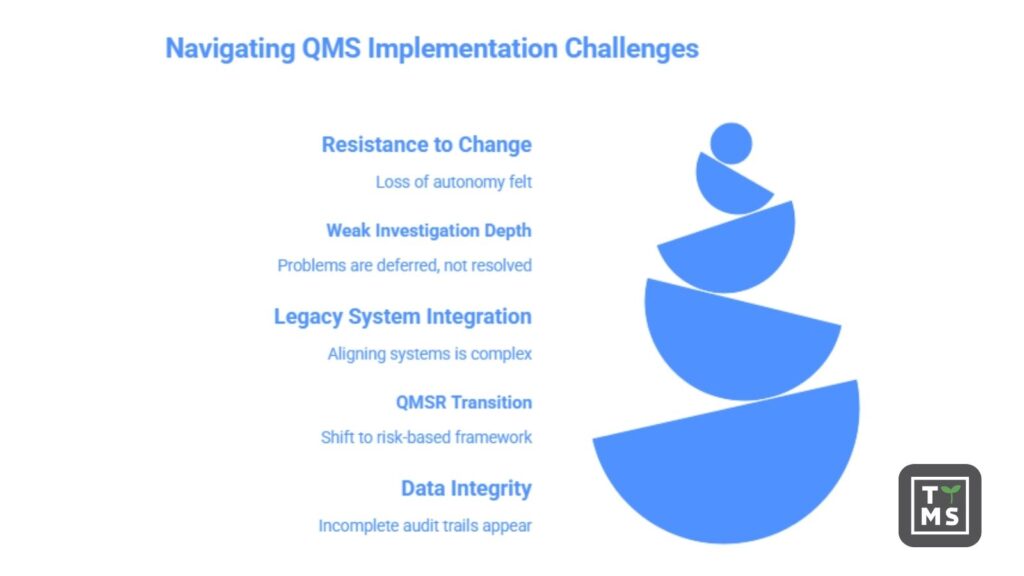
Even well-resourced organizations run into predictable difficulties when building or upgrading a pharmaceutical quality management system. Knowing where these challenges typically appear makes them much easier to anticipate.
Resistance to change is nearly universal. Quality systems require people to follow documented procedures, escalate deviations, and accept oversight of their work. That can feel like a loss of autonomy, especially in organizations where informal practices have worked “well enough” for years. The most effective counter is leadership visibility. When senior management participates in management reviews, acts on audit findings, and visibly applies quality principles to their own decisions, the culture shifts over time.
Weak investigation depth is a recurring technical problem. Organizations that routinely attribute deviations to operator error without deeper analysis aren’t resolving problems; they’re deferring them. Structured root cause analysis tools need to be built into deviation management workflows, and investigators need training in their application. The same FY2024 pharmaceutical enforcement data showing quality unit failures as the top finding also reveals that incomplete CAPA closure and inadequate investigation documentation are the most consistent upstream causes.
Legacy system integration presents a practical barrier that becomes more acute as organizations adopt electronic QMS platforms. Aligning aging ERP systems, laboratory information management systems, and manufacturing execution systems with a new eQMS requires careful planning, interface validation, and often significant IT resource. TTMS addresses this through its computerized systems validation methodology, providing strategic support across the full system lifecycle from design through retirement, using GAMP 5.0 and risk-based validation approaches that account for system interdependencies.
The QMSR transition effective February 2026 adds another layer of complexity for organizations that have historically aligned their QMS with FDA’s Quality System Regulation. The shift to a risk-based, ISO 13485-aligned framework requires gap analyses covering CAPA, supplier controls, process validation, and nonconformance management. For companies that haven’t yet started this assessment, the window is narrow.
Data integrity remains an area of sustained regulatory focus. Incomplete audit trails, unauthorized system access, and records that can’t be attributed to specific individuals continue to appear in FDA observations. Moving to a validated, cloud-based QMS with role-based access and automated audit trail capture removes much of the manual data integrity burden, but the transition itself must be managed carefully to avoid creating new gaps in the process.
7. Frequently Asked Questions About Quality Management Systems in Pharma
What is a QMS system in the pharmaceutical context?
A pharmaceutical QMS is a documented framework of policies, processes, and controls designed to ensure that medicinal products are consistently manufactured, tested, and released to quality standards. It integrates regulatory compliance requirements from bodies like the FDA and EMA with operational processes covering documentation, training, deviation management, supplier qualification, and continuous improvement.
What is the difference between GMP and a QMS?
GMP regulations define minimum standards for manufacturing processes and facilities. A QMS is the overarching system that implements and manages compliance with those standards. GMP tells you what the requirements are; the QMS is the operational structure that ensures you meet them consistently.
Which regulations must a pharma QMS address?
In the United States, pharma QMS must comply with FDA 21 CFR Parts 210 and 211 for drug manufacturing and 21 CFR Part 11 for electronic records. In the European Union, QMS must address EudraLex Volume 4 GMP guidelines, including Annex 11 (computerised systems) and Annex 15 (qualification and validation). Globally, harmonized frameworks include ICH Q10, Q9(R1), and Q8. ISO 9001 and ISO 15378 apply to organizations operating under ISO certification, particularly packaging suppliers.
What are the most common QMS failures in FDA inspections?
The most common QMS failures cited during FDA inspections include inadequate quality unit oversight, weak CAPA systems, poor document control, data integrity deficiencies, and insufficient component identity testing. Based on FY2024 enforcement trends, contamination remained the most frequently reported postmarket defect, particularly affecting ophthalmic agents, antibacterials, and other sterile products.
When should a pharma company move to an eQMS?
The practical answer is before document volume and process complexity exceed what paper-based systems can manage reliably. For most organizations, that threshold arrives well before they expect it. The regulatory risk of paper-based records grows with organizational size, product complexity, and inspection frequency. Transitioning to a validated electronic QMS, particularly a cloud-based platform with integrated audit trail and role-based access, significantly reduces that risk and improves inspection readiness.
How does TTMS support pharmaceutical QMS implementation?
TTMS provides end-to-end quality management services structured around its 4Q service framework: computerized systems validation, equipment and process qualification, secure IT and manufacturing process design, and compliance audits. With extensive experience supporting large international pharmaceutical companies under FDA and EU GMP frameworks, TTMS combines technical validation expertise with practical quality management knowledge to help organizations build, maintain, and continuously improve their quality systems. Whether the challenge is a new eQMS implementation, maintaining a validated state for legacy systems, or preparing for a regulatory audit, TTMS offers both on-site and remote delivery tailored to client needs.