A sales rep in Manila may need to learn the same product update as an engineer in Warsaw or a compliance officer in Toronto. Yet they work in different languages, time zones, and regulatory environments. For companies running global employee training programs in 2026, this makes a single standardized training deck increasingly impractical.
Global training therefore requires a balance between consistency and local relevance. Core knowledge, processes, and brand standards may stay the same across markets, while other parts of the training need to reflect local regulations, language, culture, or job-specific requirements.
The challenge is not simply to translate the same course into multiple languages. It is to decide what should remain standardized, what needs to be adapted, and where full localization is necessary. The right approach can make training easier to scale, more relevant for employees, and more consistent across regions.
1. What Global Employee Training Looks Like in 2026
Global employee training in 2026 is increasingly designed around a shared core with room for local adaptation. Companies may standardize product knowledge, internal processes, brand guidelines, or compliance principles, while adjusting language, examples, legal references, and delivery formats for individual markets.
Digital learning platforms make this approach easier to manage across regions. Employees in São Paulo and Seoul can complete the same core course while receiving content adapted to their language, role, or local requirements. This helps organizations maintain consistency without if every audience should receive exactly the same version of the training.
Artificial intelligence and data analytics have added another layer of sophistication. Training systems now track how individual employees learn, where they struggle, and what content keeps them engaged, then adjust the experience accordingly. Personalization has become the baseline expectation for global employee training and development, not some nice-to-have extra.
1.1 Key Differences from Traditional, Single-Region Training
Traditional training is often designed for one language, regulatory environment, and organizational context. Global employee training has to account for several of these at the same time.
A compliance or safety course, for example, may need more than a direct translation. Legal terminology, procedures, examples, and even the way instructions are presented can differ between countries. Live training also requires additional planning when employees are spread across time zones.
As a result, global training programs are usually built around a combination of standardized and localized content. The key is deciding which elements need to remain consistent across the organization and which should be adapted for a particular market or audience.
1.2 Why This Matters Now: Distributed Teams, AI, and Skills Gaps
Distributed teams are the norm rather than the exception, and that alone forces companies to rethink how they train people. Add rapidly evolving AI tools and widening skills gaps across industries, and the pressure to modernize training becomes hard to ignore. Companies that fail to adapt risk losing talent to competitors offering more relevant, more accessible learning experiences. Those that invest in scalable solutions for global employee training are better positioned to keep pace with both technology shifts and workforce expectations.
2. The Business Case: Benefits of Global Employee Training and Development
Global employee training supports much more than compliance. It helps companies build the skills they need across different markets, introduce new processes more consistently, reduce operational risk, and give employees a clearer understanding of what is expected of them.
Its value is especially visible in organizations that operate across several countries, where differences in skills, regulations, language, and local working practices can quickly create gaps between teams.
2.1 Closing Skills Gaps Across Markets
Skills gaps rarely look the same from one region to the next. A well-designed global training program identifies where those gaps exist and builds targeted content to close them, so every market has the competencies it needs to hit business goals. This matters especially as new technologies and processes roll out faster than ever, leaving less room for regional teams to fall behind.
2.2 Boosting Engagement, Confidence, and Retention Worldwide
Employees who feel equipped to do their jobs well tend to stick around longer. Strong training programs give people the confidence to take on new responsibilities, and that confidence translates into higher engagement and better retention across every office, not just headquarters.
2.3 Strengthening Compliance and Reducing Regional Risk
Regulations differ from country to country, and getting them wrong can be costly. A structured global training approach makes sure compliance training reflects local laws while still aligning with company-wide standards, which keeps costly missteps in any one market to a minimum.
2.4 Building a Consistent Culture Across Borders
Culture can fracture quickly across a distributed workforce if there’s no shared thread connecting offices. Training is one of the most effective tools for reinforcing company values and expectations everywhere the business operates. It gives teams a sense of belonging to the same organization, even when they’ve never met face to face.
3. Common Challenges in Training a Global, Distributed Workforce
Running training across several countries introduces challenges that are less visible in a single-market program. Language, time zones, local regulations, infrastructure, and differences in learning culture all affect how training should be designed and delivered.
The difficulty is usually not creating one course. It is maintaining a program that works across different environments without making it unnecessarily complex or expensive.
3.1 Language and Cultural Diversity
Language barriers can quietly undermine even the best-designed course. Beyond translation, cultural context shapes how people read examples, humor, feedback, all of it, and training that ignores this risks losing its audience before the message ever lands. Automated translation tools help with speed, but they still miss idiom and tone often enough that human review remains necessary before content goes live in a new market.
3.2 Time Zone and Logistical Barriers
Coordinating live sessions across a dozen time zones is nearly impossible without leaving someone out. That’s pushing companies toward asynchronous, self-paced formats that let employees engage with material on their own schedule instead of forcing everyone into the same time slot. The trade-off: self-paced courses without any live touchpoint or accountability structure tend to see weaker completion rates than blended formats, which is worth weighing before going fully asynchronous.
3.3 Balancing Global Consistency with Local Relevance
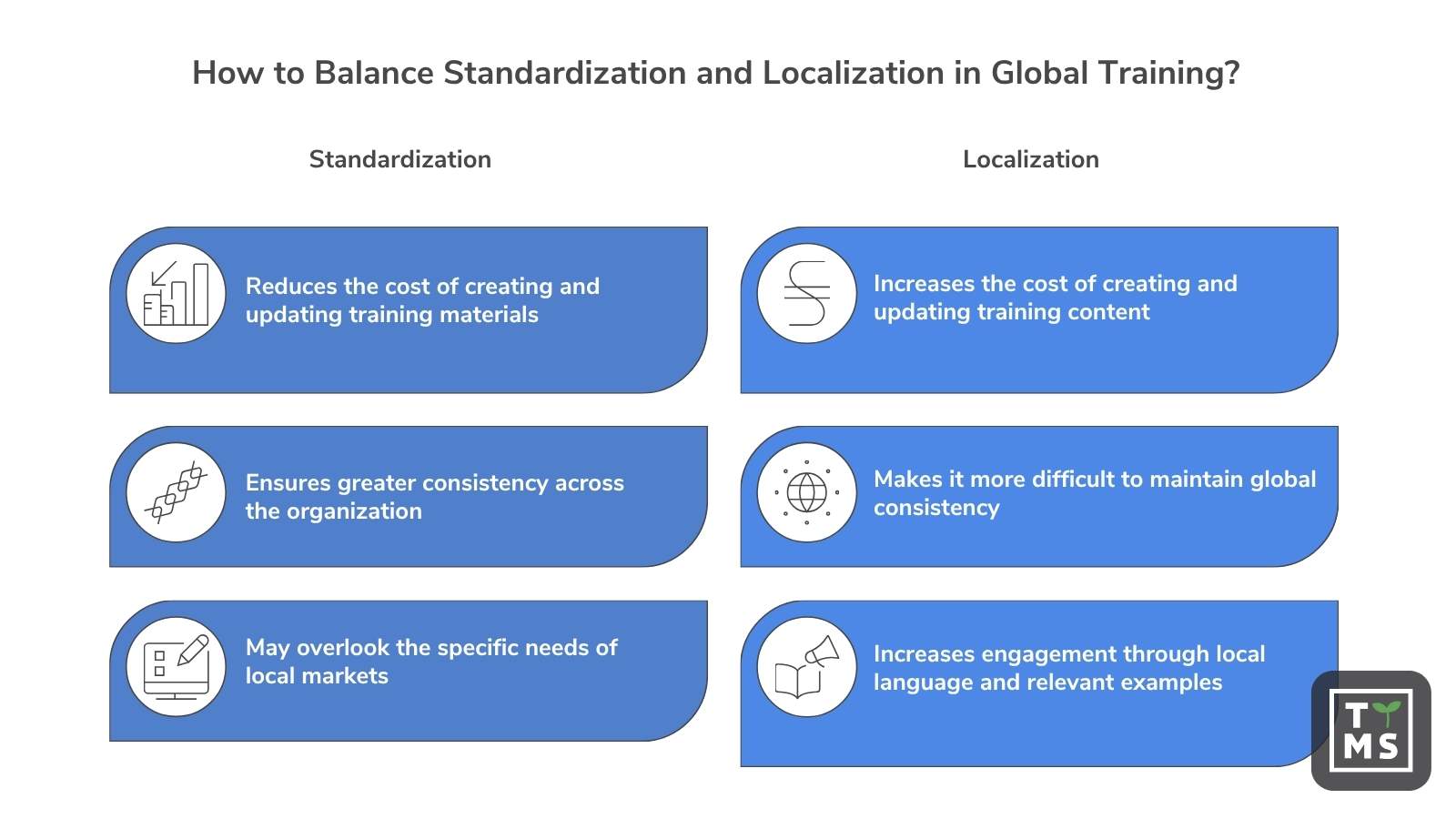
Lean too hard on standardization and training feels disconnected from local realities. Lean too hard on localization and the company loses a consistent message, plus the cost and coordination burden can outweigh the benefit for smaller or less regulated markets. Striking that balance is one of the harder judgment calls in designing any global employee training and development strategy.
3.4 Technology and Infrastructure Disparities
Not every office has the same bandwidth, devices, or digital literacy. Training platforms need to work reliably across varying levels of technological infrastructure, or entire regions risk being left with a worse learning experience than others.
3.5 Measuring Impact Across Multiple Regions
Data collected in one market doesn’t always translate cleanly to another. Comparing outcomes across regions requires consistent metrics and reporting tools, otherwise it becomes difficult to know whether the program is working everywhere it’s deployed.
4. FourCore Strategies for Structuring Global Training Programs
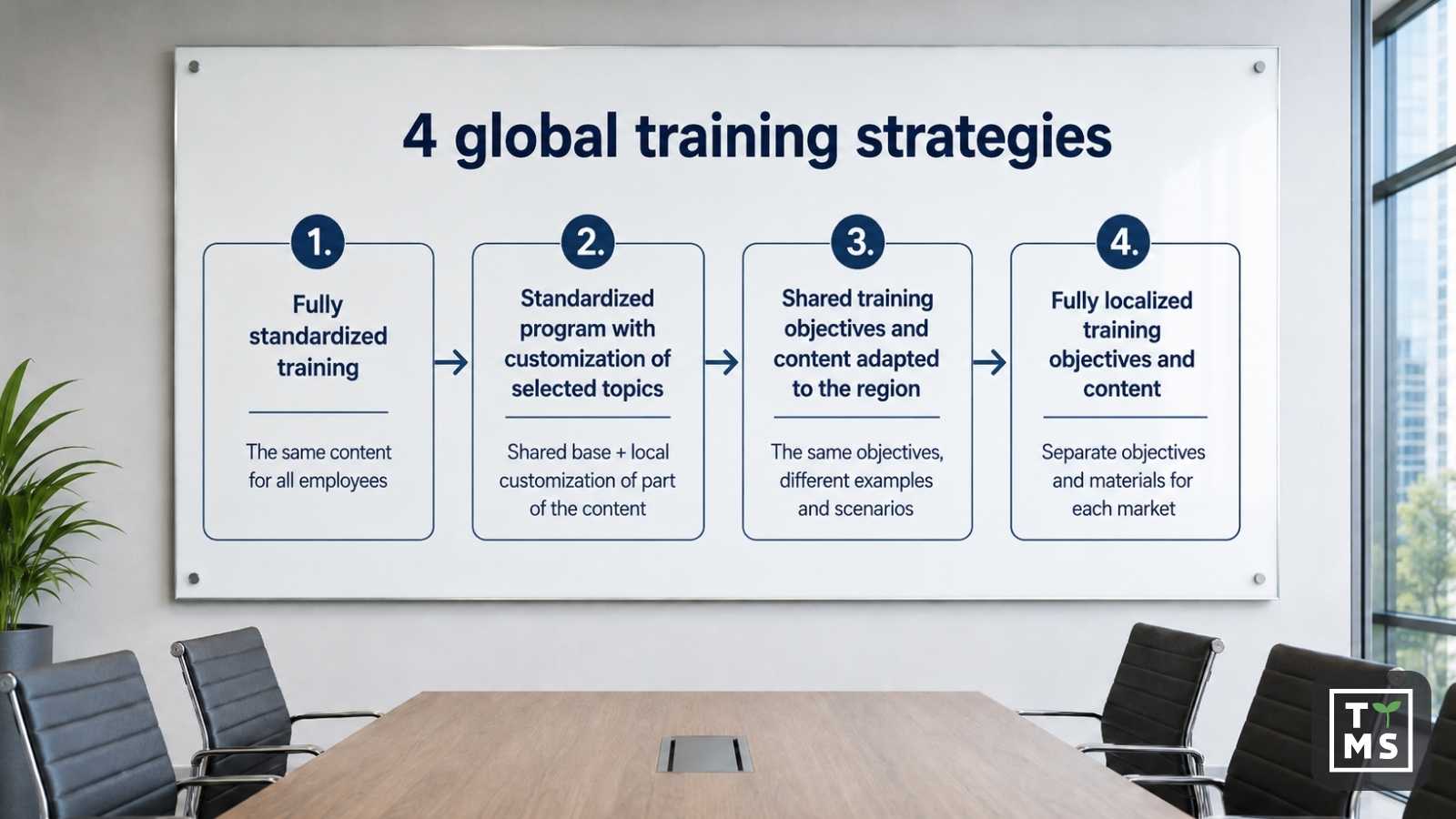
Companies generally choose from four broad approaches when structuring global training, each with its own trade-offs between simplicity and personalization.
Strategy 1: Fully Standardized Training for All Topics
This approach delivers identical content everywhere. It’s the easiest to build and maintain, but it risks missing the cultural and regulatory details that matter in specific markets.
Strategy 2: Standardized Approach, Customized by Topic
Here, some topics stay uniform across the company while others get adapted per region. This gives more flexibility than a fully standardized model without the resource demands of full localization.
Strategy 3: Shared Objectives with Region-Specific Content
Under this strategy, every region works toward the same learning objectives but builds content that fits local context. It’s a middle ground that keeps the company aligned while respecting regional differences.
Strategy 4: Fully Localized Objectives and Content per Region
This is the most tailored approach, with both objectives and content built specifically for each market. It delivers the most relevant experience but demands significant time, budget, and coordination, and it’s often overkilled for smaller regional offices or lightly regulated topics where a shared, lightly adapted version works just as well.
Choosing the Right Strategy for Your Organization
The right strategy depends on company size, industry regulation, and how much variation exists between regional teams. Organizations with tighter budgets often start with a standardized core and layer in customization as they scale, while larger multinationals with complex regulatory needs may need full localization from day one.
5. Building Blocks of an Effective Global Training and Development Program
A global training strategy needs to translate into a program that employees can actually use across different countries, roles, and working environments. That means deciding what people need to learn, which content should be shared globally, where local adaptation is necessary, and how employees will access the training.
5.1 Types of Training to Include: Technical, Compliance, Leadership, and Soft Skills
Most global training programs cover several different areas. These may include role-specific technical skills, compliance and safety training, leadership development, product knowledge, and soft skills such as communication or teamwork.
They do not all require the same approach. Product or process training can often use a common global core, while compliance content may need significant changes to reflect local regulations. Leadership and communication training may also need different examples or scenarios depending on the cultural and organizational context.
5.2 Localization and Multilingual Content Delivery
Localization goes beyond swapping words from one language to another. It means adjusting examples, tone, and even visual design so the material feels natural to the audience. Multilingual delivery has become a baseline expectation for any employee training platform for global companies serving a diverse workforce.
5.3 Blended and Self-Paced Learning Models for Different Time Zones
Combining live sessions with self-paced modules gives employees flexibility to learn when it suits them, without losing the benefits of interactive discussion when schedules do align. This blended model has become one of the most practical answers to the time zone problem.
5.4 Peer Learning and Regional Mentorship Networks
Some knowledge is easier to develop through interaction with colleagues than through a course alone.
Regional mentors, subject-matter experts, and peer groups can help employees apply what they have learned to their actual work. They can also answer questions that are specific to a particular market, customer group, or local process.
This is especially useful after formal training has finished, when employees start applying new knowledge in day-to-day situations.
6. Using AI and Technology to Scale Training for Skills Development
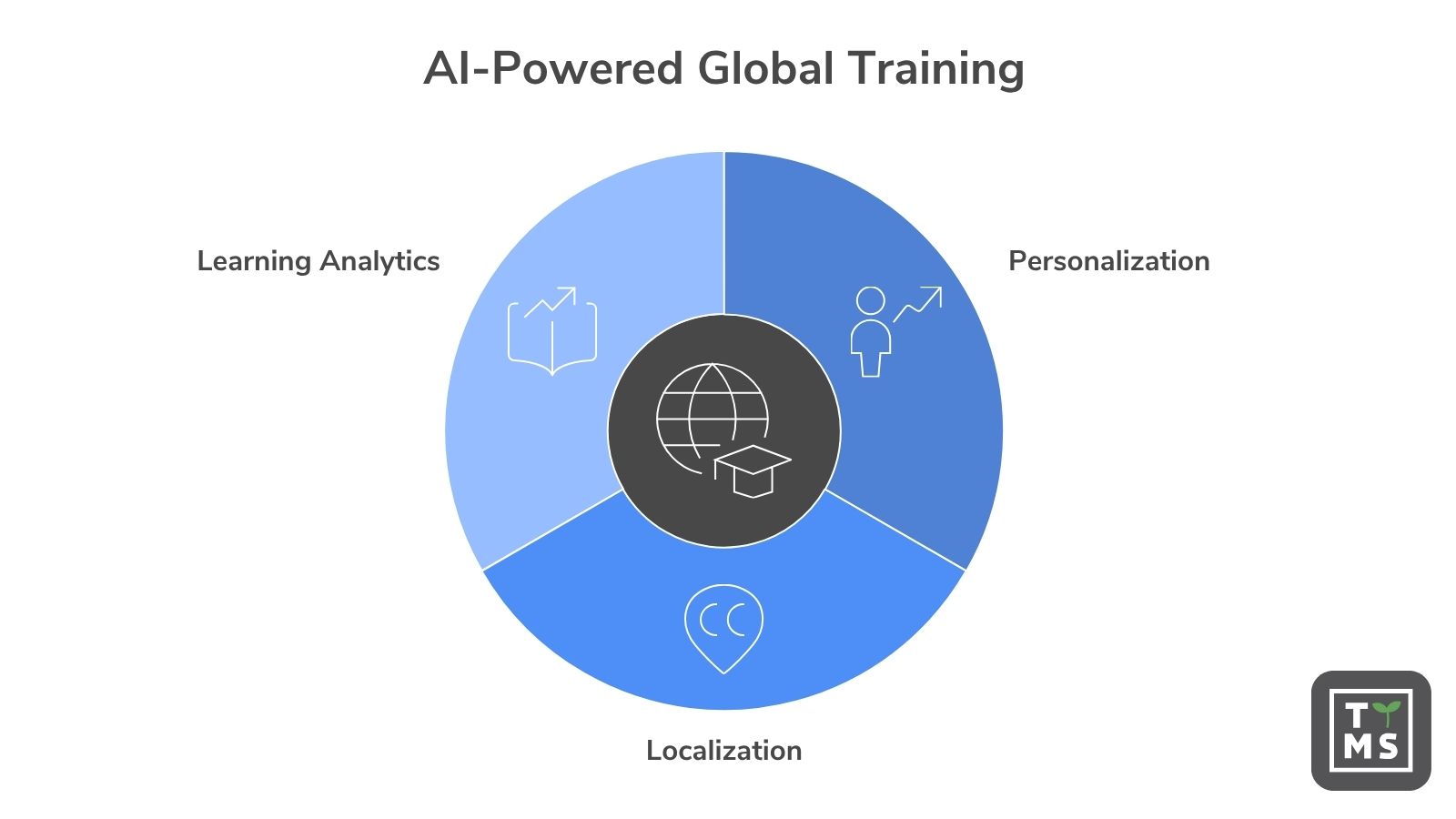
Technology makes it possible to deliver and manage training across large, distributed teams. AI can support this process by helping organizations personalize learning, adapt content, translate materials, and analyze training data. Human review is still important, especially when content involves compliance, safety, culture, or sensitive terminology.
6.1 AI-Driven Personalization and Adaptive Learning Paths
AI can adjust a learning path in real time based on how an individual employee is progressing. It gives someone more practice where they’re struggling and pushes them faster through material they’ve already nailed down. This kind of personalization would be nearly impossible to manage manually across a large, distributed workforce.
6.2 Automated Translation and Localization Tools
Automated translation tools speed up the process of adapting content for multiple markets, cutting both cost and turnaround time. Paired with human review for cultural accuracy, these tools make multilingual delivery far more manageable than it used to be, though relying on machine translation alone still creates a real risk of tone-deaf or awkward phrasing in markets with limited review.
6.3 Learning Analytics for Real-Time Performance Insights
Learning analytics help L&D teams understand how employees are progressing across courses and regions. They can show completion rates, assessment results, engagement with individual modules, or areas where learners repeatedly encounter difficulties.
This data can be used to improve existing courses, identify skills gaps, and decide where additional training or support is needed. It also gives global training teams a more consistent way to compare results across markets.
TTMS supports organizations in building and maintaining this type of learning environment through its AI Solutions and E-Learning administration services. Depending on the scale and complexity of the program, this may include AI-assisted content creation and adaptation, multilingual course management, hosting, reporting, and ongoing updates.
The level of technology should match the actual training needs. A large international program may benefit from automation and advanced analytics, while a smaller rollout can often be managed effectively with a simpler platform and a well-defined review process.
7. How to Implement a Global Training Strategy
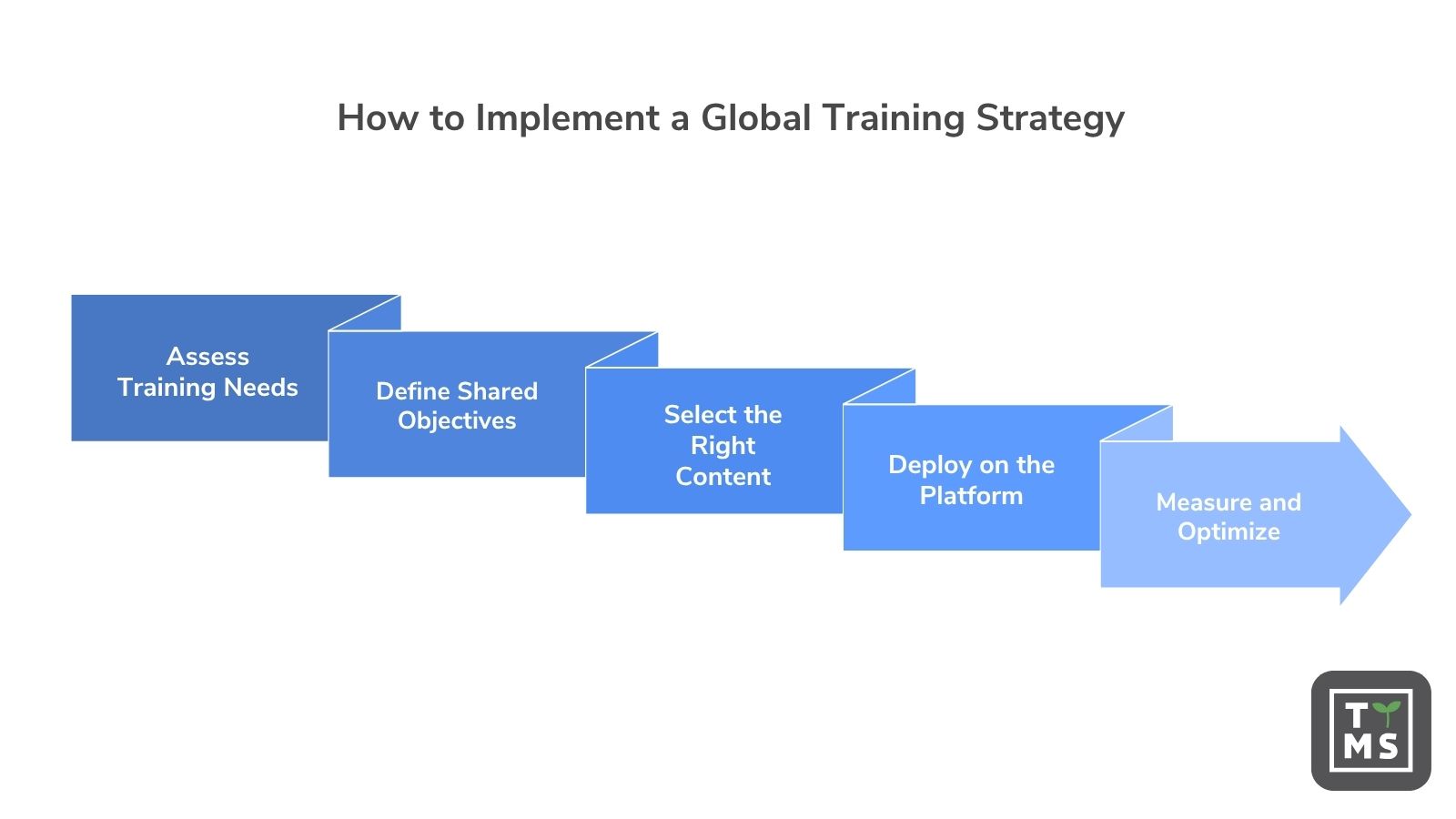
Rolling out a global training strategy starts with a clear assessment of organizational needs and a definition of what success should look like. From there, companies select the training methods and delivery formats that fit their workforce, whether that means blended learning, mobile-first content, or live regional workshops. Engaging local stakeholders early is essential, since they’re the ones who know which cultural or regulatory details need attention before content goes live.
Technology plays a central role in execution. An employee training platform for global companies needs to handle content hosting, multilingual delivery, and progress tracking, ideally within a single system rather than a patchwork of tools. Continuous evaluation and feedback loops then let teams refine the program over time, rather than treating the initial rollout as a finished product.
TTMS can also support the operational side of a global training rollout by automating processes around course assignment, approvals, reminders, and completion tracking. With Process Automation and Low-Code Power Apps, these workflows can be connected across departments and regional offices, reducing the need to manage them through separate spreadsheets or manual email exchanges. For organizations already using Microsoft 365 and Azure, training processes can also be integrated with the tools employees and administrators use every day.
8. Measuring ROI and Impact of Corporate Training Programs Globally
Proving the value of a global training investment requires looking at more than completion rates. Organizations should track performance indicators tied to productivity, retention, and skill application on the job, alongside qualitative feedback that reveals how employees perceive the training’s usefulness. Comparing outcomes between trained and untrained groups offers one of the clearest ways to demonstrate tangible impact and gives leadership the evidence it needs to justify continued investment or adjust course where results fall short.
Business Intelligence tools, such as Snowflake DWH and Power BI, can play a useful role here by consolidating training data from multiple regions into a single view. That makes it far easier to spot trends and report results across the organization instead of reviewing each market’s numbers in isolation.
9. Real-World Examples of Global Employee Training Done Right
Successful global employee training starts with matching the learning format to the content, audience, and business context. Some topics can be delivered through standardized materials across regions, while others require a more tailored approach because of local regulations, safety requirements, language, or cultural differences.
A good example comes from a global production and technology company that needed to standardize Health & Safety training for production and office employees across five locations worldwide. Previously, individual sites used different materials, which made it difficult to ensure that employees received the same information and that training completion was properly tracked.
TTMS developed a single interactive e-learning course built around workplace scenarios and storytelling. Employees worked through situations that could lead to accidents and selected the appropriate response, receiving immediate feedback on their decisions. The course helped the company deliver the same core safety principles across a multicultural workforce while replacing part of its previously time-consuming classroom training.
The platform also gave managers visibility into who had started or completed the training and automatically reminded employees about approaching deadlines. According to the case study, the organization subsequently recorded fewer accidents across its locations.
This example shows an important principle of global employee training: not every subject should be handled in the same way. Compliance and safety content often needs more careful adaptation and stronger learner engagement, while other training can remain more standardized. Technology makes it easier to distribute and update learning across locations, but the format and level of localization should still reflect the needs of each audience.
If you are planning to scale employee training across countries, languages, or business units, TTMS can help you choose the right mix of standardization, localization, technology, and content formats. Talk to our e-learning experts about your training needs and the best way to structure a global program.
Frequently Asked Questions
What is global employee training?
Global employee training refers to the systematic development of skills and knowledge among employees across different regions and cultures, ensuring that training is relevant, accessible, and effective for a diverse workforce.
How to manage global employee training?
Managing global employee training involves understanding cultural differences, using technology to improve accessibility, and making sure training content is both standardized and localized to meet regional needs.
How do companies handle language barriers in global training?
Companies address language barriers by localizing training content, using multilingual support, and employing translation tools to ensure that all employees can understand and engage with the training material.
What’s the difference between standardized and localized training?
Standardized training provides a uniform approach across all regions, while localized training adapts content to fit the specific cultural and linguistic needs of different employee groups.
How do you measure the success of a global training program?
Success can be measured through various metrics, including employee performance improvements, retention rates, engagement levels, and feedback from participants regarding the training’s relevance and effectiveness.
Building an effective global employee training program takes more than good intentions. It needs the right mix of strategy, localization, and technology, plus a partner who knows how to bring those pieces together. Companies exploring global employee training management software or looking to modernize their approach to workforce learning can turn to TTMS for guidance grounded in real IT implementation experience across AI, automation, and e-learning administration.