1. From Detection to Decision: The Evolution of Counter-Drone Systems
Counter-drone capability is no longer a niche air-defence add-on. It is becoming a core layer of force protection, base defence, manoeuvre support, and critical-infrastructure resilience. Recent policy from the U.S. Department of Defense treats the rapid proliferation of unmanned systems as a strategic problem, not merely a tactical one, and links the threat directly to growing autonomy, AI, networking, and mass availability. In practice, that means decision-makers should stop asking whether AI belongs in counter-UAS and start asking where in the kill chain it delivers measurable advantage without creating unacceptable legal, cyber, or operational risk.
The strongest emerging design pattern is not “one better sensor” but a layered system-of-systems: radar for wide-area surveillance, RF/SIGINT for emissions-based early warning and attribution, EO/IR for recognition, acoustic sensing for close-range passive cueing, and AI-driven fusion to reduce false alarms, prioritize tracks, and compress operator workload. That architecture aligns with current Army sensor-integration efforts and reflects a broader shift toward. For organizations building counter-drone capabilities, the implication is clear: the defensible value lies not in a single model, but in open integration, common data models, edge-ready inference, secure middleware, and verification pipelines that connect sensors, C2 workflows, and effectors into a functioning whole.
2. The Problem AI Must Solve
The problem statement is sharper than “detect the drone.” A defendable counter-drone AI stack must identify a small, low, slow, and often low-cost target in clutter; distinguish it from birds, friendly UAS, or civilian traffic; maintain track continuity under manoeuvre and intermittent observability; estimate intent and threat level; and support a lawful neutralization decision quickly enough to matter. The operational burden is compounded by the fact that many drones are cheap enough to be used in swarms or in repeated probing attacks, which puts enormous pressure on operator attention and on the cost-per-engagement equation.
That is why current defence thinking places increased emphasis on machine-speed decision support, passive and active defences, and layered architectures that can scale from installation protection to mobile formations. Army C-UAS experimentation now explicitly frames the requirement around integrating best-of-breed sensors, reducing cognitive load, and speeding decisions from human tempo toward machine tempo, while still keeping commanders and operators responsible for force application.
3. Sensing Modalities and Multi-Sensor Fusion
No single sensor closes the counter-drone problem. Recent reviews and programme evidence converge on the same point: radar, RF, EO/IR, acoustic, and passive sensing each solve different parts of detection, classification, and localization, and each fails under different conditions. Radar remains the backbone for all-weather surveillance and early track generation. EO/IR remains the strongest route to visual confirmation and forensic-quality evidence. RF and SIGINT layers can classify protocols, identify emitters, or exploit Remote ID and telemetry when they are present. Acoustic sensing adds a cheap passive layer at shorter range, especially in the last hundreds of metres. The result is a strong bias toward fused architectures rather than monolithic point solutions.
The state of the art is moving from simple sensor “stacking” to explicit fusion at different levels. Pereira et al. (2024) compare pixel-level and decision-level EO/IR fusion around a YOLOv7-plus-ByteTrack pipeline. Arapoglou et al. (2025) describe hierarchical multi-sensor threat detection and decision-making. More recent anti-UAV work also divides fusion into early/data-level, feature-level, and late/decision-level approaches, with growing interest in hierarchical combinations that preserve robustness when one modality degrades. The practical lesson for procurement is straightforward: ask not only whether a vendor fuses sensors, but where fusion occurs, what timing assumptions it needs, how it degrades when one modality drops out, and how outputs are exposed to C2.
3.1 Sensor comparison
| Modality | Indicative range | Practical resolution and identification value | Strengths | Main limitations | Typical cost and integration complexity |
|---|---|---|---|---|---|
| Radar | Roughly 2-5+ km for many small-UAS use cases | Good range and velocity; some systems support micro-Doppler cues for class discrimination | All-weather, day/night, wide-area search, fast track initiation | Small RCS targets, clutter, multipath, false alarms without fusion | Medium to high |
| Acoustic | Roughly 50-200 m in noisy settings; farther in quiet environments | Good bearing with arrays; poor direct ranging unless fused | Passive, low cost, useful for close-in cueing and redundancy | Noise, wind, urban masking, limited reach | Low to medium |
| EO/IR | Roughly 0.5-2+ km for practical recognition, optics-dependent | Very high angular detail; strongest for confirmation and BDA | Positive ID, visual evidence, day/night with thermal | Weather, haze, camouflage, occlusion, weak native depth | Medium |
| RF detection and Remote ID exploitation | Roughly 1-3+ km for common control and telemetry links; farther when Remote ID conditions are favorable | Strong protocol and device discrimination; coarse geolocation unless multi-node | Fast early warning when the target emits; low collateral burden | Fails against RF-silent, autonomous, or fiber-linked drones | Low to medium |
| SIGINT and passive RF geolocation | Highly emitter- and geometry-dependent; often km-scale LOS coverage | Can support attribution, emitter characterization, and multi-node geolocation | Valuable for intent inference and network-level picture | Not all threats emit; requires timing, baselining, and spectrum expertise | Medium to high |
The ranges above are indicative, not procurement specifications. They synthesize representative values from recent reviews and exemplar systems: NATO multistatic radar work reports drone-detection ranges up to 5 km, RF-based studies report strong performance past 2-3 km for emitting targets, EO/IR effectiveness is highly optics- and cueing-dependent, and acoustic systems can collapse to roughly 50-200 m in noisy environments even when they remain valuable as a passive confirmation layer. Cost and complexity are inferential, based on hardware, calibration, synchronization, and network-integration demands rather than a single official price baseline.
4. AI Models Across the Counter-Drone Workflow
The model landscape is already specialized by function. CNN-style detectors and YOLO-family models still dominate real-time EO/IR detection because they fit strict latency budgets. Sequence models are increasingly used to suppress hard false positives such as birds or clutter trajectories. Akyon et al. (2022) show 3D CNN, LSTM, and transformer-style sequence classifiers for drone-vs-bird discrimination. Pereira et al. (2024) pair YOLOv7 with ByteTrack. CVPR Anti-UAV benchmark results in 2025 show that the most competitive trackers are still hybrid systems, blending learned detection with motion-aware association rather than relying on “pure AI” end-to-end pipelines.
Fusion models are also maturing. Recent work spans multimodal transformers for radar-acoustic-video fusion, hierarchical visible/infrared fusion, RF open-set recognition models, and graph-based anomaly detection over flight telemetry. Dong et al. (2025) identify multimodal fusion, self-supervision, adversarially oriented benchmarks, and synthetic-data generation as the main frontier areas. Feng et al. (2025) push anomaly detection toward causality-enhanced graph neural networks, which is especially relevant for identifying abnormal flight behaviour, spoofing effects, or mission-profile deviations that a single image frame cannot reveal. MMAUD (2024) matters here because it provides a rare public benchmark with stereo vision, LiDAR, radar, audio arrays, and accurate ground truth for detection, classification, and trajectory estimation.
In operational terms, the workflow is best thought of as four linked AI functions rather than one monolithic “autonomous” block:
- Detection and cueing: radar, RF, SIGINT, acoustic, or wide-FOV video flag candidate objects and hand them to higher-cost recognition models.
- Classification and identification: CNNs, spectrogram classifiers, sequence models, and multimodal transformers distinguish hostile drones from birds, friendly UAS, or benign aerial objects.
- Tracking and intent estimation: trackers such as ByteTrack, adaptive Kalman variants, and motion-association logic preserve continuity through occlusion, target loss, or erratic manoeuvre.
- Neutralization support: threat-ranking and policy engines recommend options such as monitoring, handoff, soft-kill, or hard-kill, but the decision should remain bounded by rules-of-engagement, legal review, airspace deconfliction, and system state confidence.
5. Edge AI, Cybersecurity, and Adversarial Robustness
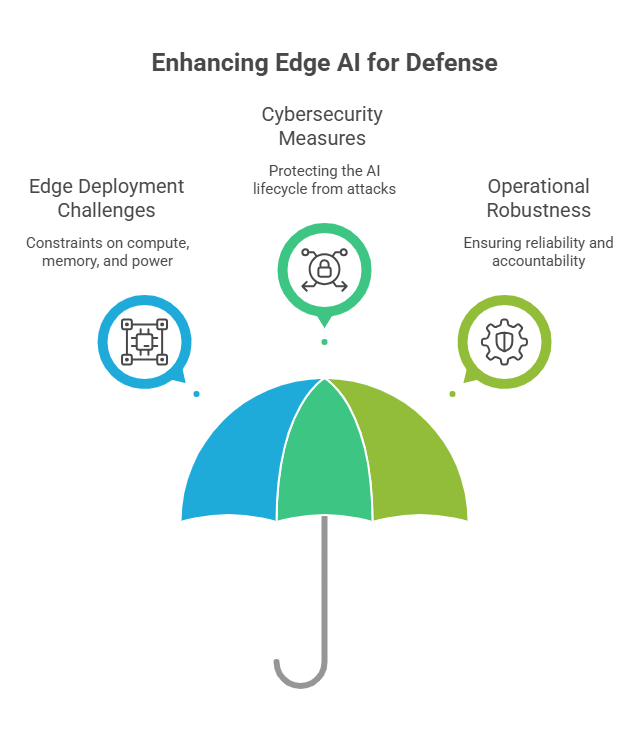
Edge deployment is where many promising demos fail. Recent studies on edge AI in defence systems point this out directly: counter-drone systems often need to run on mobile surveillance platforms at the edge, where compute, memory, power, and cooling are constrained. In military settings, those constraints sit on top of denied, degraded, intermittent, and low-bandwidth networking, so offloading everything to a remote cloud is often unrealistic. The right design response is not “bigger model, bigger GPU,” but model partitioning, selective inferencing, hardware-aware compression, graceful degradation, and a clear separation between edge-critical tasks and rear-echelon analytics.
Cybersecurity has to cover the full AI-and-sensor lifecycle. The NIST 2025 adversarial machine-learning taxonomy explicitly frames attacks across model methods, lifecycle stages, attacker goals, and attacker knowledge. The DoD’s 2025 AI cybersecurity tailoring guide likewise argues that cyber risk management must be integrated from the start of the AI lifecycle, not bolted on after model training. For counter-drone systems, that means protecting sensor firmware, timing and PNT, RF ingest, message brokers, feature stores, model artifacts, signed updates, and effector interfaces as one attack surface.
Operational robustness also has a policy dimension. NATO’s revised AI strategy and related certification work place lawfulness, responsibility, explainability, reliability, governability, and bias mitigation at the centre of defence AI. For counter-UAS, that translates into auditable operator displays, confidence-aware recommendations, known fallback modes, and the ability to disengage or revert when the system drifts outside validated operating conditions. In other words: a system that cannot explain why it recommends jamming or firing is not mature enough for serious deployment, regardless of benchmark accuracy.
6. C2 Integration and Rules of Engagement
AI does not replace the C2 stack; it becomes a decision-support layer inside a broader C4ISR architecture. Current Army integration work is instructive here. Integrated Sensor Architecture is explicitly designed to let sensors from different manufacturers interoperate through common standards, reduce translation bottlenecks, and lower latency at the tactical edge. NGC2 (Next Generation Command and Control), in turn, is explicitly data-centric, cloud-native, and built around open architectures. This makes the DoD Directive 3000.09 especially relevant, as it requires appropriate levels of human judgment over the use of force, alongside rigorous legal review, testing, and cybersecurity safeguards.
This matters acutely for electronic attack. A useful Polish-language reminder comes from the Polish Civil Aviation Authority’s GNSS interference seminar, which highlights how even anti-drone jamming incidents can produce wider aviation-side effects on navigation and surveillance environments. For system architects, that means soft-kill chains must be airspace-aware, spectrum-managed, geofenced, and fully logged. In business terms, buyers should prioritize traceable policy engines and authority management just as highly as raw sensor performance.
7. Testing, Validation, and Operational Lessons
Testing has to move well beyond static accuracy scores. The Chief Digital and Artificial Intelligence Office test-and-evaluation frameworks emphasize lifecycle T&E and operational realism; their core message is that justified confidence comes from testing AI-enabled capabilities under the complexities of real use, not from isolated lab metrics alone. Standardized counter-drone evaluation work is pushing the same direction: detection, tracking, and identification should be measured separately, under different weather, background clutter, target classes, false-positive tolerances, and decision-latency constraints.
Datasets and simulation are central because truly representative hostile-drone data are hard to collect. Public resources such as the Anti-UAV challenge, drone-vs-bird datasets, and MMAUD are increasingly important because they expose models to small-object, infrared, multimodal, and trajectory-estimation problems. But dataset work alone is insufficient. Teams need sim-to-real pipelines, red-teaming, replay environments, and cyber-range-style exercises that include spoofing, RF noise, degraded networks, operator overload, and sensor dropout. That is consistent both with NATO’s use of cyber range and simulation for realistic training and with current anti-UAV research trends toward synthetic data and adversarial benchmarking.
Operational examples reinforce the point. NATO’s 2023 and 2024 counter-drone exercises have emphasized interoperability, while Ukrainian participation in the 2024 C-UAS TIE explicitly connected allied experimentation to battlefield lessons on drone autonomy and interoperability. The U.S. Army 2025 Project Flytrap 4.5 series tested detect-discriminate-defeat products against simulated drone threats in NATO airspace and framed the exercise as a coalition environment for passive and active sensors, defeat options, data flow, and interoperability. Separately, recent Army C5ISR work on FoCUS shows the value of modular, government-owned software that integrates multiple sensing modalities into a single platform, reduces cognitive load, and can be fielded across echelons. These are strong signals for buyers: insist on experimentation in realistic networks and coalition contexts, not just demo-day drone shots against a blue sky.
8. Conclusion: Integration Is the Real Advantage
The future of counter-drone systems will not be decided by a single breakthrough model or sensor. It will be shaped by the ability to integrate detection, classification, tracking, and decision-making into a coherent, reliable, and secure system. Organizations that invest only in point solutions will face fragmentation, latency, and operational risk. Those that focus on integration, data consistency, and system-level design will gain a decisive advantage – not just in detection, but in actionable decision-making.
For defence stakeholders, the key question is no longer whether AI works. It is whether it is deployed in a way that is interoperable, explainable, and operationally reliable.
At Transition Technologies MS, we focus on building exactly these kinds of integrated, mission-ready systems – connecting sensors, AI models, and command layers into a unified operational environment. Learn more about our capabilities at TTMS Defence.

What is adversarial machine learning and why does it matter in defence systems?
Adversarial machine learning refers to techniques used to manipulate or deceive AI models by altering input data in subtle ways. In the context of counter-drone systems, this could mean tricking a detection model into misclassifying a drone as a harmless object or failing to detect it altogether.
This is particularly important in defence because AI systems operate in contested environments where adversaries actively attempt to disrupt or exploit them. Standards and frameworks developed by organizations such as NIST emphasize that security must be considered across the entire AI lifecycle – from data collection and model training to deployment and updates.
In practice, this means counter-drone systems must be designed to remain reliable even when inputs are noisy, incomplete, or intentionally manipulated.
What does “edge deployment” mean in military AI systems?
Edge deployment means running AI models directly on local devices – such as sensors, vehicles, or portable systems – rather than relying on centralized cloud infrastructure. This is critical in military environments where connectivity may be limited, unreliable, or intentionally disrupted.
For counter-drone systems, edge AI allows real-time detection and response without depending on external networks. However, it also introduces constraints related to processing power, memory, and energy consumption.
To address this, engineers use techniques such as model optimization, compression, and selective inference to ensure that AI systems remain both efficient and effective in field conditions.
What are RF, SIGINT, EO/IR, and acoustic sensors in drone detection?
These terms refer to different types of sensors used in counter-drone systems:
RF (Radio Frequency) sensors detect communication signals between a drone and its operator.
SIGINT (Signals Intelligence) expands on RF by analyzing and interpreting electronic signals for identification and attribution.
EO/IR (Electro-Optical / Infrared) sensors use visual and thermal imaging to detect and identify objects.
Acoustic sensors detect the sound signatures produced by drone motors and propellers.
Each of these sensors has strengths and limitations. For example, RF detection works well when a drone is actively communicating, while EO/IR provides visual confirmation. Modern systems combine multiple sensor types to improve accuracy and reliability.
What are YOLO models and pipelines like YOLOv7 + ByteTrack?
YOLO (You Only Look Once) is a family of real-time object detection models widely used in computer vision. These models are designed to identify objects in images or video streams quickly, making them suitable for time-sensitive applications such as drone detection.
A pipeline such as YOLOv7 combined with ByteTrack integrates detection and tracking. YOLOv7 identifies objects frame by frame, while ByteTrack maintains continuity by tracking those objects across multiple frames.
This combination allows systems not only to detect a drone but also to follow its movement over time, which is essential for threat assessment and response.
What is C4ISR / NGC2 and why is it important for counter-drone systems?
C4ISR stands for Command, Control, Communications, Computers, Intelligence, Surveillance, and Reconnaissance. It refers to the integrated systems that collect data, process it, and support decision-making in military operations.
NGC2 (Next Generation Command and Control) is a modern approach to C2 that emphasizes data-centric architectures, interoperability, and cloud-native design. It enables faster and more informed decision-making by connecting multiple data sources into a unified operational picture.
In counter-drone systems, this integration is critical. Detection alone is not enough – data must be combined, interpreted, and translated into actionable decisions within a broader operational context.
What is MMAUD and why are datasets important in counter-drone AI?
MMAUD is an example of a multimodal dataset used in anti-drone research. It combines data from multiple sensor types, such as video, radar, and audio, to support the development and evaluation of detection and tracking models.
Datasets like MMAUD are essential because they allow engineers to train and test AI systems under realistic conditions. However, collecting real-world data for hostile drone scenarios is difficult, which is why simulation and synthetic data are often used alongside real datasets.
The quality and diversity of training data directly impact how well a system performs in real operational environments.