It’s mid-December, and for the past few days we’ve been putting OpenAI’s newest model – GPT-5.2 – through its paces. Another update, another version number, another announcement. OpenAI has gotten us used to a rapid release cycle lately: frequent model upgrades that don’t always promise a revolution, but quietly push performance, accuracy, and usefulness a little further each time. So the natural question is: is GPT-5.2 just another incremental step, or does it actually change how businesses can use AI?
Early signals are hard to ignore. Companies testing GPT-5.2 report tangible productivity gains – from saving 40-60 minutes per day for typical ChatGPT Enterprise users, to over 10 hours a week for power users. The model feels noticeably stronger where it matters most for business: building spreadsheets and presentations, writing and reviewing code, analyzing images and long documents, working with tools, and coordinating complex, multi-step tasks.

GPT-5.2 isn’t about flashy demos. It’s about execution. About turning generative AI into something that fits naturally into professional workflows and delivers measurable economic value. In this article, we take a closer look at what’s actually new in GPT-5.2, how it compares to GPT-5.1, and why it may become one of the most important large language models yet for enterprise AI and real-world business applications. GPT-5.2 fits naturally into modern enterprise AI solutions, supporting automation, decision-making, and scalable knowledge work across organizations.
1. Why GPT-5.2 Matters for Business in 2025 and 2026
GPT‑5.2 is OpenAI’s most capable model for professional knowledge work to date. In rigorous evaluations, it has achieved human-expert-level performance on a broad array of business tasks across 44 different occupations. In fact, on the GDPval benchmark – which measures how well the AI can produce work products like sales presentations, accounting spreadsheets, marketing plans, and more – GPT‑5.2 “Thinking” matched or outperformed top human professionals 70.9% of the time. This is a remarkable jump from earlier models, essentially making GPT‑5.2 the first AI model to perform at or above expert human level on such a diverse set of real-world tasks. According to expert judges, GPT‑5.2’s outputs show an “exciting and noticeable leap in output quality,” often looking as if they were produced by a team of skilled professionals.
Equally important for businesses, GPT‑5.2 can deliver this expert-level work with astonishing speed and efficiency. In trials, it generated complex work products (presentations, spreadsheets, etc.) over 11 times faster than human experts and at under 1% of the cost. This suggests that when paired with human oversight, GPT‑5.2 can dramatically boost productivity while lowering costs for knowledge-intensive tasks. For example, on an internal test simulating a junior investment banking analyst’s work (building detailed financial models for a Fortune 500 company), GPT‑5.2 scored ~9% higher than GPT‑5.1 (68.4% vs 59.1%), demonstrating improved accuracy and better formatting of results. Side-by-side comparisons showed that GPT‑5.2 produces far more polished and sophisticated spreadsheets and slides than its predecessor – outputs that require minimal editing before use.
GPT‑5.2 can generate complex, well-formatted work products (like financial spreadsheets) that previously took experts hours to create. In tests, GPT‑5.2’s spreadsheet outputs were significantly more detailed and polished (right) compared to those from GPT‑5.1 (left). This highlights GPT‑5.2’s value in automating professional tasks with speed and precision.
Such capabilities translate into tangible business value. Teams can leverage GPT‑5.2 to automate report writing, create presentations or strategy documents, draft marketing content, generate project plans, and more – all in a fraction of the time it used to take. By handling the heavy lifting of first-draft creation and data processing, GPT‑5.2 allows human professionals to focus on refining and making high-level decisions, thereby accelerating workflows across departments. In short, GPT‑5.2 sets a new standard for AI in the workplace, delivering quality and efficiency that can significantly enhance an organization’s productivity.
2. GPT-5.2 Performance Improvements: Faster, Smarter, More Reliable AI
Early user feedback suggests that GPT-5.2 often feels faster than GPT-5.1 at first glance. This is mainly because the model defaults to lower or no explicit reasoning, prioritizing responsiveness unless deeper reasoning is explicitly enabled. This reflects a broader shift in how OpenAI balances speed, cost, and reliability across GPT-5.2 modes. However, raw speed is only part of the equation. For many teams, what matters more is what the model can actually deliver in day-to-day work. For companies in the software industry – and businesses with internal development teams – GPT-5.2 represents a clear step forward in coding assistance. The model has achieved state-of-the-art results on leading coding benchmarks, including 55.6% on SWE-Bench Pro and 80% on SWE-Bench Verified, indicating stronger performance in debugging, refactoring, and implementing real-world software changes.
Early testers describe GPT-5.2 as a “powerful daily partner for engineers across the stack.” It performs particularly well in front-end and UI/UX tasks, where it can generate complex interfaces or even complete small applications from a single prompt. This agentic approach to coding allows teams to prototype faster, reduce backlog pressure, and rely on the model for more complete first-pass solutions.
For businesses, the impact is clear. Development teams can shorten delivery cycles by offloading routine coding, testing, and troubleshooting tasks to GPT-5.2. At the same time, non-technical users can leverage natural language prompts to automate simple applications or workflows, lowering the barrier to software creation across the enterprise. In practice, GPT-5.2 shifts the performance discussion away from raw latency and toward reliability. For many enterprise tasks, completing a request correctly in a single pass is often more valuable than receiving a faster but less precise response.

3. How GPT-5.2 Improves Accuracy and Reduces Hallucinations in Business Use Cases
One of the biggest concerns businesses have with AI models is factual accuracy and reliability of the outputs. GPT‑5.2 delivers notable improvements on this front, making it a more trustworthy assistant for professional use. In internal evaluations, GPT‑5.2 “Thinking” responses had 30% fewer errors (hallucinations or incorrect statements) compared to GPT‑5.1. In other words, it’s significantly less prone to “hallucinating” false information, thanks to enhancements in its training and reasoning processes. This reduction in mistakes means that when using GPT‑5.2 for research, analysis, or decision support, professionals will encounter fewer misleading or incorrect answers. The model is better at sticking to factual references and clarifying uncertainty when it isn’t confident, which makes its outputs more dependable.
Of course, no AI is perfect – and OpenAI acknowledges that critical outputs should still be double-checked by humans. However, the trend is positive: GPT‑5.2’s improved factuality and reasoning reduce the risk of errors propagating into business decisions or client-facing content. This is especially important in domains like finance, law, medicine, or science, where accuracy is paramount. By combining GPT‑5.2 with verification steps (like enabling its advanced reasoning modes or tool use for fact-checking), companies can achieve highly reliable results. This makes GPT‑5.2 not just more powerful, but also more aligned with real-world business needs – providing information you can act on with greater confidence.
In addition to factual accuracy, OpenAI has continued to strengthen GPT‑5.2’s safety and guardrails, which is crucial for enterprise adoption. The model has updated content filters and has undergone extensive internal testing (including mental health evaluations) to ensure it responds helpfully and responsibly in sensitive contexts. The improved safety architecture means GPT‑5.2 is better at refusing inappropriate requests and guiding users toward proper resources when needed, which helps organizations maintain compliance and ethical use of AI. As a result, businesses can deploy GPT‑5.2 with greater peace of mind, knowing that the AI is less likely to produce harmful or off-brand outputs.
4. GPT-5.2 Multimodal Capabilities: Text, Images, and Long Contexts
GPT‑5.2 also breaks new ground with its ability to handle much larger contexts and multimodal (image + text) inputs, which is a boon for many business applications. This model can effectively remember and analyze extremely long documents – far beyond the few-thousand-token limits of older GPT models. In fact, GPT‑5.2 demonstrated near-perfect performance on an OpenAI evaluation that required understanding information spread across hundreds of thousands of tokens. It’s reportedly the first model to achieve almost 100% accuracy on tasks that involve up to 256,000 tokens of input (equivalent to hundreds of pages of text). For practical purposes, this means GPT‑5.2 can read and summarize lengthy reports, legal contracts, research papers, or entire project documentation, all while maintaining context and coherence. Professionals can feed enormous datasets or multiple documents into GPT‑5.2 and get synthesized insights, comparisons, or detailed analyses that wouldn’t have been possible before. This extended context window makes GPT‑5.2 incredibly well-suited for industries dealing with big data and lengthy records – such as law (e-discovery), finance (prospectus or SEC report analysis), consultancy (researching across many sources), and academia.
Another exciting feature is GPT‑5.2’s enhanced vision capabilities. It is OpenAI’s strongest multimodal model yet, able to interpret and reason about images with much greater accuracy. Error rates on tasks like chart analysis and user interface understanding have been cut roughly in half compared to previous models. In business contexts, this translates to the model being able to analyze visual information like graphs, dashboards, design mockups, engineering diagrams, product photos, or even scanned documents. For example, GPT‑5.2 can accurately read a complex financial chart or a KPI dashboard screenshot and provide insights or explanations. It can examine a process flow diagram or an architectural schematic and answer questions about it. This opens the door to automating many tasks that involve both text and imagery – from parsing PDFs with charts, to assisting customer support with troubleshooting based on a photo, to helping designers by critiquing UI screenshots.
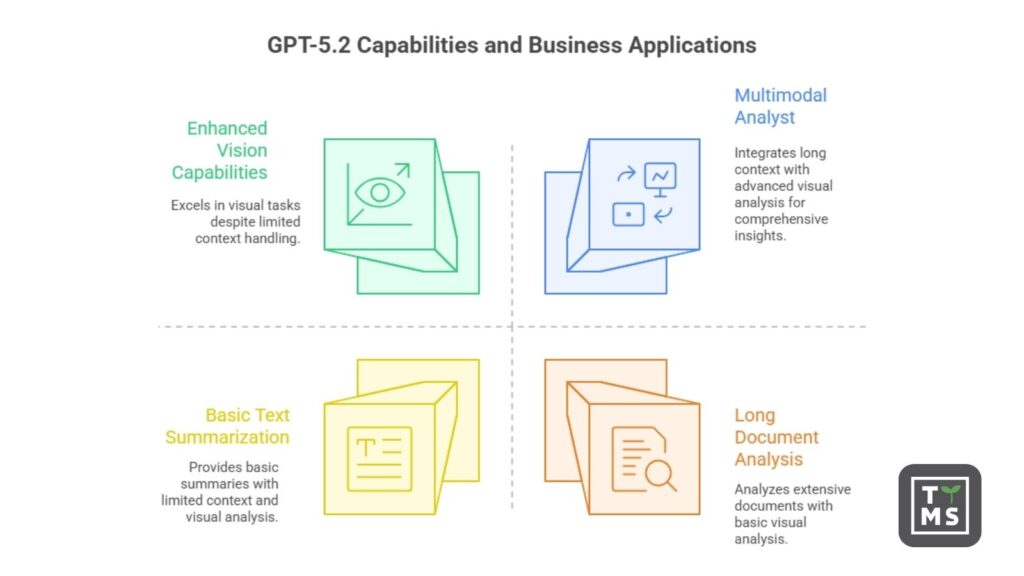
Compared to its predecessors, GPT‑5.2 has a much stronger grasp of spatial and visual details. It understands how elements are positioned in an image and how they relate, which was a weakness in earlier models. For instance, given a photo of a computer motherboard, GPT‑5.2 can identify and label the key components (CPU socket, RAM slots, ports, etc.) with reasonable accuracy, whereas GPT‑5.1 could only recognize a few parts and struggled with spatial arrangement. This improved visual comprehension means businesses can use GPT‑5.2 in workflows where interpreting images is central – such as inspecting industrial equipment images for parts, analyzing medical scans (with proper regulatory oversight), or reading and organizing information from scanned invoices and forms.
By combining long context handling with vision, GPT‑5.2 can be a multimodal analyst for your organization. Imagine feeding in an entire annual report (dozens of pages of text and charts) – GPT‑5.2 can parse it in one go and produce an executive summary with references to specific figures. Or consider an e-commerce scenario: GPT‑5.2 could take a product image and its description and generate a detailed, SEO-optimized catalog entry, having “understood” the image content. The ability to seamlessly integrate visual and textual analysis sets GPT‑5.2 apart as a comprehensive AI assistant for modern businesses.
5. GPT-5.2 Behavior in Enterprise Workflows: Instruction Following Over Raw Speed
Beyond benchmarks, pricing, and raw performance metrics, one characteristic consistently stands out in hands-on use of GPT-5.2: its strong instruction-following behavior. Compared to many alternative models, GPT-5.2 is more likely to do exactly what is requested, even when tasks are complex, constrained, or require careful adherence to specific requirements. This reliability often comes with a trade-off. In deeper reasoning modes, GPT-5.2 may take longer to respond than faster, more lightweight models. However, the model compensates by reducing drift, avoiding unnecessary tangents, and delivering outputs that require fewer corrections. In practice, this leads to fewer follow-up prompts, fewer revisions, and less manual intervention.
For enterprise teams, this shift is significant. A model that takes slightly longer but delivers a correct, usable result on the first attempt is often more valuable than a faster model that requires multiple iterations. In this sense, GPT-5.2 prioritizes correctness, predictability, and task completion over raw response speed – a trade-off that aligns well with real-world business workflows.
6. GPT-5.2 Use Cases for Business and Enterprise Teams
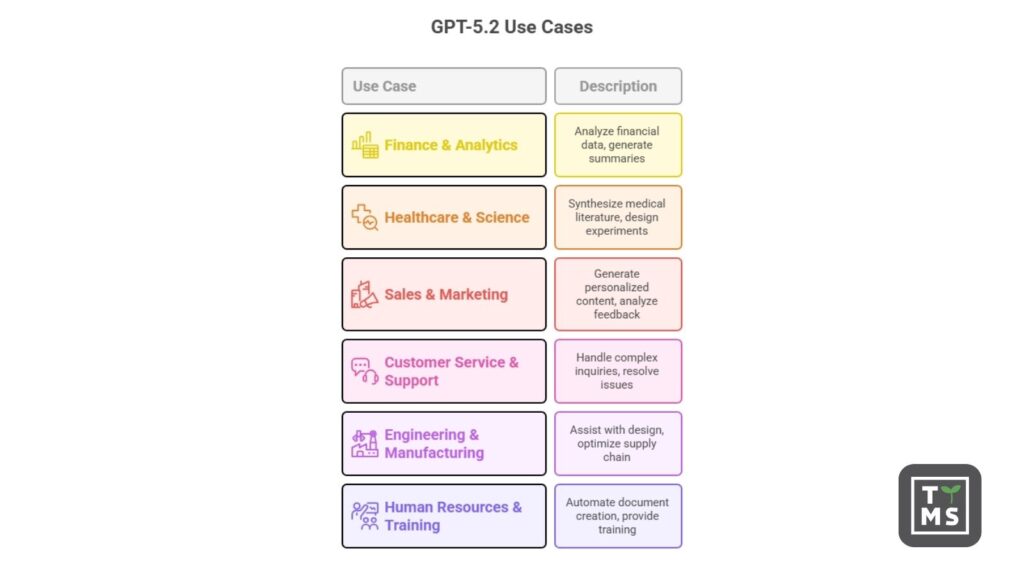
With its combination of enhanced reasoning, longer memory, coding prowess, visual understanding, and tool use, GPT‑5.2 is poised to transform workflows across virtually every industry. It is essentially a general-purpose cognitive engine that organizations can adapt to their specific needs. Here are just a few examples of how GPT‑5.2 can be applied in business settings:
6.1 Finance & Analytics
Analyze financial statements, market reports, or big data sets to produce insights and forecasts. GPT‑5.2 can serve as a virtual financial analyst – pulling key information from thousands of pages, running calculations or models via tools, and generating digestible summaries for decision-makers. It excels in “wind tunneling” scenarios, explaining trade-offs and producing defensible plans for stakeholders, which is invaluable for strategic planning and risk analysis.
6.2 Healthcare & Science
Assist researchers and doctors by synthesizing medical literature or suggesting hypotheses. GPT‑5.2 has been found to be one of the world’s best models for assisting and accelerating scientists, excelling at answering graduate-level science and engineering questions. It can help design experiments, analyze patient data (with privacy safeguards), or even propose plausible solutions to complex problems. For example, GPT‑5.2 has successfully drafted parts of mathematical proofs in research settings, indicating its potential in R&D-heavy industries.
6.3 Sales & Marketing
Generate high-quality content at scale – from personalized marketing emails and social media posts to product descriptions and ad copy – all tailored to the brand voice. GPT‑5.2’s improved language skills and factual accuracy mean marketing teams can rely on it for first drafts of content that require minimal editing. It can also analyze customer feedback or sales calls (using transcription + long context) to extract insights on product sentiment or lead quality.
6.4 Customer Service & Support
Deploy GPT‑5.2-powered chatbots or virtual agents that can handle complex customer inquiries with minimal escalation. Because GPT‑5.2 can integrate context from past interactions and backend databases, it can resolve issues that normally would require a human rep – such as troubleshooting technical problems using product documentation, processing refunds or account changes via tool use, and providing empathetic, well-informed responses. Companies like Zoom and Notion, who had early access, observed GPT‑5.2 delivering state-of-the-art long-horizon reasoning in support scenarios, meaning it can follow an issue through multiple turns to reach a solution.
6.5 Engineering & Manufacturing
Utilize GPT‑5.2 as an intelligent assistant for design and maintenance. It can parse technical drawings, equipment manuals, or CAD files (via vision), answer questions about them, and even generate work instructions or troubleshooting steps. For manufacturers, GPT‑5.2 could help optimize supply chain workflows by analyzing data from various sources (schedules, inventories, market trends) and planning adjustments. Its ability to handle large context means it could take in all relevant documents and outputs a comprehensive plan or diagnostic report.
6.6 Human Resources & Training
Use GPT‑5.2 to automate HR document creation (like contracts, policy manuals, onboarding guides) and to provide training support. It can develop engaging training materials or quizzes, tailored to the company’s internal knowledge base. As an HR assistant, it could answer employees’ questions about company policy or benefits by pulling from relevant documents, thanks to its deep context understanding. Additionally, GPT‑5.2-Chat (a chat-optimized version of the model) is more effective at giving clear explanations and step-by-step guidance, which can be useful for mentoring or career coaching scenarios inside organizations.
What makes GPT‑5.2 truly enterprise-ready is how it combines structured output, reliable tool usage, and compliance-friendly features. According to Microsoft, “the age of AI small talk is over” – businesses need AI that is a reliable reasoning partner capable of solving high-stakes, ambiguous problems, not just chit-chat. GPT‑5.2 rises to that challenge by providing multi-step logical reasoning, context-aware planning on large inputs, and agentic execution of tasks – all under the governance of improved safety controls. This means teams can trust GPT‑5.2 to not only generate ideas, but also to carry them out and deliver structured, auditable outputs that meet real-world requirements. From financial services to healthcare, manufacturing to customer experience, GPT‑5.2 can be the AI backbone that helps organizations innovate and operate more effectively.
7. GPT-5.2 Pricing and Costs: What Businesses Need to Know
Despite higher per-token pricing, GPT-5.2 often reduces the total cost of achieving a desired quality level by requiring fewer iterations and less corrective prompting. For enterprises, this shifts the discussion from raw token prices to efficiency, output quality, and time savings.
7.1 How businesses can access GPT-5.2
- ChatGPT Plus, Pro, Business, and Enterprise
Immediate access through OpenAI’s interface for content creation, analysis, and everyday knowledge work. - OpenAI API
Full flexibility for integrating GPT-5.2 into internal tools, products, and enterprise systems such as CRMs or AI assistants.
7.2 Pricing perspective for enterprises
- Higher per-token cost compared to GPT-5.1 reflects stronger reasoning and higher-quality outputs.
- Fewer retries and follow-up prompts often lower the effective cost per completed task.
- Better first-pass accuracy reduces manual review and correction time.
7.3 Why GPT-5.2 makes economic sense
- Less rework – tasks are more often completed correctly in a single pass.
- Faster time-to-value – fewer iterations mean quicker delivery.
- Higher output quality – suitable for production and client-facing workflows.
7.4 Enterprise readiness at a glance
| Area | GPT-5.2 Enterprise Impact |
|---|---|
| Access | ChatGPT plans and OpenAI API |
| Cost model | Higher per-token, lower cost per outcome |
| Scalability | Designed for production workloads |
| Security & compliance | Enterprise-grade infrastructure |
| Best use cases | Coding, analysis, automation, knowledge work |
To get started, organizations typically choose between a managed experience with ChatGPT Enterprise or a custom deployment via the API. In both cases, pilot projects focused on high-impact workflows are the fastest way to validate ROI and identify scalable use cases across teams.
8. Conclusion: GPT-5.2 and the Future of Enterprise AI
GPT-5.2 is not just another incremental update in OpenAI’s model lineup. It represents a clear shift in how large language models are optimized for real-world business use: less focus on raw speed alone, and more emphasis on reliability, instruction-following, and completing complex tasks correctly in fewer iterations.
For enterprises, this change matters. GPT-5.2 consistently shows that a slightly slower response can be a worthwhile trade-off when it leads to higher-quality outputs, fewer corrections, and lower overall effort. Combined with improved coding capabilities, stronger handling of long context, and more predictable behavior, the model is well suited for production workflows rather than isolated experiments.
Equally important, GPT-5.2 is not a single, fixed experience. Its real value emerges when organizations consciously choose the right mode for the right task, balancing speed, cost, and reasoning depth. Companies that approach GPT-5.2 as a flexible system, rather than a one-size-fits-all tool, are best positioned to turn its capabilities into measurable business value.
The next step is not simply adopting GPT-5.2, but implementing it thoughtfully across processes, teams, and systems. If you are looking to move beyond experimentation and build AI solutions that deliver tangible results, TTMS can help you design, implement, and scale enterprise-grade AI solutions tailored to your business needs. From strategy and architecture to implementation and scaling, enterprise AI requires more than just choosing the right model.
👉 Explore how we support companies with AI adoption and automation: https://ttms.com/ai-solutions-for-business/

FAQ
What is GPT-5.2 and how is it different from previous GPT models?
GPT-5.2 is OpenAI’s most advanced large language model to date, designed specifically to perform better in real-world, professional and enterprise environments. Compared to GPT-5.1, it offers stronger reasoning, higher output quality, fewer hallucinations, improved coding capabilities, and better handling of long documents and complex tasks. Rather than focusing on flashy demos, GPT-5.2 emphasizes reliability, consistency, and productivity – qualities that matter most in business use cases.
How can businesses use GPT-5.2 in everyday operations?
Businesses use GPT-5.2 across a wide range of functions, including document analysis, reporting, customer support, software development, internal knowledge management, and process automation. The model excels at multi-step tasks, such as preparing presentations from raw data, analyzing long reports, or coordinating workflows using tools and APIs. This makes GPT-5.2 suitable not just for experimentation, but for integration into daily operational processes.
Is GPT-5.2 suitable for enterprise-grade and mission-critical use cases?
GPT-5.2 is significantly more reliable than earlier models, with a lower error rate and better control over factual accuracy. While human oversight is still recommended for high-stakes decisions, GPT-5.2 is well-suited for enterprise-grade applications where consistency and structured outputs are required. Its improved tool usage, long-context understanding, and safety mechanisms make it a strong foundation for enterprise AI assistants and automation systems.
How does GPT-5.2 pricing work for businesses and enterprises?
GPT-5.2 is available through both ChatGPT Enterprise plans and the OpenAI API, with pricing depending on usage volume and deployment model. While per-token costs may be higher than older models, GPT-5.2 often delivers better results in fewer iterations, which can reduce overall operational costs. For many companies, the key factor is not the token price itself, but the return on investment gained through productivity improvements and automation.
What industries benefit the most from GPT-5.2 adoption?
GPT-5.2 delivers the greatest value in industries that rely heavily on knowledge work, complex documentation, and repeatable decision-making processes. Financial services, technology, healthcare, legal, consulting, real estate, and professional services are among the biggest beneficiaries. In these sectors, GPT-5.2 can automate analysis, accelerate reporting, support customer interactions, and enhance internal knowledge systems, making it a versatile AI foundation across multiple business domains.
Is GPT-5.2 faster than GPT-5.1 in response generation?
From the very first interaction, GPT-5.2 feels noticeably faster when generating responses. Answers appear more fluid, with fewer pauses during generation and less visible hesitation compared to GPT-5.1. This creates a clear impression of improved responsiveness, even before considering more complex use cases.
OpenAI has not published official latency benchmarks that compare GPT-5.2 and GPT-5.1 in milliseconds, so there are no confirmed figures that prove a specific speed increase. However, the perceived speed improvement is likely the result of more stable token generation, improved model efficiency, and stronger instruction-following. GPT-5.2 tends to complete answers in a single, coherent pass rather than stopping, correcting itself, or requiring regeneration.
In simple prompts, raw response times may be similar between the two models. The difference becomes more apparent in longer or more demanding prompts, where GPT-5.2 maintains smoother output and reaches a usable final answer more quickly. While this does not guarantee faster first-token latency, it does result in a clearly faster and more consistent user experience overall.