
Imagine delegating your most tedious business tasks to an intelligent assistant that works 24/7, never makes a mistake, and only gets smarter with time. This is no longer science fiction – it’s the reality of artificial intelligence (AI) in business automation, and companies are rapidly adopting it. Organizations have seen productivity boosts of up to 40% and 83% of firms now rank AI as a top strategic priority for the future. From customer service chatbots that handle millions of inquiries to algorithms that predict market trends in seconds, AI is fundamentally transforming how work gets done.
Importantly, AI-driven automation isn’t about replacing people – it’s about augmenting them. By offloading repetitive, low-value tasks to machines, employees are freed to focus on creativity, strategy, and innovation, where human insight matters most. Embracing AI has quickly shifted from a cutting-edge option to a business necessity. In fact, 82% of business leaders expect AI to disrupt their industry within five years, and most feel “excited, optimistic, and motivated” by this AI-driven future. In short, adopting AI for automation is becoming essential for staying competitive, not just a tech experiment.
1. Real-World Applications of AI-Powered Automation
AI has evolved from a futuristic concept into a practical tool that is revolutionizing work across almost every business function. Today, companies integrate AI into everything from customer service and marketing to supply chain management and finance. Thanks to AI’s ability to process large volumes of data quickly and accurately, it excels at automating routine tasks that used to be time-consuming and error-prone for humans.
Across industries, real-world examples highlight AI’s impact: In hospitality and retail, Hilton Hotels used AI to optimize staff scheduling (improving employee satisfaction and guest experiences), while H&M’s AI chatbot assists online shoppers with questions and product recommendations, boosting customer engagement and sales. In finance and e-commerce, banking giant HSBC employs voice-recognition AI to authenticate phone customers faster and reduce fraud risk, and fashion retailer Zara’s website chatbot instantly answers customer questions about sizing and stock, freeing up human agents to handle more complex requests. AI is also streamlining behind-the-scenes operations: Unilever’s AI-driven platform, for example, improved demand forecast accuracy from 67% to 92%, cutting excess inventory by €300 million, and Coca-Cola’s AI models reduced forecasting errors by 30%. In logistics, Microsoft’s use of AI shrank a four-day fulfillment planning process down to just 30 minutes (with improved accuracy), and shippers like FedEx leverage AI to optimize delivery routes and predict maintenance, saving millions in operational costs. These cases show how AI automation can drive efficiency and innovation in virtually every sector, from faster customer service to smarter supply chains.
2. Key Benefits of AI-Powered Automation
Adopting AI for automation offers numerous benefits for organizations of all sizes. Some of the key advantages include:
- Higher Productivity and Efficiency: AI systems (like virtual assistants or bots) handle repetitive tasks tirelessly, freeing up employees for more strategic, high-value work. This means your team can accomplish more in the same amount of time, focusing on creativity and problem-solving instead of routine drudgery.
- Streamlined Operations and Cost Savings: Intelligent automation optimizes processes end-to-end. For example, AI can predict equipment failures or supply chain delays in advance and adjust plans accordingly, leading to cost savings and faster deliveries by preventing downtime and bottlenecks. Overall, operations become more agile and efficient.
- Improved Customer Engagement: AI-driven chatbots and support agents offer 24/7 service, providing instant responses to customer inquiries at any hour. This reduces wait times and improves customer satisfaction. Routine questions get handled immediately, while human staff can devote attention to more complex customer needs – resulting in better service at lower cost.
- Personalized Experiences at Scale: AI enables businesses to tailor products, services, and content to individual preferences like never before. From recommendation engines that suggest the perfect product to dynamic marketing campaigns adapted to each user, AI delivers personalization that fosters greater customer loyalty. Crucially, it does this at scale – something impractical with manual effort alone.
- Better Decision-Making: AI rapidly analyzes large datasets to uncover patterns, trends, and insights that humans might miss. By turning raw data into actionable intelligence, AI helps leaders make more informed decisions. Whether it’s forecasting market changes or identifying inefficiencies, AI-driven analytics give managers a clearer picture, leading to smarter strategies and outcomes.
These benefits explain why AI automation is such a game-changer: it not only makes processes faster and cheaper, but often improves the quality of outcomes (happier customers, more accurate predictions, etc.) at the same time.
3. TTMS AI Solutions – Automate Your Business with Expert Help
Embracing AI for automation can be transformative, but you don’t have to pursue it alone. Transition Technologies MS (TTMS) specializes in delivering AI-driven solutions that help businesses automate processes intelligently and effectively. With a proven track record of implementing AI across industries – from finance and legal to education and IT – TTMS can assist your organization on its automation journey. Below are some of our flagship AI products and services that can jump-start your automation efforts:
3.1 AI4Legal – Intelligent Automation for Law Firms
AI4Legal is an advanced solution designed for legal professionals, automating time-consuming tasks like analyzing court documents, generating draft contracts, and processing case transcripts. By leveraging technologies such as Azure OpenAI and Llama, AI4Legal helps law firms quickly review large volumes of case files and even create summarized briefs or first-draft pleadings with ease. This eliminates manual drudgery and human error in document review, allowing lawyers to focus on complex legal analysis and client interaction. The system is scalable for any size firm – from a small practice to a large legal department – and maintains high standards of accuracy, security, and compliance. In short, AI4Legal can significantly boost efficiency and productivity in legal workflows while ensuring sensitive data remains protected.
3.2 AI4Content – AI Document Analysis Tool
Every business deals with a multitude of documents – reports, forms, research papers, and more. AI4Content acts as an AI-powered document analyst that can automatically process and summarize various types of documents in minutes. It’s like having a tireless assistant that reads and distills paperwork for you. You can feed it PDFs, Word files, spreadsheets – even audio transcript text – and get back structured summaries or reports tailored to your needs. AI4Content is highly customizable; you can define the format and components of the output to fit your internal reporting standards. Crucially, it’s built with enterprise-grade security, so your sensitive data stays protected throughout the analysis process. This tool is ideal for industries like finance (to summarize analyst reports), pharma (to extract insights from lengthy research articles), or any field where critical information is hidden in lengthy texts – AI4Content will surface the key points in a fraction of the time it takes humans.
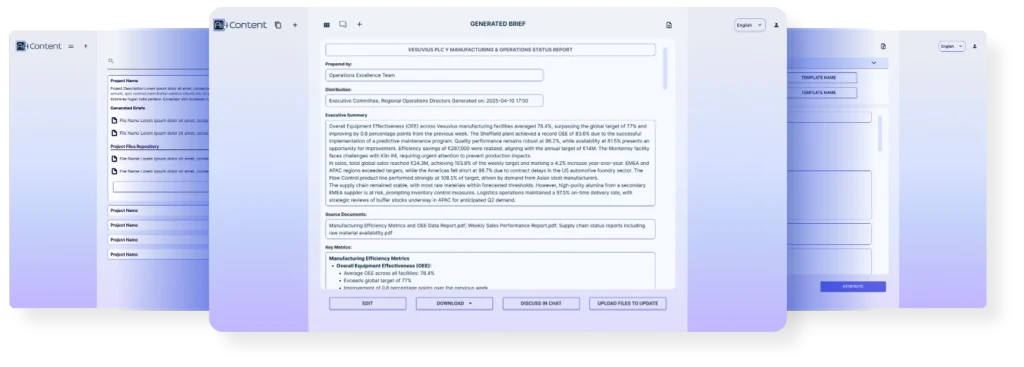
3.3 AI4E-learning – AI-Powered E-Learning Authoring
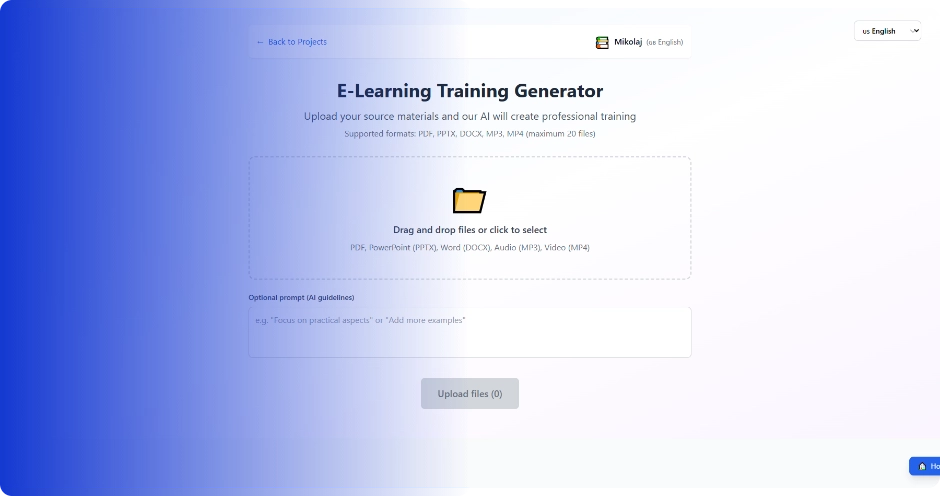
If your organization produces training or educational content, AI4E‑Learning can revolutionize that process. This AI-driven platform takes your existing materials (documents, presentations, audio, video) and rapidly generates professional e-learning courses out of them. For instance, you could upload an internal policy PDF along with a recorded lecture, and AI4E‑Learning will create a structured online training module complete with key takeaways, quiz questions, and even instructor notes or slides. It’s a huge time-saver for HR and L&D (Learning & Development) departments. The generated content can be easily edited and personalized via an intuitive interface, so you remain in control of the final output. Companies using AI4E‑Learning find they can develop employee training programs much faster without sacrificing quality – all while ensuring the content stays consistent with their internal knowledge base and branding guidelines.
3.4 AI4Knowledge – AI-Based Knowledge Management
AI4Knowledge is an intelligent knowledge hub that makes your organization’s information accessible on-demand. It acts as a central repository for procedures, manuals, FAQs, and best practices, equipped with a natural language search interface. Instead of trawling through intranet pages or shared folders, employees can simply ask the system questions (in plain language) and receive clear, step-by-step answers drawn from your company’s documentation. This platform drastically reduces the time spent searching for information – effectively giving back hours of productivity that would otherwise be lost. Features like advanced indexing (to connect related information), duplicate document detection, and automatic content updates ensure that your knowledge base stays organized and up-to-date. Whether it’s a new hire looking up how to perform a task or a veteran employee needing a quick policy refresher, AI4Knowledge provides instant support, leading to faster decision-making and fewer errors in day-to-day execution.
3.5 AI4Localisation – AI-Powered Content Localization
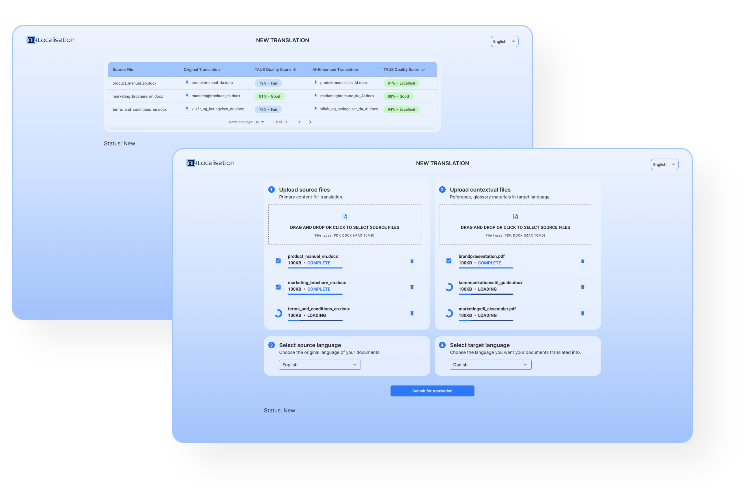
For businesses operating across multiple languages and markets, AI4Localisation is a game-changer. This is an AI-driven translation and localization platform that produces fast, context-aware translations tailored to your industry. It goes beyond basic machine translation by allowing customization for tone, style, and terminology – ensuring the translated content reads as if it were crafted by a native industry expert. AI4Localisation supports 30+ languages and can even handle large multi-language projects simultaneously. With built-in quality assessment tools, you receive quality scores and suggestions for any needed post-editing, though in many cases the output is already close to publication-ready. Companies using AI4Localisation have achieved up to 70% faster translation turnarounds for their documents and marketing materials. From websites and product manuals to e-learning content (it even integrates with AI4E‑Learning), this service helps you speak your customer’s language without the usual delays and costs.
3.6 AML Track – Automated Anti-Money Laundering Compliance
Compliance automation is a pressing need, especially in finance, legal, and other regulated sectors. AML Track is an advanced AI platform (developed by TTMS in partnership with the law firm Sawaryn & Partners) designed to automate key anti-money laundering (AML) processes and take the headache out of regulatory compliance. This solution streamlines customer due diligence, real-time transaction monitoring, sanctions and PEP list screening, and generates audit-ready AML reports – all in one integrated system. In practice, AML Track automatically pulls data from public registers (e.g. corporate registries), verifies customer identities, checks if any client or counterparty appears on international sanctions or politically exposed persons lists, and continuously monitors transactions for suspicious patterns. It then compiles its findings into comprehensive reports to satisfy regulatory requirements, eliminating the need for manual cross-checks across multiple databases. The platform is kept up-to-date with the latest global and local AML regulations (including the EU’s 6AMLD), so your business stays compliant by default. By centralizing and automating AML compliance, AML Track reduces human error, speeds up compliance procedures, and minimizes the risk of regulatory fines. It’s a scalable solution suitable for banks, fintech startups, insurance companies, real estate firms, or any institution deemed an “obliged entity” under AML laws. In short, AML Track lets you stay ahead of financial crime risks while significantly cutting the cost and effort of compliance.

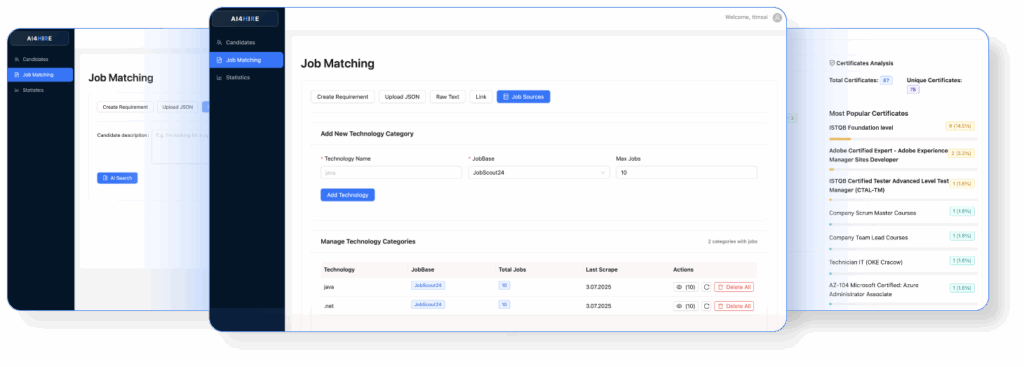
3.7 AI4Hire – AI Resume Screening Software
AI4Hire is an advanced AI-powered resume screening platform that helps HR teams identify top candidates quickly and accurately. The system automatically analyzes resumes, job applications, and professional profiles, extracting key skills, experience, education, and role fit with high precision. Using natural language processing and semantic matching, AI4Hire can review hundreds of applications in minutes, eliminating manual screening and reducing the risk of bias or oversight. It generates structured candidate summaries, match scores, and clear insights into strengths, gaps, and overall suitability. The platform can be customized to reflect your organization’s hiring criteria, industry terminology, and competency models. AI4Hire accelerates recruitment, improves the quality of shortlists, and allows recruiters to focus on interviews and relationship-building instead of administrative filtering.
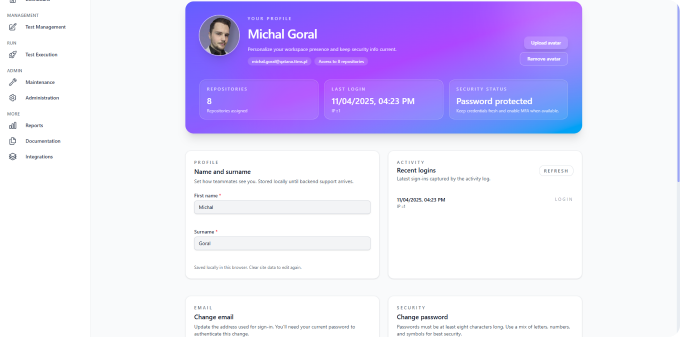
3.8 Quatana – AI-powered Software Test Management Tool
QATANA is an AI-powered test management tool from Transition Technologies MS (TTMS), designed to streamline the entire testing lifecycle. The platform automatically generates draft test cases and selects relevant regression test suites based on ticketing data and release notes — significantly reducing the manual workload for QA teams. It offers full test lifecycle management: you can create, clone, organize, and link test cases with requirements, maintain traceability matrices, and track defects within the same system. QATANA supports hybrid workflows, combining manual and automated tests (e.g. with Playwright) in a unified view. With real-time dashboards, predictive analytics, and flexible integrations (Jira, AI-RAG frameworks, bulk import/export), it enhances transparency, speeds up testing, and helps teams focus on the most critical tests. On-premise deployment and robust audit-ready logging ensure it meets compliance and data-security requirements — making it suitable even for regulated industries.
Each of these TTMS AI solutions is backed by our team of experts who will work closely with you from planning through deployment. We understand that successful AI integration requires more than just software installation – it takes aligning the technology with your business goals, integrating with your existing IT systems, and training your people to get the most out of the tools. Our approach emphasizes collaboration and customization: we tailor our platforms to your unique needs and ensure a smooth change management process. By partnering with TTMS, you gain a trusted guide in the AI journey. We’ll help you automate intelligently and transform your operations, so you can reap the benefits of AI automation faster and with confidence. If you’re ready to explore what AI can do for your organization, contact us and let’s build it together.
What are the first steps to start using AI in my small business?
The best starting point is to identify which tasks consume the most time or create the most operational friction – these areas typically benefit most from AI. Next, explore simple, low-barrier tools such as chatbots, document analyzers, or scheduling automation to gain early wins without major investment. It’s also helpful to map your current workflows so you know exactly where AI can add value. Finally, consider consulting a technology partner who can guide you through selecting tools, integrating them with your existing systems, and training your team.
Do I need technical knowledge to implement AI tools in my company?
In most cases, no. Many modern AI tools are designed to be user-friendly and require minimal technical expertise. Platforms for automation, content generation, or analytics often come with intuitive interfaces and ready-made templates that simplify setup. For more complex projects – such as integrating AI with internal systems or automating specialized processes – working with an experienced provider can ensure everything is configured properly and aligned with your business goals.
How expensive is it to adopt AI in a small business?
The cost varies widely depending on the type of solution and its level of customization. Entry-level AI tools, such as chat assistants or document processing apps, are often affordable and billed as monthly subscriptions. More advanced implementations, like predictive analytics or integrated workflow automation, may require a larger investment. However, many small businesses recover these costs quickly thanks to time savings, improved accuracy, and increased productivity generated by automation.
How can I measure whether AI is actually improving my business?
Start by defining clear metrics before implementation – for example, time saved on manual tasks, reduction in errors, faster customer response times, or improved sales conversion. After deploying AI, track these indicators regularly to compare performance. Many AI platforms include dashboards that provide real-time insights, making it easy to see where efficiency is improving. Over time, the data will show measurable gains that validate the value of your AI investment.