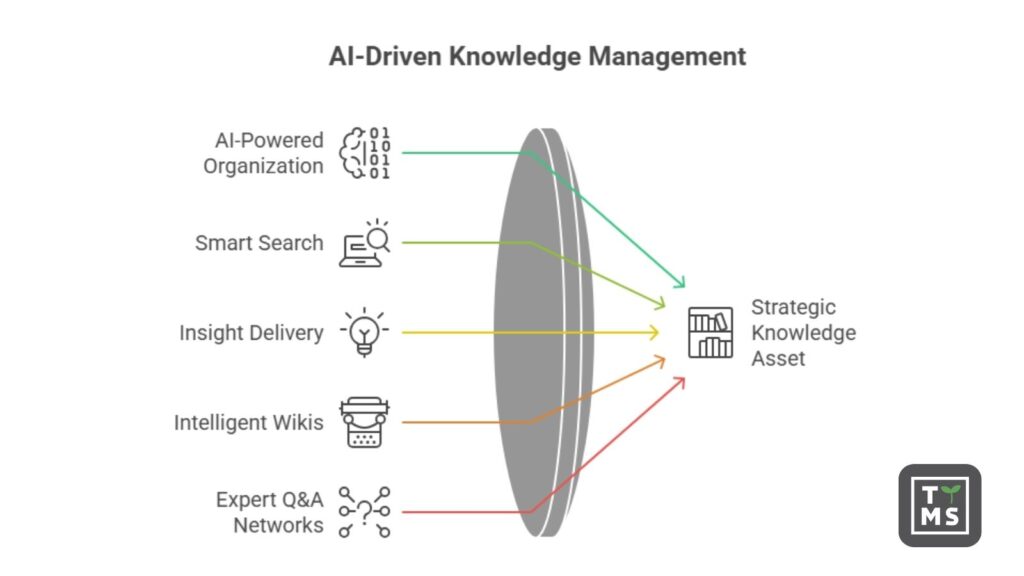
Managing knowledge at an enterprise scale can be challenging – scattered documents, tribal know-how, and constant updates make it hard to keep everyone on the same page. Fortunately, the latest AI-based knowledge management systems for enterprise use artificial intelligence to organize information, provide smart search results, and deliver insights when and where employees need them. In this article, we explore the 10 best enterprise AI knowledge management software solutions that large organizations can leverage to capture institutional knowledge and empower their teams. These top AI-powered platforms each bring something unique, from intelligent wikis to expert Q&A networks, helping companies turn their collective knowledge into a strategic asset. Let’s dive into the list of the enterprise knowledge best AI management software options and see how they stack up.
1. TTMS AI4Knowledge – AI-Powered Enterprise Knowledge Hub
TTMS AI4Knowledge is an advanced AI-based knowledge management system for enterprises that centralizes and streamlines internal knowledge sharing. It serves as a single source of truth for company procedures, policies, and guidelines, allowing employees to quickly search using natural language questions and receive accurate, context-rich answers or concise document summaries. The platform uses AI-powered indexing and semantic search to interpret queries and instantly find relevant information, significantly reducing the time staff spend hunting for answers. Key AI features include automatic duplicate detection to eliminate redundant documents, content freshness checks to keep knowledge up-to-date, and robust security controls so that sensitive information is only accessible to authorized users. With TTMS’s AI4Knowledge, large enterprises can improve employee onboarding, training, and decision-making by making the right knowledge easily accessible across the organization.
| Product name | TTMS AI4Knowledge |
|---|---|
| Pricing | Custom (enterprise quote) |
| Key features | AI semantic search, document summarization, duplicate detection, automated content updates |
| Primary HR use case(s) | Employee onboarding & training |
| Headquarters location | Warsaw, Poland |
| Website | ttms.com/ai-based-knowledge-management-system |
2. Document360 – AI-Powered Knowledge Base Software
Document360 is a dedicated AI-driven knowledge base platform that helps enterprises easily create, manage, and publish both internal and external knowledge bases. Designed for everything from internal policy wikis to customer-facing help centers, it offers semantic AI search and an AI writing assistant to auto-generate content, tags, and SEO metadata, ensuring information is easy to find and consistently formatted. Teams use Document360 to centralize company SOPs, product documentation, FAQs and more, benefiting from features like version control, workflow approvals, and detailed analytics that keep the knowledge base accurate and actionable. This platform is especially useful for reducing support workload and improving employee self-service by providing a structured, searchable repository of organizational knowledge.
| Product name | Document360 |
|---|---|
| Pricing | Free trial; tiered plans available |
| Key features | AI search & auto-tagging, AI content writer, version control, analytics |
| Primary HR use case(s) | Internal policy knowledge base & SOP documentation |
| Headquarters location | London, UK |
| Website | document360.com |
3. Atlassian Confluence – Collaborative Wiki with AI Assistance
Confluence by Atlassian is a widely used collaborative workspace and enterprise knowledge management platform that now integrates AI to improve how teams capture and access knowledge. Long popular as a company wiki for documentation and project collaboration, Confluence’s recent addition of Atlassian Intelligence brings features like automatic meeting notes summarization, AI-generated content suggestions, and enhanced search that understands natural language queries. This means employees can more easily find relevant pages or get page summaries without combing through long documents. Confluence remains a top choice for a top AI enterprise knowledge management system because it combines familiar wiki functionality with time-saving AI automation that keeps content organized, up-to-date, and easier to navigate at scale.
| Product name | Atlassian Confluence |
|---|---|
| Pricing | Free plan (up to 10 users); paid per-user plans |
| Key features | AI content generation & summarization, AI-enhanced search, workflow automation |
| Primary HR use case(s) | Company-wide wiki & team documentation |
| Headquarters location | Sydney, Australia |
| Website | atlassian.com/software/confluence |
4. Guru – Contextual Knowledge Sharing with AI
Guru is an AI-powered knowledge management tool designed to centralize a company’s collective knowledge and proactively deliver the right information to employees when they need it. Guru captures information in bite-sized “cards” and lives where you work – it integrates with tools like Slack, Microsoft Teams, browsers, and CRM systems to provide context-relevant knowledge suggestions without users leaving their workflow. The platform’s advanced AI automatically flags outdated content, suggests new or updated content to fill gaps, and ensures that teams always have up-to-date answers at their fingertips. Guru is especially popular for sales enablement and support teams, as it surfaces verified answers in real time (for example, responding to a sales rep’s question with the latest product info) and improves cross-team knowledge sharing and consistency.
| Product name | Guru |
|---|---|
| Pricing | Free trial (30 days); from $15/user/month; Enterprise custom |
| Key features | AI knowledge alerts, browser & chat integrations, contextual suggestions, analytics |
| Primary HR use case(s) | Sales enablement & internal knowledge sharing |
| Headquarters location | Philadelphia, USA |
| Website | getguru.com |
5. Bloomfire – AI-Driven Knowledge Sharing Platform
Bloomfire is a knowledge management platform that centralizes organizational information and makes it easily accessible through AI-driven search and social features. It applies natural language processing to understand search intent and deliver contextually relevant results, while automatically tagging and categorizing content for better organization. Bloomfire also fosters collaborative knowledge sharing: employees can contribute content, ask and answer questions, and engage in discussions around shared knowledge, creating a vibrant internal community of learning. Its AI features provide smart recommendations and content health insights, helping knowledge managers identify gaps or stale information. Companies often use Bloomfire for cross-department knowledge sharing, onboarding new hires with rich media content, and building a searchable archive of institutional knowledge that encourages employees to learn from each other.
| Product name | Bloomfire |
|---|---|
| Pricing | Custom (based on team size & needs) |
| Key features | AI-driven search & tagging, Q&A and social collaboration, content analytics |
| Primary HR use case(s) | Employee training & cross-team knowledge sharing |
| Headquarters location | Austin, USA |
| Website | bloomfire.com |
6. Stack Overflow for Teams – Internal Q&A with AI Support
Stack Overflow for Teams brings the familiar Q&A format of Stack Overflow into the enterprise, providing a private, collaborative knowledge base in question-and-answer form. Aimed especially at technical and IT teams, it captures solutions and best practices shared by employees and makes them searchable for future reference. The platform includes AI and automation features that suggest relevant existing answers as users type a new question (to reduce duplicates), use context-aware search to improve query results, and even monitor content health by flagging outdated answers for review. Over time, the knowledge base “learns” and grows more valuable, helping companies retain expertise and enabling employees to find answers to technical questions quickly. For HR, this means your engineering or product teams spend less time answering repeat questions and more time innovating, while new hires ramp up faster by searching the team’s Q&A archive.
| Product name | Stack Overflow for Teams |
|---|---|
| Pricing | Free (up to 50 users); Business and Enterprise tiers |
| Key features | Contextual AI search, duplicate question detection, integrations (Slack, Jira), content health monitoring |
| Primary HR use case(s) | Technical knowledge exchange (IT/dev teams) |
| Headquarters location | New York, USA |
| Website | stackoverflow.com/teams |
7. Helpjuice – Simple Knowledge Base with AI Capabilities
Helpjuice is a straightforward yet powerful knowledge base software that allows organizations to create and maintain both internal and external knowledge repositories with ease. It’s known for quick setup and a clean UI, enabling HR teams or knowledge managers to customize the look and structure of their knowledge base and control access for different user groups. Helpjuice has embraced AI by integrating features like AI-powered search (so employees can find answers even if they don’t use exact keywords) and an AI writing assistant to help authors generate or improve knowledge articles faster. These intelligent features, combined with robust analytics on article usage and easy content editing, make Helpjuice a popular choice for companies that want an out-of-the-box solution to empower employee self-service and keep organizational knowledge well-organized.
| Product name | Helpjuice |
|---|---|
| Pricing | Plans starting at $249/month |
| Key features | AI-powered search, AI content assistant, customization options, granular access control |
| Primary HR use case(s) | Employee self-service helpdesk & documentation |
| Headquarters location | Austin, USA |
| Website | helpjuice.com |
8. Slite – Team Knowledge Base with AI Assistance
Slite is a modern team knowledge hub and documentation tool that has recently integrated AI to keep information organized and easy to consume. It provides a clean, distraction-free workspace where teams can create pages for notes, project docs, or internal guides, and then leverage built-in AI features for faster knowledge management. For example, Slite’s AI can automatically summarize long documents, clean up notes into more structured formats, and even generate content based on prompts, helping teams document knowledge more efficiently. With version tracking and real-time collaborative editing, Slite ensures everyone is working off the latest information. This tool is especially useful for distributed or remote teams that need a lightweight wiki – it keeps a company’s knowledge base accessible and up-to-date, while AI reduces the manual effort of organizing and updating content.
| Product name | Slite |
|---|---|
| Pricing | Free plan; Standard ($10/user/mo) & Premium ($15/user/mo) |
| Key features | AI content summarizer, smart suggestions, version history, real-time collaboration |
| Primary HR use case(s) | Team documentation & knowledge hub |
| Headquarters location | Paris, France |
| Website | slite.com |
9. Starmind – AI Expert Network and Q&A Platform
Starmind takes a unique approach to enterprise knowledge management by building a real-time knowledge network that connects employees with experts and answers across the organization. Instead of relying solely on static documents, Starmind uses self-learning AI algorithms to identify subject matter experts on any given topic and route questions to them or surface existing answers, effectively creating a dynamic internal Q&A community. Employees can ask questions in plain language and get answers either from the knowledge base or directly from colleagues who have the expertise – all facilitated by AI that learns who knows what in the company. This human-centered, AI-powered approach helps large enterprises tap into tacit knowledge, break down silos, and preserve expertise (for example, after a merger or during employee turnover). Starmind is especially valuable as an internal knowledge exchange for R&D, IT, and specialized domains where finding “who knows the answer” quickly can save significant time and resources.
| Product name | Starmind |
|---|---|
| Pricing | Custom (enterprise licensing) |
| Key features | AI expert identification, real-time Q&A platform, self-learning knowledge network, knowledge routing |
| Primary HR use case(s) | Internal expert Q&A network |
| Headquarters location | Zurich, Switzerland |
| Website | starmind.ai |
10. Capacity – AI Knowledge Base and Helpdesk Automation
Capacity is an AI-powered knowledge base and support automation platform geared towards large organizations that need to handle a high volume of inquiries from employees or customers. At its core, Capacity provides a dynamic, centralized knowledge base that stores all of a company’s information – policies, how-tos, FAQs, documents – and makes it instantly accessible through an AI chatbot interface. Employees can ask the chatbot questions (e.g. “How do I reset my VPN password?”) and get immediate answers pulled from the verified knowledge base, or have tickets automatically routed if human help is needed. Capacity also includes powerful workflow automation (including RPA) to handle routine processes and a host of integrations (email, Slack, HR systems, ITSM tools) to embed knowledge into everyday work. For HR and IT teams, Capacity acts as a 24/7 self-service concierge – deflecting repetitive questions, onboarding new hires with interactive guides, and ensuring that accurate information is always available on demand. Its enterprise-grade security and user management make it suitable for handling sensitive HR knowledge and internal support tasks at scale.
| Product name | Capacity |
|---|---|
| Pricing | Enterprise (starts at ~$25,000/year) |
| Key features | AI chatbot interface, unified knowledge base, workflow automation, enterprise integrations |
| Primary HR use case(s) | HR/IT support automation (employee FAQs) |
| Headquarters location | St. Louis, USA |
| Website | capacity.com |
Elevate Your Enterprise Knowledge Management with TTMS AI4Knowledge
The above list of top AI enterprise knowledge management systems showcases how AI can revolutionize the way large businesses handle their knowledge – from intelligent search and document automation to expert identification and chatbot support. While each tool has its strengths, TTMS’s AI4Knowledge stands out as a comprehensive solution tailored for enterprise needs. It combines powerful AI search, summarization, and content governance features with the security and customization that big organizations require. If you’re looking to implement the best enterprise AI knowledge management software for your company, consider starting with TTMS’s AI4Knowledge. With TTMS as your partner, you can transform scattered corporate knowledge into a smart, centralized resource that boosts productivity and keeps every employee informed. Learn more about TTMS’s AI-driven knowledge management solution and take the first step towards a more intelligent enterprise knowledge hub today.

How do AI-based knowledge management systems improve decision-making in large enterprises?
AI-powered KMS platforms improve decision-making by giving employees instant access to verified, context-aware information rather than forcing them to rely on outdated files or institutional memory. These systems interpret natural-language queries, retrieve the most relevant content, and summarize long documents so users understand key insights faster. Over time, AI learns patterns across the organization – such as common questions, repeated issues or compliance topics – allowing it to proactively surface knowledge before it is even requested. This reduces decision delays, supports consistency across departments, and ensures leaders always operate with current, accurate information.
Are enterprise AI knowledge management tools difficult to implement in organizations with legacy systems?
While older systems can introduce integration challenges, most modern AI KMS tools are designed to work alongside existing infrastructure with minimal disruption. Vendors typically offer APIs, connectors, and migration utilities that help import documents, classify content, and sync user permissions from legacy systems. The biggest work usually involves organizing existing knowledge and defining governance rules, rather than technical complexity. Once deployed, AI automates tagging, deduplication, and content cleanup, making it easier for large companies to modernize their knowledge ecosystem without replacing all previous tools.
What security risks should enterprises consider before adopting an AI-driven knowledge management platform?
Enterprises should evaluate how a platform manages access control, encryption, audit logs, and segregation of sensitive information. Because knowledge bases often include internal procedures, financial data, or compliance materials, it is essential that the AI respects user permissions and does not surface restricted content to unauthorized employees. Companies should also assess whether the solution uses on-premises deployment, private cloud, or shared cloud infrastructure. Leading tools include role-based access control, content-level restrictions, and governance dashboards that help organizations ensure knowledge integrity and regulatory compliance.
How does AI help maintain the accuracy and relevance of knowledge in large organizations?
AI continuously analyzes all documents stored within the system, identifying outdated policies, duplicated content, and missing topics that should be documented. This proactive monitoring is crucial in enterprises where thousands of files change monthly and manual oversight becomes unrealistic. Many tools suggest updates to authors, flag broken links, or highlight inconsistencies across teams. By reducing knowledge decay and keeping information aligned with the latest processes, AI ensures that employees always work with the most reliable and up-to-date content available.
What ROI can enterprises expect from implementing an AI-based knowledge management system?
Organizations typically see returns in faster onboarding, reduced support burden, improved employee productivity, and fewer errors caused by outdated or inaccessible information. AI-driven search dramatically shortens the time employees spend looking for internal guidance, while automated content governance reduces the manual work of maintaining a knowledge base. Many companies also benefit from better cross-department collaboration, as AI surfaces relevant knowledge that teams might not have known existed. Over time, these efficiency gains compound, creating measurable savings and improved operational agility across the enterprise.