Corporate L&D departments face a major challenge: how to develop effective training faster while maintaining high course quality. Artificial intelligence in education and training can significantly accelerate this process by generating course drafts from source documents. AI prepares the first draft, while subject matter experts review and refine the generated materials. This can reduce course development time from weeks to hours.
How generative AI in education transforms corporate training
E-learning courses have often been developed as one-off projects. Teams gathered materials, wrote a script and built the module, but the content could soon become outdated after publication. Artificial intelligence in learning supports a more continuous approach: an AI tool prepares the first draft, and a subject matter expert reviews, updates and approves the content. For L&D departments, this means a shorter path from identifying a business need to delivering a training programme and fewer hours spent on repetitive course development tasks.
These two contexts must be distinguished. In schools and universities, AI supports the teacher and the student (as discussed in our article on AI in higher education).
In corporate learning, AI helps reduce the time needed to develop employee training and supports consistent quality across different languages and cultural contexts.
Organisations planning to use AI more widely usually start by defining their objectives and assessing the data available to them.
If you want to learn more, visit our page on AI solutions for business.
AI in education: benefits for course development time and costs
Much of the cost of developing an e-learning course comes from gathering expert input, structuring the content and creating exercises. Artificial intelligence in training can shorten this stage by using source materials in DOC, PDF or PPT formats to generate a structured first draft of the course, complete with exercises and versions in different languages.
AI4E-learning is an AI-powered tool for creating e-learning courses from source documents. It generates a structured draft that a subject matter expert can review and refine before exporting the approved course as a SCORM-compliant package for use in an existing LMS. Every element remains editable, giving the expert control over the course’s scope, factual accuracy and final content.
This can significantly shorten course development time and help L&D teams deliver training sooner. With less time spent on repetitive production tasks, experts can focus on reviewing factual accuracy, refining the content and keeping it up to date.
We have gathered practical examples of how to do this in our material on building effective e-learning with AI.
AI-powered learning: personalised and adaptive learning paths
The same content does not work equally well for every employee. Someone new to a role may need the basics, while a more experienced colleague may be ready for advanced topics. AI can help adapt the pace of learning, level of difficulty and feedback to each employee’s existing knowledge and progress.
The AI Center team at the University of Szczecin identifies personalised learning as one of the main benefits of AI in education. In a corporate setting, this can help employees develop the required skills and knowledge more quickly, while reducing the risk of training being too basic or too demanding for some team members.
Personalisation also requires careful design. Making learning easier does not necessarily help employees retain what they have learnt, as we discuss in the next section.
Our company blog article on e-learning trends explores how corporate learning is evolving.
What science says: AI, cognitive load and knowledge retention
Faster course development and personalised learning are key benefits of AI. But does easier access to ready-made answers actually help people learn and retain information? Research suggests that this is not always the case.
A study by a team of researchers from Carnegie Mellon University and Microsoft Research, led by Hao-Ping Lee (CHI 2025 conference), involved 319 knowledge workers. It turned out that individuals who trusted AI-generated answers more reported less engagement in critical thinking. Similar correlations were observed by Michael Gerlich, a professor at the SBS Swiss Business School, who surveyed 666 people in 2025. More frequent use of AI was associated with a greater tendency to offload cognitive effort onto technology. Both studies indicate a correlation, but they do not prove that AI causes a decline in these skills.
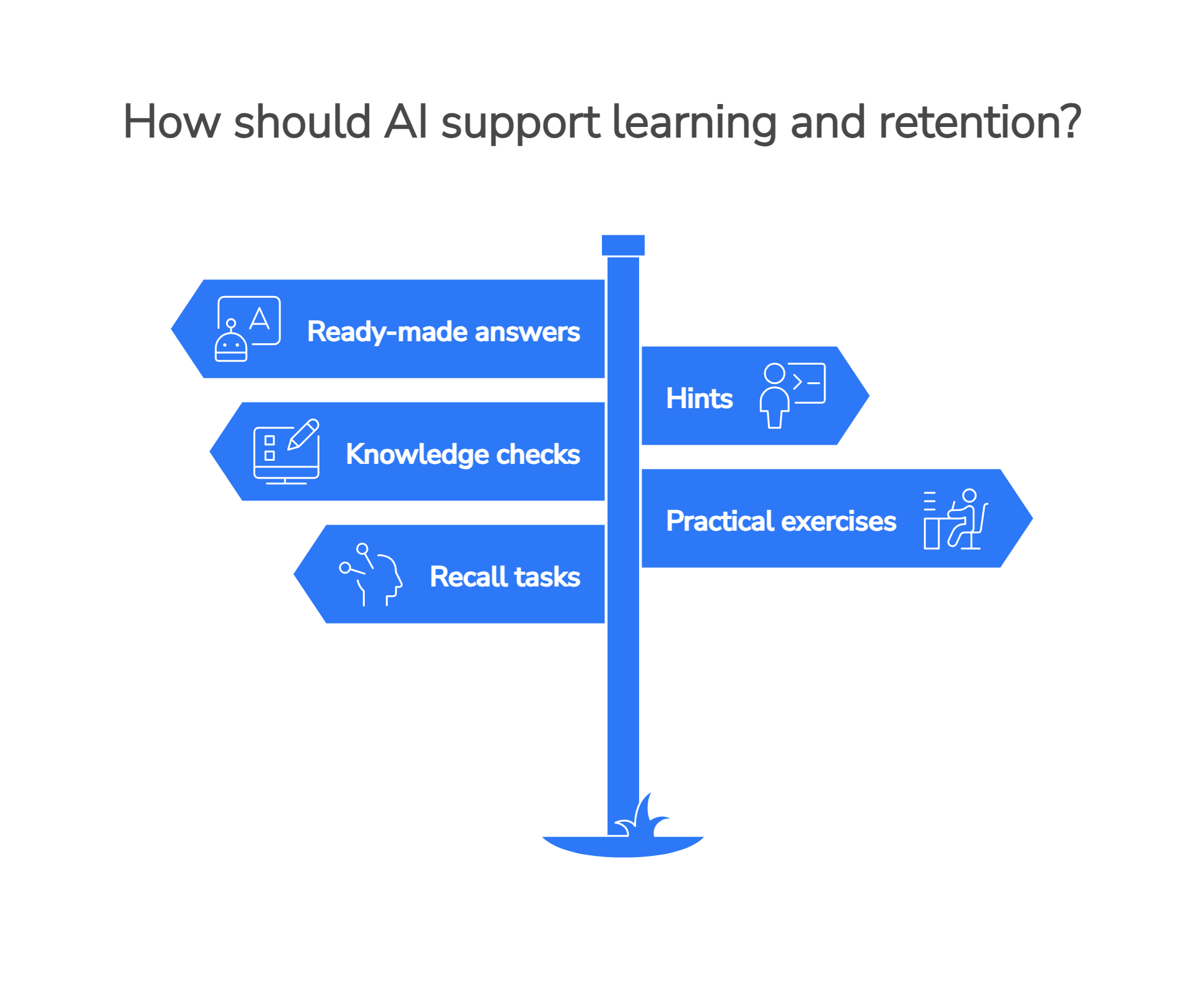
Even more interesting conclusions come from an experiment by Bastani and colleagues, published in PNAS in 2025. Students using GPT-4 achieved better results during exercises, but when their access to AI was removed, their performance was worse than the control group. The problem was significantly reduced when the tool guided students through tasks using hints instead of providing ready-made solutions.
What does this mean for companies designing training? AI should help employees understand the material, but it should not do the thinking for them. That is why it is worth using knowledge checks, practical exercises and tasks that require recalling previously learned information. This approach supports long-term retention and skill development.
We also apply this principle in AI4E-learning, combining AI-generated content with exercises and expert review to create courses that engage learners and help them apply what they have learnt at work.
AI is changing education: the role of subject matter experts
In AI4E-learning, subject matter experts remain responsible for the quality of the final course. AI generates the initial draft and automates repetitive tasks, while an expert checks factual accuracy, adapts the content to the organisation’s context and approves the final version. This is the human-in-the-loop approach in practice.
Control over data is equally important. In this configuration, AI4E-learning uses Azure OpenAI. Data processing and access controls depend on the client’s infrastructure and configuration settings. Responsible use of AI in training therefore requires appropriate technical safeguards alongside expert review of the generated content.
This division of roles is visible in specific tasks:
| Task | What AI does | What humans decide |
|---|---|---|
| Course structure | proposes the layout of modules and learning objectives | approves the scope and sequence |
| Content and exercises | generates the first draft from source materials | verifies factual accuracy |
| Language versions | creates translations and variants | approves terminology and context |
| Data | operates within the client tenant | decides on access and data scope |
AI applications in learning: a practical example
A training project for one of our clients’ helpdesk teams shows how AI can support corporate learning in practice. A traditional presentation was replaced with an interactive course in which employees completed exercises and received feedback tailored to their mistakes.
The result was faster, more consistent onboarding for new employees and fewer questions directed to experienced colleagues. The course was developed using the company’s existing materials, and a subject matter expert reviewed each section before publication.
We deliver projects like this as part of our e-learning services.
AI in online learning: a corporate training case study
Using AI in corporate training involves several risks, including inaccurate AI-generated content, inadequate protection of personal data and barriers to accessing training. These risks can be reduced through expert review, appropriate data security measures and regular monitoring of tool performance.
Legal requirements must also be considered. The EU AI Act (Regulation 2024/1689) classifies certain AI systems used in education and vocational training as high-risk, including those used to evaluate learning outcomes or determine access to education. The requirements that apply to an AI tool in corporate e-learning depend on its intended purpose and use.
Before implementation, we therefore assess what the AI system will be used for, what data it will process and which decisions require human oversight. This helps us identify applicable regulatory obligations and plan appropriate security measures and content review procedures. We discuss these ethical considerations in more detail in our company blog article on AI ethics in education.
The future of AI in education: making corporate learning effective
Artificial intelligence can significantly streamline corporate training development, particularly when used in tools designed specifically for e-learning. AI4E-learning, for example, helps structure courses, automate repetitive tasks and create exercises. A subject matter expert remains responsible for factual accuracy and the quality of the final course.
Using general-purpose language models in training requires careful content review and oversight of the learning process. AI can generate inaccurate information, and access to ready-made answers does not necessarily help employees retain knowledge or develop skills. A well-designed training programme should therefore encourage employees to solve problems independently and apply what they have learnt in practical situations.
Where to start? Choose one repetitive training process, define the rules for expert content verification and check whether employees can independently apply the acquired knowledge.
If you are planning to use AI in corporate training, contact our specialists. During a free consultation, we will discuss your needs and the possibilities of implementing AI4E-learning in your organisation. TTMS Malaysia is a Registered Training Provider with HRD Corp, so Malaysian employers can fund TTMS training from their HRD Corp levy.
FAQ – Frequently asked questions
How is AI changing education and corporate training?
AI can be used to create courses faster, personalise learning paths, generate exercises and feedback, and translate content into multiple languages. The final result is always verified by an expert or trainer.
Will AI replace trainers or teachers?
No. AI supports the trainer by taking over repetitive work and personalising learning, while decisions regarding scope, quality and context remain in human hands.
How does generative AI in education speed up course creation?
Tools such as AI4E-learning generate a structured course draft from source materials. A subject matter expert reviews and refines the content before the approved course is exported as a SCORM-compliant package. This can significantly reduce development time, while expert review remains essential to ensuring quality.
What are the risks of artificial intelligence in learning?
The main risks include inaccurate AI-generated content, inadequate protection of personal data and barriers to accessing training. Certain AI systems used in education may also be subject to high-risk requirements under the EU AI Act, depending on their intended purpose and use. These risks can be reduced through expert review, appropriate controls over data access and processing, and assessment of applicable legal requirements.
Does using AI impair knowledge retention?
The studies discussed above suggest that relying on AI-generated answers may reduce engagement in critical thinking and affect performance when AI support is removed. The findings vary by study design and context. Training should therefore include tasks that require learners to recall information and solve problems independently, alongside expert review of the course content.